The document explains tag questions, which are small questions added to the end of statements to confirm or seek agreement, using auxiliary verbs and specific structures depending on the statement's main verb. It details the formation rules for tag questions based on the tense and nature of the verb, including positive and negative constructions. Additionally, the document highlights exceptions and unique cases in tag question formation.
Tag Questions
What isTag Question?
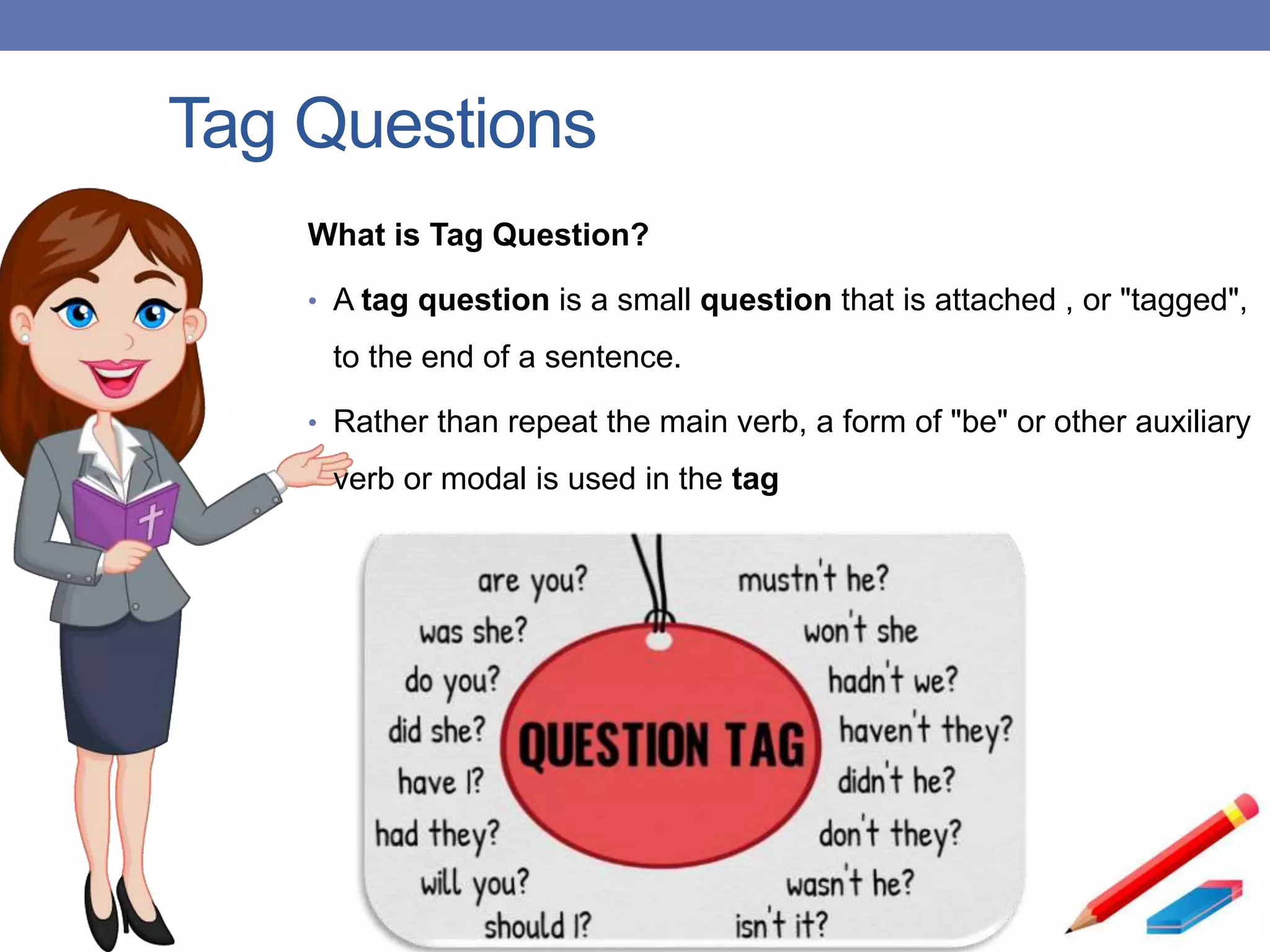
• A tag question is a small question that is attached , or "tagged",
to the end of a sentence.
• Rather than repeat the main verb, a form of "be" or other auxiliary
verb or modal is used in the tag
3.
Tag Questions
What isTag Question?
• It is also known as question tail is a grammatical structure in which
a declarative or an imperative statement is turned into a question by
the addition of an interrogative fragment (the "tag").
• For example, in the sentence "You're Ram, aren't you?", the statemen
"You're Ram" is turned into a question by the tag "aren't you"
They are mainly used in speech when we want to:
• confirm that something is true or not, or
• to encourage a reply from the person we are speaking t
4.
Tag Questions… intonation
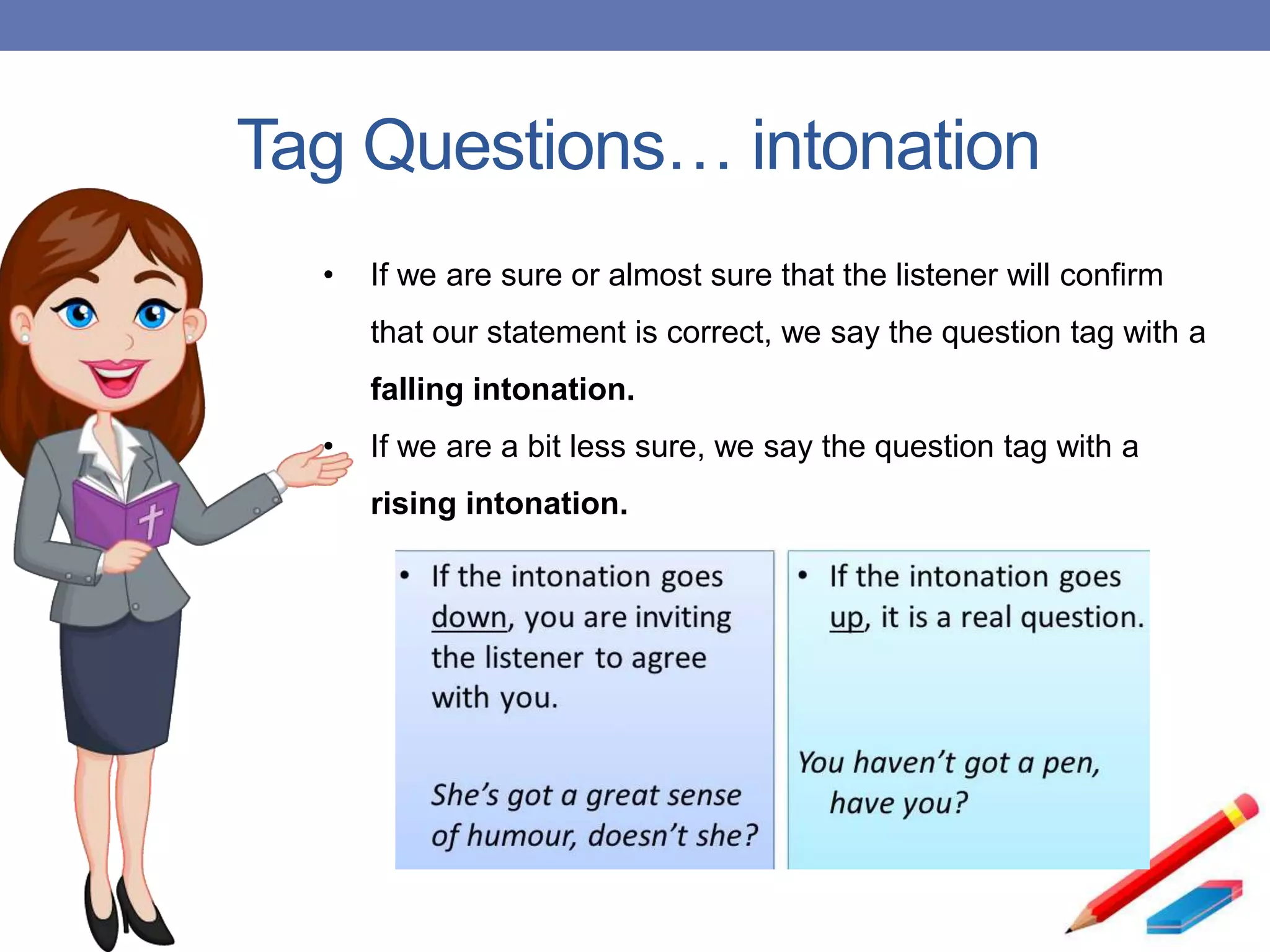
•If we are sure or almost sure that the listener will confirm
that our statement is correct, we say the question tag with a
falling intonation.
• If we are a bit less sure, we say the question tag with a
rising intonation.
Tag Questions; Structure
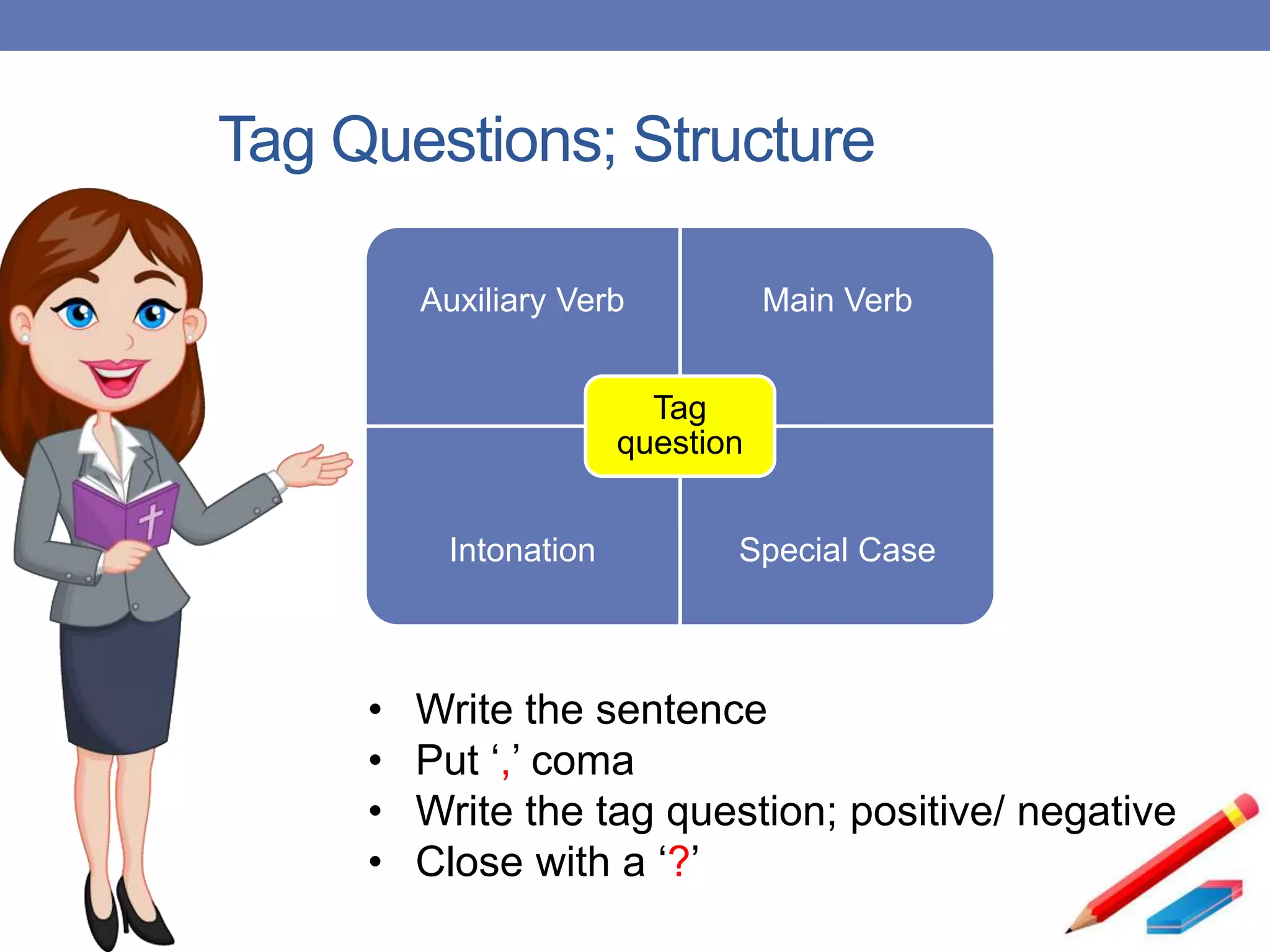
AuxiliaryVerb Main Verb
Intonation Special Case
Tag
question
• Write the sentence
• Put ‘,’ coma
• Write the tag question; positive/ negative
• Close with a ‘?’
7.
Tag Question FormationRules
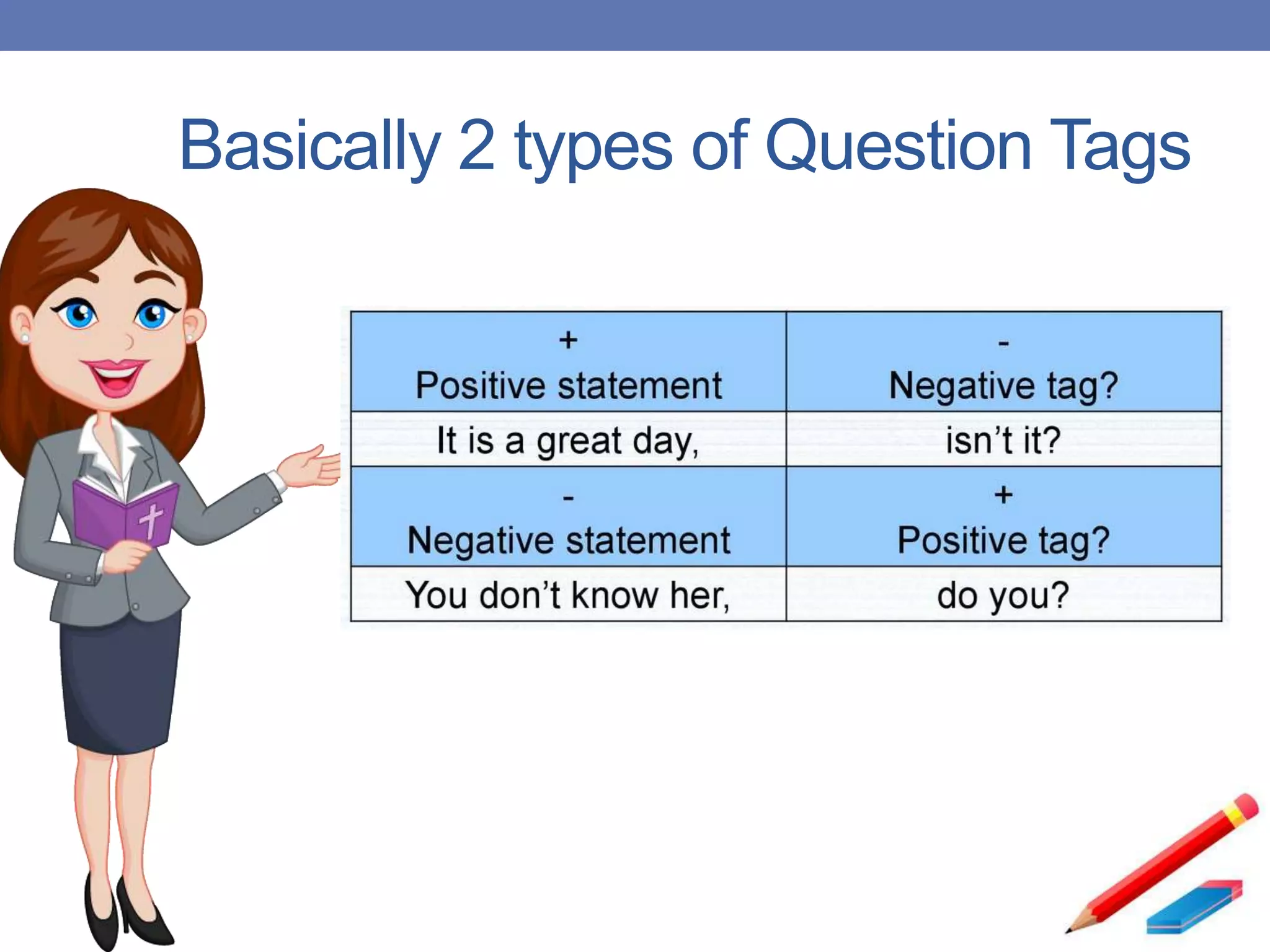
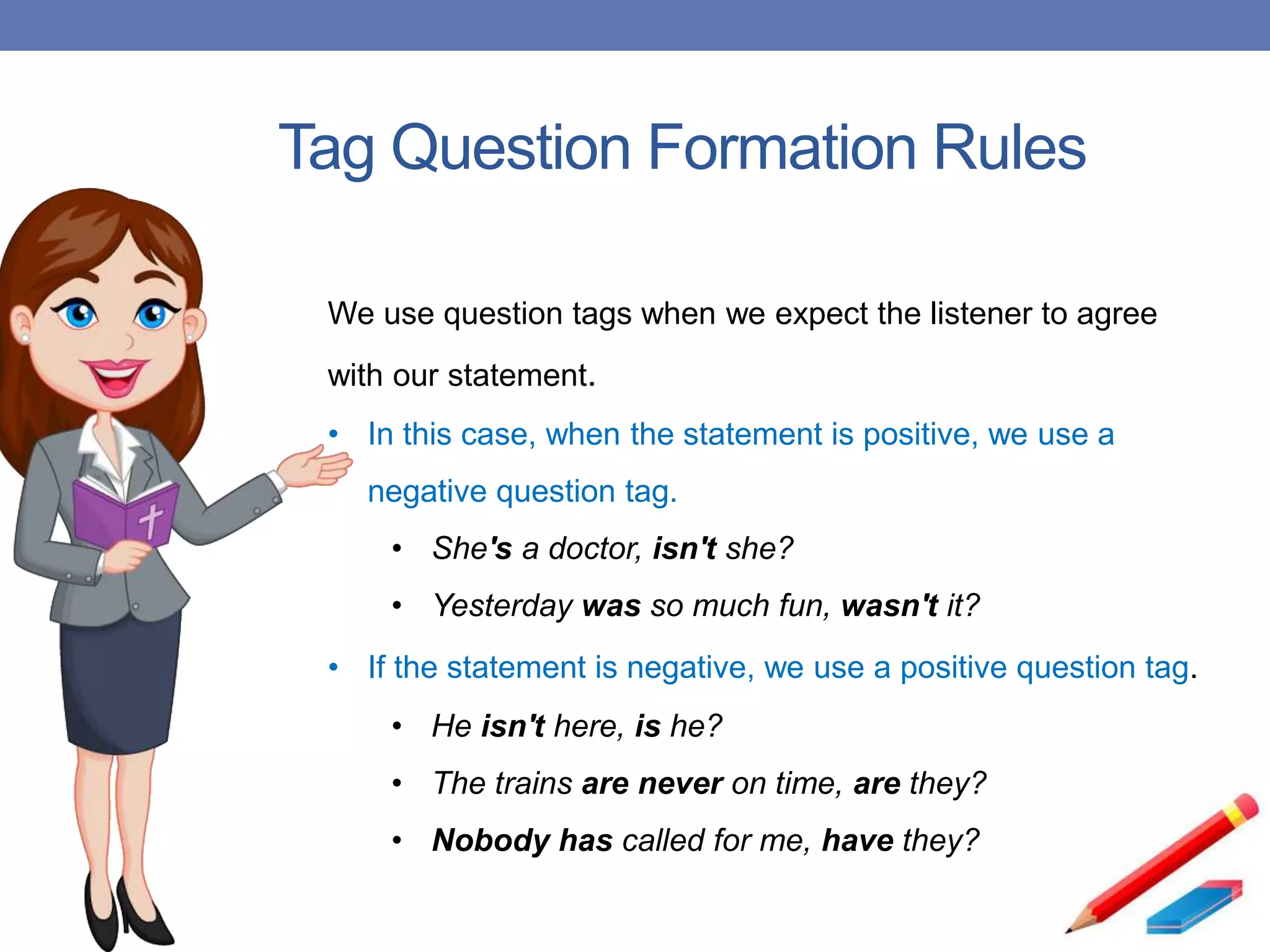
We use question tags when we expect the listener to agree
with our statement.
• In this case, when the statement is positive, we use a
negative question tag.
• She's a doctor, isn't she?
• Yesterday was so much fun, wasn't it?
• If the statement is negative, we use a positive question tag.
• He isn't here, is he?
• The trains are never on time, are they?
• Nobody has called for me, have they?
8.
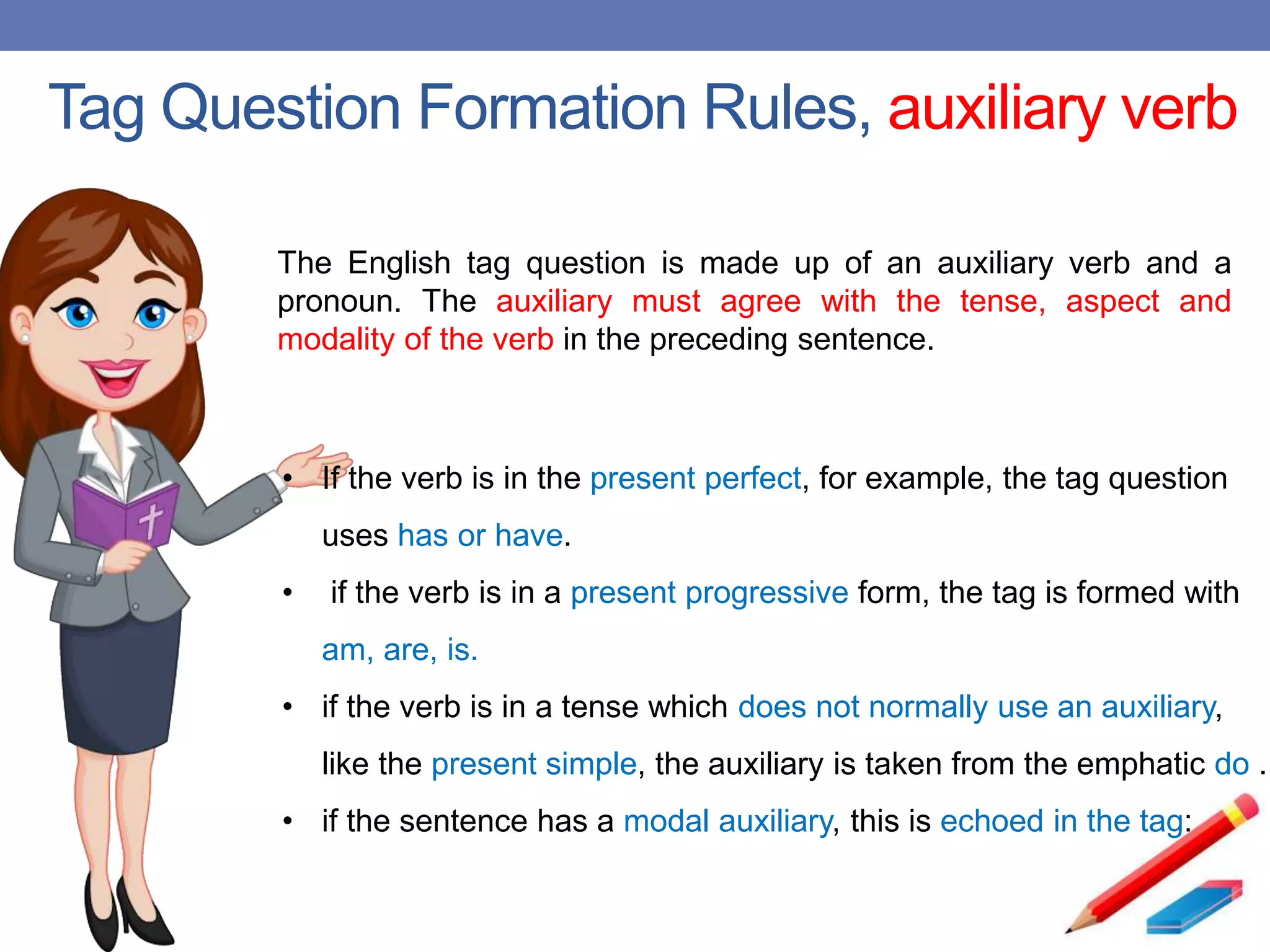
Tag Question FormationRules, auxiliary verb
• If the verb is in the present perfect, for example, the tag question
uses has or have.
• if the verb is in a present progressive form, the tag is formed with
am, are, is.
• if the verb is in a tense which does not normally use an auxiliary,
like the present simple, the auxiliary is taken from the emphatic do .
• if the sentence has a modal auxiliary, this is echoed in the tag:
The English tag question is made up of an auxiliary verb and a
pronoun. The auxiliary must agree with the tense, aspect and
modality of the verb in the preceding sentence.
9.
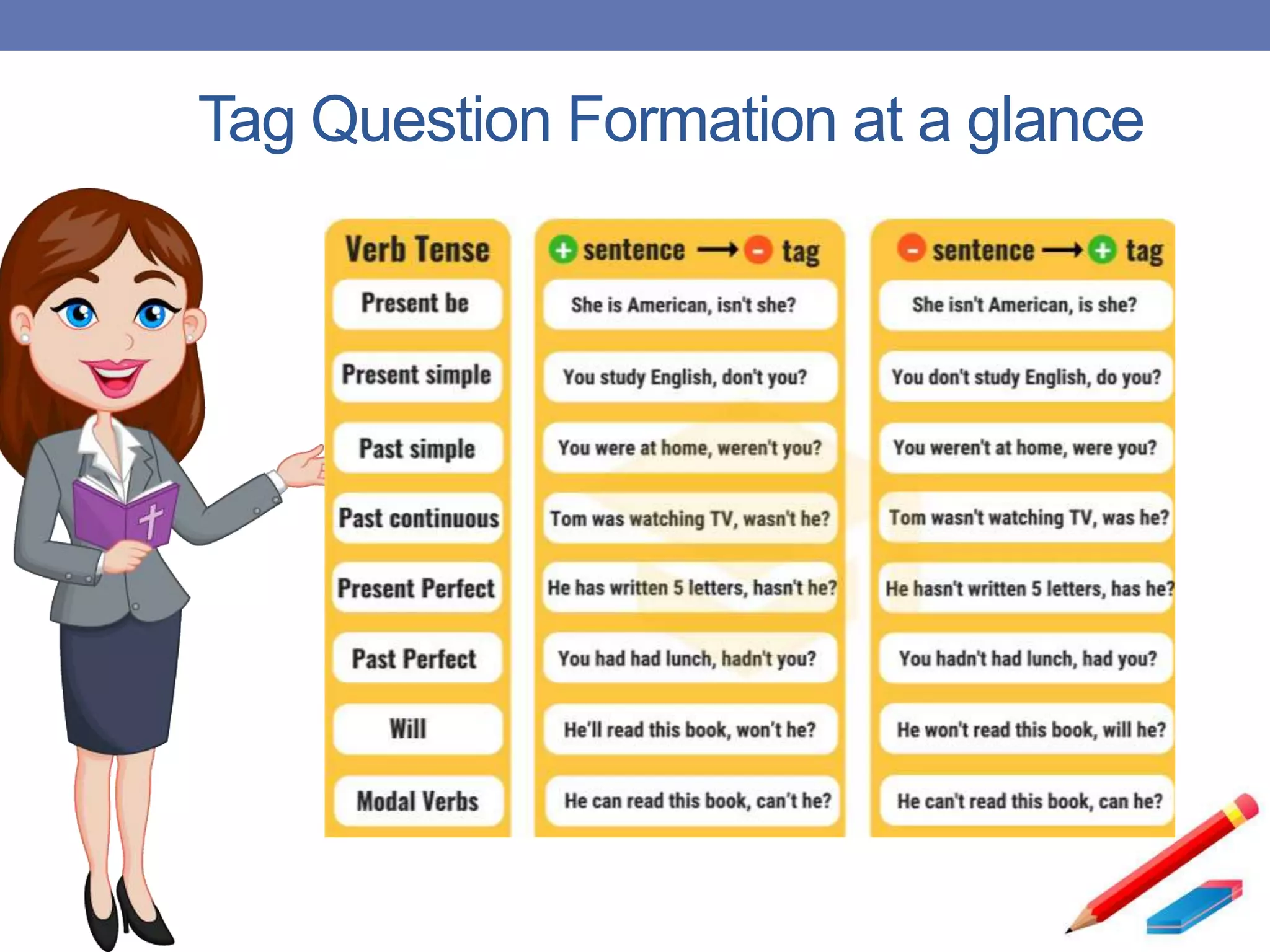
Tag Question FormationRules, auxiliary verb
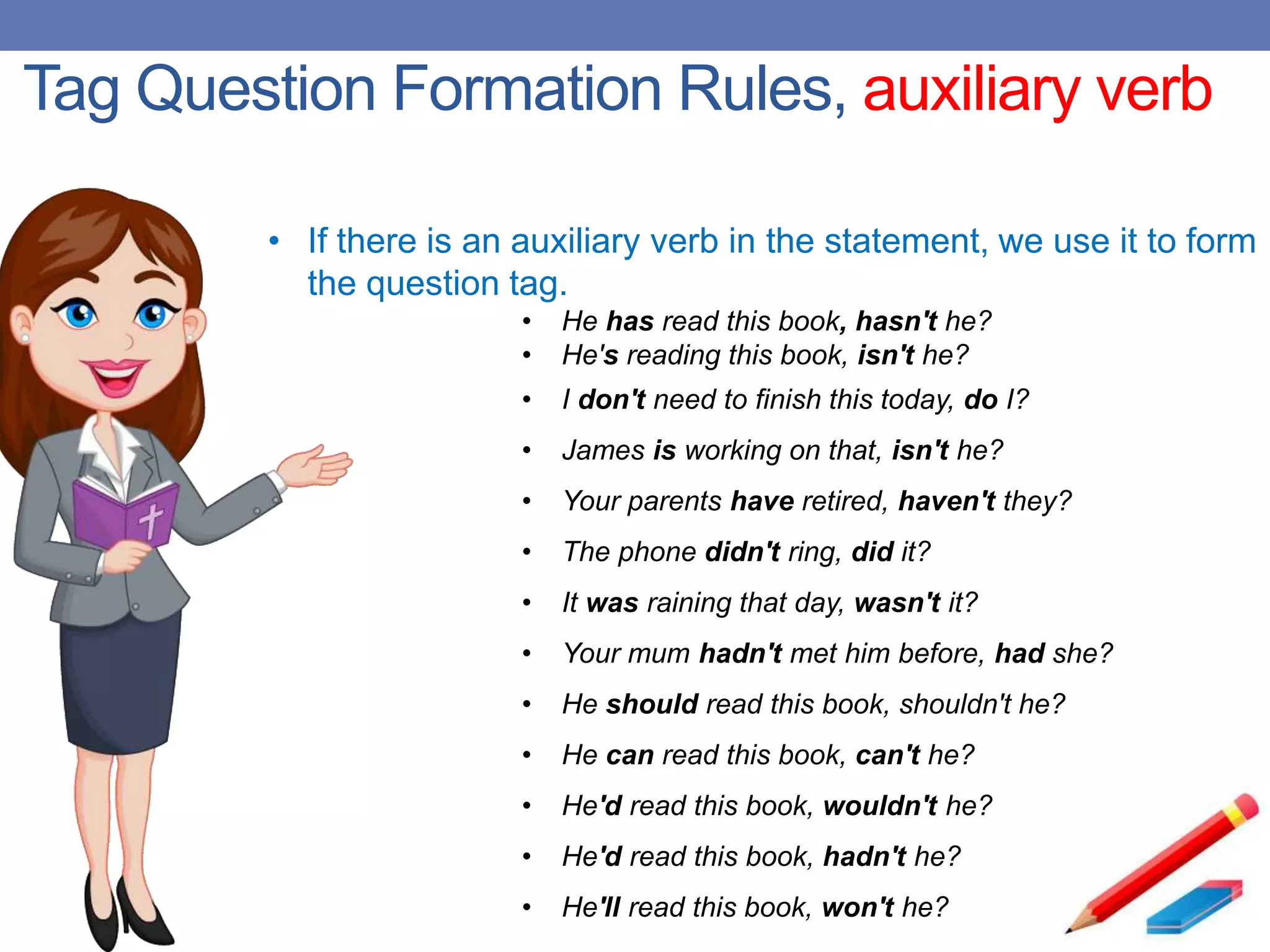
• If there is an auxiliary verb in the statement, we use it to form
the question tag.
• He has read this book, hasn't he?
• He's reading this book, isn't he?
• I don't need to finish this today, do I?
• James is working on that, isn't he?
• Your parents have retired, haven't they?
• The phone didn't ring, did it?
• It was raining that day, wasn't it?
• Your mum hadn't met him before, had she?
• He should read this book, shouldn't he?
• He can read this book, can't he?
• He'd read this book, wouldn't he?
• He'd read this book, hadn't he?
• He'll read this book, won't he?
10.
Tag Question FormationRules, Main verb
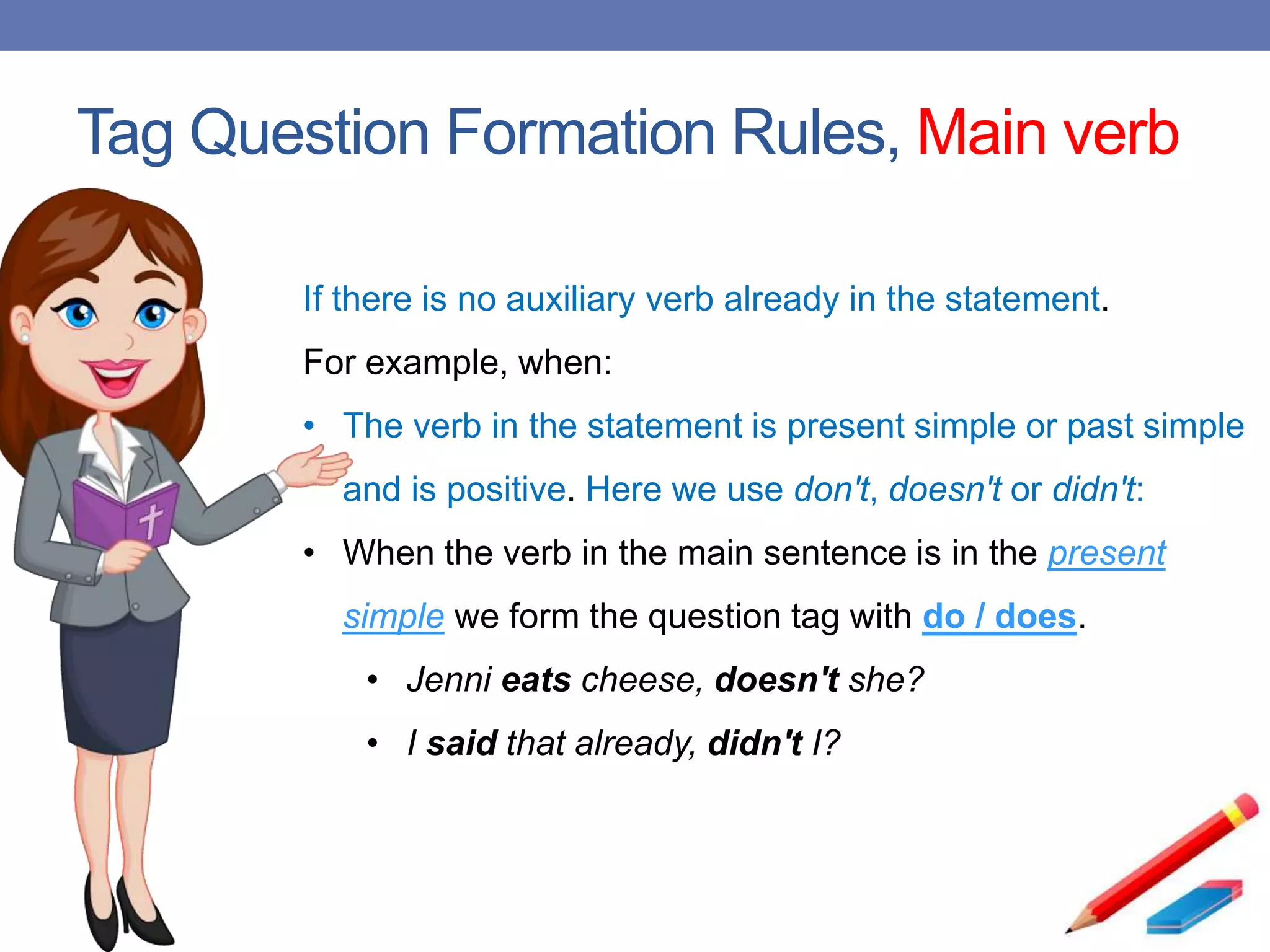
If there is no auxiliary verb already in the statement.
For example, when:
• The verb in the statement is present simple or past simple
and is positive. Here we use don't, doesn't or didn't:
• When the verb in the main sentence is in the present
simple we form the question tag with do / does.
• Jenni eats cheese, doesn't she?
• I said that already, didn't I?
11.
Tag Question FormationRules; Main verb
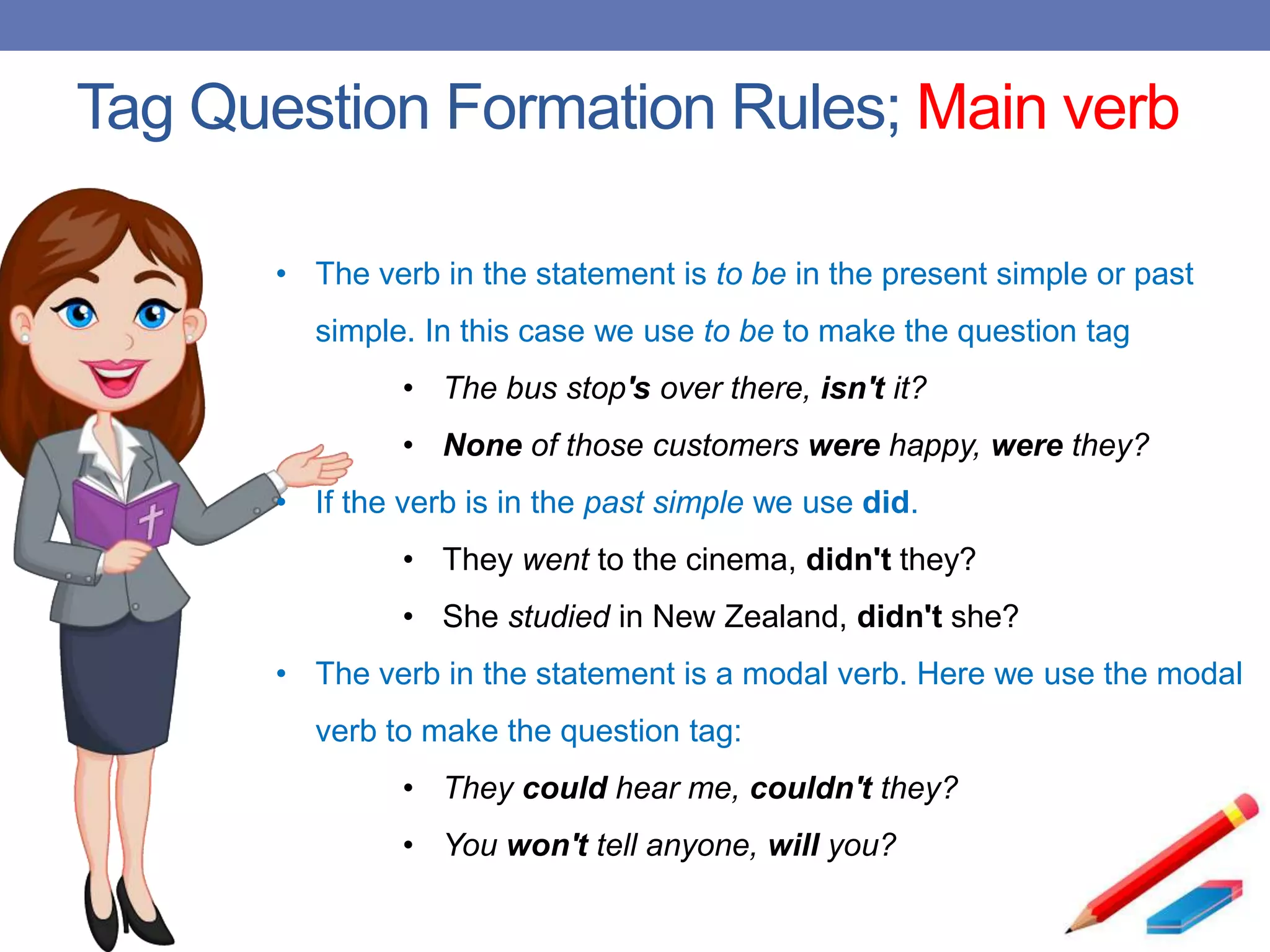
• The verb in the statement is to be in the present simple or past
simple. In this case we use to be to make the question tag
• The bus stop's over there, isn't it?
• None of those customers were happy, were they?
• If the verb is in the past simple we use did.
• They went to the cinema, didn't they?
• She studied in New Zealand, didn't she?
• The verb in the statement is a modal verb. Here we use the modal
verb to make the question tag:
• They could hear me, couldn't they?
• You won't tell anyone, will you?
12.
Tag Question Formation;Main verb
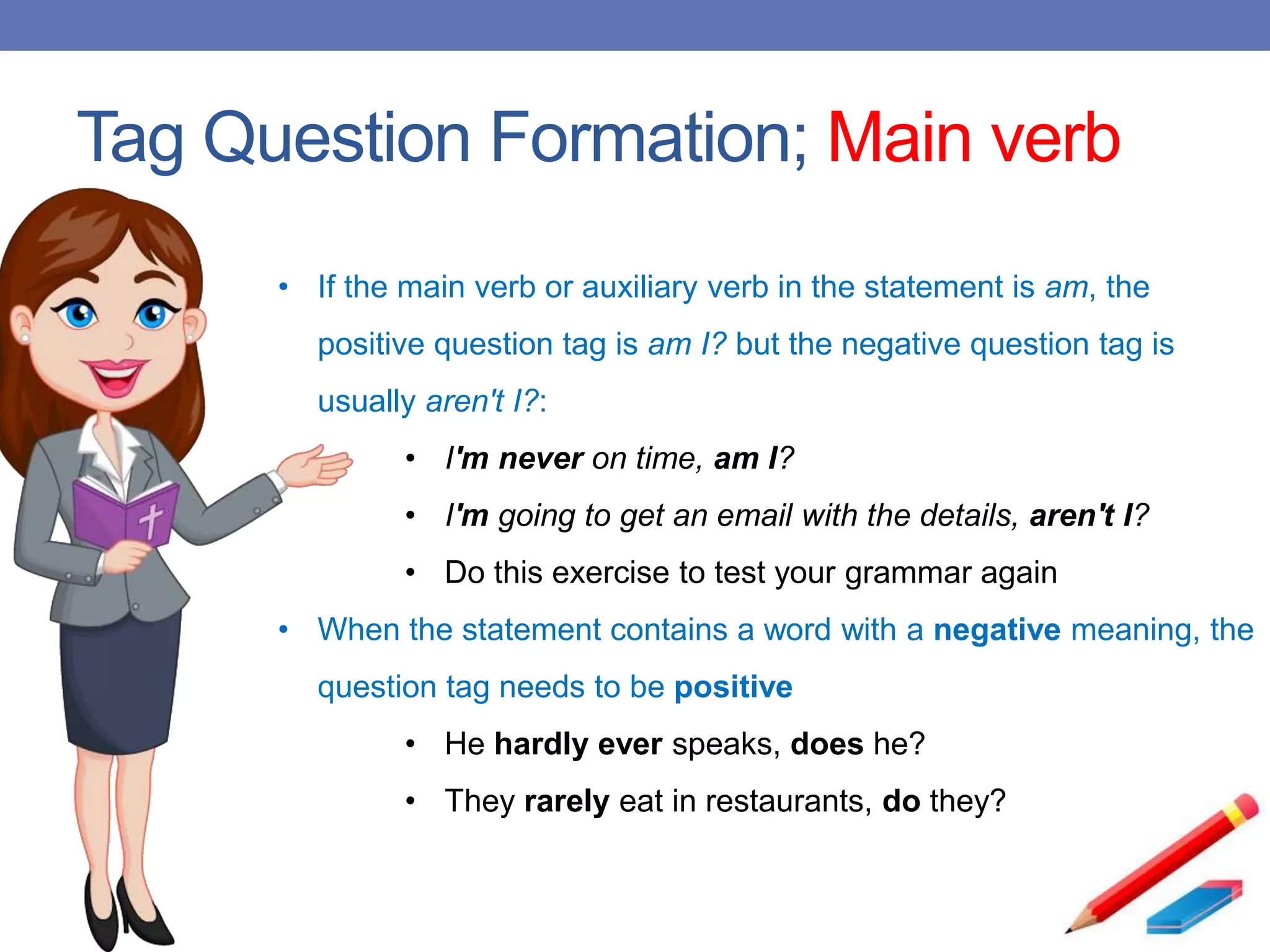
• If the main verb or auxiliary verb in the statement is am, the
positive question tag is am I? but the negative question tag is
usually aren't I?:
• I'm never on time, am I?
• I'm going to get an email with the details, aren't I?
• Do this exercise to test your grammar again
• When the statement contains a word with a negative meaning, the
question tag needs to be positive
• He hardly ever speaks, does he?
• They rarely eat in restaurants, do they?
Exceptions
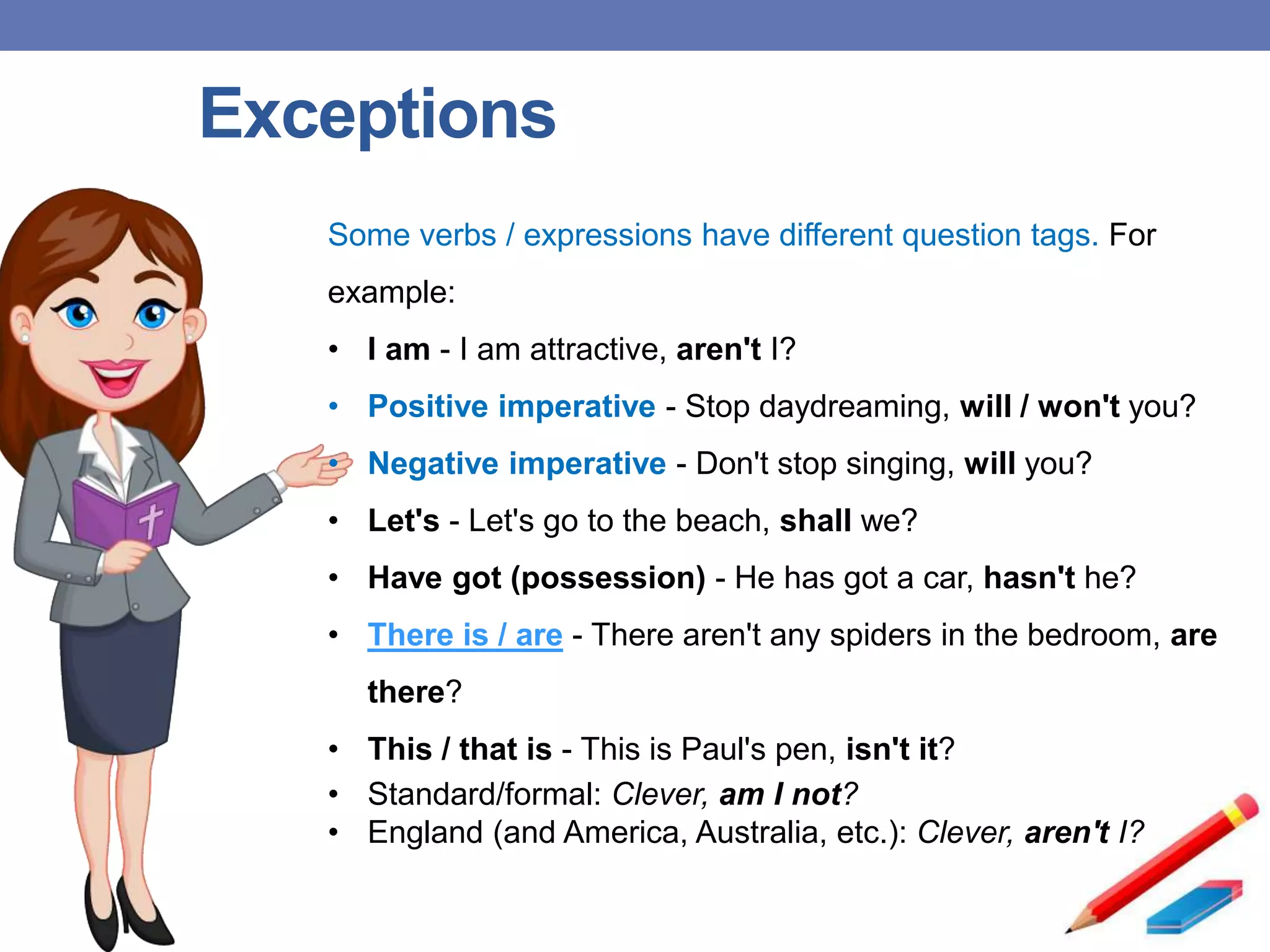
Some verbs /expressions have different question tags. For
example:
• I am - I am attractive, aren't I?
• Positive imperative - Stop daydreaming, will / won't you?
• Negative imperative - Don't stop singing, will you?
• Let's - Let's go to the beach, shall we?
• Have got (possession) - He has got a car, hasn't he?
• There is / are - There aren't any spiders in the bedroom, are
there?
• This / that is - This is Paul's pen, isn't it?
• Standard/formal: Clever, am I not?
• England (and America, Australia, etc.): Clever, aren't I?
15.
Exceptions
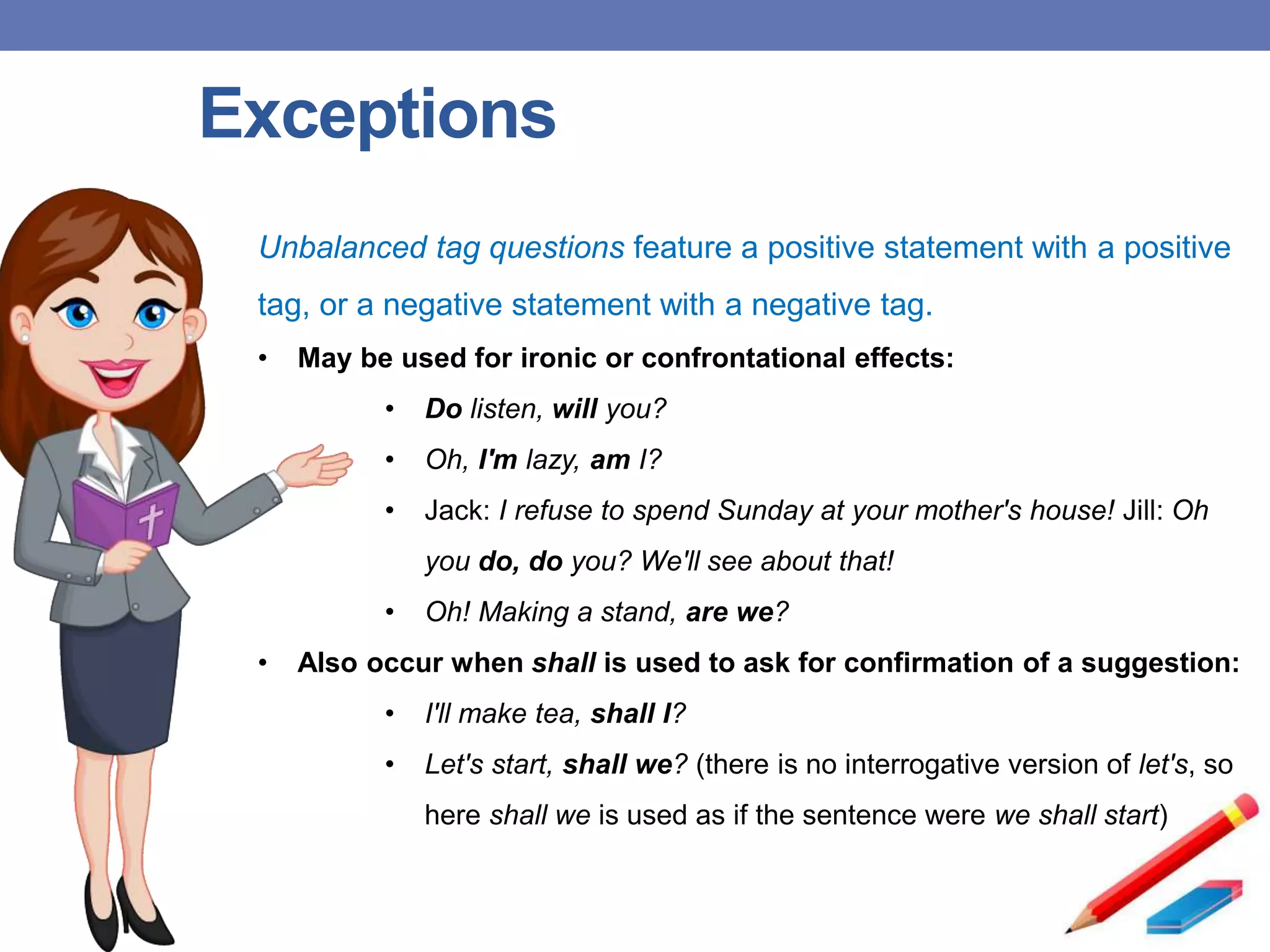
Unbalanced tag questionsfeature a positive statement with a positive
tag, or a negative statement with a negative tag.
• May be used for ironic or confrontational effects:
• Do listen, will you?
• Oh, I'm lazy, am I?
• Jack: I refuse to spend Sunday at your mother's house! Jill: Oh
you do, do you? We'll see about that!
• Oh! Making a stand, are we?
• Also occur when shall is used to ask for confirmation of a suggestion:
• I'll make tea, shall I?
• Let's start, shall we? (there is no interrogative version of let's, so
here shall we is used as if the sentence were we shall start)
16.
Exceptions
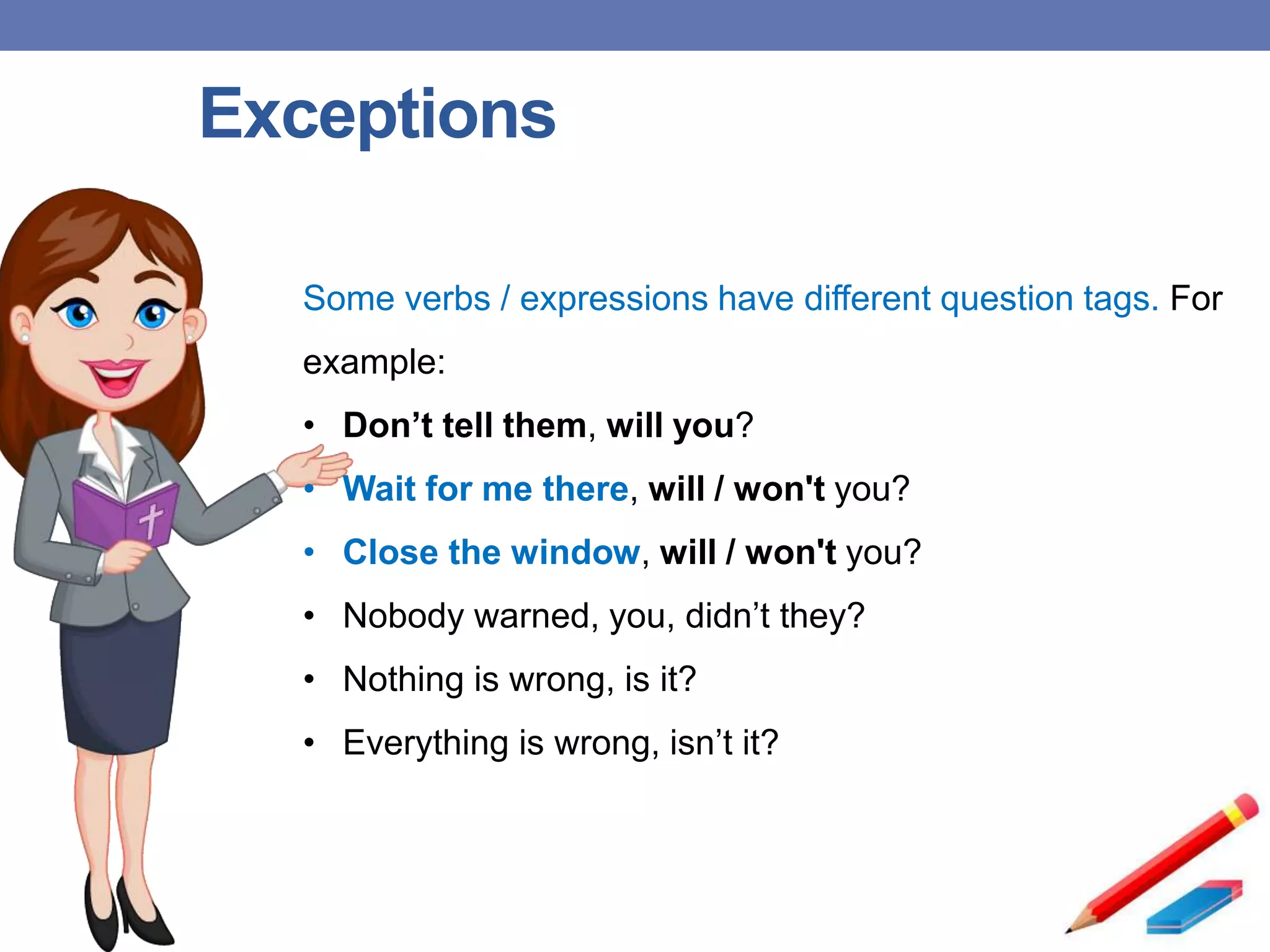
Some verbs /expressions have different question tags. For
example:
• Don’t tell them, will you?
• Wait for me there, will / won't you?
• Close the window, will / won't you?
• Nobody warned, you, didn’t they?
• Nothing is wrong, is it?
• Everything is wrong, isn’t it?