Question tags
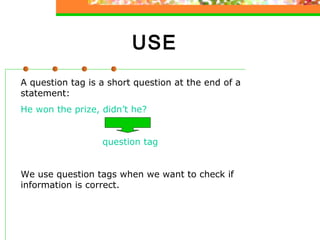
USE
A question tag is a short question at the end of a
statement:
He won the prize, didn’t he?
question tag
We use question tags when we want to check if
information is correct.
FORM
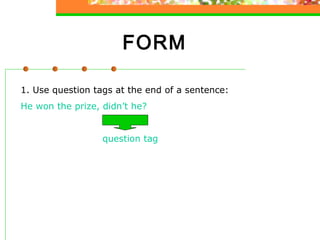
1. Use question tags at the end of a sentence:
He won the prize, didn’t he?
question tag
FORM
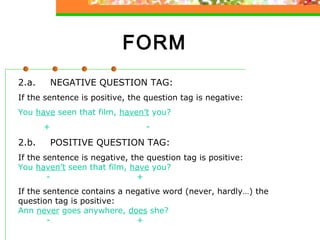
2.a. NEGATIVE QUESTION TAG:
If the sentence is positive, the question tag is negative:
You have seen that film, haven’t you?
+ -
2.b. POSITIVE QUESTION TAG:
If the sentence is negative, the question tag is positive:
You haven’t seen that film, have you?
- +
If the sentence contains a negative word (never, hardly…) the
question tag is positive:
Ann never goes anywhere, does she?
- +
FORM
3. Questions tags consist of …
AUXILIARY VERB + PRONOUN:
I shouldn’t laugh, shouldshould II?
Sarah was winning, wasn’twasn’t sheshe?
We use the auxiliary verb that is used in the previous
sentence. If there is no auxiliary verb, se use “do/does”
(present tense) and “did” (past tense):
You live near here, don’tdon’t you?
You turned left, didn’tdidn’t you?
The pronoun refers to the subject of the previous
sentence.
FORM
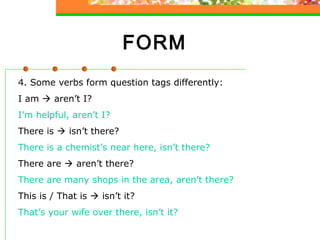
4. Some verbs form question tags differently:
I am  aren’t I?
I’m helpful, aren’t I?
There is  isn’t there?
There is a chemist’s near here, isn’t there?
There are  aren’t there?
There are many shops in the area, aren’t there?
This is / That is  isn’t it?
That’s your wife over there, isn’t it?
FORM
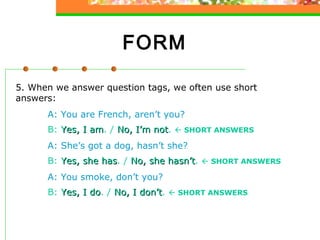
5. When we answer question tags, we often use short
answers:
A: You are French, aren’t you?
B: Yes, I amYes, I am. / No, I’m notNo, I’m not.  SHORT ANSWERS
A: She’s got a dog, hasn’t she?
B: Yes, she hasYes, she has. / No, she hasn’tNo, she hasn’t.  SHORT ANSWERS
A: You smoke, don’t you?
B: Yes, I doYes, I do. / No, I don’tNo, I don’t.  SHORT ANSWERS
FORM
6. Intonation:
When we are sure of the answer, the voice goes
down in the question tag:
John doesn’t like gold, does he?
The speaker knows John doesn’t like gold.
When we are not sure of the answer, the voice
goes up:
They left for Milan, didn’t they?
 The speaker doesn’t know if they left for Milan
or not.

Question tags explanation

  • 1.
  • 2.
    USE A question tagis a short question at the end of a statement: He won the prize, didn’t he? question tag We use question tags when we want to check if information is correct.
  • 3.
    FORM 1. Use questiontags at the end of a sentence: He won the prize, didn’t he? question tag
  • 4.
    FORM 2.a. NEGATIVE QUESTIONTAG: If the sentence is positive, the question tag is negative: You have seen that film, haven’t you? + - 2.b. POSITIVE QUESTION TAG: If the sentence is negative, the question tag is positive: You haven’t seen that film, have you? - + If the sentence contains a negative word (never, hardly…) the question tag is positive: Ann never goes anywhere, does she? - +
  • 5.
    FORM 3. Questions tagsconsist of … AUXILIARY VERB + PRONOUN: I shouldn’t laugh, shouldshould II? Sarah was winning, wasn’twasn’t sheshe? We use the auxiliary verb that is used in the previous sentence. If there is no auxiliary verb, se use “do/does” (present tense) and “did” (past tense): You live near here, don’tdon’t you? You turned left, didn’tdidn’t you? The pronoun refers to the subject of the previous sentence.
  • 6.
    FORM 4. Some verbsform question tags differently: I am  aren’t I? I’m helpful, aren’t I? There is  isn’t there? There is a chemist’s near here, isn’t there? There are  aren’t there? There are many shops in the area, aren’t there? This is / That is  isn’t it? That’s your wife over there, isn’t it?
  • 7.
    FORM 5. When weanswer question tags, we often use short answers: A: You are French, aren’t you? B: Yes, I amYes, I am. / No, I’m notNo, I’m not.  SHORT ANSWERS A: She’s got a dog, hasn’t she? B: Yes, she hasYes, she has. / No, she hasn’tNo, she hasn’t.  SHORT ANSWERS A: You smoke, don’t you? B: Yes, I doYes, I do. / No, I don’tNo, I don’t.  SHORT ANSWERS
  • 8.
    FORM 6. Intonation: When weare sure of the answer, the voice goes down in the question tag: John doesn’t like gold, does he? The speaker knows John doesn’t like gold. When we are not sure of the answer, the voice goes up: They left for Milan, didn’t they?  The speaker doesn’t know if they left for Milan or not.