Understanding &
Responding to Bullying
Part II
Understanding the bully & targets
Helping the bully & targets
Parents & schools
Activities from “A Parent’s Guide to Understanding and Responding to Bullying”
(The Bully Busters Approach)
By: Arthur M. Horne, Jennifer L. Stoddard, and Christopher D. Bell
Let’s have a QUICK Review
Part I
• Increasing Your Awareness
• What Causes Bullying & What Can We
Do?
• Tools for Strong Families
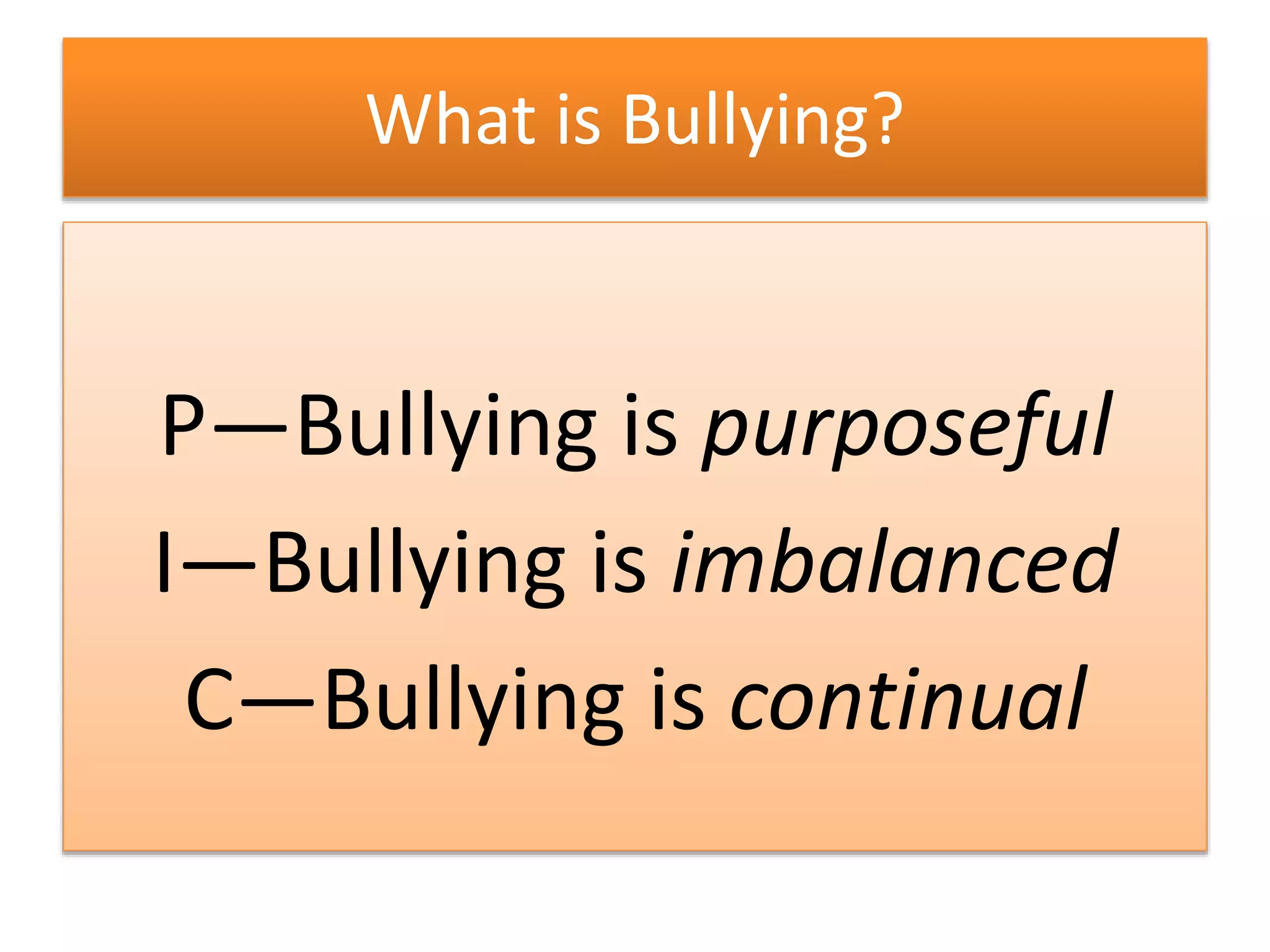
What is Bullying?
P—Bullying is purposeful
I—Bullying is imbalanced
C—Bullying is continual
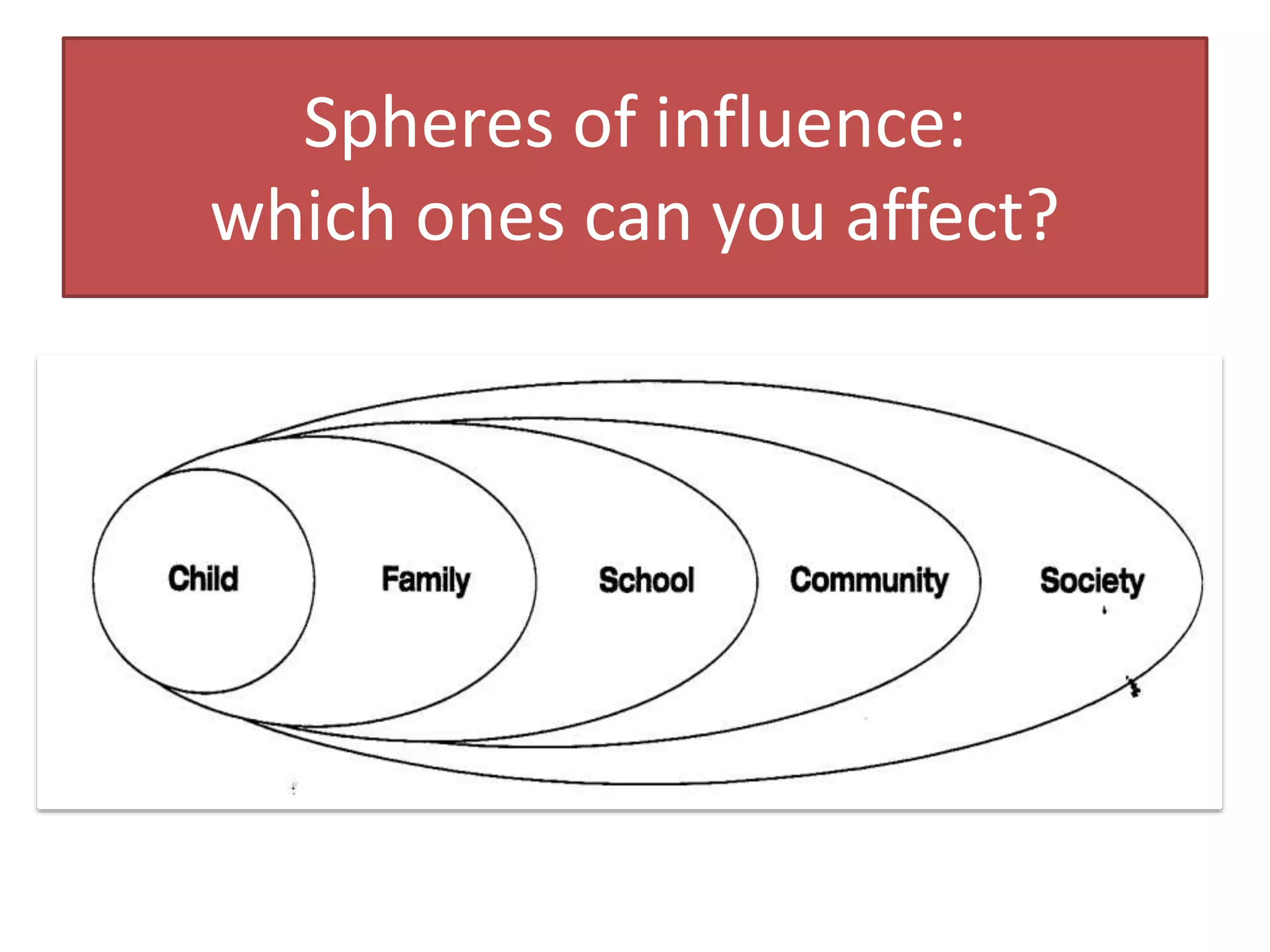
Spheres of influence:
which ones can you affect?
THE BIG QUESTIONS
A way to successfully approach problems within
your family (problem solving model)
1. What is your goal?
2. What are you doing?
3. Is what you are doing helping you achieve your
goal?
4. If not, what can you do differently?
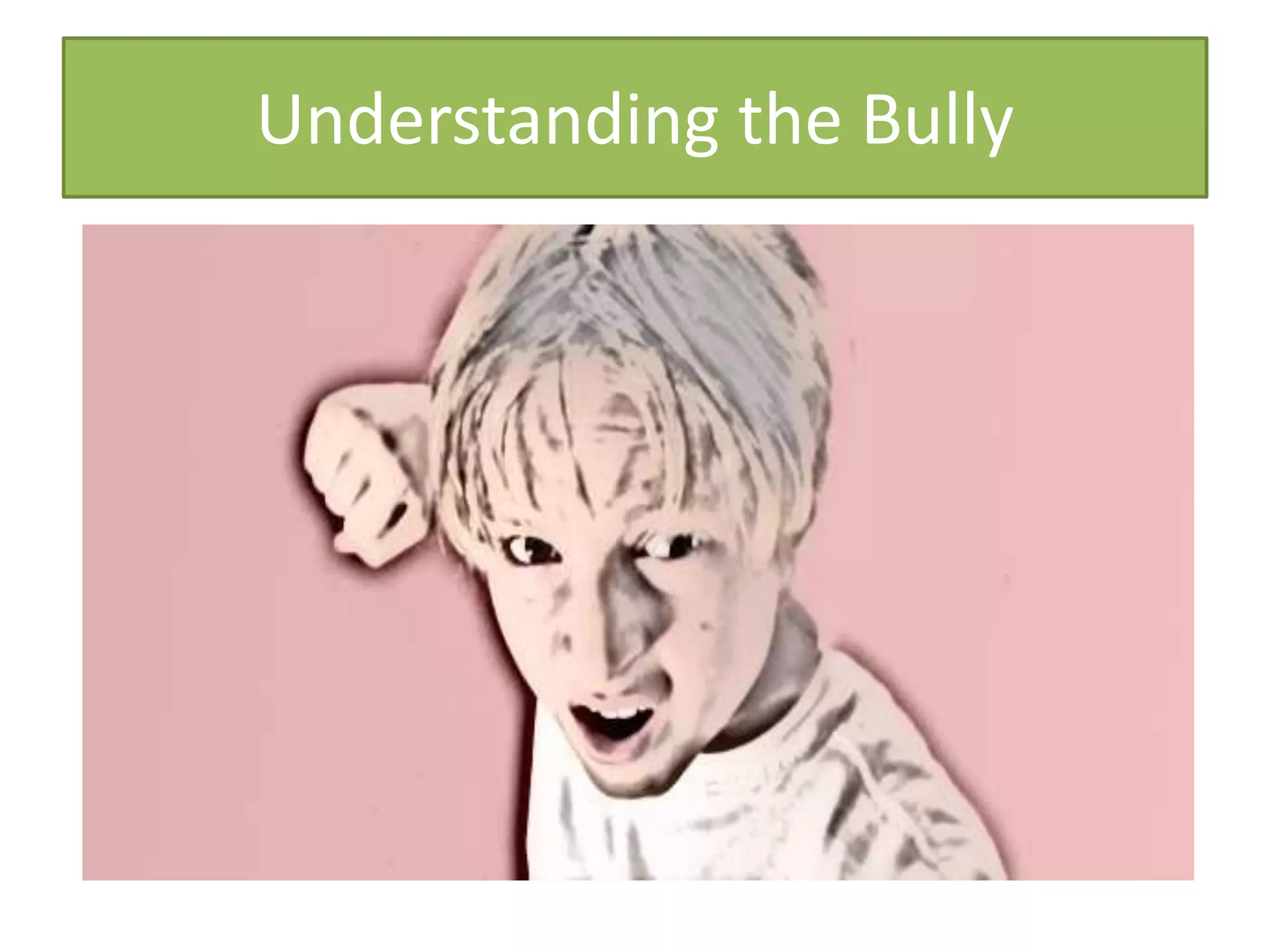
Understanding the Bully
Aggressive
Bullying:
7 Characteristics
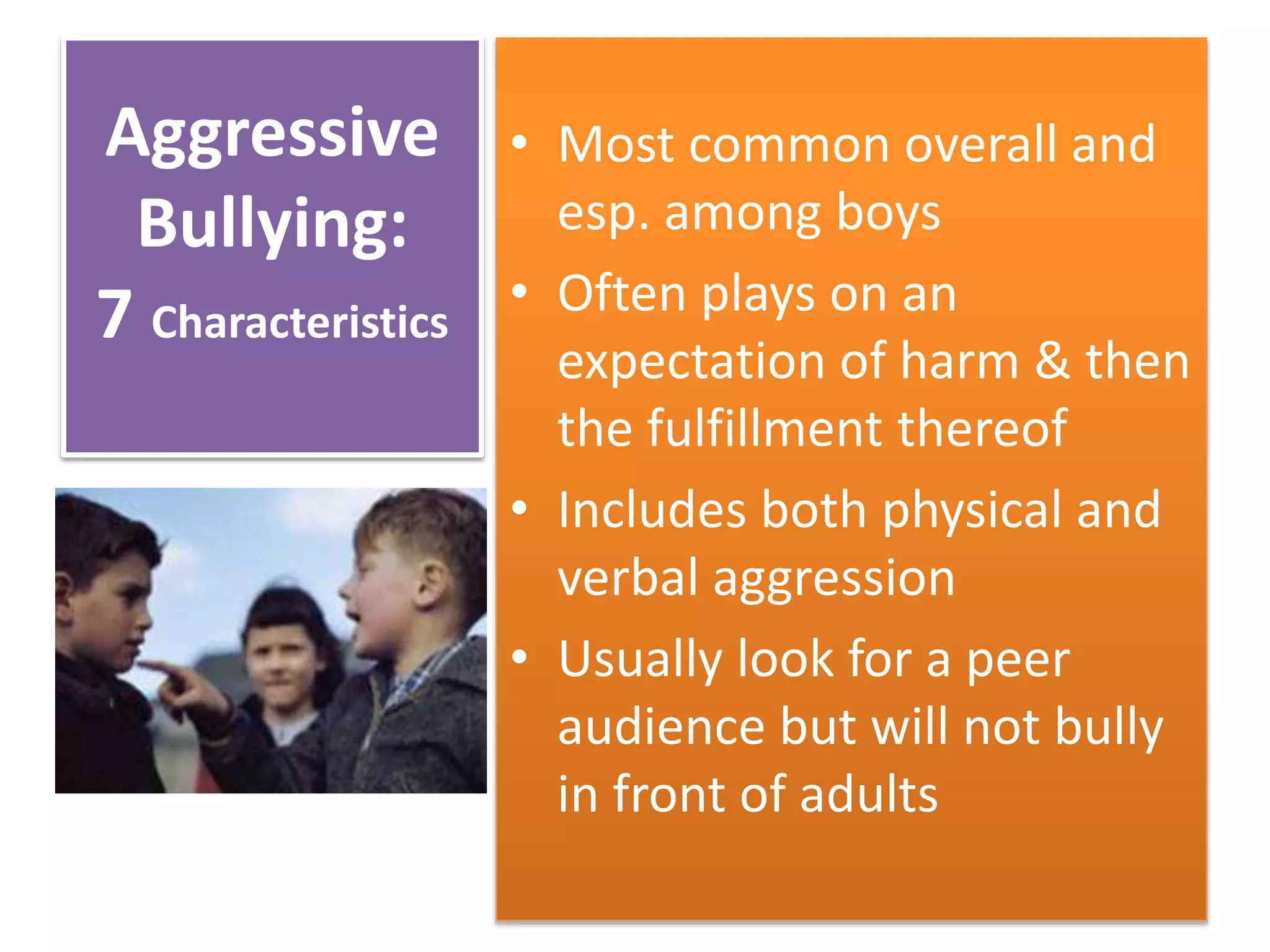
• Most common overall and
esp. among boys
• Often plays on an
expectation of harm & then
the fulfillment thereof
• Includes both physical and
verbal aggression
• Usually look for a peer
audience but will not bully
in front of adults
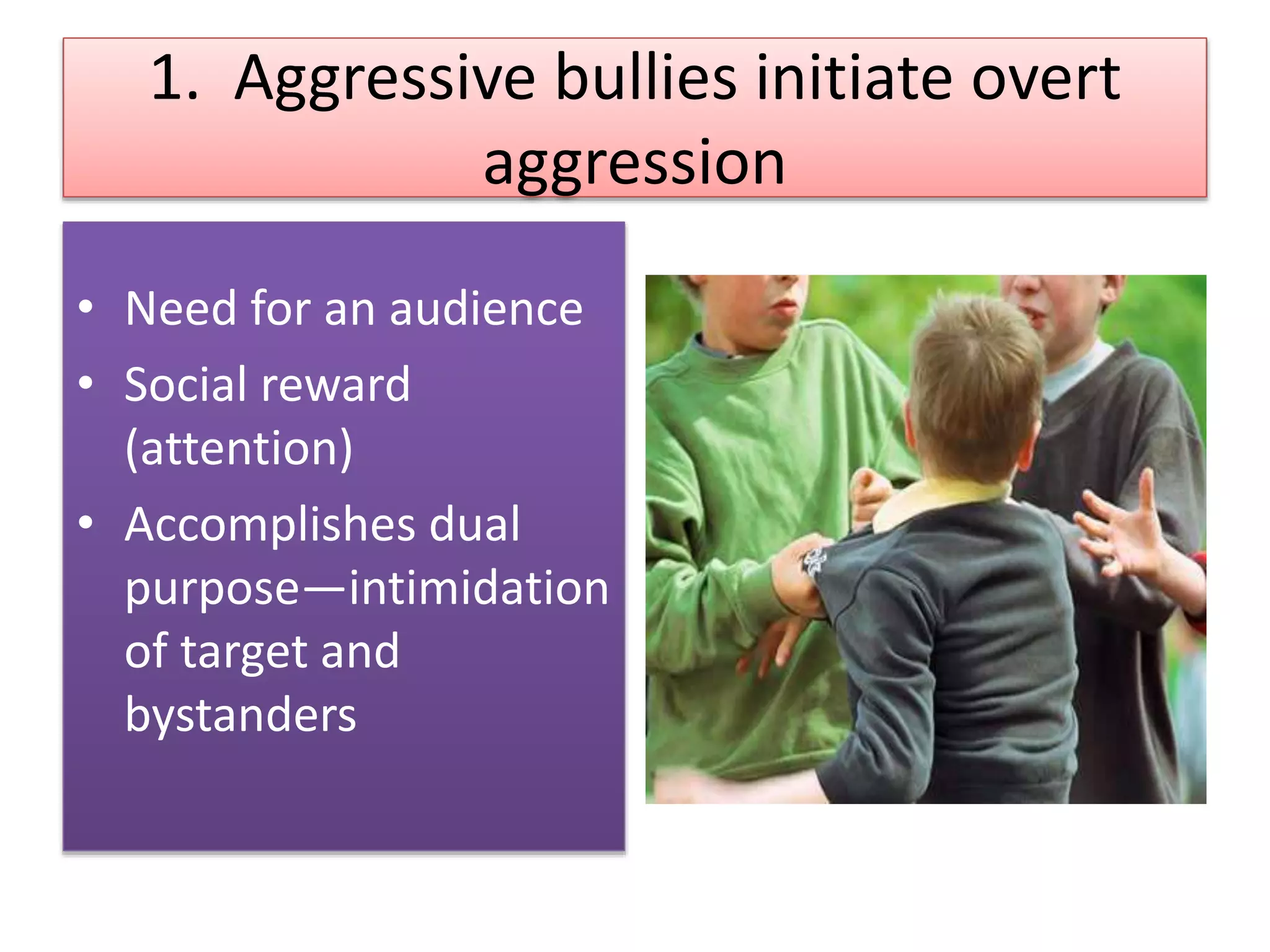
1. Aggressive bullies initiate overt
aggression
• Need for an audience
• Social reward
(attention)
• Accomplishes dual
purpose—intimidation
of target and
bystanders
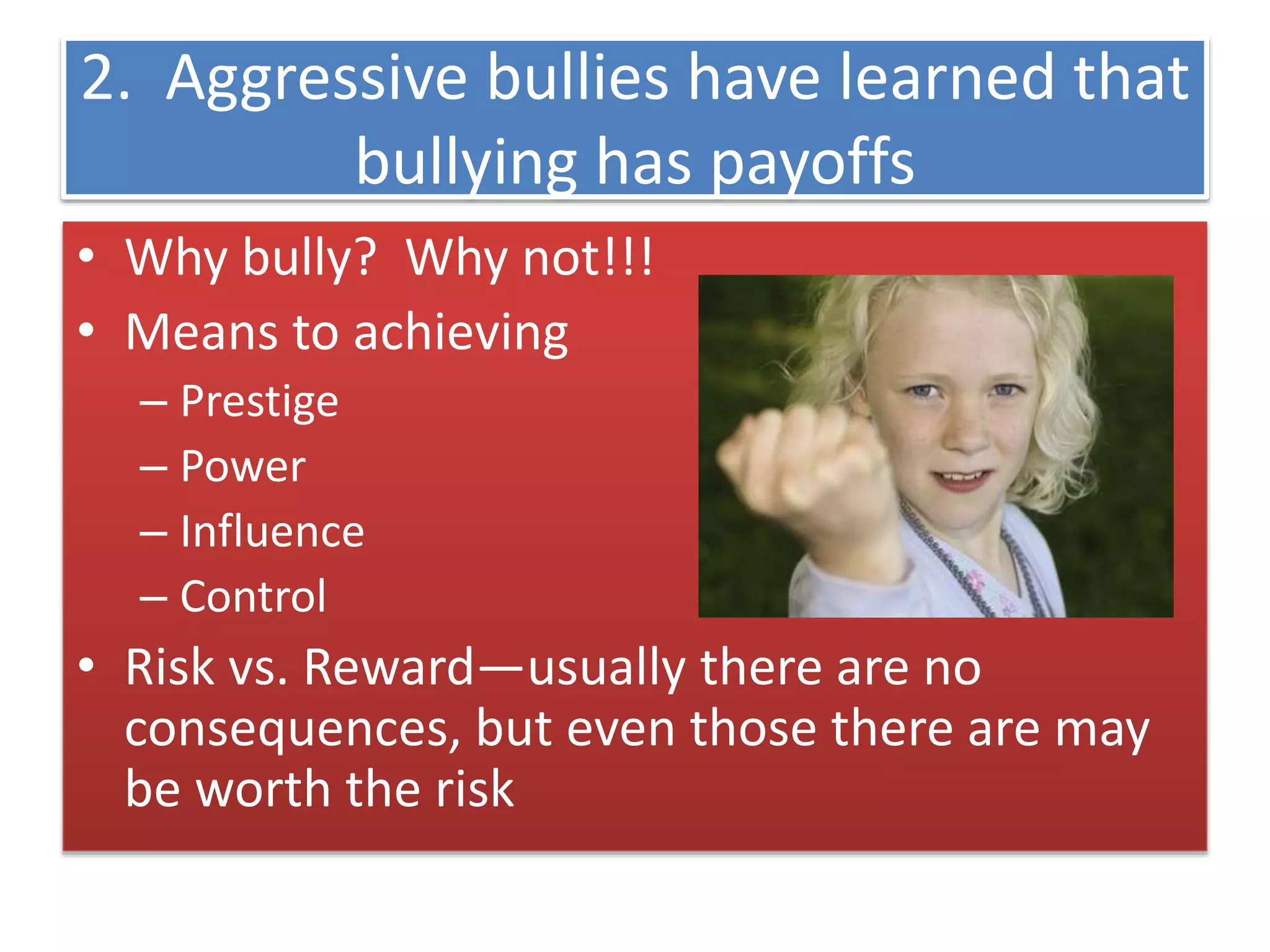
2. Aggressive bullies have learned that
bullying has payoffs
• Why bully? Why not!!!
• Means to achieving
– Prestige
– Power
– Influence
– Control
• Risk vs. Reward—usually there are no
consequences, but even those there are may
be worth the risk
3. Aggressive bullies are fearless,
impulsive and coercive
Lack/Find unrewarding
• Ability to resolve
conflicts peacefully
• Ability to plan and
execute decisions;
reflection
• Ability to be caring
Coping Mechanism
• Fearlessness
• Impulsive action
• Coerciveness, using
threats and violence
4. Aggressive bullies are adaptable
and use multiple forms of violence
• Hitting, kicking, other physical forms
• Threat of physical violence
• Damaging or stealing property
• Creating cliques
• Coercing others to join in
• Inciting fear through veiled means
• Often have reputations among peers and
school personnel
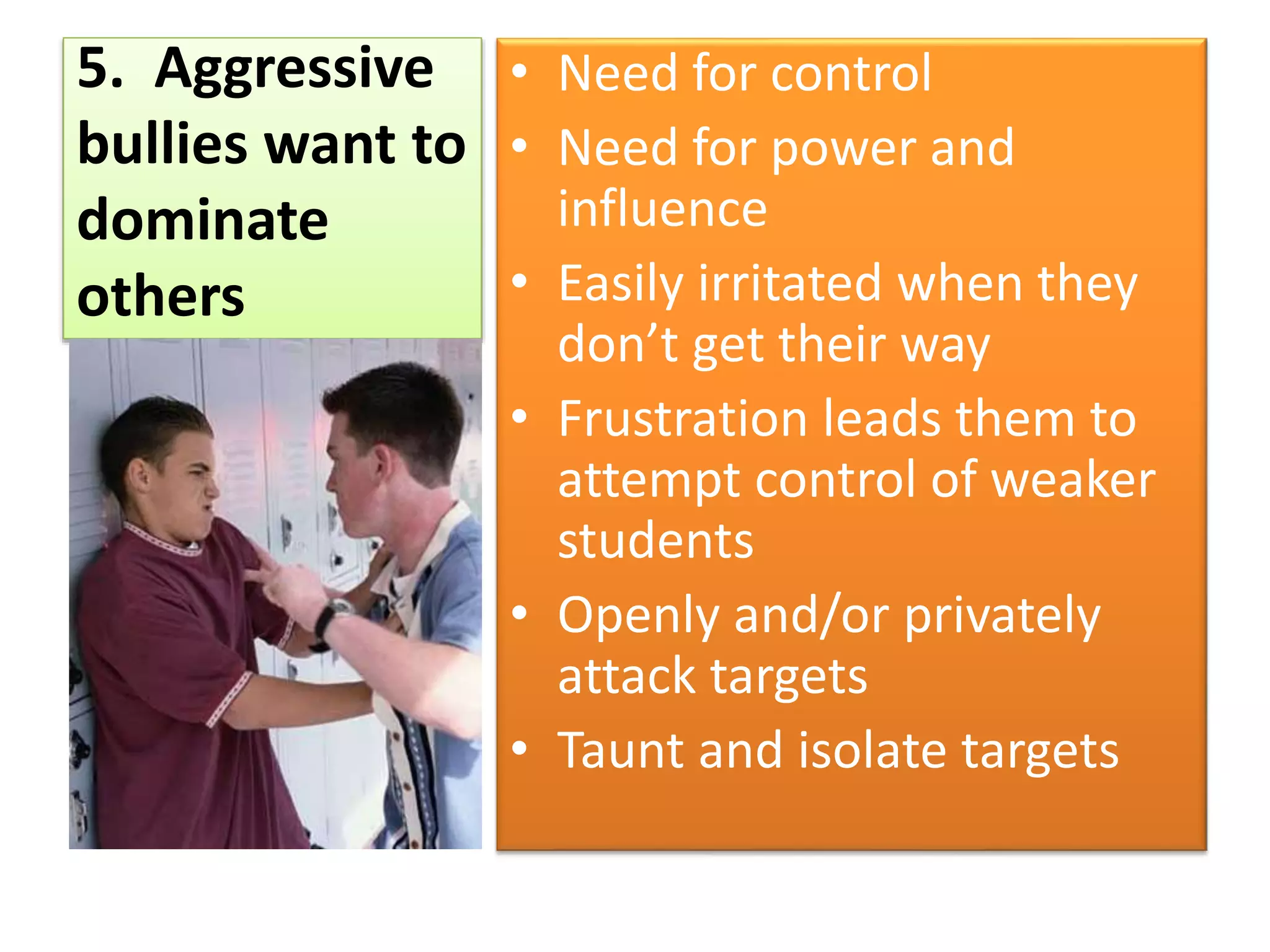
5. Aggressive
bullies want to
dominate
others
• Need for control
• Need for power and
influence
• Easily irritated when they
don’t get their way
• Frustration leads them to
attempt control of weaker
students
• Openly and/or privately
attack targets
• Taunt and isolate targets
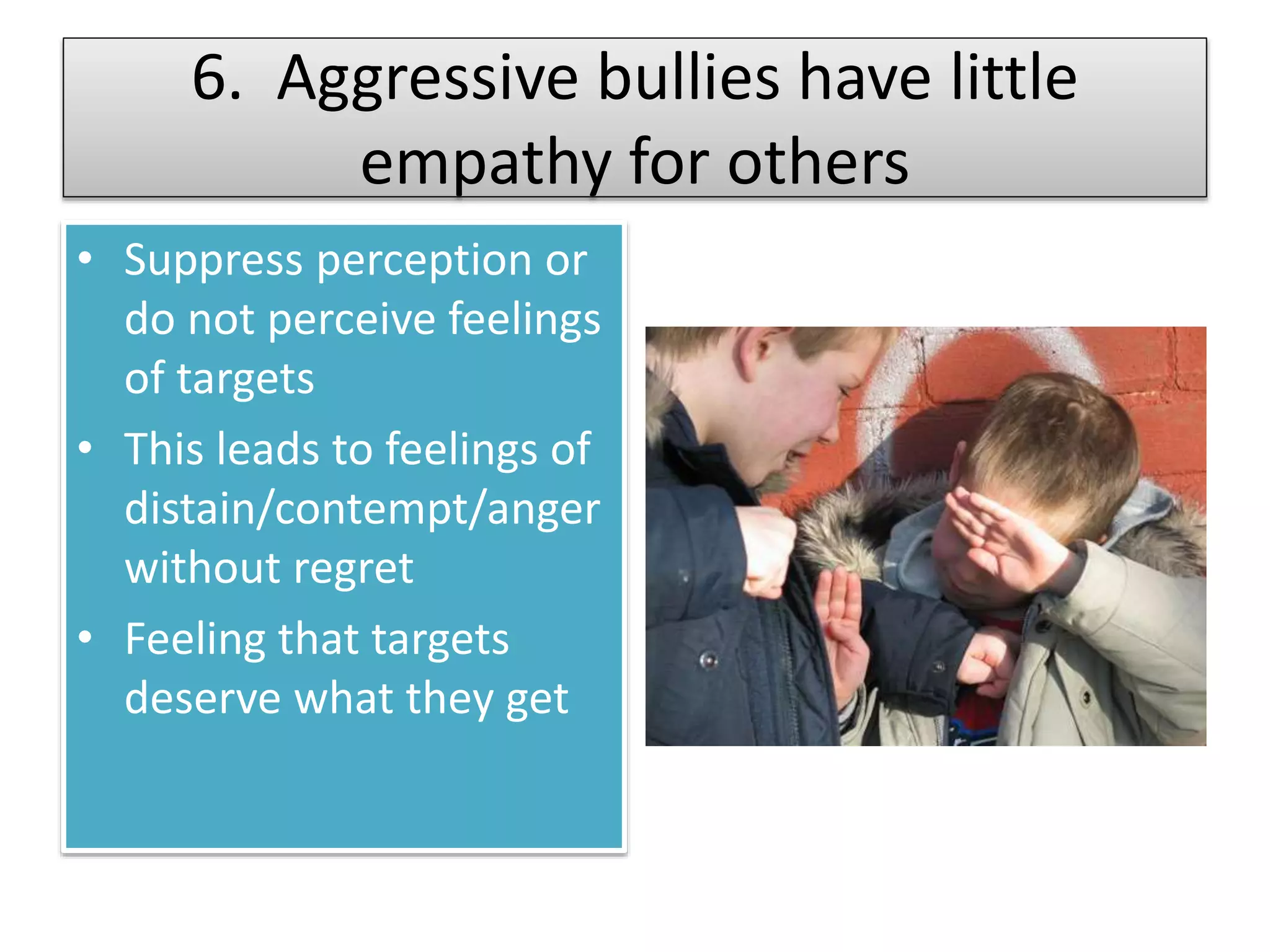
6. Aggressive bullies have little
empathy for others
• Suppress perception or
do not perceive feelings
of targets
• This leads to feelings of
distain/contempt/anger
without regret
• Feeling that targets
deserve what they get
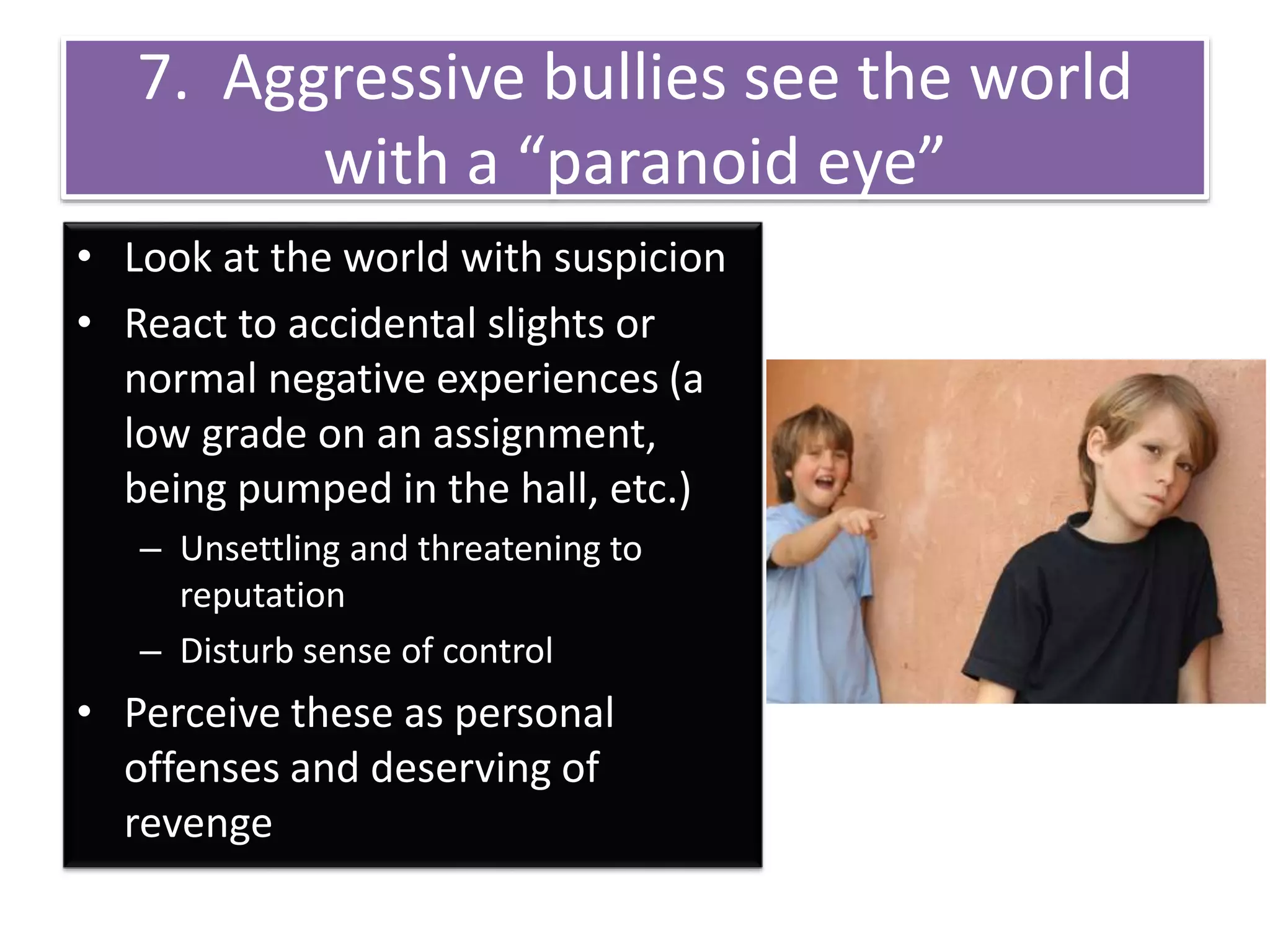
7. Aggressive bullies see the world
with a “paranoid eye”
• Look at the world with suspicion
• React to accidental slights or
normal negative experiences (a
low grade on an assignment,
being pumped in the hall, etc.)
– Unsettling and threatening to
reputation
– Disturb sense of control
• Perceive these as personal
offenses and deserving of
revenge
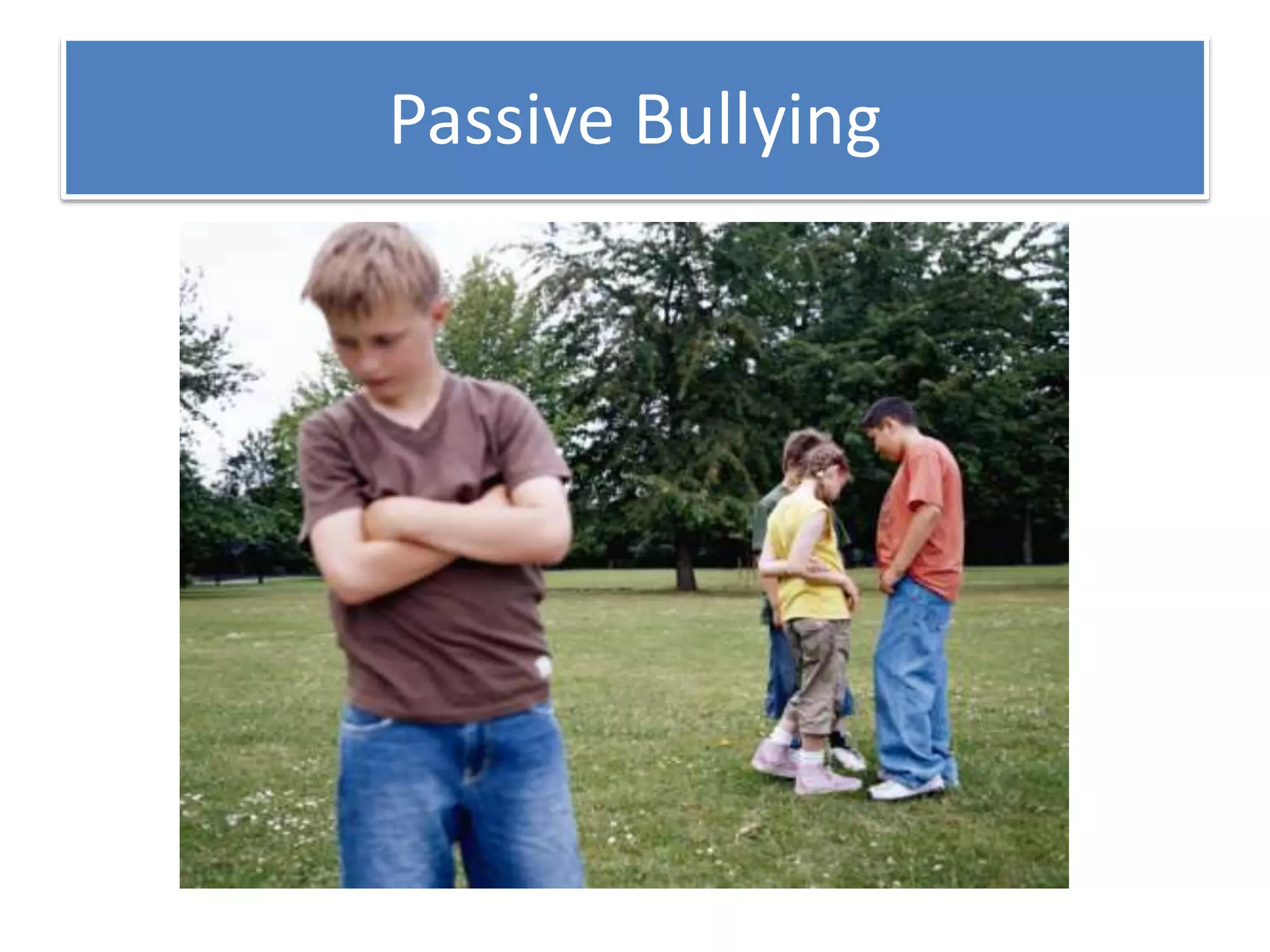
Passive Bullying
Characteristics of Passive Bullies
• Use covert or indirect aggression
• Are generally dependent, insecure and anxious
• Lack strong inhibitions against aggression
• Commonly engage in social exclusion
• Often participate in (but are unlikely to initiate)
aggression
• Lack social status among peers
• Are “camp followers” and “hangers on”
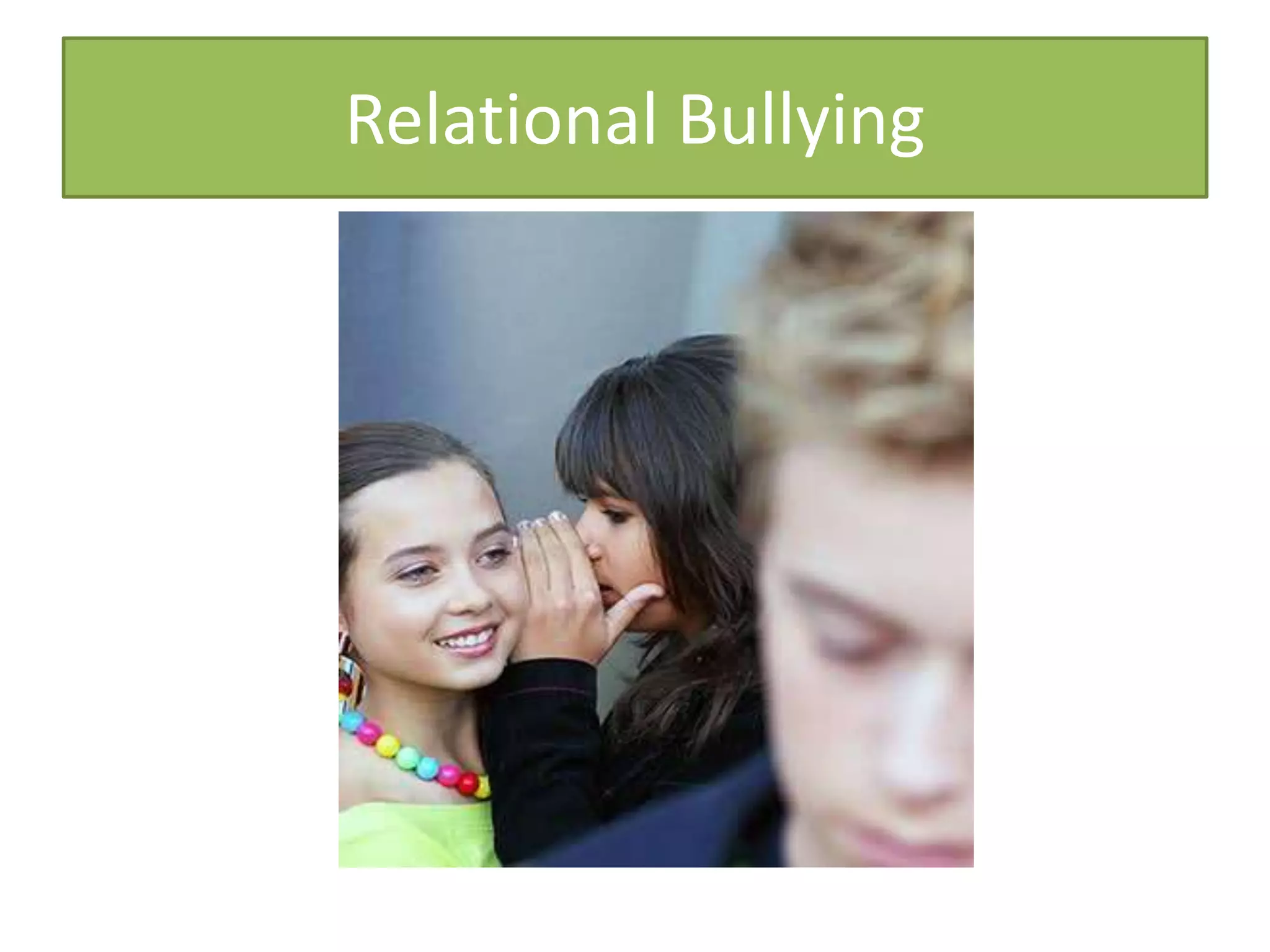
Relational Bullying
Characteristics of Relational Bullies
• Most common type among girls
• Attempts to gain power, prestige and
influence by excluding others
• Uses exclusion to get even when they feel that
they have been slighted or insulted
• Manipulate social patterns
• Spread rumors and lies
Cyberbullying
• Follows children into their
homes—even bedrooms
• IMs, text messages, Facebook,
email, blogs, chat rooms,
online journals
• Unsupervised and feeling of
anonymity—can lead to
greater cruelty than face-to-
face interactions
• Often unreported because
children to not want to lose
access to this private world
Sexual Harassment
• Defined as unwelcome
– sexual advances
– Requests for sexual favors
– Derogatory verbal slurs
– Interfering with an individual’s academic or social
functioning
• Can be
– Cross-gender
– Same-sex
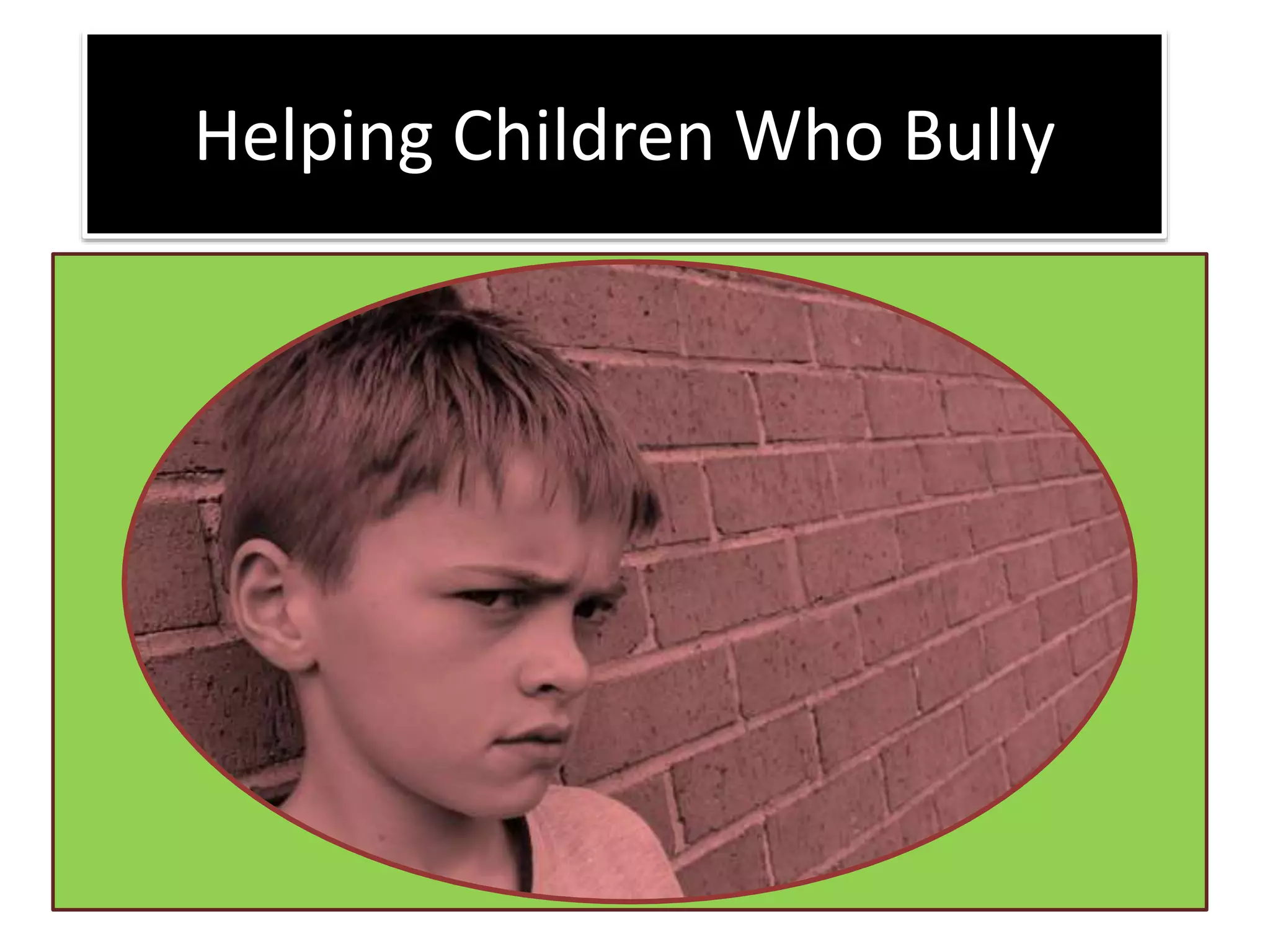
Helping Children Who Bully
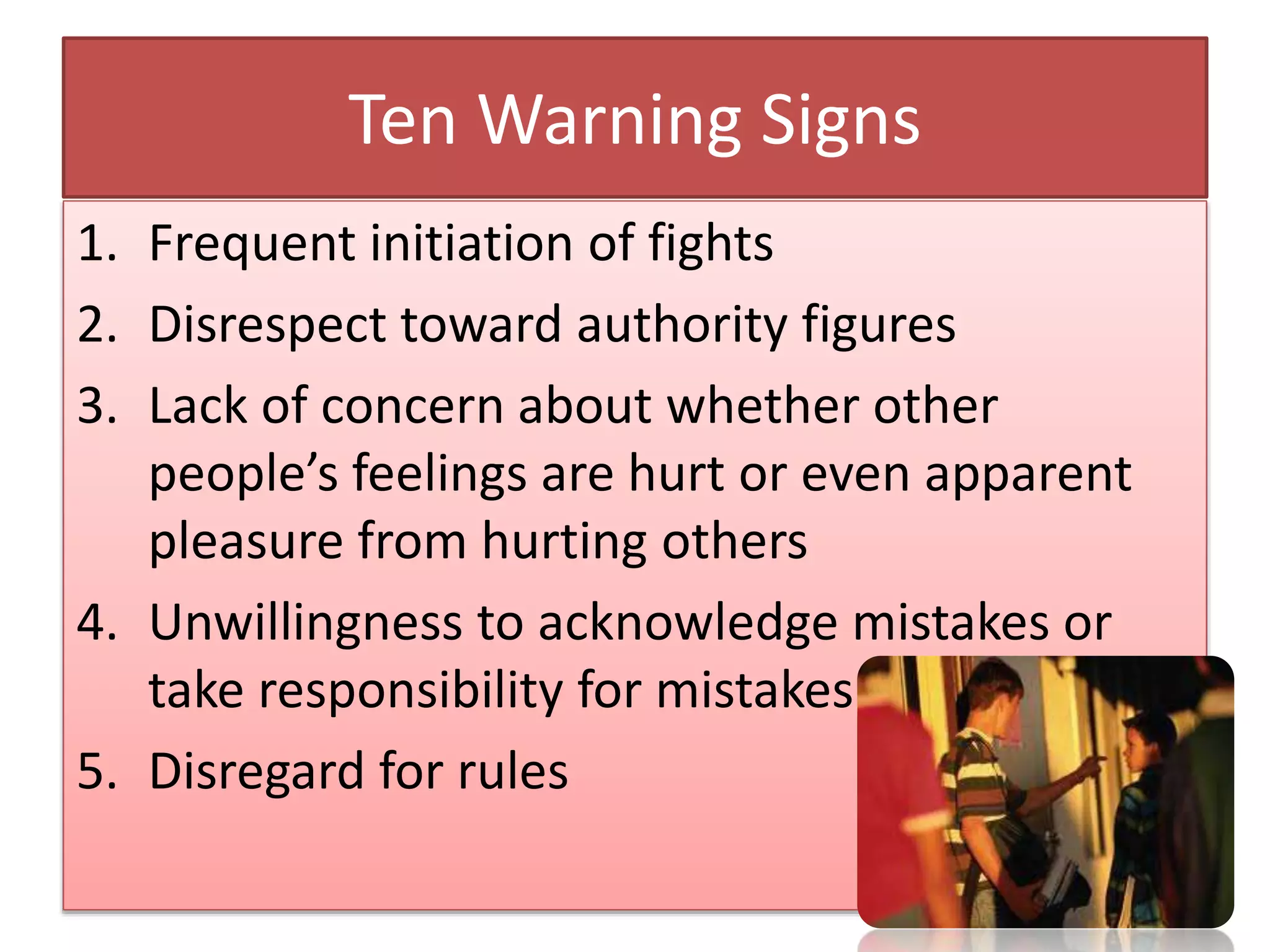
Ten Warning Signs
1. Frequent initiation of fights
2. Disrespect toward authority figures
3. Lack of concern about whether other
people’s feelings are hurt or even apparent
pleasure from hurting others
4. Unwillingness to acknowledge mistakes or
take responsibility for mistakes
5. Disregard for rules
Ten Warning Signs (Continued)
6. Lack of fear
7. Teasing or intentionally harming pets or other
animals
8. Lying in order to get out of trouble or avoid
negative consequences
9. Use of anger and aggression to get one’s own
way
10. Unwillingness to trust or open up to others
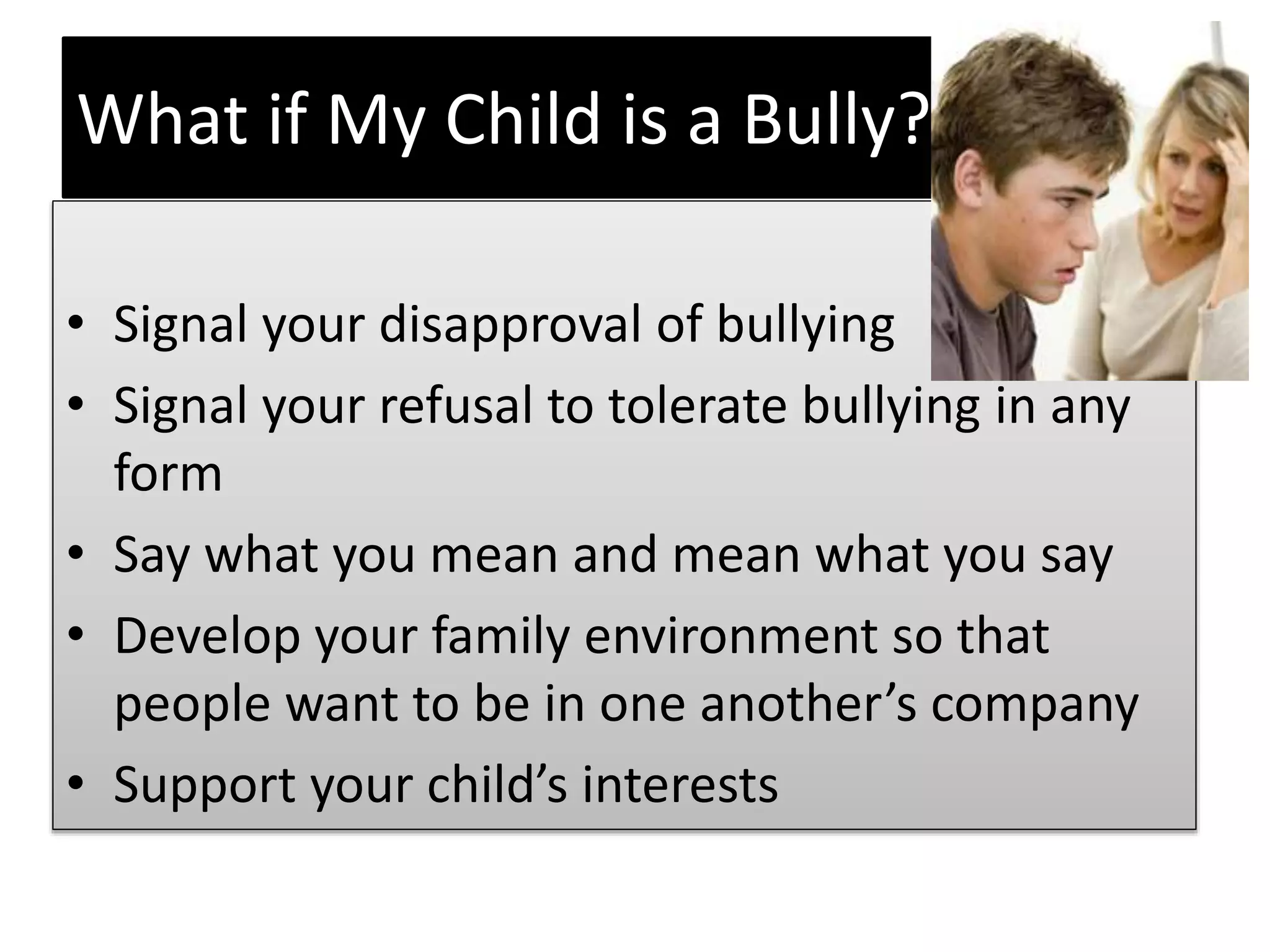
What if My Child is a Bully?
• Signal your disapproval of bullying
• Signal your refusal to tolerate bullying in any
form
• Say what you mean and mean what you say
• Develop your family environment so that
people want to be in one another’s company
• Support your child’s interests
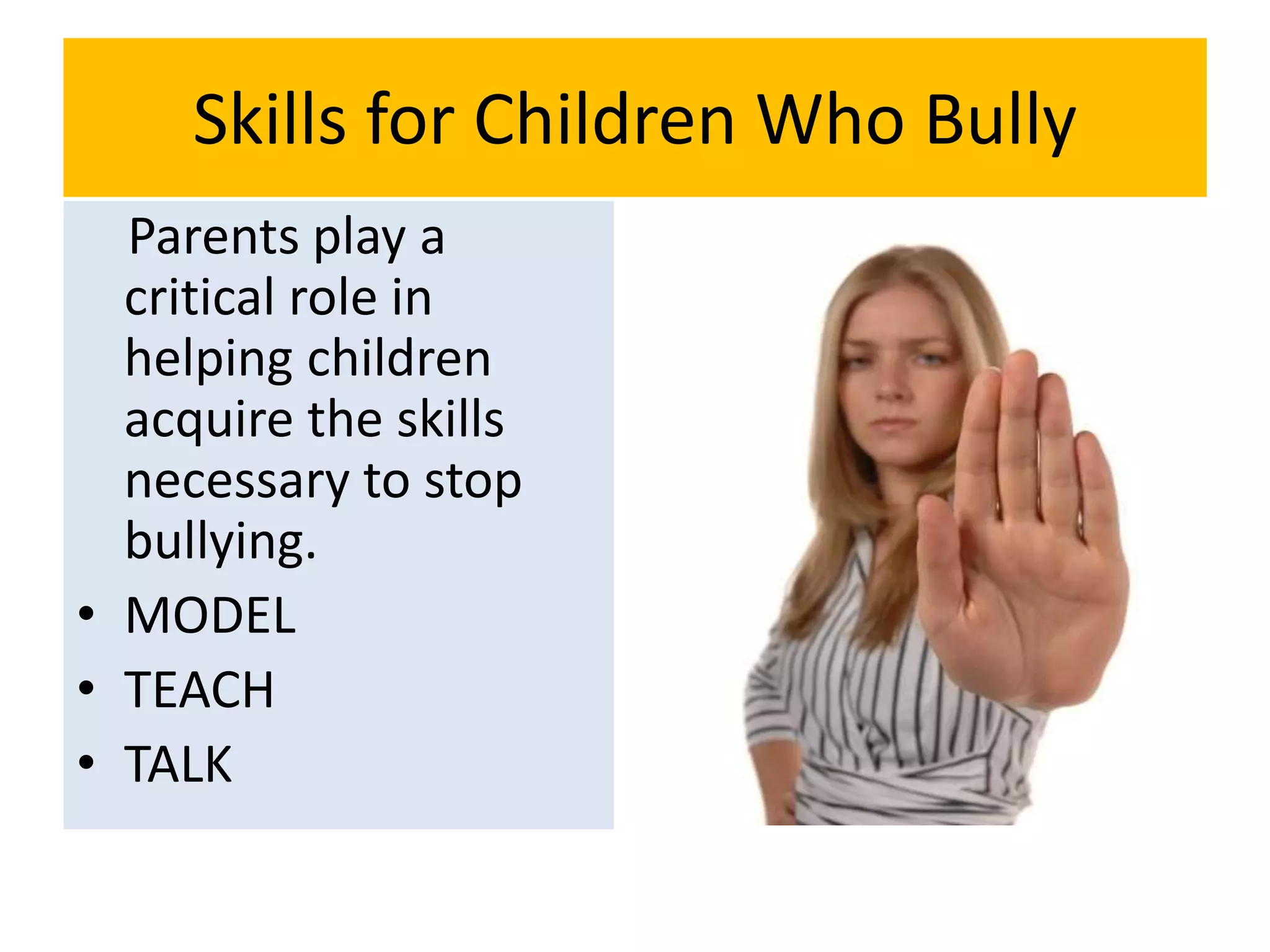
Skills for Children Who Bully
Parents play a
critical role in
helping children
acquire the skills
necessary to stop
bullying.
• MODEL
• TEACH
• TALK
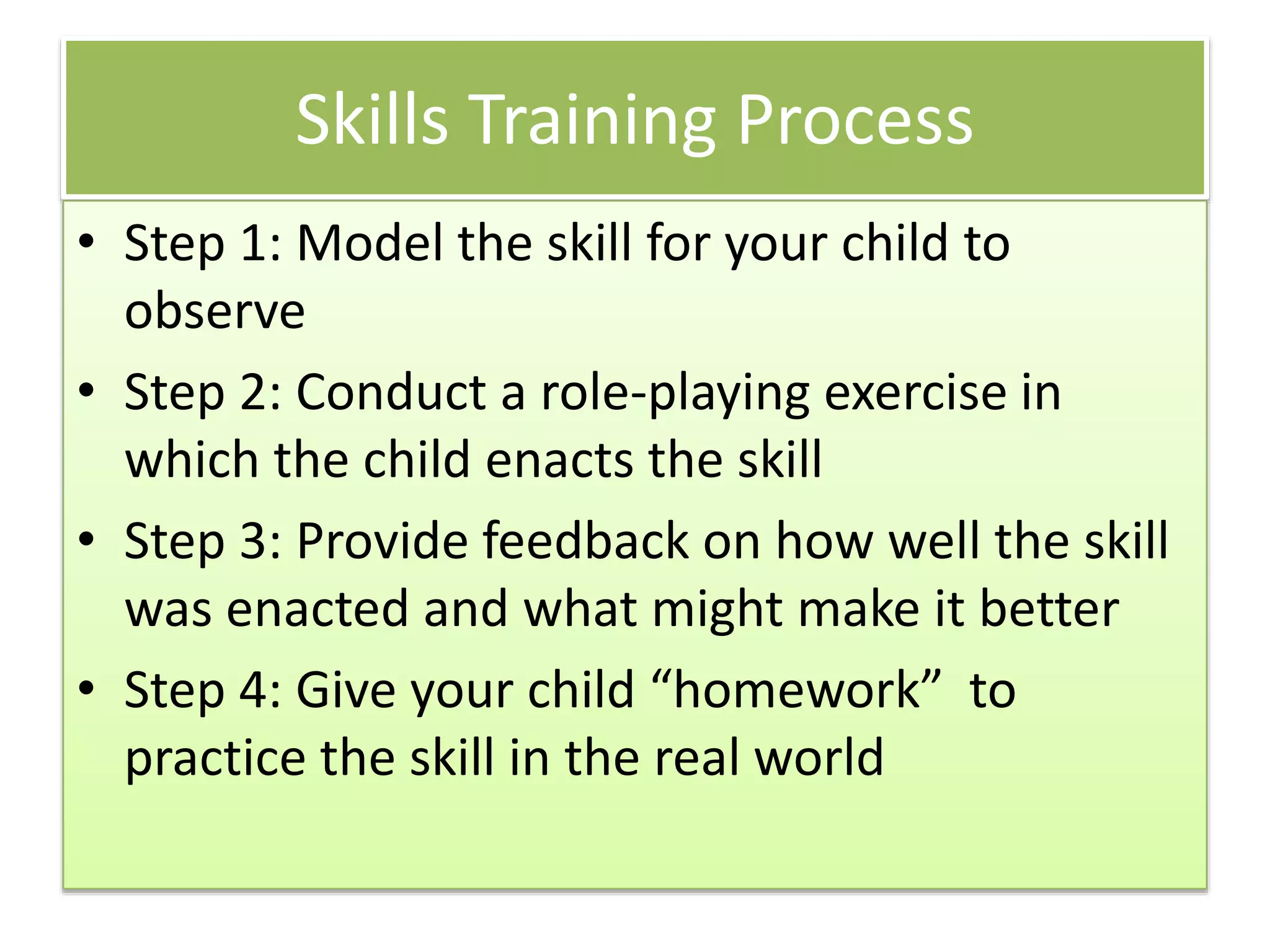
Skills Training Process
• Step 1: Model the skill for your child to
observe
• Step 2: Conduct a role-playing exercise in
which the child enacts the skill
• Step 3: Provide feedback on how well the skill
was enacted and what might make it better
• Step 4: Give your child “homework” to
practice the skill in the real world
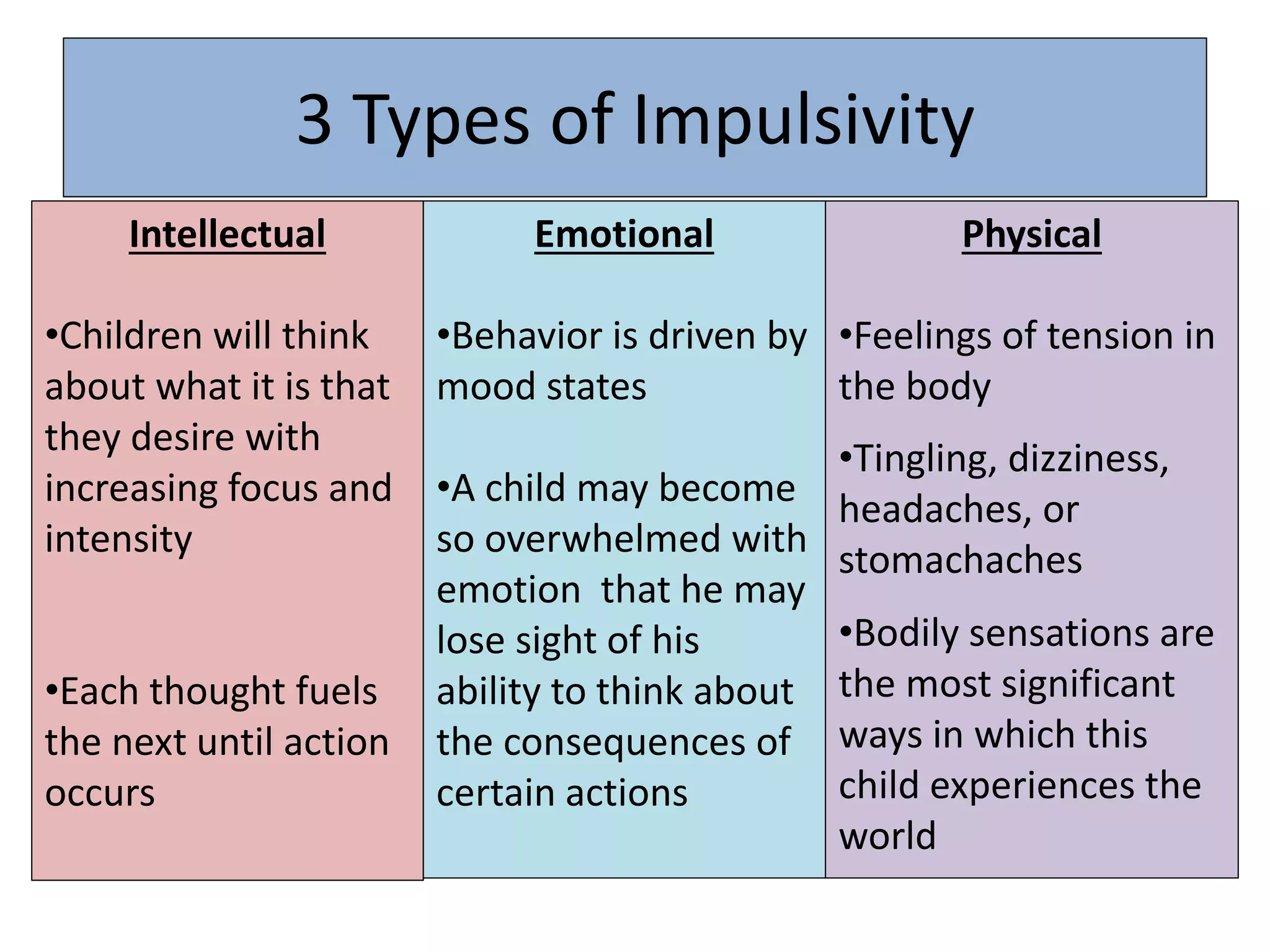
3 Types of Impulsivity
Intellectual
•Children will think
about what it is that
they desire with
increasing focus and
intensity
•Each thought fuels
the next until action
occurs
Emotional
•Behavior is driven by
mood states
•A child may become
so overwhelmed with
emotion that he may
lose sight of his
ability to think about
the consequences of
certain actions
Physical
•Feelings of tension in
the body
•Tingling, dizziness,
headaches, or
stomachaches
•Bodily sensations are
the most significant
ways in which this
child experiences the
world
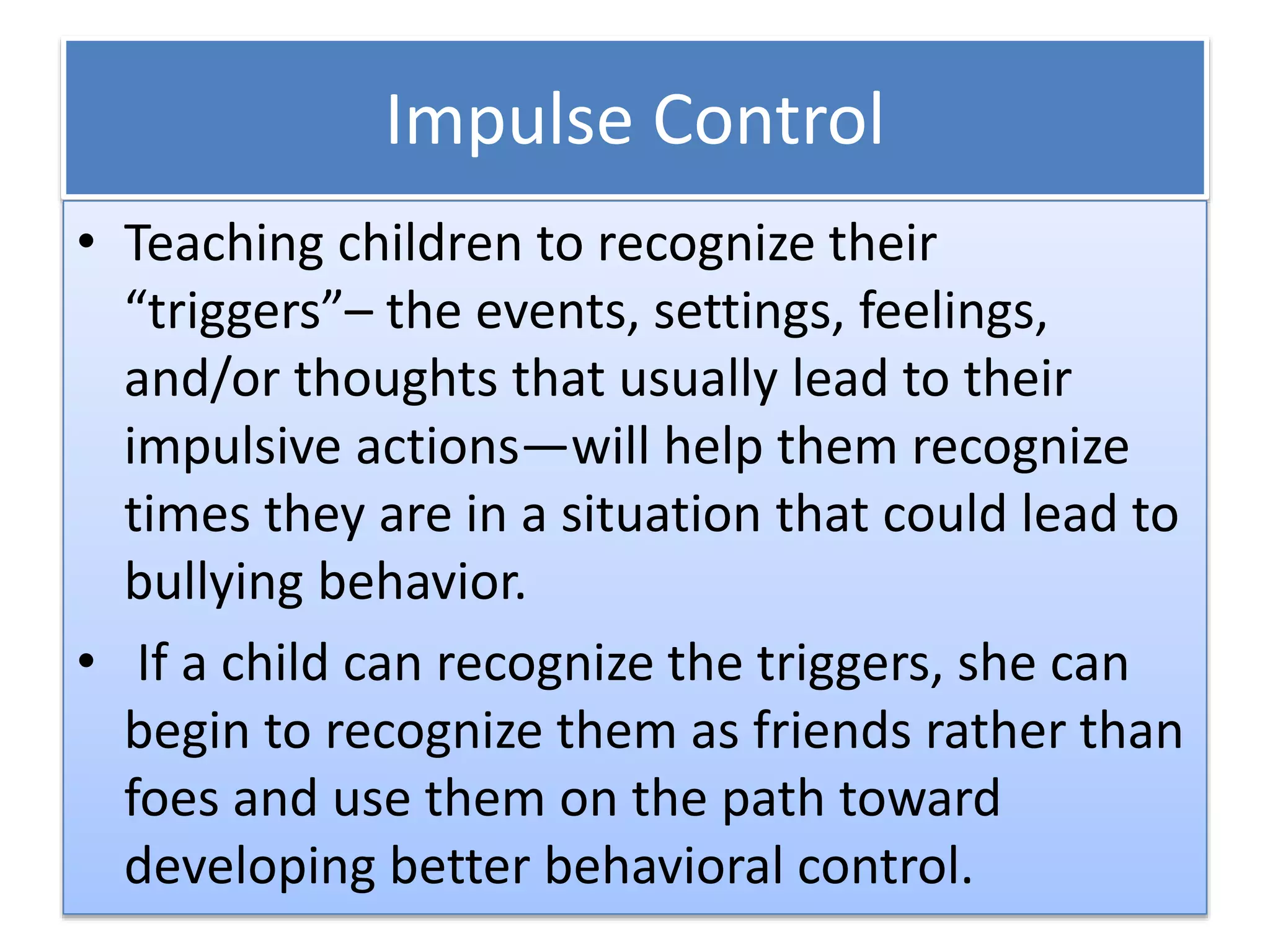
Impulse Control
• Teaching children to recognize their
“triggers”– the events, settings, feelings,
and/or thoughts that usually lead to their
impulsive actions—will help them recognize
times they are in a situation that could lead to
bullying behavior.
• If a child can recognize the triggers, she can
begin to recognize them as friends rather than
foes and use them on the path toward
developing better behavioral control.
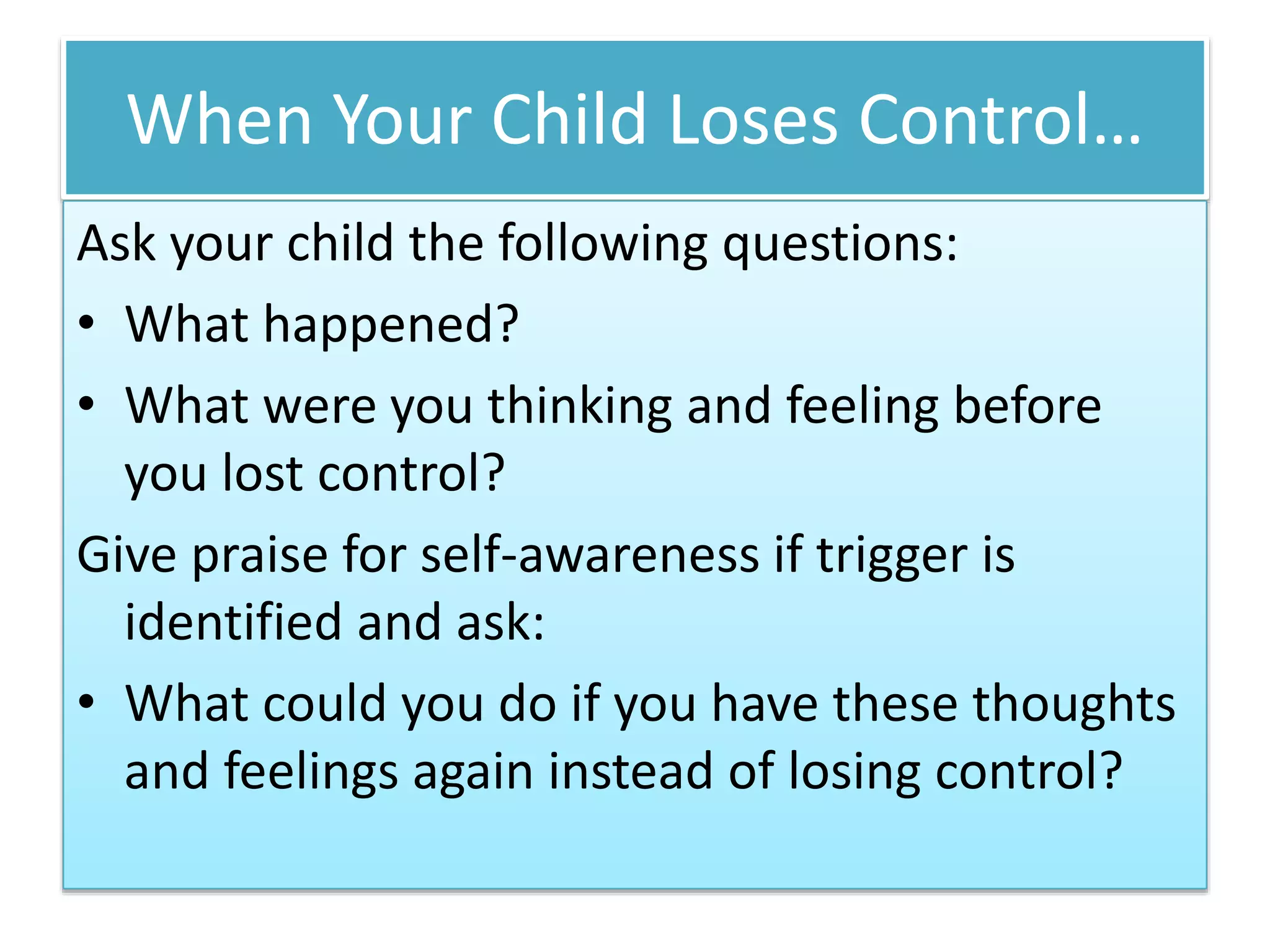
When Your Child Loses Control…
Ask your child the following questions:
• What happened?
• What were you thinking and feeling before
you lost control?
Give praise for self-awareness if trigger is
identified and ask:
• What could you do if you have these thoughts
and feelings again instead of losing control?
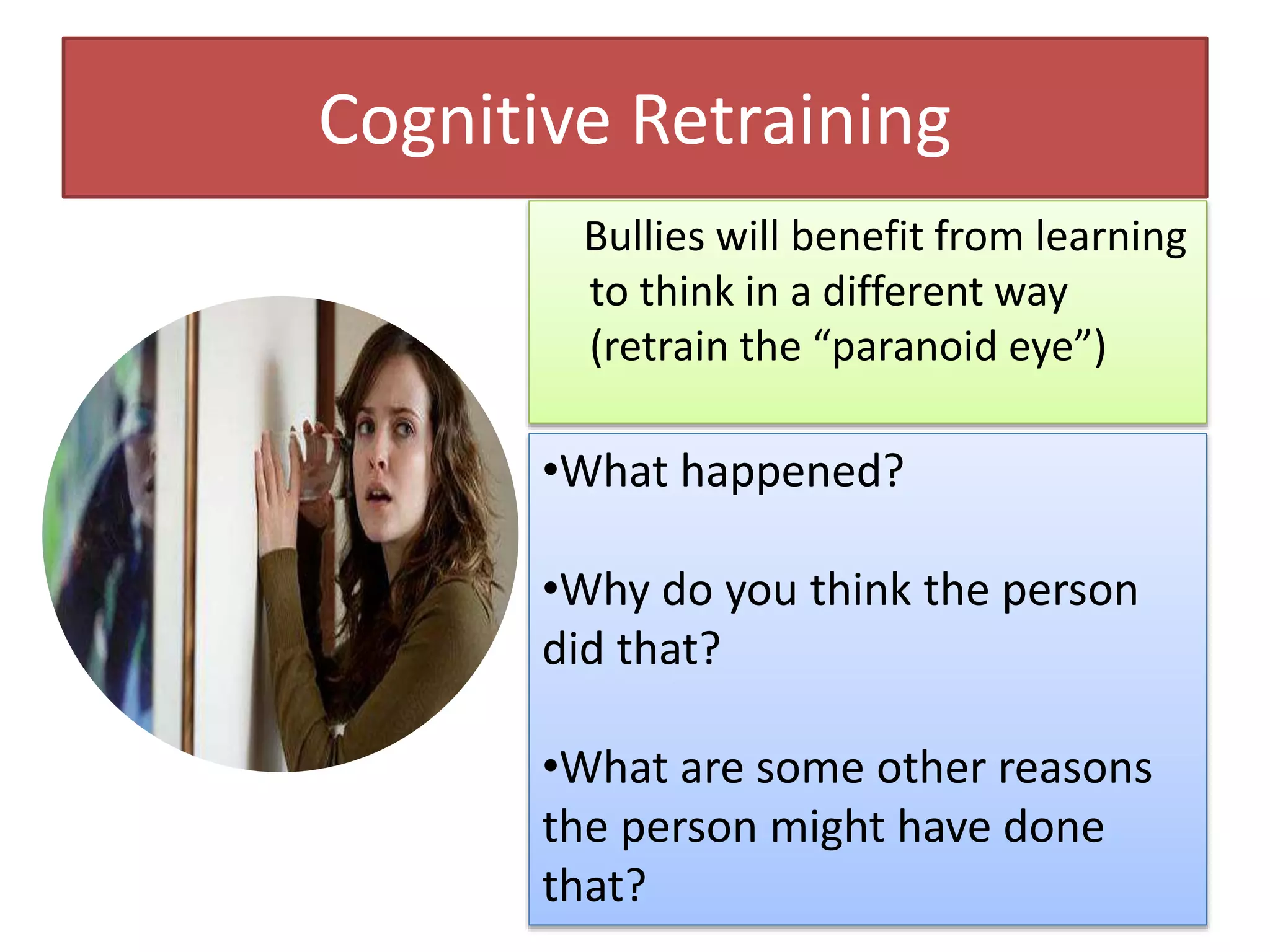
Cognitive Retraining
Bullies will benefit from learning
to think in a different way
(retrain the “paranoid eye”)
•What happened?
•Why do you think the person
did that?
•What are some other reasons
the person might have done
that?
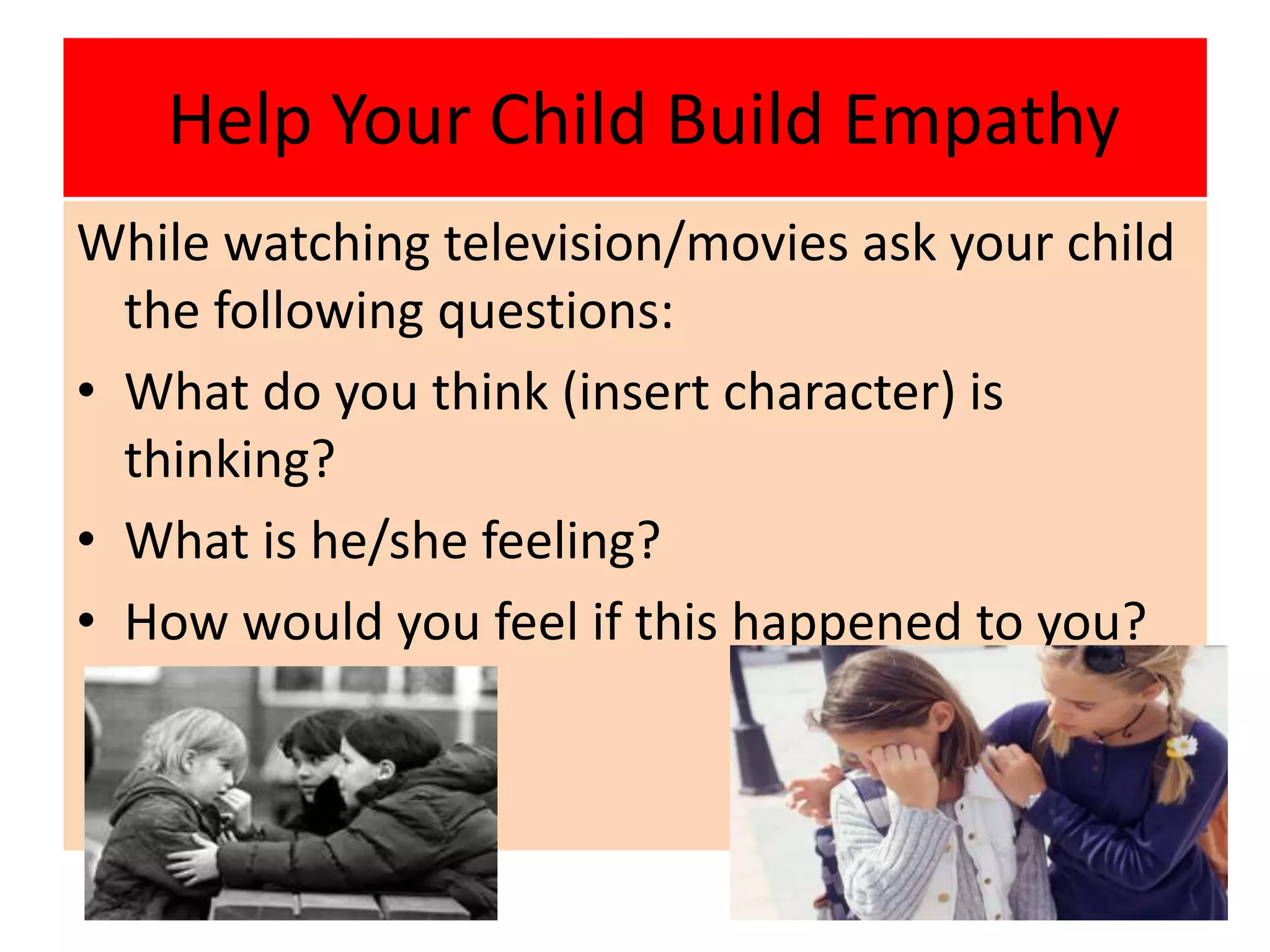
Help Your Child Build Empathy
While watching television/movies ask your child
the following questions:
• What do you think (insert character) is
thinking?
• What is he/she feeling?
• How would you feel if this happened to you?
Problem Solving
STOPP
S—Stop: Stop, settle down, and be calm
T—Think: Think about the problem and your goals
O—Options: Think about the options or solutions to
the problem
P—Plan: Examine the consequences of different
options, choose the best plan, and do it
P—Plan working? If yes, great! If not, try a new plan!
OR…try The Big Questions (from Part 1)
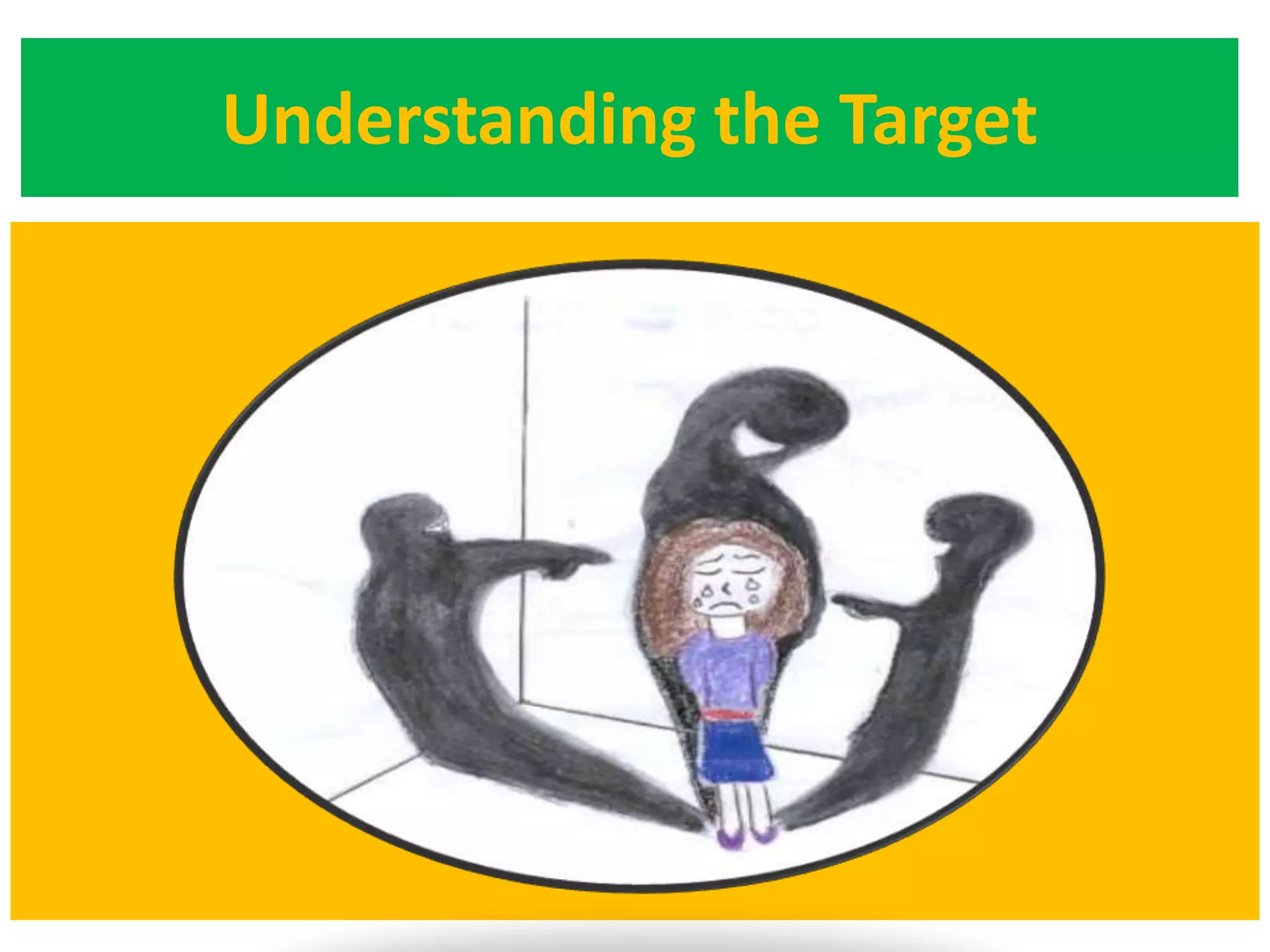
Understanding the Target
a
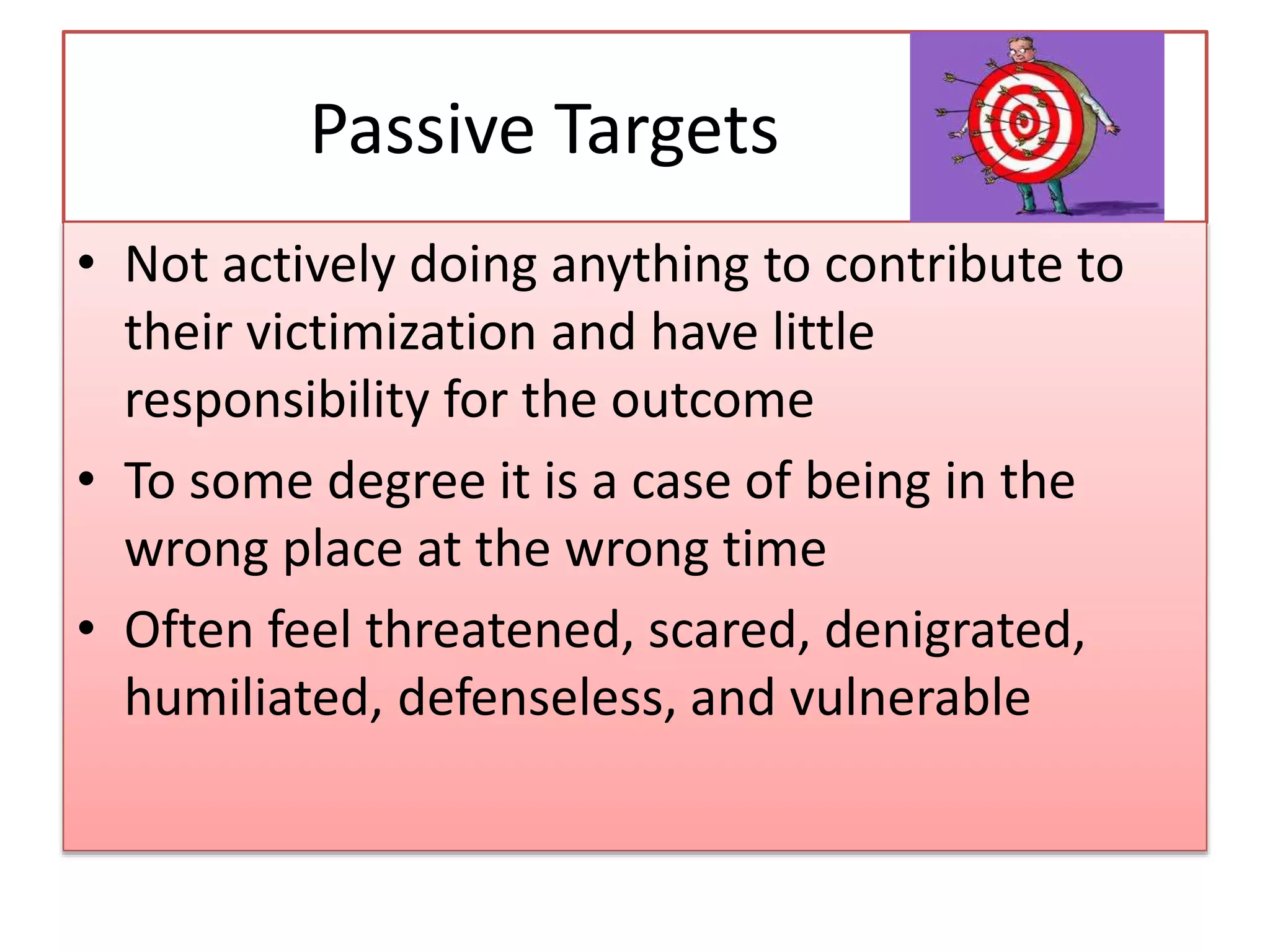
Passive Targets
• Not actively doing anything to contribute to
their victimization and have little
responsibility for the outcome
• To some degree it is a case of being in the
wrong place at the wrong time
• Often feel threatened, scared, denigrated,
humiliated, defenseless, and vulnerable
Passive Target Characteristics
• Generally have low self-esteem
• Describe their experience as one of social
isolation and abandonment
• Tend to be smaller and have less developed
physical skills
• May be targeted because of intellectual abilities
• May be of lower socioeconomic status
• Appear more anxious, nervous, and insecure than
their peers
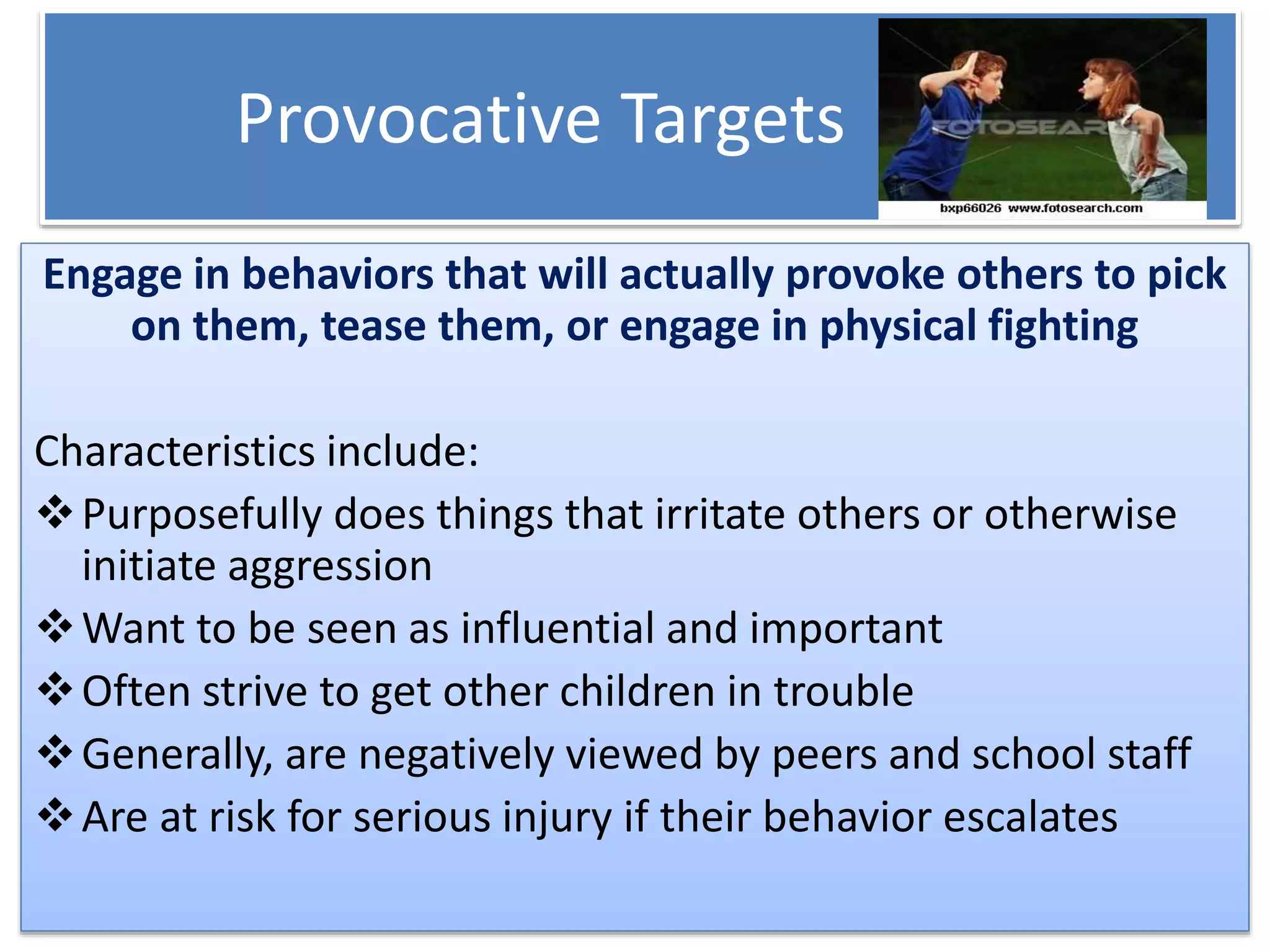
Provocative Targets
Engage in behaviors that will actually provoke others to pick
on them, tease them, or engage in physical fighting
Characteristics include:
Purposefully does things that irritate others or otherwise
initiate aggression
Want to be seen as influential and important
Often strive to get other children in trouble
Generally, are negatively viewed by peers and school staff
Are at risk for serious injury if their behavior escalates
Targets of Relational Bullying
When someone is systematically excluded from a
group or ignored by peers.
An attempt to join the clique or group is often
rejected
Experience being ignored, treated as nonpersons,
and help in contempt
Common among girls and increases as children get
older, develop effective social skills, and have a
better understanding of exclusion
Often overlooked because it is not apparent
Apply the PIC Criteria to Relational
• (P) Is it purposeful?
Relational bullying is intentional and is often well planned.
• (I) Is there an imbalance of power?
Clearly, those who are doing the excluding have power over
the child who is denied participation
• (C) Is it continual?
Relational bullying is rarely a single event. Once the persons
doing the excluding have identified a target, they often
continue to reject the individual
Bystanders
People who witness or hear about
bullying as also affected
2 possible reactions:
 Afraid
Fear that if they interfere they will become the target
Should realize they possess alternative strategies and resources to help the
target
 Guilty
Can result in shame and remorse which can lead to sadness and general
avoidance of the conflict.
“Learned helplessness”, feel they are unable to have impact on their life or
other’s
Students who intervene won’t always be successful and it may even escalate
the situation. But children tend to listen to each other and empowered
bystanders are often effective in stopping aggressive behaviors
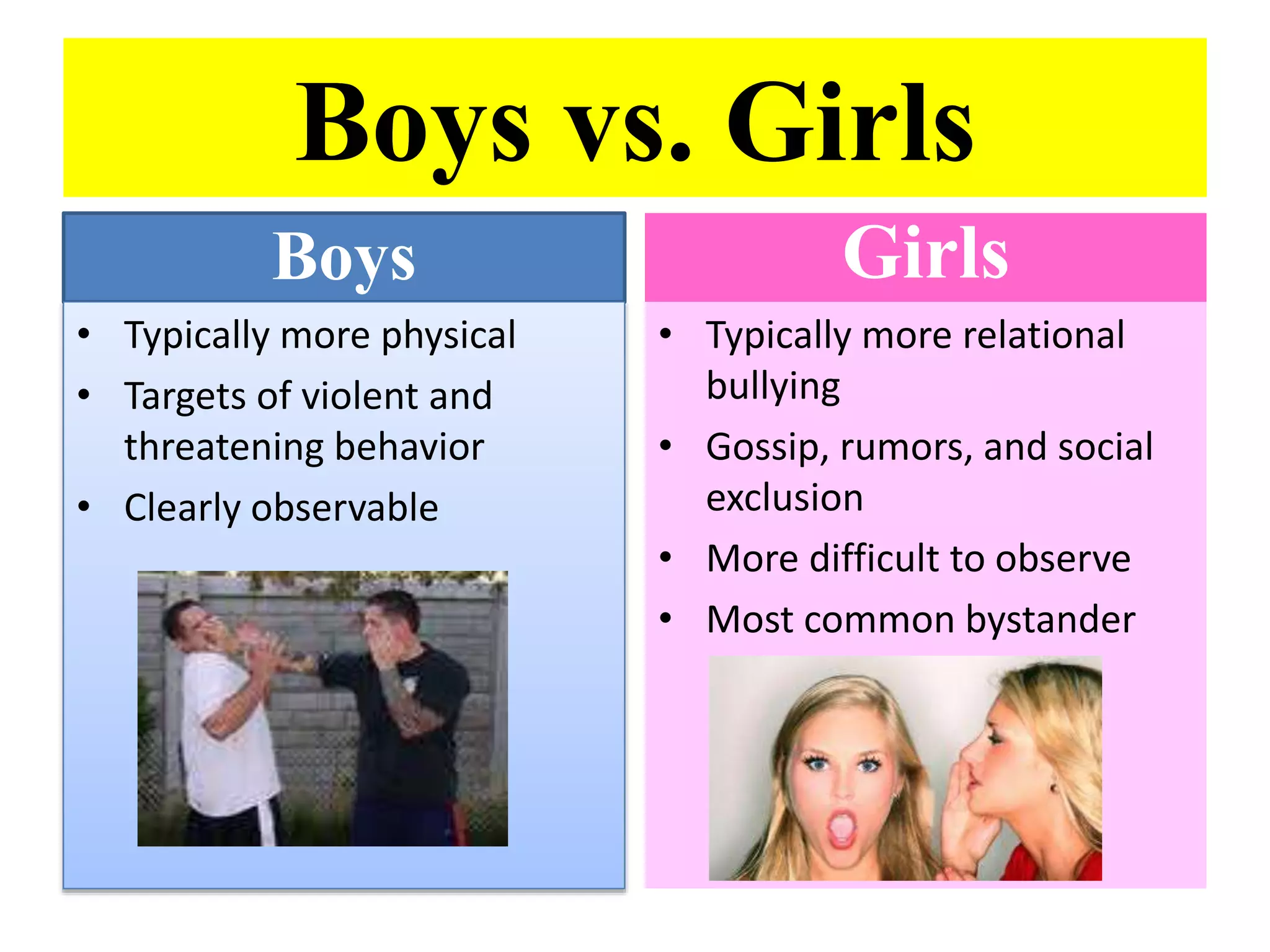
Boys vs. Girls
Boys
• Typically more physical
• Targets of violent and
threatening behavior
• Clearly observable
Girls
• Typically more relational
bullying
• Gossip, rumors, and social
exclusion
• More difficult to observe
• Most common bystander
Helping Targets of Bullying
Ten Warning Signs
1. Physical signs of fighting
2. Frequent illnesses or trouble
sleeping
3. Sudden decrease in school
performance
4. Peer rejection
5. Depression, unexplained or
uncontrolled crying,
thoughts or talk of suicide
6. Avoiding certain groups at
school, unwillingness to walk
to or from school
Ten Warning Signs, continued…
7. Sudden and unexplained
changes in request for
lunch items
8. Development of tics, nail-
biting or hair-pulling, bed-
wetting
9. Truancy or refusal to go to
school or other activities
10. Suddenly avoiding group
activities (recess/lunch/
neighborhood gatherings)
Parents: how to help—7 methods
1. Prize your child
• Do not overlook issues
but deliver corrections
respectfully
– Give alternatives
– Make it clear what
behavior is unacceptable
– Make your child feel
valued and loved
Parents: how to help…
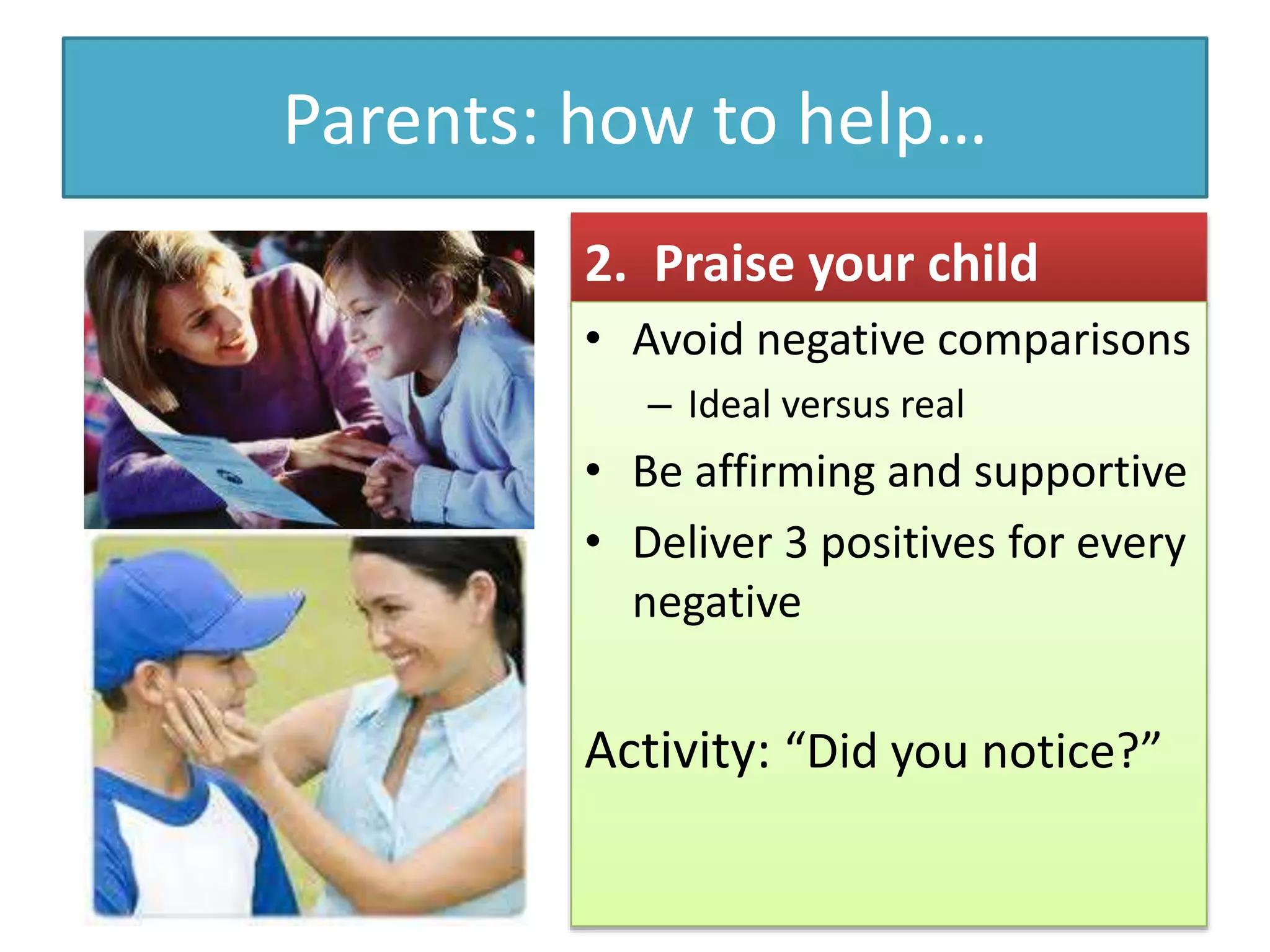
2. Praise your child
• Avoid negative comparisons
– Ideal versus real
• Be affirming and supportive
• Deliver 3 positives for every
negative
Activity: “Did you notice?”
Parents: how to help…
3. Promote humor
• Avoid teasing each
other over
uncontrollable things
(i.e., red hair, height,
glasses, etc.)
• Help children to learn
and identify what is
funny without being
harmful
Parents: how to help…
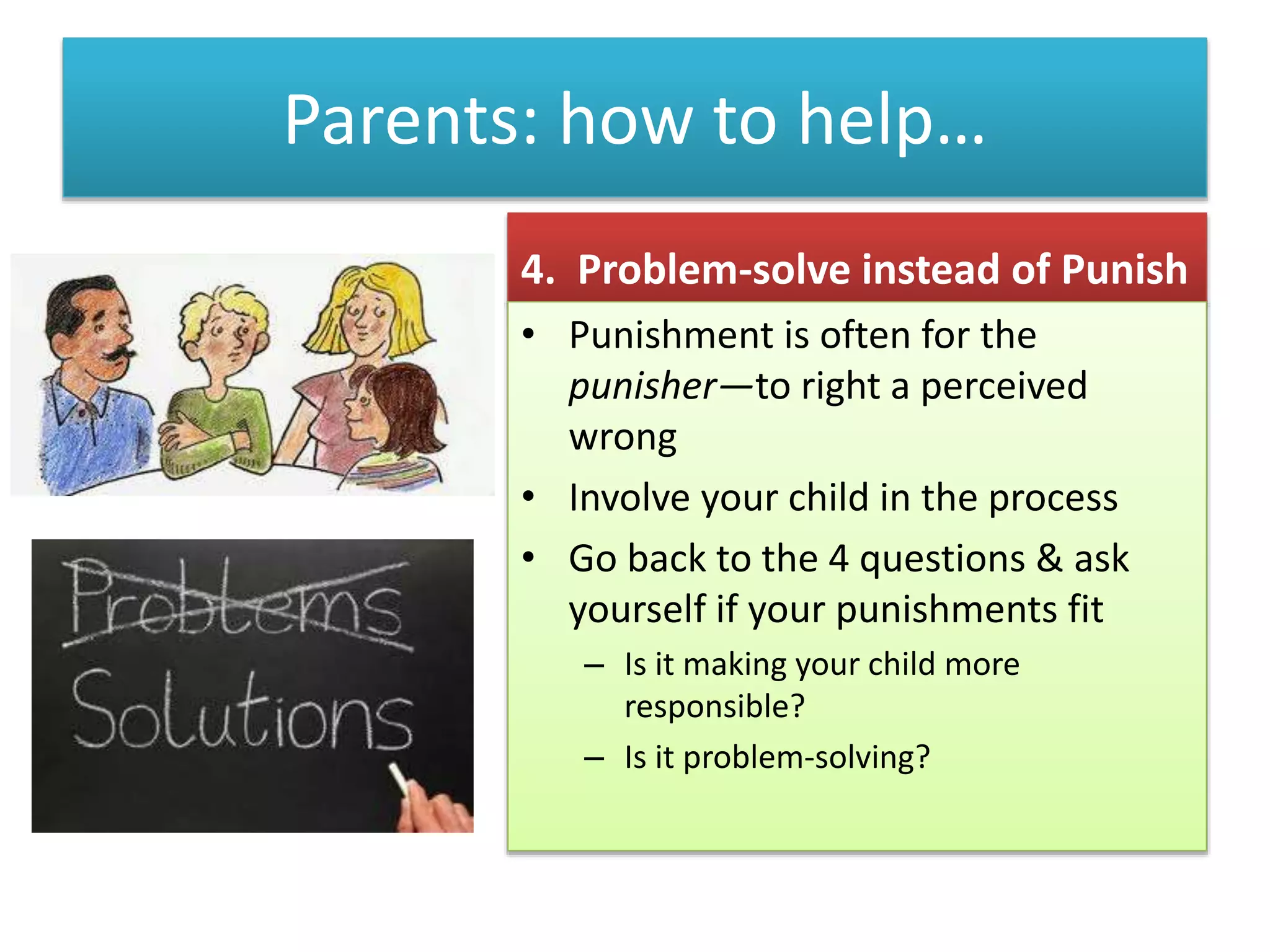
4. Problem-solve instead of Punish
• Punishment is often for the
punisher—to right a perceived
wrong
• Involve your child in the process
• Go back to the 4 questions & ask
yourself if your punishments fit
– Is it making your child more
responsible?
– Is it problem-solving?
Parents: how to help…
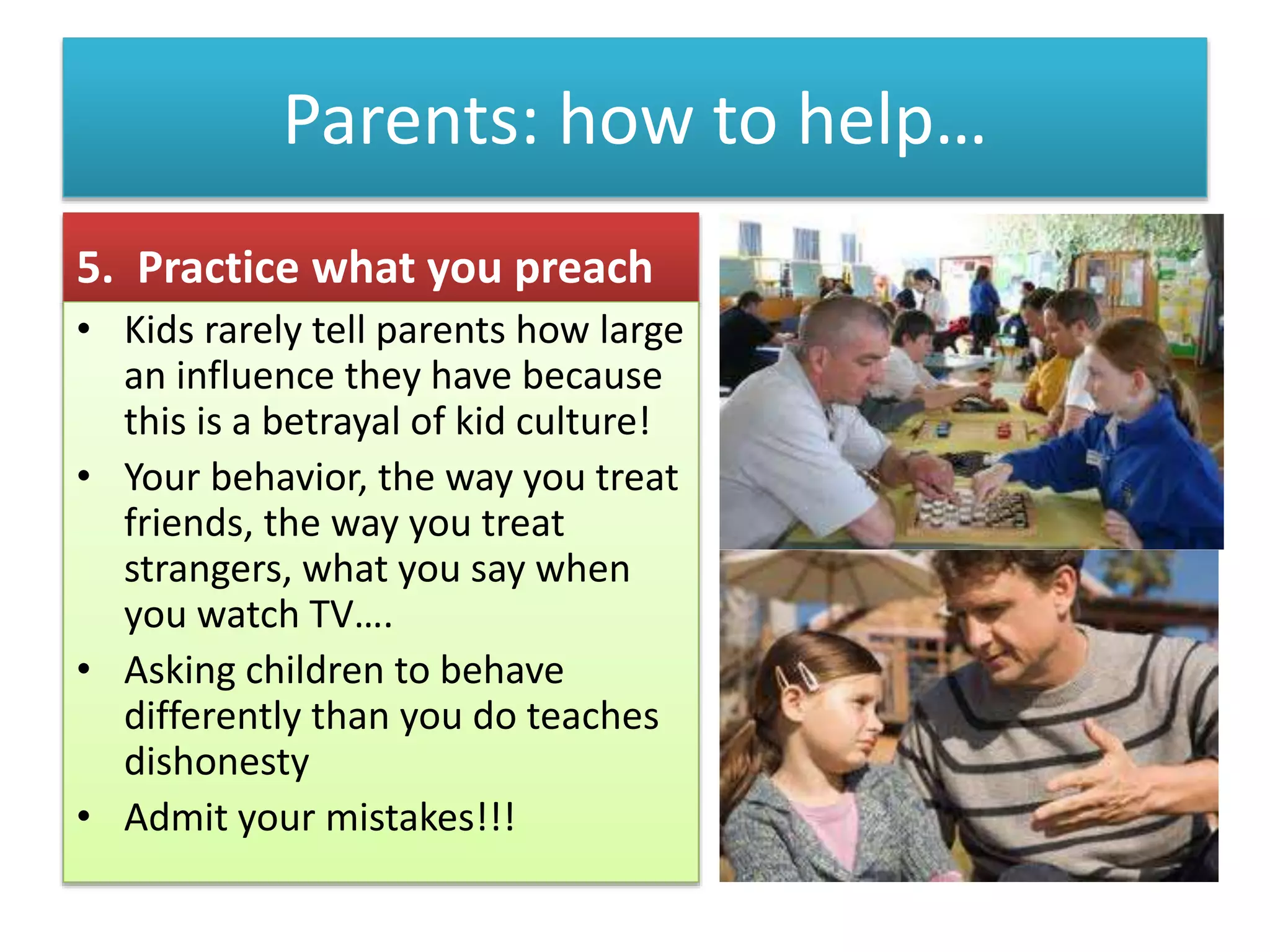
5. Practice what you preach
• Kids rarely tell parents how large
an influence they have because
this is a betrayal of kid culture!
• Your behavior, the way you treat
friends, the way you treat
strangers, what you say when
you watch TV….
• Asking children to behave
differently than you do teaches
dishonesty
• Admit your mistakes!!!
Parents: how to help…
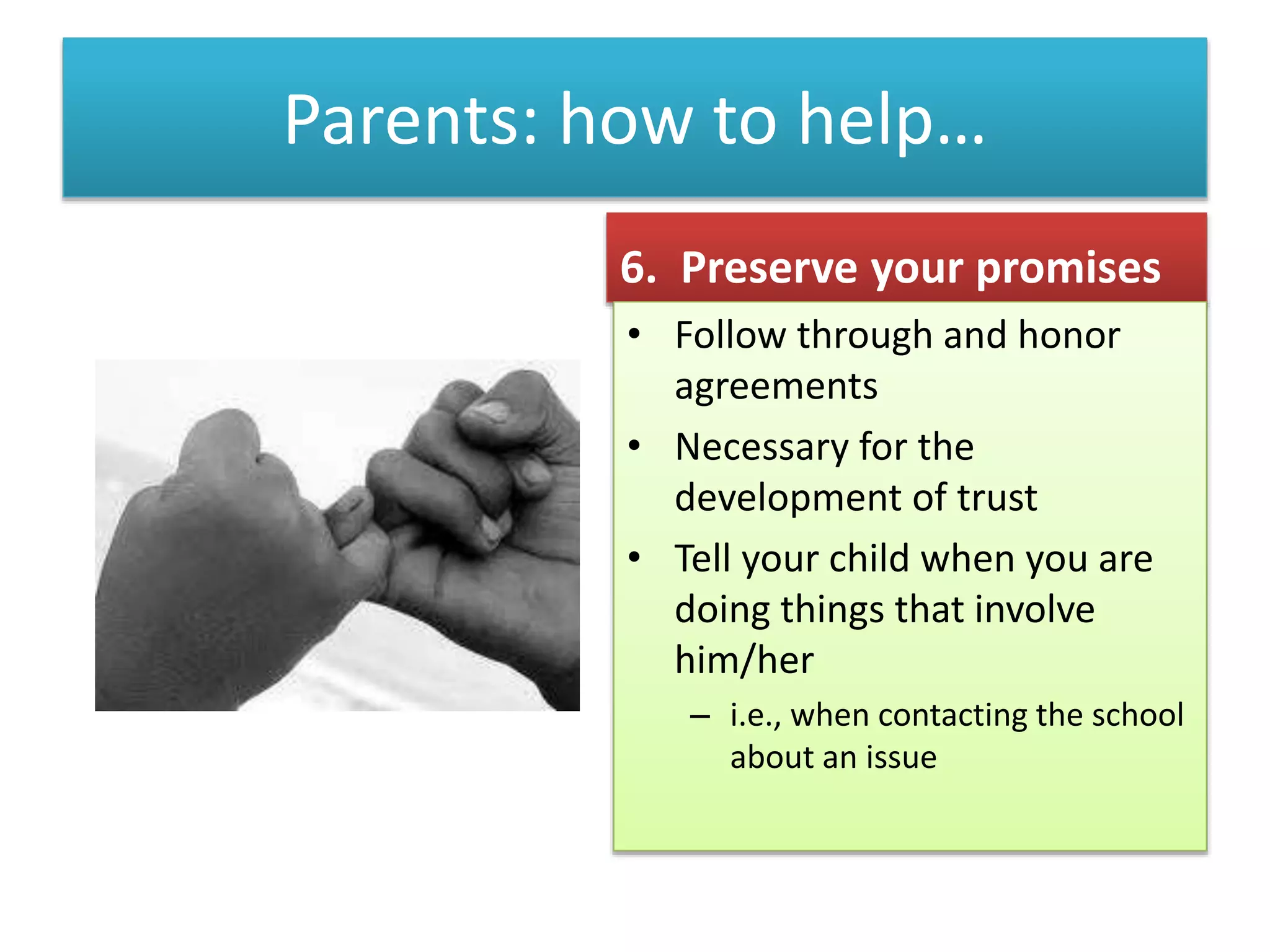
6. Preserve your promises
• Follow through and honor
agreements
• Necessary for the
development of trust
• Tell your child when you are
doing things that involve
him/her
– i.e., when contacting the school
about an issue
Parents: how to help…
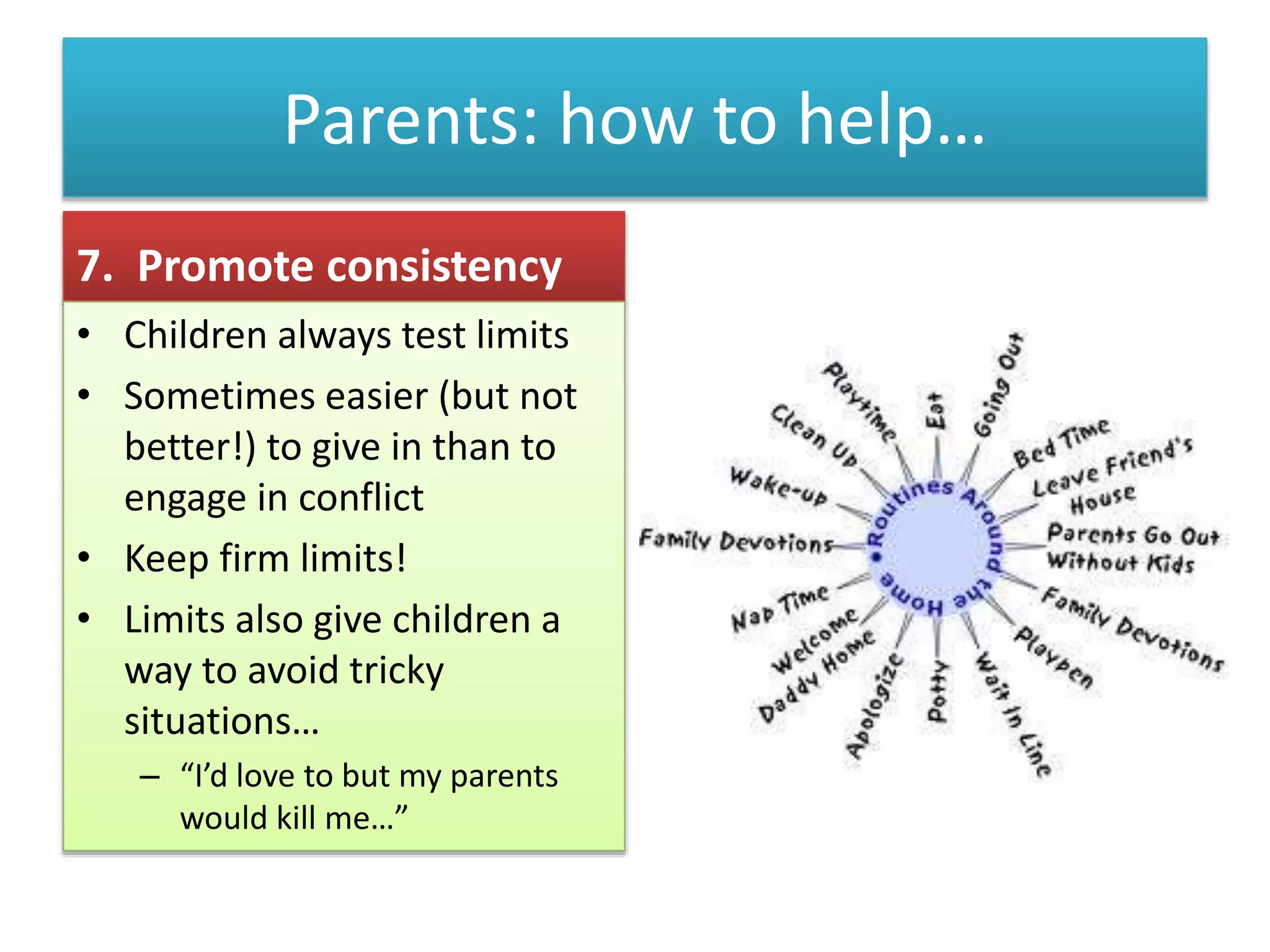
7. Promote consistency
• Children always test limits
• Sometimes easier (but not
better!) to give in than to
engage in conflict
• Keep firm limits!
• Limits also give children a
way to avoid tricky
situations…
– “I’d love to but my parents
would kill me…”
Advice for targets
Bad advice
• Ignore it
• Walk away
• Fight back
• Submit
quietly
Good advice
• Try not to react intensely
– This robs bully of emotional payoff
• Respond atypically: not like a bully and
not like a target. Throw them!
• Don’t try to be invisible
– Approach first
• Empowerment!
– Not to suggest that targets are
responsible—just to give them the skills to
combat what they encounter
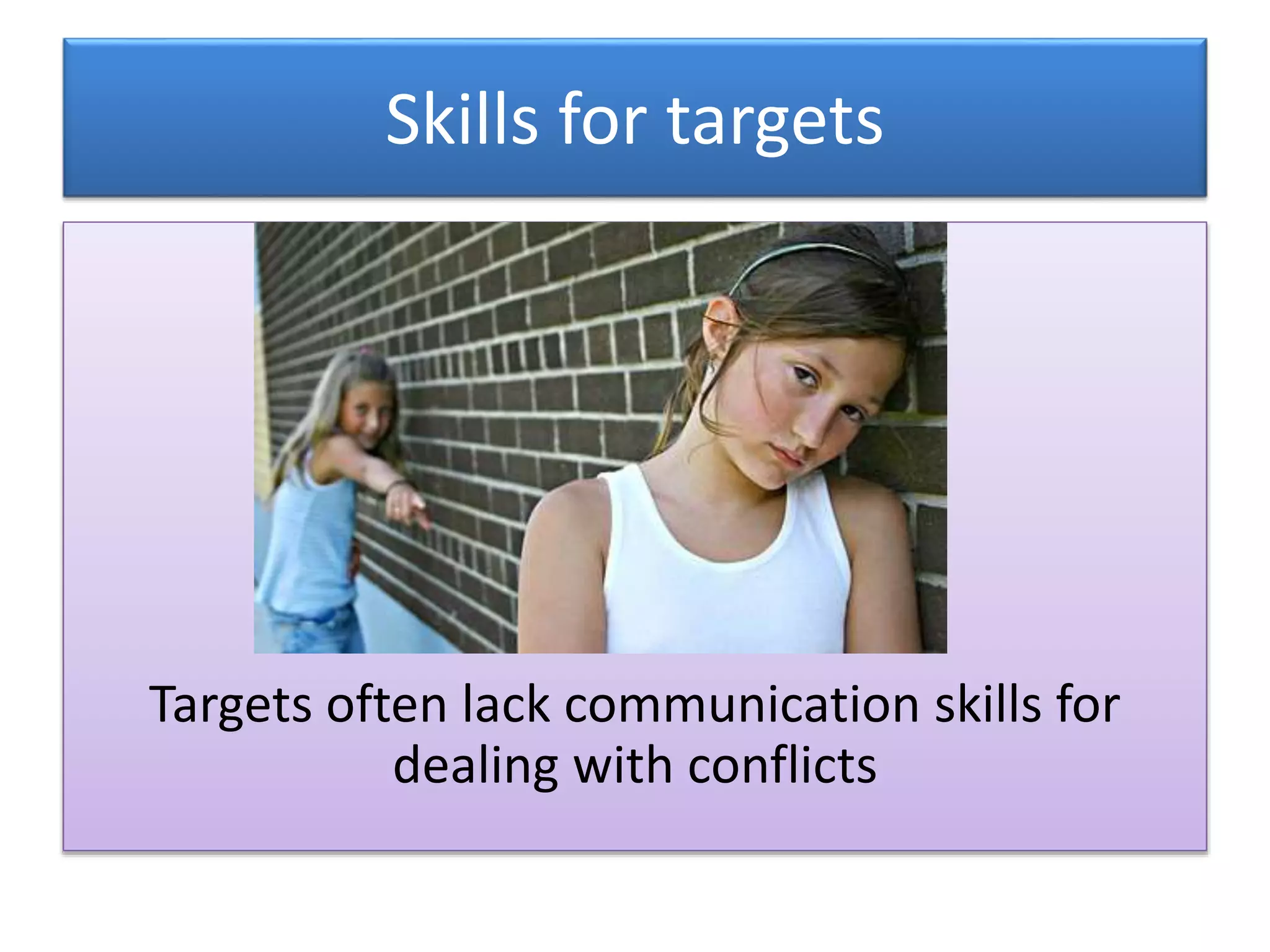
Skills for targets
Targets often lack communication skills for
dealing with conflicts
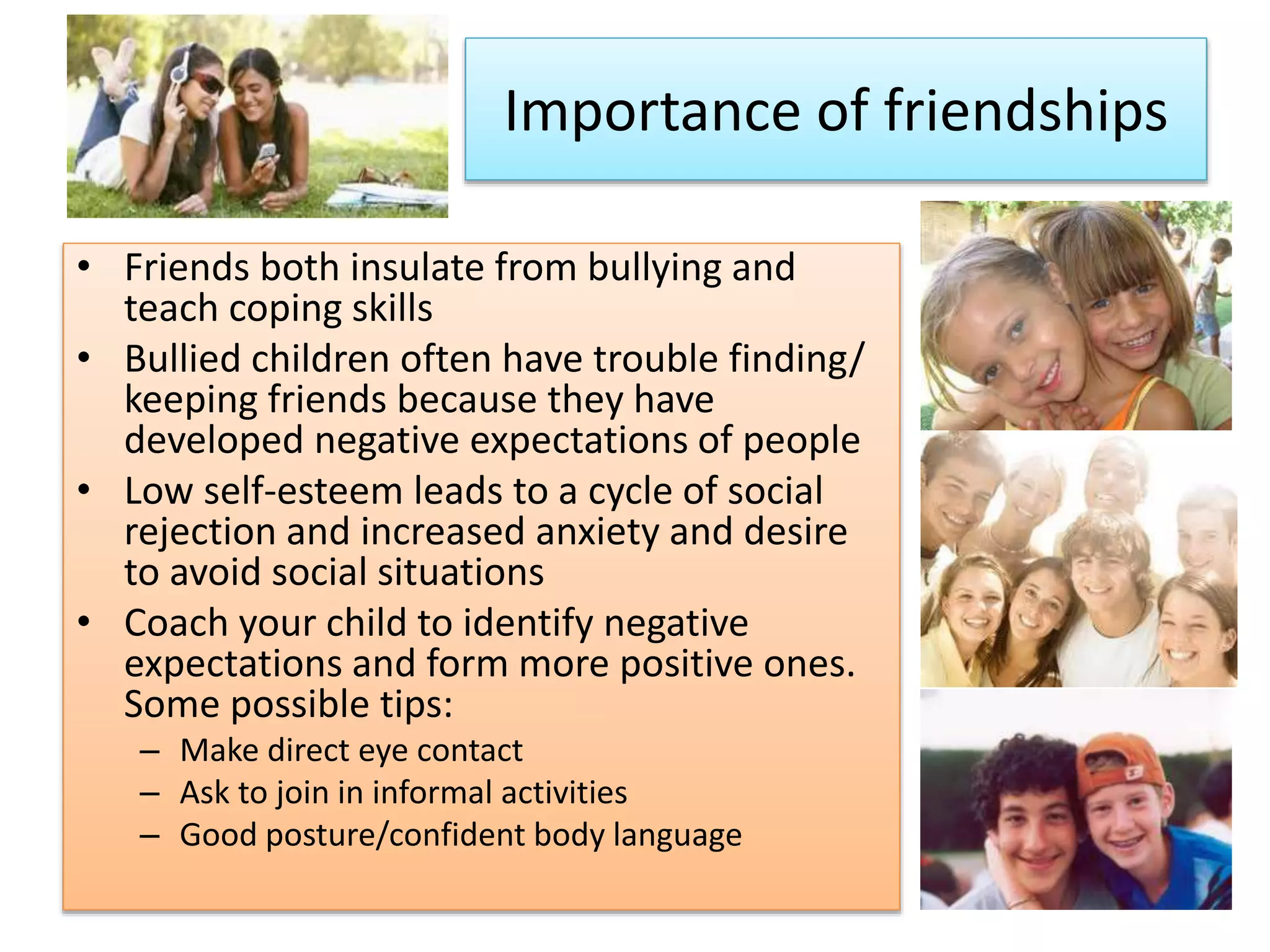
Importance of friendships
• Friends both insulate from bullying and
teach coping skills
• Bullied children often have trouble finding/
keeping friends because they have
developed negative expectations of people
• Low self-esteem leads to a cycle of social
rejection and increased anxiety and desire
to avoid social situations
• Coach your child to identify negative
expectations and form more positive ones.
Some possible tips:
– Make direct eye contact
– Ask to join in informal activities
– Good posture/confident body language
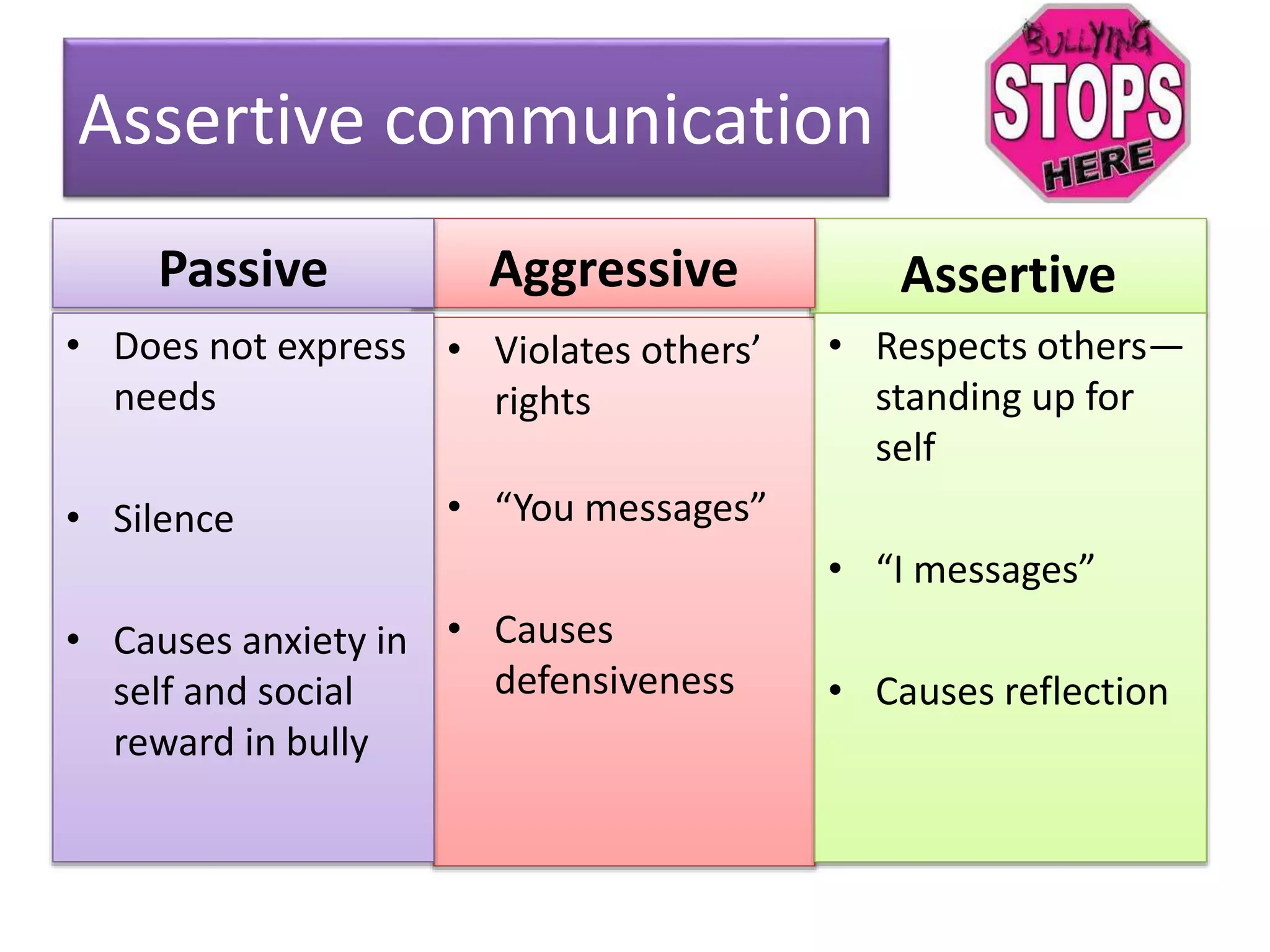
Assertive communication
• Violates others’
rights
• “You messages”
• Causes
defensiveness
Assertive
• Respects others—
standing up for
self
• “I messages”
• Causes reflection
AggressivePassive
• Does not express
needs
• Silence
• Causes anxiety in
self and social
reward in bully
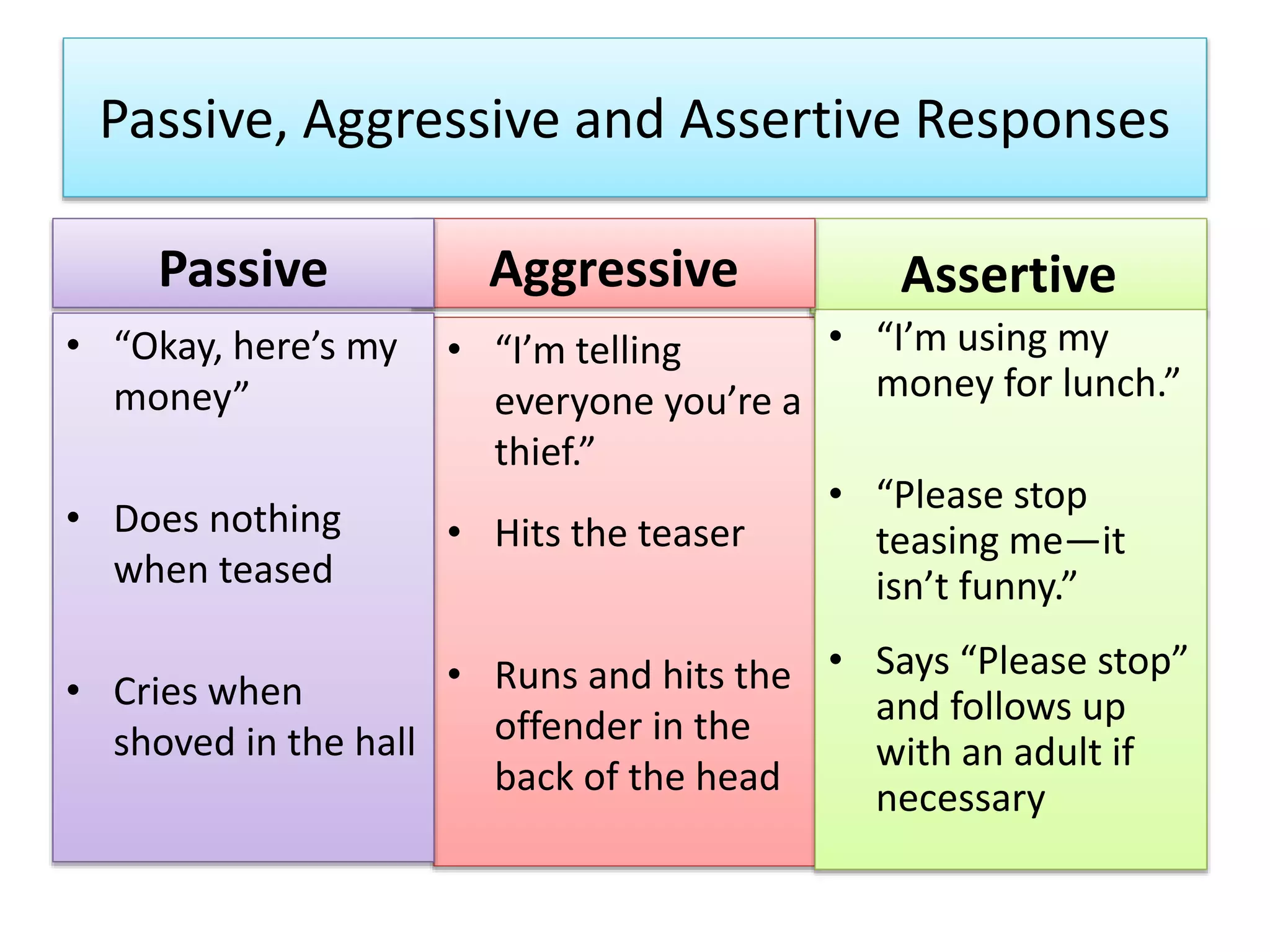
Passive, Aggressive and Assertive Responses
• “I’m telling
everyone you’re a
thief.”
• Hits the teaser
• Runs and hits the
offender in the
back of the head
Assertive
• “I’m using my
money for lunch.”
• “Please stop
teasing me—it
isn’t funny.”
• Says “Please stop”
and follows up
with an adult if
necessary
AggressivePassive
• “Okay, here’s my
money”
• Does nothing
when teased
• Cries when
shoved in the hall
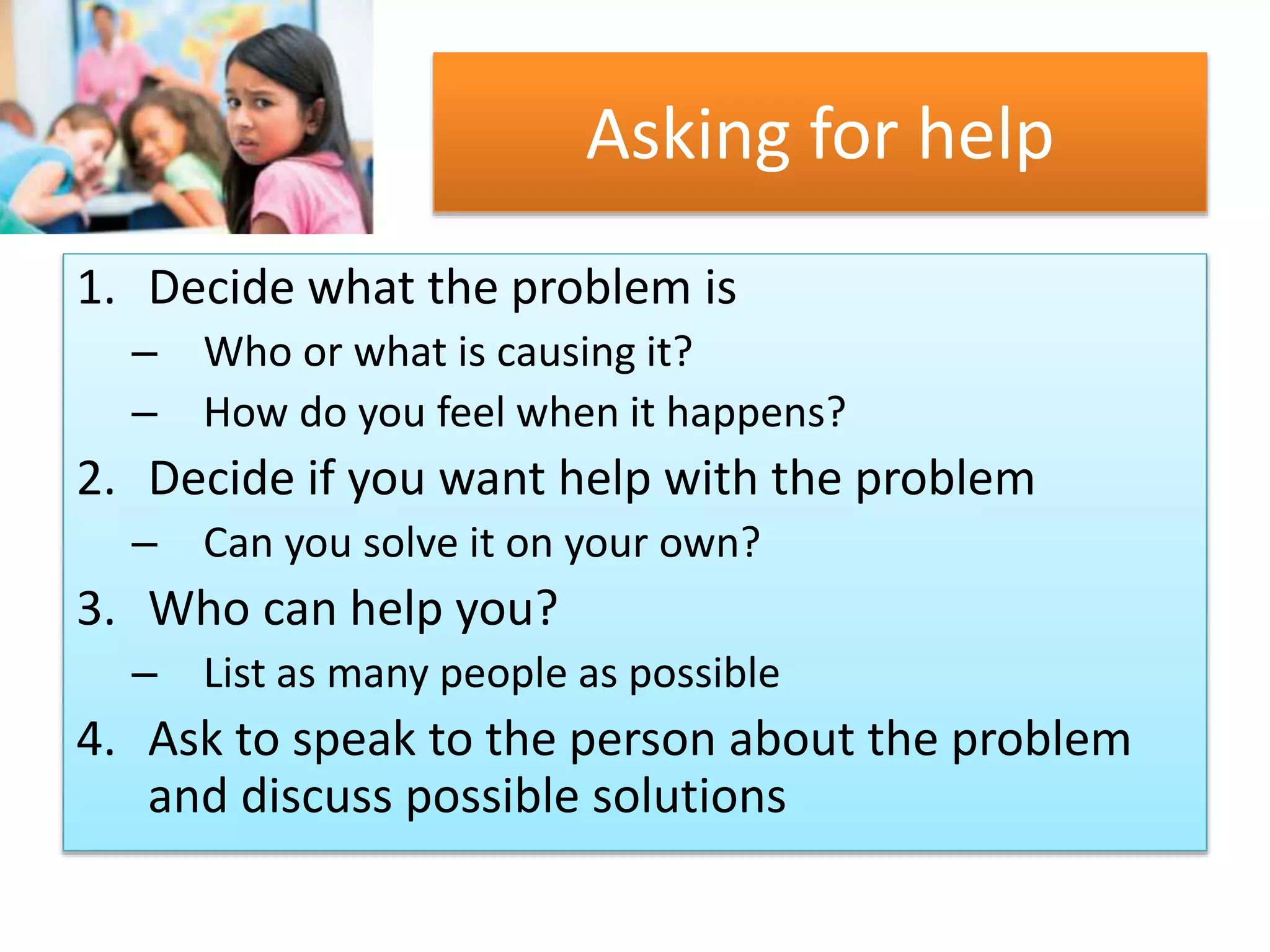
Asking for help
1. Decide what the problem is
– Who or what is causing it?
– How do you feel when it happens?
2. Decide if you want help with the problem
– Can you solve it on your own?
3. Who can help you?
– List as many people as possible
4. Ask to speak to the person about the problem
and discuss possible solutions
Help for bystanders
Bystanders
• Potential source of help for
targets but also targets
themselves
• Experience fear and guilt,
responsibility, remorse
• Can feel depression, conflict
avoidance and “learned
helplessness”
Empowering bystanders
• Can best help through
indirect intervention
– Tell an adult
– Express disapproval when
it is safe to do so
– Support target afterward
– Talk about the incident
with other bystanders
Parents and School
Let’s work together!
If your child is involved in a bullying situation it can be
happening at school
Schools have the responsibility
to maintain a safe and
comfortable learning
environment for students
Enlist the school’s assistance, seek solutions, and work
cooperatively
Positive School Climate
• Excellence in teaching
• School values
• Awareness of strengths and problems
• Established policies and accountability
• Caring and respect
• Positive expectations
• Support for teachers
• Positive physical environment
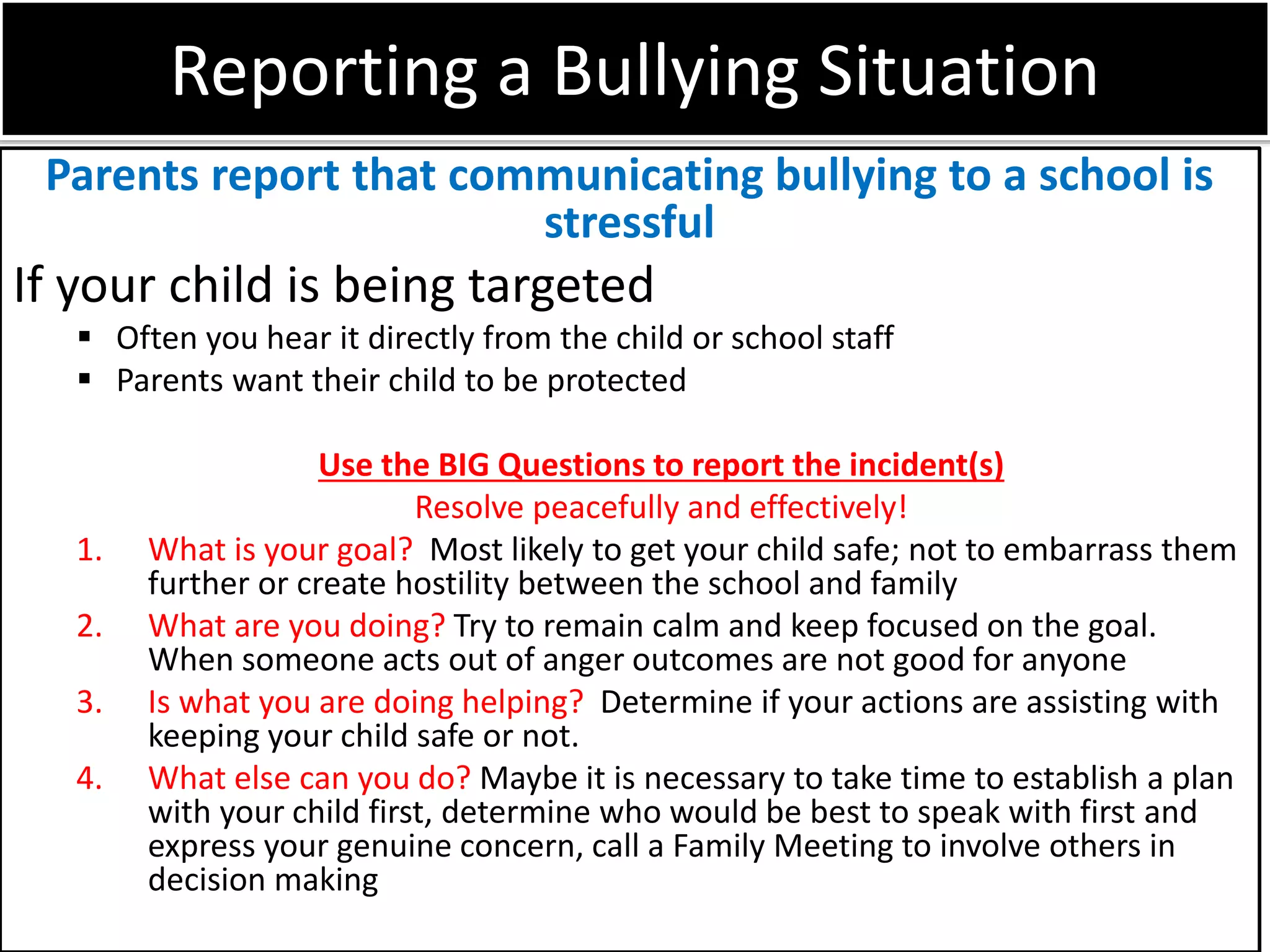
Reporting a Bullying Situation
Parents report that communicating bullying to a school is
stressful
If your child is being targeted
 Often you hear it directly from the child or school staff
 Parents want their child to be protected
Use the BIG Questions to report the incident(s)
Resolve peacefully and effectively!
1. What is your goal? Most likely to get your child safe; not to embarrass them
further or create hostility between the school and family
2. What are you doing? Try to remain calm and keep focused on the goal.
When someone acts out of anger outcomes are not good for anyone
3. Is what you are doing helping? Determine if your actions are assisting with
keeping your child safe or not.
4. What else can you do? Maybe it is necessary to take time to establish a plan
with your child first, determine who would be best to speak with first and
express your genuine concern, call a Family Meeting to involve others in
decision making
Reporting a Bullying Situation cont.
If your child is engaging in bullying:
• Typically hear from the target’s parents or the
school
• Understandably hard to hear
• Often skeptical of what they hear
• Child often denies or lessens any bullying-like
behavior
• Best to work with the school staff to find out the
problem and establish a plan as effectively
possible
Quesstion & Answer
Reflection Time
Comments

Understanding & Responding to Bullying Part II

  • 1.
    Understanding & Responding toBullying Part II Understanding the bully & targets Helping the bully & targets Parents & schools Activities from “A Parent’s Guide to Understanding and Responding to Bullying” (The Bully Busters Approach) By: Arthur M. Horne, Jennifer L. Stoddard, and Christopher D. Bell
  • 2.
    Let’s have aQUICK Review Part I • Increasing Your Awareness • What Causes Bullying & What Can We Do? • Tools for Strong Families
  • 3.
    What is Bullying? P—Bullyingis purposeful I—Bullying is imbalanced C—Bullying is continual
  • 4.
    Spheres of influence: whichones can you affect?
  • 5.
    THE BIG QUESTIONS Away to successfully approach problems within your family (problem solving model) 1. What is your goal? 2. What are you doing? 3. Is what you are doing helping you achieve your goal? 4. If not, what can you do differently?
  • 6.
  • 7.
    Aggressive Bullying: 7 Characteristics • Mostcommon overall and esp. among boys • Often plays on an expectation of harm & then the fulfillment thereof • Includes both physical and verbal aggression • Usually look for a peer audience but will not bully in front of adults
  • 8.
    1. Aggressive bulliesinitiate overt aggression • Need for an audience • Social reward (attention) • Accomplishes dual purpose—intimidation of target and bystanders
  • 9.
    2. Aggressive bullieshave learned that bullying has payoffs • Why bully? Why not!!! • Means to achieving – Prestige – Power – Influence – Control • Risk vs. Reward—usually there are no consequences, but even those there are may be worth the risk
  • 10.
    3. Aggressive bulliesare fearless, impulsive and coercive Lack/Find unrewarding • Ability to resolve conflicts peacefully • Ability to plan and execute decisions; reflection • Ability to be caring Coping Mechanism • Fearlessness • Impulsive action • Coerciveness, using threats and violence
  • 11.
    4. Aggressive bulliesare adaptable and use multiple forms of violence • Hitting, kicking, other physical forms • Threat of physical violence • Damaging or stealing property • Creating cliques • Coercing others to join in • Inciting fear through veiled means • Often have reputations among peers and school personnel
  • 12.
    5. Aggressive bullies wantto dominate others • Need for control • Need for power and influence • Easily irritated when they don’t get their way • Frustration leads them to attempt control of weaker students • Openly and/or privately attack targets • Taunt and isolate targets
  • 13.
    6. Aggressive bullieshave little empathy for others • Suppress perception or do not perceive feelings of targets • This leads to feelings of distain/contempt/anger without regret • Feeling that targets deserve what they get
  • 14.
    7. Aggressive bulliessee the world with a “paranoid eye” • Look at the world with suspicion • React to accidental slights or normal negative experiences (a low grade on an assignment, being pumped in the hall, etc.) – Unsettling and threatening to reputation – Disturb sense of control • Perceive these as personal offenses and deserving of revenge
  • 15.
  • 16.
    Characteristics of PassiveBullies • Use covert or indirect aggression • Are generally dependent, insecure and anxious • Lack strong inhibitions against aggression • Commonly engage in social exclusion • Often participate in (but are unlikely to initiate) aggression • Lack social status among peers • Are “camp followers” and “hangers on”
  • 17.
  • 18.
    Characteristics of RelationalBullies • Most common type among girls • Attempts to gain power, prestige and influence by excluding others • Uses exclusion to get even when they feel that they have been slighted or insulted • Manipulate social patterns • Spread rumors and lies
  • 19.
    Cyberbullying • Follows childreninto their homes—even bedrooms • IMs, text messages, Facebook, email, blogs, chat rooms, online journals • Unsupervised and feeling of anonymity—can lead to greater cruelty than face-to- face interactions • Often unreported because children to not want to lose access to this private world
  • 20.
    Sexual Harassment • Definedas unwelcome – sexual advances – Requests for sexual favors – Derogatory verbal slurs – Interfering with an individual’s academic or social functioning • Can be – Cross-gender – Same-sex
  • 21.
  • 22.
    Ten Warning Signs 1.Frequent initiation of fights 2. Disrespect toward authority figures 3. Lack of concern about whether other people’s feelings are hurt or even apparent pleasure from hurting others 4. Unwillingness to acknowledge mistakes or take responsibility for mistakes 5. Disregard for rules
  • 23.
    Ten Warning Signs(Continued) 6. Lack of fear 7. Teasing or intentionally harming pets or other animals 8. Lying in order to get out of trouble or avoid negative consequences 9. Use of anger and aggression to get one’s own way 10. Unwillingness to trust or open up to others
  • 24.
    What if MyChild is a Bully? • Signal your disapproval of bullying • Signal your refusal to tolerate bullying in any form • Say what you mean and mean what you say • Develop your family environment so that people want to be in one another’s company • Support your child’s interests
  • 25.
    Skills for ChildrenWho Bully Parents play a critical role in helping children acquire the skills necessary to stop bullying. • MODEL • TEACH • TALK
  • 26.
    Skills Training Process •Step 1: Model the skill for your child to observe • Step 2: Conduct a role-playing exercise in which the child enacts the skill • Step 3: Provide feedback on how well the skill was enacted and what might make it better • Step 4: Give your child “homework” to practice the skill in the real world
  • 27.
    3 Types ofImpulsivity Intellectual •Children will think about what it is that they desire with increasing focus and intensity •Each thought fuels the next until action occurs Emotional •Behavior is driven by mood states •A child may become so overwhelmed with emotion that he may lose sight of his ability to think about the consequences of certain actions Physical •Feelings of tension in the body •Tingling, dizziness, headaches, or stomachaches •Bodily sensations are the most significant ways in which this child experiences the world
  • 28.
    Impulse Control • Teachingchildren to recognize their “triggers”– the events, settings, feelings, and/or thoughts that usually lead to their impulsive actions—will help them recognize times they are in a situation that could lead to bullying behavior. • If a child can recognize the triggers, she can begin to recognize them as friends rather than foes and use them on the path toward developing better behavioral control.
  • 29.
    When Your ChildLoses Control… Ask your child the following questions: • What happened? • What were you thinking and feeling before you lost control? Give praise for self-awareness if trigger is identified and ask: • What could you do if you have these thoughts and feelings again instead of losing control?
  • 30.
    Cognitive Retraining Bullies willbenefit from learning to think in a different way (retrain the “paranoid eye”) •What happened? •Why do you think the person did that? •What are some other reasons the person might have done that?
  • 31.
    Help Your ChildBuild Empathy While watching television/movies ask your child the following questions: • What do you think (insert character) is thinking? • What is he/she feeling? • How would you feel if this happened to you?
  • 32.
    Problem Solving STOPP S—Stop: Stop,settle down, and be calm T—Think: Think about the problem and your goals O—Options: Think about the options or solutions to the problem P—Plan: Examine the consequences of different options, choose the best plan, and do it P—Plan working? If yes, great! If not, try a new plan! OR…try The Big Questions (from Part 1)
  • 33.
  • 34.
    Passive Targets • Notactively doing anything to contribute to their victimization and have little responsibility for the outcome • To some degree it is a case of being in the wrong place at the wrong time • Often feel threatened, scared, denigrated, humiliated, defenseless, and vulnerable
  • 35.
    Passive Target Characteristics •Generally have low self-esteem • Describe their experience as one of social isolation and abandonment • Tend to be smaller and have less developed physical skills • May be targeted because of intellectual abilities • May be of lower socioeconomic status • Appear more anxious, nervous, and insecure than their peers
  • 36.
    Provocative Targets Engage inbehaviors that will actually provoke others to pick on them, tease them, or engage in physical fighting Characteristics include: Purposefully does things that irritate others or otherwise initiate aggression Want to be seen as influential and important Often strive to get other children in trouble Generally, are negatively viewed by peers and school staff Are at risk for serious injury if their behavior escalates
  • 37.
    Targets of RelationalBullying When someone is systematically excluded from a group or ignored by peers. An attempt to join the clique or group is often rejected Experience being ignored, treated as nonpersons, and help in contempt Common among girls and increases as children get older, develop effective social skills, and have a better understanding of exclusion Often overlooked because it is not apparent
  • 38.
    Apply the PICCriteria to Relational • (P) Is it purposeful? Relational bullying is intentional and is often well planned. • (I) Is there an imbalance of power? Clearly, those who are doing the excluding have power over the child who is denied participation • (C) Is it continual? Relational bullying is rarely a single event. Once the persons doing the excluding have identified a target, they often continue to reject the individual
  • 39.
    Bystanders People who witnessor hear about bullying as also affected 2 possible reactions:  Afraid Fear that if they interfere they will become the target Should realize they possess alternative strategies and resources to help the target  Guilty Can result in shame and remorse which can lead to sadness and general avoidance of the conflict. “Learned helplessness”, feel they are unable to have impact on their life or other’s Students who intervene won’t always be successful and it may even escalate the situation. But children tend to listen to each other and empowered bystanders are often effective in stopping aggressive behaviors
  • 40.
    Boys vs. Girls Boys •Typically more physical • Targets of violent and threatening behavior • Clearly observable Girls • Typically more relational bullying • Gossip, rumors, and social exclusion • More difficult to observe • Most common bystander
  • 41.
  • 42.
    Ten Warning Signs 1.Physical signs of fighting 2. Frequent illnesses or trouble sleeping 3. Sudden decrease in school performance 4. Peer rejection 5. Depression, unexplained or uncontrolled crying, thoughts or talk of suicide 6. Avoiding certain groups at school, unwillingness to walk to or from school
  • 43.
    Ten Warning Signs,continued… 7. Sudden and unexplained changes in request for lunch items 8. Development of tics, nail- biting or hair-pulling, bed- wetting 9. Truancy or refusal to go to school or other activities 10. Suddenly avoiding group activities (recess/lunch/ neighborhood gatherings)
  • 44.
    Parents: how tohelp—7 methods 1. Prize your child • Do not overlook issues but deliver corrections respectfully – Give alternatives – Make it clear what behavior is unacceptable – Make your child feel valued and loved
  • 45.
    Parents: how tohelp… 2. Praise your child • Avoid negative comparisons – Ideal versus real • Be affirming and supportive • Deliver 3 positives for every negative Activity: “Did you notice?”
  • 46.
    Parents: how tohelp… 3. Promote humor • Avoid teasing each other over uncontrollable things (i.e., red hair, height, glasses, etc.) • Help children to learn and identify what is funny without being harmful
  • 47.
    Parents: how tohelp… 4. Problem-solve instead of Punish • Punishment is often for the punisher—to right a perceived wrong • Involve your child in the process • Go back to the 4 questions & ask yourself if your punishments fit – Is it making your child more responsible? – Is it problem-solving?
  • 48.
    Parents: how tohelp… 5. Practice what you preach • Kids rarely tell parents how large an influence they have because this is a betrayal of kid culture! • Your behavior, the way you treat friends, the way you treat strangers, what you say when you watch TV…. • Asking children to behave differently than you do teaches dishonesty • Admit your mistakes!!!
  • 49.
    Parents: how tohelp… 6. Preserve your promises • Follow through and honor agreements • Necessary for the development of trust • Tell your child when you are doing things that involve him/her – i.e., when contacting the school about an issue
  • 50.
    Parents: how tohelp… 7. Promote consistency • Children always test limits • Sometimes easier (but not better!) to give in than to engage in conflict • Keep firm limits! • Limits also give children a way to avoid tricky situations… – “I’d love to but my parents would kill me…”
  • 51.
    Advice for targets Badadvice • Ignore it • Walk away • Fight back • Submit quietly Good advice • Try not to react intensely – This robs bully of emotional payoff • Respond atypically: not like a bully and not like a target. Throw them! • Don’t try to be invisible – Approach first • Empowerment! – Not to suggest that targets are responsible—just to give them the skills to combat what they encounter
  • 52.
    Skills for targets Targetsoften lack communication skills for dealing with conflicts
  • 53.
    Importance of friendships •Friends both insulate from bullying and teach coping skills • Bullied children often have trouble finding/ keeping friends because they have developed negative expectations of people • Low self-esteem leads to a cycle of social rejection and increased anxiety and desire to avoid social situations • Coach your child to identify negative expectations and form more positive ones. Some possible tips: – Make direct eye contact – Ask to join in informal activities – Good posture/confident body language
  • 54.
    Assertive communication • Violatesothers’ rights • “You messages” • Causes defensiveness Assertive • Respects others— standing up for self • “I messages” • Causes reflection AggressivePassive • Does not express needs • Silence • Causes anxiety in self and social reward in bully
  • 55.
    Passive, Aggressive andAssertive Responses • “I’m telling everyone you’re a thief.” • Hits the teaser • Runs and hits the offender in the back of the head Assertive • “I’m using my money for lunch.” • “Please stop teasing me—it isn’t funny.” • Says “Please stop” and follows up with an adult if necessary AggressivePassive • “Okay, here’s my money” • Does nothing when teased • Cries when shoved in the hall
  • 56.
    Asking for help 1.Decide what the problem is – Who or what is causing it? – How do you feel when it happens? 2. Decide if you want help with the problem – Can you solve it on your own? 3. Who can help you? – List as many people as possible 4. Ask to speak to the person about the problem and discuss possible solutions
  • 57.
    Help for bystanders Bystanders •Potential source of help for targets but also targets themselves • Experience fear and guilt, responsibility, remorse • Can feel depression, conflict avoidance and “learned helplessness” Empowering bystanders • Can best help through indirect intervention – Tell an adult – Express disapproval when it is safe to do so – Support target afterward – Talk about the incident with other bystanders
  • 58.
    Parents and School Let’swork together! If your child is involved in a bullying situation it can be happening at school Schools have the responsibility to maintain a safe and comfortable learning environment for students Enlist the school’s assistance, seek solutions, and work cooperatively
  • 59.
    Positive School Climate •Excellence in teaching • School values • Awareness of strengths and problems • Established policies and accountability • Caring and respect • Positive expectations • Support for teachers • Positive physical environment
  • 60.
    Reporting a BullyingSituation Parents report that communicating bullying to a school is stressful If your child is being targeted  Often you hear it directly from the child or school staff  Parents want their child to be protected Use the BIG Questions to report the incident(s) Resolve peacefully and effectively! 1. What is your goal? Most likely to get your child safe; not to embarrass them further or create hostility between the school and family 2. What are you doing? Try to remain calm and keep focused on the goal. When someone acts out of anger outcomes are not good for anyone 3. Is what you are doing helping? Determine if your actions are assisting with keeping your child safe or not. 4. What else can you do? Maybe it is necessary to take time to establish a plan with your child first, determine who would be best to speak with first and express your genuine concern, call a Family Meeting to involve others in decision making
  • 61.
    Reporting a BullyingSituation cont. If your child is engaging in bullying: • Typically hear from the target’s parents or the school • Understandably hard to hear • Often skeptical of what they hear • Child often denies or lessens any bullying-like behavior • Best to work with the school staff to find out the problem and establish a plan as effectively possible
  • 62.