
RESEARCH AND PRACTICE
HIGHLIGHTS: PREVENTING
BULLYING ABUSE
AND SCHOOL VIOLENCE

                                 Amanda Nickerson, PhD
                        Associate Professor and Director
              Alberti Center for Bullying Abuse Prevention
                                     University at Buffalo
                                    nickersa@buffalo.edu
                             gse.buffalo.edu/alberticenter
Overview
   Introduction and needs assessment
   Alberti Center slideshow
   Facts and figures about bullying
   Prevention and intervention: The best of our
    knowledge
   Vision for and highlights from Alberti Center
Facts and Figures
Bullying

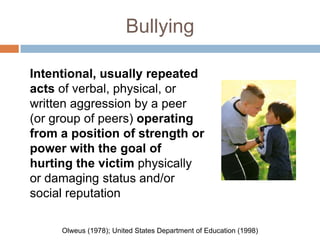
Intentional, usually repeated
acts of verbal, physical, or
written aggression by a peer
(or group of peers) operating
from a position of strength or
power with the goal of
hurting the victim physically
or damaging status and/or
social reputation

     Olweus (1978); United States Department of Education (1998)
Types of Bullying
   Physical bullying
       punching, shoving, acts that hurt people

   Verbal bullying
       name calling, making offensive remarks

   Indirect bullying
       spreading rumors, excluding, ganging up

   Cyber bullying
       willful and repeated harm inflicted through the use of
        computers, cell phones, and other electronic devices

                        Hinduja & Patchin (2009)
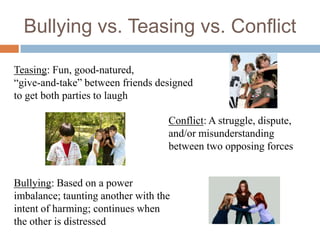
Bullying vs. Teasing vs. Conflict

Teasing: Fun, good-natured,
“give-and-take” between friends designed
to get both parties to laugh

                                   Conflict: A struggle, dispute,
                                   and/or misunderstanding
                                   between two opposing forces


Bullying: Based on a power
imbalance; taunting another with the
intent of harming; continues when
the other is distressed
Prevalence
   Estimates vary WIDELY, but according to
    student self-report...
     20-25% have bullied at least once
         5-20%        bully consistently

     15-40% are targets of bullying
          20-25% are bullied regularly
          ~ 18-20% are cyber-bullied
          1-2% are extreme victims who   experience
           severe traumatization or distress

       Carylyle & Steinman (2007); Cowie (2000); Nansel et al. (2001);
           Perry, Kusel, & Perry (1988); Skiba & Fontanini (2000)
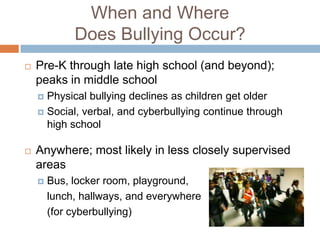
When and Where
             Does Bullying Occur?
   Pre-K through late high school (and beyond);
    peaks in middle school
     Physical bullying declines as children get older
     Social, verbal, and cyberbullying continue through
      high school

   Anywhere; most likely in less closely supervised
    areas
       Bus, locker room, playground,
        lunch, hallways, and everywhere
        (for cyberbullying)
Gender Differences

    Boys
      More  direct, physical bullying
      Bully more frequently than girls
      Bully both boys and girls


    Girls
      More indirect
      More subtle, hard to detect, and often occurs in
       groups
      Tend to target other girls of the same age
      Cyberbullying slightly more common than for
       males
 Banks (2000); Cook, Williams, Guerra, Kim, & Sadek, (2010); Crick & Grotpeter, (1995);
Hinduja & Patchin, (2009); Hoover & Oliver, (1996); Nansel et al., (2001); Olweus, (2002);
Common Characteristics of
           Students who Bully
   Desire for power and control
   Get satisfaction from others’ suffering
   Justify their behavior (“he deserved it”)
   More exposed to physical punishment
   More likely to be depressed
   Engage in other risky and delinquent
    behaviors
     Alcohol and drug use
     Fighting


     Batsche & Knoff (1994); Beaver, Perron, & Howard, (2010); Olweus (1993);
            Swearer et al. (in press); Vaughn, Bender, DeLisi, (in press)
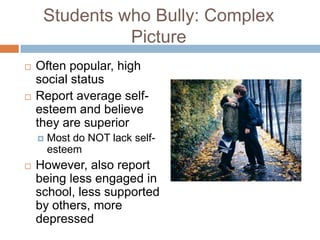
Students who Bully: Complex
               Picture
   Often popular, high
    social status
   Report average self-
    esteem and believe
    they are superior
       Most do NOT lack self-
        esteem
   However, also report
    being less engaged in
    school, less supported
    by others, more
    depressed
Characteristics of Children
              who are Bullied
   Have a position of relative weakness
       Age, ethnic background, financial status, disability,
        sexual orientation
   Most are passive and lack assertiveness
     Do nothing to invite aggression
     Do not fight back when attacked
     May relate better to adults than peers


   Fewer provoke others (provocative victims or
    bully-victims)
       Offend, irritate, tease others
       Reactive; fight back when attacked
Boivin, Poulin, & Vitaro (1994); Hodges & Perry (1999); Olweus (1978, 1993, 2001);
                         Schwartz (2000); Snyder et al. (2003)
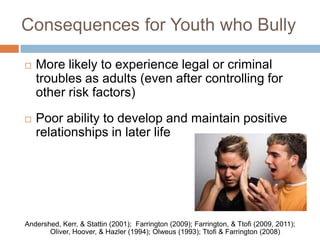
Consequences for Youth who Bully

   More likely to experience legal or criminal
    troubles as adults (even after controlling for
    other risk factors)

   Poor ability to develop and maintain positive
    relationships in later life


Andershed, Kerr, & Stattin (2001); Farrington (2009); Farrington, & Ttofi (2009, 2011);
       Oliver, Hoover, & Hazler (1994); Olweus (1993); Ttofi & Farrington (2008)
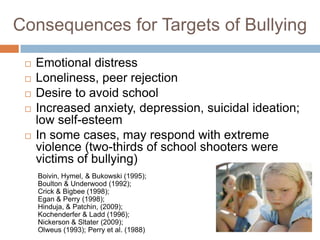
Consequences for Targets of Bullying

    Emotional distress
    Loneliness, peer rejection
    Desire to avoid school
    Increased anxiety, depression, suicidal ideation;
     low self-esteem
    In some cases, may respond with extreme
     violence (two-thirds of school shooters were
     victims of bullying)
     Boivin, Hymel, & Bukowski (1995);
     Boulton & Underwood (1992);
     Crick & Bigbee (1998);
     Egan & Perry (1998);
     Hinduja, & Patchin, (2009);
     Kochenderfer & Ladd (1996);
     Nickerson & Sltater (2009);
     Olweus (1993); Perry et al. (1988)
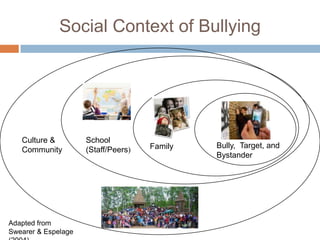
Social Context of Bullying


   Culture &         School
                                     Family   Bully, Target, and
   Community         (Staff/Peers)
                                              Bystander


Adapted from
Swearer & Espelage
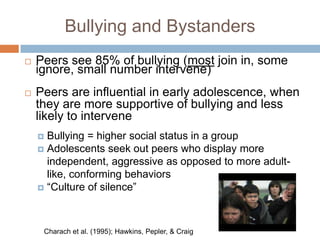
Bullying and Bystanders
   Peers see 85% of bullying (most join in, some
    ignore, small number intervene)
   Peers are influential in early adolescence, when
    they are more supportive of bullying and less
    likely to intervene
     Bullying = higher social status in a group
     Adolescents seek out peers who display more
      independent, aggressive as opposed to more adult-
      like, conforming behaviors
     “Culture of silence”


     Charach et al. (1995); Hawkins, Pepler, & Craig
Bullying and School Environment

   Bullying is more likely to thrive in:
     Unsupportive or unhealthy school climates
     Environments lacking in sense of belonging for
      students and strong relationships among and between
      students, teachers, and families
     Schools where adults ignore or dismiss bullying
      behaviors
     Schools who serve students who are not academically
      engaged
     LEADERSHIP IS CRITICAL!!!


Doll, Song, Champion, & Jones, (2011); Holt, Keyes, & Koenig, (2011); Kasen, Johnson,
                Chen, Crawford, & Cohen, (2011); Swearer (in press)
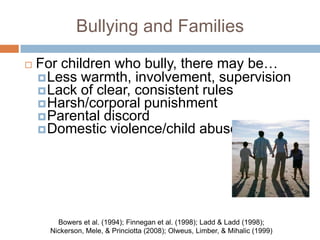
Bullying and Families

   For children who bully, there may be…
     Less warmth, involvement, supervision
     Lack of clear, consistent rules
     Harsh/corporal punishment
     Parental discord
     Domestic violence/child abuse


        Bowers et al. (1994); Finnegan et al. (1998); Ladd & Ladd (1998);
      Nickerson, Mele, & Princiotta (2008); Olweus, Limber, & Mihalic (1999)
Bullying and Families (cont.)

   For children who are bullied, there may be…
     More intense, positive, and overprotective parenting
      (for boys)
     More threats of rejection and lack of assertion (for
      girls)
     Inconsistent discipline practices (overprotective and
      neglectful) without warmth for bully-victims

   For children who intervene, there may be…
       More open, trusting relationships with mothers

          Bowers et al. (1994); Finnegan et al. (1998); Ladd & Ladd (1998);
        Nickerson, Mele, & Princiotta (2008); Olweus, Limber, & Mihalic (1999)
Bullying and School Staff
   Often not involved in bullying problem or
    resolution
     Intervene less than 10% of the time
     Not told about problem (victims fear reprisal)

   Powerful influence on peer acceptance of
    others
     Warmth, positive feedback leads to greater peer
      acceptance


Banks (1997); Chang (2003); Cohn & Canter (2002); Hughes, Cavell, & Willson (2001);
                                   Limber (2002);
  Mullin-Rindler (2003); Skiba & Fonanini (2000); White, Sherman, & Jones (1996)
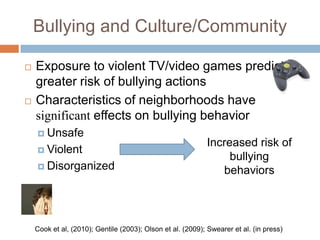
Bullying and Culture/Community

   Exposure to violent TV/video games predicts
    greater risk of bullying actions
   Characteristics of neighborhoods have
    significant effects on bullying behavior
     Unsafe
                                                            Increased risk of
     Violent
                                                                 bullying
     Disorganized
                                                               behaviors


    Cook et al, (2010); Gentile (2003); Olson et al. (2009); Swearer et al. (in press)
Prevention and Intervention:
The Best of our Knowledge
What can Schools do?

   Have a clear and sensible definition of bullying
   Collect data about its occurrence in your
    school
   Ensure that behavioral and social-emotional
    skills are developed to prevent bullying
   Develop and implement anti-bullying policy
   Actively involve students in efforts
    Provide training to staff and parents about
Farrington & Ttofi, (2009); Gregory, Cornell, responses (2010); Koth, Bradshaw, &
     bullying and effective Fan, Sheras, & Shih
      Leaf, (2008); Olweus (1993); Olweus, Limber, & Mihalic (1999); Rigby (n.d.)
Anti-Bullying Policies

   Definitions
   Statement about expected behaviors and
    prohibitions
   Reporting procedure
   Investigation and disciplinary actions
       Continuum of consequences and interventions
   Training and prevention procedures
   Assistance for target
Working with Parents

   Proactively communicate the importance
    of a safe and respectful environment
     Workshops,   newsletters, open house

   Be clear about school’s policies

   Communicate about incidents
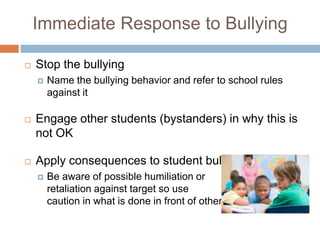
Immediate Response to Bullying

   Stop the bullying
       Name the bullying behavior and refer to school rules
        against it

   Engage other students (bystanders) in why this is
    not OK

   Apply consequences to student bullying
       Be aware of possible humiliation or
        retaliation against target so use
        caution in what is done in front of others
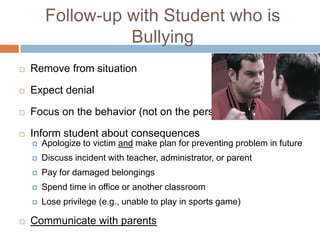
Follow-up with Student who is
                  Bullying
   Remove from situation

   Expect denial

   Focus on the behavior (not on the person)

   Inform student about consequences
       Apologize to victim and make plan for preventing problem in future
       Discuss incident with teacher, administrator, or parent
       Pay for damaged belongings
       Spend time in office or another classroom
       Lose privilege (e.g., unable to play in sports game)

   Communicate with parents
Communicating with Parents
   Be timely with communication!
   Focus on the behavior (not the person)
   Avoid blaming or judging (expect denial)
   Emphasize how this type of behavior can be a
    problem for their child, the other person, and the
    school environment
   Inform parent about school response
   Work together to help child behave in other ways
Follow-up with Student who is
           Bullied
   Listen and empathize – allow to tell story

   Ask how you can work together to support and
    stop

   Assure that action will be taken
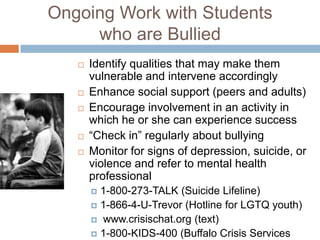
Ongoing Work with Students
     who are Bullied
      Identify qualities that may make them
       vulnerable and intervene accordingly
      Enhance social support (peers and adults)
      Encourage involvement in an activity in
       which he or she can experience success
      “Check in” regularly about bullying
      Monitor for signs of depression, suicide, or
       violence and refer to mental health
       professional
        1-800-273-TALK (Suicide Lifeline)
        1-866-4-U-Trevor (Hotline for LGTQ youth)
        www.crisischat.org (text)
        1-800-KIDS-400 (Buffalo Crisis Services
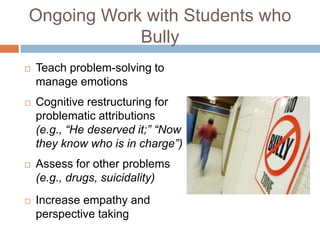
Ongoing Work with Students who
            Bully
   Teach problem-solving to
    manage emotions
   Cognitive restructuring for
    problematic attributions
    (e.g., “He deserved it;” “Now
    they know who is in charge”)
   Assess for other problems
    (e.g., drugs, suicidality)
   Increase empathy and
    perspective taking
Anti-Bullying Programs

   Some evidence to support effectiveness of
    school bullying interventions in
    enhancing…
     Teacher  knowledge
     Efficacy in intervention skills

     Behavior in responding to incidences of bullying

     To a lesser extent, reduction of participation of
      students in bully and victim roles


           (Merrell, Gueldner, Ross, & Isava, 2008 meta-analysis)
Anti-Bullying Programs

   On average, bullying decreased by 20-
    30% and victimization 17-20% through the
    use of school-based interventions
   Best results for programs that are:
     intensive and long-lasting
     carefully monitored for fidelity of implementation
     assessed regularly (2x monthly)
     evidence-based
     inclusive of parent training activities


                  (Ttofi & Farrington, 2011 meta-analysis)
What DOESN’T Work?
   Brief assemblies or one-day awareness raising
    events
   Zero-tolerance policies
     May result in under-reporting bullying
     Limited evidence in curbing bullying behavior


   Peer mediation, peer-led conflict resolution
     Many programs that used this approach actually saw an
      increase in victimization
     Grouping children who bully together may actually
      reinforce this behavior


Dodge, Dishion, & Lansford, (2006); Farrington & Ttofi, (2009); Nansel et al., (2001)
Vision for and Highlights from
Alberti Center
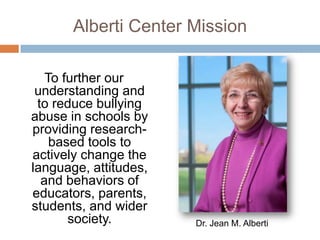
Alberti Center Mission

   To further our
 understanding and
 to reduce bullying
abuse in schools by
providing research-
    based tools to
actively change the
language, attitudes,
  and behaviors of
educators, parents,
students, and wider
       society.        Dr. Jean M. Alberti
Current Research Projects

   Bullying and Wellness Study (Grades 5-8)

   School Climate and Prevention and
    Intervention Efforts Regarding Bullying and
    Harassment
     Before   and after Dignity Act implementation

   PREPaRE School Crisis Prevention and
    Intervention Training Evaluation

   Past Victimization and Current Attachment in
    College Students
Proposed Research Projects
          (grant proposals)
   Changes in students’ attitudes and bullying
    behaviors in middle school in relation to
    schools’ school climate and bullying prevention
    efforts

   Effectiveness of social norms and bystander
    intervention training on peer intervention in
    bullying and sexual harassment
Translating Research to Practice
   Website
       Resources, presentations, and events!

   Presentations

   Media interviews and appearances

   Quarterly e-newsletters (sign up for our mailing
    list!)

   Colloquia and annual conference
   Education.com Special Edition, “Bullying at
    School and Online” – good for parents!
Closing (and Opening)

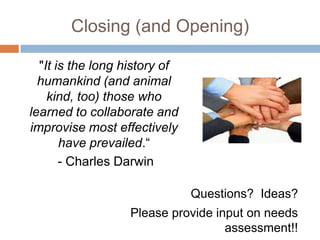
  "It is the long history of
  humankind (and animal
    kind, too) those who
learned to collaborate and
improvise most effectively
       have prevailed.“
       - Charles Darwin

                               Questions? Ideas?
                  Please provide input on needs
                                   assessment!!

Alberti Center Sample Presentation for Educators and Professionals

  • 1.
    RESEARCH AND PRACTICE HIGHLIGHTS:PREVENTING BULLYING ABUSE AND SCHOOL VIOLENCE Amanda Nickerson, PhD Associate Professor and Director Alberti Center for Bullying Abuse Prevention University at Buffalo nickersa@buffalo.edu gse.buffalo.edu/alberticenter
  • 2.
    Overview  Introduction and needs assessment  Alberti Center slideshow  Facts and figures about bullying  Prevention and intervention: The best of our knowledge  Vision for and highlights from Alberti Center
  • 3.
  • 4.
    Bullying Intentional, usually repeated actsof verbal, physical, or written aggression by a peer (or group of peers) operating from a position of strength or power with the goal of hurting the victim physically or damaging status and/or social reputation Olweus (1978); United States Department of Education (1998)
  • 5.
    Types of Bullying  Physical bullying  punching, shoving, acts that hurt people  Verbal bullying  name calling, making offensive remarks  Indirect bullying  spreading rumors, excluding, ganging up  Cyber bullying  willful and repeated harm inflicted through the use of computers, cell phones, and other electronic devices Hinduja & Patchin (2009)
  • 6.
    Bullying vs. Teasingvs. Conflict Teasing: Fun, good-natured, “give-and-take” between friends designed to get both parties to laugh Conflict: A struggle, dispute, and/or misunderstanding between two opposing forces Bullying: Based on a power imbalance; taunting another with the intent of harming; continues when the other is distressed
  • 7.
    Prevalence  Estimates vary WIDELY, but according to student self-report...  20-25% have bullied at least once  5-20% bully consistently  15-40% are targets of bullying  20-25% are bullied regularly  ~ 18-20% are cyber-bullied  1-2% are extreme victims who experience severe traumatization or distress Carylyle & Steinman (2007); Cowie (2000); Nansel et al. (2001); Perry, Kusel, & Perry (1988); Skiba & Fontanini (2000)
  • 8.
    When and Where Does Bullying Occur?  Pre-K through late high school (and beyond); peaks in middle school  Physical bullying declines as children get older  Social, verbal, and cyberbullying continue through high school  Anywhere; most likely in less closely supervised areas  Bus, locker room, playground, lunch, hallways, and everywhere (for cyberbullying)
  • 9.
    Gender Differences  Boys  More direct, physical bullying  Bully more frequently than girls  Bully both boys and girls  Girls  More indirect  More subtle, hard to detect, and often occurs in groups  Tend to target other girls of the same age  Cyberbullying slightly more common than for males Banks (2000); Cook, Williams, Guerra, Kim, & Sadek, (2010); Crick & Grotpeter, (1995); Hinduja & Patchin, (2009); Hoover & Oliver, (1996); Nansel et al., (2001); Olweus, (2002);
  • 10.
    Common Characteristics of Students who Bully  Desire for power and control  Get satisfaction from others’ suffering  Justify their behavior (“he deserved it”)  More exposed to physical punishment  More likely to be depressed  Engage in other risky and delinquent behaviors  Alcohol and drug use  Fighting Batsche & Knoff (1994); Beaver, Perron, & Howard, (2010); Olweus (1993); Swearer et al. (in press); Vaughn, Bender, DeLisi, (in press)
  • 11.
    Students who Bully:Complex Picture  Often popular, high social status  Report average self- esteem and believe they are superior  Most do NOT lack self- esteem  However, also report being less engaged in school, less supported by others, more depressed
  • 12.
    Characteristics of Children who are Bullied  Have a position of relative weakness  Age, ethnic background, financial status, disability, sexual orientation  Most are passive and lack assertiveness  Do nothing to invite aggression  Do not fight back when attacked  May relate better to adults than peers  Fewer provoke others (provocative victims or bully-victims)  Offend, irritate, tease others  Reactive; fight back when attacked Boivin, Poulin, & Vitaro (1994); Hodges & Perry (1999); Olweus (1978, 1993, 2001); Schwartz (2000); Snyder et al. (2003)
  • 13.
    Consequences for Youthwho Bully  More likely to experience legal or criminal troubles as adults (even after controlling for other risk factors)  Poor ability to develop and maintain positive relationships in later life Andershed, Kerr, & Stattin (2001); Farrington (2009); Farrington, & Ttofi (2009, 2011); Oliver, Hoover, & Hazler (1994); Olweus (1993); Ttofi & Farrington (2008)
  • 14.
    Consequences for Targetsof Bullying  Emotional distress  Loneliness, peer rejection  Desire to avoid school  Increased anxiety, depression, suicidal ideation; low self-esteem  In some cases, may respond with extreme violence (two-thirds of school shooters were victims of bullying) Boivin, Hymel, & Bukowski (1995); Boulton & Underwood (1992); Crick & Bigbee (1998); Egan & Perry (1998); Hinduja, & Patchin, (2009); Kochenderfer & Ladd (1996); Nickerson & Sltater (2009); Olweus (1993); Perry et al. (1988)
  • 15.
    Social Context ofBullying Culture & School Family Bully, Target, and Community (Staff/Peers) Bystander Adapted from Swearer & Espelage
  • 16.
    Bullying and Bystanders  Peers see 85% of bullying (most join in, some ignore, small number intervene)  Peers are influential in early adolescence, when they are more supportive of bullying and less likely to intervene  Bullying = higher social status in a group  Adolescents seek out peers who display more independent, aggressive as opposed to more adult- like, conforming behaviors  “Culture of silence” Charach et al. (1995); Hawkins, Pepler, & Craig
  • 17.
    Bullying and SchoolEnvironment  Bullying is more likely to thrive in:  Unsupportive or unhealthy school climates  Environments lacking in sense of belonging for students and strong relationships among and between students, teachers, and families  Schools where adults ignore or dismiss bullying behaviors  Schools who serve students who are not academically engaged  LEADERSHIP IS CRITICAL!!! Doll, Song, Champion, & Jones, (2011); Holt, Keyes, & Koenig, (2011); Kasen, Johnson, Chen, Crawford, & Cohen, (2011); Swearer (in press)
  • 18.
    Bullying and Families  For children who bully, there may be…  Less warmth, involvement, supervision  Lack of clear, consistent rules  Harsh/corporal punishment  Parental discord  Domestic violence/child abuse Bowers et al. (1994); Finnegan et al. (1998); Ladd & Ladd (1998); Nickerson, Mele, & Princiotta (2008); Olweus, Limber, & Mihalic (1999)
  • 19.
    Bullying and Families(cont.)  For children who are bullied, there may be…  More intense, positive, and overprotective parenting (for boys)  More threats of rejection and lack of assertion (for girls)  Inconsistent discipline practices (overprotective and neglectful) without warmth for bully-victims  For children who intervene, there may be…  More open, trusting relationships with mothers Bowers et al. (1994); Finnegan et al. (1998); Ladd & Ladd (1998); Nickerson, Mele, & Princiotta (2008); Olweus, Limber, & Mihalic (1999)
  • 20.
    Bullying and SchoolStaff  Often not involved in bullying problem or resolution  Intervene less than 10% of the time  Not told about problem (victims fear reprisal)  Powerful influence on peer acceptance of others  Warmth, positive feedback leads to greater peer acceptance Banks (1997); Chang (2003); Cohn & Canter (2002); Hughes, Cavell, & Willson (2001); Limber (2002); Mullin-Rindler (2003); Skiba & Fonanini (2000); White, Sherman, & Jones (1996)
  • 21.
    Bullying and Culture/Community  Exposure to violent TV/video games predicts greater risk of bullying actions  Characteristics of neighborhoods have significant effects on bullying behavior  Unsafe Increased risk of  Violent bullying  Disorganized behaviors Cook et al, (2010); Gentile (2003); Olson et al. (2009); Swearer et al. (in press)
  • 22.
    Prevention and Intervention: TheBest of our Knowledge
  • 23.
    What can Schoolsdo?  Have a clear and sensible definition of bullying  Collect data about its occurrence in your school  Ensure that behavioral and social-emotional skills are developed to prevent bullying  Develop and implement anti-bullying policy  Actively involve students in efforts  Provide training to staff and parents about Farrington & Ttofi, (2009); Gregory, Cornell, responses (2010); Koth, Bradshaw, & bullying and effective Fan, Sheras, & Shih Leaf, (2008); Olweus (1993); Olweus, Limber, & Mihalic (1999); Rigby (n.d.)
  • 24.
    Anti-Bullying Policies  Definitions  Statement about expected behaviors and prohibitions  Reporting procedure  Investigation and disciplinary actions  Continuum of consequences and interventions  Training and prevention procedures  Assistance for target
  • 25.
    Working with Parents  Proactively communicate the importance of a safe and respectful environment  Workshops, newsletters, open house  Be clear about school’s policies  Communicate about incidents
  • 26.
    Immediate Response toBullying  Stop the bullying  Name the bullying behavior and refer to school rules against it  Engage other students (bystanders) in why this is not OK  Apply consequences to student bullying  Be aware of possible humiliation or retaliation against target so use caution in what is done in front of others
  • 27.
    Follow-up with Studentwho is Bullying  Remove from situation  Expect denial  Focus on the behavior (not on the person)  Inform student about consequences  Apologize to victim and make plan for preventing problem in future  Discuss incident with teacher, administrator, or parent  Pay for damaged belongings  Spend time in office or another classroom  Lose privilege (e.g., unable to play in sports game)  Communicate with parents
  • 28.
    Communicating with Parents  Be timely with communication!  Focus on the behavior (not the person)  Avoid blaming or judging (expect denial)  Emphasize how this type of behavior can be a problem for their child, the other person, and the school environment  Inform parent about school response  Work together to help child behave in other ways
  • 29.
    Follow-up with Studentwho is Bullied  Listen and empathize – allow to tell story  Ask how you can work together to support and stop  Assure that action will be taken
  • 30.
    Ongoing Work withStudents who are Bullied  Identify qualities that may make them vulnerable and intervene accordingly  Enhance social support (peers and adults)  Encourage involvement in an activity in which he or she can experience success  “Check in” regularly about bullying  Monitor for signs of depression, suicide, or violence and refer to mental health professional  1-800-273-TALK (Suicide Lifeline)  1-866-4-U-Trevor (Hotline for LGTQ youth)  www.crisischat.org (text)  1-800-KIDS-400 (Buffalo Crisis Services
  • 31.
    Ongoing Work withStudents who Bully  Teach problem-solving to manage emotions  Cognitive restructuring for problematic attributions (e.g., “He deserved it;” “Now they know who is in charge”)  Assess for other problems (e.g., drugs, suicidality)  Increase empathy and perspective taking
  • 32.
    Anti-Bullying Programs  Some evidence to support effectiveness of school bullying interventions in enhancing…  Teacher knowledge  Efficacy in intervention skills  Behavior in responding to incidences of bullying  To a lesser extent, reduction of participation of students in bully and victim roles (Merrell, Gueldner, Ross, & Isava, 2008 meta-analysis)
  • 33.
    Anti-Bullying Programs  On average, bullying decreased by 20- 30% and victimization 17-20% through the use of school-based interventions  Best results for programs that are:  intensive and long-lasting  carefully monitored for fidelity of implementation  assessed regularly (2x monthly)  evidence-based  inclusive of parent training activities (Ttofi & Farrington, 2011 meta-analysis)
  • 34.
    What DOESN’T Work?  Brief assemblies or one-day awareness raising events  Zero-tolerance policies  May result in under-reporting bullying  Limited evidence in curbing bullying behavior  Peer mediation, peer-led conflict resolution  Many programs that used this approach actually saw an increase in victimization  Grouping children who bully together may actually reinforce this behavior Dodge, Dishion, & Lansford, (2006); Farrington & Ttofi, (2009); Nansel et al., (2001)
  • 35.
    Vision for andHighlights from Alberti Center
  • 36.
    Alberti Center Mission To further our understanding and to reduce bullying abuse in schools by providing research- based tools to actively change the language, attitudes, and behaviors of educators, parents, students, and wider society. Dr. Jean M. Alberti
  • 37.
    Current Research Projects  Bullying and Wellness Study (Grades 5-8)  School Climate and Prevention and Intervention Efforts Regarding Bullying and Harassment  Before and after Dignity Act implementation  PREPaRE School Crisis Prevention and Intervention Training Evaluation  Past Victimization and Current Attachment in College Students
  • 38.
    Proposed Research Projects (grant proposals)  Changes in students’ attitudes and bullying behaviors in middle school in relation to schools’ school climate and bullying prevention efforts  Effectiveness of social norms and bystander intervention training on peer intervention in bullying and sexual harassment
  • 39.
    Translating Research toPractice  Website  Resources, presentations, and events!  Presentations  Media interviews and appearances  Quarterly e-newsletters (sign up for our mailing list!)  Colloquia and annual conference  Education.com Special Edition, “Bullying at School and Online” – good for parents!
  • 40.
    Closing (and Opening) "It is the long history of humankind (and animal kind, too) those who learned to collaborate and improvise most effectively have prevailed.“ - Charles Darwin Questions? Ideas? Please provide input on needs assessment!!