Bullying 411
Essential QuestionWhat is bullying?
GET THINKING!What do you know about bullying?   What do you want to learn about bullying?
 Bullying (Definition)Repeatedly causing someone to feel stressed, humiliated or threatened in an effort to assert power  or control over that person
Types of BullyingBullying can be divided into five main categories:Physical BullyingVerbal BullyingRelational Bullying (AKA Emotional/Social Bullying)Cyber BullyingSexual Bullying
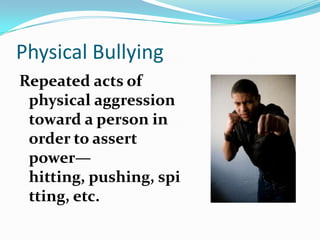
Physical BullyingRepeated acts of physical aggression toward a person in order to assert power—hitting, pushing, spitting, etc.
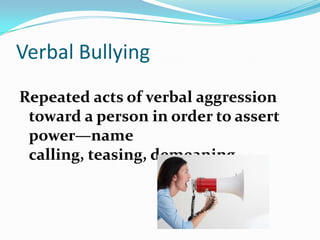
Verbal BullyingRepeated acts of verbal aggression toward a person in order to assert power—name calling, teasing, demeaning
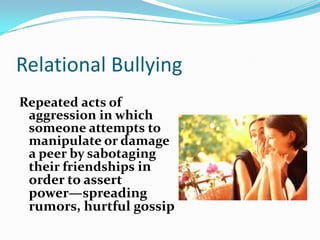
Relational BullyingRepeated acts of aggression in which someone attempts to manipulate or damage a peer by sabotaging their friendships in order to assert power—spreading rumors, hurtful gossip
Cyber Bullying (Definition)Using the internet or other digital technologies to communicate words, images or language in an effort to purposely cause distress to another.
Sexual BullyingAny unwanted sexual advances or actions intended to make the other person uncomfortable, embarrassed,  or humiliated.  May include obscenities, or gestures, exposure or physical contact.
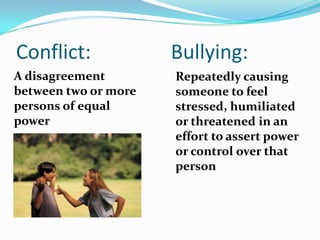
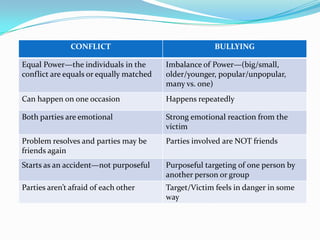
Conflict:                Bullying:A disagreement between two or more persons of equal power	Repeatedly causing someone to feel stressed, humiliated or threatened in an effort to assert power  or control over that person
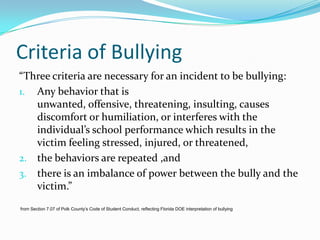
Criteria of Bullying“Three criteria are necessary for an incident to be bullying:Any behavior that is unwanted, offensive, threatening, insulting, causes discomfort or humiliation, or interferes with the individual’s school performance which results in the victim feeling stressed, injured, or threatened,the behaviors are repeated ,andthere is an imbalance of power between the bully and the victim.”   from Section 7.07 of Polk County’s Code of Student Conduct, reflecting Florida DOE interpretation of bullying
THINK….Decide if the following scenarios meet all three criteria to be considered bullying, or if it is a conflict which should be worked out.  If the scenario is an example of bullying, identify the type of bullying depicted. 
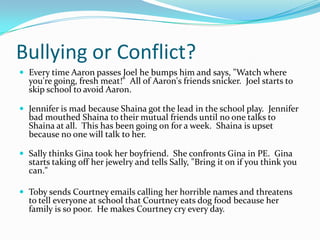
Bullying or Conflict?Every time Aaron passes Joel he bumps him and says, "Watch where you're going, fresh meat!"  All of Aaron's friends snicker.  Joel starts to skip school to avoid Aaron. Jennifer is mad because Shaina got the lead in the school play.  Jennifer bad mouthed Shaina to their mutual friends until no one talks to Shaina at all.  This has been going on for a week.  Shaina is upset because no one will talk to her.  Sally thinks Gina took her boyfriend.  She confronts Gina in PE.  Gina starts taking off her jewelry and tells Sally, "Bring it on if you think you can."  Toby sends Courtney emails calling her horrible names and threatens to tell everyone at school that Courtney eats dog food because her family is so poor.  He makes Courtney cry every day.
Dealing with Bullying
Essential QuestionHow should we respond to bullying?
GET THINKING!Think about a time when you witnessed bullying and didnothing to stop it because you weren’t sure what to do.What feelings did you have as a bystander?
Who Has The Power?Who has the most power in a bullying situation:  the bully, the victim or the person watching what is going on?  Why do you think so?If you said, “the person watching,” YOU ARE CORRECT!
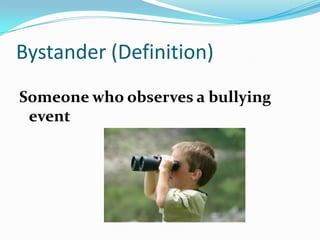
Bystander (Definition)Someone who observes a bullying event
Types of BystandersSidekick—A bystander who actively joins in at the bully’s invitation.  Usually is a friend of the bully.Reinforcer—A bystander who does not actively participate in the bullying but laughs or encourages the bully in some way (smiling, hanging around, comments, gestures).Onlooker—A bystander who does not support the bully but does nothing when others are bullied.  This  student does not want to get involved and may feel that bullying is none of his/her business.Defender—Bystander who tries to stop bullying while maintaining personal safety.  May comfort the victim and get adult help if necessary.
Interesting Fact:Most students are ONLOOKERS!  They don’t support the bullying, but they don’t get involved in helping the target/victim either.Why do you think students are reluctant to get involved?
Why Kids Don’t Get InvolvedThey don’t know what to do or how to stop it.They are afraid that if they try to do something, they may do something wrong and make the situation worse.They fear that if they intervene, they may be next on the bully’s list for bullying.They think their friends may reject them if they reach out to someone who is an “outsider.”
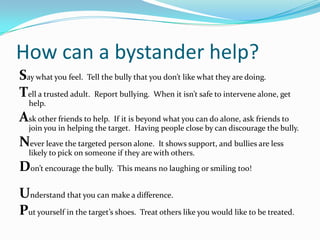
How can a bystander help?Say what you feel.  Tell the bully that you don’t like what they are doing.Tell a trusted adult.  Report bullying.  When it isn’t safe to intervene alone, get help.Ask other friends to help.  If it is beyond what you can do alone, ask friends to join you in helping the target.  Having people close by can discourage the bully.Never leave the targeted person alone.  It shows support, and bullies are less likely to pick on someone if they are with others.Don’t encourage the bully.  This means no laughing or smiling too!  Understand that you can make a difference.Put yourself in the target’s shoes.  Treat others like you would like to be treated.
Don’t Be a Target for Bullying!There is no way of telling who a bully is by how he/she looks.Bullies come in all shapes and disguises.Bullies bully in all different ways.Bullies all have one thing in common:  they want to be powerful and in controlIf you are being bullied, there are things you can do to help keep you safe and help you steer out of the bully’s way. The following tips will help:
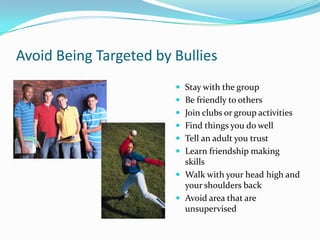
Avoid Being Targeted by BulliesStay with the groupBe friendly to othersJoin clubs or group activitiesFind things you do wellTell an adult you trustLearn friendship making skillsWalk with your head high and your shoulders backAvoid area that are unsupervised
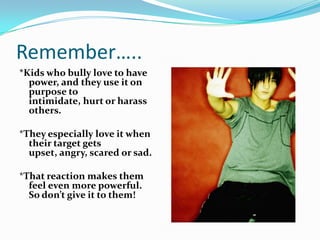
Remember…..*Kids who bully love to have power, and they use it on purpose to intimidate, hurt or harass others. *They especially love it when their target gets upset, angry, scared or sad. *That reaction makes them feel even more powerful. So don’t give it to them!
Report Bullying!Any student, parent or other interested party can report suspected bullying.BULLYING CAN BE REPORTED ANONYMOUSLY!
Reporting vs RattingRatting:When a person tell something minor to an authority figure in hopes that it will get someone into trouble.Reporting:When a person shares important information with an authority figure in order to prevent someone from being in danger or hurt.
Ways to Report Bullying Call the school and report via the phone.Go to the school and talk to personnel in person.
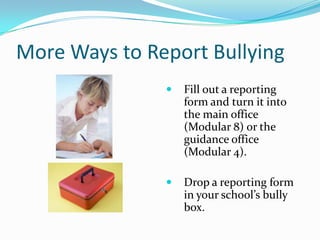
More Ways to Report BullyingFill out a reporting form and turn it into the main office (Modular 8) or the guidance office (Modular 4).Drop a reporting form in your school’s bully box.
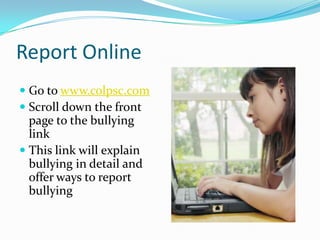
Report OnlineGo to www.colpsc.comScroll down the front page to the bullying linkThis link will explain bullying in detail and offer ways to report bullying
Reporting the 411	When reporting bullying, make sure you have all of the facts:Who is being bullied?Who is the person(s) bullying?What happened?Where did it happen?When did it happen?  How often does it happen?Names of individuals who saw it happen (if any)?
Think:Which reporting methods are you most comfortable using if you ever had to report bullying?Identify two adults who will listen to you if you ever need to report bullying.
In Summary…Finish this sentence, “The most important thing about bullying that I learned today was _________?”

Bullying Lessons PowerPoint COL at PSC

  • 1.
  • 2.
  • 3.
    GET THINKING!What doyou know about bullying? What do you want to learn about bullying?
  • 4.
    Bullying (Definition)Repeatedlycausing someone to feel stressed, humiliated or threatened in an effort to assert power or control over that person
  • 5.
    Types of BullyingBullyingcan be divided into five main categories:Physical BullyingVerbal BullyingRelational Bullying (AKA Emotional/Social Bullying)Cyber BullyingSexual Bullying
  • 6.
    Physical BullyingRepeated actsof physical aggression toward a person in order to assert power—hitting, pushing, spitting, etc.
  • 7.
    Verbal BullyingRepeated actsof verbal aggression toward a person in order to assert power—name calling, teasing, demeaning
  • 8.
    Relational BullyingRepeated actsof aggression in which someone attempts to manipulate or damage a peer by sabotaging their friendships in order to assert power—spreading rumors, hurtful gossip
  • 9.
    Cyber Bullying (Definition)Usingthe internet or other digital technologies to communicate words, images or language in an effort to purposely cause distress to another.
  • 10.
    Sexual BullyingAny unwantedsexual advances or actions intended to make the other person uncomfortable, embarrassed, or humiliated. May include obscenities, or gestures, exposure or physical contact.
  • 11.
    Conflict: Bullying:A disagreement between two or more persons of equal power Repeatedly causing someone to feel stressed, humiliated or threatened in an effort to assert power or control over that person
  • 13.
    Criteria of Bullying“Threecriteria are necessary for an incident to be bullying:Any behavior that is unwanted, offensive, threatening, insulting, causes discomfort or humiliation, or interferes with the individual’s school performance which results in the victim feeling stressed, injured, or threatened,the behaviors are repeated ,andthere is an imbalance of power between the bully and the victim.” from Section 7.07 of Polk County’s Code of Student Conduct, reflecting Florida DOE interpretation of bullying
  • 14.
    THINK….Decide if thefollowing scenarios meet all three criteria to be considered bullying, or if it is a conflict which should be worked out.  If the scenario is an example of bullying, identify the type of bullying depicted. 
  • 15.
    Bullying or Conflict?Everytime Aaron passes Joel he bumps him and says, "Watch where you're going, fresh meat!"  All of Aaron's friends snicker.  Joel starts to skip school to avoid Aaron. Jennifer is mad because Shaina got the lead in the school play.  Jennifer bad mouthed Shaina to their mutual friends until no one talks to Shaina at all.  This has been going on for a week.  Shaina is upset because no one will talk to her.  Sally thinks Gina took her boyfriend.  She confronts Gina in PE.  Gina starts taking off her jewelry and tells Sally, "Bring it on if you think you can."  Toby sends Courtney emails calling her horrible names and threatens to tell everyone at school that Courtney eats dog food because her family is so poor.  He makes Courtney cry every day.
  • 16.
  • 17.
    Essential QuestionHow shouldwe respond to bullying?
  • 18.
    GET THINKING!Think abouta time when you witnessed bullying and didnothing to stop it because you weren’t sure what to do.What feelings did you have as a bystander?
  • 19.
    Who Has ThePower?Who has the most power in a bullying situation: the bully, the victim or the person watching what is going on? Why do you think so?If you said, “the person watching,” YOU ARE CORRECT!
  • 20.
    Bystander (Definition)Someone whoobserves a bullying event
  • 21.
    Types of BystandersSidekick—Abystander who actively joins in at the bully’s invitation. Usually is a friend of the bully.Reinforcer—A bystander who does not actively participate in the bullying but laughs or encourages the bully in some way (smiling, hanging around, comments, gestures).Onlooker—A bystander who does not support the bully but does nothing when others are bullied. This student does not want to get involved and may feel that bullying is none of his/her business.Defender—Bystander who tries to stop bullying while maintaining personal safety. May comfort the victim and get adult help if necessary.
  • 22.
    Interesting Fact:Most studentsare ONLOOKERS! They don’t support the bullying, but they don’t get involved in helping the target/victim either.Why do you think students are reluctant to get involved?
  • 23.
    Why Kids Don’tGet InvolvedThey don’t know what to do or how to stop it.They are afraid that if they try to do something, they may do something wrong and make the situation worse.They fear that if they intervene, they may be next on the bully’s list for bullying.They think their friends may reject them if they reach out to someone who is an “outsider.”
  • 24.
    How can abystander help?Say what you feel. Tell the bully that you don’t like what they are doing.Tell a trusted adult. Report bullying. When it isn’t safe to intervene alone, get help.Ask other friends to help. If it is beyond what you can do alone, ask friends to join you in helping the target. Having people close by can discourage the bully.Never leave the targeted person alone. It shows support, and bullies are less likely to pick on someone if they are with others.Don’t encourage the bully. This means no laughing or smiling too! Understand that you can make a difference.Put yourself in the target’s shoes. Treat others like you would like to be treated.
  • 25.
    Don’t Be aTarget for Bullying!There is no way of telling who a bully is by how he/she looks.Bullies come in all shapes and disguises.Bullies bully in all different ways.Bullies all have one thing in common: they want to be powerful and in controlIf you are being bullied, there are things you can do to help keep you safe and help you steer out of the bully’s way. The following tips will help:
  • 26.
    Avoid Being Targetedby BulliesStay with the groupBe friendly to othersJoin clubs or group activitiesFind things you do wellTell an adult you trustLearn friendship making skillsWalk with your head high and your shoulders backAvoid area that are unsupervised
  • 27.
    Remember…..*Kids who bullylove to have power, and they use it on purpose to intimidate, hurt or harass others. *They especially love it when their target gets upset, angry, scared or sad. *That reaction makes them feel even more powerful. So don’t give it to them!
  • 28.
    Report Bullying!Any student,parent or other interested party can report suspected bullying.BULLYING CAN BE REPORTED ANONYMOUSLY!
  • 29.
    Reporting vs RattingRatting:Whena person tell something minor to an authority figure in hopes that it will get someone into trouble.Reporting:When a person shares important information with an authority figure in order to prevent someone from being in danger or hurt.
  • 30.
    Ways to ReportBullying Call the school and report via the phone.Go to the school and talk to personnel in person.
  • 31.
    More Ways toReport BullyingFill out a reporting form and turn it into the main office (Modular 8) or the guidance office (Modular 4).Drop a reporting form in your school’s bully box.
  • 32.
    Report OnlineGo towww.colpsc.comScroll down the front page to the bullying linkThis link will explain bullying in detail and offer ways to report bullying
  • 33.
    Reporting the 411 Whenreporting bullying, make sure you have all of the facts:Who is being bullied?Who is the person(s) bullying?What happened?Where did it happen?When did it happen? How often does it happen?Names of individuals who saw it happen (if any)?
  • 34.
    Think:Which reporting methodsare you most comfortable using if you ever had to report bullying?Identify two adults who will listen to you if you ever need to report bullying.
  • 35.
    In Summary…Finish thissentence, “The most important thing about bullying that I learned today was _________?”

Editor's Notes

  • #5 Ask students what types of behavior they consider bullying. In a “Bullying” Wordsplash on the board, list all of their ideas. Then introduce each of the types of bullying. As you introduce each type, return to the Wordsplash and circle, underline, etc. examples which are indicative of the type of bullying you have introduced.
  • #12 Tell students that you can’t talk about bullying without distinguishing it from conflict, and sometimes people don’t understand the differences. Often times, students report being bullied, when really they are in a conflict with another person.
  • #20 Once posing this question and taking responses, by show of hands have students collectively indicate which ones that they chose. Let them know that the students who said, “person watching” or “bystander” are correct.
  • #22 Once these definitions have been introduced, ask students to privately think about which category they feel they most likely resemble.
  • #23 On the board, record their responses to this question.