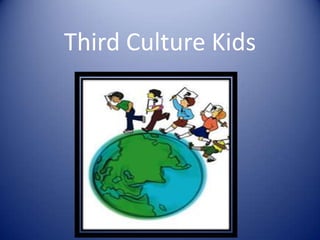
Third Culture Kids
There was no funeral.No flowers.No ceremony.No one had died.No weeping or wailing. Just in my heart.I can’t…But I did anyway,And nobody knew I couldn’t.I don’t want to…But nobody else said they didn’t.So I put down my panicand picked up my luggageand got on the plane.There was no funeral.				--”Mock Funeral” by Alex Graham James
Definition of ‘Third Culture Kid’“A Third Culture Kid (TCK) is a person who has spent a significant part of his or her developmental years outside the parents’ culture. The TCK builds relationships to all of the cultures, while not having full ownership in any. Although elements from each culture are assimilated into the TCK’s life experience, the sense of belonging is in relationship to others of similar background.” (Pollock and Van Reken, 1999)
Examples of TCK’sTraditional TCK’s—Children who move into another culture with parents due to a parent’s career choiceBi/multi-cultural/and/or bi/multi-racial children—Children born to parents from at least two cultures or racesChildren of immigrants—Children whose parents have made a permanent move to a new country where they were not originally citizensChildren of refugees—Children whose parents are living outside their original country or place due to unchosen circumstances such as war, violence, famine, or other natural disasters
Examples of TCK’sChildren of minorities—Children whose parents are from a racial or ethnic group which is not part of the majority or ethnicity of the country in which they liveInternational adoptees—Children adopted by parents from another country other than the one of that child’s birth“Domestic” TCK’s—Children whose parents have moved in or among various subcultures within that child’s home countryChildren are often in more than one of these categories at the same time.
IDENTITY
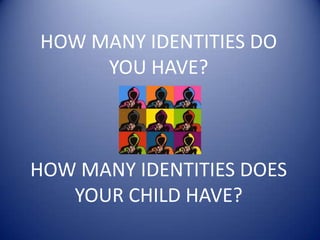
HOW MANY IDENTITIES DO YOU HAVE?HOW MANY IDENTITIES DOES YOUR CHILD HAVE?
WHAT IS IDENTITY?Identity “represents the process by which the person seeks to integrate his/her various statuses and roles, as well as his diverse experiences, into a coherent image of self”. (Epstein, 1978)
Answering the question ‘Who am I?’ is one of the biggest tasks of the adolescent (adult?) years. However, some adolescents may become overwhelmed by the task ofidentity development and neither explore nor make commitments.
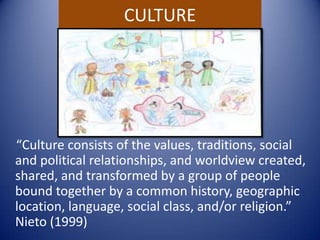
CULTURE    “Culture consists of the values, traditions, social and political relationships, and worldview created, shared, and transformed by a group of people bound together by a common history, geographic location, language, social class, and/or religion.” Nieto (1999)
SIGNIFICANCE OF CULTUREWhen we have stayed in a particular culture long enough to internalize its behaviors and the assumptions behind them, we have an almost intuitive sense of what is right, humorous, appropriate, or offensive in any particular situation. Being “in the know” gives us a sense of stability, deep security, and belonging. When we are having to learn and relearn the basic rules by which the world around us is operating, our energies are spent on surviving rather than thriving; struggling to understand what is happening rather than fully participating in the event.
SIGNIFICANCE OF CULTURE    When people first go to another country as adults, they experience culture shock and need a period of adjustment, but their value system, sense of identity, and the establishment of core relationships with family and friends have already developed in the home culture. Their basic sense of who they are and where they belong are intact. Children and adolescents who move among different cultures are doing so before they have formed their own personal and cultural identity.
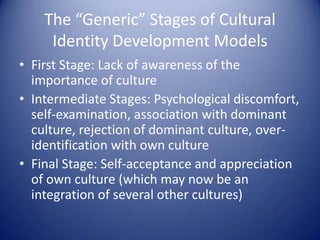
The “Generic” Stages of Cultural Identity Development ModelsFirst Stage: Lack of awareness of the importance of cultureIntermediate Stages: Psychological discomfort, self-examination, association with dominant culture, rejection of dominant culture, over-identification with own cultureFinal Stage: Self-acceptance and appreciation of own culture (which may now be an integration of several other cultures)
Pro’s of Being a TCKGreater understanding of other cultures builds sensitivity and awareness (flexibility, tolerance, respect)Reflective thinkers—knowing that there are many ways to approach a given situation and that their way may not be the best way\Quick, adaptable thinkers who are used to thinking outside of the boxStronger practical skills—observational skills, listening skills, cross-cultural skills, social skills, linguistic skills
Pro’s of Being a TCKGlobally minded and have a keen understanding for what is happening in the world around themDevelop sensitivity and empathy at an earlier age and at a deeper levelMature (in some areas) more quickly—early autonomy, relationship to adults, broad base of knowledge
Pro’s of Being a TCKInternational schools offer enhanced and enriched academic programs and have good links with many universities around the worldIncreased opportunities to travel and experience new cultures first hand—authentic learning experiencesDrawn to careers associated with service to the community or the world
Con’s of Being a TCKLack of a ‘home base’ means it’s hardfor TCK’s to have an identity of where they are from or what nationality they truly are, which can create a feeling of emptiness. The rootless and restless syndrome. “I don’t belong anywhere.”The emotional upset of having to say goodbye to people and places on a regular basisFinding it difficult to make new connections and friends—”what’s the point if we’re going to move on again soon anyway”—separation anxiety, loneliness and isolation
Con’s of Being a TCKThe anger felt toward parents for ‘plucking’ them away from their ‘home’The guilt felt that is associated with being angry at parentsFamily disharmonyCulture shockUnidentified learning disabilities
Con’s of Being a TCKEducational gaps due to different curriculums being followed at different schoolsMay not deal well with conflicts. It has always been easier to ‘outwait’ them, knowing another move is coming soonSeen as unpatriotic if a TCK tries to present another culture’s potential viewpointConfused loyalties—sense of confusion about complex things such as politics, patriotism, and values
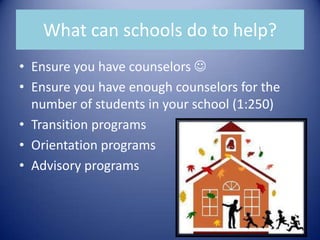
What can schools do to help?Ensure you have counselors Ensure you have enough counselors for the number of students in your school (1:250)Transition programsOrientation programsAdvisory programs
What can parents do to help?Involve your children in decision-making during the move (to the extent possible)Allow your children choices to establish a sense of control in their lives (where to have dinner , what movie to see, etc.)Provide time for children to grieve and be supportive of their needs—each move is a TRUE loss for themValidate and acknowledge (and at times this may include educating and labeling) the emotions and feelings your child is experiencing; for many people simply discovering that there are legitimate reasons for their feelings not only helps them understand themselves better, it also normalizes their experience.
What can parents do to help?Have a ‘home base’ in what you consider to be your home, that you visit at least once a year where your child has their own room.Talk about your home culture and keep connected with family still living in your ‘home base’Build strong ties in each community in which you liveSet aside special “family time” and establish family traditionsProvide opportunities for your children to express their grief/anger (journaling, scrapbooking, etc.)Seek help from your school  or outside counselor
What can children do to help themselves?Research where you are going before you get thereBe involved in family conversations and decisions about where you are moving toLearn about the new country you will be living in prior to moving thereConnect with your new school via the counselor or a student
What can children do to help themselves?Have someone you can talk to about your feelingsKnow that it’s okay to feel overwhelmed and unsureBecome involved in after school activities, clubs and community events
Interesting Info…TCK’s tend to have more in common with one another, regardless of nationality, than they do with non-TCKs from their own countryTCK’s link, bond and look to their peers for norms and acceptance much more readily than they will do with adults  ???TCK’s generally are much more successful in higher education and in attaining high level jobs
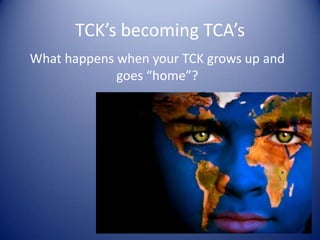
TCK’s becoming TCA’sWhat happens when your TCK grows up and goes “home”?
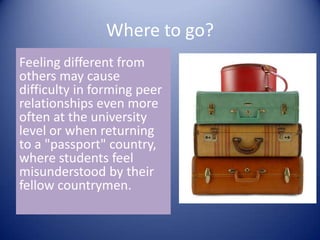
Where to go?Feeling different from others may cause difficulty in forming peer relationships even more often at the university level or when returning to a "passport" country, where students feel misunderstood by their fellow countrymen.
“My lack of understanding of common topics of conversation such as TV shows and politics was embarrassing. My gap of knowledge in the modern culture with regard commercials, programs/activities growing up, and that my peers did not understand my experiences, was a constant reminder of my time away from ‘the norm.’ Reverse Culture Shock does exist.”  					              Warren Heaps, TCKSo what are the options?
ACO’s (American Colleges Overseas)ProsConsStudent bodies are approximately 50-85% internationals, many of  whom are TCK’sDiversity and tolerance are the normPeer-to peer support / mentoring International Networking – benefits as an Alumni when they become expats themselves “Closer to home” – sometimes locations are near family/parents, easing the transitionLose the opportunity to reconnect with home in a concentrated and controlled environmentHarder to gauge the relative value of some ACO diplomas/schoolsProlongs the TCK culture so that the transition into a non-TCK culture is significantly delayed
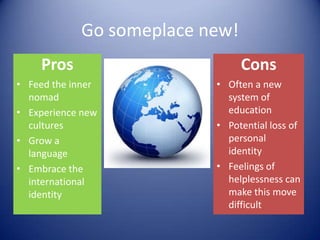
Go someplace new!ProsConsFeed the inner nomadExperience new culturesGrow a languageEmbrace the international identityOften a new system of educationPotential loss of personal identityFeelings of helplessness can make this move difficult
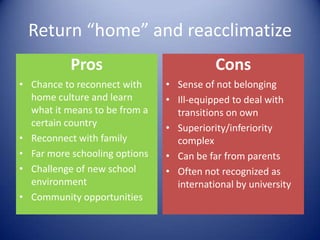
Return “home” and reacclimatize ProsChance to reconnect with home culture and learn what it means to be from a certain countryReconnect with familyFar more schooling optionsChallenge of new school environmentCommunity opportunitiesConsSense of not belongingIll-equipped to deal with transitions on ownSuperiority/inferiority complexCan be far from parentsOften not recognized as international by university
Questions??

Third culture kids pp

  • 1.
  • 2.
    There was nofuneral.No flowers.No ceremony.No one had died.No weeping or wailing. Just in my heart.I can’t…But I did anyway,And nobody knew I couldn’t.I don’t want to…But nobody else said they didn’t.So I put down my panicand picked up my luggageand got on the plane.There was no funeral. --”Mock Funeral” by Alex Graham James
  • 3.
    Definition of ‘ThirdCulture Kid’“A Third Culture Kid (TCK) is a person who has spent a significant part of his or her developmental years outside the parents’ culture. The TCK builds relationships to all of the cultures, while not having full ownership in any. Although elements from each culture are assimilated into the TCK’s life experience, the sense of belonging is in relationship to others of similar background.” (Pollock and Van Reken, 1999)
  • 4.
    Examples of TCK’sTraditionalTCK’s—Children who move into another culture with parents due to a parent’s career choiceBi/multi-cultural/and/or bi/multi-racial children—Children born to parents from at least two cultures or racesChildren of immigrants—Children whose parents have made a permanent move to a new country where they were not originally citizensChildren of refugees—Children whose parents are living outside their original country or place due to unchosen circumstances such as war, violence, famine, or other natural disasters
  • 5.
    Examples of TCK’sChildrenof minorities—Children whose parents are from a racial or ethnic group which is not part of the majority or ethnicity of the country in which they liveInternational adoptees—Children adopted by parents from another country other than the one of that child’s birth“Domestic” TCK’s—Children whose parents have moved in or among various subcultures within that child’s home countryChildren are often in more than one of these categories at the same time.
  • 6.
  • 7.
    HOW MANY IDENTITIESDO YOU HAVE?HOW MANY IDENTITIES DOES YOUR CHILD HAVE?
  • 8.
    WHAT IS IDENTITY?Identity“represents the process by which the person seeks to integrate his/her various statuses and roles, as well as his diverse experiences, into a coherent image of self”. (Epstein, 1978)
  • 9.
    Answering the question‘Who am I?’ is one of the biggest tasks of the adolescent (adult?) years. However, some adolescents may become overwhelmed by the task ofidentity development and neither explore nor make commitments.
  • 10.
    CULTURE “Culture consists of the values, traditions, social and political relationships, and worldview created, shared, and transformed by a group of people bound together by a common history, geographic location, language, social class, and/or religion.” Nieto (1999)
  • 11.
    SIGNIFICANCE OF CULTUREWhenwe have stayed in a particular culture long enough to internalize its behaviors and the assumptions behind them, we have an almost intuitive sense of what is right, humorous, appropriate, or offensive in any particular situation. Being “in the know” gives us a sense of stability, deep security, and belonging. When we are having to learn and relearn the basic rules by which the world around us is operating, our energies are spent on surviving rather than thriving; struggling to understand what is happening rather than fully participating in the event.
  • 12.
    SIGNIFICANCE OF CULTURE When people first go to another country as adults, they experience culture shock and need a period of adjustment, but their value system, sense of identity, and the establishment of core relationships with family and friends have already developed in the home culture. Their basic sense of who they are and where they belong are intact. Children and adolescents who move among different cultures are doing so before they have formed their own personal and cultural identity.
  • 13.
    The “Generic” Stagesof Cultural Identity Development ModelsFirst Stage: Lack of awareness of the importance of cultureIntermediate Stages: Psychological discomfort, self-examination, association with dominant culture, rejection of dominant culture, over-identification with own cultureFinal Stage: Self-acceptance and appreciation of own culture (which may now be an integration of several other cultures)
  • 14.
    Pro’s of Beinga TCKGreater understanding of other cultures builds sensitivity and awareness (flexibility, tolerance, respect)Reflective thinkers—knowing that there are many ways to approach a given situation and that their way may not be the best way\Quick, adaptable thinkers who are used to thinking outside of the boxStronger practical skills—observational skills, listening skills, cross-cultural skills, social skills, linguistic skills
  • 15.
    Pro’s of Beinga TCKGlobally minded and have a keen understanding for what is happening in the world around themDevelop sensitivity and empathy at an earlier age and at a deeper levelMature (in some areas) more quickly—early autonomy, relationship to adults, broad base of knowledge
  • 16.
    Pro’s of Beinga TCKInternational schools offer enhanced and enriched academic programs and have good links with many universities around the worldIncreased opportunities to travel and experience new cultures first hand—authentic learning experiencesDrawn to careers associated with service to the community or the world
  • 17.
    Con’s of Beinga TCKLack of a ‘home base’ means it’s hardfor TCK’s to have an identity of where they are from or what nationality they truly are, which can create a feeling of emptiness. The rootless and restless syndrome. “I don’t belong anywhere.”The emotional upset of having to say goodbye to people and places on a regular basisFinding it difficult to make new connections and friends—”what’s the point if we’re going to move on again soon anyway”—separation anxiety, loneliness and isolation
  • 18.
    Con’s of Beinga TCKThe anger felt toward parents for ‘plucking’ them away from their ‘home’The guilt felt that is associated with being angry at parentsFamily disharmonyCulture shockUnidentified learning disabilities
  • 19.
    Con’s of Beinga TCKEducational gaps due to different curriculums being followed at different schoolsMay not deal well with conflicts. It has always been easier to ‘outwait’ them, knowing another move is coming soonSeen as unpatriotic if a TCK tries to present another culture’s potential viewpointConfused loyalties—sense of confusion about complex things such as politics, patriotism, and values
  • 20.
    What can schoolsdo to help?Ensure you have counselors Ensure you have enough counselors for the number of students in your school (1:250)Transition programsOrientation programsAdvisory programs
  • 21.
    What can parentsdo to help?Involve your children in decision-making during the move (to the extent possible)Allow your children choices to establish a sense of control in their lives (where to have dinner , what movie to see, etc.)Provide time for children to grieve and be supportive of their needs—each move is a TRUE loss for themValidate and acknowledge (and at times this may include educating and labeling) the emotions and feelings your child is experiencing; for many people simply discovering that there are legitimate reasons for their feelings not only helps them understand themselves better, it also normalizes their experience.
  • 22.
    What can parentsdo to help?Have a ‘home base’ in what you consider to be your home, that you visit at least once a year where your child has their own room.Talk about your home culture and keep connected with family still living in your ‘home base’Build strong ties in each community in which you liveSet aside special “family time” and establish family traditionsProvide opportunities for your children to express their grief/anger (journaling, scrapbooking, etc.)Seek help from your school or outside counselor
  • 23.
    What can childrendo to help themselves?Research where you are going before you get thereBe involved in family conversations and decisions about where you are moving toLearn about the new country you will be living in prior to moving thereConnect with your new school via the counselor or a student
  • 24.
    What can childrendo to help themselves?Have someone you can talk to about your feelingsKnow that it’s okay to feel overwhelmed and unsureBecome involved in after school activities, clubs and community events
  • 25.
    Interesting Info…TCK’s tendto have more in common with one another, regardless of nationality, than they do with non-TCKs from their own countryTCK’s link, bond and look to their peers for norms and acceptance much more readily than they will do with adults ???TCK’s generally are much more successful in higher education and in attaining high level jobs
  • 26.
    TCK’s becoming TCA’sWhathappens when your TCK grows up and goes “home”?
  • 27.
    Where to go?Feelingdifferent from others may cause difficulty in forming peer relationships even more often at the university level or when returning to a "passport" country, where students feel misunderstood by their fellow countrymen.
  • 28.
    “My lack ofunderstanding of common topics of conversation such as TV shows and politics was embarrassing. My gap of knowledge in the modern culture with regard commercials, programs/activities growing up, and that my peers did not understand my experiences, was a constant reminder of my time away from ‘the norm.’ Reverse Culture Shock does exist.” Warren Heaps, TCKSo what are the options?
  • 29.
    ACO’s (American CollegesOverseas)ProsConsStudent bodies are approximately 50-85% internationals, many of whom are TCK’sDiversity and tolerance are the normPeer-to peer support / mentoring International Networking – benefits as an Alumni when they become expats themselves “Closer to home” – sometimes locations are near family/parents, easing the transitionLose the opportunity to reconnect with home in a concentrated and controlled environmentHarder to gauge the relative value of some ACO diplomas/schoolsProlongs the TCK culture so that the transition into a non-TCK culture is significantly delayed
  • 31.
    Go someplace new!ProsConsFeedthe inner nomadExperience new culturesGrow a languageEmbrace the international identityOften a new system of educationPotential loss of personal identityFeelings of helplessness can make this move difficult
  • 32.
    Return “home” andreacclimatize ProsChance to reconnect with home culture and learn what it means to be from a certain countryReconnect with familyFar more schooling optionsChallenge of new school environmentCommunity opportunitiesConsSense of not belongingIll-equipped to deal with transitions on ownSuperiority/inferiority complexCan be far from parentsOften not recognized as international by university
  • 33.