|UNDERSTANDING

Santosh C. Hulagabali
Librarian
Nagindas Khandwala College | Malad (W) | Mumbai-400 064
www.nkc.ac.in | santosh@nkc.ac.in
Overview










Meaning
Why Plagiarism is so rampant?
Cases
Why does plagiarism matter?
Referencing Styles
How to avoid
Penalties
Plagiarism Detection-Softwares
Tips
COIST | Librarian Santosh C. Hulagabali

2
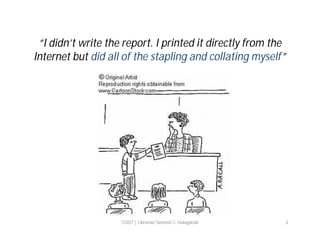
“I didn’t write the report. I printed it directly from the
Internet but did all of the stapling and collating myself”

COIST | Librarian Santosh C. Hulagabali

3
Meaning
 Plagiarism: Copying or paraphrasing of other
people’s work or ideas into your own work
without full acknowledgement (UoO).
 Collusion is another form of plagiarism
involving the unauthorised collaboration of
students (or others) in a piece of work (UoO).

COIST | Librarian Santosh C. Hulagabali

4
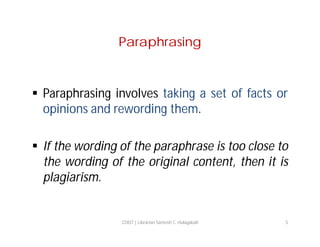
Paraphrasing

 Paraphrasing involves taking a set of facts or
opinions and rewording them.
 If the wording of the paraphrase is too close to
the wording of the original content, then it is
plagiarism.

COIST | Librarian Santosh C. Hulagabali

5
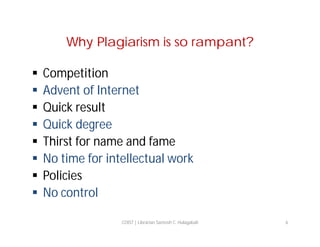
Why Plagiarism is so rampant?









Competition
Advent of Internet
Quick result
Quick degree
Thirst for name and fame
No time for intellectual work
Policies
No control
COIST | Librarian Santosh C. Hulagabali

6
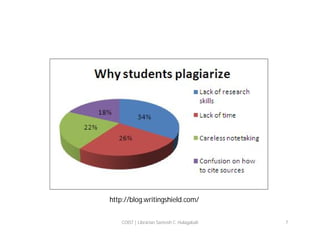
http://blog.writingshield.com/
COIST | Librarian Santosh C. Hulagabali

7
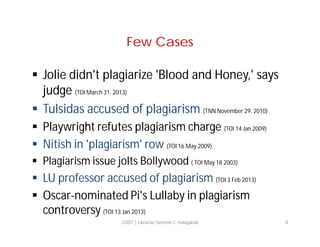
Few Cases
 Jolie didn't plagiarize 'Blood and Honey,' says
judge (TOI March 31, 2013)
 Tulsidas accused of plagiarism (TNN November 29, 2010)
 Playwright refutes plagiarism charge (TOI 14 Jan 2009)
 Nitish in 'plagiarism' row (TOI 16 May 2009)
 Plagiarism issue jolts Bollywood ( TOI May 18 2003)

 LU professor accused of plagiarism (TOI 3 Feb 2013)
 Oscar-nominated Pi's Lullaby in plagiarism
controversy (TOI 13 Jan 2013)
COIST | Librarian Santosh C. Hulagabali

8
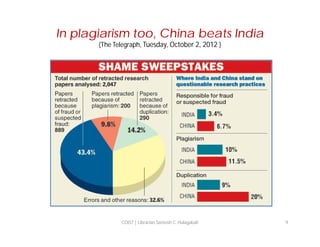
In plagiarism too, China beats India
(The Telegraph, Tuesday, October 2, 2012 )

COIST | Librarian Santosh C. Hulagabali

9
Why does plagiarism matter?

 It is a breach of academic integrity.
 Plagiarism is unethical.
 Can have serious consequences for your
future career.
 It also undermines the (self) standards of your
institution and of the degrees it issues.

COIST | Librarian Santosh C. Hulagabali

10
Unintentional Plagiarism
 Paraphrasing poorly: changing a few words
without changing the sentence structure of the
original, or changing the sentence structure but
not the words.
 Quoting poorly: putting quotation marks around
part of a quotation but not around all of it, or
putting quotation marks around a passage that is
partly paraphrased and partly quoted.
 Citing poorly: omitting an occasional citation or
citing inaccurately.
MLA handbook for writers of research papers. (7th ed.). The Modern Language Association of America. New York: 2009. Print.

COIST | Librarian Santosh C. Hulagabali

11
Intentional Plagiarism
 Passing off as one’s own pre-written papers
from the Internet or other sources.
 Copying an essay or article from the
Internet, on-line source, or electronic
database without quoting or giving credit.
 Cutting and pasting from more than one
source to create a paper without quoting or
giving credit.
 Borrowing words or ideas from other
authors or sources without giving credit.
MLA handbook for writers of research papers. (7th ed.). The Modern Language Association of America. New York: 2009. Print.

COIST | Librarian Santosh C. Hulagabali

12
Examples of Plagiarism
Include: copying (using another person's language
and/or ideas as if they are a candidate's own), by:
 quoting verbatim another person's work
without due acknowledgement of the source;
 paraphrasing another person's work by
changing some of the words without due
acknowledgement of the source;
COIST | Librarian Santosh C. Hulagabali

13
Cont..

 using ideas taken from someone else without
reference to the originator;
 cutting and pasting from the Internet;
 submitting someone else's work as part of a
candidate's own, without identifying clearly
who did the work.

COIST | Librarian Santosh C. Hulagabali

14
How to avoid Plagiarism?
– The use of another’s exact words (quoting
verbatim) without citing the author.
Incorrect
Plagiarism is the reproduction of someone else’s words,
ideas or findings and presenting them as one’s own
without proper acknowledgement.

Correct
Plagiarism is the “reproduction of someone else’s words,
ideas or findings and presenting them as one’s own
without proper acknowledgement” (Undergraduate
Course Handbook: 2008, p.24)
COIST | Librarian Santosh C. Hulagabali

15
Cont..
 when presenting the views and work of others,
you must give an indication of the source of the
material conventions.
write: '... as Sharpe (1993) has shown', and give
the full details of the work quoted in your
bibliography
 if you quote text verbatim, make this completely
evident
'The elk is of necessity less graceful than the
gazelle' (Thompson, 1942, p. 46).
COIST | Librarian Santosh C. Hulagabali

16
Cont..
 set the quoted text apart from your own text (e.g. by
indenting a paragraph) and identify it in a suitable way (e.g.
by using inverted commas and adding a reference as above)
 if you are copying text, keep a note of the author and the
reference as you go along, with the copied text, so that you
will not mistakenly think the material to be your own work
when you come back to it in a few weeks' time.
 if you reproduce an illustration or include someone else's
data in a graph or table, include the reference to the
original work, e.g. '(figure redrawn from Webb, 1976)' or '(1
= data from Webb, 1976).
COIST | Librarian Santosh C. Hulagabali

17
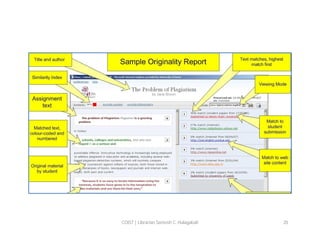
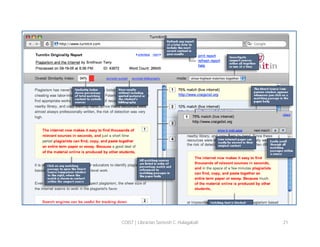
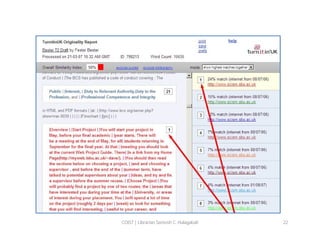
Plagiarism Detection
 A process of locating instances of plagiarism
within a work or document.
 Widespread use of computers and the advent
of the Internet has made it easier to plagiarize
the work of others.
 Many free/commercial softwares available
COIST | Librarian Santosh C. Hulagabali

18
Plagiarism Softwares
Free

Commercial

Chimpsky
CitePlag
CopyTracker
Plagium
SeeSources
The Plagiarism Checker
Plagiarism Detect

Turnitin
Attributor
Copyscape
PlagTracker
Ithenticate
Plagiarismdetect
PlagScan
Veriguide

COIST | Librarian Santosh C. Hulagabali

19
COIST | Librarian Santosh C. Hulagabali

20
COIST | Librarian Santosh C. Hulagabali

21
COIST | Librarian Santosh C. Hulagabali

22
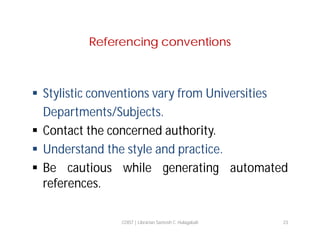
Referencing conventions

 Stylistic conventions vary from Universities
Departments/Subjects.
 Contact the concerned authority.
 Understand the style and practice.
 Be cautious while generating automated
references.
COIST | Librarian Santosh C. Hulagabali

23
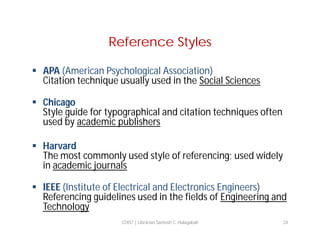
Reference Styles
 APA (American Psychological Association)
Citation technique usually used in the Social Sciences
 Chicago
Style guide for typographical and citation techniques often
used by academic publishers
 Harvard
The most commonly used style of referencing; used widely
in academic journals
 IEEE (Institute of Electrical and Electronics Engineers)
Referencing guidelines used in the fields of Engineering and
Technology
COIST | Librarian Santosh C. Hulagabali

24
Cont..
 MLA (Modern Language Association)
Style guide used particularly in academic writing for
languages and literature.
 MRHA (Modern Humanities Research Association)
Style guide used for academic theses and essays in the
Humanities
 OSCOLA (Oxford Standard for Citation of Legal Authorities)
Citation guidelines for legal materials.
 Vancouver
Style of referencing using a numerical system - often used
in medical writing
COIST | Librarian Santosh C. Hulagabali

25
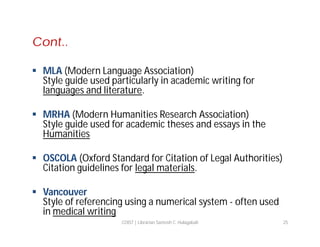
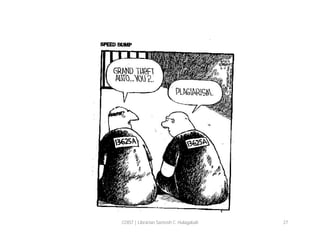
The Penalties of Plagiarism
 Although plagiarism can be intentional or
unintentional, both have consequences.
– Receiving zero on the assignment
– Failing the course
– Suspension
– Expulsion

COIST | Librarian Santosh C. Hulagabali

26
COIST | Librarian Santosh C. Hulagabali

27
Tips
 At first it may seem very difficult to develop your
own views.
 You are not necessarily expected to become an
original thinker, but you are expected to be an
independent one.
 Assess critically the work of others, weigh up
differing arguments and draw your own
conclusions.
 Practice any one reference style (APA).
COIST | Librarian Santosh C. Hulagabali

28
Cont..
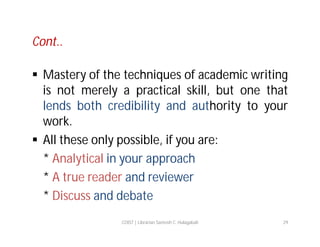
 Mastery of the techniques of academic writing
is not merely a practical skill, but one that
lends both credibility and authority to your
work.
 All these only possible, if you are:
* Analytical in your approach
* A true reader and reviewer
* Discuss and debate
COIST | Librarian Santosh C. Hulagabali

29
COIST | Librarian Santosh C. Hulagabali

30
Disclaimer:
The information and screenshots used in this presentations are used for educational training, teaching
and research, not for any commercial purposes.
© 2011 Librarian Santosh C. Hulagabali

31
References










http://www.ox.ac.uk/students/academic/goodpractice/about/
http://www.admin.cam.ac.uk/univ/plagiarism/students/statement.html
www.centralia.edu/academics/.../Plagiarism.ppt
http://en.wikipedia.org/wiki/Plagiarism_detection
http://examples.yourdictionary.com/examples/examples-of-paraphrasing.html
http://fairuse.stanford.edu/Copyright_and_Fair_Use_Overview/chapter9/9-a.html
http://blog.writingshield.com/index.php/2011/02/understanding-student-plagiarism/
www.google.com
http://www.telegraphindia.com/1121002/jsp/nation/story_16042659.jsp

COIST | Librarian Santosh C. Hulagabali

32

Understanding Plagiarism

  • 1.
    |UNDERSTANDING Santosh C. Hulagabali Librarian NagindasKhandwala College | Malad (W) | Mumbai-400 064 www.nkc.ac.in | santosh@nkc.ac.in
  • 2.
    Overview          Meaning Why Plagiarism isso rampant? Cases Why does plagiarism matter? Referencing Styles How to avoid Penalties Plagiarism Detection-Softwares Tips COIST | Librarian Santosh C. Hulagabali 2
  • 3.
    “I didn’t writethe report. I printed it directly from the Internet but did all of the stapling and collating myself” COIST | Librarian Santosh C. Hulagabali 3
  • 4.
    Meaning  Plagiarism: Copyingor paraphrasing of other people’s work or ideas into your own work without full acknowledgement (UoO).  Collusion is another form of plagiarism involving the unauthorised collaboration of students (or others) in a piece of work (UoO). COIST | Librarian Santosh C. Hulagabali 4
  • 5.
    Paraphrasing  Paraphrasing involvestaking a set of facts or opinions and rewording them.  If the wording of the paraphrase is too close to the wording of the original content, then it is plagiarism. COIST | Librarian Santosh C. Hulagabali 5
  • 6.
    Why Plagiarism isso rampant?         Competition Advent of Internet Quick result Quick degree Thirst for name and fame No time for intellectual work Policies No control COIST | Librarian Santosh C. Hulagabali 6
  • 7.
  • 8.
    Few Cases  Joliedidn't plagiarize 'Blood and Honey,' says judge (TOI March 31, 2013)  Tulsidas accused of plagiarism (TNN November 29, 2010)  Playwright refutes plagiarism charge (TOI 14 Jan 2009)  Nitish in 'plagiarism' row (TOI 16 May 2009)  Plagiarism issue jolts Bollywood ( TOI May 18 2003)  LU professor accused of plagiarism (TOI 3 Feb 2013)  Oscar-nominated Pi's Lullaby in plagiarism controversy (TOI 13 Jan 2013) COIST | Librarian Santosh C. Hulagabali 8
  • 9.
    In plagiarism too,China beats India (The Telegraph, Tuesday, October 2, 2012 ) COIST | Librarian Santosh C. Hulagabali 9
  • 10.
    Why does plagiarismmatter?  It is a breach of academic integrity.  Plagiarism is unethical.  Can have serious consequences for your future career.  It also undermines the (self) standards of your institution and of the degrees it issues. COIST | Librarian Santosh C. Hulagabali 10
  • 11.
    Unintentional Plagiarism  Paraphrasingpoorly: changing a few words without changing the sentence structure of the original, or changing the sentence structure but not the words.  Quoting poorly: putting quotation marks around part of a quotation but not around all of it, or putting quotation marks around a passage that is partly paraphrased and partly quoted.  Citing poorly: omitting an occasional citation or citing inaccurately. MLA handbook for writers of research papers. (7th ed.). The Modern Language Association of America. New York: 2009. Print. COIST | Librarian Santosh C. Hulagabali 11
  • 12.
    Intentional Plagiarism  Passingoff as one’s own pre-written papers from the Internet or other sources.  Copying an essay or article from the Internet, on-line source, or electronic database without quoting or giving credit.  Cutting and pasting from more than one source to create a paper without quoting or giving credit.  Borrowing words or ideas from other authors or sources without giving credit. MLA handbook for writers of research papers. (7th ed.). The Modern Language Association of America. New York: 2009. Print. COIST | Librarian Santosh C. Hulagabali 12
  • 13.
    Examples of Plagiarism Include:copying (using another person's language and/or ideas as if they are a candidate's own), by:  quoting verbatim another person's work without due acknowledgement of the source;  paraphrasing another person's work by changing some of the words without due acknowledgement of the source; COIST | Librarian Santosh C. Hulagabali 13
  • 14.
    Cont..  using ideastaken from someone else without reference to the originator;  cutting and pasting from the Internet;  submitting someone else's work as part of a candidate's own, without identifying clearly who did the work. COIST | Librarian Santosh C. Hulagabali 14
  • 15.
    How to avoidPlagiarism? – The use of another’s exact words (quoting verbatim) without citing the author. Incorrect Plagiarism is the reproduction of someone else’s words, ideas or findings and presenting them as one’s own without proper acknowledgement. Correct Plagiarism is the “reproduction of someone else’s words, ideas or findings and presenting them as one’s own without proper acknowledgement” (Undergraduate Course Handbook: 2008, p.24) COIST | Librarian Santosh C. Hulagabali 15
  • 16.
    Cont..  when presentingthe views and work of others, you must give an indication of the source of the material conventions. write: '... as Sharpe (1993) has shown', and give the full details of the work quoted in your bibliography  if you quote text verbatim, make this completely evident 'The elk is of necessity less graceful than the gazelle' (Thompson, 1942, p. 46). COIST | Librarian Santosh C. Hulagabali 16
  • 17.
    Cont..  set thequoted text apart from your own text (e.g. by indenting a paragraph) and identify it in a suitable way (e.g. by using inverted commas and adding a reference as above)  if you are copying text, keep a note of the author and the reference as you go along, with the copied text, so that you will not mistakenly think the material to be your own work when you come back to it in a few weeks' time.  if you reproduce an illustration or include someone else's data in a graph or table, include the reference to the original work, e.g. '(figure redrawn from Webb, 1976)' or '(1 = data from Webb, 1976). COIST | Librarian Santosh C. Hulagabali 17
  • 18.
    Plagiarism Detection  Aprocess of locating instances of plagiarism within a work or document.  Widespread use of computers and the advent of the Internet has made it easier to plagiarize the work of others.  Many free/commercial softwares available COIST | Librarian Santosh C. Hulagabali 18
  • 19.
    Plagiarism Softwares Free Commercial Chimpsky CitePlag CopyTracker Plagium SeeSources The PlagiarismChecker Plagiarism Detect Turnitin Attributor Copyscape PlagTracker Ithenticate Plagiarismdetect PlagScan Veriguide COIST | Librarian Santosh C. Hulagabali 19
  • 20.
    COIST | LibrarianSantosh C. Hulagabali 20
  • 21.
    COIST | LibrarianSantosh C. Hulagabali 21
  • 22.
    COIST | LibrarianSantosh C. Hulagabali 22
  • 23.
    Referencing conventions  Stylisticconventions vary from Universities Departments/Subjects.  Contact the concerned authority.  Understand the style and practice.  Be cautious while generating automated references. COIST | Librarian Santosh C. Hulagabali 23
  • 24.
    Reference Styles  APA(American Psychological Association) Citation technique usually used in the Social Sciences  Chicago Style guide for typographical and citation techniques often used by academic publishers  Harvard The most commonly used style of referencing; used widely in academic journals  IEEE (Institute of Electrical and Electronics Engineers) Referencing guidelines used in the fields of Engineering and Technology COIST | Librarian Santosh C. Hulagabali 24
  • 25.
    Cont..  MLA (ModernLanguage Association) Style guide used particularly in academic writing for languages and literature.  MRHA (Modern Humanities Research Association) Style guide used for academic theses and essays in the Humanities  OSCOLA (Oxford Standard for Citation of Legal Authorities) Citation guidelines for legal materials.  Vancouver Style of referencing using a numerical system - often used in medical writing COIST | Librarian Santosh C. Hulagabali 25
  • 26.
    The Penalties ofPlagiarism  Although plagiarism can be intentional or unintentional, both have consequences. – Receiving zero on the assignment – Failing the course – Suspension – Expulsion COIST | Librarian Santosh C. Hulagabali 26
  • 27.
    COIST | LibrarianSantosh C. Hulagabali 27
  • 28.
    Tips  At firstit may seem very difficult to develop your own views.  You are not necessarily expected to become an original thinker, but you are expected to be an independent one.  Assess critically the work of others, weigh up differing arguments and draw your own conclusions.  Practice any one reference style (APA). COIST | Librarian Santosh C. Hulagabali 28
  • 29.
    Cont..  Mastery ofthe techniques of academic writing is not merely a practical skill, but one that lends both credibility and authority to your work.  All these only possible, if you are: * Analytical in your approach * A true reader and reviewer * Discuss and debate COIST | Librarian Santosh C. Hulagabali 29
  • 30.
    COIST | LibrarianSantosh C. Hulagabali 30
  • 31.
    Disclaimer: The information andscreenshots used in this presentations are used for educational training, teaching and research, not for any commercial purposes. © 2011 Librarian Santosh C. Hulagabali 31
  • 32.