1
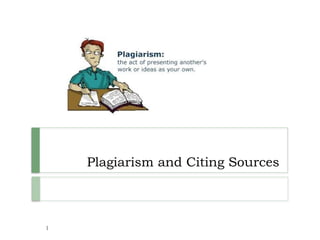
Plagiarism and Citing Sources
2
“Plagiarism is using others’ ideas and
words without clearly acknowledging
the source of that information”
(Writing Tutorial Services, 2004).
Notice that it does not matter whether or
not the failure to give credit is intentional.
Any lack of credit, even accidental, is
considered plagiarism.
At California State University San Marcos, the
General Catalog (2008) defines plagiarism as:
1.not giving proper credit for ideas, words, or
“specific substance of another’s work,” (84)
2.claiming authorship on a group project
without actually doing the work,
3.claiming someone else’s artistic or scholarly
work as your own.
 Any form of information requires
acknowledgement.A common perception is that
only the exact copying of words from a printed
publication constitutes plagiarism.The requirement
to acknowledge sources is much broader. In
particular, it is important to understand that the
source of ideas — opinions, theories, facts, etc. —
as well as words must be credited..
 Sources of words and ideas come in many forms,
all of which require proper attribution to avoid
plagiarism.This web site focuses on plagiarism as it
appears in student papers using written sources
but the concepts can be applied to any type of
source material. Information sources can include:
• spoken words such as conversations and
interviews,
• written words including email and web pages as
well as published and print materials,
• multimedia such as movies, music and photographs,
and
• any other way to express an idea including
statistics, drawings, graphs, maps, etc.
3
Exact Copy Plagiarism
There are two types of exact copy plagiarism —
whole source and partial copy.
Whole source plagiarism is claiming an entire
work as your own.The most common example
is when a student puts his or her name on a
paper written by another person.Whole source
plagiarism also includes claiming to be the
creator of such things as a work of art, an entire
song, or a scientific theorem.
Examples of plagiarizing an entire paper include
turning in as your own work:
 a friend’s paper
 a purchased paper
 a paper published in another source such as
a journal or the Internet
Partial copy plagiarism occurs
when the exact words or content
from a source are inserted as part
of your paper without giving proper
attribution. Examples include
 cutting and pasting from an
electronic source
 copying from a printed source
 repeating a conversation,
interview remarks, etc. verbatim
 inserting a photo, audio clip, or
other multimedia element
4
Paraphrase
 Many people believe that putting a piece
of text or an idea into ‘their own words’
avoids the issue of plagiarism.There is a
formal term for putting text or ideas
into ‘your own words’ — it is called
paraphrasing.
 The purpose of paraphrase is often to
summarize or simplify the author’s ideas,
making them easier to understand, more
approachable.You might also use
paraphrase to emphasize a particular
idea or train of thought from the
original author’s text. Paraphrasing is
acceptable but it is important to
acknowledge the original author’s ideas,
even if it is has been substantially re-
expressed.
 It is important to be cautious
rewriting a piece of information
in your own words, or
paraphrasing. Close paraphrase,
where trivial changes are made
such as substituting similar words
or changing the sentence order,
is essentially the same as copying
the author’s words directly.
 This is not enough to count as an
original expression of the idea
and is still considered a form of
exact copy plagiarism.
5
Common Knowledge
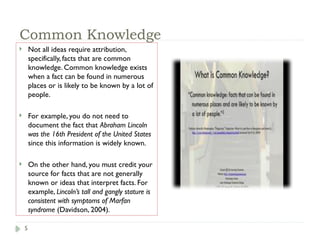
 Not all ideas require attribution,
specifically, facts that are common
knowledge. Common knowledge exists
when a fact can be found in numerous
places or is likely to be known by a lot of
people.
 For example, you do not need to
document the fact that Abraham Lincoln
was the 16th President of the United States
since this information is widely known.
 On the other hand, you must credit your
source for facts that are not generally
known or ideas that interpret facts. For
example, Lincoln’s tall and gangly stature is
consistent with symptoms of Marfan
syndrome (Davidson, 2004).
6
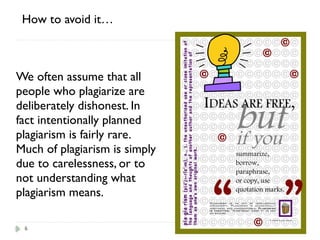
We often assume that all
people who plagiarize are
deliberately dishonest. In
fact intentionally planned
plagiarism is fairly rare.
Much of plagiarism is simply
due to carelessness, or to
not understanding what
plagiarism means.
How to avoid it…
7
Quiz time to check understanding
 You can use your notes to answer the following quiz
questions.
8
Quiz- write down your answers only
Is it plagiarism?YES or NO
1. You write a paper on the legalization of
marijuana for your high school Current Events
class.You save that paper and hand it in to
satisfy the persuasive paper requirement in
your EAP class here at IBU. Is it plagiarism?
2. You are working on a computer slide
show presentation for your EAP class.You
want to make the point that Shakespeare’s
works have been plagiarized throughout the
centuries.You capture a painting of
Shakespeare from the Web for your first slide.
Is it plagiarism?
3. In your computer slide show presentation
about Shakespeare’s works, you include a snippet
of famous dialogue from Romeo and Juliet. Is it
plagiarism?
4. You decide the best way to get across your
point about Shakespeare’s works being
plagiarized is to show some examples. You
include a video clip from the film West Side
Story in your presentation. Is it plagiarism?
5. Your professor says some interesting things
in today’s lecture on Plato.You decide to use
her ideas to begin your paper. Is it plagiarism?
9
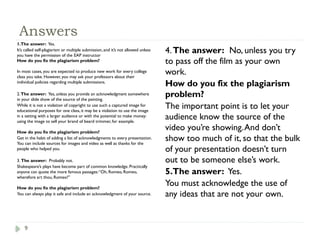
Answers
1.The answer: Yes.
It’s called self-plagiarism or multiple submission, and it’s not allowed unless
you have the permission of the EAP instructor
How do you fix the plagiarism problem?
In most cases, you are expected to produce new work for every college
class you take. However, you may ask your professors about their
individual policies regarding multiple submissions.
2.The answer: Yes, unless you provide an acknowledgment somewhere
in your slide show of the source of the painting.
While it is not a violation of copyright to use such a captured image for
educational purposes for one class, it may be a violation to use the image
in a setting with a larger audience or with the potential to make money:
using the image to sell your brand of beard trimmer, for example.
How do you fix the plagiarism problem?
Get in the habit of adding a list of acknowledgments to every presentation.
You can include sources for images and video as well as thanks for the
people who helped you.
3. The answer: Probably not.
Shakespeare’s plays have become part of common knowledge. Practically
anyone can quote the more famous passages:“Oh, Romeo, Romeo,
wherefore art thou, Romeo?”
How do you fix the plagiarism problem?
You can always play it safe and include an acknowledgment of your source.
4.The answer: No, unless you try
to pass off the film as your own
work.
How do you fix the plagiarism
problem?
The important point is to let your
audience know the source of the
video you’re showing.And don’t
show too much of it, so that the bulk
of your presentation doesn’t turn
out to be someone else’s work.
5.The answer: Yes.
You must acknowledge the use of
any ideas that are not your own.
10
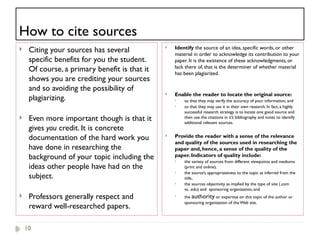
How to cite sources
 Citing your sources has several
specific benefits for you the student.
Of course, a primary benefit is that it
shows you are crediting your sources
and so avoiding the possibility of
plagiarizing.
 Even more important though is that it
gives you credit. It is concrete
documentation of the hard work you
have done in researching the
background of your topic including the
ideas other people have had on the
subject.
 Professors generally respect and
reward well-researched papers.
 Identify the source of an idea, specific words, or other
material in order to acknowledge its contribution to your
paper. It is the existence of these acknowledgments, or
lack there of, that is the determiner of whether material
has been plagiarized.
 Enable the reader to locate the original source:
 so that they may verify the accuracy of your information, and
 so that they may use it in their own research. In fact, a highly
successful research strategy is to locate one good source and
then use the citations in it’s bibliography and notes to identify
additional relevant sources.
 Provide the reader with a sense of the relevance
and quality of the sources used in researching the
paper and, hence, a sense of the quality of the
paper. Indicators of quality include:
 the variety of sources from different viewpoints and mediums
(print and online),
 the source’s appropriateness to the topic as inferred from the
title,
 the sources objectivity as implied by the type of site (.com
vs. .edu) and sponsoring organization, and
 the authority or expertise on this topic of the author or
sponsoring organization of the Web site.
11
Citing online sources
 The rules for citation styles were
developed for print sources —
long before online documents
were available. So not too
surprisingly, it can be difficult to
locate identifying information
equivalent to that available in print
publications in an online source
and fit it into a traditional citation
format.
 Sometimes you have to do some
investigation. Understanding the
basic purposes of citation can help
you determine what information
you really need.
The three basic
purposes of citation are
to:
 identify your source,
 enable others to
locate the source, and
 provide brief criteria
to evaluate the
source’s relevance
and quality.
12
Citation Styles
 Rules for citing sources and citation formats
can get complicated.A number of style guides
have been developed that provide
consistency in how information is cited.
Some of the most common styles are APA,
Chicago, and MLA.
 Citation styles are often associated with
certain professional groups and disciplines.
For instance,APA,American Psychological
Association, is often used in the sciences
while MLA, Modern Language Association, is
popular in the literature and humanities area.
 Rules for citation styles change over time,
particularly recently with the Internet, so it is
important to use the latest edition.Any
library will have some, if not all, of these style
guides.
APA
 Publication Manual of the American Psychological
Association, 6th ed. (2009). Washington, DC :
American Psychological Association.
 The basic format for citing Web sources in
APA style is:
Author’s name (last name, first and any middle
initials). (Date of Internet posting or revision).
Title of page. Title of complete work [if
applicable]. Retrieval statement.
 Neyhart, D. & Karper, E. (2008).APA
formatting and style guide.
Purdue University OnlineWriting Lab.
Retrieved Aug. 29, 2011, from:
http://owl.english.purdue.edu/owl/resource/56
0/01/
 American Psychological Association. (2011).
"Basics of APA Style". APAStyle.org.
Retrieved Aug. 29, 2011, from: <
http://www.apastyle.org/learn/tutorials
/basics-tutorial.aspx>
13
Son of a citation machine
 A lot has changed with
regard to citation. One
online source for helping
you make citations is
Son of a citation machine.
http://citationmachine.net/in
dex2.php?reqstyleid=2&new
style=2&stylebox=2
Task: Use the citation
machine to make citations for
all 6 of your sources.
You need to list them
alphabetically by last name or
title on the sheet of paper.
Double space and use a
hanging indent from the
second line.
14
Sample Reference Page

PLAGIARISM.pptxintellectual propertywertt

  • 1.
  • 2.
    2 “Plagiarism is usingothers’ ideas and words without clearly acknowledging the source of that information” (Writing Tutorial Services, 2004). Notice that it does not matter whether or not the failure to give credit is intentional. Any lack of credit, even accidental, is considered plagiarism. At California State University San Marcos, the General Catalog (2008) defines plagiarism as: 1.not giving proper credit for ideas, words, or “specific substance of another’s work,” (84) 2.claiming authorship on a group project without actually doing the work, 3.claiming someone else’s artistic or scholarly work as your own.  Any form of information requires acknowledgement.A common perception is that only the exact copying of words from a printed publication constitutes plagiarism.The requirement to acknowledge sources is much broader. In particular, it is important to understand that the source of ideas — opinions, theories, facts, etc. — as well as words must be credited..  Sources of words and ideas come in many forms, all of which require proper attribution to avoid plagiarism.This web site focuses on plagiarism as it appears in student papers using written sources but the concepts can be applied to any type of source material. Information sources can include: • spoken words such as conversations and interviews, • written words including email and web pages as well as published and print materials, • multimedia such as movies, music and photographs, and • any other way to express an idea including statistics, drawings, graphs, maps, etc.
  • 3.
    3 Exact Copy Plagiarism Thereare two types of exact copy plagiarism — whole source and partial copy. Whole source plagiarism is claiming an entire work as your own.The most common example is when a student puts his or her name on a paper written by another person.Whole source plagiarism also includes claiming to be the creator of such things as a work of art, an entire song, or a scientific theorem. Examples of plagiarizing an entire paper include turning in as your own work:  a friend’s paper  a purchased paper  a paper published in another source such as a journal or the Internet Partial copy plagiarism occurs when the exact words or content from a source are inserted as part of your paper without giving proper attribution. Examples include  cutting and pasting from an electronic source  copying from a printed source  repeating a conversation, interview remarks, etc. verbatim  inserting a photo, audio clip, or other multimedia element
  • 4.
    4 Paraphrase  Many peoplebelieve that putting a piece of text or an idea into ‘their own words’ avoids the issue of plagiarism.There is a formal term for putting text or ideas into ‘your own words’ — it is called paraphrasing.  The purpose of paraphrase is often to summarize or simplify the author’s ideas, making them easier to understand, more approachable.You might also use paraphrase to emphasize a particular idea or train of thought from the original author’s text. Paraphrasing is acceptable but it is important to acknowledge the original author’s ideas, even if it is has been substantially re- expressed.  It is important to be cautious rewriting a piece of information in your own words, or paraphrasing. Close paraphrase, where trivial changes are made such as substituting similar words or changing the sentence order, is essentially the same as copying the author’s words directly.  This is not enough to count as an original expression of the idea and is still considered a form of exact copy plagiarism.
  • 5.
    5 Common Knowledge  Notall ideas require attribution, specifically, facts that are common knowledge. Common knowledge exists when a fact can be found in numerous places or is likely to be known by a lot of people.  For example, you do not need to document the fact that Abraham Lincoln was the 16th President of the United States since this information is widely known.  On the other hand, you must credit your source for facts that are not generally known or ideas that interpret facts. For example, Lincoln’s tall and gangly stature is consistent with symptoms of Marfan syndrome (Davidson, 2004).
  • 6.
    6 We often assumethat all people who plagiarize are deliberately dishonest. In fact intentionally planned plagiarism is fairly rare. Much of plagiarism is simply due to carelessness, or to not understanding what plagiarism means. How to avoid it…
  • 7.
    7 Quiz time tocheck understanding  You can use your notes to answer the following quiz questions.
  • 8.
    8 Quiz- write downyour answers only Is it plagiarism?YES or NO 1. You write a paper on the legalization of marijuana for your high school Current Events class.You save that paper and hand it in to satisfy the persuasive paper requirement in your EAP class here at IBU. Is it plagiarism? 2. You are working on a computer slide show presentation for your EAP class.You want to make the point that Shakespeare’s works have been plagiarized throughout the centuries.You capture a painting of Shakespeare from the Web for your first slide. Is it plagiarism? 3. In your computer slide show presentation about Shakespeare’s works, you include a snippet of famous dialogue from Romeo and Juliet. Is it plagiarism? 4. You decide the best way to get across your point about Shakespeare’s works being plagiarized is to show some examples. You include a video clip from the film West Side Story in your presentation. Is it plagiarism? 5. Your professor says some interesting things in today’s lecture on Plato.You decide to use her ideas to begin your paper. Is it plagiarism?
  • 9.
    9 Answers 1.The answer: Yes. It’scalled self-plagiarism or multiple submission, and it’s not allowed unless you have the permission of the EAP instructor How do you fix the plagiarism problem? In most cases, you are expected to produce new work for every college class you take. However, you may ask your professors about their individual policies regarding multiple submissions. 2.The answer: Yes, unless you provide an acknowledgment somewhere in your slide show of the source of the painting. While it is not a violation of copyright to use such a captured image for educational purposes for one class, it may be a violation to use the image in a setting with a larger audience or with the potential to make money: using the image to sell your brand of beard trimmer, for example. How do you fix the plagiarism problem? Get in the habit of adding a list of acknowledgments to every presentation. You can include sources for images and video as well as thanks for the people who helped you. 3. The answer: Probably not. Shakespeare’s plays have become part of common knowledge. Practically anyone can quote the more famous passages:“Oh, Romeo, Romeo, wherefore art thou, Romeo?” How do you fix the plagiarism problem? You can always play it safe and include an acknowledgment of your source. 4.The answer: No, unless you try to pass off the film as your own work. How do you fix the plagiarism problem? The important point is to let your audience know the source of the video you’re showing.And don’t show too much of it, so that the bulk of your presentation doesn’t turn out to be someone else’s work. 5.The answer: Yes. You must acknowledge the use of any ideas that are not your own.
  • 10.
    10 How to citesources  Citing your sources has several specific benefits for you the student. Of course, a primary benefit is that it shows you are crediting your sources and so avoiding the possibility of plagiarizing.  Even more important though is that it gives you credit. It is concrete documentation of the hard work you have done in researching the background of your topic including the ideas other people have had on the subject.  Professors generally respect and reward well-researched papers.  Identify the source of an idea, specific words, or other material in order to acknowledge its contribution to your paper. It is the existence of these acknowledgments, or lack there of, that is the determiner of whether material has been plagiarized.  Enable the reader to locate the original source:  so that they may verify the accuracy of your information, and  so that they may use it in their own research. In fact, a highly successful research strategy is to locate one good source and then use the citations in it’s bibliography and notes to identify additional relevant sources.  Provide the reader with a sense of the relevance and quality of the sources used in researching the paper and, hence, a sense of the quality of the paper. Indicators of quality include:  the variety of sources from different viewpoints and mediums (print and online),  the source’s appropriateness to the topic as inferred from the title,  the sources objectivity as implied by the type of site (.com vs. .edu) and sponsoring organization, and  the authority or expertise on this topic of the author or sponsoring organization of the Web site.
  • 11.
    11 Citing online sources The rules for citation styles were developed for print sources — long before online documents were available. So not too surprisingly, it can be difficult to locate identifying information equivalent to that available in print publications in an online source and fit it into a traditional citation format.  Sometimes you have to do some investigation. Understanding the basic purposes of citation can help you determine what information you really need. The three basic purposes of citation are to:  identify your source,  enable others to locate the source, and  provide brief criteria to evaluate the source’s relevance and quality.
  • 12.
    12 Citation Styles  Rulesfor citing sources and citation formats can get complicated.A number of style guides have been developed that provide consistency in how information is cited. Some of the most common styles are APA, Chicago, and MLA.  Citation styles are often associated with certain professional groups and disciplines. For instance,APA,American Psychological Association, is often used in the sciences while MLA, Modern Language Association, is popular in the literature and humanities area.  Rules for citation styles change over time, particularly recently with the Internet, so it is important to use the latest edition.Any library will have some, if not all, of these style guides. APA  Publication Manual of the American Psychological Association, 6th ed. (2009). Washington, DC : American Psychological Association.  The basic format for citing Web sources in APA style is: Author’s name (last name, first and any middle initials). (Date of Internet posting or revision). Title of page. Title of complete work [if applicable]. Retrieval statement.  Neyhart, D. & Karper, E. (2008).APA formatting and style guide. Purdue University OnlineWriting Lab. Retrieved Aug. 29, 2011, from: http://owl.english.purdue.edu/owl/resource/56 0/01/  American Psychological Association. (2011). "Basics of APA Style". APAStyle.org. Retrieved Aug. 29, 2011, from: < http://www.apastyle.org/learn/tutorials /basics-tutorial.aspx>
  • 13.
    13 Son of acitation machine  A lot has changed with regard to citation. One online source for helping you make citations is Son of a citation machine. http://citationmachine.net/in dex2.php?reqstyleid=2&new style=2&stylebox=2 Task: Use the citation machine to make citations for all 6 of your sources. You need to list them alphabetically by last name or title on the sheet of paper. Double space and use a hanging indent from the second line.
  • 14.