INFORMING, EDUCATING, EMPOWERING FAMILIES
617-236-7210 | www.fcsn.org | fcsninfo@fcsn.org
Understanding
My Child’s
Learning Style
Parent Training and Information Center
Federation for Children with Special Needs
© Federation for Children with Special Needs
The Schrafft Center ● 529 Main Street, Suite 1M3 ● Boston, MA 02129
617-236-7210 ● Toll Free 1-800-33-0688 ● Fax 617-241-0330
The Federation for Children
with Special Needs
advocates for quality education, parent
participation and access to quality
health care services for all children,
especially those with disabilities.
Who We Are …
The Parent Training and Information
Center (PTIC), provides free information,
support, technical assistance and affordable
workshops to families who have children with
disabilities and the professionals who work
with them.
Workshop Agenda
Different Learning Styles
•Sensory Learning
•Group and Cooperative Learning
Supporting Learners in the
Classroom
•Tiered Instruction
•Social/Emotional - PBIS
•Universal Design for Learning (UDL)
•Differentiated Instruction
Resources
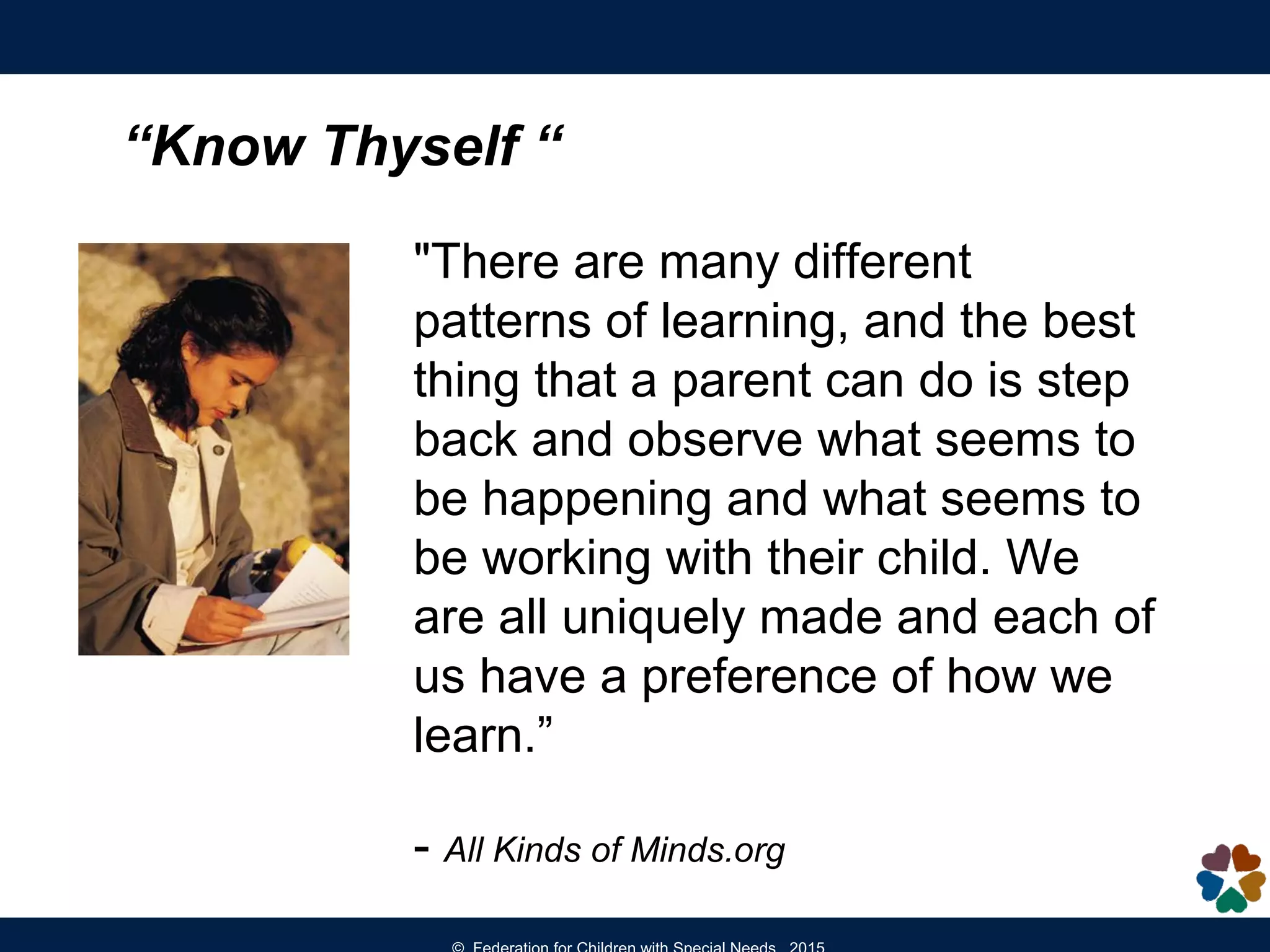
“Know Thyself “
"There are many different
patterns of learning, and the best
thing that a parent can do is step
back and observe what seems to
be happening and what seems to
be working with their child. We
are all uniquely made and each of
us have a preference of how we
learn.”
- All Kinds of Minds.org
How Do Today’s Students Learn?
Science has given us new discoveries about the brain
and learning, while our best schools and teachers are
showing us how to energize, engage, inspire, and
prepare.
What We’ve Learned
•The human brain physically changes when we learn.
•Student beliefs influence how they learn.
•Everything matters when it comes to learning.
•Learning should reflect real life.
- The New England Secondary School Consortium
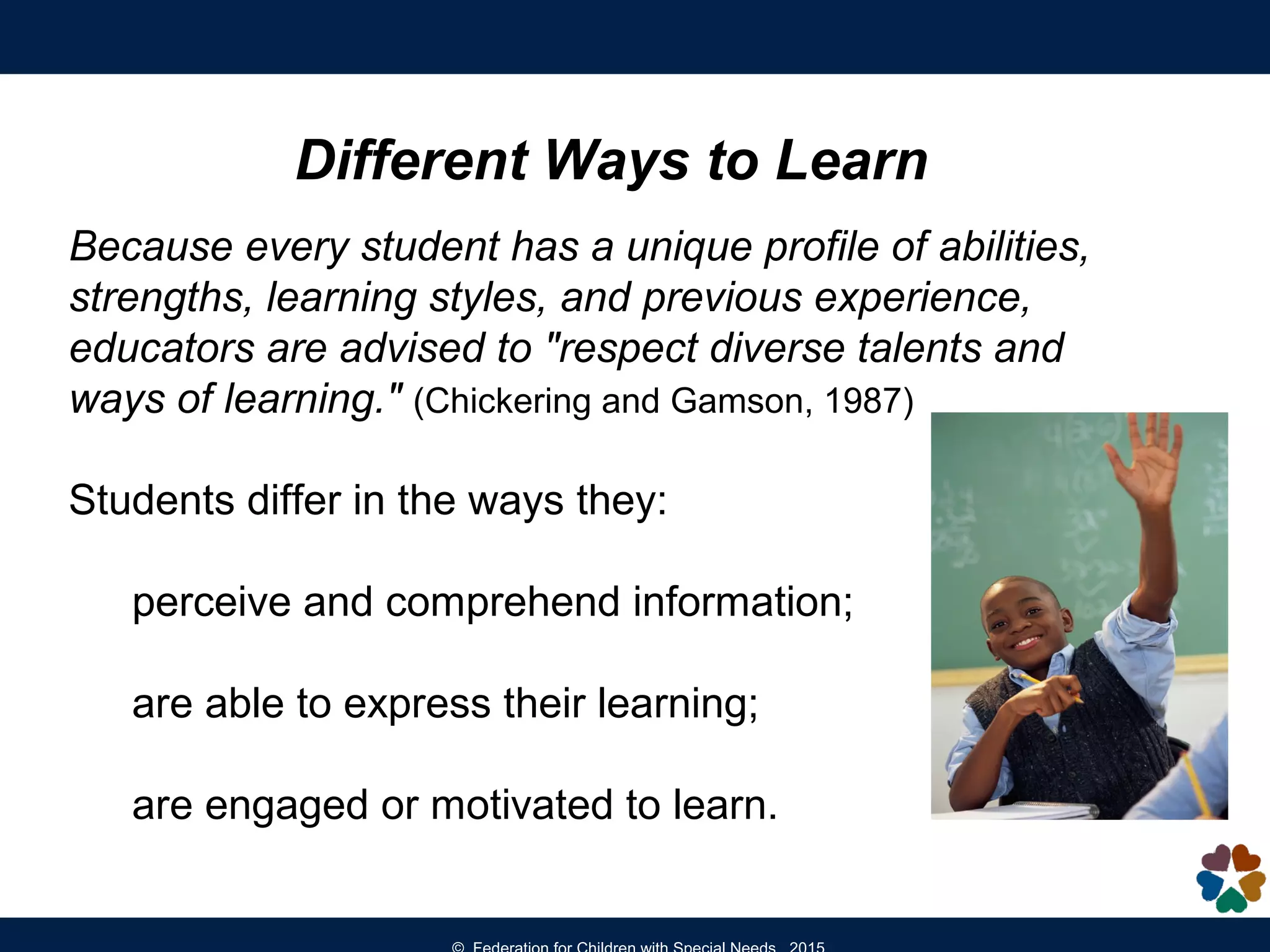
Different Ways to Learn
Because every student has a unique profile of abilities,
strengths, learning styles, and previous experience,
educators are advised to "respect diverse talents and
ways of learning." (Chickering and Gamson, 1987)
Students differ in the ways they:
perceive and comprehend information;
are able to express their learning;
are engaged or motivated to learn.
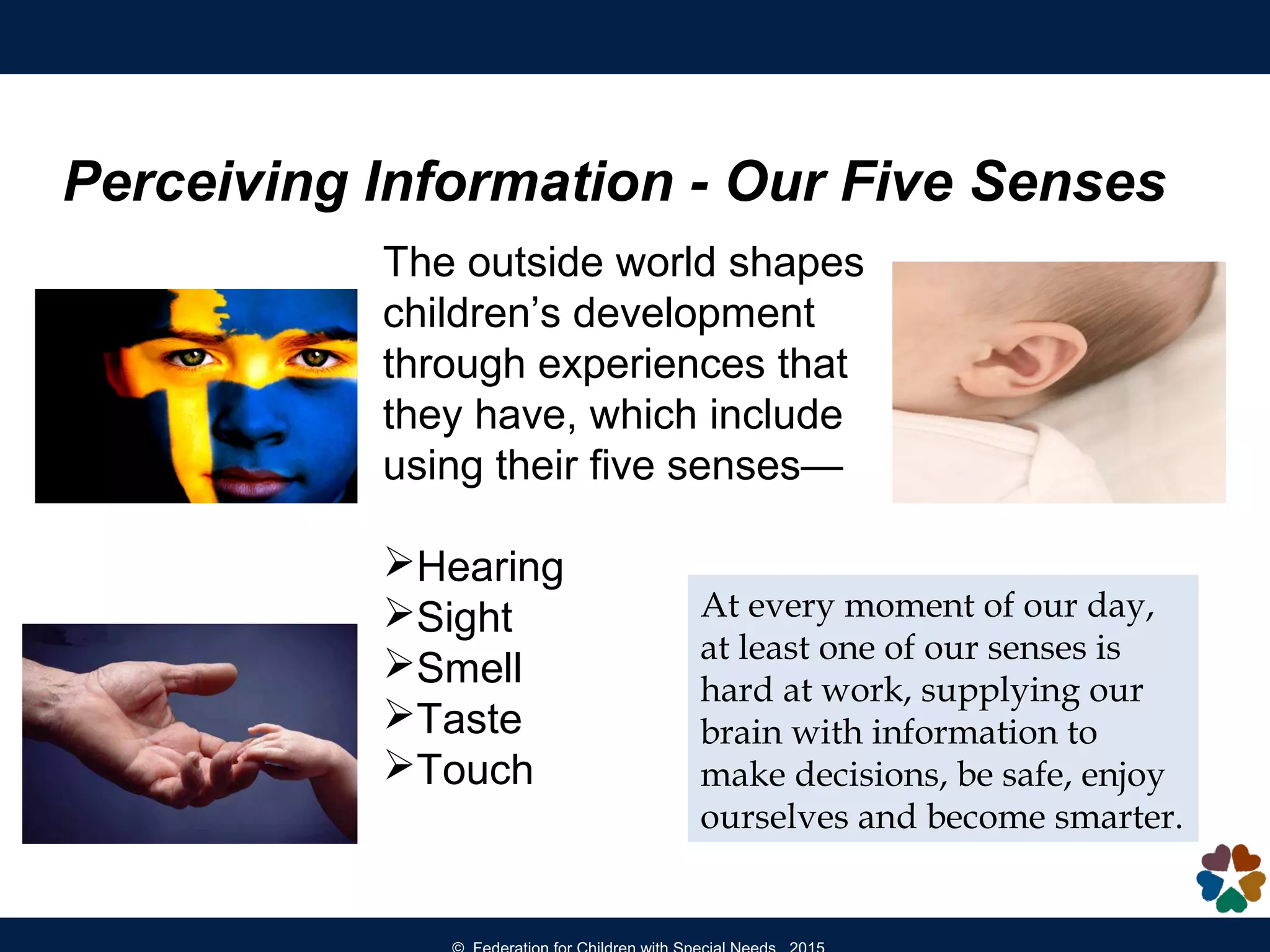
Perceiving Information - Our Five Senses
The outside world shapes
children’s development
through experiences that
they have, which include
using their five senses—
Hearing
Sight
Smell
Taste
Touch
At every moment of our day,
at least one of our senses is
hard at work, supplying our
brain with information to
make decisions, be safe, enjoy
ourselves and become smarter.
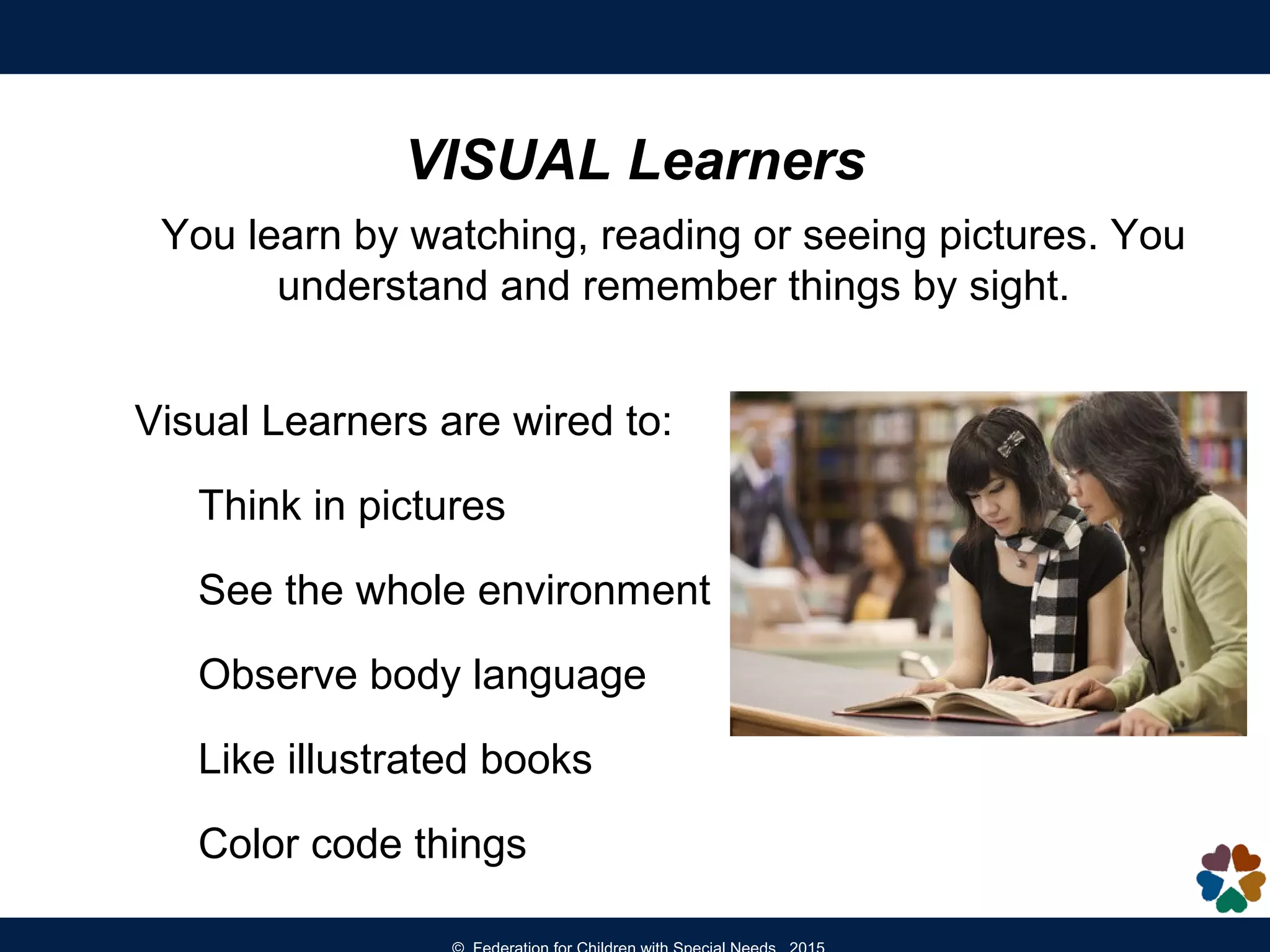
VISUAL Learners
You learn by watching, reading or seeing pictures. You
understand and remember things by sight.
Visual Learners are wired to:
Think in pictures
See the whole environment
Observe body language
Like illustrated books
Color code things
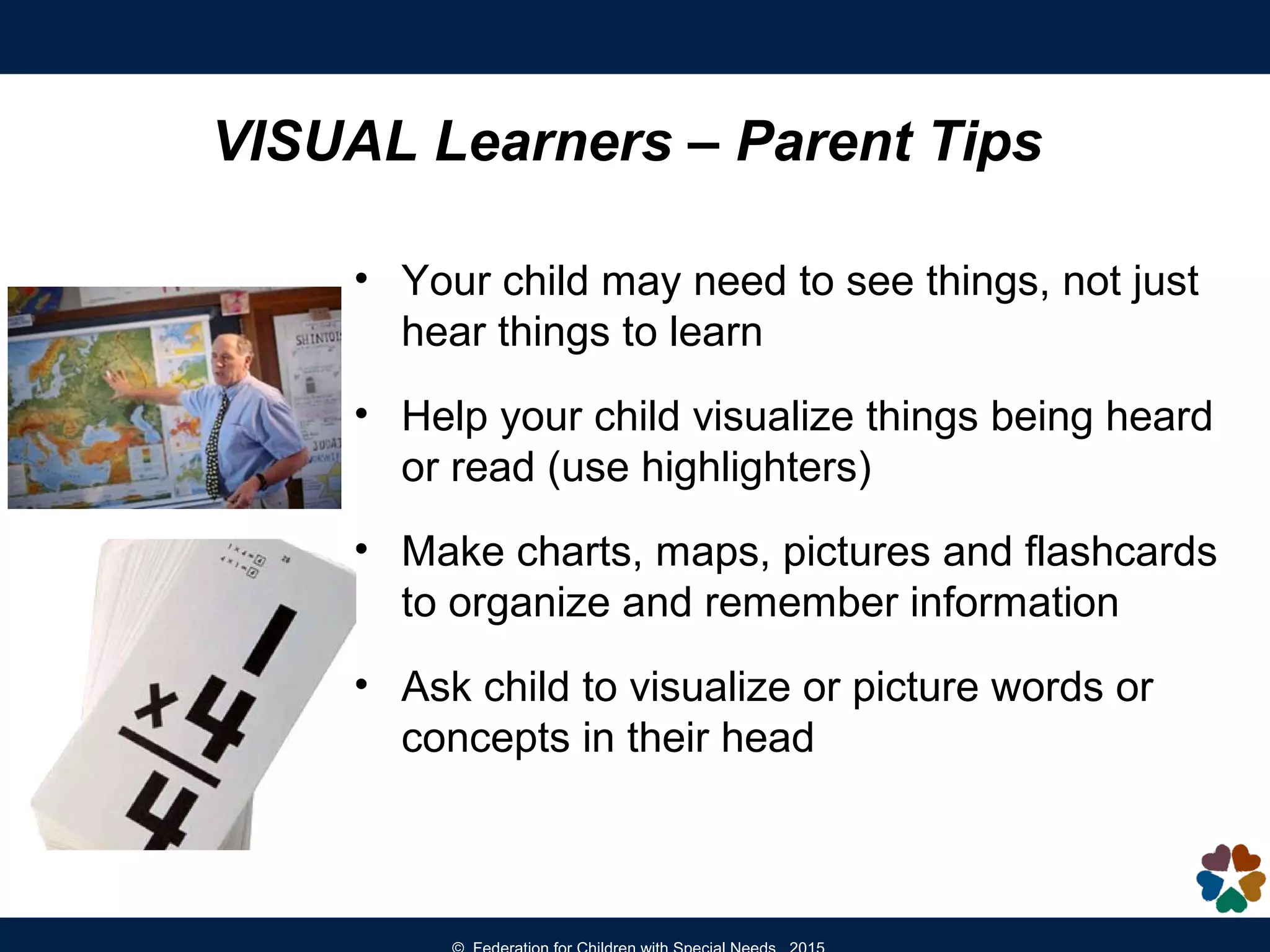
VISUAL Learners – Parent Tips
• Your child may need to see things, not just
hear things to learn
• Help your child visualize things being heard
or read (use highlighters)
• Make charts, maps, pictures and flashcards
to organize and remember information
• Ask child to visualize or picture words or
concepts in their head
AUDITORY Learners
You learn by hearing and listening. You understand and
remember things you have heard.
Auditory Leaners are wired to:
Store information by the way it sounds
Have an easier time understanding spoken instructions
Problem solve by talking it through
Listen to learn
Remember people’s names
AUDITORY Learners – Parent Tips
• Encourage your child to tell a story to demonstrate
their point of view
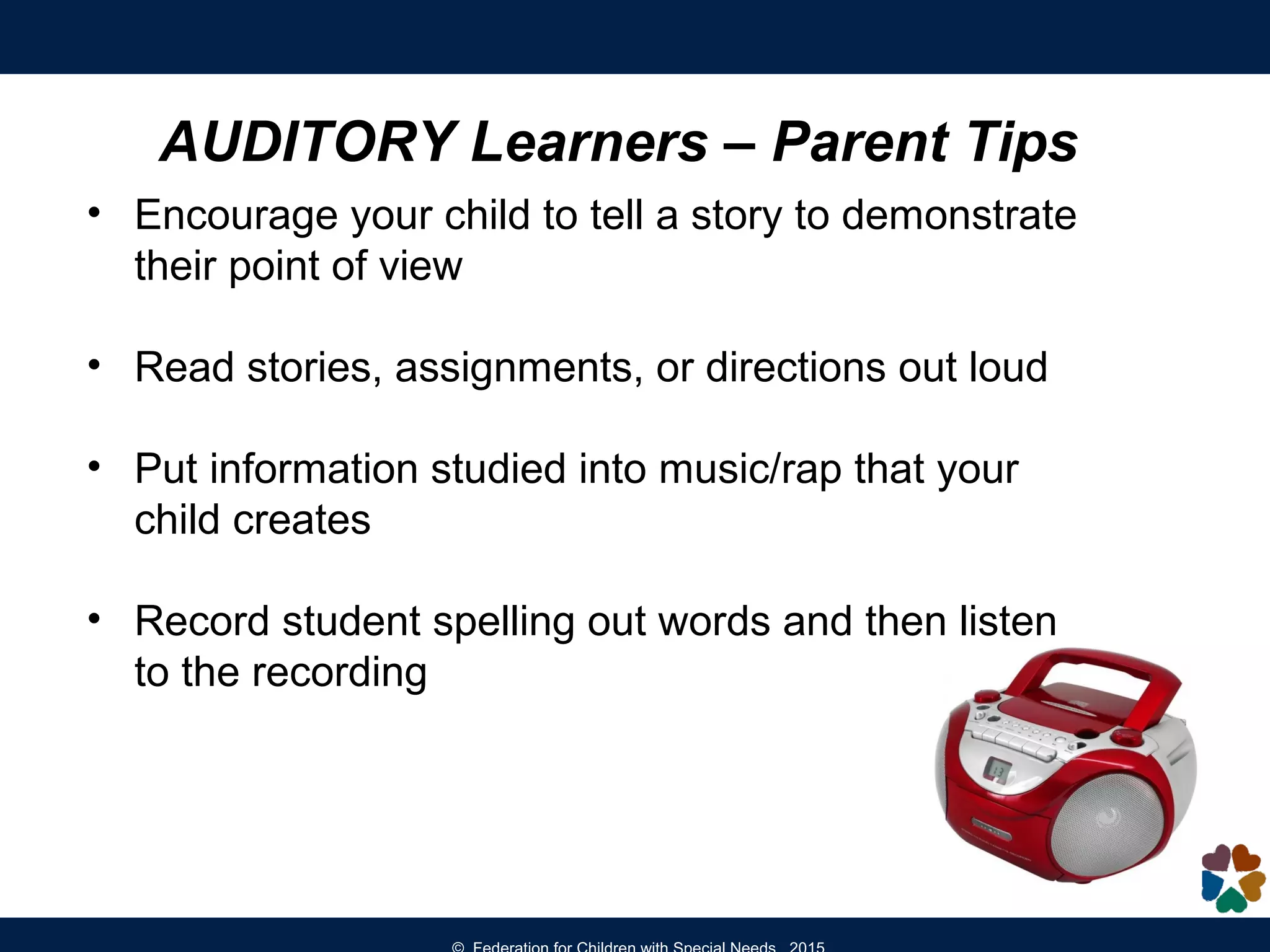
• Read stories, assignments, or directions out loud
• Put information studied into music/rap that your
child creates
• Record student spelling out words and then listen
to the recording
TACTILE Learners
You learn by touching and doing. You understand and
remember things through physical movement. You are a
"hands-on" learner who prefers to touch, move, build, or
draw what you learn.
Tactile Learners are wired to:
Learn better when some type of physical activity is
involved
Tap a pencil, shake their foot, or hold on to something
while learning
Use a computer to reinforce learning through the
sense of touch
TACTILE Learners – Parent Tips
• Provide opportunity for extra curricula activities:
sports, dance, acting
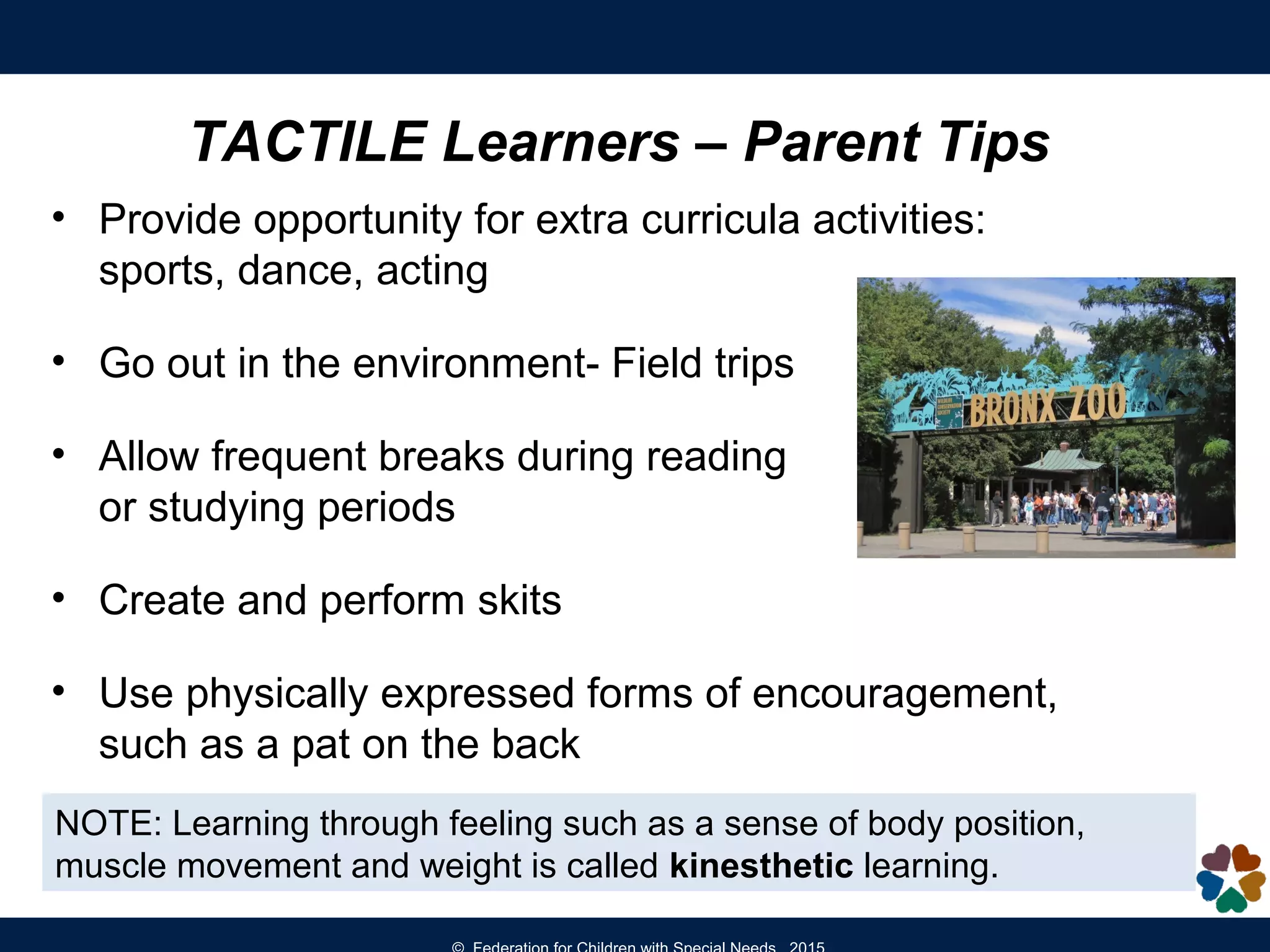
• Go out in the environment- Field trips
• Allow frequent breaks during reading
or studying periods
• Create and perform skits
• Use physically expressed forms of encouragement,
such as a pat on the back
NOTE: Learning through feeling such as a sense of body position,
muscle movement and weight is called kinesthetic learning.
Different Methods of Learning
Most people learn using a combination of learning
styles and methods.
Average amount of information that is retained
through a particular learning method:
Lecture = 5%
Reading = 10%
Audiovisual = 20%
Demonstration = 30%
Discussion Group = 50%
Practice by doing = 75%
Teach others / immediate use of learning = 90%
Individual vs.
Group Learning
In 1983, Howard Gardner
proposed that there are several
different types of intelligences, or
learning styles.
Interpersonal (People Smart) –
Learn through relating to others by sharing, comparing,
and cooperating. [Examples: group leaders and team players]
Intrapersonal (Self Smart) –
Learn best by working alone and setting individual goals.
[Examples: independent and organized students]
Cooperative Learning
WHAT IS IT? - Small Group Learning
Cooperative learning is a successful teaching
strategy in which small teams, each with students of
different levels of ability, use a variety of learning
activities to improve their understanding of a subject.
Each member of a team is responsible not only for
learning what is taught but also for helping
teammates learn, thus creating an atmosphere of
achievement.
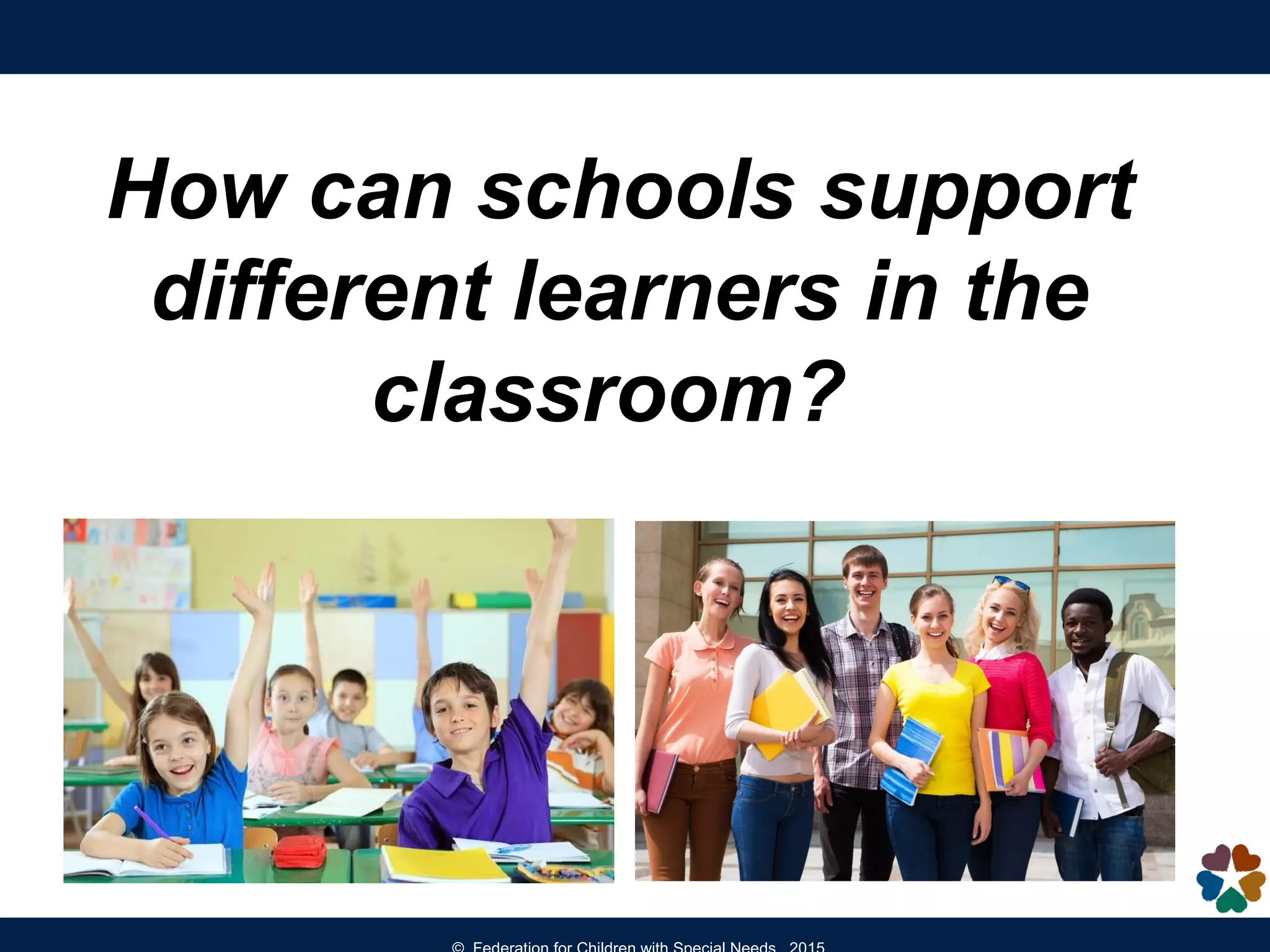
How can schools support
different learners in the
classroom?
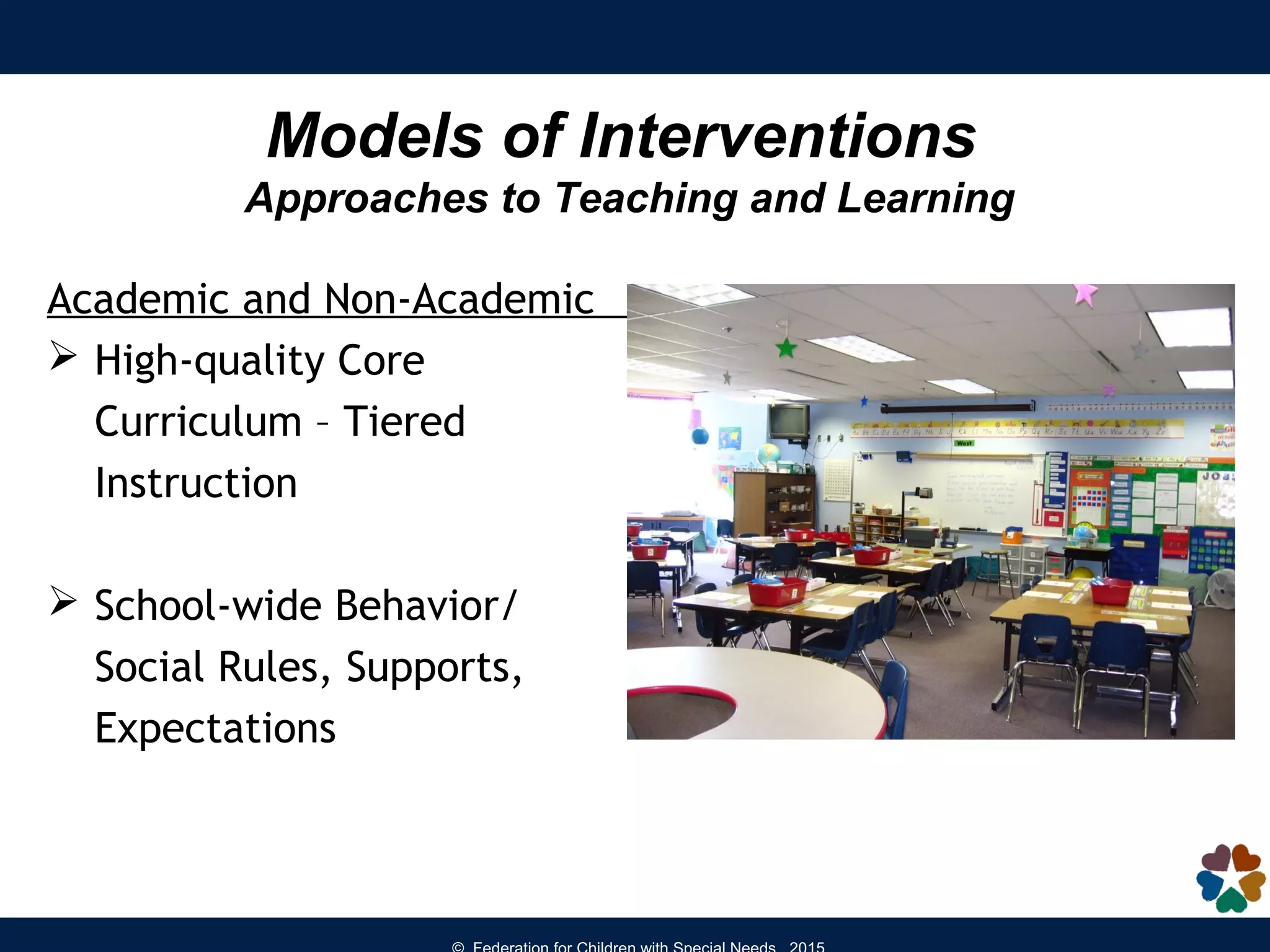
Models of Interventions
Approaches to Teaching and Learning
Academic and Non-Academic
 High-quality Core
Curriculum – Tiered
Instruction
 School-wide Behavior/
Social Rules, Supports,
Expectations
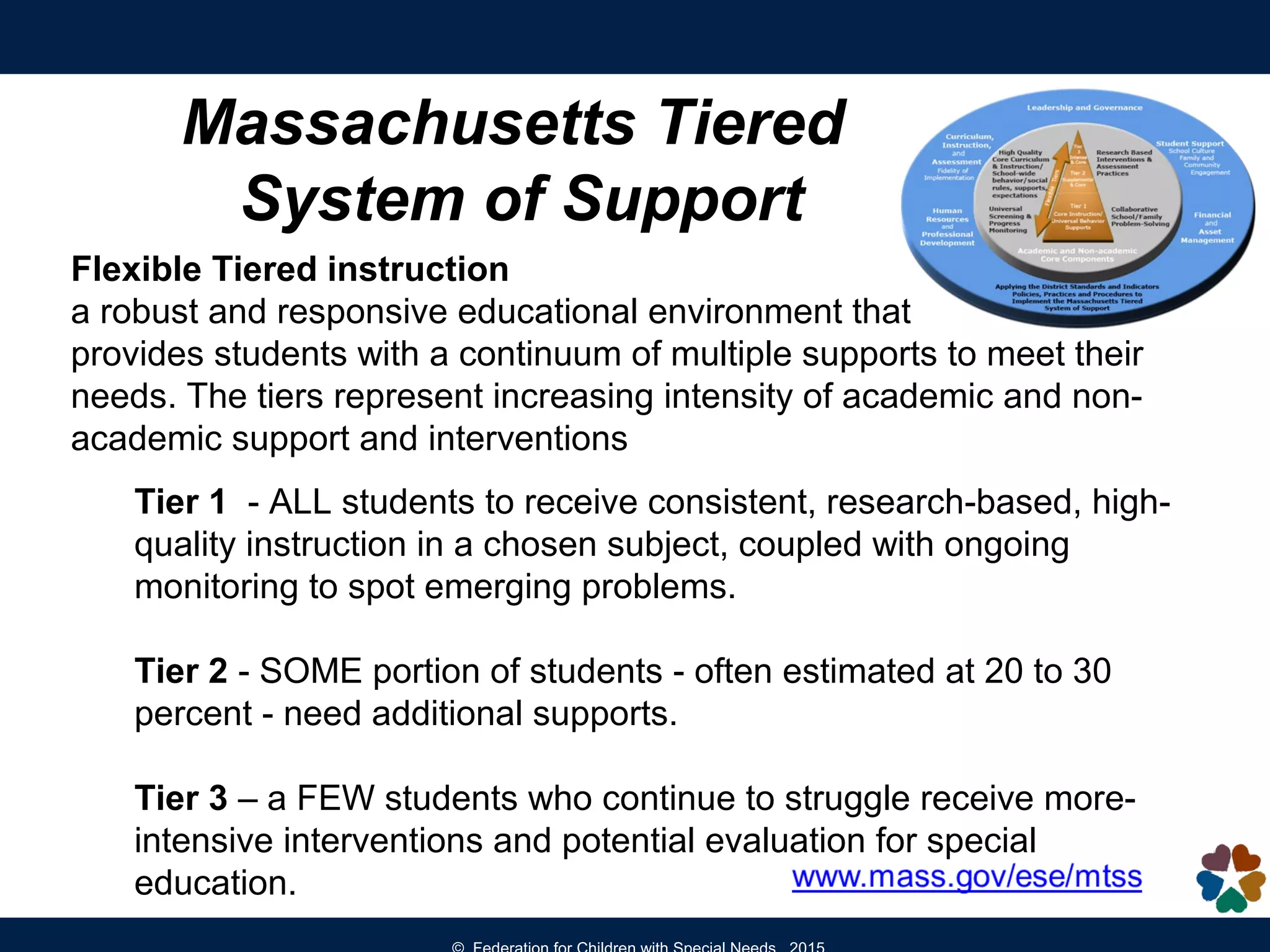
Massachusetts Tiered
System of Support
Flexible Tiered instruction
a robust and responsive educational environment that
provides students with a continuum of multiple supports to meet their
needs. The tiers represent increasing intensity of academic and non-
academic support and interventions
Tier 1 - ALL students to receive consistent, research-based, high-
quality instruction in a chosen subject, coupled with ongoing
monitoring to spot emerging problems.
Tier 2 - SOME portion of students - often estimated at 20 to 30
percent - need additional supports.
Tier 3 – a FEW students who continue to struggle receive more-
intensive interventions and potential evaluation for special
education.
Social/Emotional Support in the
Classroom
Developing students’ social and emotional competencies -
• recognize and manage their emotions,
• demonstrate caring and concern for others,
• establish positive relationships,
• make responsible decisions, and
• constructively handle challenging social situations
helps schools create safe learning environments that contribute to
academic achievement for all.
Positive Behavior Interventions and Supports (PBIS) is a
proactive approach to establishing the behavioral supports and
social culture and needed for all students in a school to achieve
social, emotional and academic success.
UDL – A Teaching Strategy to Support
all Learners in the Classroom
• Address learner variability
• Based on scientific insights into how humans learn
• Builds on students’ strengths
Universal Design for Learning
is a set of principles for curriculum development that give all
individuals equal opportunities to learn.
UDL provides a blueprint for creating instructional goals,
methods, materials, and assessments that work for
everyone--not a single, one-size-fits-all solution but rather
flexible approaches that can be customized and adjusted
for individual needs.
A Framework for Learning
UDL= Universal Design for Learning
Three primary brain networks come into play:
1. The WHAT of Learning – Recognition Network
(How we gather facts and categorize what we see, hear and
read)
2. The HOW of Learning – Strategic Network
(How we plan and perform tasks, express our ideas)
3. The WHY of Learning – Affective Network
(How we engage and stay motivated, challenged, excited or
interested)
www.cast.org
Provide Multiple Means of
REPRESENTATION
(the WHAT of Learning)
All students have different ways of approaching content.
Learning occurs best when multiple representations are used –
allow students to make connections within, as well as between,
concepts.
Present information and content in different ways:
•Make sure videos have captions
•Use text-to-speech
•Provide translations
•Clarify difficult vocabulary
•Show concepts in lots of different ways
•Highlight important ideas
GOAL – to become resourceful and knowledgeable Learners
Provide Multiple Means of
ACTION & EXPRESSION
(the HOW of Learning)
Learners differ in the ways that they can navigate a learning environment
and express what they know. Some may be able to express themselves
well in written text but not speech, and vice versa. Action and expression
require a great deal of strategy, practice, and organization.
Differentiate the ways that students can express what they know
•Provide multiple tools
•Help learners use Assistive Technology (AT) when necessary
•Allow written or verbal responses
•Provide time for learners to practice and explore
•Provide planning supports like graphic organizers
•Help learners set goals
GOAL – to become strategic, goal-oriented learners
Provide Multiple Means of
ENGAGEMENT
(the WHY of Learning)
Learners differ in the ways in which they can be engaged or
motivated to learn. Some learners might like to work alone, while
others prefer to work with their peers.
Stimulate interest and motivation for learning
•Allow for choice
•Make learning relevant to the learner's life
•Provide safe and comfortable environments
•Include ways to learn with peers
•Build coping skills and strategies
•Help learners reflect on their learning
GOAL – to become purposeful, motivated learners
Differentiated Instruction
“Differentiated instruction”—the process of identifying
students’ individual learning strengths, needs, and interests
and adapting lessons to match them.
Teachers may vary their approach to the same material with
different students in the same classroom and assignments
can be structured to help students of different ability and
interest levels meet the same goals.
EXAMPLE:
A teacher may allow an introverted student to write an essay
on a historical topic while a more outgoing student gives an
oral presentation on the same subject.
District Curriculum
Accommodation Plan (DCAP)
… to assist the regular classroom teacher in analyzing and
accommodating diverse learning styles of all children in the
regular classroom and in providing appropriate services and
support within the regular education program …
M.G.L.c. 71, Section 38Q1/2
https://malegislature.gov/Laws/GeneralLaws/PartI/TitleXII/Chapter71/Section38Q1~2
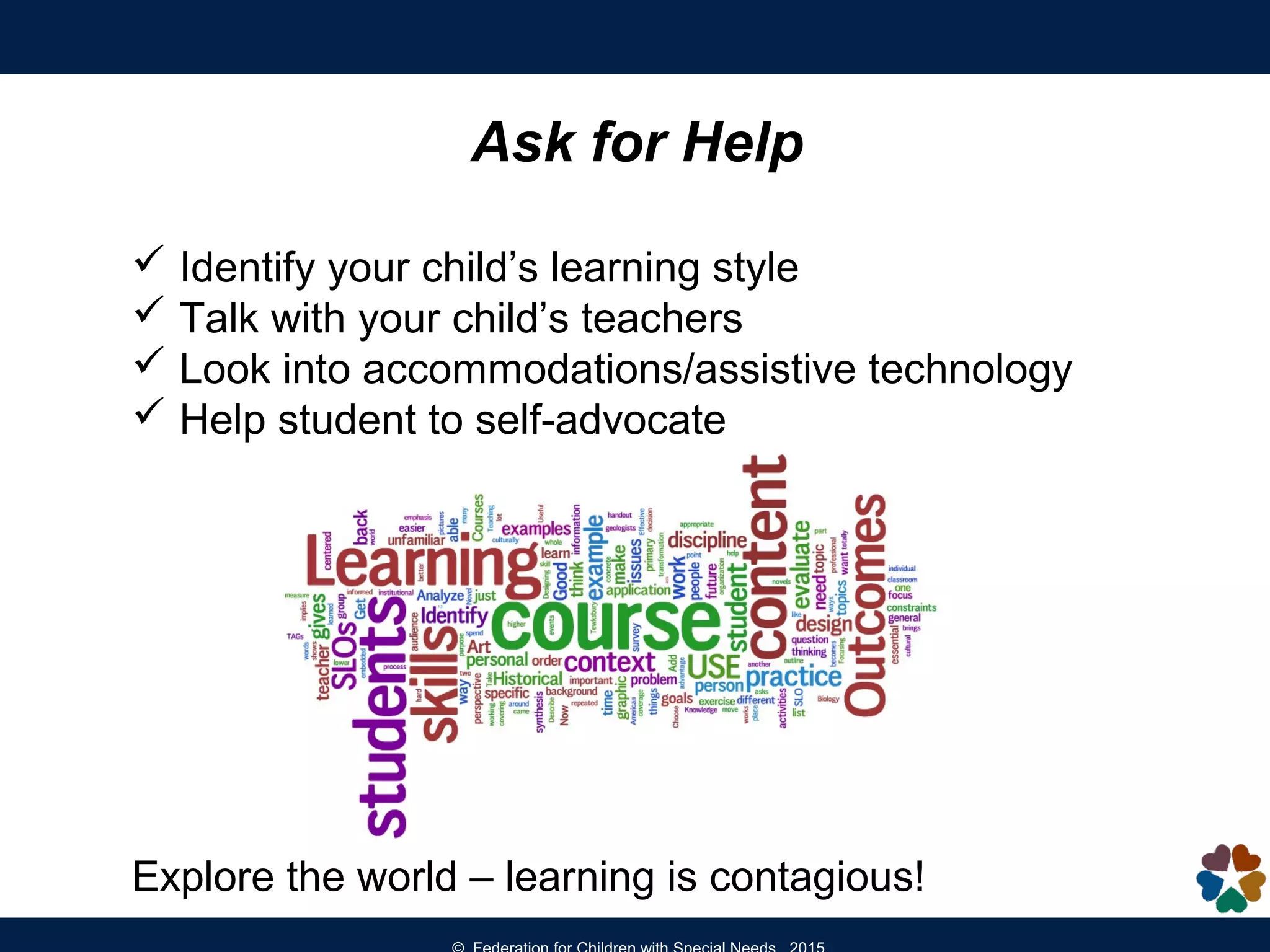
Ask for Help
 Identify your child’s learning style
 Talk with your child’s teachers
 Look into accommodations/assistive technology
 Help student to self-advocate
Explore the world – learning is contagious!
Families are Important!
The ongoing and meaningful
involvement of families
increases student success.
Effective family engagement is a shared responsibility of
families, schools and communities for student learning and
achievement; it is continuous from birth to young adulthood; and
it occurs across multiple setting where children learn.
http://www.doe.mass.edu/boe/sac/parent/FSCPfundamentals.docx
Online Resources
National Center on Universal Design for Learning
http://www.udlcenter.org/
Center for Applied Special Technology - CAST
http://www.cast.org/
Massachusetts Tiered System of Support - MTTS
www.mass.gov/ese/mtss
Use of Technology in Teaching and Learning/US Dept. of Education
http://www.ed.gov/oii-news/use-technology-teaching-and-learning
Family and Community Engagement
http://www.doe.mass.edu/FamComm/f_involvement.html?section=resources
Federation for Children with Special Needs – FCSN
www.fcsn.org
Contact our Call Center
617-236-7210
Visit our website
www.fcsn.org
Email Us
info@fcsn.org
Follow Us on . . .
How Can We Help You?
INFORMING, EDUCATING, EMPOWERING FAMILIES
617-236-7210 | www.fcsn.org | fcsninfo@fcsn.org
Thank you for coming!
Parent Training and Information Center (PTIC) and The Link Center
are supported in part by grants from
the U.S. Dept. of Education, Office of Special Education Programs,
the Rehabilitation Services Administration and
the MA Dept. of Elementary and Secondary Education
Any questions?

Understanding My Child's Learning Style

  • 1.
    INFORMING, EDUCATING, EMPOWERINGFAMILIES 617-236-7210 | www.fcsn.org | fcsninfo@fcsn.org
  • 2.
    Understanding My Child’s Learning Style ParentTraining and Information Center Federation for Children with Special Needs © Federation for Children with Special Needs The Schrafft Center ● 529 Main Street, Suite 1M3 ● Boston, MA 02129 617-236-7210 ● Toll Free 1-800-33-0688 ● Fax 617-241-0330
  • 3.
    The Federation forChildren with Special Needs advocates for quality education, parent participation and access to quality health care services for all children, especially those with disabilities. Who We Are … The Parent Training and Information Center (PTIC), provides free information, support, technical assistance and affordable workshops to families who have children with disabilities and the professionals who work with them.
  • 4.
    Workshop Agenda Different LearningStyles •Sensory Learning •Group and Cooperative Learning Supporting Learners in the Classroom •Tiered Instruction •Social/Emotional - PBIS •Universal Design for Learning (UDL) •Differentiated Instruction Resources
  • 5.
    “Know Thyself “ "Thereare many different patterns of learning, and the best thing that a parent can do is step back and observe what seems to be happening and what seems to be working with their child. We are all uniquely made and each of us have a preference of how we learn.” - All Kinds of Minds.org
  • 6.
    How Do Today’sStudents Learn? Science has given us new discoveries about the brain and learning, while our best schools and teachers are showing us how to energize, engage, inspire, and prepare. What We’ve Learned •The human brain physically changes when we learn. •Student beliefs influence how they learn. •Everything matters when it comes to learning. •Learning should reflect real life. - The New England Secondary School Consortium
  • 7.
    Different Ways toLearn Because every student has a unique profile of abilities, strengths, learning styles, and previous experience, educators are advised to "respect diverse talents and ways of learning." (Chickering and Gamson, 1987) Students differ in the ways they: perceive and comprehend information; are able to express their learning; are engaged or motivated to learn.
  • 8.
    Perceiving Information -Our Five Senses The outside world shapes children’s development through experiences that they have, which include using their five senses— Hearing Sight Smell Taste Touch At every moment of our day, at least one of our senses is hard at work, supplying our brain with information to make decisions, be safe, enjoy ourselves and become smarter.
  • 9.
    VISUAL Learners You learnby watching, reading or seeing pictures. You understand and remember things by sight. Visual Learners are wired to: Think in pictures See the whole environment Observe body language Like illustrated books Color code things
  • 10.
    VISUAL Learners –Parent Tips • Your child may need to see things, not just hear things to learn • Help your child visualize things being heard or read (use highlighters) • Make charts, maps, pictures and flashcards to organize and remember information • Ask child to visualize or picture words or concepts in their head
  • 11.
    AUDITORY Learners You learnby hearing and listening. You understand and remember things you have heard. Auditory Leaners are wired to: Store information by the way it sounds Have an easier time understanding spoken instructions Problem solve by talking it through Listen to learn Remember people’s names
  • 12.
    AUDITORY Learners –Parent Tips • Encourage your child to tell a story to demonstrate their point of view • Read stories, assignments, or directions out loud • Put information studied into music/rap that your child creates • Record student spelling out words and then listen to the recording
  • 13.
    TACTILE Learners You learnby touching and doing. You understand and remember things through physical movement. You are a "hands-on" learner who prefers to touch, move, build, or draw what you learn. Tactile Learners are wired to: Learn better when some type of physical activity is involved Tap a pencil, shake their foot, or hold on to something while learning Use a computer to reinforce learning through the sense of touch
  • 14.
    TACTILE Learners –Parent Tips • Provide opportunity for extra curricula activities: sports, dance, acting • Go out in the environment- Field trips • Allow frequent breaks during reading or studying periods • Create and perform skits • Use physically expressed forms of encouragement, such as a pat on the back NOTE: Learning through feeling such as a sense of body position, muscle movement and weight is called kinesthetic learning.
  • 15.
    Different Methods ofLearning Most people learn using a combination of learning styles and methods. Average amount of information that is retained through a particular learning method: Lecture = 5% Reading = 10% Audiovisual = 20% Demonstration = 30% Discussion Group = 50% Practice by doing = 75% Teach others / immediate use of learning = 90%
  • 16.
    Individual vs. Group Learning In1983, Howard Gardner proposed that there are several different types of intelligences, or learning styles. Interpersonal (People Smart) – Learn through relating to others by sharing, comparing, and cooperating. [Examples: group leaders and team players] Intrapersonal (Self Smart) – Learn best by working alone and setting individual goals. [Examples: independent and organized students]
  • 17.
    Cooperative Learning WHAT ISIT? - Small Group Learning Cooperative learning is a successful teaching strategy in which small teams, each with students of different levels of ability, use a variety of learning activities to improve their understanding of a subject. Each member of a team is responsible not only for learning what is taught but also for helping teammates learn, thus creating an atmosphere of achievement.
  • 18.
    How can schoolssupport different learners in the classroom?
  • 19.
    Models of Interventions Approachesto Teaching and Learning Academic and Non-Academic  High-quality Core Curriculum – Tiered Instruction  School-wide Behavior/ Social Rules, Supports, Expectations
  • 20.
    Massachusetts Tiered System ofSupport Flexible Tiered instruction a robust and responsive educational environment that provides students with a continuum of multiple supports to meet their needs. The tiers represent increasing intensity of academic and non- academic support and interventions Tier 1 - ALL students to receive consistent, research-based, high- quality instruction in a chosen subject, coupled with ongoing monitoring to spot emerging problems. Tier 2 - SOME portion of students - often estimated at 20 to 30 percent - need additional supports. Tier 3 – a FEW students who continue to struggle receive more- intensive interventions and potential evaluation for special education.
  • 21.
    Social/Emotional Support inthe Classroom Developing students’ social and emotional competencies - • recognize and manage their emotions, • demonstrate caring and concern for others, • establish positive relationships, • make responsible decisions, and • constructively handle challenging social situations helps schools create safe learning environments that contribute to academic achievement for all. Positive Behavior Interventions and Supports (PBIS) is a proactive approach to establishing the behavioral supports and social culture and needed for all students in a school to achieve social, emotional and academic success.
  • 22.
    UDL – ATeaching Strategy to Support all Learners in the Classroom • Address learner variability • Based on scientific insights into how humans learn • Builds on students’ strengths Universal Design for Learning is a set of principles for curriculum development that give all individuals equal opportunities to learn. UDL provides a blueprint for creating instructional goals, methods, materials, and assessments that work for everyone--not a single, one-size-fits-all solution but rather flexible approaches that can be customized and adjusted for individual needs.
  • 23.
    A Framework forLearning UDL= Universal Design for Learning Three primary brain networks come into play: 1. The WHAT of Learning – Recognition Network (How we gather facts and categorize what we see, hear and read) 2. The HOW of Learning – Strategic Network (How we plan and perform tasks, express our ideas) 3. The WHY of Learning – Affective Network (How we engage and stay motivated, challenged, excited or interested) www.cast.org
  • 24.
    Provide Multiple Meansof REPRESENTATION (the WHAT of Learning) All students have different ways of approaching content. Learning occurs best when multiple representations are used – allow students to make connections within, as well as between, concepts. Present information and content in different ways: •Make sure videos have captions •Use text-to-speech •Provide translations •Clarify difficult vocabulary •Show concepts in lots of different ways •Highlight important ideas GOAL – to become resourceful and knowledgeable Learners
  • 25.
    Provide Multiple Meansof ACTION & EXPRESSION (the HOW of Learning) Learners differ in the ways that they can navigate a learning environment and express what they know. Some may be able to express themselves well in written text but not speech, and vice versa. Action and expression require a great deal of strategy, practice, and organization. Differentiate the ways that students can express what they know •Provide multiple tools •Help learners use Assistive Technology (AT) when necessary •Allow written or verbal responses •Provide time for learners to practice and explore •Provide planning supports like graphic organizers •Help learners set goals GOAL – to become strategic, goal-oriented learners
  • 26.
    Provide Multiple Meansof ENGAGEMENT (the WHY of Learning) Learners differ in the ways in which they can be engaged or motivated to learn. Some learners might like to work alone, while others prefer to work with their peers. Stimulate interest and motivation for learning •Allow for choice •Make learning relevant to the learner's life •Provide safe and comfortable environments •Include ways to learn with peers •Build coping skills and strategies •Help learners reflect on their learning GOAL – to become purposeful, motivated learners
  • 27.
    Differentiated Instruction “Differentiated instruction”—theprocess of identifying students’ individual learning strengths, needs, and interests and adapting lessons to match them. Teachers may vary their approach to the same material with different students in the same classroom and assignments can be structured to help students of different ability and interest levels meet the same goals. EXAMPLE: A teacher may allow an introverted student to write an essay on a historical topic while a more outgoing student gives an oral presentation on the same subject.
  • 28.
    District Curriculum Accommodation Plan(DCAP) … to assist the regular classroom teacher in analyzing and accommodating diverse learning styles of all children in the regular classroom and in providing appropriate services and support within the regular education program … M.G.L.c. 71, Section 38Q1/2 https://malegislature.gov/Laws/GeneralLaws/PartI/TitleXII/Chapter71/Section38Q1~2
  • 29.
    Ask for Help Identify your child’s learning style  Talk with your child’s teachers  Look into accommodations/assistive technology  Help student to self-advocate Explore the world – learning is contagious!
  • 30.
    Families are Important! Theongoing and meaningful involvement of families increases student success. Effective family engagement is a shared responsibility of families, schools and communities for student learning and achievement; it is continuous from birth to young adulthood; and it occurs across multiple setting where children learn. http://www.doe.mass.edu/boe/sac/parent/FSCPfundamentals.docx
  • 31.
    Online Resources National Centeron Universal Design for Learning http://www.udlcenter.org/ Center for Applied Special Technology - CAST http://www.cast.org/ Massachusetts Tiered System of Support - MTTS www.mass.gov/ese/mtss Use of Technology in Teaching and Learning/US Dept. of Education http://www.ed.gov/oii-news/use-technology-teaching-and-learning Family and Community Engagement http://www.doe.mass.edu/FamComm/f_involvement.html?section=resources Federation for Children with Special Needs – FCSN www.fcsn.org
  • 32.
    Contact our CallCenter 617-236-7210 Visit our website www.fcsn.org Email Us info@fcsn.org Follow Us on . . . How Can We Help You?
  • 33.
    INFORMING, EDUCATING, EMPOWERINGFAMILIES 617-236-7210 | www.fcsn.org | fcsninfo@fcsn.org Thank you for coming! Parent Training and Information Center (PTIC) and The Link Center are supported in part by grants from the U.S. Dept. of Education, Office of Special Education Programs, the Rehabilitation Services Administration and the MA Dept. of Elementary and Secondary Education Any questions?