







Understanding
influence in
social media
Francesco D’Orazio, Research Director, Face, @abc3d

AQR, London, 5 September 2011


                                                       © 2010 Thomas Doyle
In 1958 Herbert Kelman identified three
broad varieties of social influence:"

compliance appear to agree with others, but
actually keep dissenting opinions private   "


identification influenced by someone who is
liked and respected   "


internalization accept a belief or behavior and
agree both publicly and privately
                                                © 2010 Thomas Doyle
Our need to be right
Informational social Influence"

Our need to be liked
Normative social influence


                                 © 2010 Thomas Doyle
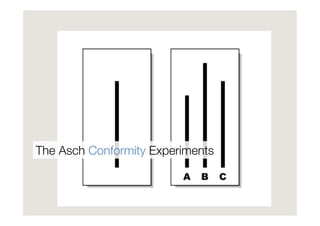
The Asch Conformity Experiments
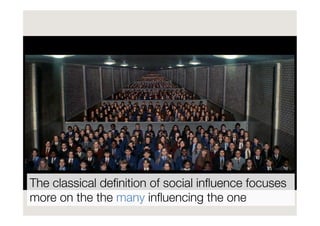
The classical definition of social influence focuses
more on the the many influencing the one
“Social influence occurs when
   an individual's thoughts,
    feelings or actions are
  affected by other people.”
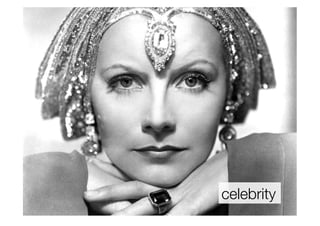
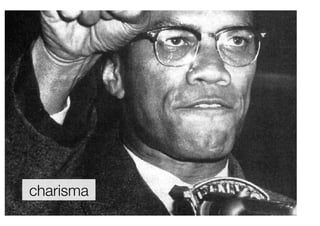
unless we are confronted with an
    extraordinary individual…
authority
celebrity
charisma
Now, has social media
changed the mechanics
of social influence?
Three types of structures
in social media:"

Pyramid > Twitter"

Circle > Facebook"

Hybrid > Blogs, Google +
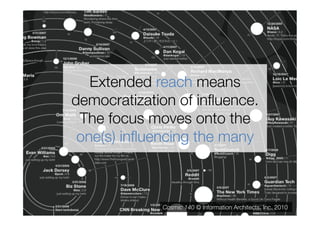
Extended reach means
democratization of influence.
 The focus moves onto the "
 one(s) influencing the many


             Cosmic 140 © Information Architects, Inc. 2010
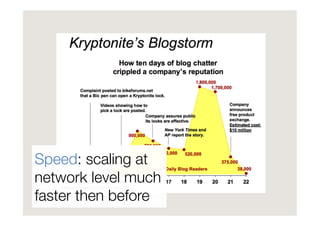
Speed: scaling at
network level much
faster then before
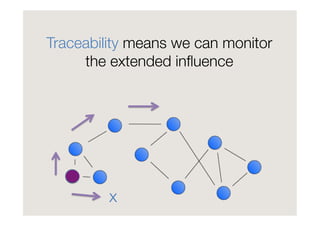
Traceability means we can monitor
     the extended influence


         x
Traceability means we can monitor
      the extended influence


NYTlabs > Project Cascade"
structures underlying sharing
activity on the web"
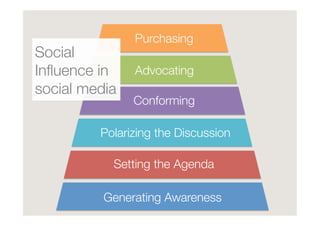
Purchasing
Social
Influence in   Advocating
social media
                Conforming

          Polarizing the Discussion

            Setting the Agenda

          Generating Awareness
…the underlying single mechanic
   being Behaviour Change


                     © B.J. Fogg – The Fogg Behavior Model
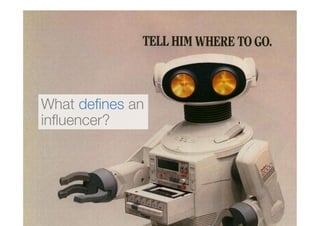
What defines an
influencer?
Universal influencers
        do not exist
© 2010 Thomas Doyle


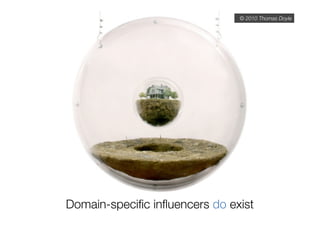
Domain-specific influencers do exist
Credibility: expertise,
charisma, authority in
a specific domain
Trust: ability to set
 the agenda, trigger
    discussions and
generating reactions
Reach: access to a
potentially wide
network of people
Network Quality:
2nd, 3rd, 4th level
    connections
Timing: ability to
be in synch with
the needs of the
audience
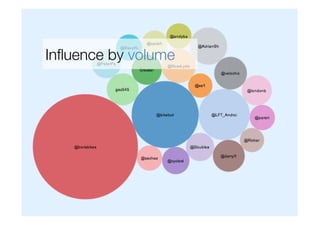
Influence by volume
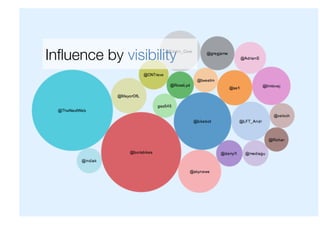
Influence by visibility
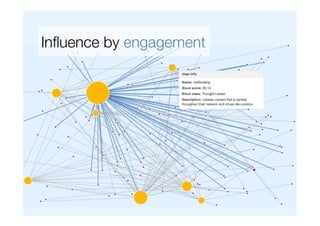
Influence by engagement
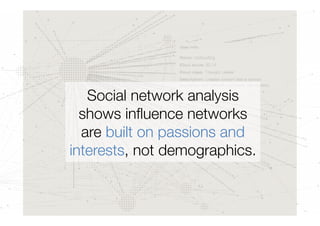
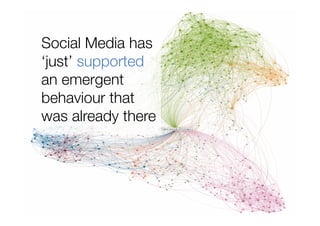
Social network analysis
  shows influence networks
  are built on passions and
interests, not demographics.
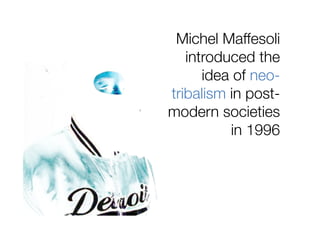
Michel Maffesoli
   introduced the
      idea of neo-
tribalism in post-
modern societies
          in 1996
Social Media has
‘just’ supported
an emergent
behaviour that
was already there
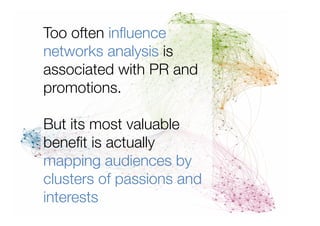
Too often influence
networks analysis is
associated with PR and
promotions. "

But its most valuable
benefit is actually
mapping audiences by
clusters of passions and
interests
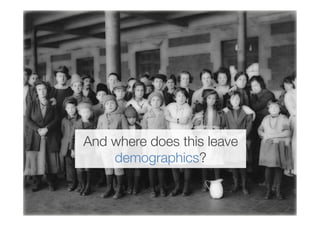
And where does this leave
    demographics?
Thanks
Francesco D’Orazio, @abc3d


                              © 2010 Thomas Doyle

Understanding influence in social media