
Augmenting Brands with Real Time Data
Philip McNaughton, Face


                                        A case-study about
                                        using social media
                                         data to scale up
                                        qualitative insights
You can’t turn data into a story without joining it with other data
                                       - Flip Kromer, founder and CTO Infochimps
This is a story about joining qualitative and quantitative data together
Where Social Media                     But we can
Research is now….                      do more….


 Monitoring
 Campaign Tracking                                                Validating
                                                                   insights
 Topic Buzz                                         Scaling up
                                                    qualitative
 Mining Insights                                     learning


                                                          On a mass scale


         More specifically it’s a story about the power of scaling up
                  qualitative insights with Social Media
A client came to us with insights developed
through qualitative research, and asked us to
       validate, sharpen and prioritize.
We first took a traditional approach: a
  survey > participants respond to
 insights and tell us what they think
Great, but some limiting factors…


    Artificial
    Evaluative responses
    Still limited sample size
    No depth
This time, we wanted to augment this data with something a little different
We wanted to see whether the insights played out organically in the real
   world, not in the artificial world of the survey and the focus group
We set out to see how
 Social Media could
augment and validate
  the learning on a
     mass scale
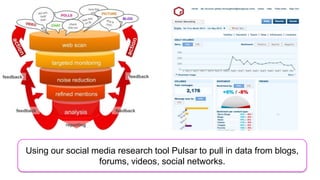
Using our social media research tool Pulsar to pull in data from blogs,
                  forums, videos, social networks.
The Big Challenge; if we can’t ask a
specific question of social media users,
 how can we ‘find’ a specific answer?
Starts by creating search terms that look very broadly at the
   insights, their categories, and behavior around them.
Create a clean data set with non-original consumer content removed –
                        5000 pieces of content
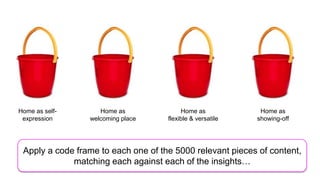
Home as self-       Home as               Home as            Home as
 expression      welcoming place     flexible & versatile   showing-off


 Apply a code frame to each one of the 5000 relevant pieces of content,
             matching each against each of the insights…
Obtain the relative size
   of each insight’s
foundation in real time,
    organic data
Qualitatively interrogate the data in each insight bucket for depth
                        around its meaning
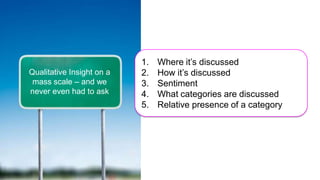
1.   Where it’s discussed
Qualitative Insight on a   2.   How it’s discussed
 mass scale – and we       3.   Sentiment
never even had to ask      4.   What categories are discussed
                           5.   Relative presence of a category
Match our social insights
 back with the quantitative
data, to create a 360 degree
      data perspective
A word to the wise…


Qualitative Insight on a
 mass scale – and we
never even had to ask             Depends on penetration of SM
                                  Data must be cleaned
                                  Human process – labor intensive
                                  SM is organic, but not the whole story
                                  Still needs other data for control
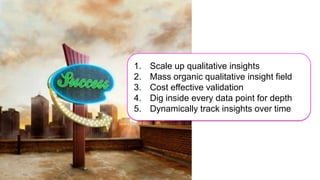
1.   Scale up qualitative insights
Qualitative Insight on a
                           2.   Mass organic qualitative insight field
 mass scale – and we
never even had to ask      3.   Cost effective validation
                           4.   Dig inside every data point for depth
                           5.   Dynamically track insights over time
Thanks!
   @facecocreation
info@facegroup.com
www.facegroup.com

Augmenting Brands

  • 1.
    Augmenting Brands withReal Time Data Philip McNaughton, Face A case-study about using social media data to scale up qualitative insights
  • 2.
    You can’t turndata into a story without joining it with other data - Flip Kromer, founder and CTO Infochimps
  • 3.
    This is astory about joining qualitative and quantitative data together
  • 4.
    Where Social Media But we can Research is now…. do more…. Monitoring Campaign Tracking Validating insights Topic Buzz Scaling up qualitative Mining Insights learning On a mass scale More specifically it’s a story about the power of scaling up qualitative insights with Social Media
  • 5.
    A client cameto us with insights developed through qualitative research, and asked us to validate, sharpen and prioritize.
  • 6.
    We first tooka traditional approach: a survey > participants respond to insights and tell us what they think
  • 7.
    Great, but somelimiting factors… Artificial Evaluative responses Still limited sample size No depth
  • 8.
    This time, wewanted to augment this data with something a little different
  • 9.
    We wanted tosee whether the insights played out organically in the real world, not in the artificial world of the survey and the focus group
  • 10.
    We set outto see how Social Media could augment and validate the learning on a mass scale
  • 11.
    Using our socialmedia research tool Pulsar to pull in data from blogs, forums, videos, social networks.
  • 12.
    The Big Challenge;if we can’t ask a specific question of social media users, how can we ‘find’ a specific answer?
  • 13.
    Starts by creatingsearch terms that look very broadly at the insights, their categories, and behavior around them.
  • 14.
    Create a cleandata set with non-original consumer content removed – 5000 pieces of content
  • 15.
    Home as self- Home as Home as Home as expression welcoming place flexible & versatile showing-off Apply a code frame to each one of the 5000 relevant pieces of content, matching each against each of the insights…
  • 16.
    Obtain the relativesize of each insight’s foundation in real time, organic data
  • 17.
    Qualitatively interrogate thedata in each insight bucket for depth around its meaning
  • 18.
    1. Where it’s discussed Qualitative Insight on a 2. How it’s discussed mass scale – and we 3. Sentiment never even had to ask 4. What categories are discussed 5. Relative presence of a category
  • 19.
    Match our socialinsights back with the quantitative data, to create a 360 degree data perspective
  • 20.
    A word tothe wise… Qualitative Insight on a mass scale – and we never even had to ask Depends on penetration of SM Data must be cleaned Human process – labor intensive SM is organic, but not the whole story Still needs other data for control
  • 21.
    1. Scale up qualitative insights Qualitative Insight on a 2. Mass organic qualitative insight field mass scale – and we never even had to ask 3. Cost effective validation 4. Dig inside every data point for depth 5. Dynamically track insights over time
  • 22.
    Thanks! @facecocreation info@facegroup.com www.facegroup.com

Editor's Notes

  • #3 Thank you. This is a story about using Social Media in Research, and of course we have heard a lot about that over the last couple of days. Ricardo from Mastercard yesterday talked about the journey from Questioning to ListeningToday I am going to talk about how questioning and listening can work together.
  • #4 Aspractioners of social media research, its sometimes easy to be seduced into thinking that it has all the answers. Of course, that is very far from the truth. My thinking is that social media research works best of all when it is used in synthesis with other data sources. Not just as an add-on, but in a more directly integrated way with other research data – qual and quant.
  • #5 Lots of things that social media is good for. But we can do more….There’s a lot of talk in the industry about social media research being a meeting point for qualitative and quantitative research.And at face we have been exploring one way of working at that intersection.
  • #6 RB were feeling pretty comfortable with these insights, but they had been developed in a small scale way, and they wanted to find a way of validating, sharpening and prioritising
  • #7 So we took a 2 step approach to this. Firstly, a relatively traditional survey approach.
  • #13 Of course, this is always the challenge with social media. It inverts the traditional research process of question and answer. The answers are there, but how to filter and question the data in the way which finds the answers you need. This was particularly magnified in this case because we were looking for something very specific.
  • #14 Of course, social media is primarily about filtering and questioning a potentially endless data field in the right way. The first thing was to narrow down a potential data set that we could search in.Focus on change and disatisfaction with the home environment
  • #15 But this still leaves us with a huge amount of content that we know is roughly in the right area. How do we go about questioning this data set to validate our 4 insights…
  • #16 And it actually a very traditional MR method > coding open-ended data.
  • #17 Ultimately, what we were shooting for…. !
  • #18 It’s great to be able to do that. But of course we can do even more….
  • #22 Final point is the most interesting here. And it applies to social media not just in insight validation, but across segmentaion, comms tracking. So if I was to leave you with one bigger though about the benefit and relevance of social media research it’s that, the fact that it offers us a real-time, truly dynamic insight field. We just need to be as good as we can be at learning how to question it!