A Facebook Word-of-Mouth for the
Emergence of Collective Network: A
Cyber-field Study
- Who are the Influentials?
- Structural Social Influence Model of Facebook
WOM
Kyounghee “Hazel” Kwon (PhD)
What this project about…
—  Social	
  Network	
  Sites	
  as	
  the	
  prevalent	
  

Web	
  2.0	
  Service	
  
—  A	
  culture	
  of	
  sharing	
  on	
  SNS	
  
—  Interpersonal/relational	
  sharing	
  

produces	
  social	
  information	
  
—  Social	
  information	
  produces	
  social	
  

influence	
  	
  
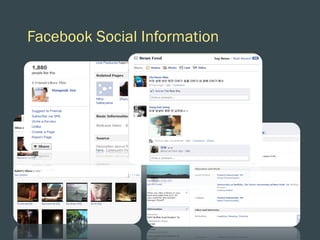
Facebook Social Information
Levels of Influence Studied…
—  Individual	
  Level:	
  Personal	
  Influence	
  

(the	
  “Influentials”)	


—  Social	
  Network-­‐Level:	
  Structural	
  Social	
  

Influence	


Taking	
  Network	
  Approach	
  is	
  
advantageous	
  and	
  contributory	
  
to	
  the	
  limited	
  CMC	
  literature	
  
that	
  focus	
  on	
  intra-­‐individual	
  
psychological	
  processing	


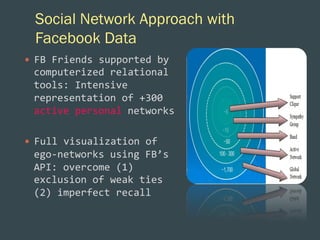
Social Network Approach with
Facebook Data
—  FB	
  Friends	
  supported	
  by	
  

computerized	
  relational	
  
tools:	
  Intensive	
  
representation	
  of	
  +300	
  
active	
  personal	
  networks	
  
—  Full	
  visualization	
  of	
  

ego-­‐networks	
  using	
  FB’s	
  
API:	
  overcome	
  (1)	
  
exclusion	
  of	
  weak	
  ties	
  
(2)	
  imperfect	
  recall	
  
—  A	
  cyber-­‐behavioral	
  	
  field	
  study:	
  

Mobilizing	
  a	
  campus	
  advocacy	
  
network	
  on	
  FB	
  through	
  WOM	


—  Recruit	
  “opinion	
  leader”	
  (OL)	
  players	
  
—  OL…	
  

(1)	
  sent	
  the	
  group	
  invitation	
  message	
  to	
  
their	
  college	
  friends	
  
(2)	
  did	
  the	
  survey	
  about	
  themselves	
  
(3)	
  let	
  the	
  researcher	
  access	
  to	
  the	
  
personal	
  network	
  data	
  in	
  FB	
  :friends	
  
names	
  list	
  +	
  sociometric	
  (optional)	
  	
  
—  In	
  the	
  end	
  of	
  project,	
  the	
  researcher	
  
matched	
  those	
  who	
  joined	
  the	
  group	
  with	
  
the	
  names	
  identified	
  in	
  the	
  name	
  list.	
  
STUDY 1
Individual Level: Personal Influence
—  Personal	
  influence	
  becomes	
  critical	
  for	
  

others’	
  decision	
  making	
  process	
  
—  “More	
  influential”	
  than	
  others?	
  
—  Profiling	
  opinion	
  leaders	
  has	
  been	
  a	
  
major	
  topic	
  in	
  diffusion,	
  marketing,	
  &	
  
political	
  comm	
  
—  Four	
  approaches:	
  sociometric,	
  key	
  
informant’s	
  rating,	
  self-­‐designating,	
  
observation	
  
—  Compare self-designating and observation

methods in identifying the influentials
—  Characterize the influentials in FB context
—  Emphasis on social attributes


  -­‐	
  Innovators	
  are	
  not	
  always	
  the	
  
influentials	
  (Rogers,	
  1995.	
  p.388)	


  -­‐	
  Must	
  have	
  “follower	
  groups”	


  -­‐	
  Equivalent	
  terms:	
  Maven,	
  buzzer,	
  
navigator,	
  social	
  connector,	
  network	
  hub	


  -­‐	
  How	
  to	
  measure	
  	
  FB-­‐specific	
  social	
  
attributes?	
  	
  
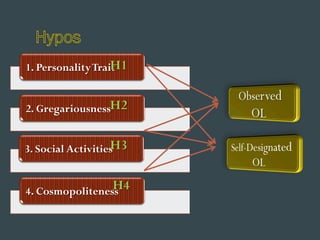
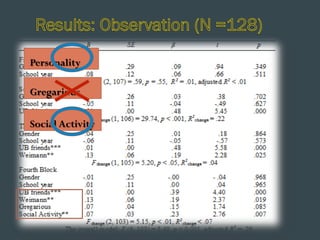
H1
1. Personality Trait
2. GregariousnessH2

H3
3. Social Activities
H4
4. Cosmopoliteness
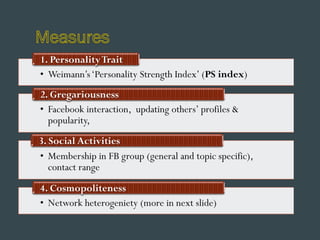
1. Personality Trait
•  Weimann’s ‘Personality Strength Index’ (PS index)
2. Gregariousness
•  Facebook interaction, updating others’ profiles &
popularity,
3. Social Activities
•  Membership in FB group (general and topic specific),
contact range
4. Cosmopoliteness
•  Network heterogeniety (more in next slide)
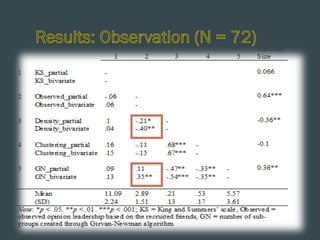
—  Self-­‐designated	
  OL-­‐ship:	
  King	
  

and	
  Summers’	
  OL	
  scale	
  (KS	
  
scale)	
  (M=7.05	
  out	
  of	
  10,	
  SD	
  =	
  
2.17)	
  
—  Observed	
  OL-­‐ship:	
  number	
  of	
  
members	
  mobilized	
  by	
  each	
  OL	
  
player’s	
  invitation	
  (M=23.51)	
  
(Duplicated	
  invitees	
  excluded:	
  
1711	
  out	
  of	
  7486,	
  22.86%).	
  
Transformed	
  due	
  to	
  severe	
  
skewness	
  (M=2.81,	
  SD	
  =	
  1.49)	
  	
  
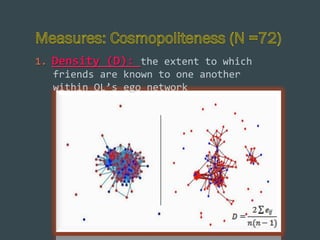
1.  Density	
  (D):	
  the	
  extent	
  to	
  which	
  
friends	
  are	
  known	
  to	
  one	
  another	
  
within	
  OL’s	
  ego	
  network	


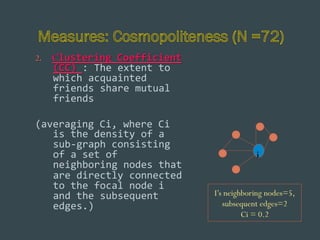
Clustering	
  Coefficient	
  
(CC)	
  :	
  The	
  extent	
  to	
  
which	
  acquainted	
  
friends	
  share	
  mutual	
  
friends	


(averaging	
  Ci,	
  where	
  Ci	
  
is	
  the	
  density	
  of	
  a	
  
sub-­‐graph	
  consisting	
  
of	
  a	
  set	
  of	
  
neighboring	
  nodes	
  that	
  
are	
  directly	
  connected	
  
to	
  the	
  focal	
  node	
  i	
  
and	
  the	
  subsequent	
  
edges.)	
  
2. 

i

I’s neighboring nodes=5,
subsequent edges=2
Ci = 0.2
3.  Girvan-­‐Newman	
  community	
  structure	


  -­‐	
  “Edge-­‐betweenness”	


  (1)	
  calculate	
  edge-­‐betweenness	
  for	
  all	
  edges	


  (2)	
  remove	
  the	
  edge	
  of	
  the	
  highest	
  betweenness	


  (3)	
  recalculate	
  for	
  the	
  remaining	
  edges	


  (4)	
  repeating	
  from	
  (2)	
  until	
  no	
  edge	
  remains	


  (5)	
  produce	
  number	
  of	
  sub-­‐groups	
  (Girvan	
  &	
  
Newman,	
  2002)	


  The	
  more	
  sub-­‐groups	
  are	
  identified,	
  the	
  
more	
  the	
  personal	
  network	
  is	
  heterogeneous	


Personality
Gregarious
Social Activity
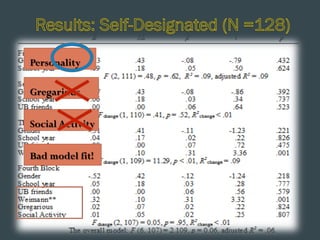
Personality
Gregarious
Social Activity
Bad model fit!
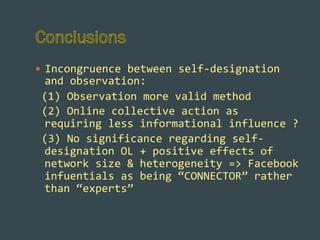
—  Incongruence	
  between	
  self-­‐designation	
  

and	
  observation:	
  
	
  (1)	
  Observation	
  more	
  valid	
  method	
  
	
  (2)	
  Online	
  collective	
  action	
  as	
  
requiring	
  less	
  informational	
  influence	
  ?	
  
	
  (3)	
  No	
  significance	
  regarding	
  self-­‐
designation	
  OL	
  +	
  positive	
  effects	
  of	
  
network	
  size	
  &	
  heterogeneity	
  =>	
  Facebook	
  
infuentials	
  as	
  being	
  “CONNECTOR”	
  rather	
  
than	
  “experts”	
  
STUDY 2
Network Level
Social structural influence on WOM
—  WOM	
  widely	
  discussed	
  topic	
  in	
  online	
  

environment	
  
—  Even	
  more	
  visible	
  in	
  SNS	
  	
  
—  Individual	
  aspect	
  widely	
  discussed	
  
(e.g.	
  social	
  psychological	
  motive,	
  
opinion	
  leadership)	
  
—  Few	
  studies	
  on	
  social	
  structural	
  
aspect:	
  important	
  but	
  hard	
  to	
  measure	
  	
  
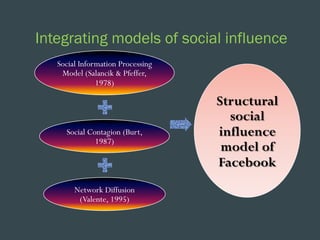
Integrating models of social influence
Social Information Processing
Model (Salancik & Pfeffer,
1978)

Social Contagion (Burt,
1987)

Network Diffusion
(Valente, 1995)

Structural
social
influence
model of
Facebook
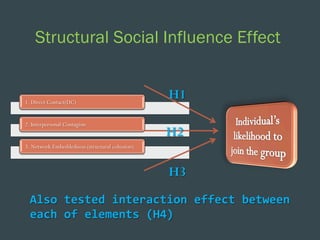
Structural Social Influence Effect

1. Direct Contact(DC)
2. Interpersonal Contagion

H1
H2

3. Network Embeddedness (structural cohesion)

H3
Also	
  tested	
  interaction	
  effect	
  between	
  
each	
  of	
  elements	
  (H4)	
  
Methods
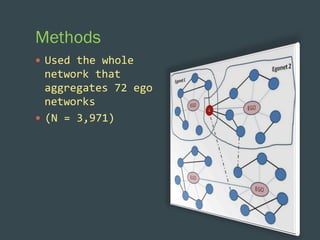
—  Used	
  the	
  whole	
  

network	
  that	
  
aggregates	
  72	
  ego	
  
networks	
  	
  
—  (N	
  =	
  3,971)	
  
Methods
—  Network	
  Measures	
  
(1)  DC:	
  	
  number	
  of	
  personal	
  recommendations	
  

an	
  individual	
  receives	
  
(2)  Contagion:	
  Personal	
  Network	
  Exposure	
  
(PNE)	
  
(3)  Embeddedness:	
  Krackhardt’s	
  simmelian-­‐
ties	
  (1998)	
  (the	
  total	
  frequency	
  of	
  a	
  
person’s	
  being	
  co-­‐cliqued	
  with	
  
others.)	
  
Descriptive
—  882	
  invitees	
  joined	
  the	
  group	
  (22.2%)	
  
—  Directly	
  contacted	
  by	
  a	
  single	
  inviter	
  

(N=3060,	
  77.1%),	
  by	
  two	
  (N=648,	
  16.3%),	
  by	
  
three	
  (N	
  =194,	
  4.9%),	
  by	
  four	
  (N=51,	
  
1.35%),	
  by	
  five	
  (N	
  =	
  12),	
  and	
  more	
  than	
  six	
  
inviter(N	
  =6)	
  
—  Network	
  exposure	
  to	
  one	
  group	
  member	
  
(N=554,	
  14%),	
  two	
  (N=356,	
  9%),	
  three	
  
(N=316,	
  8%),	
  four	
  (N=251,	
  6.3%),	
  five	
  
(N=181,	
  4.6%),	
  and	
  more	
  than	
  five	
  (N=843,	
  
21.1%)	
  (M	
  =	
  3.39)	


  As	
  a	
  proportion,	
  12%	
  
social	
  contacts	
  are	
  group	
  members	
  on	
  
average	
  (SD	
  =	
  .13).	
  	
  
Descriptive
—  Embeddedness:	
  12%	
  (N	
  =	
  556)	
  were	
  not	
  

simmelian-­‐tied;	
  for	
  the	
  rest,	
  the	
  
range	
  was	
  from	
  2	
  to	
  208	
  =>	
  log-­‐
transformed	
  (M	
  =2.35,	
  SD	
  =1.3)	


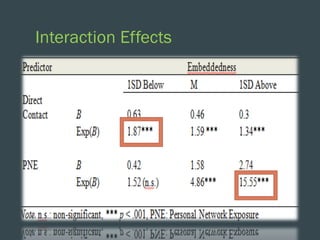
Interaction Effects
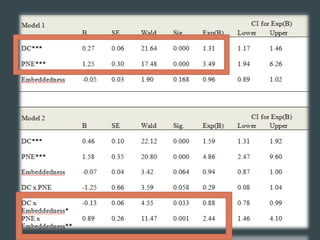
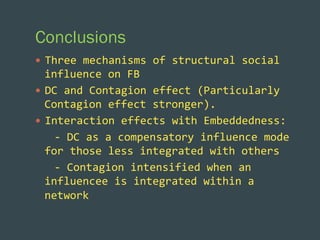
Conclusions
—  Three	
  mechanisms	
  of	
  structural	
  social	
  

influence	
  on	
  FB	
  
—  DC	
  and	
  Contagion	
  effect	
  (Particularly	
  
Contagion	
  effect	
  stronger).	
  
—  Interaction	
  effects	
  with	
  Embeddedness:	


  -­‐	
  DC	
  as	
  a	
  compensatory	
  influence	
  mode	
  
for	
  those	
  less	
  integrated	
  with	
  others	


  -­‐	
  Contagion	
  intensified	
  when	
  an	
  
influencee	
  is	
  integrated	
  within	
  a	
  
network	
  
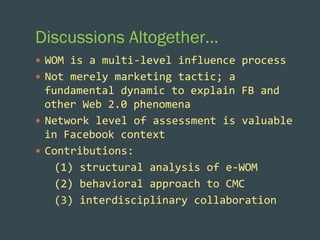
Discussions Altogether…
—  WOM	
  is	
  a	
  multi-­‐level	
  influence	
  process	
  
—  Not	
  merely	
  marketing	
  tactic;	
  a	
  

fundamental	
  dynamic	
  to	
  explain	
  FB	
  and	
  
other	
  Web	
  2.0	
  phenomena	
  
—  Network	
  level	
  of	
  assessment	
  is	
  valuable	
  
in	
  Facebook	
  context	
  
—  Contributions:	


  (1)	
  structural	
  analysis	
  of	
  e-­‐WOM	


  (2)	
  behavioral	
  approach	
  to	
  CMC	


  (3)	
  interdisciplinary	
  collaboration	
  
Limitations…
—  	
  Simplified	
  field	
  study:	
  Needs	
  to	
  be	
  

applied	
  to	
  more	
  complex	
  real	
  cases	
  on	
  SNS	
  
(e.g.	
  sharing	
  drug	
  information,	
  fundraising	
  
effect)	
  
—  Data	
  autocorrelations	
  	
  
—  Longitudinal	
  aspect	
  into	
  consideration	
  
(PNE)	
  	
  
—  Overcome	
  dichotomized	
  relational	
  aspect:	
  
adopting	
  communication	
  history	
  archived	
  on	
  
profile	
  wall	
  	
  
—  Look	
  at	
  evolutionary	
  process	
  of	
  FB	
  group	
  
(investigation	
  of	
  diffusion	
  process)	
  	
  
Thank you~!

Network Exposure Influence on Facebook Behaviors

  • 1.
    A Facebook Word-of-Mouthfor the Emergence of Collective Network: A Cyber-field Study - Who are the Influentials? - Structural Social Influence Model of Facebook WOM Kyounghee “Hazel” Kwon (PhD)
  • 2.
    What this projectabout… —  Social  Network  Sites  as  the  prevalent   Web  2.0  Service   —  A  culture  of  sharing  on  SNS   —  Interpersonal/relational  sharing   produces  social  information   —  Social  information  produces  social   influence    
  • 3.
  • 4.
    Levels of InfluenceStudied… —  Individual  Level:  Personal  Influence   (the  “Influentials”)     —  Social  Network-­‐Level:  Structural  Social   Influence       Taking  Network  Approach  is   advantageous  and  contributory   to  the  limited  CMC  literature   that  focus  on  intra-­‐individual   psychological  processing          
  • 5.
    Social Network Approachwith Facebook Data —  FB  Friends  supported  by   computerized  relational   tools:  Intensive   representation  of  +300   active  personal  networks   —  Full  visualization  of   ego-­‐networks  using  FB’s   API:  overcome  (1)   exclusion  of  weak  ties   (2)  imperfect  recall  
  • 6.
    —  A  cyber-­‐behavioral    field  study:   Mobilizing  a  campus  advocacy   network  on  FB  through  WOM    
  • 8.
    —  Recruit  “opinion  leader”  (OL)  players   —  OL…   (1)  sent  the  group  invitation  message  to   their  college  friends   (2)  did  the  survey  about  themselves   (3)  let  the  researcher  access  to  the   personal  network  data  in  FB  :friends   names  list  +  sociometric  (optional)     —  In  the  end  of  project,  the  researcher   matched  those  who  joined  the  group  with   the  names  identified  in  the  name  list.  
  • 9.
    STUDY 1 Individual Level:Personal Influence
  • 10.
    —  Personal  influence  becomes  critical  for   others’  decision  making  process   —  “More  influential”  than  others?   —  Profiling  opinion  leaders  has  been  a   major  topic  in  diffusion,  marketing,  &   political  comm   —  Four  approaches:  sociometric,  key   informant’s  rating,  self-­‐designating,   observation  
  • 11.
    —  Compare self-designatingand observation methods in identifying the influentials —  Characterize the influentials in FB context —  Emphasis on social attributes      -­‐  Innovators  are  not  always  the   influentials  (Rogers,  1995.  p.388)        -­‐  Must  have  “follower  groups”          -­‐  Equivalent  terms:  Maven,  buzzer,   navigator,  social  connector,  network  hub        -­‐  How  to  measure    FB-­‐specific  social   attributes?    
  • 12.
    H1 1. Personality Trait 2.GregariousnessH2 H3 3. Social Activities H4 4. Cosmopoliteness
  • 13.
    1. Personality Trait • Weimann’s ‘Personality Strength Index’ (PS index) 2. Gregariousness •  Facebook interaction, updating others’ profiles & popularity, 3. Social Activities •  Membership in FB group (general and topic specific), contact range 4. Cosmopoliteness •  Network heterogeniety (more in next slide)
  • 14.
    —  Self-­‐designated  OL-­‐ship:  King   and  Summers’  OL  scale  (KS   scale)  (M=7.05  out  of  10,  SD  =   2.17)   —  Observed  OL-­‐ship:  number  of   members  mobilized  by  each  OL   player’s  invitation  (M=23.51)   (Duplicated  invitees  excluded:   1711  out  of  7486,  22.86%).   Transformed  due  to  severe   skewness  (M=2.81,  SD  =  1.49)    
  • 15.
    1.  Density  (D):  the  extent  to  which   friends  are  known  to  one  another   within  OL’s  ego  network      
  • 16.
    Clustering  Coefficient   (CC)  :  The  extent  to   which  acquainted   friends  share  mutual   friends             (averaging  Ci,  where  Ci   is  the  density  of  a   sub-­‐graph  consisting   of  a  set  of   neighboring  nodes  that   are  directly  connected   to  the  focal  node  i   and  the  subsequent   edges.)   2.  i I’s neighboring nodes=5, subsequent edges=2 Ci = 0.2
  • 17.
    3.  Girvan-­‐Newman  community  structure        -­‐  “Edge-­‐betweenness”        (1)  calculate  edge-­‐betweenness  for  all  edges      (2)  remove  the  edge  of  the  highest  betweenness      (3)  recalculate  for  the  remaining  edges      (4)  repeating  from  (2)  until  no  edge  remains      (5)  produce  number  of  sub-­‐groups  (Girvan  &   Newman,  2002)                The  more  sub-­‐groups  are  identified,  the   more  the  personal  network  is  heterogeneous        
  • 18.
  • 19.
  • 21.
    —  Incongruence  between  self-­‐designation   and  observation:    (1)  Observation  more  valid  method    (2)  Online  collective  action  as   requiring  less  informational  influence  ?    (3)  No  significance  regarding  self-­‐ designation  OL  +  positive  effects  of   network  size  &  heterogeneity  =>  Facebook   infuentials  as  being  “CONNECTOR”  rather   than  “experts”  
  • 22.
  • 23.
    Social structural influenceon WOM —  WOM  widely  discussed  topic  in  online   environment   —  Even  more  visible  in  SNS     —  Individual  aspect  widely  discussed   (e.g.  social  psychological  motive,   opinion  leadership)   —  Few  studies  on  social  structural   aspect:  important  but  hard  to  measure    
  • 24.
    Integrating models ofsocial influence Social Information Processing Model (Salancik & Pfeffer, 1978) Social Contagion (Burt, 1987) Network Diffusion (Valente, 1995) Structural social influence model of Facebook
  • 25.
    Structural Social InfluenceEffect 1. Direct Contact(DC) 2. Interpersonal Contagion H1 H2 3. Network Embeddedness (structural cohesion) H3 Also  tested  interaction  effect  between   each  of  elements  (H4)  
  • 26.
    Methods —  Used  the  whole   network  that   aggregates  72  ego   networks     —  (N  =  3,971)  
  • 27.
    Methods —  Network  Measures   (1)  DC:    number  of  personal  recommendations   an  individual  receives   (2)  Contagion:  Personal  Network  Exposure   (PNE)   (3)  Embeddedness:  Krackhardt’s  simmelian-­‐ ties  (1998)  (the  total  frequency  of  a   person’s  being  co-­‐cliqued  with   others.)  
  • 28.
    Descriptive —  882  invitees  joined  the  group  (22.2%)   —  Directly  contacted  by  a  single  inviter   (N=3060,  77.1%),  by  two  (N=648,  16.3%),  by   three  (N  =194,  4.9%),  by  four  (N=51,   1.35%),  by  five  (N  =  12),  and  more  than  six   inviter(N  =6)   —  Network  exposure  to  one  group  member   (N=554,  14%),  two  (N=356,  9%),  three   (N=316,  8%),  four  (N=251,  6.3%),  five   (N=181,  4.6%),  and  more  than  five  (N=843,   21.1%)  (M  =  3.39)            As  a  proportion,  12%   social  contacts  are  group  members  on   average  (SD  =  .13).    
  • 29.
    Descriptive —  Embeddedness:  12%  (N  =  556)  were  not   simmelian-­‐tied;  for  the  rest,  the   range  was  from  2  to  208  =>  log-­‐ transformed  (M  =2.35,  SD  =1.3)      
  • 31.
  • 32.
    Conclusions —  Three  mechanisms  of  structural  social   influence  on  FB   —  DC  and  Contagion  effect  (Particularly   Contagion  effect  stronger).   —  Interaction  effects  with  Embeddedness:          -­‐  DC  as  a  compensatory  influence  mode   for  those  less  integrated  with  others        -­‐  Contagion  intensified  when  an   influencee  is  integrated  within  a   network  
  • 33.
    Discussions Altogether… —  WOM  is  a  multi-­‐level  influence  process   —  Not  merely  marketing  tactic;  a   fundamental  dynamic  to  explain  FB  and   other  Web  2.0  phenomena   —  Network  level  of  assessment  is  valuable   in  Facebook  context   —  Contributions:        (1)  structural  analysis  of  e-­‐WOM        (2)  behavioral  approach  to  CMC          (3)  interdisciplinary  collaboration  
  • 34.
    Limitations… —   Simplified  field  study:  Needs  to  be   applied  to  more  complex  real  cases  on  SNS   (e.g.  sharing  drug  information,  fundraising   effect)   —  Data  autocorrelations     —  Longitudinal  aspect  into  consideration   (PNE)     —  Overcome  dichotomized  relational  aspect:   adopting  communication  history  archived  on   profile  wall     —  Look  at  evolutionary  process  of  FB  group   (investigation  of  diffusion  process)    
  • 35.