Marc Imhotep Cray, M.D.
Case Trigger 3
2
A 42-year-old HIV-positive man presents to the emergency department with
hemoptysis. He states that he has lost 15 pounds over the last 2 months and
has had an intermittent fever, cough, and chills. He has not been taking any of
his HIV medications and his CD4 count is 130. A chest x-ray reveals a lesion in
his apical right lung. He is able to cough up green mucous coated with blood.
You send the sample off for staining and culture. The sample reveals acid-fast
bacilli and you decide to admit this patient to an isolation room and begin
him on a multidrug treatment regimen while drug susceptibility tests are run.
Marc Imhotep Cray, M.D.
Pulmonary Tuberculosis
3
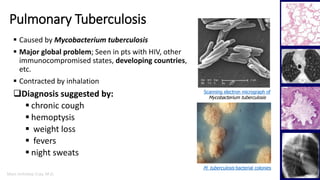
๏‚ง Caused by Mycobacterium tuberculosis
๏‚ง Major global problem; Seen in pts with HIV, other
immunocompromised states, developing countries,
etc.
๏‚ง Contracted by inhalation
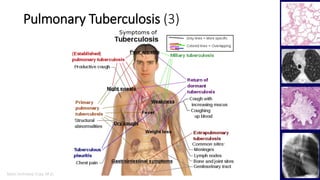
๏ฑDiagnosis suggested by:
๏‚ง chronic cough
๏‚ง hemoptysis
๏‚ง weight loss
๏‚ง fevers
๏‚ง night sweats
M. tuberculosis bacterial colonies
Scanning electron micrograph of
Mycobacterium tuberculosis
Marc Imhotep Cray, M.D.
Pulmonary Tuberculosis (2)
4Chandrasoma P, Taylor CR. Concise Pathology, 3rd ed. Stamford, CT: Appleton& Lange, 1998: 523
Marc Imhotep Cray, M.D.
Pulmonary Tuberculosis (3)
5
Marc Imhotep Cray, M.D.
Pulmonary TB (4)
6
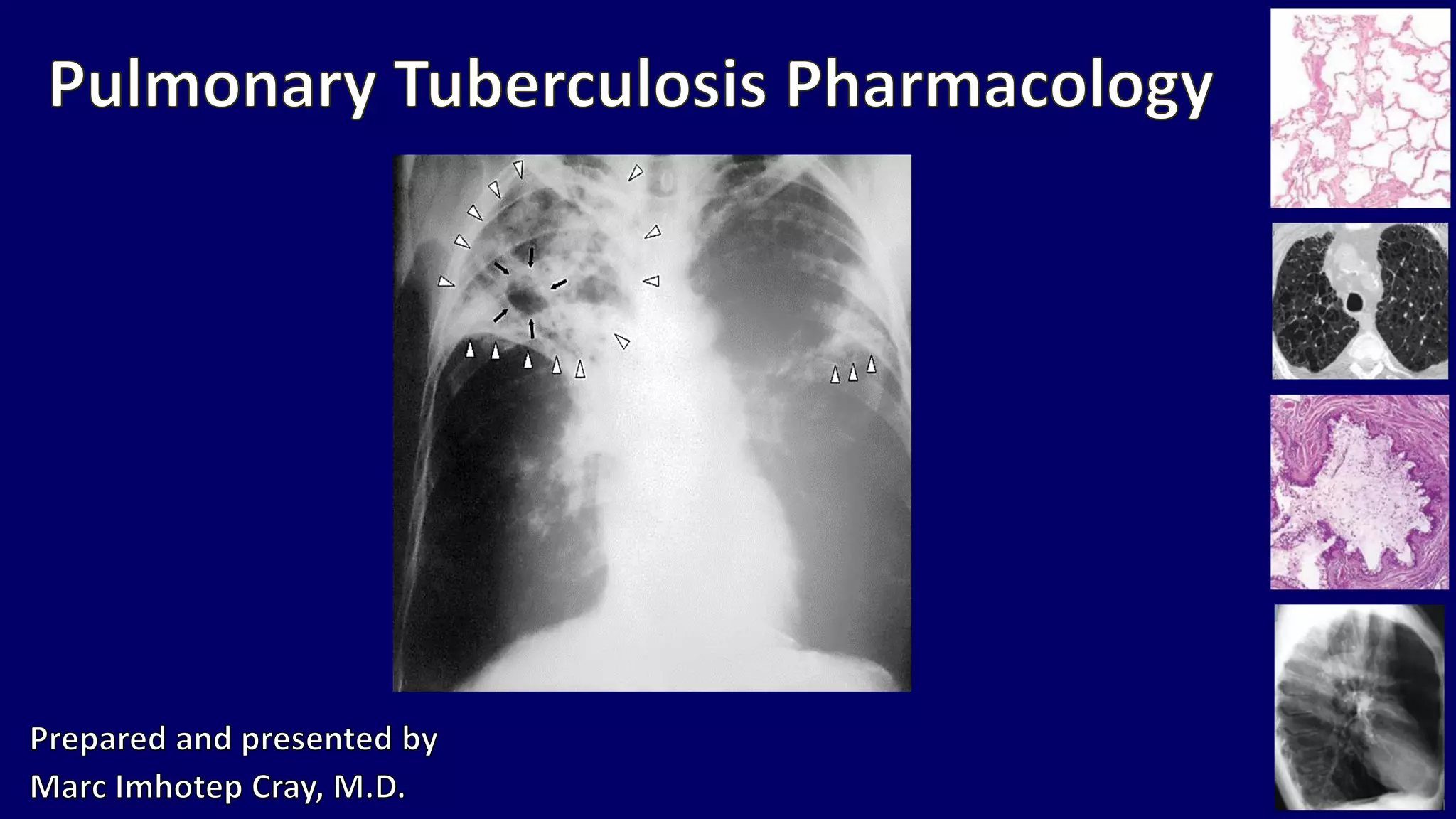
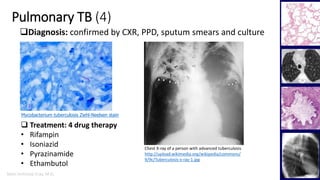
๏ฑDiagnosis: confirmed by CXR, PPD, sputum smears and culture
Chest X-ray of a person with advanced tuberculosis
http://upload.wikimedia.org/wikipedia/commons/
9/9c/Tuberculosis-x-ray-1.jpg
Mycobacterium tuberculosis Ziehl-Neelsen stain
๏ฑ Treatment: 4 drug therapy
โ€ข Rifampin
โ€ข Isoniazid
โ€ข Pyrazinamide
โ€ข Ethambutol
Marc Imhotep Cray, M.D.
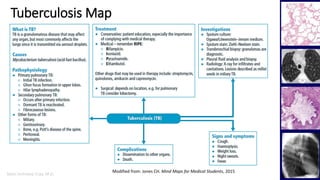
Modified from: Jones CH. Mind Maps for Medical Students, 2015
Tuberculosis Map
Marc Imhotep Cray, M.D.
Key Points
8
๏ฑPresenting symptoms of reactivation TB include chronic cough,
hemoptysis, intermittent fevers, night sweats, and weight loss
๏ฑChest x-ray may show any variety of infiltrate although classically
shows granulomatous or cavitary lesions in upper lobes
๏ฑPatients with pulmonary infiltrates suspicious for TB must be
kept in isolation until three sputum samples are negative for
acid-fast organisms
๏ฑPositive PPD suggests prior infection with M. tuberculosis, but
does not necessarily imply active TB
Marc Imhotep Cray, M.D.
Key Points (2)
9
๏ฑAny PPD reaction in immunocompromised persons is positive
๏ฑFor individuals at high risk, 5 mm is positive
๏ฑFor individuals with several risk factors, 10 mm is positive
๏ฑFor individuals at low risk, 15 mm is positive
๏ฑInitial treatment of active TB consists of a four-drug regimen
๏ฑDuration of treatment is at least 6 months due to large number
of inactive organisms and poor drug penetration into caseating
granulomas and cavitary lesions
Marc Imhotep Cray, M.D. 10
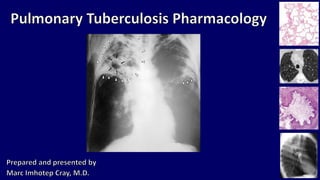
Pulmonary Tuberculosis Pharmacology
Marc Imhotep Cray, M.D. 11
โ€œTuberculosis Medicationโ€
Medication Summary
โ€œThe treatment of tuberculosis (TB) must satisfy the following basic therapeutic principles:
โ€ข Any regimen must use multiple drugs to which Mycobacterium tuberculosis is
susceptible
โ€ข The medications must be taken regularly
โ€ข The therapy must continue for a period sufficient to resolve the illness
New cases are initially treated with four drugs: isoniazid, rifampin, pyrazinamide, and either
ethambutol or streptomycin. After 2 months, they are then treated with a continuation
phase of 4 months with isoniazid and rifampin. Patients requiring retreatment should
initially receive at least 5 drugs, including isoniazid, rifampin, pyrazinamide, and at east 2
(preferably 3) new drugs to which the patient has not been exposed.โ€
Source: Herchline ET, Tuberculosis Medication. Medscape. Updated Oct 22, 2015
Available at: http://emedicine.medscape.com/article/230802-medication
Accessed: Dec. 30, 2015
Marc Imhotep Cray, M.D.
Commonly used drug regimens for
Tuberculosis (MTb Drug Combinations)
12
๏ฑ Active TB is Tx most often initially with four drugs in a long-term
treatment (6โ€“12 months) plan to avoid development of antibiotic
resistance
๏‚ง In general, 6-month regimens are used for patients with culture-positive TB
๏‚ง Regimen consists of INH, rifampin, pyrazinamide, and ethambutol
o All four agents are used for initial 2 months๏ƒ  continuation phase is 4
months and consists of first two agents (INH, rifampin) only
o Continuation phase is extended for an additional 3-6 months in patients
who had cavitary lesions at presentation or on a follow-up chest x-ray, or
are culture positive at 2-month point
o Second-line agents (e.g., fluoroquinolones, cycloserine, and amikacin) can be
used when there is resistance to first-line agents
๏ฑ Due to rapid development of resistance, single-drug therapy is only
useful for prophylaxis
Marc Imhotep Cray, M.D.
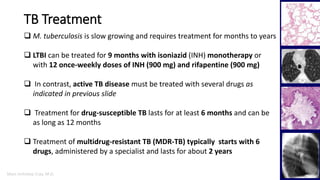
TB Treatment
๏ฑ M. tuberculosis is slow growing and requires treatment for months to years
๏ฑ LTBI can be treated for 9 months with isoniazid (INH) monotherapy or
with 12 once-weekly doses of INH (900 mg) and rifapentine (900 mg)
๏ฑ In contrast, active TB disease must be treated with several drugs as
indicated in previous slide
๏ฑ Treatment for drug-susceptible TB lasts for at least 6 months and can be
as long as 12 months
๏ฑ Treatment of multidrug-resistant TB (MDR-TB) typically starts with 6
drugs, administered by a specialist and lasts for about 2 years
Marc Imhotep Cray, M.D.
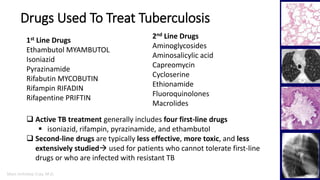
Drugs Used To Treat Tuberculosis
14
1st Line Drugs
Ethambutol MYAMBUTOL
Isoniazid
Pyrazinamide
Rifabutin MYCOBUTIN
Rifampin RIFADIN
Rifapentine PRIFTIN
2nd Line Drugs
Aminoglycosides
Aminosalicylic acid
Capreomycin
Cycloserine
Ethionamide
Fluoroquinolones
Macrolides
๏ฑ Active TB treatment generally includes four first-line drugs
๏‚ง isoniazid, rifampin, pyrazinamide, and ethambutol
๏ฑ Second-line drugs are typically less effective, more toxic, and less
extensively studied๏ƒ  used for patients who cannot tolerate first-line
drugs or who are infected with resistant TB
Marc Imhotep Cray, M.D.
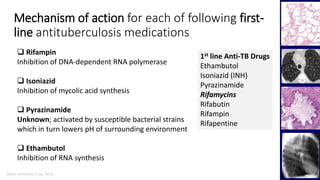
Mechanism of action for each of following first-
line antituberculosis medications
๏ฑ Rifampin
Inhibition of DNA-dependent RNA polymerase
๏ฑ Isoniazid
Inhibition of mycolic acid synthesis
๏ฑ Pyrazinamide
Unknown; activated by susceptible bacterial strains
which in turn lowers pH of surrounding environment
๏ฑ Ethambutol
Inhibition of RNA synthesis
1st line Anti-TB Drugs
Ethambutol
Isoniazid (INH)
Pyrazinamide
Rifamycins
Rifabutin
Rifampin
Rifapentine
Marc Imhotep Cray, M.D.
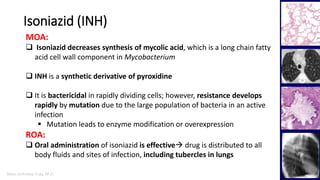
Isoniazid (INH)
16
MOA:
๏ฑ Isoniazid decreases synthesis of mycolic acid, which is a long chain fatty
acid cell wall component in Mycobacterium
๏ฑ INH is a synthetic derivative of pyroxidine
๏ฑ It is bactericidal in rapidly dividing cells; however, resistance develops
rapidly by mutation due to the large population of bacteria in an active
infection
๏‚ง Mutation leads to enzyme modification or overexpression
ROA:
๏ฑ Oral administration of isoniazid is effective๏ƒ  drug is distributed to all
body fluids and sites of infection, including tubercles in lungs
Marc Imhotep Cray, M.D.
Isoniazid
17
Pharmacokinetics-metabolism:
๏ฑ Isoniazid is acetylated in liver๏ƒ  rate of acetylation varies in a bimodal
distribution due to genetic polymorphisms
๏ฑ Fast acetylators will have lower blood concentrations
o This is dominant trait
๏‚ง Slow acetylators are more likely to develop toxicity
Adverse Effects:
๏ฑ Side effects from isoniazid are rare, are usually dose dependent, include:
๏‚ง Hepatitis๏ƒ  increases in incidence with age and use of alcohol
๏‚ง Peripheral neuritis (INH interferes with peripheral metabolic
activation of vitamin B6)
o Note: Isoniazid can achieve levels in breast milk high enough to cause a
pyridoxine deficiency in infant unless mother is supplemented with vitamin
This can be avoided by giving pyridoxine
Marc Imhotep Cray, M.D.
Rifampin
18
MOA:
๏ฑ Rifampin inhibits the ฮฒ-subunit of DNA-dependent RNA Polymerase๏ƒ 
selectively reduces RNA synthesis in bacteria
๏ฑ Bactericidal for Mycobacterium and has good penetration into
tissues and tuberculous lesions
Other Uses:
๏ฑ It is also used prophylactically for patients exposed to:
๏‚ง Neisseria meningitidis
๏‚ง Haemophilus influenzae, type b
Marc Imhotep Cray, M.D.
Rifampin
19
Pharmacokinetics-metabolism:
๏ฑ Metabolism occurs in liver๏ƒ  activates MFOs (enzyme inducer)
๏‚ง Rifampin self-induces its own metabolism (cytochrome P450 system)
๏‚ง It also enhances metabolism of several other drugs (enzyme inducer)
o oral contraceptives, anticoagulants, ketoconazole, cyclosporine, and
chloramphenicol are examples
o Rifabutin can be substituted for rifampin to avoid this
problem=less potent inducer of cytochrome P450 enzymes
๏ฑ Rifampin is not used in TB Tx as a single agent due to emergence of
resistance
Mechanisms of resistance:
๏‚ง Resistance can be caused by alteration of ฮฒ-subunit of RNA
polymerase, or decreased permeability to drug
Marc Imhotep Cray, M.D.
Rifampin
Adverse Effects:
๏‚ง flu-like syndrome
๏‚ง hepatotoxicity [(hepatitis; elevated liver function tests (LFTs)]
๏‚ง drug-drug interactions (cytochrome P-450 inducer)
๏‚ง proteinuria
๏‚ง thrombocytopenia
๏‚ง red-orange discoloration of tears, sweat, urine and stool
o Contact lenses can be permanently stained with this orange
discoloration
o This side effect can be a source of great concern to individuals who
are not warned of its possibility
Marc Imhotep Cray, M.D.
Rifabutin
21
Adverse Effects:
๏ฑ Has adverse effects similar to those of rifampin but can also cause
๏‚ง uveitis,
๏‚ง skin hyperpigmentation, and
๏‚ง neutropenia
MOA:
๏ฑ Same as rifampin=inhibits the ฮฒ-subunit of DNA-dependent RNA
Polymerase๏ƒ  selectively reduces RNA synthesis in bacteria
A derivative of rifampin, is preferred drug for use in patients with
tuberculosis and human immunodeficiency virus (HIV) disease who are
concomitantly treated with protease inhibitors or nonnucleoside reverse
transcriptase inhibitors ๏ƒ  because it is a less potent inducer of cytochrome
P450 enzymes
Marc Imhotep Cray, M.D.
Pyrazinamide
22
MOA:
๏ฑ Pyrazinamide is bactericidal by an unknown mechanism
๏ฑ It is effective when given orally, including good CSF penetration
๏ฑ Pyrazinamide is a prodrug that must be hydrolyzed to active form
๏‚ง Loss of hydrolase leads to resistance
Adverse Effects:
๏‚ง Phototoxicity
๏‚ง increased porphyrin synthesis
๏‚ง hepatitis
๏‚ง arthralgias
๏‚ง myalgias
๏‚ง hyperuricemia
Marc Imhotep Cray, M.D.
Ethambutol
23
MOA:
Ethambutol inhibits mycolic acid synthesis but is only bacteriostatic
Adverse Effects:
๏‚ง optic (retrobulbar) neuritis
๏‚ง decreased visual acuity
๏‚ง red-green color blindness (impaired ability to discriminate colors)
๏‚ง hyperuricemia
Marc Imhotep Cray, M.D.
Second-line Drugs Used in Tx of Tuberculosis
24
๏ฑThe aminoglycoside streptomycin is bactericidal, but it:
๏‚ง Must be administered parenterally
๏‚ง Only kills extracellular organisms and does not penetrate into cells
๏‚ง Does not distribute as widely in body as other drugs
๏‚ง Although total period of Tx for TB is a minimum of 6 months,
streptomycin therapy is not commonly used for full duration of
therapy, because of toxicity concerns
o Streptomycin is arguably most ototoxic aminoglycoside
o recommended when less potentially hazardous therapeutic agents are ineffective
or contraindicated
๏ฑFluoroquinolones and macrolides also have antimycobacterial activity
Second- line agents can be used when there is resistance to first-line agents.
Marc Imhotep Cray, M.D.
Second-line Drugs Used in Tx of MTb cont.
25
๏ฑ Aminosalicylic acid (PAS)
MOA Aminosalicylic acid is an analog of PABA; it works similar to sulfonamides but only
penetrates mycobacteria
Adverse effect GI disturbances
๏ฑ Ethionamide
MOA Ethionamide, like isoniazid, blocks the synthesis of mycolic acids
Resistance develops rapidly, but there is no cross-resistance to INH.
Adverse effect poorly tolerated; it commonly produces severe GI disturbances
Without concomitant pyridoxine peripheral, neuropathies may occur
Hepatotoxicity is not uncommon
๏ฑ Cycloserine
MOA Cycloserine is an analog of d-alanine that inhibits cell wall biosynthesis
Adverse effect causes CNS toxicity, including seizures and peripheral neuropathy; alcohol
increases the possibility of seizures
Pyridoxine administered with cycloserine reduces incidence of neuropathies
Marc Imhotep Cray, M.D. 26
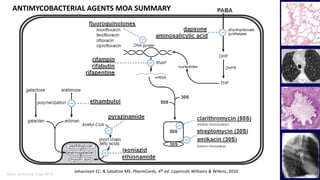
ANTIMYCOBACTERIAL AGENTS MOA SUMMARY
Johannsen EC. & Sabatine MS. PharmCards, 4th ed. Lippincott Williams & Wilkins, 2010
Marc Imhotep Cray, M.D.
Question 1
27
As part of a multidrug attack on patientโ€™s infection with Mycobacterium
tuberculosis, a physician plans to use an aminoglycoside antibiotic. Which
drug is most active against the tubercle bacillus and seems to be associated
with the fewest problems with resistance or typical aminoglycoside-
induced adverse effects?
(A) Amikacin
(B) Kanamycin
(C) Neomycin
(D) Streptomycin
(E) Tobramycin
Marc Imhotep Cray, M.D.
Answer 1
28
D. Streptomycin is bactericidal for the tubercle bacillus organism. Other
aminoglycosides (eg, gentamicin, tobramycin, neomycin, amikacin, and
kanamycin) have activity against this organism but are seldom used clinically
because of toxicity or development of resistance. Streptomycin is arguably
the most ototoxic aminoglycoside
Refs. Brunton, pp 1505-1509, 1514-1515
Katzung, pp 822f, 824-825, 828, 840t.
Marc Imhotep Cray, M.D.
Question 2
29
A patient with tuberculosis is being treated with isoniazid. She develops
paresthesias, muscle aches, and unsteadiness. Which vitamin needs to be
given in supplemental doses in order to reverse these symptomsโ€”or used
from the outset to prevent them in high-risk patients?
(A) Vitamin A
(B) Vitamin B1
(C) Vitamin B6
(D) Vitamin C
(E) Vitamin K
Marc Imhotep Cray, M.D.
Answer 2
30
C. Pyridoxine deficiencies arise often during isoniazid therapy because the
antimycobacterial drug interferes with metabolic activation of the vitamin.
The treatment or prophylaxis for at-risk patients is to administer relatively
large doses of B6 (pyridoxine)
Refs. Brunton, pp 639, 780, 1086, 1555-1558
Katzung, pp 840-841.
Marc Imhotep Cray, M.D.
Question 3
31
A 59-year-old woman is diagnosed with tuberculosis (TB). Before prescribing
a multidrug regimen, you take a careful medication history because one of
the drugs commonly used to treat TB induces some of the microsomal
cytochrome P450 enzymes in the liver, and is a common cause of drugโ€“drug
interactions. What is the most likely drug?
(A)Ethambutol
(B)Isoniazid
(C)Pyrazinamide
(D)Rifampin
(E)Streptomycin
Marc Imhotep Cray, M.D.
Answer 3
32
D. Rifampin induces cytochrome P450 enzymes, which causes a significant
increase in elimination rates of many interacting drugs, such as oral
contraceptives, anticoagulants, ketoconazole, cyclosporine, and
chloramphenicol. It also promotes urinary excretion of methadone, which
may precipitate withdrawal. Ethambutol (a), isoniazid (b), pyrazinamide (c),
and vitamin B6 (e) are not P450 inducers, although the metabolism of some
of these drugs can be induced by rifampin.
Refs. Brunton, pp 1012-1013, 1524-1525;
Katzung, pp 840-842, 848, 1160t.
Marc Imhotep Cray, M.D.
Question 4
33
A patient with active tuberculosis is being treated with isoniazid (INH) and
ethambutol as part of the overall regimen. What is the main effect expected
of the ethambutol?
(A)Facilitated entry of the INH into the mycobacteria
(B)Facilitated penetration of the blood-brain barrier
(C)Retarded absorption after intramuscular injection
(D)Retarded development of organism resistance
(E)Slowed renal excretion of INH to help maintain effective blood levels
Marc Imhotep Cray, M.D.
Answer 4
34
D. An important problem in the chemotherapy of TB is bacterial drug
resistance. For this reason, concurrent administration of two or more drugs
should be employed to delay the development of resistance. Ethambutol is
often given along with INH for this purpose. Streptomycin or rifampin may
also be added to the regimen to delay even further the development of drug
resistance
Refs. Brunton, pp 1533, 1558-1559
Katzung, pp 840t, 842
Marc Imhotep Cray, M.D.
Question 5
35
A 34-year-old man with a history of recurrent tuberculosis on a multidrug
regimen, including isoniazid. He presents to his primary care physician
complaining of paresthesias of his hands and feet. What is the most likely
explanation for this finding?
(A) Diabetes mellitus
(B) Lumbar disc disease
(C) Peripheral neuritis
(D) Spinal cord compression
(E) Urinary tract infection
Marc Imhotep Cray, M.D.
Answer 5
36
C. Isoniazid is associated with development of peripheral neuritis
(manifesting as paresthesias of the hands and feet), which is the most
common adverse effect and appears to be caused by a relative pyridoxine
deficiency. Most of the toxic reactions are corrected by supplementation of
25 to 50 mg/d of pyridoxine (vitamin B6).
(A) Although diabetes mellitus can cause peripheral neuropathy, it is unlikely in this
patient because there is no indication that blood sugar levels are abnormal.
(B) History in this question gives no indication of lumbar disc abnormality. No evidence of
imaging study to suggest this finding is provided.
(D)No history of trauma is provided in this question to suggest spinal cord compression.
(E) This patient does not have any urinary symptoms; thus, urinary
tract infection is unlikely.
Marc Imhotep Cray, M.D.
Question 6
37
A 34-year-old Ethiopian with HIV disease complains of a productive cough with
hemoptysis and night sweats. A sputum smear is positive for acid-fast bacilli.
He is placed in isolation and started on isoniazid, rifampin, pyrazinamide, and
ethambutol. A few months later, he complains of a loss of his ability to
discriminate certain colors. What is causing his vision impairment?
(A) Ethambutol
(B) Isoniazid
(C) Miliary TB
(D) Pyrazinamide
(E) Rifampin
Marc Imhotep Cray, M.D.
Answer 6
38
A. This patientโ€™s presentation is consistent with an active tuberculosis
infection. Because of his HIV status, he is started on quadruple therapy.
Ethambutol is notable for its ability to cause optic neuritis, which may
manifest as impaired ability to discriminate colors as in this patientโ€™s case.
Vision usually returns to normal after a few weeks of discontinuation of
ethambutol.
(B) Isoniazid can cause optic neuritis but much less commonly than ethambutol. Isoniazidโ€™s
major adverse reaction is hepatitis.
C) Miliary tuberculosis is extremely unlikely in this case because the patient is taking four
antituberculosis drugs. This patientโ€™s presentation and history point to ethambutol toxicity.
(D) Pyrazinamide is not known to cause optic neuritis.
Marc Imhotep Cray, M.D.
Question 7
39
A 39-year-old man with HIV disease and active tuberculosis is hospitalized for
therapy. He currently takes a protease inhibitor. He complains of cough,
dyspnea, and chest pressure. Which of the following is the best treatment
adjunct for this patient?
(A) Prednisone
(B) Rifabutin
(C) Rifampin
(D) Ribavirin
(E) Testosterone
Marc Imhotep Cray, M.D.
Answer 7
40
B. Rifabutin, a derivative of rifampin, is the preferred drug for use in patients
with tuberculosis and human immunodeficiency virus (HIV) disease who are
concomitantly treated with protease inhibitors or nonnucleoside reverse
transcriptase inhibitors because it is a less potent inducer of cytochrome P450
enzymes.
(A)This patient would benefit from an antituberculosis agent that will have limited hepatic side
effects.
(C) Rifampin is not the preferred treatment for this patient with HIV disease.
(D) Ribavirin would not likely be of benefit to this patient with tuberculosis.
(E)Testosterone is not helpful because this patient has
HIV disease and tuberculosis.
Marc Imhotep Cray, M.D.
The next two questions are linked.
Questions 8
41
A 42-year-old man who recently immigrated to California from Cambodia
presents with a 2-week history of fever, night sweats, a 15-pound weight
loss, and cough productive of bloody sputum. Granulomatous lesions can be
visualized on a chest radiograph. What is the most likely organism causing
this infection?
(A) Histoplasma capsulatum
(B) Echinococcus granulosus
(C) Mycobacterium tuberculosis
(D) Streptococcus pneumoniae
(E) Salmonella typhi
Marc Imhotep Cray, M.D.
Linked to previous question.
Question 9
42
Sputum from the patient in the above case showed acid-fast bacilli. A nucleic
acid amplification test confirmed the diagnosis. What is the appropriate
initial therapy for this patient?
(A) Isoniazid
(B) Drug combination of isoniazid and rifampin
(C) Drug combination of isoniazid, ciprofloxacin, and amikacin
(D) Drug combination of isoniazid, rifampin, pyrazinamide, and ethambutol
(E) Drug combination of isoniazid, streptomycin, pyrazinamide, ciprofloxacin,
and amikacin
Marc Imhotep Cray, M.D.
Answer 8
43
C. Mycobacterium tuberculosis. The history, signs, and symptoms of this case
are consistent with tuberculosis. This infection is more common among
immigrants from Southeast Asia. California is one of several states from which
most of the diagnoses of TB are reported.
None of the other infections present in the manner described in this case. Although a cause of
lung granulomas, H. capsulatum is not endemic to California, or to Southeast Asia.
Pulmonary infections due to S. pneumoniae typically have an abrupt onset. Rust-colored
sputum may be produced; however, granulomas are not found.
S. typhi presents with fever and abdominal complaints
Marc Imhotep Cray, M.D.
Answer 9
44
D. Drug combination of isoniazid, rifampin, pyrazinamide, and ethambutol.
Current treatment guidelines recommend these four drugs for the first 2
months of therapy for TB. A reduction in the number of drugs after 2
months is dependent on finding no cavitation of chest radiographs and no
acid-fast bacilli on sputum stain. The rationale for a four drug combination is
to cover for drug-resistant organisms as well as to prevent the development
of drug resistance.
Marc Imhotep Cray, M.D.
Question 10
45
Which of the following side effects occurs commonly with the administration
of rifampin?
(A) Liver failure
(B) Renal failure
(C) Orange discoloration of secretions
(D) Anemia
(E) Leukopenia
Marc Imhotep Cray, M.D.
Answer 10
46
Rifampin will turn all of an individualโ€™s secretions, such as urine, sweat, tears,
and stool, an orange color. Contact lenses can be permanently stained with
this orange discoloration. This side effect is a source of great concern to
individuals who are not warned of its possibility.
Marc Imhotep Cray, M.D. 47
Marc Imhotep Cray, M.D.
Further study:
48
eLearning (IVMS Cloud Folders)
๏‚ง Pharmacology
๏‚ง Infectious Disease
๏‚ง Microbial biology & Immune System
Textbooks:
๏‚ง Batchelder A. et al. Rapid Clinical Pharmacology- A Student Formulary. 1st
ed. John Wiley & Sons, 2011
๏‚ง Carroll KC etal. Jawetz, Melnick, & Adelbergโ€™s Medical Microbiology 27th
Ed. New York: McGraw-Hill, 2016
๏‚ง Gallagher JC, MacDougall C. Antibiotics simplified. 2nd Ed. Jones & Bartlett
Learning, 2012
๏‚ง Ryan KJ and Ray CG Eds. Sherris Medical Microbiology, 5th Ed. New York:
McGraw-Hill, 2010

Pulmonary tuberculosis pharmacology

  • 1.
  • 2.
    Marc Imhotep Cray,M.D. Case Trigger 3 2 A 42-year-old HIV-positive man presents to the emergency department with hemoptysis. He states that he has lost 15 pounds over the last 2 months and has had an intermittent fever, cough, and chills. He has not been taking any of his HIV medications and his CD4 count is 130. A chest x-ray reveals a lesion in his apical right lung. He is able to cough up green mucous coated with blood. You send the sample off for staining and culture. The sample reveals acid-fast bacilli and you decide to admit this patient to an isolation room and begin him on a multidrug treatment regimen while drug susceptibility tests are run.
  • 3.
    Marc Imhotep Cray,M.D. Pulmonary Tuberculosis 3 ๏‚ง Caused by Mycobacterium tuberculosis ๏‚ง Major global problem; Seen in pts with HIV, other immunocompromised states, developing countries, etc. ๏‚ง Contracted by inhalation ๏ฑDiagnosis suggested by: ๏‚ง chronic cough ๏‚ง hemoptysis ๏‚ง weight loss ๏‚ง fevers ๏‚ง night sweats M. tuberculosis bacterial colonies Scanning electron micrograph of Mycobacterium tuberculosis
  • 4.
    Marc Imhotep Cray,M.D. Pulmonary Tuberculosis (2) 4Chandrasoma P, Taylor CR. Concise Pathology, 3rd ed. Stamford, CT: Appleton& Lange, 1998: 523
  • 5.
    Marc Imhotep Cray,M.D. Pulmonary Tuberculosis (3) 5
  • 6.
    Marc Imhotep Cray,M.D. Pulmonary TB (4) 6 ๏ฑDiagnosis: confirmed by CXR, PPD, sputum smears and culture Chest X-ray of a person with advanced tuberculosis http://upload.wikimedia.org/wikipedia/commons/ 9/9c/Tuberculosis-x-ray-1.jpg Mycobacterium tuberculosis Ziehl-Neelsen stain ๏ฑ Treatment: 4 drug therapy โ€ข Rifampin โ€ข Isoniazid โ€ข Pyrazinamide โ€ข Ethambutol
  • 7.
    Marc Imhotep Cray,M.D. Modified from: Jones CH. Mind Maps for Medical Students, 2015 Tuberculosis Map
  • 8.
    Marc Imhotep Cray,M.D. Key Points 8 ๏ฑPresenting symptoms of reactivation TB include chronic cough, hemoptysis, intermittent fevers, night sweats, and weight loss ๏ฑChest x-ray may show any variety of infiltrate although classically shows granulomatous or cavitary lesions in upper lobes ๏ฑPatients with pulmonary infiltrates suspicious for TB must be kept in isolation until three sputum samples are negative for acid-fast organisms ๏ฑPositive PPD suggests prior infection with M. tuberculosis, but does not necessarily imply active TB
  • 9.
    Marc Imhotep Cray,M.D. Key Points (2) 9 ๏ฑAny PPD reaction in immunocompromised persons is positive ๏ฑFor individuals at high risk, 5 mm is positive ๏ฑFor individuals with several risk factors, 10 mm is positive ๏ฑFor individuals at low risk, 15 mm is positive ๏ฑInitial treatment of active TB consists of a four-drug regimen ๏ฑDuration of treatment is at least 6 months due to large number of inactive organisms and poor drug penetration into caseating granulomas and cavitary lesions
  • 10.
    Marc Imhotep Cray,M.D. 10 Pulmonary Tuberculosis Pharmacology
  • 11.
    Marc Imhotep Cray,M.D. 11 โ€œTuberculosis Medicationโ€ Medication Summary โ€œThe treatment of tuberculosis (TB) must satisfy the following basic therapeutic principles: โ€ข Any regimen must use multiple drugs to which Mycobacterium tuberculosis is susceptible โ€ข The medications must be taken regularly โ€ข The therapy must continue for a period sufficient to resolve the illness New cases are initially treated with four drugs: isoniazid, rifampin, pyrazinamide, and either ethambutol or streptomycin. After 2 months, they are then treated with a continuation phase of 4 months with isoniazid and rifampin. Patients requiring retreatment should initially receive at least 5 drugs, including isoniazid, rifampin, pyrazinamide, and at east 2 (preferably 3) new drugs to which the patient has not been exposed.โ€ Source: Herchline ET, Tuberculosis Medication. Medscape. Updated Oct 22, 2015 Available at: http://emedicine.medscape.com/article/230802-medication Accessed: Dec. 30, 2015
  • 12.
    Marc Imhotep Cray,M.D. Commonly used drug regimens for Tuberculosis (MTb Drug Combinations) 12 ๏ฑ Active TB is Tx most often initially with four drugs in a long-term treatment (6โ€“12 months) plan to avoid development of antibiotic resistance ๏‚ง In general, 6-month regimens are used for patients with culture-positive TB ๏‚ง Regimen consists of INH, rifampin, pyrazinamide, and ethambutol o All four agents are used for initial 2 months๏ƒ  continuation phase is 4 months and consists of first two agents (INH, rifampin) only o Continuation phase is extended for an additional 3-6 months in patients who had cavitary lesions at presentation or on a follow-up chest x-ray, or are culture positive at 2-month point o Second-line agents (e.g., fluoroquinolones, cycloserine, and amikacin) can be used when there is resistance to first-line agents ๏ฑ Due to rapid development of resistance, single-drug therapy is only useful for prophylaxis
  • 13.
    Marc Imhotep Cray,M.D. TB Treatment ๏ฑ M. tuberculosis is slow growing and requires treatment for months to years ๏ฑ LTBI can be treated for 9 months with isoniazid (INH) monotherapy or with 12 once-weekly doses of INH (900 mg) and rifapentine (900 mg) ๏ฑ In contrast, active TB disease must be treated with several drugs as indicated in previous slide ๏ฑ Treatment for drug-susceptible TB lasts for at least 6 months and can be as long as 12 months ๏ฑ Treatment of multidrug-resistant TB (MDR-TB) typically starts with 6 drugs, administered by a specialist and lasts for about 2 years
  • 14.
    Marc Imhotep Cray,M.D. Drugs Used To Treat Tuberculosis 14 1st Line Drugs Ethambutol MYAMBUTOL Isoniazid Pyrazinamide Rifabutin MYCOBUTIN Rifampin RIFADIN Rifapentine PRIFTIN 2nd Line Drugs Aminoglycosides Aminosalicylic acid Capreomycin Cycloserine Ethionamide Fluoroquinolones Macrolides ๏ฑ Active TB treatment generally includes four first-line drugs ๏‚ง isoniazid, rifampin, pyrazinamide, and ethambutol ๏ฑ Second-line drugs are typically less effective, more toxic, and less extensively studied๏ƒ  used for patients who cannot tolerate first-line drugs or who are infected with resistant TB
  • 15.
    Marc Imhotep Cray,M.D. Mechanism of action for each of following first- line antituberculosis medications ๏ฑ Rifampin Inhibition of DNA-dependent RNA polymerase ๏ฑ Isoniazid Inhibition of mycolic acid synthesis ๏ฑ Pyrazinamide Unknown; activated by susceptible bacterial strains which in turn lowers pH of surrounding environment ๏ฑ Ethambutol Inhibition of RNA synthesis 1st line Anti-TB Drugs Ethambutol Isoniazid (INH) Pyrazinamide Rifamycins Rifabutin Rifampin Rifapentine
  • 16.
    Marc Imhotep Cray,M.D. Isoniazid (INH) 16 MOA: ๏ฑ Isoniazid decreases synthesis of mycolic acid, which is a long chain fatty acid cell wall component in Mycobacterium ๏ฑ INH is a synthetic derivative of pyroxidine ๏ฑ It is bactericidal in rapidly dividing cells; however, resistance develops rapidly by mutation due to the large population of bacteria in an active infection ๏‚ง Mutation leads to enzyme modification or overexpression ROA: ๏ฑ Oral administration of isoniazid is effective๏ƒ  drug is distributed to all body fluids and sites of infection, including tubercles in lungs
  • 17.
    Marc Imhotep Cray,M.D. Isoniazid 17 Pharmacokinetics-metabolism: ๏ฑ Isoniazid is acetylated in liver๏ƒ  rate of acetylation varies in a bimodal distribution due to genetic polymorphisms ๏ฑ Fast acetylators will have lower blood concentrations o This is dominant trait ๏‚ง Slow acetylators are more likely to develop toxicity Adverse Effects: ๏ฑ Side effects from isoniazid are rare, are usually dose dependent, include: ๏‚ง Hepatitis๏ƒ  increases in incidence with age and use of alcohol ๏‚ง Peripheral neuritis (INH interferes with peripheral metabolic activation of vitamin B6) o Note: Isoniazid can achieve levels in breast milk high enough to cause a pyridoxine deficiency in infant unless mother is supplemented with vitamin This can be avoided by giving pyridoxine
  • 18.
    Marc Imhotep Cray,M.D. Rifampin 18 MOA: ๏ฑ Rifampin inhibits the ฮฒ-subunit of DNA-dependent RNA Polymerase๏ƒ  selectively reduces RNA synthesis in bacteria ๏ฑ Bactericidal for Mycobacterium and has good penetration into tissues and tuberculous lesions Other Uses: ๏ฑ It is also used prophylactically for patients exposed to: ๏‚ง Neisseria meningitidis ๏‚ง Haemophilus influenzae, type b
  • 19.
    Marc Imhotep Cray,M.D. Rifampin 19 Pharmacokinetics-metabolism: ๏ฑ Metabolism occurs in liver๏ƒ  activates MFOs (enzyme inducer) ๏‚ง Rifampin self-induces its own metabolism (cytochrome P450 system) ๏‚ง It also enhances metabolism of several other drugs (enzyme inducer) o oral contraceptives, anticoagulants, ketoconazole, cyclosporine, and chloramphenicol are examples o Rifabutin can be substituted for rifampin to avoid this problem=less potent inducer of cytochrome P450 enzymes ๏ฑ Rifampin is not used in TB Tx as a single agent due to emergence of resistance Mechanisms of resistance: ๏‚ง Resistance can be caused by alteration of ฮฒ-subunit of RNA polymerase, or decreased permeability to drug
  • 20.
    Marc Imhotep Cray,M.D. Rifampin Adverse Effects: ๏‚ง flu-like syndrome ๏‚ง hepatotoxicity [(hepatitis; elevated liver function tests (LFTs)] ๏‚ง drug-drug interactions (cytochrome P-450 inducer) ๏‚ง proteinuria ๏‚ง thrombocytopenia ๏‚ง red-orange discoloration of tears, sweat, urine and stool o Contact lenses can be permanently stained with this orange discoloration o This side effect can be a source of great concern to individuals who are not warned of its possibility
  • 21.
    Marc Imhotep Cray,M.D. Rifabutin 21 Adverse Effects: ๏ฑ Has adverse effects similar to those of rifampin but can also cause ๏‚ง uveitis, ๏‚ง skin hyperpigmentation, and ๏‚ง neutropenia MOA: ๏ฑ Same as rifampin=inhibits the ฮฒ-subunit of DNA-dependent RNA Polymerase๏ƒ  selectively reduces RNA synthesis in bacteria A derivative of rifampin, is preferred drug for use in patients with tuberculosis and human immunodeficiency virus (HIV) disease who are concomitantly treated with protease inhibitors or nonnucleoside reverse transcriptase inhibitors ๏ƒ  because it is a less potent inducer of cytochrome P450 enzymes
  • 22.
    Marc Imhotep Cray,M.D. Pyrazinamide 22 MOA: ๏ฑ Pyrazinamide is bactericidal by an unknown mechanism ๏ฑ It is effective when given orally, including good CSF penetration ๏ฑ Pyrazinamide is a prodrug that must be hydrolyzed to active form ๏‚ง Loss of hydrolase leads to resistance Adverse Effects: ๏‚ง Phototoxicity ๏‚ง increased porphyrin synthesis ๏‚ง hepatitis ๏‚ง arthralgias ๏‚ง myalgias ๏‚ง hyperuricemia
  • 23.
    Marc Imhotep Cray,M.D. Ethambutol 23 MOA: Ethambutol inhibits mycolic acid synthesis but is only bacteriostatic Adverse Effects: ๏‚ง optic (retrobulbar) neuritis ๏‚ง decreased visual acuity ๏‚ง red-green color blindness (impaired ability to discriminate colors) ๏‚ง hyperuricemia
  • 24.
    Marc Imhotep Cray,M.D. Second-line Drugs Used in Tx of Tuberculosis 24 ๏ฑThe aminoglycoside streptomycin is bactericidal, but it: ๏‚ง Must be administered parenterally ๏‚ง Only kills extracellular organisms and does not penetrate into cells ๏‚ง Does not distribute as widely in body as other drugs ๏‚ง Although total period of Tx for TB is a minimum of 6 months, streptomycin therapy is not commonly used for full duration of therapy, because of toxicity concerns o Streptomycin is arguably most ototoxic aminoglycoside o recommended when less potentially hazardous therapeutic agents are ineffective or contraindicated ๏ฑFluoroquinolones and macrolides also have antimycobacterial activity Second- line agents can be used when there is resistance to first-line agents.
  • 25.
    Marc Imhotep Cray,M.D. Second-line Drugs Used in Tx of MTb cont. 25 ๏ฑ Aminosalicylic acid (PAS) MOA Aminosalicylic acid is an analog of PABA; it works similar to sulfonamides but only penetrates mycobacteria Adverse effect GI disturbances ๏ฑ Ethionamide MOA Ethionamide, like isoniazid, blocks the synthesis of mycolic acids Resistance develops rapidly, but there is no cross-resistance to INH. Adverse effect poorly tolerated; it commonly produces severe GI disturbances Without concomitant pyridoxine peripheral, neuropathies may occur Hepatotoxicity is not uncommon ๏ฑ Cycloserine MOA Cycloserine is an analog of d-alanine that inhibits cell wall biosynthesis Adverse effect causes CNS toxicity, including seizures and peripheral neuropathy; alcohol increases the possibility of seizures Pyridoxine administered with cycloserine reduces incidence of neuropathies
  • 26.
    Marc Imhotep Cray,M.D. 26 ANTIMYCOBACTERIAL AGENTS MOA SUMMARY Johannsen EC. & Sabatine MS. PharmCards, 4th ed. Lippincott Williams & Wilkins, 2010
  • 27.
    Marc Imhotep Cray,M.D. Question 1 27 As part of a multidrug attack on patientโ€™s infection with Mycobacterium tuberculosis, a physician plans to use an aminoglycoside antibiotic. Which drug is most active against the tubercle bacillus and seems to be associated with the fewest problems with resistance or typical aminoglycoside- induced adverse effects? (A) Amikacin (B) Kanamycin (C) Neomycin (D) Streptomycin (E) Tobramycin
  • 28.
    Marc Imhotep Cray,M.D. Answer 1 28 D. Streptomycin is bactericidal for the tubercle bacillus organism. Other aminoglycosides (eg, gentamicin, tobramycin, neomycin, amikacin, and kanamycin) have activity against this organism but are seldom used clinically because of toxicity or development of resistance. Streptomycin is arguably the most ototoxic aminoglycoside Refs. Brunton, pp 1505-1509, 1514-1515 Katzung, pp 822f, 824-825, 828, 840t.
  • 29.
    Marc Imhotep Cray,M.D. Question 2 29 A patient with tuberculosis is being treated with isoniazid. She develops paresthesias, muscle aches, and unsteadiness. Which vitamin needs to be given in supplemental doses in order to reverse these symptomsโ€”or used from the outset to prevent them in high-risk patients? (A) Vitamin A (B) Vitamin B1 (C) Vitamin B6 (D) Vitamin C (E) Vitamin K
  • 30.
    Marc Imhotep Cray,M.D. Answer 2 30 C. Pyridoxine deficiencies arise often during isoniazid therapy because the antimycobacterial drug interferes with metabolic activation of the vitamin. The treatment or prophylaxis for at-risk patients is to administer relatively large doses of B6 (pyridoxine) Refs. Brunton, pp 639, 780, 1086, 1555-1558 Katzung, pp 840-841.
  • 31.
    Marc Imhotep Cray,M.D. Question 3 31 A 59-year-old woman is diagnosed with tuberculosis (TB). Before prescribing a multidrug regimen, you take a careful medication history because one of the drugs commonly used to treat TB induces some of the microsomal cytochrome P450 enzymes in the liver, and is a common cause of drugโ€“drug interactions. What is the most likely drug? (A)Ethambutol (B)Isoniazid (C)Pyrazinamide (D)Rifampin (E)Streptomycin
  • 32.
    Marc Imhotep Cray,M.D. Answer 3 32 D. Rifampin induces cytochrome P450 enzymes, which causes a significant increase in elimination rates of many interacting drugs, such as oral contraceptives, anticoagulants, ketoconazole, cyclosporine, and chloramphenicol. It also promotes urinary excretion of methadone, which may precipitate withdrawal. Ethambutol (a), isoniazid (b), pyrazinamide (c), and vitamin B6 (e) are not P450 inducers, although the metabolism of some of these drugs can be induced by rifampin. Refs. Brunton, pp 1012-1013, 1524-1525; Katzung, pp 840-842, 848, 1160t.
  • 33.
    Marc Imhotep Cray,M.D. Question 4 33 A patient with active tuberculosis is being treated with isoniazid (INH) and ethambutol as part of the overall regimen. What is the main effect expected of the ethambutol? (A)Facilitated entry of the INH into the mycobacteria (B)Facilitated penetration of the blood-brain barrier (C)Retarded absorption after intramuscular injection (D)Retarded development of organism resistance (E)Slowed renal excretion of INH to help maintain effective blood levels
  • 34.
    Marc Imhotep Cray,M.D. Answer 4 34 D. An important problem in the chemotherapy of TB is bacterial drug resistance. For this reason, concurrent administration of two or more drugs should be employed to delay the development of resistance. Ethambutol is often given along with INH for this purpose. Streptomycin or rifampin may also be added to the regimen to delay even further the development of drug resistance Refs. Brunton, pp 1533, 1558-1559 Katzung, pp 840t, 842
  • 35.
    Marc Imhotep Cray,M.D. Question 5 35 A 34-year-old man with a history of recurrent tuberculosis on a multidrug regimen, including isoniazid. He presents to his primary care physician complaining of paresthesias of his hands and feet. What is the most likely explanation for this finding? (A) Diabetes mellitus (B) Lumbar disc disease (C) Peripheral neuritis (D) Spinal cord compression (E) Urinary tract infection
  • 36.
    Marc Imhotep Cray,M.D. Answer 5 36 C. Isoniazid is associated with development of peripheral neuritis (manifesting as paresthesias of the hands and feet), which is the most common adverse effect and appears to be caused by a relative pyridoxine deficiency. Most of the toxic reactions are corrected by supplementation of 25 to 50 mg/d of pyridoxine (vitamin B6). (A) Although diabetes mellitus can cause peripheral neuropathy, it is unlikely in this patient because there is no indication that blood sugar levels are abnormal. (B) History in this question gives no indication of lumbar disc abnormality. No evidence of imaging study to suggest this finding is provided. (D)No history of trauma is provided in this question to suggest spinal cord compression. (E) This patient does not have any urinary symptoms; thus, urinary tract infection is unlikely.
  • 37.
    Marc Imhotep Cray,M.D. Question 6 37 A 34-year-old Ethiopian with HIV disease complains of a productive cough with hemoptysis and night sweats. A sputum smear is positive for acid-fast bacilli. He is placed in isolation and started on isoniazid, rifampin, pyrazinamide, and ethambutol. A few months later, he complains of a loss of his ability to discriminate certain colors. What is causing his vision impairment? (A) Ethambutol (B) Isoniazid (C) Miliary TB (D) Pyrazinamide (E) Rifampin
  • 38.
    Marc Imhotep Cray,M.D. Answer 6 38 A. This patientโ€™s presentation is consistent with an active tuberculosis infection. Because of his HIV status, he is started on quadruple therapy. Ethambutol is notable for its ability to cause optic neuritis, which may manifest as impaired ability to discriminate colors as in this patientโ€™s case. Vision usually returns to normal after a few weeks of discontinuation of ethambutol. (B) Isoniazid can cause optic neuritis but much less commonly than ethambutol. Isoniazidโ€™s major adverse reaction is hepatitis. C) Miliary tuberculosis is extremely unlikely in this case because the patient is taking four antituberculosis drugs. This patientโ€™s presentation and history point to ethambutol toxicity. (D) Pyrazinamide is not known to cause optic neuritis.
  • 39.
    Marc Imhotep Cray,M.D. Question 7 39 A 39-year-old man with HIV disease and active tuberculosis is hospitalized for therapy. He currently takes a protease inhibitor. He complains of cough, dyspnea, and chest pressure. Which of the following is the best treatment adjunct for this patient? (A) Prednisone (B) Rifabutin (C) Rifampin (D) Ribavirin (E) Testosterone
  • 40.
    Marc Imhotep Cray,M.D. Answer 7 40 B. Rifabutin, a derivative of rifampin, is the preferred drug for use in patients with tuberculosis and human immunodeficiency virus (HIV) disease who are concomitantly treated with protease inhibitors or nonnucleoside reverse transcriptase inhibitors because it is a less potent inducer of cytochrome P450 enzymes. (A)This patient would benefit from an antituberculosis agent that will have limited hepatic side effects. (C) Rifampin is not the preferred treatment for this patient with HIV disease. (D) Ribavirin would not likely be of benefit to this patient with tuberculosis. (E)Testosterone is not helpful because this patient has HIV disease and tuberculosis.
  • 41.
    Marc Imhotep Cray,M.D. The next two questions are linked. Questions 8 41 A 42-year-old man who recently immigrated to California from Cambodia presents with a 2-week history of fever, night sweats, a 15-pound weight loss, and cough productive of bloody sputum. Granulomatous lesions can be visualized on a chest radiograph. What is the most likely organism causing this infection? (A) Histoplasma capsulatum (B) Echinococcus granulosus (C) Mycobacterium tuberculosis (D) Streptococcus pneumoniae (E) Salmonella typhi
  • 42.
    Marc Imhotep Cray,M.D. Linked to previous question. Question 9 42 Sputum from the patient in the above case showed acid-fast bacilli. A nucleic acid amplification test confirmed the diagnosis. What is the appropriate initial therapy for this patient? (A) Isoniazid (B) Drug combination of isoniazid and rifampin (C) Drug combination of isoniazid, ciprofloxacin, and amikacin (D) Drug combination of isoniazid, rifampin, pyrazinamide, and ethambutol (E) Drug combination of isoniazid, streptomycin, pyrazinamide, ciprofloxacin, and amikacin
  • 43.
    Marc Imhotep Cray,M.D. Answer 8 43 C. Mycobacterium tuberculosis. The history, signs, and symptoms of this case are consistent with tuberculosis. This infection is more common among immigrants from Southeast Asia. California is one of several states from which most of the diagnoses of TB are reported. None of the other infections present in the manner described in this case. Although a cause of lung granulomas, H. capsulatum is not endemic to California, or to Southeast Asia. Pulmonary infections due to S. pneumoniae typically have an abrupt onset. Rust-colored sputum may be produced; however, granulomas are not found. S. typhi presents with fever and abdominal complaints
  • 44.
    Marc Imhotep Cray,M.D. Answer 9 44 D. Drug combination of isoniazid, rifampin, pyrazinamide, and ethambutol. Current treatment guidelines recommend these four drugs for the first 2 months of therapy for TB. A reduction in the number of drugs after 2 months is dependent on finding no cavitation of chest radiographs and no acid-fast bacilli on sputum stain. The rationale for a four drug combination is to cover for drug-resistant organisms as well as to prevent the development of drug resistance.
  • 45.
    Marc Imhotep Cray,M.D. Question 10 45 Which of the following side effects occurs commonly with the administration of rifampin? (A) Liver failure (B) Renal failure (C) Orange discoloration of secretions (D) Anemia (E) Leukopenia
  • 46.
    Marc Imhotep Cray,M.D. Answer 10 46 Rifampin will turn all of an individualโ€™s secretions, such as urine, sweat, tears, and stool, an orange color. Contact lenses can be permanently stained with this orange discoloration. This side effect is a source of great concern to individuals who are not warned of its possibility.
  • 47.
  • 48.
    Marc Imhotep Cray,M.D. Further study: 48 eLearning (IVMS Cloud Folders) ๏‚ง Pharmacology ๏‚ง Infectious Disease ๏‚ง Microbial biology & Immune System Textbooks: ๏‚ง Batchelder A. et al. Rapid Clinical Pharmacology- A Student Formulary. 1st ed. John Wiley & Sons, 2011 ๏‚ง Carroll KC etal. Jawetz, Melnick, & Adelbergโ€™s Medical Microbiology 27th Ed. New York: McGraw-Hill, 2016 ๏‚ง Gallagher JC, MacDougall C. Antibiotics simplified. 2nd Ed. Jones & Bartlett Learning, 2012 ๏‚ง Ryan KJ and Ray CG Eds. Sherris Medical Microbiology, 5th Ed. New York: McGraw-Hill, 2010