
Understanding
 Governance
Opening Questions and Agenda
 • What do you mean by Governance?

 • What do you mean by Management?
 • What is the difference between Governance and Management?
 • What is IT Governance?

 • What is Information Security Governance?
  From here, we will imply the meaning of Governance in “corporate context” only.
Governance
Governance is the system by which an organization is directed
and controlled.

It consists of a set of responsibilities that give strategic
guidance to management to run the organization smoothly.
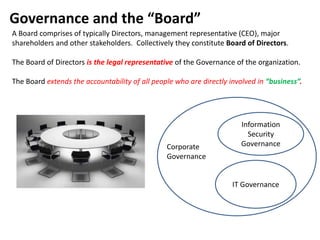
Governance and the “Board”
A Board comprises of typically Directors, management representative (CEO), major
shareholders and other stakeholders. Collectively they constitute Board of Directors.

The Board of Directors is the legal representative of the Governance of the organization.

The Board extends the accountability of all people who are directly involved in “business”.


                                                                       Information
                                                                         Security
                                                Corporate              Governance
                                                Governance


                                                                     IT Governance
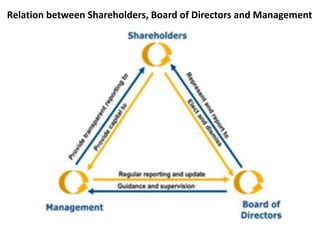
Relation between Shareholders, Board of Directors and Management
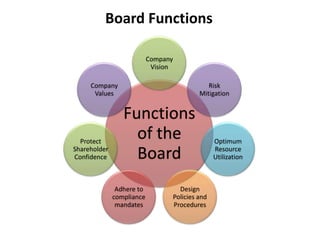
Board Functions

                           Company
                            Vision

     Company                                     Risk
      Values                                  Mitigation


                 Functions
  Protect
                   of the                           Optimum
Shareholder
Confidence         Board                            Resource
                                                    Utilization


               Adhere to               Design
              compliance             Policies and
               mandates              Procedures
Comparison between
  Governance and
   Management
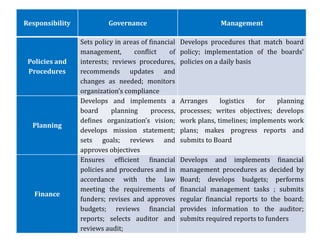
Responsibility            Governance                             Management

                 Sets policy in areas of financial   Develops procedures that match board
                 management,       conflict     of   policy; implementation of the boards’
 Policies and    interests; reviews procedures,      policies on a daily basis
 Procedures      recommends updates and
                 changes as needed; monitors
                 organization’s compliance
                 Develops and implements a           Arranges     logistics   for  planning
                 board      planning      process,   processes; writes objectives; develops
                 defines organization’s vision;      work plans, timelines; implements work
  Planning
                 develops mission statement;         plans; makes progress reports and
                 sets goals; reviews and             submits to Board
                 approves objectives
                 Ensures efficient financial         Develops and implements financial
                 policies and procedures and in      management procedures as decided by
                 accordance with the law             Board; develops budgets; performs
                 meeting the requirements of         financial management tasks ; submits
   Finance
                 funders; revises and approves       regular financial reports to the board;
                 budgets; reviews financial          provides information to the auditor;
                 reports; selects auditor and        submits required reports to funders
                 reviews audit;
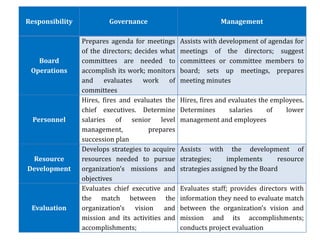
Responsibility           Governance                            Management

                 Prepares agenda for meetings     Assists with development of agendas for
                 of the directors; decides what   meetings of the directors; suggest
   Board         committees are needed to         committees or committee members to
 Operations      accomplish its work; monitors    board; sets up meetings, prepares
                 and evaluates work of            meeting minutes
                 committees
                 Hires, fires and evaluates the   Hires, fires and evaluates the employees.
                 chief executives. Determine      Determines       salaries     of   lower
  Personnel      salaries of senior level         management and employees
                 management,           prepares
                 succession plan
                 Develops strategies to acquire   Assists with the development of
 Resource        resources needed to pursue       strategies;     implements      resource
Development      organization’s missions and      strategies assigned by the Board
                 objectives
                 Evaluates chief executive and    Evaluates staff; provides directors with
                 the match between the            information they need to evaluate match
 Evaluation      organization’s vision and        between the organization’s vision and
                 mission and its activities and   mission and its accomplishments;
                 accomplishments;                 conducts project evaluation
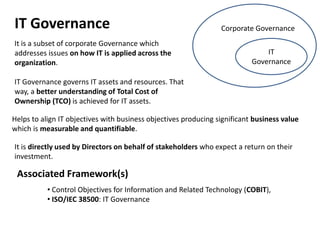
IT Governance                                                    Corporate Governance
It is a subset of corporate Governance which
addresses issues on how IT is applied across the                               IT
organization.                                                              Governance

IT Governance governs IT assets and resources. That
way, a better understanding of Total Cost of
Ownership (TCO) is achieved for IT assets.

Helps to align IT objectives with business objectives producing significant business value
which is measurable and quantifiable.

It is directly used by Directors on behalf of stakeholders who expect a return on their
investment.

 Associated Framework(s)
           • Control Objectives for Information and Related Technology (COBIT),
           • ISO/IEC 38500: IT Governance
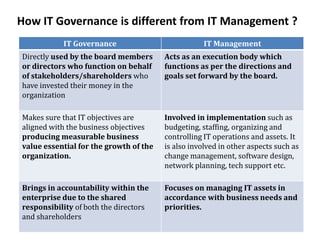
How IT Governance is different from IT Management ?
           IT Governance                           IT Management
Directly used by the board members      Acts as an execution body which
or directors who function on behalf     functions as per the directions and
of stakeholders/shareholders who        goals set forward by the board.
have invested their money in the
organization

Makes sure that IT objectives are       Involved in implementation such as
aligned with the business objectives    budgeting, staffing, organizing and
producing measurable business           controlling IT operations and assets. It
value essential for the growth of the   is also involved in other aspects such as
organization.                           change management, software design,
                                        network planning, tech support etc.

Brings in accountability within the     Focuses on managing IT assets in
enterprise due to the shared            accordance with business needs and
responsibility of both the directors    priorities.
and shareholders
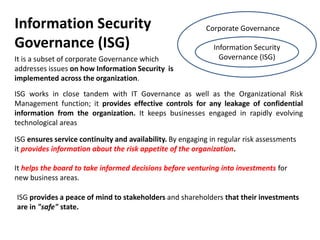
Information Security                                       Corporate Governance

Governance (ISG)                                              Information Security
It is a subset of corporate Governance which                    Governance (ISG)
addresses issues on how Information Security is
implemented across the organization.
ISG works in close tandem with IT Governance as well as the Organizational Risk
Management function; it provides effective controls for any leakage of confidential
information from the organization. It keeps businesses engaged in rapidly evolving
technological areas

ISG ensures service continuity and availability. By engaging in regular risk assessments
it provides information about the risk appetite of the organization.

It helps the board to take informed decisions before venturing into investments for
new business areas.

ISG provides a peace of mind to stakeholders and shareholders that their investments
are in "safe" state.
Implementing good IS Governance

• Is your IS Governance delivering value?

• Is your IS Governance well planned?

• Is your IS Governance well managed and measurable?

• Is your IS Governance able to properly manage and mitigate risk?
THANK YOU !!
          - Manasdeep

Understanding Governance

  • 1.
  • 2.
    Opening Questions andAgenda • What do you mean by Governance? • What do you mean by Management? • What is the difference between Governance and Management? • What is IT Governance? • What is Information Security Governance? From here, we will imply the meaning of Governance in “corporate context” only.
  • 3.
    Governance Governance is thesystem by which an organization is directed and controlled. It consists of a set of responsibilities that give strategic guidance to management to run the organization smoothly.
  • 4.
    Governance and the“Board” A Board comprises of typically Directors, management representative (CEO), major shareholders and other stakeholders. Collectively they constitute Board of Directors. The Board of Directors is the legal representative of the Governance of the organization. The Board extends the accountability of all people who are directly involved in “business”. Information Security Corporate Governance Governance IT Governance
  • 5.
    Relation between Shareholders,Board of Directors and Management
  • 6.
    Board Functions Company Vision Company Risk Values Mitigation Functions Protect of the Optimum Shareholder Confidence Board Resource Utilization Adhere to Design compliance Policies and mandates Procedures
  • 7.
    Comparison between Governance and Management
  • 8.
    Responsibility Governance Management Sets policy in areas of financial Develops procedures that match board management, conflict of policy; implementation of the boards’ Policies and interests; reviews procedures, policies on a daily basis Procedures recommends updates and changes as needed; monitors organization’s compliance Develops and implements a Arranges logistics for planning board planning process, processes; writes objectives; develops defines organization’s vision; work plans, timelines; implements work Planning develops mission statement; plans; makes progress reports and sets goals; reviews and submits to Board approves objectives Ensures efficient financial Develops and implements financial policies and procedures and in management procedures as decided by accordance with the law Board; develops budgets; performs meeting the requirements of financial management tasks ; submits Finance funders; revises and approves regular financial reports to the board; budgets; reviews financial provides information to the auditor; reports; selects auditor and submits required reports to funders reviews audit;
  • 9.
    Responsibility Governance Management Prepares agenda for meetings Assists with development of agendas for of the directors; decides what meetings of the directors; suggest Board committees are needed to committees or committee members to Operations accomplish its work; monitors board; sets up meetings, prepares and evaluates work of meeting minutes committees Hires, fires and evaluates the Hires, fires and evaluates the employees. chief executives. Determine Determines salaries of lower Personnel salaries of senior level management and employees management, prepares succession plan Develops strategies to acquire Assists with the development of Resource resources needed to pursue strategies; implements resource Development organization’s missions and strategies assigned by the Board objectives Evaluates chief executive and Evaluates staff; provides directors with the match between the information they need to evaluate match Evaluation organization’s vision and between the organization’s vision and mission and its activities and mission and its accomplishments; accomplishments; conducts project evaluation
  • 10.
    IT Governance Corporate Governance It is a subset of corporate Governance which addresses issues on how IT is applied across the IT organization. Governance IT Governance governs IT assets and resources. That way, a better understanding of Total Cost of Ownership (TCO) is achieved for IT assets. Helps to align IT objectives with business objectives producing significant business value which is measurable and quantifiable. It is directly used by Directors on behalf of stakeholders who expect a return on their investment. Associated Framework(s) • Control Objectives for Information and Related Technology (COBIT), • ISO/IEC 38500: IT Governance
  • 11.
    How IT Governanceis different from IT Management ? IT Governance IT Management Directly used by the board members Acts as an execution body which or directors who function on behalf functions as per the directions and of stakeholders/shareholders who goals set forward by the board. have invested their money in the organization Makes sure that IT objectives are Involved in implementation such as aligned with the business objectives budgeting, staffing, organizing and producing measurable business controlling IT operations and assets. It value essential for the growth of the is also involved in other aspects such as organization. change management, software design, network planning, tech support etc. Brings in accountability within the Focuses on managing IT assets in enterprise due to the shared accordance with business needs and responsibility of both the directors priorities. and shareholders
  • 12.
    Information Security Corporate Governance Governance (ISG) Information Security It is a subset of corporate Governance which Governance (ISG) addresses issues on how Information Security is implemented across the organization. ISG works in close tandem with IT Governance as well as the Organizational Risk Management function; it provides effective controls for any leakage of confidential information from the organization. It keeps businesses engaged in rapidly evolving technological areas ISG ensures service continuity and availability. By engaging in regular risk assessments it provides information about the risk appetite of the organization. It helps the board to take informed decisions before venturing into investments for new business areas. ISG provides a peace of mind to stakeholders and shareholders that their investments are in "safe" state.
  • 13.
    Implementing good ISGovernance • Is your IS Governance delivering value? • Is your IS Governance well planned? • Is your IS Governance well managed and measurable? • Is your IS Governance able to properly manage and mitigate risk?
  • 14.
    THANK YOU !! - Manasdeep