Corporate
     Governance

       The Financial
         Steward
Learning Objectives:
• Discuss governance best
  practices
• Prepare effective board meeting
  agendas and reports

                                    1
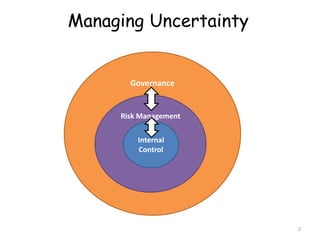
Managing Uncertainty


       Governance


     Risk Management

         Internal
         Control


                       2
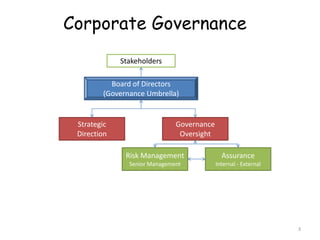
Corporate Governance
             Stakeholders

          Board of Directors
        (Governance Umbrella)


 Strategic                    Governance
 Direction                     Oversight

              Risk Management                Assurance
               Senior Management           Internal - External


                                                                 3
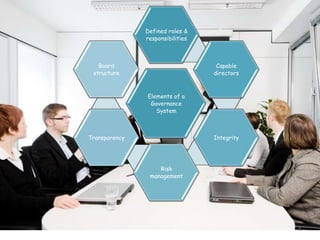
Defined roles &
               responsibilities


   Board                           Capable
 structure                        directors


               Elements of a
                Governance
                  System


Transparency                      Integrity


                   Risk
                management


                                              4
Board Challenges

 Size and complexity

 Ownership structure

 Transitioning companies
  between stages of the
  lifecycle

 Related party transactions


                                   5
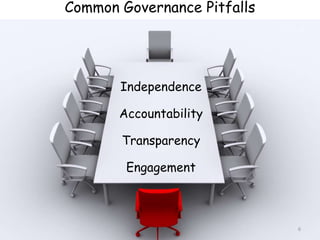
Common Governance Pitfalls


       Independence

       Accountability

       Transparency

        Engagement


                             6
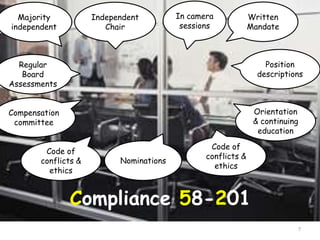
Majority           Independent         In camera            Written
independent             Chair             sessions            Mandate


  Regular                                                         Position
   Board                                                        descriptions
Assessments


Compensation                                                   Orientation
 committee                                                     & continuing
                                                                education
                                                 Code of
        Code of
                                                conflicts &
       conflicts &         Nominations
                                                  ethics
         ethics


               Compliance 58-201
                                                                          7
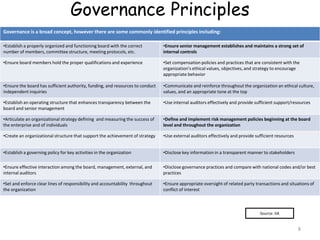
Governance Principles
Governance is a broad concept, however there are some commonly identified principles including:

•Establish a properly organized and functioning board with the correct          •Ensure senior management establishes and maintains a strong set of
number of members, committee structure, meeting protocols, etc.                 internal controls

•Ensure board members hold the proper qualifications and experience             •Set compensation policies and practices that are consistent with the
                                                                                organization’s ethical values, objectives, and strategy to encourage
                                                                                appropriate behavior

•Ensure the board has sufficient authority, funding, and resources to conduct   •Communicate and reinforce throughout the organization an ethical culture,
independent inquiries                                                           values, and an appropriate tone at the top

•Establish an operating structure that enhances transparency between the        •Use internal auditors effectively and provide sufficient support/resources
board and senior management

•Articulate an organizational strategy defining and measuring the success of    •Define and implement risk management policies beginning at the board
the enterprise and of individuals                                               level and throughout the organization

•Create an organizational structure that support the achievement of strategy    •Use external auditors effectively and provide sufficient resources


•Establish a governing policy for key activities in the organization            •Disclose key information in a transparent manner to stakeholders

•Ensure effective interaction among the board, management, external, and        •Disclose governance practices and compare with national codes and/or best
internal auditors                                                               practices

•Set and enforce clear lines of responsibility and accountability throughout    •Ensure appropriate oversight of related party transactions and situations of
the organization                                                                conflict of interest


                                                                                                                                 Source: IIA


                                                                                                                                                      8
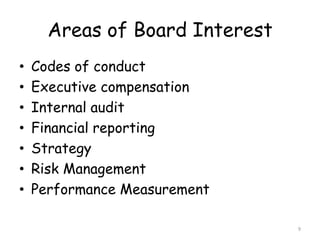
Areas of Board Interest
•   Codes of conduct
•   Executive compensation
•   Internal audit
•   Financial reporting
•   Strategy
•   Risk Management
•   Performance Measurement

                                9
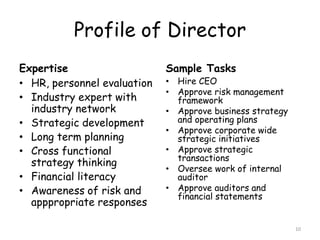
Profile of Director
Expertise                    Sample Tasks
• HR, personnel evaluation   • Hire CEO
                             • Approve risk management
• Industry expert with         framework
  industry network           • Approve business strategy
• Strategic development        and operating plans
                             • Approve corporate wide
• Long term planning           strategic initiatives
• Cross functional           • Approve strategic
                               transactions
  strategy thinking
                             • Oversee work of internal
• Financial literacy           auditor
• Awareness of risk and      • Approve auditors and
                               financial statements
  apppropriate responses

                                                           10
11
12
Case Study
Assume that Sally accepts PEGroup’s
offer and a 5 person board is formed.
Sally asks you to prepare the agenda
for both the Board and Audit
Committee. Assume year end results will
be approved during the meeting.
                                          13
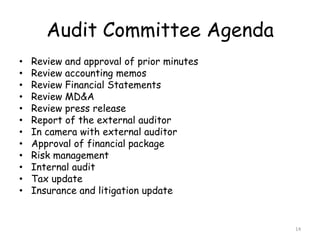
Audit Committee Agenda
•   Review and approval of prior minutes
•   Review accounting memos
•   Review Financial Statements
•   Review MD&A
•   Review press release
•   Report of the external auditor
•   In camera with external auditor
•   Approval of financial package
•   Risk management
•   Internal audit
•   Tax update
•   Insurance and litigation update


                                           14
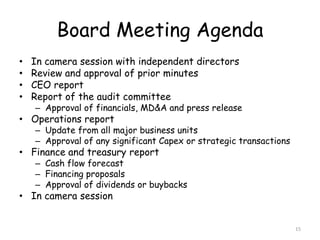
Board Meeting Agenda
•   In camera session with independent directors
•   Review and approval of prior minutes
•   CEO report
•   Report of the audit committee
    – Approval of financials, MD&A and press release
• Operations report
    – Update from all major business units
    – Approval of any significant Capex or strategic transactions
• Finance and treasury report
    – Cash flow forecast
    – Financing proposals
    – Approval of dividends or buybacks
• In camera session


                                                                    15
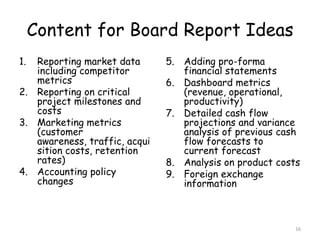
Content for Board Report Ideas
1. Reporting market data       5. Adding pro-forma
   including competitor           financial statements
   metrics                     6. Dashboard metrics
2. Reporting on critical          (revenue, operational,
   project milestones and         productivity)
   costs                       7. Detailed cash flow
3. Marketing metrics              projections and variance
   (customer                      analysis of previous cash
   awareness, traffic, acqui      flow forecasts to
   sition costs, retention        current forecast
   rates)                      8. Analysis on product costs
4. Accounting policy           9. Foreign exchange
   changes                        information


                                                          16

Governance and the audit committee

  • 1.
    Corporate Governance The Financial Steward Learning Objectives: • Discuss governance best practices • Prepare effective board meeting agendas and reports 1
  • 2.
    Managing Uncertainty Governance Risk Management Internal Control 2
  • 3.
    Corporate Governance Stakeholders Board of Directors (Governance Umbrella) Strategic Governance Direction Oversight Risk Management Assurance Senior Management Internal - External 3
  • 4.
    Defined roles & responsibilities Board Capable structure directors Elements of a Governance System Transparency Integrity Risk management 4
  • 5.
    Board Challenges  Sizeand complexity  Ownership structure  Transitioning companies between stages of the lifecycle  Related party transactions 5
  • 6.
    Common Governance Pitfalls Independence Accountability Transparency Engagement 6
  • 7.
    Majority Independent In camera Written independent Chair sessions Mandate Regular Position Board descriptions Assessments Compensation Orientation committee & continuing education Code of Code of conflicts & conflicts & Nominations ethics ethics Compliance 58-201 7
  • 8.
    Governance Principles Governance isa broad concept, however there are some commonly identified principles including: •Establish a properly organized and functioning board with the correct •Ensure senior management establishes and maintains a strong set of number of members, committee structure, meeting protocols, etc. internal controls •Ensure board members hold the proper qualifications and experience •Set compensation policies and practices that are consistent with the organization’s ethical values, objectives, and strategy to encourage appropriate behavior •Ensure the board has sufficient authority, funding, and resources to conduct •Communicate and reinforce throughout the organization an ethical culture, independent inquiries values, and an appropriate tone at the top •Establish an operating structure that enhances transparency between the •Use internal auditors effectively and provide sufficient support/resources board and senior management •Articulate an organizational strategy defining and measuring the success of •Define and implement risk management policies beginning at the board the enterprise and of individuals level and throughout the organization •Create an organizational structure that support the achievement of strategy •Use external auditors effectively and provide sufficient resources •Establish a governing policy for key activities in the organization •Disclose key information in a transparent manner to stakeholders •Ensure effective interaction among the board, management, external, and •Disclose governance practices and compare with national codes and/or best internal auditors practices •Set and enforce clear lines of responsibility and accountability throughout •Ensure appropriate oversight of related party transactions and situations of the organization conflict of interest Source: IIA 8
  • 9.
    Areas of BoardInterest • Codes of conduct • Executive compensation • Internal audit • Financial reporting • Strategy • Risk Management • Performance Measurement 9
  • 10.
    Profile of Director Expertise Sample Tasks • HR, personnel evaluation • Hire CEO • Approve risk management • Industry expert with framework industry network • Approve business strategy • Strategic development and operating plans • Approve corporate wide • Long term planning strategic initiatives • Cross functional • Approve strategic transactions strategy thinking • Oversee work of internal • Financial literacy auditor • Awareness of risk and • Approve auditors and financial statements apppropriate responses 10
  • 11.
  • 12.
  • 13.
    Case Study Assume thatSally accepts PEGroup’s offer and a 5 person board is formed. Sally asks you to prepare the agenda for both the Board and Audit Committee. Assume year end results will be approved during the meeting. 13
  • 14.
    Audit Committee Agenda • Review and approval of prior minutes • Review accounting memos • Review Financial Statements • Review MD&A • Review press release • Report of the external auditor • In camera with external auditor • Approval of financial package • Risk management • Internal audit • Tax update • Insurance and litigation update 14
  • 15.
    Board Meeting Agenda • In camera session with independent directors • Review and approval of prior minutes • CEO report • Report of the audit committee – Approval of financials, MD&A and press release • Operations report – Update from all major business units – Approval of any significant Capex or strategic transactions • Finance and treasury report – Cash flow forecast – Financing proposals – Approval of dividends or buybacks • In camera session 15
  • 16.
    Content for BoardReport Ideas 1. Reporting market data 5. Adding pro-forma including competitor financial statements metrics 6. Dashboard metrics 2. Reporting on critical (revenue, operational, project milestones and productivity) costs 7. Detailed cash flow 3. Marketing metrics projections and variance (customer analysis of previous cash awareness, traffic, acqui flow forecasts to sition costs, retention current forecast rates) 8. Analysis on product costs 4. Accounting policy 9. Foreign exchange changes information 16

Editor's Notes

  • #3 Organization face uncertainty in all aspects of their business. Success is dependent on how well the organization adapts and manages those uncertainties. Organizations are structured to achieve success, which implies that structure and managing uncertainty are inextricably linked.An overall governance structure ensures that the needs of key stakeholders are met. This is achieved by providing guidance to those responsible for managing the risks of operating the business. Within the daily operations, control activities are performed to mitigate risks. Governance structures ensure the needs of stakeholders are met and that the organization is fulfilling its mission, vision, and values.Risk management identifies and manages the risks that may adversely affect the organization’s success within the context of the overall governance structure.Internal controls enable execution of risk management strategies.Information flow: The board provides direction to senior management to carry our risk management activities. Senior management provides the board with assurances of effective risk management. Senior management provides direction to lower levels of management to perform internal controls. Lower levels of management are accountable to senior management for delivering effective control.
  • #4 Corporate governance involves a set of relationships between a company’s management, its board, its shareholders, and other stakeholders. Corporate governance also provides the structure through which the objectives of the company are set, and the means of attaining those objectives and monitoring performance are determined. [Organisation for Economic Co-operation and Development]Stakeholders include direct stakeholders such as employees, customers, vendors; indirect stakeholders such as shareholders/investors and regulatory agencies; and influencing stakeholders such as financial institutions, ratings agencies, and competitors. Each group with have an interest in either the financial, compliance, operating, or strategic outcomes of the organization.The board considers the outcomes that key stakeholders would likely deem unacceptable. The board then establishes and communicates to senior management tolerance levels and boundaries, consistent with the organization’s risk appetite, based on these possible outcomes.Senior management has the responsibility to execute the board’s directions within the tolerance levels and boundaries established. Senior management will institutionalize through processes and activities to manage risk to an appropriate level by delegating and directing the people in the organization. Senior management will often fulfill its governance responsibilities by establishing a risk committee to identify and evaluate risk. Ongoing reporting requirements and risk communications are established to monitor risk management activities.Risk owners are those responsible for managing one or more risks on a day-to-day basis. They execute risk management activities and report back to senior management. Internal audit will evaluate risk management activities,make a determination of effectiveness, and report its findings to the appropriate levels of management and the board as dictated by its charter.External audits are primarily driven by regulatory or contractual requirements. While rarely comprehensive in nature, these opinions do provide the board with certain levels of assurance over areas to which they pertain.
  • #8 The Independent Board Chair is necessary to ensure the board’s agenda will enable it to successfully carry out its duties.The written mandate of the board should acknowledge responsibility for the stewardship of the issuer (strategic planning process, risk management, succession planning etc.)There should be a written code of business conduct and ethics that covers such things as: conflicts of interest, proper use of corporate assets/opportunities, confidentiality, fair dealing, compliance with laws, and reporting of any unethical behavior.The compensation committee should be made up of independent directors.Regular board assessments help the board, its committees, and each individual director consider their effectiveness and contribution.