ManagementPoojaSehgal, GBS, Noida
Management  Management in some form or another is an integral part of living and is essential wherever human efforts are to be undertaken to achieve desired goals.The  recorded history shows application of some current management techniques as far back as 5000 B.C. The Egyptian pyramids, built as early as 3000 B.C., required the organized efforts of over 100,000 workers.
ManagementIt would be natural to assume that all functions of modern management namely, planning, organizing, directing and controlling played a significant role in the construction of these monuments.The Importance of management was highlighted by the late president of United states, John Kennedy when he said that, the role of management in our society is critical in human progress.
ManagementGood Management is the backbone of successful organizations.Management is essential for organized life and necessary to run all types of organizations.
Management : DefinitionsMany management thinkers have defined management in their own ways.“Management is a set of activities directed at the efficient and effective utilization of resources in the pursuit of one or more goals.”          				By Van Fleet and Peterson
Management : DefinitionsManagement is the accomplishment of results through the efforts of other people.                                          (Lawrence A. Appley)Management is a process of planning organising, actuating and controlling to determine and accomplish the objectives by the use of people and resources. (Terry G.)
Management : DefinitionsManagement is  working with human, financial and physical resources to achieve organizational objectives by performing the planning, organizing, leading and controlling functions.  (Megginson, Mosley and Pietri)
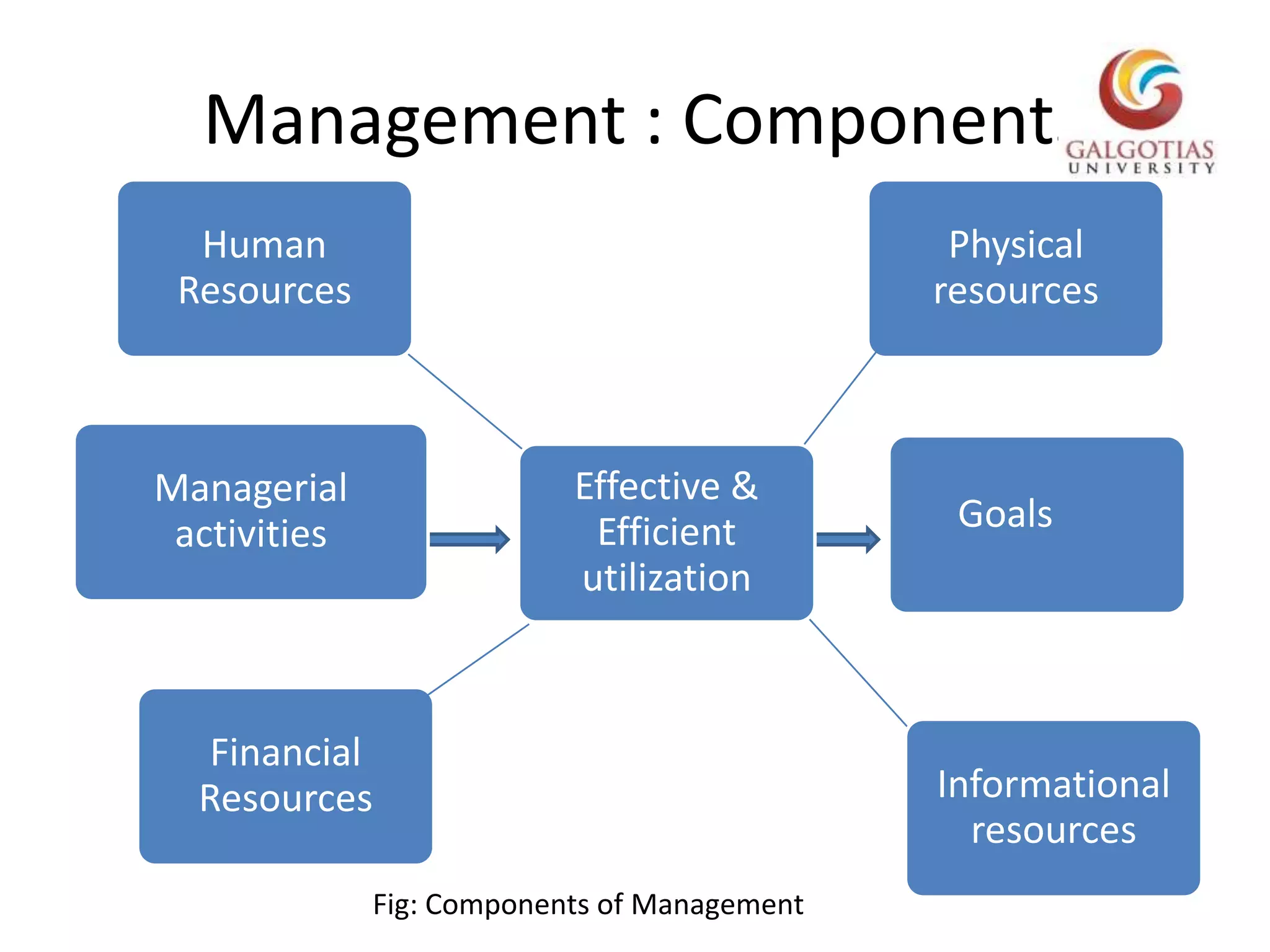
 Management : Components Physical resourcesHuman ResourcesManagerial activitiesEffective & Efficient utilizationGoalsEffective & Efficient utilizatonFinancial  ResourcesInformational resourcesFig: Components of Management
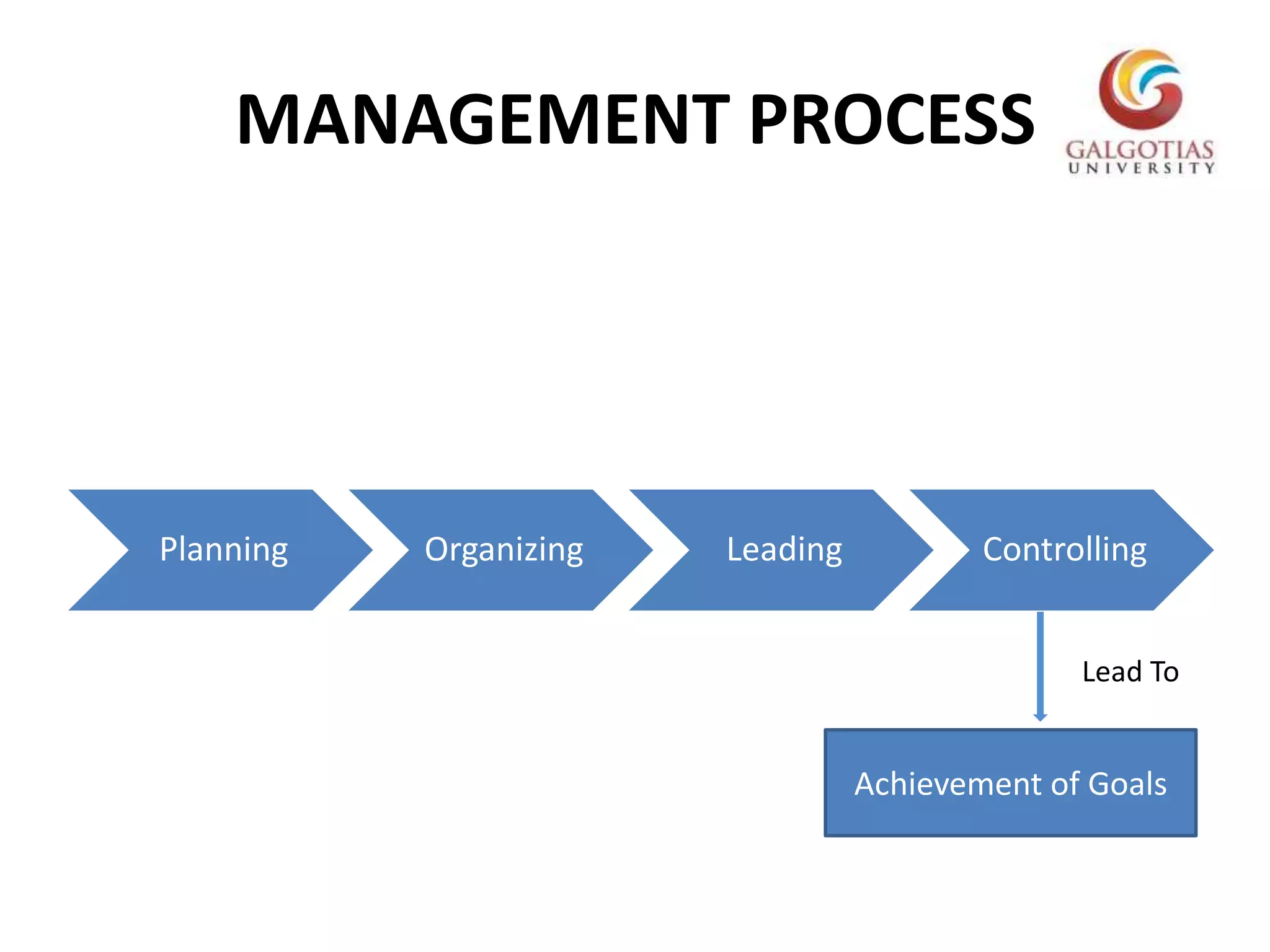
Management ProcessManagement is considered a process because it involves a series of interrelated functions. The management process includes: Planning, organizing, directing and controlling functions.
MANAGEMENT PROCESSLead ToAchievement of Goals
PlanningPlanning is considered to be the central function of management and determines an organization’s direction.Planning is a management function that involves defining goals, establishing strategies for achieving those goals and developing plans to integrate and coordinate activities.
OrganizingA management function that involves arranging and structuring work to accomplish the organizational goals.The function of organizing is primarily concerned withIdentifying the tasks that must be performed.Assigning these tasks to personnel while defining their authority and responsibility.Coordinating all these activities.
LeadingA management function that involves working with and through people to accomplish organizational goals.The leading function is concerned with leadership, communication, motivation and supervision so that the employees perform their activities in the most efficient manner possible in order to achieve the desired goals.
ControllingA management function that involves monitoring, comparing and correcting work performance. The function of control consists of those activities that are undertaken to ensure that the events do not deviate from the prearranged plans.
Features of ManagementOrganised activitiesExistence of objectivesRelationship among resourcesWorking with and through peopleDecision-making
Organised activitiesManagement can be called as a process of organised activitiesThe organised activities may take a mixture of forms ranging from a strongly structured organisation to a very relaxed organisation. It can be a company like Tata Iron and Steel Company or a local social club.
Existence of objectivesEvery group or organisation should have an objective or a set of objectives.  Without objectives, it becomes difficult to    identify the direction in which organised group activities are headed.
Working with and through peopleManagement entails engaging people and getting organisational objectives accomplished through them.The basic idea is to delegate and assign specific duties and responsibilities to subordinates.
 Relationship among resourcesThe essence of management is the integration  of the various organisational resources.Management is concerned with the  proper utilisation of human resources.
Decision-makingDecision-making involves selection of the best alternative out of the available alternatives.The quality the decision selected by the manager, determines the organisation's performance and the future of the organisation. Therefore, the success or failure rate of a manager can be judged by the quality of decisions he/she makes.
Nature of Management
Management is a universal ProcessWhere there is human activity, whether individual or joint there is management.The basic nature of management activity remains same in all areas, whether the organization to be managed is a family, club,  trade union, trust or the  government.
Management is a Factor of ProductionManagement is regarded as a factor  of ProductionIn the Modern industrial set up, qualified and efficient managers are essential to reap the fruits of huge production in business where the pattern of production has become capital intensive.
Management is a Goal OrientedThe most   important goal of all management activity is to  accomplish the objectives of an enterprise.Management at different levels seeks to achieve these goals in different ways.
Management is supreme in thought & ActionDetermination of the objectives of an enterprise tests the collective wisdom and sense of imagination of its management.  The objectives should be neither too high sounding or difficult to achieve.
Management is a Group ActivityFor the success of an enterprise, it is necessary that all the human and physical resources are efficiently coordinated to attain the maximum levels of productivity.
Management is a Social ScienceManagement means getting the tasks done by different people with different qualities. This involves dealing with individuals .
Management is an Important Organ of SocietyManagement shares a direct relationship with society. While the society influences the managerial actions, managerial actions influence the society.
Significance Of Management   Encourages Initiative   Encourages Innovation   Facilitates growth and expansion   Improves life of workers
Significance Of Management   Improves corporate image
   Motivates employees

Mba golgotias

  • 1.
  • 2.
    Management Managementin some form or another is an integral part of living and is essential wherever human efforts are to be undertaken to achieve desired goals.The recorded history shows application of some current management techniques as far back as 5000 B.C. The Egyptian pyramids, built as early as 3000 B.C., required the organized efforts of over 100,000 workers.
  • 3.
    ManagementIt would benatural to assume that all functions of modern management namely, planning, organizing, directing and controlling played a significant role in the construction of these monuments.The Importance of management was highlighted by the late president of United states, John Kennedy when he said that, the role of management in our society is critical in human progress.
  • 4.
    ManagementGood Management isthe backbone of successful organizations.Management is essential for organized life and necessary to run all types of organizations.
  • 5.
    Management : DefinitionsManymanagement thinkers have defined management in their own ways.“Management is a set of activities directed at the efficient and effective utilization of resources in the pursuit of one or more goals.” By Van Fleet and Peterson
  • 6.
    Management : DefinitionsManagementis the accomplishment of results through the efforts of other people. (Lawrence A. Appley)Management is a process of planning organising, actuating and controlling to determine and accomplish the objectives by the use of people and resources. (Terry G.)
  • 7.
    Management : DefinitionsManagementis working with human, financial and physical resources to achieve organizational objectives by performing the planning, organizing, leading and controlling functions. (Megginson, Mosley and Pietri)
  • 8.
    Management :Components Physical resourcesHuman ResourcesManagerial activitiesEffective & Efficient utilizationGoalsEffective & Efficient utilizatonFinancial ResourcesInformational resourcesFig: Components of Management
  • 9.
    Management ProcessManagement isconsidered a process because it involves a series of interrelated functions. The management process includes: Planning, organizing, directing and controlling functions.
  • 10.
  • 11.
    PlanningPlanning is consideredto be the central function of management and determines an organization’s direction.Planning is a management function that involves defining goals, establishing strategies for achieving those goals and developing plans to integrate and coordinate activities.
  • 12.
    OrganizingA management functionthat involves arranging and structuring work to accomplish the organizational goals.The function of organizing is primarily concerned withIdentifying the tasks that must be performed.Assigning these tasks to personnel while defining their authority and responsibility.Coordinating all these activities.
  • 13.
    LeadingA management functionthat involves working with and through people to accomplish organizational goals.The leading function is concerned with leadership, communication, motivation and supervision so that the employees perform their activities in the most efficient manner possible in order to achieve the desired goals.
  • 14.
    ControllingA management functionthat involves monitoring, comparing and correcting work performance. The function of control consists of those activities that are undertaken to ensure that the events do not deviate from the prearranged plans.
  • 15.
    Features of ManagementOrganisedactivitiesExistence of objectivesRelationship among resourcesWorking with and through peopleDecision-making
  • 16.
    Organised activitiesManagement canbe called as a process of organised activitiesThe organised activities may take a mixture of forms ranging from a strongly structured organisation to a very relaxed organisation. It can be a company like Tata Iron and Steel Company or a local social club.
  • 17.
    Existence of objectivesEverygroup or organisation should have an objective or a set of objectives. Without objectives, it becomes difficult to identify the direction in which organised group activities are headed.
  • 18.
    Working with andthrough peopleManagement entails engaging people and getting organisational objectives accomplished through them.The basic idea is to delegate and assign specific duties and responsibilities to subordinates.
  • 19.
    Relationship amongresourcesThe essence of management is the integration of the various organisational resources.Management is concerned with the proper utilisation of human resources.
  • 20.
    Decision-makingDecision-making involves selectionof the best alternative out of the available alternatives.The quality the decision selected by the manager, determines the organisation's performance and the future of the organisation. Therefore, the success or failure rate of a manager can be judged by the quality of decisions he/she makes.
  • 21.
  • 22.
    Management is auniversal ProcessWhere there is human activity, whether individual or joint there is management.The basic nature of management activity remains same in all areas, whether the organization to be managed is a family, club, trade union, trust or the government.
  • 23.
    Management is aFactor of ProductionManagement is regarded as a factor of ProductionIn the Modern industrial set up, qualified and efficient managers are essential to reap the fruits of huge production in business where the pattern of production has become capital intensive.
  • 24.
    Management is aGoal OrientedThe most important goal of all management activity is to accomplish the objectives of an enterprise.Management at different levels seeks to achieve these goals in different ways.
  • 25.
    Management is supremein thought & ActionDetermination of the objectives of an enterprise tests the collective wisdom and sense of imagination of its management. The objectives should be neither too high sounding or difficult to achieve.
  • 26.
    Management is aGroup ActivityFor the success of an enterprise, it is necessary that all the human and physical resources are efficiently coordinated to attain the maximum levels of productivity.
  • 27.
    Management is aSocial ScienceManagement means getting the tasks done by different people with different qualities. This involves dealing with individuals .
  • 28.
    Management is anImportant Organ of SocietyManagement shares a direct relationship with society. While the society influences the managerial actions, managerial actions influence the society.
  • 29.
    Significance Of Management Encourages Initiative Encourages Innovation Facilitates growth and expansion  Improves life of workers
  • 30.
    Significance Of Management  Improves corporate image
  • 31.
    Motivates employees
  • 32.
    Optimum use of resources
  • 33.
    Reduces wastageSignificance Of Management Increases efficiencyImproves relationsEncourages Team Work