NEUROENDOCRINE TUMORS
NEUROENDOCRINE CELLS
 Cells that are cross between endocrine and nerve
cells. Produces peptides and neuropeptides.
OVERVIEW OF NEUROENDOCRINE TUMORS
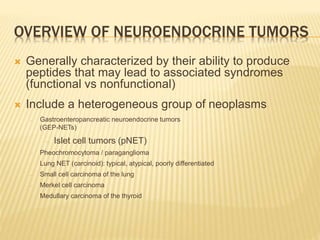
 Generally characterized by their ability to produce
peptides that may lead to associated syndromes
(functional vs nonfunctional)
 Include a heterogeneous group of neoplasms
– Gastroenteropancreatic neuroendocrine tumors
(GEP-NETs)
– Islet cell tumors (pNET)
– Pheochromocytoma / paraganglioma
– Lung NET (carcinoid): typical, atypical, poorly differentiated
– Small cell carcinoma of the lung
– Merkel cell carcinoma
– Medullary carcinoma of the thyroid
GI NEUROENDOCRINE TUMORS
 Majority of NET are
carcinoid tumors
 May go undetected for years
without obvious signs or
symptoms
• NETs can be characterized
by
their ability to produce
peptides that lead to their
syndromes2
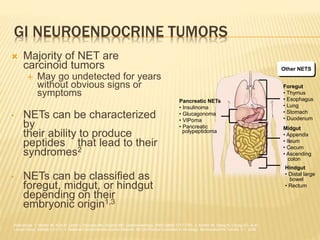
• NETs can be classified as
foregut, midgut, or hindgut
depending on their
embryonic origin1,3
Pancreatic NETs
• Insulinoma
• Glucagonoma
• VIPoma
• Pancreatic
polypeptidoma
Foregut
• Thymus
• Esophagus
• Lung
• Stomach
• Duodenum
Midgut
• Appendix
• Ileum
• Cecum
• Ascending
colon
Hindgut
• Distal large
bowel
• Rectum
Other NETS
References: 1. Modlin IM, Kidd M, Latich I, Zikusoka MN, Shapiro MD. Gastroenterology. 2005;128(6):1717-1751. 2. Modlin IM, Oberg K, Chung DC, et al.
Lancet Oncol. 2008;9(1):61-72. 3. National Comprehensive Cancer Network. NCCN Practice Guidelines in Oncology: Neuroendocrine Tumors. V.1. 2008.
1973
1974
1975
1976
1977
1978
1979
1980
1981
1982
1983
1984
1985
1986
1987
1988
1989
1990
1991
1992
1993
1994
1995
1996
1997
1998
1999
2000
2001
2002
2003
2004
0.00
1.00
2.00
3.00
4.00
5.00
6.00
0
100
200
300
400
500
600
Incidenceper100,000-NETs
Incidenceper100,000–Allmalignantneoplasms
All malignant neoplasms
Neuroendocrine tumors
Yao JC et al. J Clin Oncol. 2008;26:3063-3072.
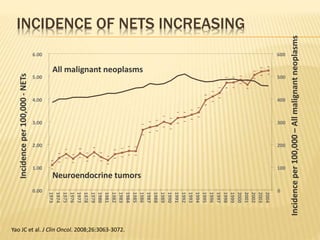
INCIDENCE OF NETS INCREASING
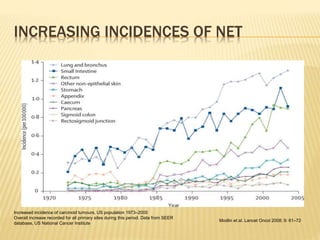
INCREASING INCIDENCES OF NET
Increased incidence of carcinoid tumours, US population 1973–2005
Overall increase recorded for all primary sites during this period. Data from SEER
database, US National Cancer Institute
Modlin et al. Lancet Oncol 2008; 9: 61–72
NETS ARE THE SECOND MOST PREVALENT
TYPE OF GI MALIGNANCY
2x more prevalent
than pancreatic cancer
]
1. National Cancer Institute. SEER Cancer Statistics Review, 1975-2004. http://seer.cancer.gov/csr/1975_2004. 2. Modlin IM, Lye KD, Kidd M. Cancer. 2003;97(4):934-959.
]
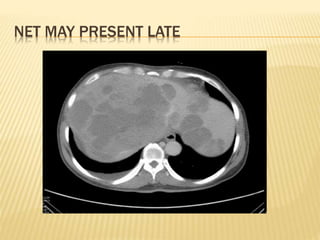
NET MAY PRESENT LATE
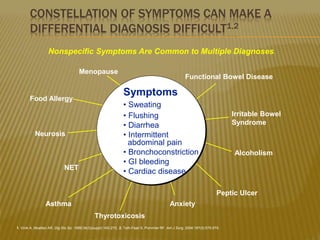
CONSTELLATION OF SYMPTOMS CAN MAKE A
DIFFERENTIAL DIAGNOSIS DIFFICULT1,2
Menopause
Irritable Bowel
Syndrome
Functional Bowel Disease
Anxiety
Neurosis
Food Allergy
Asthma
Alcoholism
Thyrotoxicosis
Peptic Ulcer
NET
Symptoms
• Sweating
• Flushing
• Diarrhea
• Intermittent
abdominal pain
• Bronchoconstriction
• GI bleeding
• Cardiac disease
Nonspecific Symptoms Are Common to Multiple Diagnoses
1. Vinik A, Moattari AR. Dig Dis Sci. 1989;34(3)(suppl):14S-27S. 2. Toth-Fejel S, Pommier RF. Am J Surg. 2004;187(5):575-579.
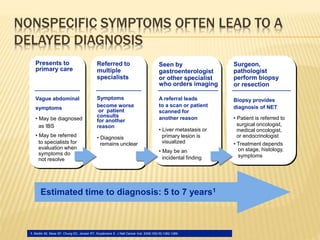
NONSPECIFIC SYMPTOMS OFTEN LEAD TO A
DELAYED DIAGNOSIS
1. Modlin IM, Moss SF, Chung DC, Jensen RT, Snyderwine E. J Natl Cancer Inst. 2008;100(18):1282-1289.
Presents to
primary care
Vague abdominal
symptoms
• May be diagnosed
as IBS
• May be referred
to specialists for
evaluation when
symptoms do
not resolve
Referred to
multiple
specialists
Symptoms
become worse
or patient
consults
for another
reason
• Diagnosis
remains unclear
Seen by
gastroenterologist
or other specialist
who orders imaging
A referral leads
to a scan or patient
scanned for
another reason
• Liver metastasis or
primary lesion is
visualized
• May be an
incidental finding
Surgeon,
pathologist
perform biopsy
or resection
Biopsy provides
diagnosis of NET
• Patient is referred to
surgical oncologist,
medical oncologist,
or endocrinologist
• Treatment depends
on stage, histology,
symptoms
Estimated time to diagnosis: 5 to 7 years1
Vague abdominal
symptoms
Primary tumor
Flushing
Metastases
Diarrhea
Death
NETS ARE OFTEN DIAGNOSED LATE
Time
Vinik A, Moattari AR. Dig Dis Sci. 1989;34[Suppl]:14S-27S.
DIAGNOSIS
 Clinical assessment
 Clinically directed workup of persistent
symptoms
 Scans
 CT scans, Octreoscans, Galium PET/CT
 Histopathological diagnosis
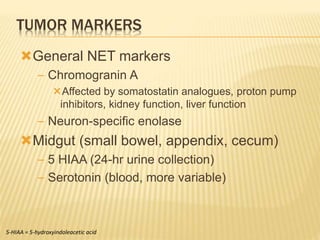
TUMOR MARKERS
General NET markers
– Chromogranin A
Affected by somatostatin analogues, proton pump
inhibitors, kidney function, liver function
– Neuron-specific enolase
Midgut (small bowel, appendix, cecum)
– 5 HIAA (24-hr urine collection)
– Serotonin (blood, more variable)
5-HIAA = 5-hydroxyindoleacetic acid
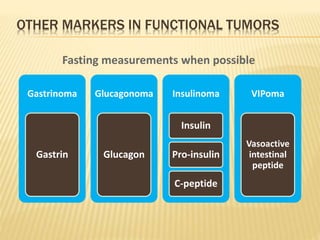
OTHER MARKERS IN FUNCTIONAL TUMORS
Gastrinoma
Gastrin
Glucagonoma
Glucagon
Insulinoma
Insulin
Pro-insulin
C-peptide
VIPoma
Vasoactive
intestinal
peptide
Fasting measurements when possible
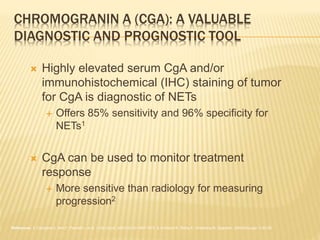
CHROMOGRANIN A (CGA): A VALUABLE
DIAGNOSTIC AND PROGNOSTIC TOOL
 Highly elevated serum CgA and/or
immunohistochemical (IHC) staining of tumor
for CgA is diagnostic of NETs
 Offers 85% sensitivity and 96% specificity for
NETs1
 CgA can be used to monitor treatment
response
 More sensitive than radiology for measuring
progression2
References: 1. Campana D, Nori F, Piscitelli L, et al. J Clin Oncol. 2007;25(15):1967-1973. 2. Eriksson B, Öberg K, Stridsberg M. Digestion. 2000;62(suppl 1):33-38.
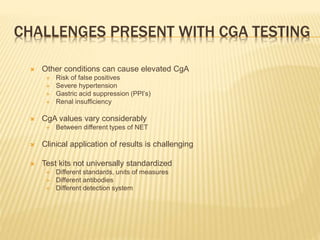
CHALLENGES PRESENT WITH CGA TESTING
 Other conditions can cause elevated CgA
 Risk of false positives
 Severe hypertension
 Gastric acid suppression (PPI’s)
 Renal insufficiency
 CgA values vary considerably
 Between different types of NET
 Clinical application of results is challenging
 Test kits not universally standardized
 Different standards, units of measures
 Different antibodies
 Different detection system
TREATMENT OPTIONS
 Surgery (curative vs debulking)
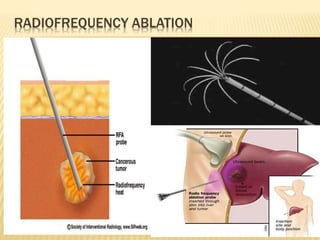
 Radiofrequency ablation
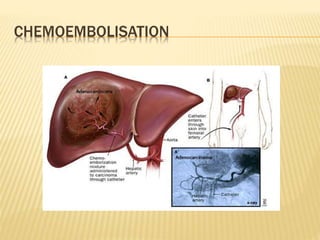
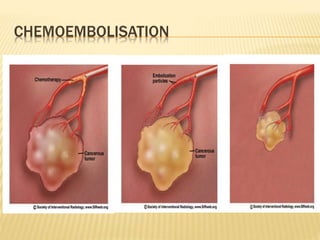
 Chemo-embolization
 Somatostatin analogue (hormonal treatment)
 Chemotherapy or other medical therapy
(targeted kinase inhibitors)
 Radionuclide therapy
SURGERY
RADIOFREQUENCY ABLATION
CHEMOEMBOLISATION
CHEMOEMBOLISATION
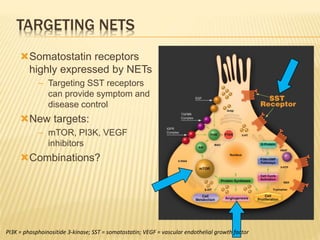
Somatostatin receptors
highly expressed by NETs
– Targeting SST receptors
can provide symptom and
disease control
New targets:
– mTOR, PI3K, VEGF
inhibitors
Combinations?
TARGETING NETS
PI3K = phosphoinositide 3-kinase; SST = somatostatin; VEGF = vascular endothelial growth factor
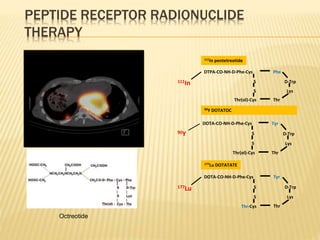
PEPTIDE RECEPTOR RADIONUCLIDE
THERAPY
Octreotide
111In pentetreotide
DTPA-CO-NH-D-Phe-Cys
S
S
Thr(ol)-Cys
Phe
D-Trp
Lys
Thr
111In
DOTA-CO-NH-D-Phe-Cys
S
S
Thr(ol)-Cys
Tyr
D-Trp
Lys
Thr
90Y DOTATOC
90Y
177Lu DOTATATE
DOTA-CO-NH-D-Phe-Cys
S
S
Thr-Cys
Tyr
D-Trp
Lys
Thr
177Lu
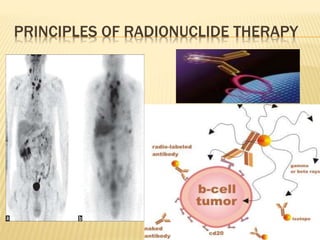
PRINCIPLES OF RADIONUCLIDE THERAPY

Understanding GEP NET Cancer

  • 1.
  • 2.
    NEUROENDOCRINE CELLS  Cellsthat are cross between endocrine and nerve cells. Produces peptides and neuropeptides.
  • 3.
    OVERVIEW OF NEUROENDOCRINETUMORS  Generally characterized by their ability to produce peptides that may lead to associated syndromes (functional vs nonfunctional)  Include a heterogeneous group of neoplasms – Gastroenteropancreatic neuroendocrine tumors (GEP-NETs) – Islet cell tumors (pNET) – Pheochromocytoma / paraganglioma – Lung NET (carcinoid): typical, atypical, poorly differentiated – Small cell carcinoma of the lung – Merkel cell carcinoma – Medullary carcinoma of the thyroid
  • 4.
    GI NEUROENDOCRINE TUMORS Majority of NET are carcinoid tumors  May go undetected for years without obvious signs or symptoms • NETs can be characterized by their ability to produce peptides that lead to their syndromes2 • NETs can be classified as foregut, midgut, or hindgut depending on their embryonic origin1,3 Pancreatic NETs • Insulinoma • Glucagonoma • VIPoma • Pancreatic polypeptidoma Foregut • Thymus • Esophagus • Lung • Stomach • Duodenum Midgut • Appendix • Ileum • Cecum • Ascending colon Hindgut • Distal large bowel • Rectum Other NETS References: 1. Modlin IM, Kidd M, Latich I, Zikusoka MN, Shapiro MD. Gastroenterology. 2005;128(6):1717-1751. 2. Modlin IM, Oberg K, Chung DC, et al. Lancet Oncol. 2008;9(1):61-72. 3. National Comprehensive Cancer Network. NCCN Practice Guidelines in Oncology: Neuroendocrine Tumors. V.1. 2008.
  • 5.
  • 6.
    INCREASING INCIDENCES OFNET Increased incidence of carcinoid tumours, US population 1973–2005 Overall increase recorded for all primary sites during this period. Data from SEER database, US National Cancer Institute Modlin et al. Lancet Oncol 2008; 9: 61–72
  • 7.
    NETS ARE THESECOND MOST PREVALENT TYPE OF GI MALIGNANCY 2x more prevalent than pancreatic cancer ] 1. National Cancer Institute. SEER Cancer Statistics Review, 1975-2004. http://seer.cancer.gov/csr/1975_2004. 2. Modlin IM, Lye KD, Kidd M. Cancer. 2003;97(4):934-959. ]
  • 8.
  • 9.
    CONSTELLATION OF SYMPTOMSCAN MAKE A DIFFERENTIAL DIAGNOSIS DIFFICULT1,2 Menopause Irritable Bowel Syndrome Functional Bowel Disease Anxiety Neurosis Food Allergy Asthma Alcoholism Thyrotoxicosis Peptic Ulcer NET Symptoms • Sweating • Flushing • Diarrhea • Intermittent abdominal pain • Bronchoconstriction • GI bleeding • Cardiac disease Nonspecific Symptoms Are Common to Multiple Diagnoses 1. Vinik A, Moattari AR. Dig Dis Sci. 1989;34(3)(suppl):14S-27S. 2. Toth-Fejel S, Pommier RF. Am J Surg. 2004;187(5):575-579.
  • 10.
    NONSPECIFIC SYMPTOMS OFTENLEAD TO A DELAYED DIAGNOSIS 1. Modlin IM, Moss SF, Chung DC, Jensen RT, Snyderwine E. J Natl Cancer Inst. 2008;100(18):1282-1289. Presents to primary care Vague abdominal symptoms • May be diagnosed as IBS • May be referred to specialists for evaluation when symptoms do not resolve Referred to multiple specialists Symptoms become worse or patient consults for another reason • Diagnosis remains unclear Seen by gastroenterologist or other specialist who orders imaging A referral leads to a scan or patient scanned for another reason • Liver metastasis or primary lesion is visualized • May be an incidental finding Surgeon, pathologist perform biopsy or resection Biopsy provides diagnosis of NET • Patient is referred to surgical oncologist, medical oncologist, or endocrinologist • Treatment depends on stage, histology, symptoms Estimated time to diagnosis: 5 to 7 years1
  • 11.
    Vague abdominal symptoms Primary tumor Flushing Metastases Diarrhea Death NETSARE OFTEN DIAGNOSED LATE Time Vinik A, Moattari AR. Dig Dis Sci. 1989;34[Suppl]:14S-27S.
  • 12.
    DIAGNOSIS  Clinical assessment Clinically directed workup of persistent symptoms  Scans  CT scans, Octreoscans, Galium PET/CT  Histopathological diagnosis
  • 13.
    TUMOR MARKERS General NETmarkers – Chromogranin A Affected by somatostatin analogues, proton pump inhibitors, kidney function, liver function – Neuron-specific enolase Midgut (small bowel, appendix, cecum) – 5 HIAA (24-hr urine collection) – Serotonin (blood, more variable) 5-HIAA = 5-hydroxyindoleacetic acid
  • 14.
    OTHER MARKERS INFUNCTIONAL TUMORS Gastrinoma Gastrin Glucagonoma Glucagon Insulinoma Insulin Pro-insulin C-peptide VIPoma Vasoactive intestinal peptide Fasting measurements when possible
  • 15.
    CHROMOGRANIN A (CGA):A VALUABLE DIAGNOSTIC AND PROGNOSTIC TOOL  Highly elevated serum CgA and/or immunohistochemical (IHC) staining of tumor for CgA is diagnostic of NETs  Offers 85% sensitivity and 96% specificity for NETs1  CgA can be used to monitor treatment response  More sensitive than radiology for measuring progression2 References: 1. Campana D, Nori F, Piscitelli L, et al. J Clin Oncol. 2007;25(15):1967-1973. 2. Eriksson B, Öberg K, Stridsberg M. Digestion. 2000;62(suppl 1):33-38.
  • 16.
    CHALLENGES PRESENT WITHCGA TESTING  Other conditions can cause elevated CgA  Risk of false positives  Severe hypertension  Gastric acid suppression (PPI’s)  Renal insufficiency  CgA values vary considerably  Between different types of NET  Clinical application of results is challenging  Test kits not universally standardized  Different standards, units of measures  Different antibodies  Different detection system
  • 17.
    TREATMENT OPTIONS  Surgery(curative vs debulking)  Radiofrequency ablation  Chemo-embolization  Somatostatin analogue (hormonal treatment)  Chemotherapy or other medical therapy (targeted kinase inhibitors)  Radionuclide therapy
  • 18.
  • 19.
  • 20.
  • 21.
  • 22.
    Somatostatin receptors highly expressedby NETs – Targeting SST receptors can provide symptom and disease control New targets: – mTOR, PI3K, VEGF inhibitors Combinations? TARGETING NETS PI3K = phosphoinositide 3-kinase; SST = somatostatin; VEGF = vascular endothelial growth factor
  • 23.
    PEPTIDE RECEPTOR RADIONUCLIDE THERAPY Octreotide 111Inpentetreotide DTPA-CO-NH-D-Phe-Cys S S Thr(ol)-Cys Phe D-Trp Lys Thr 111In DOTA-CO-NH-D-Phe-Cys S S Thr(ol)-Cys Tyr D-Trp Lys Thr 90Y DOTATOC 90Y 177Lu DOTATATE DOTA-CO-NH-D-Phe-Cys S S Thr-Cys Tyr D-Trp Lys Thr 177Lu
  • 24.

Editor's Notes