New Frontiers in
Neuroendocrine Tumors
      Treatment
       Carlos Frederico Pinto
   Instituto de Oncologia do Vale
Hospital Regional do Vale do Paraiba
                2008
Neuroendocrine Tumors -
         Background
Carcinoid, islet cell carcinoma
Slow growing, often metastatic at diagnosis
Associated with carcinoid syndrome caused by
hypersecretion of biogenic amines, peptides and
polypeptides and manifested mainly with
diarrhea and flushing
Symptoms are treated with somatostatin
analogues (Octreotide & Lanreotide)
Somatostatin analogues
Octreotide
High binding affinity for the somatostatin
receptor subtype sst2, and low affinity for sst3
and sst5 receptors
Many patients respond to Octreotide but
subsequently experience tachyphalyxis after 12-
18 months
May be due to downregulation of sst2 receptors
on tumor cells or overexpression of other
somatostatin receptors
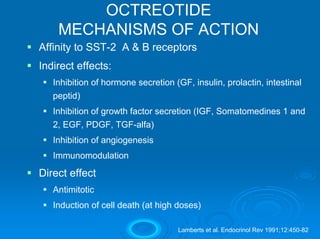
OCTREOTIDE
    MECHANISMS OF ACTION
Affinity to SST-2 A & B receptors
Indirect effects:
   Inhibition of hormone secretion (GF, insulin, prolactin, intestinal
   peptid)
   Inhibition of growth factor secretion (IGF, Somatomedines 1 and
   2, EGF, PDGF, TGF-alfa)
   Inhibition of angiogenesis
   Immunomodulation

Direct effect
   Antimitotic
   Induction of cell death (at high doses)

                                    Lamberts et al. Endocrinol Rev 1991;12:450-82
SOMATOSTATIN
         ANALOGUES
Octreotide – Sandostatin ®
             Sandostatin LAR ®
Lanreotide – Somatuline ®

SOM-230 – Pasireotide

RC-160 – Vapreotide – Octastatin ®
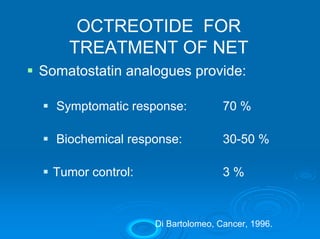
OCTREOTIDE FOR
    TREATMENT OF NET
Somatostatin analogues provide:

  Symptomatic response:            70 %

  Biochemical response:            30-50 %

  Tumor control:                   3%


                   Di Bartolomeo, Cancer, 1996.
SOMATOSTATIN ANALOGUES
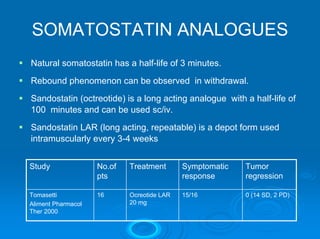
Natural somatostatin has a half-life of 3 minutes.
Rebound phenomenon can be observed in withdrawal.
Sandostatin (octreotide) is a long acting analogue with a half-life of
100 minutes and can be used sc/iv.
Sandostatin LAR (long acting, repeatable) is a depot form used
intramuscularly every 3-4 weeks


Study               No.of   Treatment       Symptomatic   Tumor
                    pts                     response      regression

Tomasetti           16      Ocreotide LAR   15/16         0 (14 SD, 2 PD)
Aliment Pharmacol           20 mg
Ther 2000
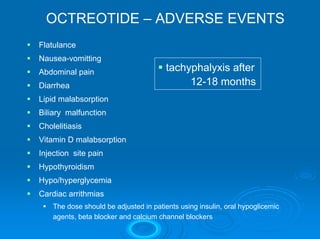
OCTREOTIDE – ADVERSE EVENTS
Flatulance
Nausea-vomitting
Abdominal pain                         tachyphalyxis after
Diarrhea                                    12-18 months
Lipid malabsorption
Biliary malfunction
Cholelitiasis
Vitamin D malabsorption
Injection site pain
Hypothyroidism
Hypo/hyperglycemia
Cardiac arrithmias
    The dose should be adjusted in patients using insulin, oral hypoglicemic
    agents, beta blocker and calcium channel blockers
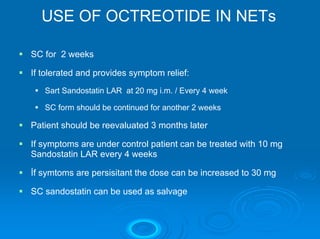
USE OF OCTREOTIDE IN NETs

SC for 2 weeks

If tolerated and provides symptom relief:
   Sart Sandostatin LAR at 20 mg i.m. / Every 4 week

   SC form should be continued for another 2 weeks

Patient should be reevaluated 3 months later

If symptoms are under control patient can be treated with 10 mg
Sandostatin LAR every 4 weeks

İf symtoms are persisitant the dose can be increased to 30 mg

SC sandostatin can be used as salvage
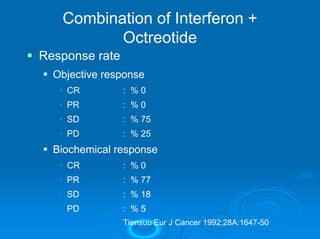
Combination of Interferon +
          Octreotide
Response rate
  Objective response
    CR          : %0
    PR          : %0
    SD          : % 75
    PD          : % 25
  Biochemical response
    CR          : %0
    PR          : % 77
    SD          : % 18
    PD          : %5
                Tiensuu Eur J Cancer 1992;28A:1647-50
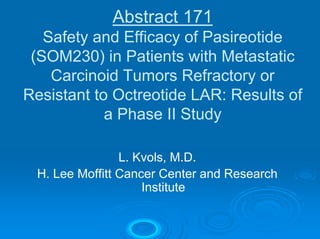
Abstract 171
   Safety and Efficacy of Pasireotide
 (SOM230) in Patients with Metastatic
    Carcinoid Tumors Refractory or
Resistant to Octreotide LAR: Results of
            a Phase II Study

                L. Kvols, M.D.
 H. Lee Moffitt Cancer Center and Research
                    Institute
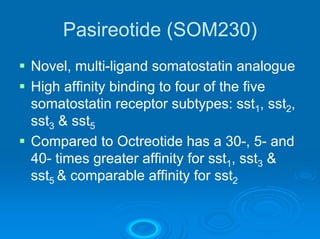
Pasireotide (SOM230)
Novel, multi-ligand somatostatin analogue
High affinity binding to four of the five
somatostatin receptor subtypes: sst1, sst2,
sst3 & sst5
Compared to Octreotide has a 30-, 5- and
40- times greater affinity for sst1, sst3 &
sst5 & comparable affinity for sst2
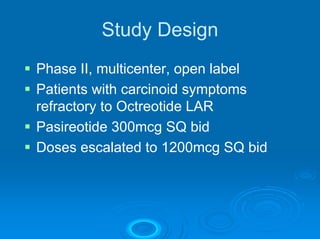
Study Design
Phase II, multicenter, open label
Patients with carcinoid symptoms
refractory to Octreotide LAR
Pasireotide 300mcg SQ bid
Doses escalated to 1200mcg SQ bid
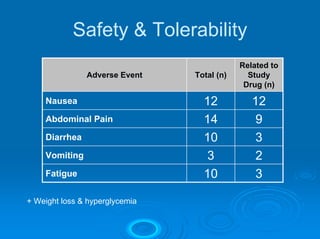
Safety & Tolerability
                                            Related to
               Adverse Event    Total (n)     Study
                                             Drug (n)

    Nausea                        12           12
    Abdominal Pain                14            9
    Diarrhea                      10            3
    Vomiting                       3           2
    Fatigue                       10            3

+ Weight loss & hyperglycemia
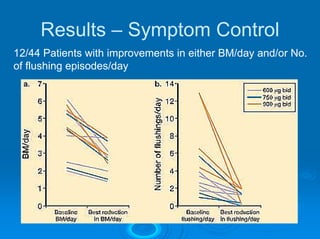
Results – Symptom Control
12/44 Patients with improvements in either BM/day and/or No.
of flushing episodes/day
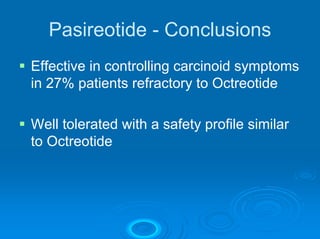
Pasireotide - Conclusions
Effective in controlling carcinoid symptoms
in 27% patients refractory to Octreotide

Well tolerated with a safety profile similar
to Octreotide
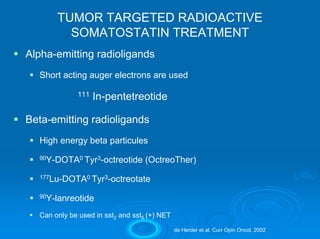
TUMOR TARGETED RADIOACTIVE
         SOMATOSTATIN TREATMENT
Alpha-emitting radioligands
  Short acting auger electrons are used

             111   In-pentetreotide

Beta-emitting radioligands
  High energy beta particules
  90Y-DOTA0 Tyr3-octreotide        (OctreoTher)
  177Lu-DOTA0 Tyr3-octreotate


  90Y-lanreotide


  Can only be used in sst2 and sst5 (+) NET

                                              de Herder et al, Curr Opin Oncol, 2002
New agents

  mTOR

   TKI
Abstract 178
Phase II Study of RAD001 (Everolimus)
  and Depot Octreotide (Sandostatin
 LAR) in Patients with Advanced Low
  Grade Neuroendocrine Carcinoma


                  J. C. Yao, M.D.
University of Texas, M.D. Anderson Cancer Center
                    ASCO 2007
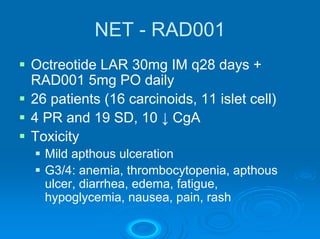
NET - RAD001
Octreotide LAR 30mg IM q28 days +
RAD001 5mg PO daily
26 patients (16 carcinoids, 11 islet cell)
4 PR and 19 SD, 10 ↓ CgA
Toxicity
  Mild apthous ulceration
  G3/4: anemia, thrombocytopenia, apthous
  ulcer, diarrhea, edema, fatigue,
  hypoglycemia, nausea, pain, rash
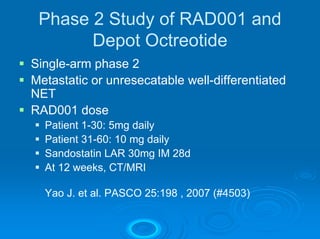
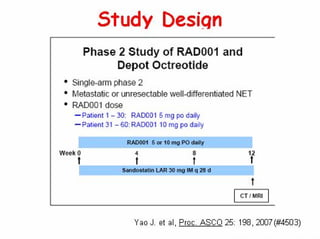
Phase 2 Study of RAD001 and
       Depot Octreotide
Single-arm phase 2
Metastatic or unresecatable well-differentiated
NET
RAD001 dose
  Patient 1-30: 5mg daily
  Patient 31-60: 10 mg daily
  Sandostatin LAR 30mg IM 28d
  At 12 weeks, CT/MRI

  Yao J. et al. PASCO 25:198 , 2007 (#4503)
Gary K. Schwartz, ASCO 2007
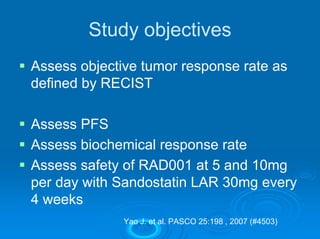
Study objectives
Assess objective tumor response rate as
defined by RECIST

Assess PFS
Assess biochemical response rate
Assess safety of RAD001 at 5 and 10mg
per day with Sandostatin LAR 30mg every
4 weeks
              Yao J. et al. PASCO 25:198 , 2007 (#4503)
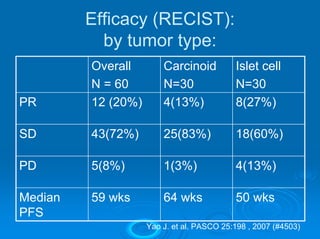
Efficacy (RECIST):
           by tumor type:
         Overall        Carcinoid          Islet cell
         N = 60         N=30               N=30
PR       12 (20%)       4(13%)             8(27%)

SD       43(72%)        25(83%)            18(60%)

PD       5(8%)          1(3%)              4(13%)

Median   59 wks         64 wks             50 wks
PFS
                    Yao J. et al. PASCO 25:198 , 2007 (#4503)
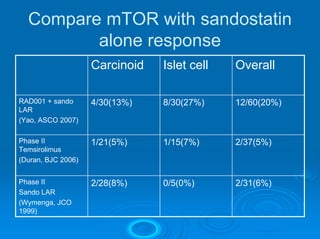
Compare mTOR with sandostatin
         alone response
                    Carcinoid   Islet cell   Overall

RAD001 + sando      4/30(13%)   8/30(27%)    12/60(20%)
LAR
(Yao, ASCO 2007)

Phase II            1/21(5%)    1/15(7%)     2/37(5%)
Temsirolimus
(Duran, BJC 2006)


Phase II            2/28(8%)    0/5(0%)      2/31(6%)
Sando LAR
(Wymenga, JCO
1999)
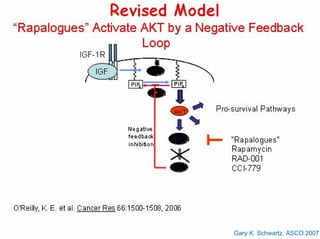
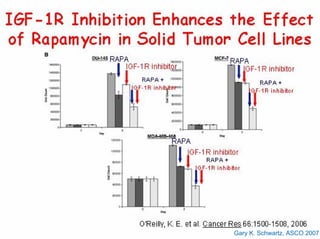
Why it works?
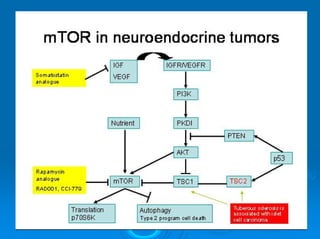
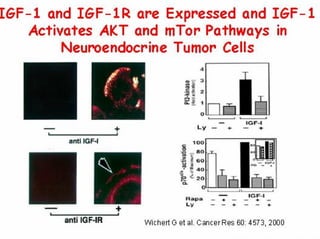
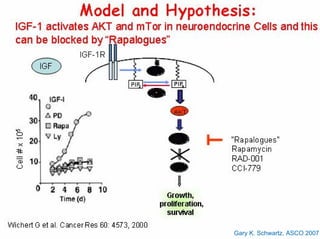
IGF-1 and IGF-1R are expressed and IGF-
1 activates AKT and mTOR Pathways in
NET cells
  Wichert G, Cancer Res, 2000.
RAPALOGs blocks signaling pro growth,
proliferation and survival:
  Rapamycin
  RAD001
  CCI-779
Gary K. Schwartz, ASCO 2007
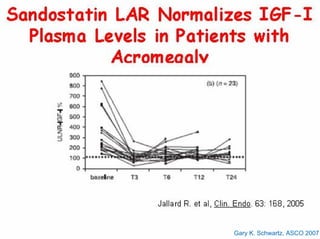
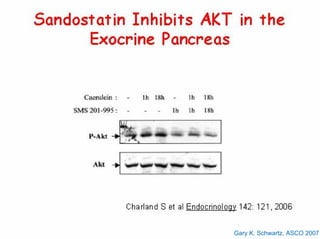
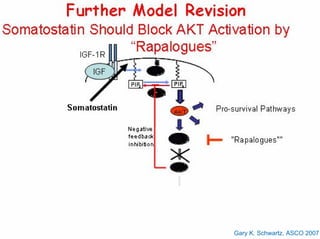
Rationale for combination
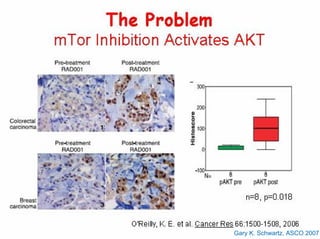
mTOR inhibition activates AKT, a survival
pathway by a negative feedback loop.
Sandostatin LAR normalizes IGF-1 levels in
patients with acromegaly
Sandostatin inhibits AKT in the exocrine
pancreas.
So...
  Sandostatin should block ATK
  activation by “Rapalogues”
IGF-1R Inhibitors
Sandostatin
IMC-A12: MoAB
BMS-536924: TKI
CP751,871: MoAB
R1507: MoAB
Sorafenib in NETs – Background
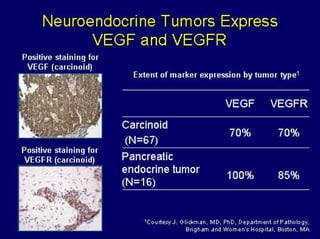
  NETs overexpress VEGF,VEGF-R, PDGF
  and PDGF-B
  Overexpression of VEGF associated with
  inferior PFS
  Increased Ki-67 is associated with inferior
  outcome

Hobday T, PASCO 25:198 , 2007 (#4504)
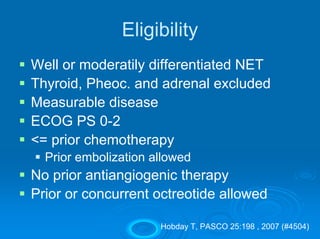
Eligibility
Well or moderatily differentiated NET
Thyroid, Pheoc. and adrenal excluded
Measurable disease
ECOG PS 0-2
<= prior chemotherapy
  Prior embolization allowed
No prior antiangiogenic therapy
Prior or concurrent octreotide allowed

                      Hobday T, PASCO 25:198 , 2007 (#4504)
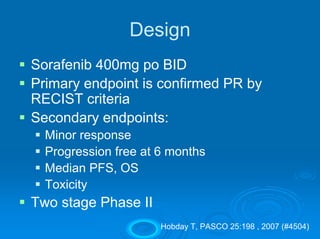
Design
Sorafenib 400mg po BID
Primary endpoint is confirmed PR by
RECIST criteria
Secondary endpoints:
  Minor response
  Progression free at 6 months
  Median PFS, OS
  Toxicity
Two stage Phase II
                      Hobday T, PASCO 25:198 , 2007 (#4504)
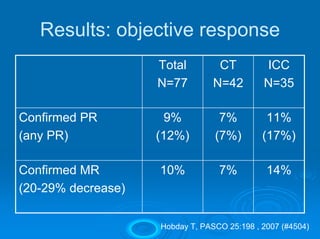
Results: objective response
                    Total         CT         ICC
                    N=77         N=42        N=35

Confirmed PR          9%          7%          11%
(any PR)            (12%)        (7%)        (17%)

Confirmed MR        10%           7%          14%
(20-29% decrease)

                    Hobday T, PASCO 25:198 , 2007 (#4504)
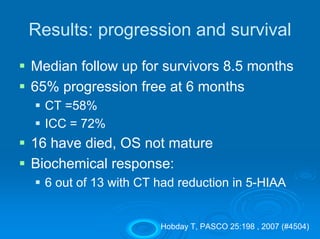
Results: progression and survival
Median follow up for survivors 8.5 months
65% progression free at 6 months
  CT =58%
  ICC = 72%
16 have died, OS not mature
Biochemical response:
  6 out of 13 with CT had reduction in 5-HIAA


                      Hobday T, PASCO 25:198 , 2007 (#4504)
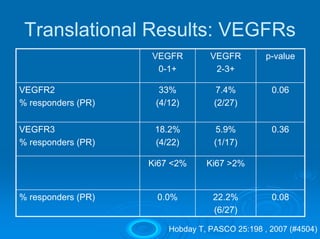
Translational Results: VEGFRs
                    VEGFR         VEGFR         p-value
                     0-1+          2-3+

VEGFR2                33%          7.4%          0.06
% responders (PR)    (4/12)        (2/27)

VEGFR3               18.2%         5.9%          0.36
% responders (PR)    (4/22)        (1/17)

                    Ki67 <2%     Ki67 >2%


% responders (PR)    0.0%          22.2%         0.08
                                   (6/27)

                        Hobday T, PASCO 25:198 , 2007 (#4504)
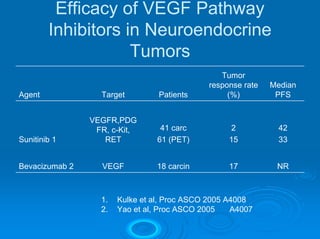
Efficacy of VEGF Pathway
        Inhibitors in Neuroendocrine
                    Tumors
                                                 Tumor
                                              response rate   Median
Agent             Target         Patients          (%)         PFS


                VEGFR,PDG
                 FR, c-Kit,       41 carc          2           42
Sunitinib 1        RET           61 (PET)          15          33


Bevacizumab 2     VEGF           18 carcin         17          NR


                  1.   Kulke et al, Proc ASCO 2005 A4008
                  2.   Yao et al, Proc ASCO 2005    A4007
New agents

Temozolomide

Bevacizumab
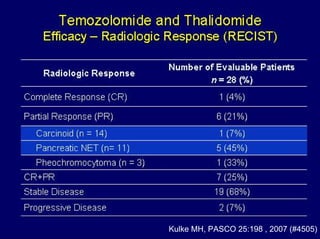
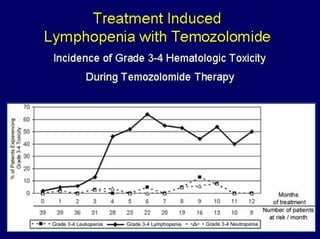
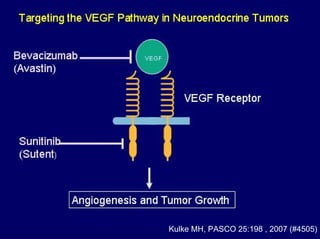
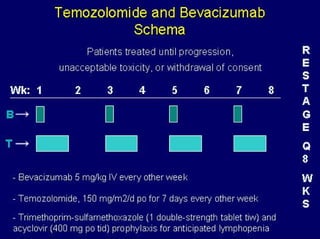
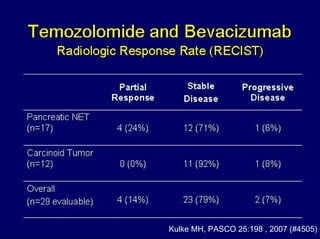
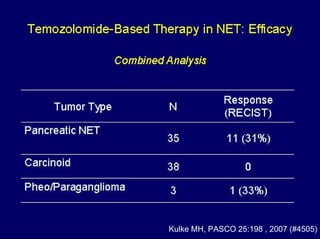
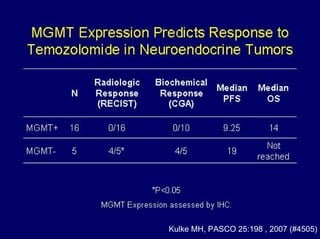
Kulke MH, PASCO 25:198 , 2007 (#4505)
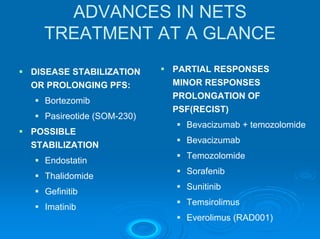
ADVANCES IN NETS
  TREATMENT AT A GLANCE
DISEASE STABILIZATION     PARTIAL RESPONSES
OR PROLONGING PFS:        MINOR RESPONSES
                          PROLONGATION OF
  Bortezomib
                          PSF(RECIST)
  Pasireotide (SOM-230)
                            Bevacizumab + temozolomide
POSSIBLE
                            Bevacizumab
STABILIZATION
                            Temozolomide
  Endostatin
                            Sorafenib
  Thalidomide
                            Sunitinib
  Gefinitib
                            Temsirolimus
  Imatinib
                            Everolimus (RAD001)
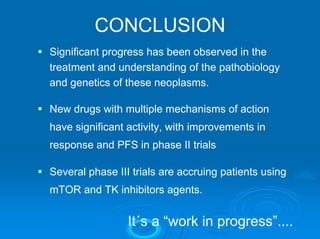
CONCLUSION
Significant progress has been observed in the
treatment and understanding of the pathobiology
and genetics of these neoplasms.

New drugs with multiple mechanisms of action
have significant activity, with improvements in
response and PFS in phase II trials

Several phase III trials are accruing patients using
mTOR and TK inhibitors agents.


                 It´s a “work in progress”....

Nets 2008 Carlos F Pinto

  • 1.
    New Frontiers in NeuroendocrineTumors Treatment Carlos Frederico Pinto Instituto de Oncologia do Vale Hospital Regional do Vale do Paraiba 2008
  • 2.
    Neuroendocrine Tumors - Background Carcinoid, islet cell carcinoma Slow growing, often metastatic at diagnosis Associated with carcinoid syndrome caused by hypersecretion of biogenic amines, peptides and polypeptides and manifested mainly with diarrhea and flushing Symptoms are treated with somatostatin analogues (Octreotide & Lanreotide)
  • 3.
  • 4.
    Octreotide High binding affinityfor the somatostatin receptor subtype sst2, and low affinity for sst3 and sst5 receptors Many patients respond to Octreotide but subsequently experience tachyphalyxis after 12- 18 months May be due to downregulation of sst2 receptors on tumor cells or overexpression of other somatostatin receptors
  • 5.
    OCTREOTIDE MECHANISMS OF ACTION Affinity to SST-2 A & B receptors Indirect effects: Inhibition of hormone secretion (GF, insulin, prolactin, intestinal peptid) Inhibition of growth factor secretion (IGF, Somatomedines 1 and 2, EGF, PDGF, TGF-alfa) Inhibition of angiogenesis Immunomodulation Direct effect Antimitotic Induction of cell death (at high doses) Lamberts et al. Endocrinol Rev 1991;12:450-82
  • 6.
    SOMATOSTATIN ANALOGUES Octreotide – Sandostatin ® Sandostatin LAR ® Lanreotide – Somatuline ® SOM-230 – Pasireotide RC-160 – Vapreotide – Octastatin ®
  • 7.
    OCTREOTIDE FOR TREATMENT OF NET Somatostatin analogues provide: Symptomatic response: 70 % Biochemical response: 30-50 % Tumor control: 3% Di Bartolomeo, Cancer, 1996.
  • 8.
    SOMATOSTATIN ANALOGUES Natural somatostatinhas a half-life of 3 minutes. Rebound phenomenon can be observed in withdrawal. Sandostatin (octreotide) is a long acting analogue with a half-life of 100 minutes and can be used sc/iv. Sandostatin LAR (long acting, repeatable) is a depot form used intramuscularly every 3-4 weeks Study No.of Treatment Symptomatic Tumor pts response regression Tomasetti 16 Ocreotide LAR 15/16 0 (14 SD, 2 PD) Aliment Pharmacol 20 mg Ther 2000
  • 9.
    OCTREOTIDE – ADVERSEEVENTS Flatulance Nausea-vomitting Abdominal pain tachyphalyxis after Diarrhea 12-18 months Lipid malabsorption Biliary malfunction Cholelitiasis Vitamin D malabsorption Injection site pain Hypothyroidism Hypo/hyperglycemia Cardiac arrithmias The dose should be adjusted in patients using insulin, oral hypoglicemic agents, beta blocker and calcium channel blockers
  • 10.
    USE OF OCTREOTIDEIN NETs SC for 2 weeks If tolerated and provides symptom relief: Sart Sandostatin LAR at 20 mg i.m. / Every 4 week SC form should be continued for another 2 weeks Patient should be reevaluated 3 months later If symptoms are under control patient can be treated with 10 mg Sandostatin LAR every 4 weeks İf symtoms are persisitant the dose can be increased to 30 mg SC sandostatin can be used as salvage
  • 11.
    Combination of Interferon+ Octreotide Response rate Objective response CR : %0 PR : %0 SD : % 75 PD : % 25 Biochemical response CR : %0 PR : % 77 SD : % 18 PD : %5 Tiensuu Eur J Cancer 1992;28A:1647-50
  • 12.
    Abstract 171 Safety and Efficacy of Pasireotide (SOM230) in Patients with Metastatic Carcinoid Tumors Refractory or Resistant to Octreotide LAR: Results of a Phase II Study L. Kvols, M.D. H. Lee Moffitt Cancer Center and Research Institute
  • 13.
    Pasireotide (SOM230) Novel, multi-ligandsomatostatin analogue High affinity binding to four of the five somatostatin receptor subtypes: sst1, sst2, sst3 & sst5 Compared to Octreotide has a 30-, 5- and 40- times greater affinity for sst1, sst3 & sst5 & comparable affinity for sst2
  • 14.
    Study Design Phase II,multicenter, open label Patients with carcinoid symptoms refractory to Octreotide LAR Pasireotide 300mcg SQ bid Doses escalated to 1200mcg SQ bid
  • 15.
    Safety & Tolerability Related to Adverse Event Total (n) Study Drug (n) Nausea 12 12 Abdominal Pain 14 9 Diarrhea 10 3 Vomiting 3 2 Fatigue 10 3 + Weight loss & hyperglycemia
  • 16.
    Results – SymptomControl 12/44 Patients with improvements in either BM/day and/or No. of flushing episodes/day
  • 17.
    Pasireotide - Conclusions Effectivein controlling carcinoid symptoms in 27% patients refractory to Octreotide Well tolerated with a safety profile similar to Octreotide
  • 18.
    TUMOR TARGETED RADIOACTIVE SOMATOSTATIN TREATMENT Alpha-emitting radioligands Short acting auger electrons are used 111 In-pentetreotide Beta-emitting radioligands High energy beta particules 90Y-DOTA0 Tyr3-octreotide (OctreoTher) 177Lu-DOTA0 Tyr3-octreotate 90Y-lanreotide Can only be used in sst2 and sst5 (+) NET de Herder et al, Curr Opin Oncol, 2002
  • 19.
    New agents mTOR TKI
  • 20.
    Abstract 178 Phase IIStudy of RAD001 (Everolimus) and Depot Octreotide (Sandostatin LAR) in Patients with Advanced Low Grade Neuroendocrine Carcinoma J. C. Yao, M.D. University of Texas, M.D. Anderson Cancer Center ASCO 2007
  • 22.
    NET - RAD001 OctreotideLAR 30mg IM q28 days + RAD001 5mg PO daily 26 patients (16 carcinoids, 11 islet cell) 4 PR and 19 SD, 10 ↓ CgA Toxicity Mild apthous ulceration G3/4: anemia, thrombocytopenia, apthous ulcer, diarrhea, edema, fatigue, hypoglycemia, nausea, pain, rash
  • 23.
    Phase 2 Studyof RAD001 and Depot Octreotide Single-arm phase 2 Metastatic or unresecatable well-differentiated NET RAD001 dose Patient 1-30: 5mg daily Patient 31-60: 10 mg daily Sandostatin LAR 30mg IM 28d At 12 weeks, CT/MRI Yao J. et al. PASCO 25:198 , 2007 (#4503)
  • 24.
  • 25.
    Study objectives Assess objectivetumor response rate as defined by RECIST Assess PFS Assess biochemical response rate Assess safety of RAD001 at 5 and 10mg per day with Sandostatin LAR 30mg every 4 weeks Yao J. et al. PASCO 25:198 , 2007 (#4503)
  • 26.
    Efficacy (RECIST): by tumor type: Overall Carcinoid Islet cell N = 60 N=30 N=30 PR 12 (20%) 4(13%) 8(27%) SD 43(72%) 25(83%) 18(60%) PD 5(8%) 1(3%) 4(13%) Median 59 wks 64 wks 50 wks PFS Yao J. et al. PASCO 25:198 , 2007 (#4503)
  • 27.
    Compare mTOR withsandostatin alone response Carcinoid Islet cell Overall RAD001 + sando 4/30(13%) 8/30(27%) 12/60(20%) LAR (Yao, ASCO 2007) Phase II 1/21(5%) 1/15(7%) 2/37(5%) Temsirolimus (Duran, BJC 2006) Phase II 2/28(8%) 0/5(0%) 2/31(6%) Sando LAR (Wymenga, JCO 1999)
  • 28.
    Why it works? IGF-1and IGF-1R are expressed and IGF- 1 activates AKT and mTOR Pathways in NET cells Wichert G, Cancer Res, 2000. RAPALOGs blocks signaling pro growth, proliferation and survival: Rapamycin RAD001 CCI-779
  • 29.
  • 30.
  • 31.
  • 32.
  • 33.
  • 34.
  • 35.
  • 36.
  • 37.
    Rationale for combination mTORinhibition activates AKT, a survival pathway by a negative feedback loop. Sandostatin LAR normalizes IGF-1 levels in patients with acromegaly Sandostatin inhibits AKT in the exocrine pancreas. So... Sandostatin should block ATK activation by “Rapalogues”
  • 38.
  • 39.
    Sorafenib in NETs– Background NETs overexpress VEGF,VEGF-R, PDGF and PDGF-B Overexpression of VEGF associated with inferior PFS Increased Ki-67 is associated with inferior outcome Hobday T, PASCO 25:198 , 2007 (#4504)
  • 40.
    Eligibility Well or moderatilydifferentiated NET Thyroid, Pheoc. and adrenal excluded Measurable disease ECOG PS 0-2 <= prior chemotherapy Prior embolization allowed No prior antiangiogenic therapy Prior or concurrent octreotide allowed Hobday T, PASCO 25:198 , 2007 (#4504)
  • 41.
    Design Sorafenib 400mg poBID Primary endpoint is confirmed PR by RECIST criteria Secondary endpoints: Minor response Progression free at 6 months Median PFS, OS Toxicity Two stage Phase II Hobday T, PASCO 25:198 , 2007 (#4504)
  • 42.
    Results: objective response Total CT ICC N=77 N=42 N=35 Confirmed PR 9% 7% 11% (any PR) (12%) (7%) (17%) Confirmed MR 10% 7% 14% (20-29% decrease) Hobday T, PASCO 25:198 , 2007 (#4504)
  • 43.
    Results: progression andsurvival Median follow up for survivors 8.5 months 65% progression free at 6 months CT =58% ICC = 72% 16 have died, OS not mature Biochemical response: 6 out of 13 with CT had reduction in 5-HIAA Hobday T, PASCO 25:198 , 2007 (#4504)
  • 44.
    Translational Results: VEGFRs VEGFR VEGFR p-value 0-1+ 2-3+ VEGFR2 33% 7.4% 0.06 % responders (PR) (4/12) (2/27) VEGFR3 18.2% 5.9% 0.36 % responders (PR) (4/22) (1/17) Ki67 <2% Ki67 >2% % responders (PR) 0.0% 22.2% 0.08 (6/27) Hobday T, PASCO 25:198 , 2007 (#4504)
  • 45.
    Efficacy of VEGFPathway Inhibitors in Neuroendocrine Tumors Tumor response rate Median Agent Target Patients (%) PFS VEGFR,PDG FR, c-Kit, 41 carc 2 42 Sunitinib 1 RET 61 (PET) 15 33 Bevacizumab 2 VEGF 18 carcin 17 NR 1. Kulke et al, Proc ASCO 2005 A4008 2. Yao et al, Proc ASCO 2005 A4007
  • 46.
  • 47.
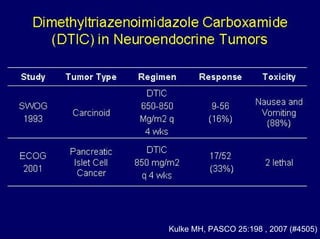
    Kulke MH, PASCO25:198 , 2007 (#4505)
  • 48.
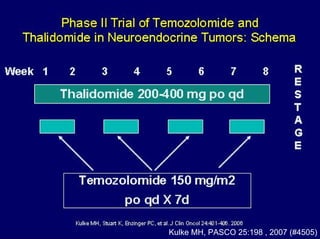
    Kulke MH, PASCO25:198 , 2007 (#4505)
  • 49.
    Kulke MH, PASCO25:198 , 2007 (#4505)
  • 52.
    Kulke MH, PASCO25:198 , 2007 (#4505)
  • 54.
    Kulke MH, PASCO25:198 , 2007 (#4505)
  • 55.
    Kulke MH, PASCO25:198 , 2007 (#4505)
  • 56.
    Kulke MH, PASCO25:198 , 2007 (#4505)
  • 57.
    ADVANCES IN NETS TREATMENT AT A GLANCE DISEASE STABILIZATION PARTIAL RESPONSES OR PROLONGING PFS: MINOR RESPONSES PROLONGATION OF Bortezomib PSF(RECIST) Pasireotide (SOM-230) Bevacizumab + temozolomide POSSIBLE Bevacizumab STABILIZATION Temozolomide Endostatin Sorafenib Thalidomide Sunitinib Gefinitib Temsirolimus Imatinib Everolimus (RAD001)
  • 58.
    CONCLUSION Significant progress hasbeen observed in the treatment and understanding of the pathobiology and genetics of these neoplasms. New drugs with multiple mechanisms of action have significant activity, with improvements in response and PFS in phase II trials Several phase III trials are accruing patients using mTOR and TK inhibitors agents. It´s a “work in progress”....