EARLY INTERVENTION
Reflecting on the scope, need for early diagnosis and
implementation.
Brought to you by….
Kamna Seth, M. S.
Director, ECE Initiatives
The Source For Learning, Inc.
Gauri Shirali-Deo, M Ed.
Senior Manager, ECE Initiatives
The Source For Learning, Inc.
Joint Position Statement of the
Division of Early Childhood (DEC)
and National Association for the
Education of Young Children (NAEYC)
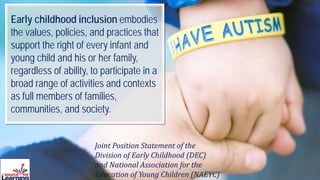
Early childhood inclusion embodies
the values, policies, and practices that
support the right of every infant and
young child and his or her family,
regardless of ability, to participate in a
broad range of activities and contexts
as full members of families,
communities, and society.
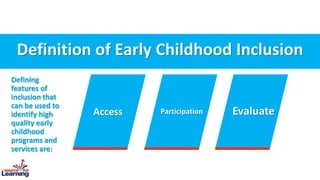
Definition of Early Childhood Inclusion
Access Participation Evaluate
Defining
features of
inclusion that
can be used to
identify high
quality early
childhood
programs and
services are:
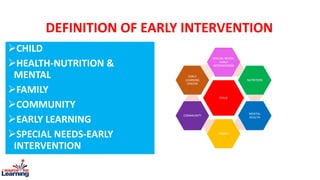
CHILD
HEALTH-NUTRITION &
MENTAL
FAMILY
COMMUNITY
EARLY LEARNING
SPECIAL NEEDS-EARLY
INTERVENTION
CHILD
SPECIAL NEEDS-
EARLY
INTERVENTION
NUTRITION
MENTAL
HEALTH
FAMILY
COMMUNITY
EARLY
LEARNING
CENTER
DEFINITION OF EARLY INTERVENTION
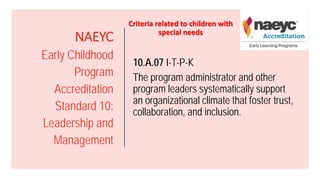
NAEYC
Early Childhood
Program
Accreditation
Standard 10:
Leadership and
Management
10.A.07 I-T-P-K
The program administrator and other
program leaders systematically support
an organizational climate that foster trust,
collaboration, and inclusion.
Criteria related to children with
special needs
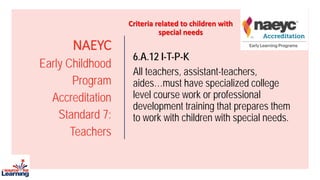
NAEYC
Early Childhood
Program
Accreditation
Standard 7:
Teachers
6.A.12 I-T-P-K
All teachers, assistant-teachers,
aides…must have specialized college
level course work or professional
development training that prepares them
to work with children with special needs.
Criteria related to children with
special needs
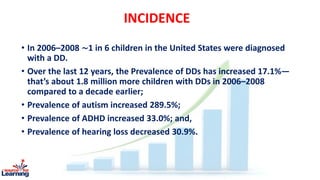
INCIDENCE
• In 2006–2008 ∼1 in 6 children in the United States were diagnosed
with a DD.
• Over the last 12 years, the Prevalence of DDs has increased 17.1%—
that’s about 1.8 million more children with DDs in 2006–2008
compared to a decade earlier;
• Prevalence of autism increased 289.5%;
• Prevalence of ADHD increased 33.0%; and,
• Prevalence of hearing loss decreased 30.9%.
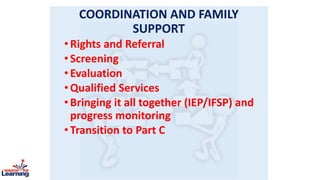
COORDINATION AND FAMILY
SUPPORT
•Rights and Referral
•Screening
•Evaluation
•Qualified Services
•Bringing it all together (IEP/IFSP) and
progress monitoring
•Transition to Part C
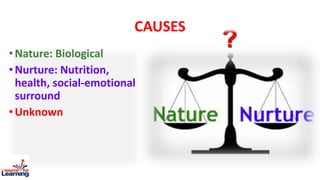
CAUSES
•Nature: Biological
•Nurture: Nutrition,
health, social-emotional
surround
•Unknown
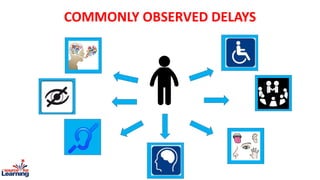
COMMONLY OBSERVED DELAYS
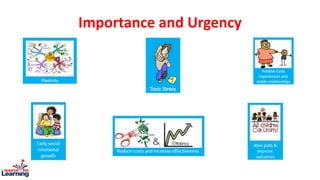
Importance and Urgency
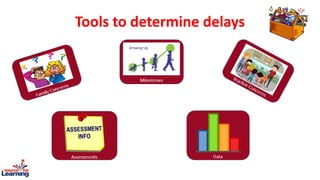
Tools to determine delays
NAEYC
Early Childhood
Program
Accreditation
Standard 7:
Assessment of
Child Progress
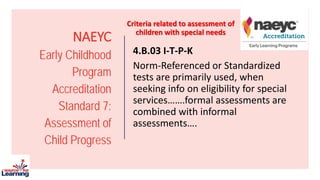
4.B.03 I-T-P-K
Norm-Referenced or Standardized
tests are primarily used, when
seeking info on eligibility for special
services…….formal assessments are
combined with informal
assessments….
Criteria related to assessment of
children with special needs
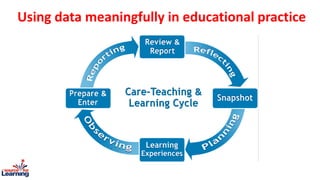
Using data meaningfully in educational practice
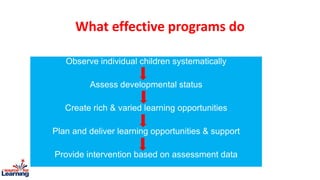
What effective programs do
Observe individual children systematically
Assess developmental status
Create rich & varied learning opportunities
Plan and deliver learning opportunities & support
Provide intervention based on assessment data
NAEYC
Early Childhood
Program
Accreditation
Standard 7:
Families
7.A.10 I-T-P-K
The program works with families on shared
caregiving issues, including routine
separations, special needs…
Criteria related to working with families of
children with special needs and the community

NAEYC
Early Childhood
Program
Accreditation
Standard 7:
Families
7.B.04 –U-I-T-P-K
When program staff suspect that a child
has a developmental delay or other
special need, this possibility is
communicated to families in a sensitive,
supportive, and confidential manner and
is provided with documentation and
explanation for the concern, suggested
next steps, and information about
resources for assessment.
Criteria related to working with families of
children with special needs and the community
NAEYC
Early Childhood
Program
Accreditation
Standard 7:
Families
7.C.06 I-T-P-K
Program staff use established linkages with
other education programs and local
elementary schools to help families prepare
for and manage their children’s transitions
between programs, including special
education programs…
Criteria related to working with families of
children with special needs and the community
NAEYC
Early Childhood
Program
Accreditation
Standard 8:
Community
Relationships
8.A.05 I-T-P-K
Program staff identify and establish
relationships with specialized consultants,
who can assist all children’s and families’ full
participation in the program. This assistance
includes support for children with disabilities,
behavioral challenges, or other special
needs.
Criteria related to working with families of
children with special needs and the community
NAEYC
Early Childhood
Program
Accreditation
Standard 10:
Leadership and
Management
10.B.10 I-T-P-K
Policies guide the appropriate use of
specialized consultants to support staff’s
efforts to meet the needs of the children
and families to fully participate in the
program…..
Criteria related to working with families of
children with special needs and the community
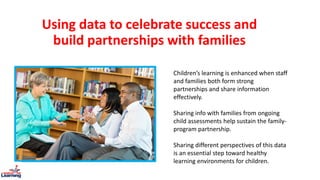
Using data to celebrate success and
build partnerships with families
Children’s learning is enhanced when staff
and families both form strong
partnerships and share information
effectively.
Sharing info with families from ongoing
child assessments help sustain the family-
program partnership.
Sharing different perspectives of this data
is an essential step toward healthy
learning environments for children.
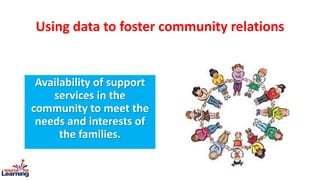
Using data to foster community relations
Availability of support
services in the
community to meet the
needs and interests of
the families.
NAEYC
Early Childhood
Program
Accreditation
Standard 10:
Leadership and
Management
10.D.06
….written procedures address
specific procedures for children with
disabilities.
Criteria related to working with children with
special needs
Processes To Support Intervention
Supporting the Early Intervention Team
NAEYC
Early Childhood
Program
Accreditation
Standard 2:
Curriculum
2.A.08 I-T-P-K
Materials & Equipment……
• k – accommodate children with
special needs.
Criteria related to accommodations and
adaptations for children with special needs
NAEYC
Early Childhood
Program
Accreditation
Standard 9:
Physical
Environment
9.A.01 – g- I-T-P-K
Adaptations that allow children with
disabilities and other special needs to
fully participate in the activities…
Criteria related to accommodations and
adaptations for children with special needs
NAEYC
Early Childhood
Program
Accreditation
Standard 9:
Physical
Environment
9.A.03 – b- I-T-P-K
Equipment, materials, & furnishings
are available that provide access for
children with disabilities to the
program’s curriculum and activities.
Criteria related to accommodations and
adaptations for children with special needs
NAEYC
Early Childhood
Program
Accreditation
Standard 9:
Physical
Environment
9.A.12 – d- I-T-P-K
Provide children with disabilities full
access to the curriculum and
activities in the indoor space.
Criteria related to accommodations and
adaptations for children with special needs
NAEYC
Early Childhood
Program
Accreditation
Standard 9:
Physical
Environment
9.B.01 – d- I-T-P-K
Adaptations are made so children
with disabilities are fully able to
participate in outdoor curriculum and
activities…
Criteria related to accommodations and
adaptations for children with special needs
NAEYC
Early Childhood
Program
Accreditation
Standard 3:
Teaching
3.A.01 I-T-P-K
Teaching/program staff work as a team to
implement daily learning activities,
including IEP/EFSP as needed.
Criteria related to accommodations and
adaptations for children with special needs
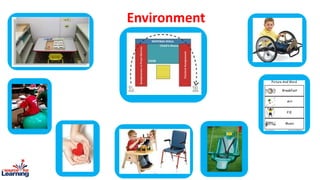
Environment
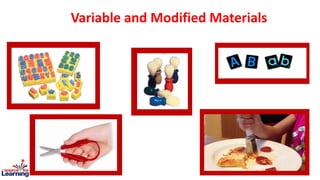
Variable and Modified Materials
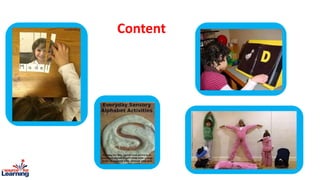
Content
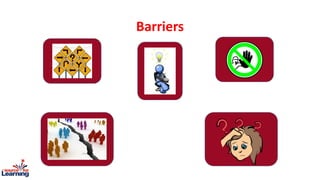
Barriers
Resources
The Source for Learning – PreschoolFirst
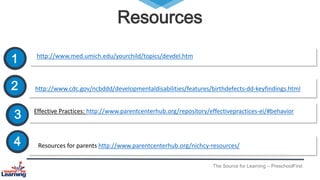
1 http://www.med.umich.edu/yourchild/topics/devdel.htm
2 http://www.cdc.gov/ncbddd/developmentaldisabilities/features/birthdefects-dd-keyfindings.html
Effective Practices: http://www.parentcenterhub.org/repository/effectivepractices-ei/#behavior
4
3
Resources for parents http://www.parentcenterhub.org/nichcy-resources/
KEEP IN TOUCH
@SFLECEI SFLECEI
www.sourceforlearning/ecei ece-pd@sflinc.org

VAECE 2017: Early Intervention: Reflecting on Scope, Need for Early Diagnosis and Implementation