EARLY INTERVENTION
9/1/17 EARLY INTERVENTION 1
Contents
• Introduction
• Goals
• Facility based early intervention
• Community based early intervention
• Indian government strategies for EI
• Common musculoskeletal conditions
9/1/17 EARLY INTERVENTION 2
WHAT IS EARLY
INTERVENTION?
9/1/17 EARLY INTERVENTION 3
Definition
• Early intervention- it describes services for
children from birth to 3 years of age who have
an established risk, have a developmental delay,
or are considered to be environmentally or
biologically at risk.
(occupational therapy for children ; Case-Smith O’ Brien 2003)
9/1/17 EARLY INTERVENTION 4
Individuals with disability education act-IDEA
• Developmental service that are provided under public
supervision
• Provided at no cost except where federal or state law
provides for a system of payments by families
• Designed to meet the developmental needs of an infants
• Following areas:- physical, cognitive, communication,
social and emotional or adaptive development
-(American academy of pediatrics october 2013)
9/1/17 EARLY INTERVENTION 5
Family centered care
• It is based on the principle that an infant
is dependent on his or her parents and
other family members for daily care and
meeting his or her physical and
emotional needs
• Birth of a child with special health care
needs affects entire family emotionally,
socially and economically
-(occupational therapy for children ; Case-Smith O’ Brien 2003)
9/1/17 EARLY INTERVENTION 6
Who needs EI?
9/1/17 EARLY INTERVENTION 7
Indications
9/1/17 EARLY INTERVENTION 8
9/1/17 EARLY INTERVENTION 9
9/1/17 EARLY INTERVENTION 10
9/1/17 EARLY INTERVENTION 11
Goals of EI
1. To promote state organization
2. To promote appropriate parent-infant interaction
3. To enhance self regulatory behaviour through
environmental modification
4. To promote postural alignment through handling &
positioning
5. To enhance oral-motor skills
9/1/17 EARLY INTERVENTION 12
6. To improve visual and auditory reactions
7. To prevent musculoskeletal abnormalities
8. To provide appropriate remediation of orthopaedic
complications
9. To provide consultation regarding developmental
intervention to team members
10. Participate in interagency collaboration in order to
facilitate transition to home
9/1/17 EARLY INTERVENTION 13
EARLY INTERVENTION TEAM
TRAINED PROFESSIONAL FOR
EARLY IDENTIFICATION
UNTRAINED PROFESSIONALS
DEPUTED FOR EARLY
IDENTIFICATION
GENERAL
PHYSICIAL/PEDIATRICIAN
ASHA WORKER
NURSING STAFF ANGANWADI WORKER
PHYSIOTHERAPIST NGO VOLUNTEERS
OCCUPATIONAL THERAPIST
PYSCHOLOGIST
AUDIOLOGIST & SPEECH
THERAPIST
9/1/17 EARLY INTERVENTION 14
FACILITY BASED EI
9/1/17 EARLY INTERVENTION 15
Facility based newborn screening:
• This includes screening of birth defects in institutional
deliveries at public health facilities, esp. at the
designated delivery points by Medical Officers/
Gynecologists.
• Existing health service providers at all designated
delivery points will be trained to detect, register report
and refer birth defects to the DEIC in District Hospitals.
9/1/17 EARLY INTERVENTION 16
EI IN NICU
9/1/17 EARLY INTERVENTION 17
GOALS OF EI IN NICU
• To facilitate parent-infant interaction
• Encourage positioning during feeding that allow eye-to-
eye contact
• Reduced level of stimulation in the environment(light,
sounds)
• Provide sensory stimulation through voice, touch &
movement
• Positioning
9/1/17 EARLY INTERVENTION 18
• To facilitate sucking-swallowing in premature infants
during feeding
• Gradual introduction of graded tactile stimuli
• Place toys in infants line of vision
• Encourage parents face the infant in his line of vision
when interacting with infant
-(Pediatric physical therapy; Tecklin 3rd
edition)
9/1/17 EARLY INTERVENTION 19
• Demographic data
• History
• Observation
• Examination
• Outcome measures
Assessment and screening
9/1/17 EARLY INTERVENTION 20
OUTCOME MEASURES/ SCREENING
TOOLS
9/1/17 EARLY INTERVENTION 21
FACTORS DENVER
DEVELOPMENTAL
SCREENING TEST II
BAYLEY INFANT
NEURO-
DEVELOPMENT
AL SCREEN
(BINS)
BARODA
DEVELOPMENTA
L SCREENING
TEST
TRIVANDRUM
DEVELOPMEN
TAL
SCREENING
CHART
AGE 0-6 years 3-24 months 0-30 months 0-24 months
FORMAT Directly Directly Directly Directly
SCREENS/
DOMAINS
Expressive &
receptive language,
fine motor, social
Neurological,
expressive &
receptive &
cognitive
Motor & cognitive Mental and
motor
ITEMS 125 11-13 54 17
SCORING Risk : N/Abnormal/
questionable
High/low/
moderate
Age equivalent &
developmental
quotient calc.
Within age
range
TIME 10-20 mins 10 mins 10 mins 5 mins
9/1/17 EARLY INTERVENTION 22
EI in NICU
• Parent education
• Natural modification
• Positioning and handling
• KMC
• Swaddling
9/1/17 EARLY INTERVENTION 23
COMMUNITY BASED EARLY
INTERVENTION SERVICES
9/1/17 EARLY INTERVENTION 24
AIMS
• Detection and management of the 4Ds prevalent
in children
• Defects at birth
• Disease in children
• Deficiency conditions
• Developmental delays including disability
9/1/17 EARLY INTERVENTION 25
HEALTH CONDITIONS IDENTIFIED FOR
SCREENING
• 1. DEFECTS AT BIRTH
• Neural tube defect
• Down’s syndrome
• Cleft lip & palate
• CTEV
• DDH
9/1/17 EARLY INTERVENTION 26
Developmental Delays and Disabilities
•Vision & Hearing impairment
•Neuro-Motor Impairment
•Motor Delay
•Cognitive Delay
•Language Delay
•Behavior Disorder (Autism)
•Learning Disorder
•Attention Deficit Hyperactivity Disorder
9/1/17 EARLY INTERVENTION 27
Implementation Mechanisms
• The Operational Guidelines outline the following mechanism to
reach all the target groups of children for health screening-
• 1. For new born:
• Community based newborn screening at home through ASHAs for
newborn till 6 weeks of age during home visitation.
• 2. For children 6 weeks to 6 years:
• Angan-wadi Center based screening by the Mobile Health Teams
• 3. For children 6 years to 18 years:
• Government and Government aided school based screening by
Mobile Health Teams.
-OPERATIONAL GUIDELINES: Rashtriya Bal Swasthya Karyakram (RBSK) feb 2013
9/1/17 EARLY INTERVENTION 28
Community based newborn screening (age 0-6
weeks) for birth defects:
• Accredited Social Health Activists (ASHAs) during home visits for
newborn care will use the screen the babies born at home and the
institutions till 6 weeks of age.
• ASHAs will be trained with simple tools for detecting gross birth
defects.
• ASHAs will mobilize caregivers of children to attend the local
Anganwadi Centers for screening by the dedicated Mobile Health
Team.
• She would be equipped with a tool kit consisting of a pictorial
reference book having self-explanatory pictures for identification of
birth defects.
9/1/17 EARLY INTERVENTION 29
Screening of children enrolled in Government and
Government aided schools:
• For children in the age groups 6 to 18 years, will be
screened in Government and Government aided
schools.
• At least three dedicated Mobile Health Teams in each
Block will be engaged to conduct screening of children.
• The number of teams may vary depending on the
number of Angan-wadi Centers, difficult to reach areas
and children enrolled in the schools.
9/1/17 EARLY INTERVENTION 30
• The screening of children in the Anganwadi Centers
would be conducted at least twice a year and at least
once a year for school children to begin with.
• The Mobile Health Team will consist of four members -
two Doctors (AYUSH) one male and one female, one
ANM/Nurse and one Pharmacist
9/1/17 EARLY INTERVENTION 31
9/1/17 EARLY INTERVENTION 32
District Early Intervention Center (DEIC):
• Established at the District Hospital.
• The purpose of Early Intervention Center is to provide
referral support to children detected with health
conditions during health screening.
-[Setting up early intervention centres in kerala – a blue print-2012]
9/1/17 EARLY INTERVENTION 33
Goals of a District Early Intervention Centre
1. To meet individual developmental needs of children with
disabilities in the context of play, individual and group
therapy, as an inherent part of the training
2. To offer comprehensive training programs for
professionals, parents and community
members
3. To offer family support and counseling
4. To provide comprehensive diagnostic services, fitting of
suitable aids and appliances
5. To facilitate parents’ role as partners in the intervention
process
9/1/17 EARLY INTERVENTION 34
6. To link early intervention to later education and
rehabilitation programs
7. To provide appropriate assistive devices, prosthetics and
orthotics
8. To support the community in setting up a barrier free
environment
9. To provide opportunities for recreation and games
10. To arrange transition to inclusive education programs
11. To demonstrate best practice in early intervention
9/1/17 EARLY INTERVENTION 35
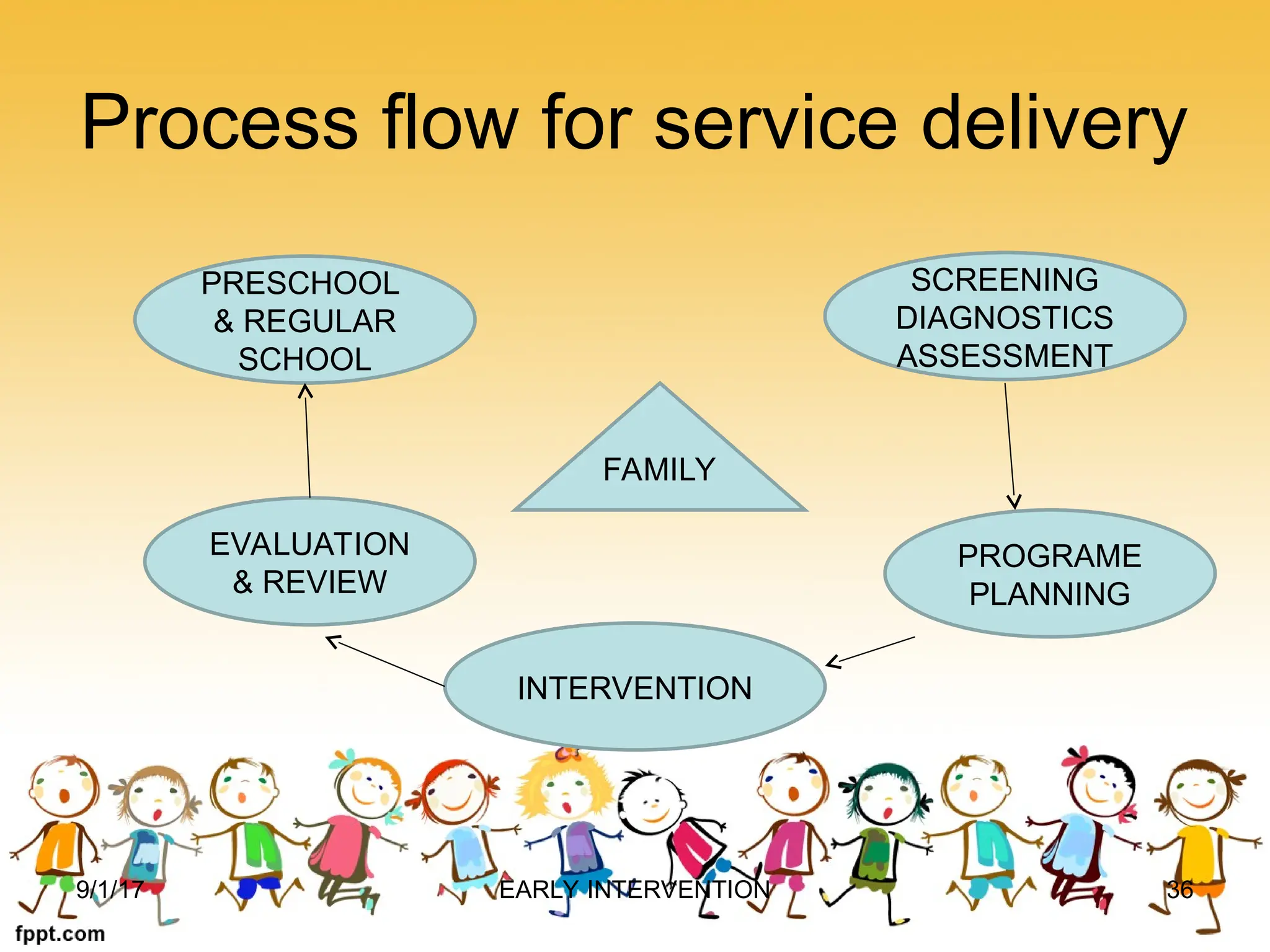
Process flow for service delivery
SCREENING
DIAGNOSTICS
ASSESSMENT
PROGRAME
PLANNING
INTERVENTION
EVALUATION
& REVIEW
PRESCHOOL
& REGULAR
SCHOOL
FAMILY
9/1/17 EARLY INTERVENTION 36
1. Identify specific services, type of support and assistive
devices required for the individual child.
2. Plan the child’s experiences and activities
3. Plan a comprehensive Individualized Family Service
Plan (IFSP).
4. Set short and long term goals, which are reviewed
quarterly with close involvement of the family.
5. Monitor and evaluate progress, in each domain.
6. Plan transition as applicable (pre-schools or regular
schools).
PROGRAMME PLANNING
9/1/17 EARLY INTERVENTION 37
CBR and DEIC
• The DEIC will offer community based services for those
families who are unable to avail of DEIC services
through linkages with community groups – Angan-wadi,
ASHA workers and local NGOs.
• Two options could be considered – (a) referrals to local
service providers after an initial assessment and needs
analysis in the DEIC and/or (b) a team from the DEIC
providing fortnightly services in the community.
9/1/17 EARLY INTERVENTION 38
• Clinic type of services would be located in the Angan-
wadi Centre or in the premises of local NGO.
• Local service providers will be trained and closely
involved for carry-over and follow up in the clinic or the
home.
• A structured plan will also have to be formulated to
extend the community outreach programs to private play
schools and government pre-schools by the Angan-wadi
and ASHA workers.
9/1/17 EARLY INTERVENTION 39
Role of District Early Intervention Center:
1. Providing referral services to referred children for
confirmation of diagnosis and treatment
2. Screening children at the “District Early Intervention
Center”
3. Visit all newborns delivered at the District Hospital for
screening all newborns irrespective of their sickness before
discharge
9/1/17 EARLY INTERVENTION 40
4. Ensure that every child born sick or preterm or with LBW
or any birth defect is followed up at the DEIC
5. All the referrals are followed and records maintained
6. The Lab Technician of the DEIC would screen the
children for disorders, at the District level depending upon
the logistics and local epidemiological situations
7. Ensure linkage with tertiary care facilities through agreed
MOU.
9/1/17 EARLY INTERVENTION 41
Process flow of Referral to District Early
Intervention Center
9/1/17 EARLY INTERVENTION 42
DEIC: NEW CASES
9/1/17 EARLY INTERVENTION 43
INDIAN GOVERNMENT STRATEGIES
FOR EI
9/1/17 EARLY INTERVENTION 44
RASHTRIYA BAL SWASTHYA
KARYAKRAM (RBSK)
Child health screening and early intervention
services under NRHM
9/1/17 EARLY INTERVENTION 45
• A child health screening and EI services launched in
February 2013 to screen diseases specific to childhood,
developmental delays, disabilities , birth defects and
deficiencies
• Initiative will cover 27 crore children between 0-18 years
• Provide free treatment including surgery
-Setting up district early intervention centres-operational guidelines may 2014
9/1/17 EARLY INTERVENTION 46
COMMON
MUSCULOSKELETAL
CONDITIONS
9/1/17 EARLY INTERVENTION 47
CEREBRAL PALSY
• Chronic non-progressive
disorder
• Stiff or floppy posture
• Excessive irritability/ high
pitched cry
• Poor head control
• Poor sucking
9/1/17 EARLY INTERVENTION 48
Treatment
• Facilitate child’s motor progress during
developmental period
• Improve efficiency child gait
• Improve the child functional abilities
• Preventing secondary problems
• Provide brace, positioning & seating equipment
9/1/17 EARLY INTERVENTION 49
• Regular therapy throughout the pre-school year
• Training skills in standing & assisted walking
• Maintain or gain or improve function after
surgical release of contracture
• Strengthening of muscles, improve endurance
• Improve QOL
9/1/17 EARLY INTERVENTION 50
CONGENITAL TORTICOLIS
• A developmental defect in
one sternocleidomastoid
muscle or malposition in
uterus
• Head fixed in side flexion to
same side and rotation to the
opposite side
• Lump in the muscle
• Prominent SCM
9/1/17 EARLY INTERVENTION 51
• Positioning & handling
• Passive stretching of SCM, upper trapezius
muscles on involved side
• Strengthen the SCM of uninvolved side by
initiating through activities
• Orthotic device
• Education to the parents
MANAGEMENT
9/1/17 EARLY INTERVENTION 52
SPINA BIFIDA
• Presence of a
midline skin defect
• Haemangioma
• Lipoma
• Tuft of hair
9/1/17 EARLY INTERVENTION 53
MANAGEMENT
• Care of skin and joint
• Management of bladder & bowel
• Prevention & correction of contractures
• Prevention of pressure sores
• Handling strategies for parents
• Orthotics and Ambulation training
9/1/17 EARLY INTERVENTION 54
CTEV
• Adduction and inversion of forefoot
• Inversion of hind foot
• Cavus and equinus with clawing of
toes
• Skin creases and bony prominences
9/1/17 EARLY INTERVENTION 55
MANAGEMENT
• Positioning of feet
• Stretching
• Passive Manipulation
• Parent education
• Splinting- Denis brown/ CTEV splints
9/1/17 EARLY INTERVENTION 56
CONGENITAL DISLOCATION OF HIP
• Asymmetry of creases of the groin
• Limitation of movement of the affected hip
• Click every time the hip is moved
• Higher buttock fold on the affected side
• Galeazzi’s sign & Ortolani test
• Positive Trendelenburg’s test
• Waddling gait
9/1/17 EARLY INTERVENTION 57
MANAGEMENT
• Upto 6 months- von rosen splint/ pavlik harness
• Plaster cast- frog leg position
• Maintenance of range of motion
• Strengthening
• Facilitation of ambulation
9/1/17 EARLY INTERVENTION 58
MUSCULAR DYSTROPHY
Clinical presentation
•Age group: before 3 yrs
•Frequent falls, difficulty
getting up
•Toe walking, clumsiness
•Pseudo-hypertrophy
•Postural changes
9/1/17 EARLY INTERVENTION 59
MANAGEMENT
• Family education
• Prevention of deformity by stretching
• Improving functional capacity
• Dietary modifications
• Postural corrections
• Respiratory care
9/1/17 EARLY INTERVENTION 60
SUMMARY
9/1/17 EARLY INTERVENTION 61
QUESTIONS????
9/1/17 EARLY INTERVENTION 62
9/1/17 EARLY INTERVENTION 63

EARLY INTERVENTION IN PAEDIATRIC PHYSIOTHERAPY

  • 1.
  • 2.
    Contents • Introduction • Goals •Facility based early intervention • Community based early intervention • Indian government strategies for EI • Common musculoskeletal conditions 9/1/17 EARLY INTERVENTION 2
  • 3.
  • 4.
    Definition • Early intervention-it describes services for children from birth to 3 years of age who have an established risk, have a developmental delay, or are considered to be environmentally or biologically at risk. (occupational therapy for children ; Case-Smith O’ Brien 2003) 9/1/17 EARLY INTERVENTION 4
  • 5.
    Individuals with disabilityeducation act-IDEA • Developmental service that are provided under public supervision • Provided at no cost except where federal or state law provides for a system of payments by families • Designed to meet the developmental needs of an infants • Following areas:- physical, cognitive, communication, social and emotional or adaptive development -(American academy of pediatrics october 2013) 9/1/17 EARLY INTERVENTION 5
  • 6.
    Family centered care •It is based on the principle that an infant is dependent on his or her parents and other family members for daily care and meeting his or her physical and emotional needs • Birth of a child with special health care needs affects entire family emotionally, socially and economically -(occupational therapy for children ; Case-Smith O’ Brien 2003) 9/1/17 EARLY INTERVENTION 6
  • 7.
    Who needs EI? 9/1/17EARLY INTERVENTION 7
  • 8.
  • 9.
  • 10.
  • 11.
  • 12.
    Goals of EI 1.To promote state organization 2. To promote appropriate parent-infant interaction 3. To enhance self regulatory behaviour through environmental modification 4. To promote postural alignment through handling & positioning 5. To enhance oral-motor skills 9/1/17 EARLY INTERVENTION 12
  • 13.
    6. To improvevisual and auditory reactions 7. To prevent musculoskeletal abnormalities 8. To provide appropriate remediation of orthopaedic complications 9. To provide consultation regarding developmental intervention to team members 10. Participate in interagency collaboration in order to facilitate transition to home 9/1/17 EARLY INTERVENTION 13
  • 14.
    EARLY INTERVENTION TEAM TRAINEDPROFESSIONAL FOR EARLY IDENTIFICATION UNTRAINED PROFESSIONALS DEPUTED FOR EARLY IDENTIFICATION GENERAL PHYSICIAL/PEDIATRICIAN ASHA WORKER NURSING STAFF ANGANWADI WORKER PHYSIOTHERAPIST NGO VOLUNTEERS OCCUPATIONAL THERAPIST PYSCHOLOGIST AUDIOLOGIST & SPEECH THERAPIST 9/1/17 EARLY INTERVENTION 14
  • 15.
    FACILITY BASED EI 9/1/17EARLY INTERVENTION 15
  • 16.
    Facility based newbornscreening: • This includes screening of birth defects in institutional deliveries at public health facilities, esp. at the designated delivery points by Medical Officers/ Gynecologists. • Existing health service providers at all designated delivery points will be trained to detect, register report and refer birth defects to the DEIC in District Hospitals. 9/1/17 EARLY INTERVENTION 16
  • 17.
    EI IN NICU 9/1/17EARLY INTERVENTION 17
  • 18.
    GOALS OF EIIN NICU • To facilitate parent-infant interaction • Encourage positioning during feeding that allow eye-to- eye contact • Reduced level of stimulation in the environment(light, sounds) • Provide sensory stimulation through voice, touch & movement • Positioning 9/1/17 EARLY INTERVENTION 18
  • 19.
    • To facilitatesucking-swallowing in premature infants during feeding • Gradual introduction of graded tactile stimuli • Place toys in infants line of vision • Encourage parents face the infant in his line of vision when interacting with infant -(Pediatric physical therapy; Tecklin 3rd edition) 9/1/17 EARLY INTERVENTION 19
  • 20.
    • Demographic data •History • Observation • Examination • Outcome measures Assessment and screening 9/1/17 EARLY INTERVENTION 20
  • 21.
  • 22.
    FACTORS DENVER DEVELOPMENTAL SCREENING TESTII BAYLEY INFANT NEURO- DEVELOPMENT AL SCREEN (BINS) BARODA DEVELOPMENTA L SCREENING TEST TRIVANDRUM DEVELOPMEN TAL SCREENING CHART AGE 0-6 years 3-24 months 0-30 months 0-24 months FORMAT Directly Directly Directly Directly SCREENS/ DOMAINS Expressive & receptive language, fine motor, social Neurological, expressive & receptive & cognitive Motor & cognitive Mental and motor ITEMS 125 11-13 54 17 SCORING Risk : N/Abnormal/ questionable High/low/ moderate Age equivalent & developmental quotient calc. Within age range TIME 10-20 mins 10 mins 10 mins 5 mins 9/1/17 EARLY INTERVENTION 22
  • 23.
    EI in NICU •Parent education • Natural modification • Positioning and handling • KMC • Swaddling 9/1/17 EARLY INTERVENTION 23
  • 24.
    COMMUNITY BASED EARLY INTERVENTIONSERVICES 9/1/17 EARLY INTERVENTION 24
  • 25.
    AIMS • Detection andmanagement of the 4Ds prevalent in children • Defects at birth • Disease in children • Deficiency conditions • Developmental delays including disability 9/1/17 EARLY INTERVENTION 25
  • 26.
    HEALTH CONDITIONS IDENTIFIEDFOR SCREENING • 1. DEFECTS AT BIRTH • Neural tube defect • Down’s syndrome • Cleft lip & palate • CTEV • DDH 9/1/17 EARLY INTERVENTION 26
  • 27.
    Developmental Delays andDisabilities •Vision & Hearing impairment •Neuro-Motor Impairment •Motor Delay •Cognitive Delay •Language Delay •Behavior Disorder (Autism) •Learning Disorder •Attention Deficit Hyperactivity Disorder 9/1/17 EARLY INTERVENTION 27
  • 28.
    Implementation Mechanisms • TheOperational Guidelines outline the following mechanism to reach all the target groups of children for health screening- • 1. For new born: • Community based newborn screening at home through ASHAs for newborn till 6 weeks of age during home visitation. • 2. For children 6 weeks to 6 years: • Angan-wadi Center based screening by the Mobile Health Teams • 3. For children 6 years to 18 years: • Government and Government aided school based screening by Mobile Health Teams. -OPERATIONAL GUIDELINES: Rashtriya Bal Swasthya Karyakram (RBSK) feb 2013 9/1/17 EARLY INTERVENTION 28
  • 29.
    Community based newbornscreening (age 0-6 weeks) for birth defects: • Accredited Social Health Activists (ASHAs) during home visits for newborn care will use the screen the babies born at home and the institutions till 6 weeks of age. • ASHAs will be trained with simple tools for detecting gross birth defects. • ASHAs will mobilize caregivers of children to attend the local Anganwadi Centers for screening by the dedicated Mobile Health Team. • She would be equipped with a tool kit consisting of a pictorial reference book having self-explanatory pictures for identification of birth defects. 9/1/17 EARLY INTERVENTION 29
  • 30.
    Screening of childrenenrolled in Government and Government aided schools: • For children in the age groups 6 to 18 years, will be screened in Government and Government aided schools. • At least three dedicated Mobile Health Teams in each Block will be engaged to conduct screening of children. • The number of teams may vary depending on the number of Angan-wadi Centers, difficult to reach areas and children enrolled in the schools. 9/1/17 EARLY INTERVENTION 30
  • 31.
    • The screeningof children in the Anganwadi Centers would be conducted at least twice a year and at least once a year for school children to begin with. • The Mobile Health Team will consist of four members - two Doctors (AYUSH) one male and one female, one ANM/Nurse and one Pharmacist 9/1/17 EARLY INTERVENTION 31
  • 32.
  • 33.
    District Early InterventionCenter (DEIC): • Established at the District Hospital. • The purpose of Early Intervention Center is to provide referral support to children detected with health conditions during health screening. -[Setting up early intervention centres in kerala – a blue print-2012] 9/1/17 EARLY INTERVENTION 33
  • 34.
    Goals of aDistrict Early Intervention Centre 1. To meet individual developmental needs of children with disabilities in the context of play, individual and group therapy, as an inherent part of the training 2. To offer comprehensive training programs for professionals, parents and community members 3. To offer family support and counseling 4. To provide comprehensive diagnostic services, fitting of suitable aids and appliances 5. To facilitate parents’ role as partners in the intervention process 9/1/17 EARLY INTERVENTION 34
  • 35.
    6. To linkearly intervention to later education and rehabilitation programs 7. To provide appropriate assistive devices, prosthetics and orthotics 8. To support the community in setting up a barrier free environment 9. To provide opportunities for recreation and games 10. To arrange transition to inclusive education programs 11. To demonstrate best practice in early intervention 9/1/17 EARLY INTERVENTION 35
  • 36.
    Process flow forservice delivery SCREENING DIAGNOSTICS ASSESSMENT PROGRAME PLANNING INTERVENTION EVALUATION & REVIEW PRESCHOOL & REGULAR SCHOOL FAMILY 9/1/17 EARLY INTERVENTION 36
  • 37.
    1. Identify specificservices, type of support and assistive devices required for the individual child. 2. Plan the child’s experiences and activities 3. Plan a comprehensive Individualized Family Service Plan (IFSP). 4. Set short and long term goals, which are reviewed quarterly with close involvement of the family. 5. Monitor and evaluate progress, in each domain. 6. Plan transition as applicable (pre-schools or regular schools). PROGRAMME PLANNING 9/1/17 EARLY INTERVENTION 37
  • 38.
    CBR and DEIC •The DEIC will offer community based services for those families who are unable to avail of DEIC services through linkages with community groups – Angan-wadi, ASHA workers and local NGOs. • Two options could be considered – (a) referrals to local service providers after an initial assessment and needs analysis in the DEIC and/or (b) a team from the DEIC providing fortnightly services in the community. 9/1/17 EARLY INTERVENTION 38
  • 39.
    • Clinic typeof services would be located in the Angan- wadi Centre or in the premises of local NGO. • Local service providers will be trained and closely involved for carry-over and follow up in the clinic or the home. • A structured plan will also have to be formulated to extend the community outreach programs to private play schools and government pre-schools by the Angan-wadi and ASHA workers. 9/1/17 EARLY INTERVENTION 39
  • 40.
    Role of DistrictEarly Intervention Center: 1. Providing referral services to referred children for confirmation of diagnosis and treatment 2. Screening children at the “District Early Intervention Center” 3. Visit all newborns delivered at the District Hospital for screening all newborns irrespective of their sickness before discharge 9/1/17 EARLY INTERVENTION 40
  • 41.
    4. Ensure thatevery child born sick or preterm or with LBW or any birth defect is followed up at the DEIC 5. All the referrals are followed and records maintained 6. The Lab Technician of the DEIC would screen the children for disorders, at the District level depending upon the logistics and local epidemiological situations 7. Ensure linkage with tertiary care facilities through agreed MOU. 9/1/17 EARLY INTERVENTION 41
  • 42.
    Process flow ofReferral to District Early Intervention Center 9/1/17 EARLY INTERVENTION 42
  • 43.
    DEIC: NEW CASES 9/1/17EARLY INTERVENTION 43
  • 44.
    INDIAN GOVERNMENT STRATEGIES FOREI 9/1/17 EARLY INTERVENTION 44
  • 45.
    RASHTRIYA BAL SWASTHYA KARYAKRAM(RBSK) Child health screening and early intervention services under NRHM 9/1/17 EARLY INTERVENTION 45
  • 46.
    • A childhealth screening and EI services launched in February 2013 to screen diseases specific to childhood, developmental delays, disabilities , birth defects and deficiencies • Initiative will cover 27 crore children between 0-18 years • Provide free treatment including surgery -Setting up district early intervention centres-operational guidelines may 2014 9/1/17 EARLY INTERVENTION 46
  • 47.
  • 48.
    CEREBRAL PALSY • Chronicnon-progressive disorder • Stiff or floppy posture • Excessive irritability/ high pitched cry • Poor head control • Poor sucking 9/1/17 EARLY INTERVENTION 48
  • 49.
    Treatment • Facilitate child’smotor progress during developmental period • Improve efficiency child gait • Improve the child functional abilities • Preventing secondary problems • Provide brace, positioning & seating equipment 9/1/17 EARLY INTERVENTION 49
  • 50.
    • Regular therapythroughout the pre-school year • Training skills in standing & assisted walking • Maintain or gain or improve function after surgical release of contracture • Strengthening of muscles, improve endurance • Improve QOL 9/1/17 EARLY INTERVENTION 50
  • 51.
    CONGENITAL TORTICOLIS • Adevelopmental defect in one sternocleidomastoid muscle or malposition in uterus • Head fixed in side flexion to same side and rotation to the opposite side • Lump in the muscle • Prominent SCM 9/1/17 EARLY INTERVENTION 51
  • 52.
    • Positioning &handling • Passive stretching of SCM, upper trapezius muscles on involved side • Strengthen the SCM of uninvolved side by initiating through activities • Orthotic device • Education to the parents MANAGEMENT 9/1/17 EARLY INTERVENTION 52
  • 53.
    SPINA BIFIDA • Presenceof a midline skin defect • Haemangioma • Lipoma • Tuft of hair 9/1/17 EARLY INTERVENTION 53
  • 54.
    MANAGEMENT • Care ofskin and joint • Management of bladder & bowel • Prevention & correction of contractures • Prevention of pressure sores • Handling strategies for parents • Orthotics and Ambulation training 9/1/17 EARLY INTERVENTION 54
  • 55.
    CTEV • Adduction andinversion of forefoot • Inversion of hind foot • Cavus and equinus with clawing of toes • Skin creases and bony prominences 9/1/17 EARLY INTERVENTION 55
  • 56.
    MANAGEMENT • Positioning offeet • Stretching • Passive Manipulation • Parent education • Splinting- Denis brown/ CTEV splints 9/1/17 EARLY INTERVENTION 56
  • 57.
    CONGENITAL DISLOCATION OFHIP • Asymmetry of creases of the groin • Limitation of movement of the affected hip • Click every time the hip is moved • Higher buttock fold on the affected side • Galeazzi’s sign & Ortolani test • Positive Trendelenburg’s test • Waddling gait 9/1/17 EARLY INTERVENTION 57
  • 58.
    MANAGEMENT • Upto 6months- von rosen splint/ pavlik harness • Plaster cast- frog leg position • Maintenance of range of motion • Strengthening • Facilitation of ambulation 9/1/17 EARLY INTERVENTION 58
  • 59.
    MUSCULAR DYSTROPHY Clinical presentation •Agegroup: before 3 yrs •Frequent falls, difficulty getting up •Toe walking, clumsiness •Pseudo-hypertrophy •Postural changes 9/1/17 EARLY INTERVENTION 59
  • 60.
    MANAGEMENT • Family education •Prevention of deformity by stretching • Improving functional capacity • Dietary modifications • Postural corrections • Respiratory care 9/1/17 EARLY INTERVENTION 60
  • 61.
  • 62.
  • 63.