AngreziPanti
COMMONLY CONFUSED
PREPOSITIONS
AngreziPanti
In vs Into
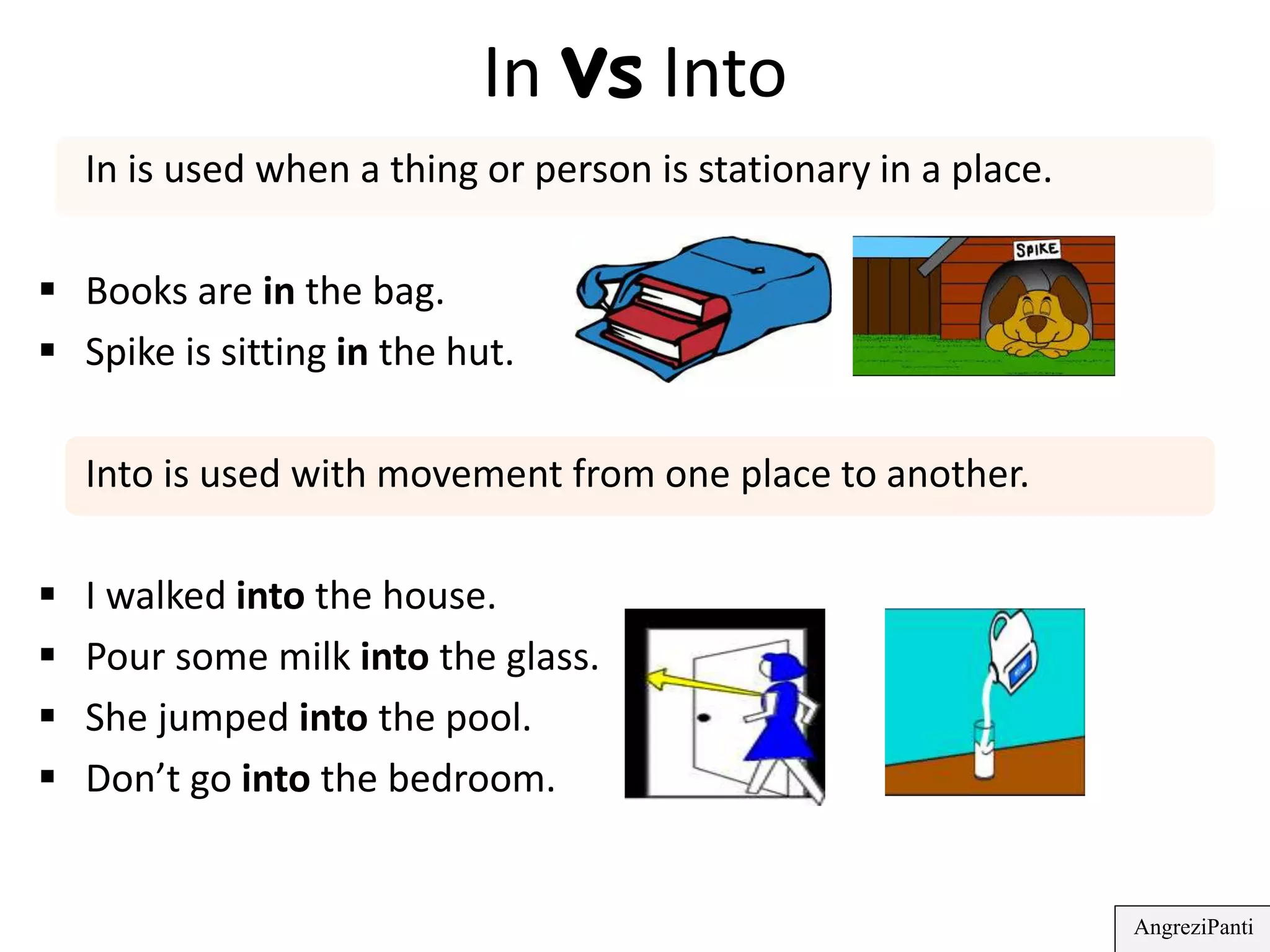
In is used when a thing or person is stationary in a place.
 Books are in the bag.
 Spike is sitting in the hut.
Into is used with movement from one place to another.
 I walked into the house.
 Pour some milk into the glass.
 She jumped into the pool.
 Don’t go into the bedroom.
AngreziPanti
On vs Onto
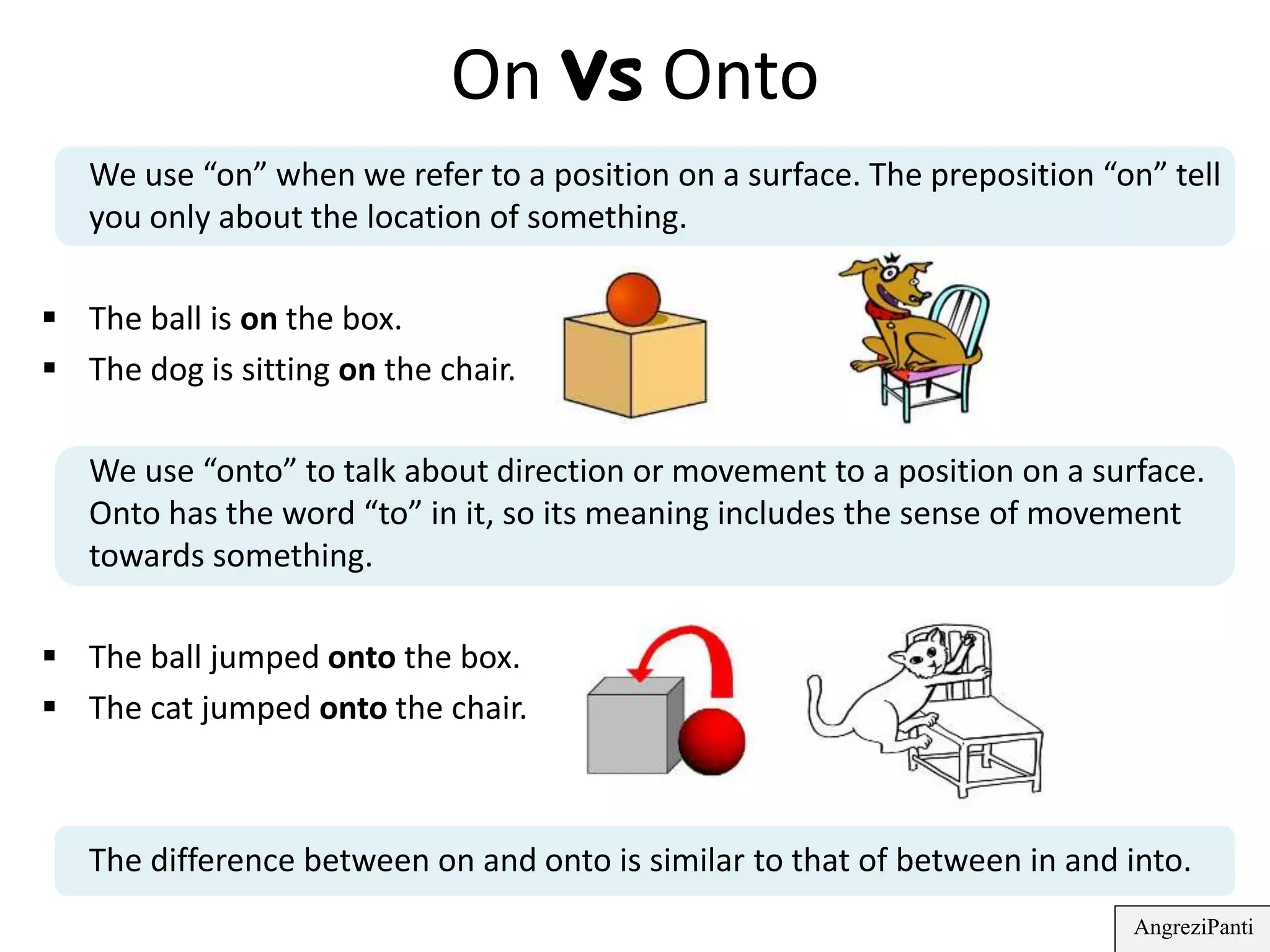
We use “on” when we refer to a position on a surface. The preposition “on” tell
you only about the location of something.
 The ball is on the box.
 The dog is sitting on the chair.
We use “onto” to talk about direction or movement to a position on a surface.
Onto has the word “to” in it, so its meaning includes the sense of movement
towards something.
 The ball jumped onto the box.
 The cat jumped onto the chair.
The difference between on and onto is similar to that of between in and into.
AngreziPanti
Beside vs Besides
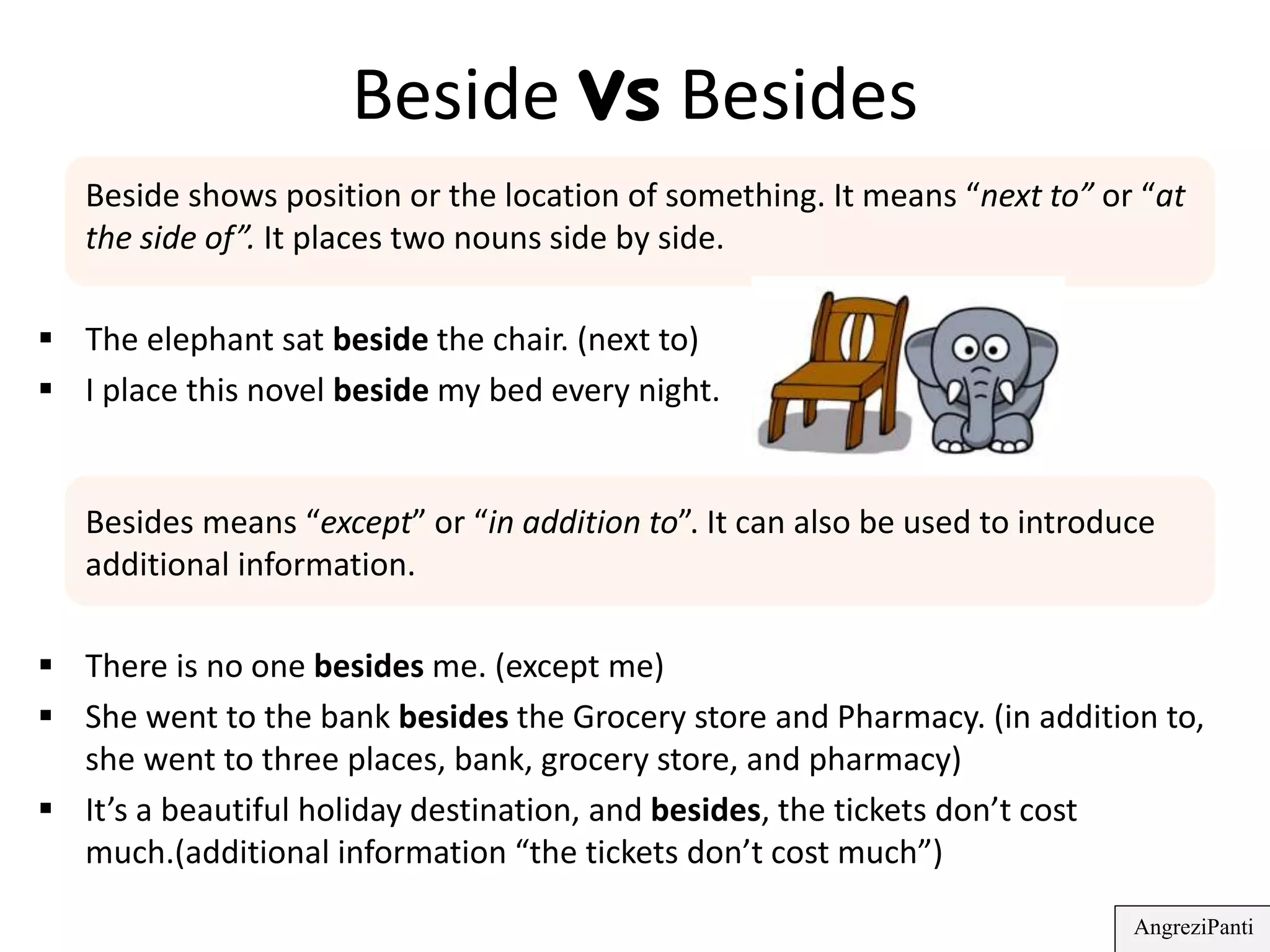
Beside shows position or the location of something. It means “next to” or “at
the side of”. It places two nouns side by side.
 The elephant sat beside the chair. (next to)
 I place this novel beside my bed every night.
Besides means “except” or “in addition to”. It can also be used to introduce
additional information.
 There is no one besides me. (except me)
 She went to the bank besides the Grocery store and Pharmacy. (in addition to,
she went to three places, bank, grocery store, and pharmacy)
 It’s a beautiful holiday destination, and besides, the tickets don’t cost
much.(additional information “the tickets don’t cost much”)
AngreziPanti
Among vs Between
It is often taught that “between” is used for two items and “among” for 3 or more.
This is not completely true.
Between is used to show relationship between two or more well defined objects.
or
Between is used when naming distinct, individual items which can be two, three or
more.
 The situation between India, China, and Japan
is not going well. (well defined objects India,
China, and Japan)
 The cat is sitting between two dogs.
Among is used when the items are part of a group or are not specifically named.
or
We use among when referring to indistinct or nonspecific
relationships or a group.
 The situation among the countries of North America is going well.
 The house is among the trees.
AngreziPanti
Around vs About
Both around and about are similar in meaning , i.e. “approximately”.
 I will meet you about/around nine o’clock.
 About/around 1000 people attended the wedding.
Both around and about can be used to talk about indefinite movements or position.
 They live somewhere around here.
 We wandered about/around the old village.
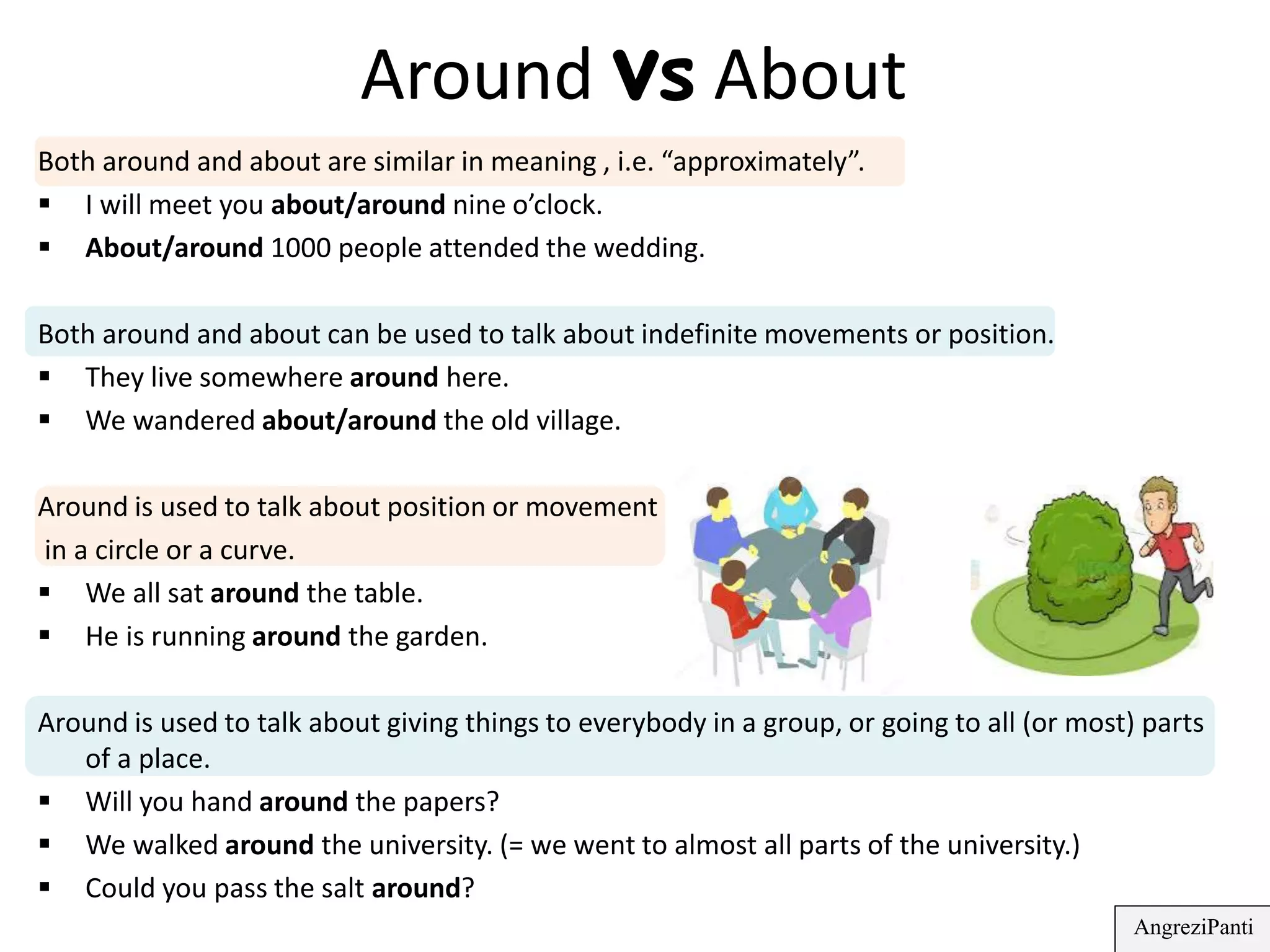
Around is used to talk about position or movement
in a circle or a curve.
 We all sat around the table.
 He is running around the garden.
Around is used to talk about giving things to everybody in a group, or going to all (or most) parts
of a place.
 Will you hand around the papers?
 We walked around the university. (= we went to almost all parts of the university.)
 Could you pass the salt around?
AngreziPanti
Of vs From
Of is mainly used as a possessive.
 The color of the car is red.
 He is the son of Seema.
 These are the paintings of Mr. Ali.
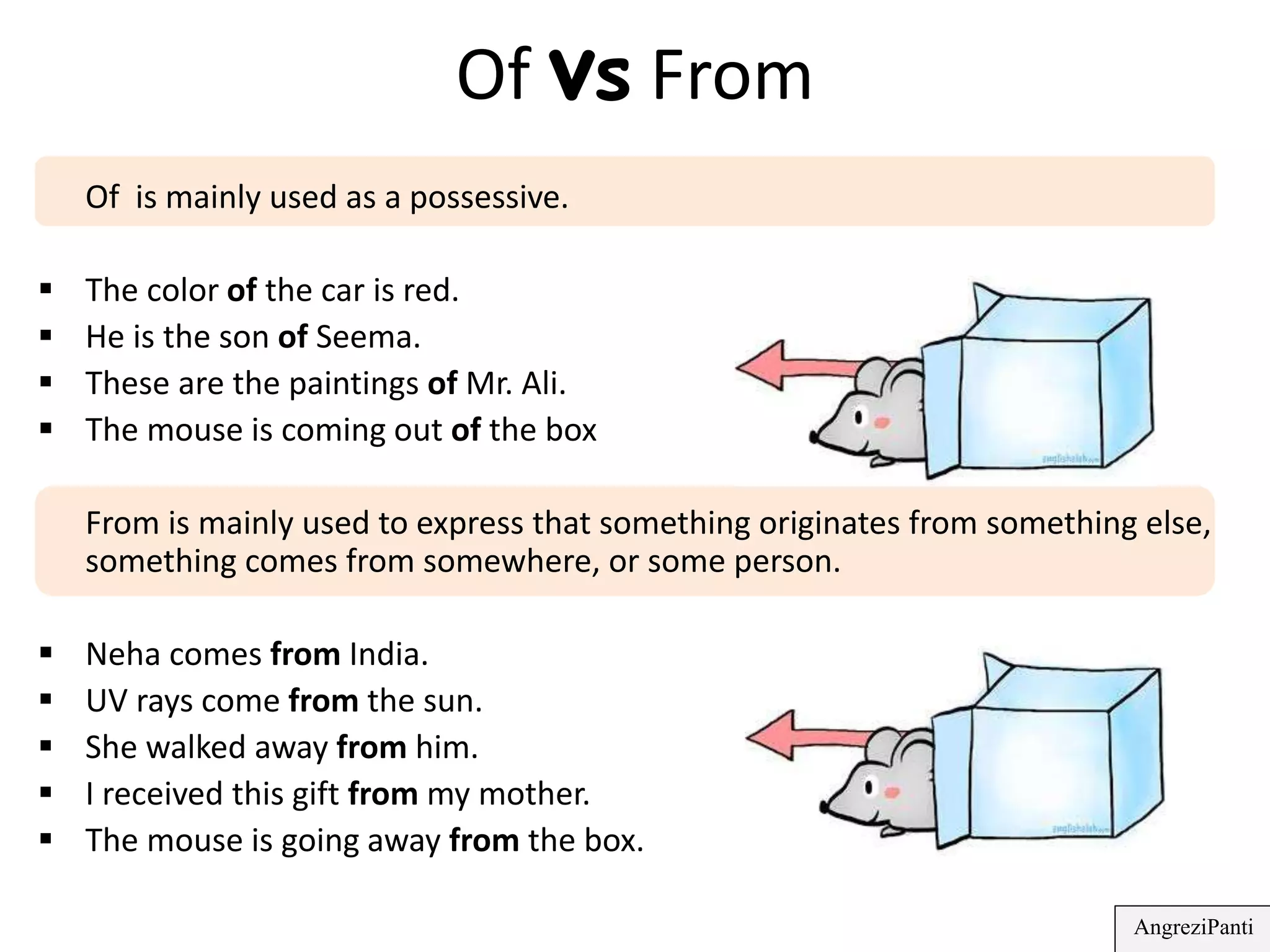
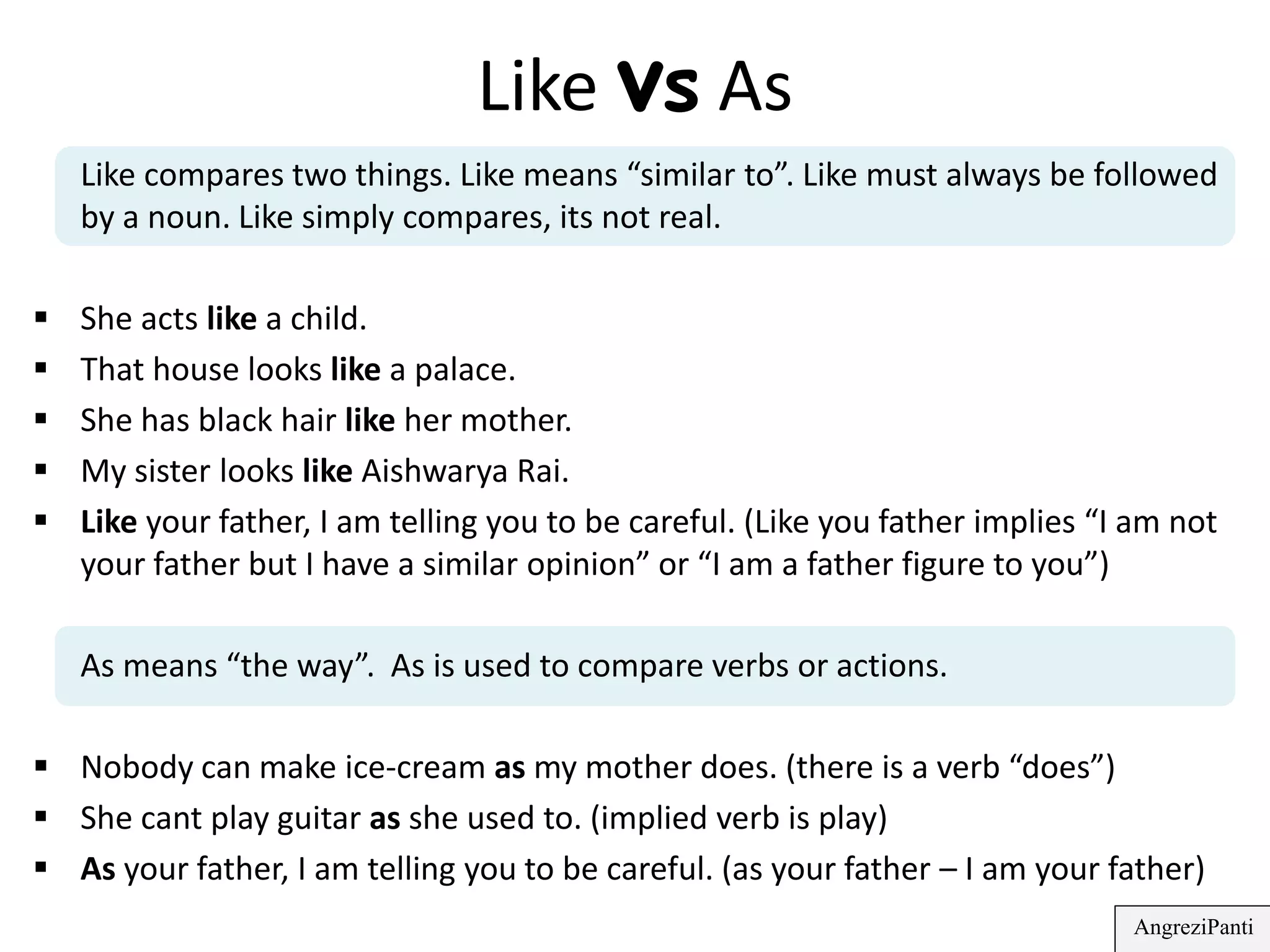
 The mouse is coming out of the box
From is mainly used to express that something originates from something else,
something comes from somewhere, or some person.
 Neha comes from India.
 UV rays come from the sun.
 She walked away from him.
 I received this gift from my mother.
 The mouse is going away from the box.
AngreziPanti
Like vs As
Like compares two things. Like means “similar to”. Like must always be followed
by a noun. Like simply compares, its not real.
 She acts like a child.
 That house looks like a palace.
 She has black hair like her mother.
 My sister looks like Aishwarya Rai.
 Like your father, I am telling you to be careful. (Like you father implies “I am not
your father but I have a similar opinion” or “I am a father figure to you”)
As means “the way”. As is used to compare verbs or actions.
 Nobody can make ice-cream as my mother does. (there is a verb “does”)
 She cant play guitar as she used to. (implied verb is play)
 As your father, I am telling you to be careful. (as your father – I am your father)
AngreziPanti
Above vs Over
Both over and above can mean “at or to a place that is higher than someone or
something”.
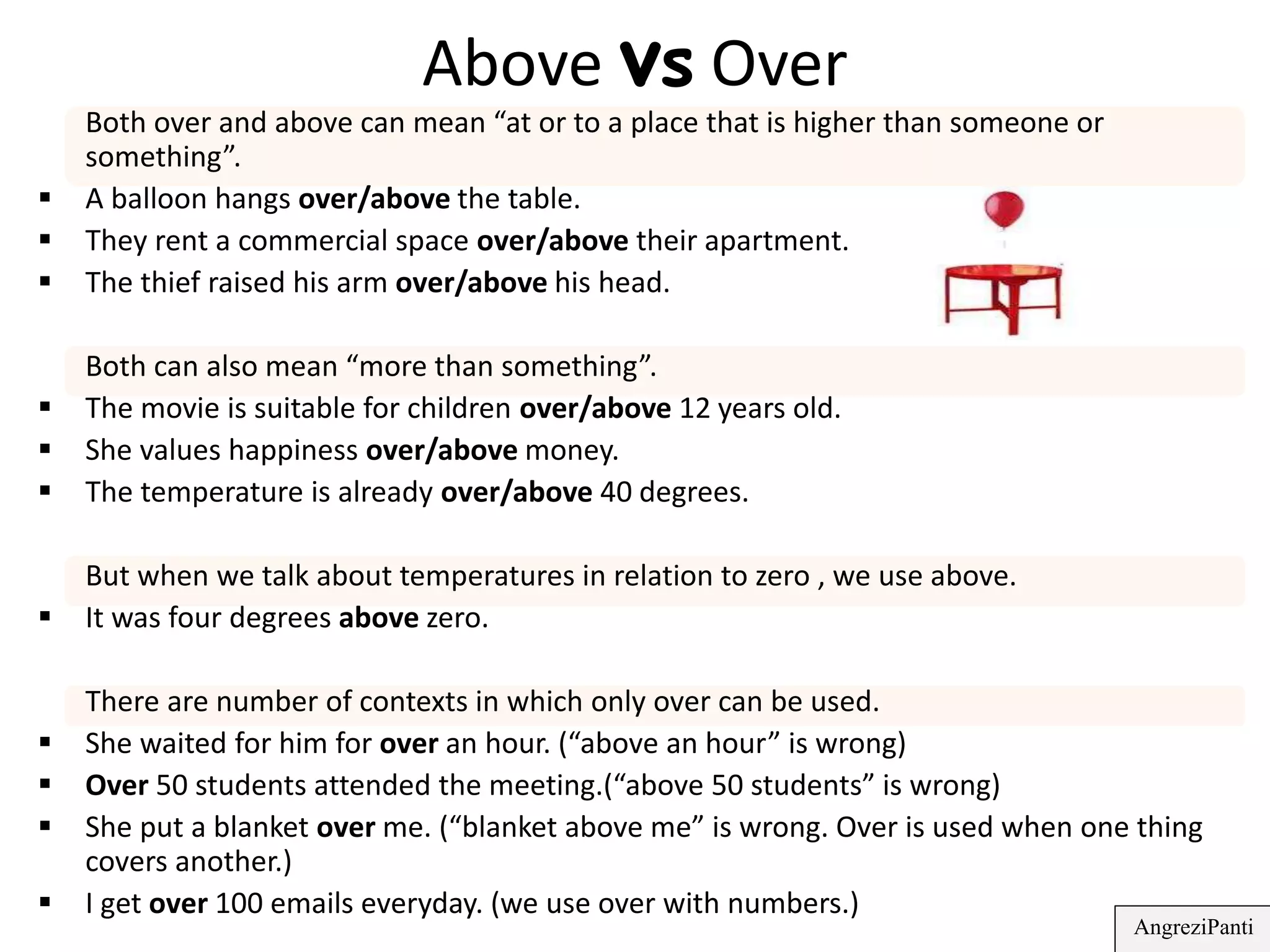
 A balloon hangs over/above the table.
 They rent a commercial space over/above their apartment.
 The thief raised his arm over/above his head.
Both can also mean “more than something”.
 The movie is suitable for children over/above 12 years old.
 She values happiness over/above money.
 The temperature is already over/above 40 degrees.
But when we talk about temperatures in relation to zero , we use above.
 It was four degrees above zero.
There are number of contexts in which only over can be used.
 She waited for him for over an hour. (“above an hour” is wrong)
 Over 50 students attended the meeting.(“above 50 students” is wrong)
 She put a blanket over me. (“blanket above me” is wrong. Over is used when one thing
covers another.)
 I get over 100 emails everyday. (we use over with numbers.)
AngreziPanti
Under vs Below
The prepositions under and below are often interchangeable. Both of them are possible in
some cases.
 They sat under/below a tree.
 Draw a line under/below each word.
But sometimes we use them in different circumstances.
Use below when the meaning is “lower or less than”
 Children below the age of 10 should not watch this movie.
 It is 10 degrees below zero.
 The sun disappeared below the horizon.
Use under to talk about something being covered by something else.
 The mouse is hiding under the chair.
 The whole village was under water.
 She threw my pen under the sofa.
Under can also mean “guided or controlled by”.
 The institute is under new management.
 Under the general’s command, the army attacked the village.
AngreziPanti
Sentences using “under”
In each of the following sentences something is being covered by something
else, so we are using “under”.
 We played and ate pizza under the trees. (we are being covered by trees. below
can also be used but under is a better choice)
 The ball went under the bed. (bed covers the ball)
 He put his hand under his coat and drew out a gun. (coat covers the hand)
 She finished the work under great pressure. (pressure covers her)
 She is under observation. (observation covers her)
 He slipped under the blanket. (blanket covers him)
 Rita muttered something under her breath. (whatever Rita muttered is covered
by her breath)
 The sun had been under a cloud all day. (cloud covers the sun)
AngreziPanti
Sentences using “below”
In each of the following sentences the meaning implied is “lower or less than”,
so we are using “below”.
• He has a birthmark just below his collarbone. (lower place)
• Around 200 people gathered in the village below us. (lower place)
• I could see a patch of the road a thousand feet below me. (lower place)
• The view below the bridge is awesome. (lower place)
• The family is living below the poverty line. (less than)
• The sun had sunk half below the horizon. (lower than)
• The pilot looked down at the sea far below. (lower place)
• Men of the rank and below live in this building. (lower rank)
• The temperature was 20 below. (below zero)
• She translated the sentences given below. (lower on the same page)
• Rita lives in the apartment below. (lower place)
AngreziPanti
Sentences using “above”
The following sentences show the various contexts in which we can use
preposition “above”.
• He lives above me. (higher position)
• Above all, you must help each other. (most importantly)
• Sign above this line. (preceding)
• No one is above the law. (higher than)
• She is above 90. (greater than)
• She values health above wealth. (here above means more than)
• The moon was above the horizon. (higher place)
• She kept her head above the water. (higher place)
• Birds circled above the dead body. (higher place)
• Our plane is flying above the clouds. (in extended space)
• The city is 1000 meters above sea level. (higher level)
• A display of fireworks above the town. (in extended space)
AngreziPanti
Sentences using “over”
The following sentences show the various contexts in which we can use
preposition “over”.
• What are you doing over here? (in or to the place indicated)
• His flat was over the shop. (at a higher level)
• She is famous all over the world. (entire)
• I am over 30. (greater than)
• We live over there. (place indicated)
• School is over at 2. (finishes at)
• She jumped over the ditch. (expressing action)
• It happened over a 100 years ago. (expressing duration)
• They placed a blanket over the dead body. (one thing is covering another)
• He turned over and went to sleep. (changed position to face in another
direction)
• Children are rushing all over the place. (everywhere)
• I have only one person over me at work. (higher in rank)
• I would choose whisky over rum. (expressing preference)
AngreziPanti
But remember,
There is no hard and fast rule.
One preposition can be used in many different contexts.
As we have seen in the previous slide there are so many contexts
in which the preposition “over” can be used.
So, prepositions need to be learned in context with the other
words they are used with.
Keep practicing 
AngreziPanti
THANK YOU
&
HAPPY LEARNING


Prepositions | Commonly confused prepositions

  • 1.
  • 2.
    AngreziPanti In vs Into Inis used when a thing or person is stationary in a place.  Books are in the bag.  Spike is sitting in the hut. Into is used with movement from one place to another.  I walked into the house.  Pour some milk into the glass.  She jumped into the pool.  Don’t go into the bedroom.
  • 3.
    AngreziPanti On vs Onto Weuse “on” when we refer to a position on a surface. The preposition “on” tell you only about the location of something.  The ball is on the box.  The dog is sitting on the chair. We use “onto” to talk about direction or movement to a position on a surface. Onto has the word “to” in it, so its meaning includes the sense of movement towards something.  The ball jumped onto the box.  The cat jumped onto the chair. The difference between on and onto is similar to that of between in and into.
  • 4.
    AngreziPanti Beside vs Besides Besideshows position or the location of something. It means “next to” or “at the side of”. It places two nouns side by side.  The elephant sat beside the chair. (next to)  I place this novel beside my bed every night. Besides means “except” or “in addition to”. It can also be used to introduce additional information.  There is no one besides me. (except me)  She went to the bank besides the Grocery store and Pharmacy. (in addition to, she went to three places, bank, grocery store, and pharmacy)  It’s a beautiful holiday destination, and besides, the tickets don’t cost much.(additional information “the tickets don’t cost much”)
  • 5.
    AngreziPanti Among vs Between Itis often taught that “between” is used for two items and “among” for 3 or more. This is not completely true. Between is used to show relationship between two or more well defined objects. or Between is used when naming distinct, individual items which can be two, three or more.  The situation between India, China, and Japan is not going well. (well defined objects India, China, and Japan)  The cat is sitting between two dogs. Among is used when the items are part of a group or are not specifically named. or We use among when referring to indistinct or nonspecific relationships or a group.  The situation among the countries of North America is going well.  The house is among the trees.
  • 6.
    AngreziPanti Around vs About Botharound and about are similar in meaning , i.e. “approximately”.  I will meet you about/around nine o’clock.  About/around 1000 people attended the wedding. Both around and about can be used to talk about indefinite movements or position.  They live somewhere around here.  We wandered about/around the old village. Around is used to talk about position or movement in a circle or a curve.  We all sat around the table.  He is running around the garden. Around is used to talk about giving things to everybody in a group, or going to all (or most) parts of a place.  Will you hand around the papers?  We walked around the university. (= we went to almost all parts of the university.)  Could you pass the salt around?
  • 7.
    AngreziPanti Of vs From Ofis mainly used as a possessive.  The color of the car is red.  He is the son of Seema.  These are the paintings of Mr. Ali.  The mouse is coming out of the box From is mainly used to express that something originates from something else, something comes from somewhere, or some person.  Neha comes from India.  UV rays come from the sun.  She walked away from him.  I received this gift from my mother.  The mouse is going away from the box.
  • 8.
    AngreziPanti Like vs As Likecompares two things. Like means “similar to”. Like must always be followed by a noun. Like simply compares, its not real.  She acts like a child.  That house looks like a palace.  She has black hair like her mother.  My sister looks like Aishwarya Rai.  Like your father, I am telling you to be careful. (Like you father implies “I am not your father but I have a similar opinion” or “I am a father figure to you”) As means “the way”. As is used to compare verbs or actions.  Nobody can make ice-cream as my mother does. (there is a verb “does”)  She cant play guitar as she used to. (implied verb is play)  As your father, I am telling you to be careful. (as your father – I am your father)
  • 9.
    AngreziPanti Above vs Over Bothover and above can mean “at or to a place that is higher than someone or something”.  A balloon hangs over/above the table.  They rent a commercial space over/above their apartment.  The thief raised his arm over/above his head. Both can also mean “more than something”.  The movie is suitable for children over/above 12 years old.  She values happiness over/above money.  The temperature is already over/above 40 degrees. But when we talk about temperatures in relation to zero , we use above.  It was four degrees above zero. There are number of contexts in which only over can be used.  She waited for him for over an hour. (“above an hour” is wrong)  Over 50 students attended the meeting.(“above 50 students” is wrong)  She put a blanket over me. (“blanket above me” is wrong. Over is used when one thing covers another.)  I get over 100 emails everyday. (we use over with numbers.)
  • 10.
    AngreziPanti Under vs Below Theprepositions under and below are often interchangeable. Both of them are possible in some cases.  They sat under/below a tree.  Draw a line under/below each word. But sometimes we use them in different circumstances. Use below when the meaning is “lower or less than”  Children below the age of 10 should not watch this movie.  It is 10 degrees below zero.  The sun disappeared below the horizon. Use under to talk about something being covered by something else.  The mouse is hiding under the chair.  The whole village was under water.  She threw my pen under the sofa. Under can also mean “guided or controlled by”.  The institute is under new management.  Under the general’s command, the army attacked the village.
  • 11.
    AngreziPanti Sentences using “under” Ineach of the following sentences something is being covered by something else, so we are using “under”.  We played and ate pizza under the trees. (we are being covered by trees. below can also be used but under is a better choice)  The ball went under the bed. (bed covers the ball)  He put his hand under his coat and drew out a gun. (coat covers the hand)  She finished the work under great pressure. (pressure covers her)  She is under observation. (observation covers her)  He slipped under the blanket. (blanket covers him)  Rita muttered something under her breath. (whatever Rita muttered is covered by her breath)  The sun had been under a cloud all day. (cloud covers the sun)
  • 12.
    AngreziPanti Sentences using “below” Ineach of the following sentences the meaning implied is “lower or less than”, so we are using “below”. • He has a birthmark just below his collarbone. (lower place) • Around 200 people gathered in the village below us. (lower place) • I could see a patch of the road a thousand feet below me. (lower place) • The view below the bridge is awesome. (lower place) • The family is living below the poverty line. (less than) • The sun had sunk half below the horizon. (lower than) • The pilot looked down at the sea far below. (lower place) • Men of the rank and below live in this building. (lower rank) • The temperature was 20 below. (below zero) • She translated the sentences given below. (lower on the same page) • Rita lives in the apartment below. (lower place)
  • 13.
    AngreziPanti Sentences using “above” Thefollowing sentences show the various contexts in which we can use preposition “above”. • He lives above me. (higher position) • Above all, you must help each other. (most importantly) • Sign above this line. (preceding) • No one is above the law. (higher than) • She is above 90. (greater than) • She values health above wealth. (here above means more than) • The moon was above the horizon. (higher place) • She kept her head above the water. (higher place) • Birds circled above the dead body. (higher place) • Our plane is flying above the clouds. (in extended space) • The city is 1000 meters above sea level. (higher level) • A display of fireworks above the town. (in extended space)
  • 14.
    AngreziPanti Sentences using “over” Thefollowing sentences show the various contexts in which we can use preposition “over”. • What are you doing over here? (in or to the place indicated) • His flat was over the shop. (at a higher level) • She is famous all over the world. (entire) • I am over 30. (greater than) • We live over there. (place indicated) • School is over at 2. (finishes at) • She jumped over the ditch. (expressing action) • It happened over a 100 years ago. (expressing duration) • They placed a blanket over the dead body. (one thing is covering another) • He turned over and went to sleep. (changed position to face in another direction) • Children are rushing all over the place. (everywhere) • I have only one person over me at work. (higher in rank) • I would choose whisky over rum. (expressing preference)
  • 15.
    AngreziPanti But remember, There isno hard and fast rule. One preposition can be used in many different contexts. As we have seen in the previous slide there are so many contexts in which the preposition “over” can be used. So, prepositions need to be learned in context with the other words they are used with. Keep practicing 
  • 16.