What is anapostrophe?
a punctuation mark (') used to indicate
either possession (e.g. Harry ' s
book ; boys ' coats ) or the omission of
letters or numbers (e.g. can ' t ; he ' s ; 1
Jan. ' 99 ).
3.
Uses of anApostrophe
Apostrophe Use: Contractions and
Omissions
Apostrophe Use: Possession
4.
Overview
Main ApostropheTakeaways:
Apostrophes have three main uses: to show ownership, omissions,
and plural letters, numbers, and symbols
An apostrophe stands in for the missing letter(s) in a contraction
like don’t or can’t.
If something is plural and showing possession, put
an apostrophe after the “s.” You can also add another ‘s’ after
the apostrophe, but it isn’t usually required.
If something is plural but not possessive, you don’t need
an apostrophe.
Only use an apostrophe with last names ending in ‘s’ when they
show possession.
To shorten decades, replace the century with an apostrophe and
add an ‘s’ at the end of the number. Never put
the apostrophe before or after the ‘s’.
5.
Contractions and
omissions
Acontraction is a shortened form of a
word (or group of words) that omits
certain letters or sounds. In a
contraction, an apostrophe represents
missing letters. The most common
contractions are made up of verbs,
auxiliaries, or modals attached to other
words: He would=He’d. I have=I’ve. They
are=They’re. You cannot=You can’t.
6.
Some writersuse less common contractions
when they want to represent a particular
style of speech. They might write somethin’ to
represent the way people often don’t
pronounce the final g of “something” in
speech. Occasionally, you might
see e’er (instead of ever) in poetry. And, of
course, in the American South, you will
probably encounter y’all (you all). Decade
names are often contracted as well: the
’60s (the 1960s).
7.
Contractions areusually considered to
be relatively casual. If you’re writing
something very formal, you may want
to avoid using them except in cases
like o’clock, where the full phrase (of the
clock) truly is rare.
8.
Possession
The rulesabout forming possessives
probably cause the most apostrophe
confusion. They vary a little bit,
depending on what type of noun you
are making into a possessive.
Here are therules of
thumb:
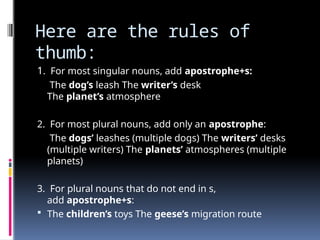
1. For most singular nouns, add apostrophe+s:
The dog’s leash The writer’s desk
The planet’s atmosphere
2. For most plural nouns, add only an apostrophe:
The dogs’ leashes (multiple dogs) The writers’ desks
(multiple writers) The planets’ atmospheres (multiple
planets)
3. For plural nouns that do not end in s,
add apostrophe+s:
The children’s toys The geese’s migration route
11.
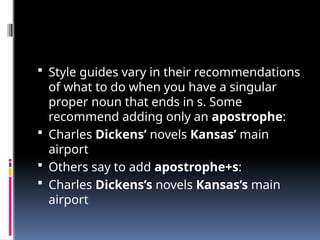
Style guidesvary in their recommendations
of what to do when you have a singular
proper noun that ends in s. Some
recommend adding only an apostrophe:
Charles Dickens’ novels Kansas’ main
airport
Others say to add apostrophe+s:
Charles Dickens’s novels Kansas’s main
airport
12.
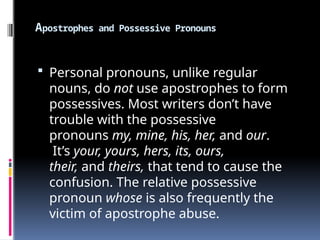
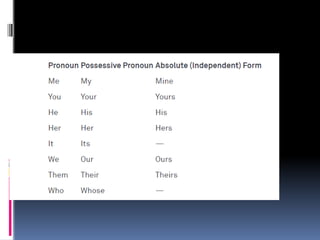
Apostrophes and PossessivePronouns
Personal pronouns, unlike regular
nouns, do not use apostrophes to form
possessives. Most writers don’t have
trouble with the possessive
pronouns my, mine, his, her, and our.
It’s your, yours, hers, its, ours,
their, and theirs, that tend to cause the
confusion. The relative possessive
pronoun whose is also frequently the
victim of apostrophe abuse.
14.
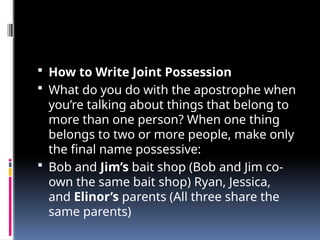
How toWrite Joint Possession
What do you do with the apostrophe when
you’re talking about things that belong to
more than one person? When one thing
belongs to two or more people, make only
the final name possessive:
Bob and Jim’s bait shop (Bob and Jim co-
own the same bait shop) Ryan, Jessica,
and Elinor’s parents (All three share the
same parents)
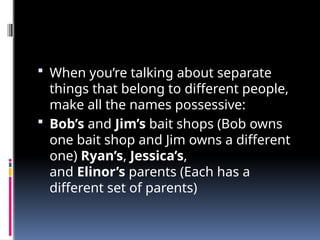
15.
When you’retalking about separate
things that belong to different people,
make all the names possessive:
Bob’s and Jim’s bait shops (Bob owns
one bait shop and Jim owns a different
one) Ryan’s, Jessica’s,
and Elinor’s parents (Each has a
different set of parents)
16.
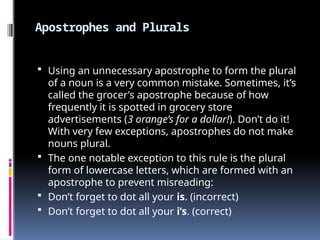
Apostrophes and Plurals
Using an unnecessary apostrophe to form the plural
of a noun is a very common mistake. Sometimes, it’s
called the grocer’s apostrophe because of how
frequently it is spotted in grocery store
advertisements (3 orange’s for a dollar!). Don’t do it!
With very few exceptions, apostrophes do not make
nouns plural.
The one notable exception to this rule is the plural
form of lowercase letters, which are formed with an
apostrophe to prevent misreading:
Don’t forget to dot all your is. (incorrect)
Don’t forget to dot all your i’s. (correct)
17.
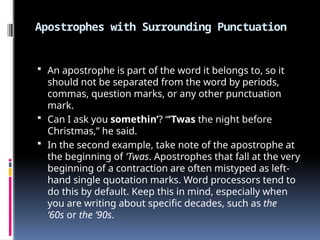
Apostrophes with SurroundingPunctuation
An apostrophe is part of the word it belongs to, so it
should not be separated from the word by periods,
commas, question marks, or any other punctuation
mark.
Can I ask you somethin’? “’Twas the night before
Christmas,” he said.
In the second example, take note of the apostrophe at
the beginning of ’Twas. Apostrophes that fall at the very
beginning of a contraction are often mistyped as left-
hand single quotation marks. Word processors tend to
do this by default. Keep this in mind, especially when
you are writing about specific decades, such as the
’60s or the ’90s.