Once upon a time,
In a Galaxy
      far, far, away…
…there lived business students…


…who embarked on a
long journey.


          To learn the correct usage
             of the Apostrophe…
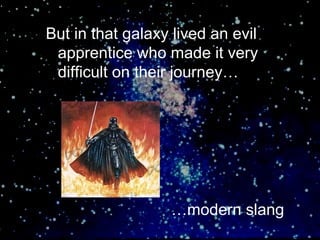
But in that galaxy lived an evil
 apprentice who made it very
 difficult on their journey…


                  …modern slang
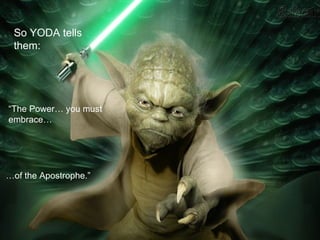
So YODA tells
 them:


“The Power… you must
embrace…


…of the Apostrophe.”
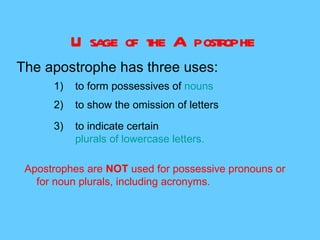
U sage of the A postrophe
The apostrophe has three uses:
      1)   to form possessives of nouns
      2)   to show the omission of letters
      3)   to indicate certain
           plurals of lowercase letters.

 Apostrophes are NOT used for possessive pronouns or
   for noun plurals, including acronyms.
So, Help me Master Yoda, What must I do ???
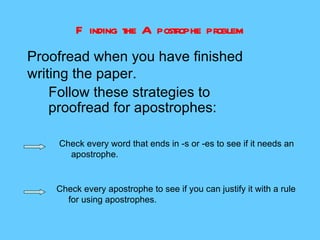
F inding the A postrophe problem
Proofread when you have finished
writing the paper.
    Follow these strategies to
    proofread for apostrophes:

    Check every word that ends in -s or -es to see if it needs an
      apostrophe.


    Check every apostrophe to see if you can justify it with a rule
      for using apostrophes.
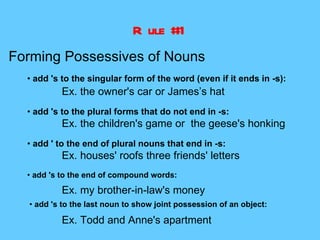
R ule #1
Forming Possessives of Nouns
  • add 's to the singular form of the word (even if it ends in -s):
          Ex. the owner's car or James’s hat
  • add 's to the plural forms that do not end in -s:
          Ex. the children's game or the geese's honking
  • add ' to the end of plural nouns that end in -s:
          Ex. houses' roofs three friends' letters
  • add 's to the end of compound words:
          Ex. my brother-in-law's money
  • add 's to the last noun to show joint possession of an object:

          Ex. Todd and Anne's apartment
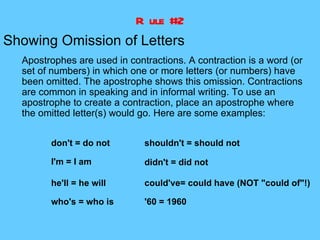
R ule #2
Showing Omission of Letters
  Apostrophes are used in contractions. A contraction is a word (or
  set of numbers) in which one or more letters (or numbers) have
  been omitted. The apostrophe shows this omission. Contractions
  are common in speaking and in informal writing. To use an
  apostrophe to create a contraction, place an apostrophe where
  the omitted letter(s) would go. Here are some examples:


        don't = do not        shouldn't = should not

        I'm = I am            didn't = did not

        he'll = he will       could've= could have (NOT "could of"!)

        who's = who is        '60 = 1960
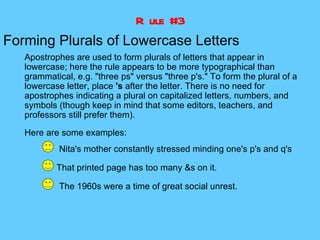
R ule #3
Forming Plurals of Lowercase Letters
   Apostrophes are used to form plurals of letters that appear in
   lowercase; here the rule appears to be more typographical than
   grammatical, e.g. "three ps" versus "three p's." To form the plural of a
   lowercase letter, place 's after the letter. There is no need for
   apostrophes indicating a plural on capitalized letters, numbers, and
   symbols (though keep in mind that some editors, teachers, and
   professors still prefer them).

   Here are some examples:
            Nita's mother constantly stressed minding one's p's and q's

           That printed page has too many &s on it.

            The 1960s were a time of great social unrest.
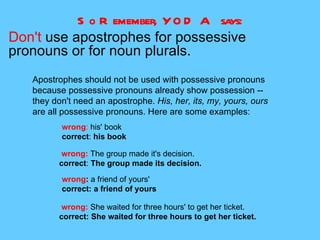
S o R emember YO D A says:
                        ,
Don't use apostrophes for possessive
pronouns or for noun plurals.
   Apostrophes should not be used with possessive pronouns
   because possessive pronouns already show possession --
   they don't need an apostrophe. His, her, its, my, yours, ours
   are all possessive pronouns. Here are some examples:
          wrong: his' book
          correct: his book

          wrong: The group made it's decision.
         correct: The group made its decision.
          wrong: a friend of yours'
          correct: a friend of yours

          wrong: She waited for three hours' to get her ticket.
         correct: She waited for three hours to get her ticket.
Master Yoda says…


  “Perfect… practice makes you.”
THE
GALACTIC
  END
CREDITS:
    Presentation arranged by:

   Ms. Princess Sally


         Information Retrieved 7/26/2005 from http://
owl.english.purdue.edu/handouts/print/grammar/g_apost.html
Go to Exercise

Correct Usage of the apostrophe

  • 1.
  • 2.
    In a Galaxy far, far, away…
  • 3.
    …there lived businessstudents… …who embarked on a long journey. To learn the correct usage of the Apostrophe…
  • 4.
    But in thatgalaxy lived an evil apprentice who made it very difficult on their journey… …modern slang
  • 5.
    So YODA tells them: “The Power… you must embrace… …of the Apostrophe.”
  • 6.
    U sage ofthe A postrophe The apostrophe has three uses: 1) to form possessives of nouns 2) to show the omission of letters 3) to indicate certain plurals of lowercase letters. Apostrophes are NOT used for possessive pronouns or for noun plurals, including acronyms.
  • 7.
    So, Help meMaster Yoda, What must I do ???
  • 8.
    F inding theA postrophe problem Proofread when you have finished writing the paper. Follow these strategies to proofread for apostrophes: Check every word that ends in -s or -es to see if it needs an apostrophe. Check every apostrophe to see if you can justify it with a rule for using apostrophes.
  • 9.
    R ule #1 FormingPossessives of Nouns • add 's to the singular form of the word (even if it ends in -s): Ex. the owner's car or James’s hat • add 's to the plural forms that do not end in -s: Ex. the children's game or the geese's honking • add ' to the end of plural nouns that end in -s: Ex. houses' roofs three friends' letters • add 's to the end of compound words: Ex. my brother-in-law's money • add 's to the last noun to show joint possession of an object: Ex. Todd and Anne's apartment
  • 10.
    R ule #2 ShowingOmission of Letters Apostrophes are used in contractions. A contraction is a word (or set of numbers) in which one or more letters (or numbers) have been omitted. The apostrophe shows this omission. Contractions are common in speaking and in informal writing. To use an apostrophe to create a contraction, place an apostrophe where the omitted letter(s) would go. Here are some examples: don't = do not shouldn't = should not I'm = I am didn't = did not he'll = he will could've= could have (NOT "could of"!) who's = who is '60 = 1960
  • 11.
    R ule #3 FormingPlurals of Lowercase Letters Apostrophes are used to form plurals of letters that appear in lowercase; here the rule appears to be more typographical than grammatical, e.g. "three ps" versus "three p's." To form the plural of a lowercase letter, place 's after the letter. There is no need for apostrophes indicating a plural on capitalized letters, numbers, and symbols (though keep in mind that some editors, teachers, and professors still prefer them). Here are some examples: Nita's mother constantly stressed minding one's p's and q's That printed page has too many &s on it. The 1960s were a time of great social unrest.
  • 12.
    S o Remember YO D A says: , Don't use apostrophes for possessive pronouns or for noun plurals. Apostrophes should not be used with possessive pronouns because possessive pronouns already show possession -- they don't need an apostrophe. His, her, its, my, yours, ours are all possessive pronouns. Here are some examples: wrong: his' book correct: his book wrong: The group made it's decision. correct: The group made its decision. wrong: a friend of yours' correct: a friend of yours wrong: She waited for three hours' to get her ticket. correct: She waited for three hours to get her ticket.
  • 13.
    Master Yoda says… “Perfect… practice makes you.”
  • 14.
  • 15.
    CREDITS: Presentation arranged by: Ms. Princess Sally Information Retrieved 7/26/2005 from http:// owl.english.purdue.edu/handouts/print/grammar/g_apost.html
  • 16.