Apostrophes have two purposes:
To indicate missing letters in words.
To indicate possession.
1.
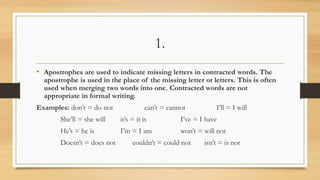
• Apostrophes are used to indicate missing letters in contracted words. The
apostrophe is used in the place of the missing letter or letters. This is often
used when merging two words into one. Contracted words are not
appropriate in formal writing.
Examples: don’t = do not can’t = cannot I’ll = I will
She’ll = she will it’s = it is I’ve = I have
He’s = he is I’m = I am won’t = will not
Doesn’t = does not couldn’t = could not isn’t = is not
I couldn’t possibly eat another thing! I don’t want him to be
offended; it’s not that the food isn’t delicious. He’s such a wonderful
cook that I’m afraid I’ve eaten too much. I won’t be able to move
soon and that wouldn’t be good!
2.
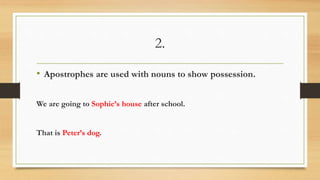
• Apostrophes are used with nouns to show possession.
We are going to Sophie’s house after school.
That is Peter’s dog.
Rules of possession:
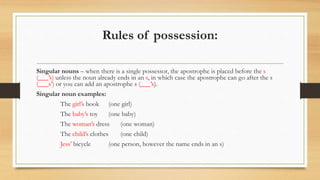
Singular nouns – when there is a single possessor, the apostrophe is placed before the s
(___’s) unless the noun already ends in an s, in which case the apostrophe can go after the s
(___s’) or you can add an apostrophe s (___’s).
Singular noun examples:
The girl’s book (one girl)
The baby’s toy (one baby)
The woman’s dress (one woman)
The child’s clothes (one child)
Jess’ bicycle (one person, however the name ends in an s)
Plural nouns – when there are multiple possessors, the apostrophe is placed after the
s if the word ends in –s, -es or –ies (___s’). There are some plural nouns that do not
end in an s. In this case, use apostrophe s.
Plural noun examples:
The girls’ books (more than one girl)
The babies’ toys (more than one baby)
The women’s clothes (more than one woman)
The children’s clothes (more than one child)
Hint…
If you are unsure of where to put the apostrophe, try rewording the sentence.
Example: The jacket of the girl = one girl = the girl’s jacket (apostrophe s).
The staffroom of the teachers = more than one teacher = the teachers’
staffroom (apostrophe after the s).
Don’t be afraid to try! Remember:

Apostrophes

  • 2.
    Apostrophes have twopurposes: To indicate missing letters in words. To indicate possession.
  • 3.
    1. • Apostrophes areused to indicate missing letters in contracted words. The apostrophe is used in the place of the missing letter or letters. This is often used when merging two words into one. Contracted words are not appropriate in formal writing. Examples: don’t = do not can’t = cannot I’ll = I will She’ll = she will it’s = it is I’ve = I have He’s = he is I’m = I am won’t = will not Doesn’t = does not couldn’t = could not isn’t = is not
  • 4.
    I couldn’t possiblyeat another thing! I don’t want him to be offended; it’s not that the food isn’t delicious. He’s such a wonderful cook that I’m afraid I’ve eaten too much. I won’t be able to move soon and that wouldn’t be good!
  • 5.
    2. • Apostrophes areused with nouns to show possession. We are going to Sophie’s house after school. That is Peter’s dog.
  • 6.
    Rules of possession: Singularnouns – when there is a single possessor, the apostrophe is placed before the s (___’s) unless the noun already ends in an s, in which case the apostrophe can go after the s (___s’) or you can add an apostrophe s (___’s). Singular noun examples: The girl’s book (one girl) The baby’s toy (one baby) The woman’s dress (one woman) The child’s clothes (one child) Jess’ bicycle (one person, however the name ends in an s)
  • 7.
    Plural nouns –when there are multiple possessors, the apostrophe is placed after the s if the word ends in –s, -es or –ies (___s’). There are some plural nouns that do not end in an s. In this case, use apostrophe s. Plural noun examples: The girls’ books (more than one girl) The babies’ toys (more than one baby) The women’s clothes (more than one woman) The children’s clothes (more than one child)
  • 8.
    Hint… If you areunsure of where to put the apostrophe, try rewording the sentence. Example: The jacket of the girl = one girl = the girl’s jacket (apostrophe s). The staffroom of the teachers = more than one teacher = the teachers’ staffroom (apostrophe after the s).
  • 9.
    Don’t be afraidto try! Remember: