Understanding and Extending
Prometheus AlertManager
Lee Calcote
calcotestudios.com/talks
Lee Calcote
linkedin.com/in/leecalcote
@lcalcote
blog.gingergeek.com
lee@calcotestudios.com
clouds, containers, infrastructure,
applications  and their management
calcotestudios.com/talks
Show of Hands
AlertManager
Prometheus
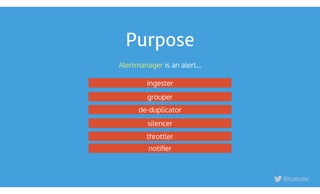
 is an alert...Alertmanager
@lcalcote
Purpose
ingester
grouper
de-duplicator
silencer
throttler
notifier
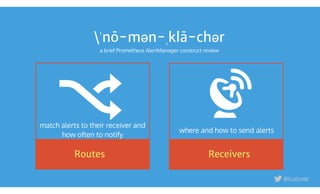
  Receivers
ˈnō-mən-ˌklā-chər
a brief Prometheus AlertManager construct review
match alerts to their receiver and
how often to notify
where and how to send alerts
 Routes
@lcalcote
- matches alerts with specific labels and prevents
them from being included in notifications.
 
 - suppress specific notifications when other
specific alerts are already firing.
 
 - categorizes alerts of similar nature into a single
notification.
Silencers
Inhibitors
Grouping
ˈnō-mən-ˌklā-chər
a brief Prometheus AlertManager construct review
Muting
Suppressing
Correlating
group_wait: 30s
group_by: ['alertname', 'cluster']
group_interval: 5m
@lcalcote
Inhibition
Multiple approaches to suppression
@lcalcote
repeat_interval
vs
Silences
vs
per routeglobalvia ui / api
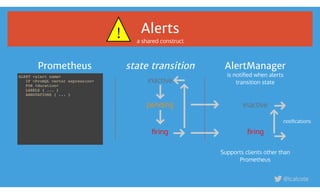
Alerts
ALERT <alert name>
IF <PromQL vector expression>
FOR <duration>
LABELS { ... }
ANNOTATIONS { ... }
Supports clients other than
Prometheus
is notified when alerts
transition state
@lcalcote
a shared construct
Prometheus AlertManager
inactive
firing
pending
state transition
inactive
firing
notifications
!
Notification Integrations
@lcalcote
Notifying to Multiple Destinations
Use  to advance to next receiver.continue
route:
receiver: email_webhook
receivers:
- name: email_webhook
email_configs:
- to: 'lee@example.io'
webhook_configs:
- url: <webhook url here>
Use a  that goes to both destinations.receiver
route:
receiver: ops-team-all # default
routes:
- match:
severity: page
receiver: ops-team-b
continue: true
- match:
severity: critical
receiver: ops-team-a
receivers:
- name: ops-team-all
email_configs:
- to: ops-team-all@example.io
- name: ops-team-a
email_configs:
- to: ops-team-a@example.io
- name: ops-team-b
email_configs:
- to: ops-team-b@example.io
or
@lcalcote
Inhibitor
Dispatcher
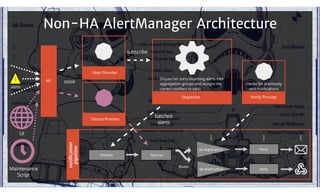
Non-HA AlertManager Architecture
Silencer
de-duplication
Dispatcher sorts incoming alerts into
aggregation groups and assigns the
correct notifiers to each.
api
Alert Provider
UI
Silence Provider
store
de-duplication
subscribe
Router
batched
alerts
notification
pipeline
Notify Provider
checks for previously
sent notifications
Retry
RetryMaintenance
Script
!
@lcalcote
alerts
@lcalcote
High Availability
being introduced in 0.5
I gossip protocols.
built atop Weave Mesh
With HA, you no longer have to monitor the monitor.
 
Designed for an alert to be sent to all instances in the cluster.
 
All Prometheus instances send alerts to all Alertmanager instances.
 
Guarantees notifications to be sent at least once.
@lcalcote
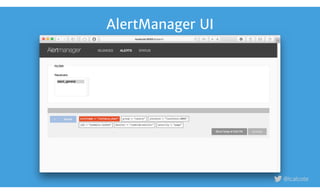
AlertManager UI
@lcalcote
@lcalcote
Story:
As an Operator, I would like to not only see a list of firing alerts,
but also a list of all transpired alerts, so that I may have additional
context as the thresholding behavior for a given defined alert.
@lcalcote
Prologue:
Alert troubleshooting is improved when operators have a view of
what is firing, has recently fired, what is normal, but also go back
in time and see what fired an hour ago. Understanding firing order
assists in root cause analysis and identify problem areas.
 
Limitations:
1. AlertManager database (SQLite) is not intended to provide
long-term storage.
Acceptance Criteria:
1. Once fired, whether actively firing or not, alerts will be
displayed on the History page.
2. Optionally, fired alerts will be notified to a Slack channel.
Stretch:
Include pagination
Add a date range picker
Add a host filter
 
Environment
test setup
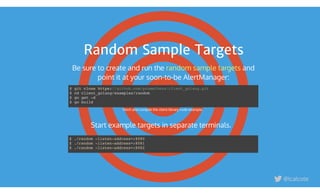
Random Sample Targets
$ git clone https://github.com/prometheus/client_golang.git
$ cd client_golang/examples/random
$ go get -d
$ go build
Fetch and compile the client library code example.
Start example targets in separate terminals.
$ ./random -listen-address=:8080
$ ./random -listen-address=:8081
$ ./random -listen-address=:8082
Be sure to create and run the  and
point it at your soon-to-be AlertManager:
random sample targets
@lcalcote
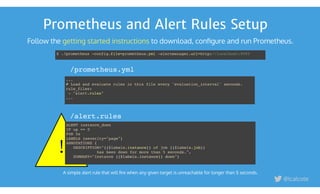
Prometheus and Alert Rules Setup
Follow the  to download, configure and run Prometheus.getting started instructions
$ ./prometheus -config.file=prometheus.yml -alertmanager.url=http://localhost:9093
ALERT instance_down
IF up == 0
FOR 5s
LABELS {severity="page"}
ANNOTATIONS {
DESCRIPTION="{{$labels.instance}} of job {{$labels.job}}
has been down for more than 5 seconds.",
SUMMARY="Instance {{$labels.instance}} down"}
/alert.rules
A simple alert rule that will fire when any given target is unreachable for longer than 5 seconds.
@lcalcote
!
...
# Load and evaluate rules in this file every 'evaluation_interval' seconds.
rule_files:
- "alert.rules"
...
/prometheus.yml
Environment
development setup
@lcalcote
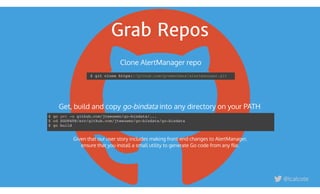
Grab Repos
$ git clone https://github.com/prometheus/alertmanager.git
Given that our user story includes making front-end changes to AlertManager,
ensure that you install a small utility to generate Go code from any file.
Clone AlertManager repo
Get, build and copy go-bindata into any directory on your PATH
$ go get -u github.com/jteeuwen/go-bindata/...
$ cd $GOPATH/src/github.com/jteeuwen/go-bindata/go-bindata
$ go build
Notification Integration
create an alert notification receiver.
 
route:
group_by: [cluster]
# If an alert isn't caught by a route, send it slack.
receiver: slack_general
routes:
# Send severity=slack alerts to slack.
- match:
severity: page
receiver: slack_general
receivers:
- name: slack_general
slack_configs:
- api_url: '<your-web-url-here>'
channel: '#<your-channel-name-here>'
send_resolved: true
Of the supported AlertManager receivers,
let’s opt for integrating Slack.
@lcalcote
@lcalcote
The  can
assist in building
routing trees.
visual editor
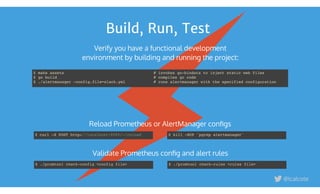
Build, Run, Test
Verify you have a functional development
environment by building and running the project:
$ make assets # invokes go-bindata to inject static web files
$ go build # compiles go code
$ ./alertmanager -config.file=slack.yml # runs alertmanager with the specified configuration
@lcalcote
$ curl -X POST http://localhost:9090/-/reload $ kill -HUP `pgrep alertmanager`
$ ./promtool check-config <config file> $ ./promtool check-rules <rules file>
Reload Prometheus or AlertManager configs
Validate Prometheus config and alert rules
@lcalcote
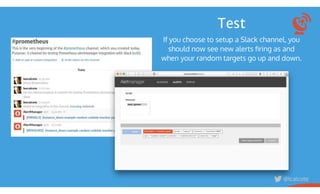
Test
If you choose to setup a Slack channel, you
should now see new alerts firing as and
when your random targets go up and down.
/ui/app/js/app.js
Changelog
/api.go
/ui/app/partials/history.html
Angular
HTML
Go
Go & SQL
/provider/provider.go
/provider/sqlite/sqlite.go
/provider/boltmem/boltmem.go
@lcalcote
All UI functionality should be addressable via API.
Let’s register a :
/api.go
new /history API endpoint
r.Get("/history", ihf("history", api.listAllAlerts))
func (api *API) listAllAlerts(w http.ResponseWriter, r *http.Request) {
alerts := api.alerts.GetAll()
defer alerts.Close()
With our /api/v1/history endpoint a newly addressable API endpoint, we’ll need to
build a function to handle requests made to it.
The  function will handle inbound
HTTP requests made to the new endpoint.
api.listAllAlerts
@lcalcote
1. Add  (e.g. GetAll() AlertIterator) to /provider/provider.go
2. Add a  to /provider/sqlite/sqlite.go
3. Add a to /provider/boltmem/boltmem.go
a new AlertIterator
new AlertProvider and SQL query
new AlertIterator and AlertProvider
With API endpoint, let’s turn our attention to the
backend for collecting the right recordset from our
data provider.
/provider
@lcalcote
/ui/app/js/app.js
angular.module('am.controllers').controller('NavCtrl',
function($scope, $location) {
$scope.items = [{
name: 'History',
url: 'history'
},
angular.module('am.services').factory('History',
function($resource) {
return $resource('', {}, {
'query': {
method: 'GET',
url: 'api/v1/history'
}
});
}
);
 NavCtrl for the :History menu item
as well as a :new History service
angular.module('am.controllers').controller('HistoryCtrl',
function($scope, History) {
$scope.refresh = function () {
History.query({},
function(data) {
$scope.groups = data.data;
console.log($scope.groups);
}, function(data) {
console.log(data.data);
})
}
$scope.refresh(); } );
and a :new History controller
angular.module('am.directives').directive('history',
function() {
return {
restrict: 'E',
scope: {
alert: '=',
group: '='
},
templateUrl: 'app/partials/history.html'
}; } );
Insert a :new History directive
@lcalcote
Finally, we’ll need a page in which to
view the transpired alerts. So, create a
new file, , under
/ui/app/partials.
 
history.html
History.html will simply format the
display a tabular recordset. A new
recordset will be retrieved from our data
provider.
/ui/app/partials/history.html
@lcalcote
Summary
This example enhancement provides a view
of transient history — that of the period that
the SQlite database holds.
 
AlertManager is not currently intended to
provide long-term storage.
 
Contributing is easier than you may think.
 
Reference
Alert History
fork
Alert History
tutorial
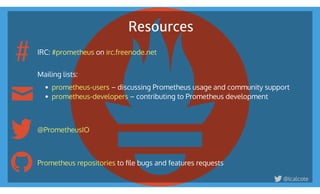
Resources
IRC:  on  
 
Mailing lists:
 – discussing Prometheus usage and community support
 – contributing to Prometheus development


 to file bugs and features requests
#prometheus irc.freenode.net
prometheus-users
prometheus-developers
@PrometheusIO
Prometheus repositories
@lcalcote
#
Lee Calcote
Thank you.
Questions?
clouds, containers, infrastructure,
applications  and their management
linkedin.com/in/leecalcote
@lcalcote
blog.gingergeek.com
lee@calcotestudios.com
calcotestudios.com/talks
yes, we're hiring

Understanding and Extending Prometheus AlertManager

  • 1.
    Understanding and Extending PrometheusAlertManager Lee Calcote calcotestudios.com/talks
  • 2.
    Lee Calcote linkedin.com/in/leecalcote @lcalcote blog.gingergeek.com lee@calcotestudios.com clouds, containers,infrastructure, applications  and their management calcotestudios.com/talks
  • 3.
  • 4.
  • 5.
  • 6.
      Receivers ˈnō-mən-ˌklā-chər a briefPrometheus AlertManager construct review match alerts to their receiver and how often to notify where and how to send alerts  Routes @lcalcote
  • 7.
    - matches alertswith specific labels and prevents them from being included in notifications.    - suppress specific notifications when other specific alerts are already firing.    - categorizes alerts of similar nature into a single notification. Silencers Inhibitors Grouping ˈnō-mən-ˌklā-chər a brief Prometheus AlertManager construct review Muting Suppressing Correlating group_wait: 30s group_by: ['alertname', 'cluster'] group_interval: 5m @lcalcote
  • 8.
    Inhibition Multiple approaches tosuppression @lcalcote repeat_interval vs Silences vs per routeglobalvia ui / api
  • 9.
    Alerts ALERT <alert name> IF<PromQL vector expression> FOR <duration> LABELS { ... } ANNOTATIONS { ... } Supports clients other than Prometheus is notified when alerts transition state @lcalcote a shared construct Prometheus AlertManager inactive firing pending state transition inactive firing notifications !
  • 10.
  • 11.
    Notifying to MultipleDestinations Use  to advance to next receiver.continue route: receiver: email_webhook receivers: - name: email_webhook email_configs: - to: 'lee@example.io' webhook_configs: - url: <webhook url here> Use a  that goes to both destinations.receiver route: receiver: ops-team-all # default routes: - match: severity: page receiver: ops-team-b continue: true - match: severity: critical receiver: ops-team-a receivers: - name: ops-team-all email_configs: - to: ops-team-all@example.io - name: ops-team-a email_configs: - to: ops-team-a@example.io - name: ops-team-b email_configs: - to: ops-team-b@example.io or @lcalcote
  • 12.
    Inhibitor Dispatcher Non-HA AlertManager Architecture Silencer de-duplication Dispatchersorts incoming alerts into aggregation groups and assigns the correct notifiers to each. api Alert Provider UI Silence Provider store de-duplication subscribe Router batched alerts notification pipeline Notify Provider checks for previously sent notifications Retry RetryMaintenance Script ! @lcalcote alerts
  • 13.
    @lcalcote High Availability being introducedin 0.5 I gossip protocols. built atop Weave Mesh With HA, you no longer have to monitor the monitor.   Designed for an alert to be sent to all instances in the cluster.   All Prometheus instances send alerts to all Alertmanager instances.   Guarantees notifications to be sent at least once. @lcalcote
  • 15.
  • 16.
  • 17.
    Story: As an Operator,I would like to not only see a list of firing alerts, but also a list of all transpired alerts, so that I may have additional context as the thresholding behavior for a given defined alert. @lcalcote Prologue: Alert troubleshooting is improved when operators have a view of what is firing, has recently fired, what is normal, but also go back in time and see what fired an hour ago. Understanding firing order assists in root cause analysis and identify problem areas.   Limitations: 1. AlertManager database (SQLite) is not intended to provide long-term storage. Acceptance Criteria: 1. Once fired, whether actively firing or not, alerts will be displayed on the History page. 2. Optionally, fired alerts will be notified to a Slack channel. Stretch: Include pagination Add a date range picker Add a host filter  
  • 18.
  • 19.
    Random Sample Targets $git clone https://github.com/prometheus/client_golang.git $ cd client_golang/examples/random $ go get -d $ go build Fetch and compile the client library code example. Start example targets in separate terminals. $ ./random -listen-address=:8080 $ ./random -listen-address=:8081 $ ./random -listen-address=:8082 Be sure to create and run the  and point it at your soon-to-be AlertManager: random sample targets @lcalcote
  • 20.
    Prometheus and AlertRules Setup Follow the  to download, configure and run Prometheus.getting started instructions $ ./prometheus -config.file=prometheus.yml -alertmanager.url=http://localhost:9093 ALERT instance_down IF up == 0 FOR 5s LABELS {severity="page"} ANNOTATIONS { DESCRIPTION="{{$labels.instance}} of job {{$labels.job}} has been down for more than 5 seconds.", SUMMARY="Instance {{$labels.instance}} down"} /alert.rules A simple alert rule that will fire when any given target is unreachable for longer than 5 seconds. @lcalcote ! ... # Load and evaluate rules in this file every 'evaluation_interval' seconds. rule_files: - "alert.rules" ... /prometheus.yml
  • 21.
  • 22.
    @lcalcote Grab Repos $ gitclone https://github.com/prometheus/alertmanager.git Given that our user story includes making front-end changes to AlertManager, ensure that you install a small utility to generate Go code from any file. Clone AlertManager repo Get, build and copy go-bindata into any directory on your PATH $ go get -u github.com/jteeuwen/go-bindata/... $ cd $GOPATH/src/github.com/jteeuwen/go-bindata/go-bindata $ go build
  • 23.
    Notification Integration create analert notification receiver.   route: group_by: [cluster] # If an alert isn't caught by a route, send it slack. receiver: slack_general routes: # Send severity=slack alerts to slack. - match: severity: page receiver: slack_general receivers: - name: slack_general slack_configs: - api_url: '<your-web-url-here>' channel: '#<your-channel-name-here>' send_resolved: true Of the supported AlertManager receivers, let’s opt for integrating Slack. @lcalcote
  • 24.
    @lcalcote The  can assist inbuilding routing trees. visual editor
  • 25.
    Build, Run, Test Verifyyou have a functional development environment by building and running the project: $ make assets # invokes go-bindata to inject static web files $ go build # compiles go code $ ./alertmanager -config.file=slack.yml # runs alertmanager with the specified configuration @lcalcote $ curl -X POST http://localhost:9090/-/reload $ kill -HUP `pgrep alertmanager` $ ./promtool check-config <config file> $ ./promtool check-rules <rules file> Reload Prometheus or AlertManager configs Validate Prometheus config and alert rules
  • 26.
    @lcalcote Test If you chooseto setup a Slack channel, you should now see new alerts firing as and when your random targets go up and down.
  • 27.
  • 28.
    @lcalcote All UI functionalityshould be addressable via API. Let’s register a : /api.go new /history API endpoint r.Get("/history", ihf("history", api.listAllAlerts)) func (api *API) listAllAlerts(w http.ResponseWriter, r *http.Request) { alerts := api.alerts.GetAll() defer alerts.Close() With our /api/v1/history endpoint a newly addressable API endpoint, we’ll need to build a function to handle requests made to it. The  function will handle inbound HTTP requests made to the new endpoint. api.listAllAlerts
  • 29.
    @lcalcote 1. Add  (e.g.GetAll() AlertIterator) to /provider/provider.go 2. Add a  to /provider/sqlite/sqlite.go 3. Add a to /provider/boltmem/boltmem.go a new AlertIterator new AlertProvider and SQL query new AlertIterator and AlertProvider With API endpoint, let’s turn our attention to the backend for collecting the right recordset from our data provider. /provider
  • 30.
    @lcalcote /ui/app/js/app.js angular.module('am.controllers').controller('NavCtrl', function($scope, $location) { $scope.items= [{ name: 'History', url: 'history' }, angular.module('am.services').factory('History', function($resource) { return $resource('', {}, { 'query': { method: 'GET', url: 'api/v1/history' } }); } );  NavCtrl for the :History menu item as well as a :new History service angular.module('am.controllers').controller('HistoryCtrl', function($scope, History) { $scope.refresh = function () { History.query({}, function(data) { $scope.groups = data.data; console.log($scope.groups); }, function(data) { console.log(data.data); }) } $scope.refresh(); } ); and a :new History controller angular.module('am.directives').directive('history', function() { return { restrict: 'E', scope: { alert: '=', group: '=' }, templateUrl: 'app/partials/history.html' }; } ); Insert a :new History directive
  • 31.
    @lcalcote Finally, we’ll needa page in which to view the transpired alerts. So, create a new file, , under /ui/app/partials.   history.html History.html will simply format the display a tabular recordset. A new recordset will be retrieved from our data provider. /ui/app/partials/history.html
  • 32.
    @lcalcote Summary This example enhancementprovides a view of transient history — that of the period that the SQlite database holds.   AlertManager is not currently intended to provide long-term storage.   Contributing is easier than you may think.   Reference Alert History fork Alert History tutorial
  • 33.
    Resources IRC:  on     Mailinglists:  – discussing Prometheus usage and community support  – contributing to Prometheus development          to file bugs and features requests #prometheus irc.freenode.net prometheus-users prometheus-developers @PrometheusIO Prometheus repositories @lcalcote #
  • 34.
    Lee Calcote Thank you. Questions? clouds,containers, infrastructure, applications  and their management linkedin.com/in/leecalcote @lcalcote blog.gingergeek.com lee@calcotestudios.com calcotestudios.com/talks yes, we're hiring