UNDERSTAND HOW TO
WORK IN PARTNERSHIP
WITH OTHERS
Unit 5
Session 1: 26/2/2015
Starter Activity
• Board blast
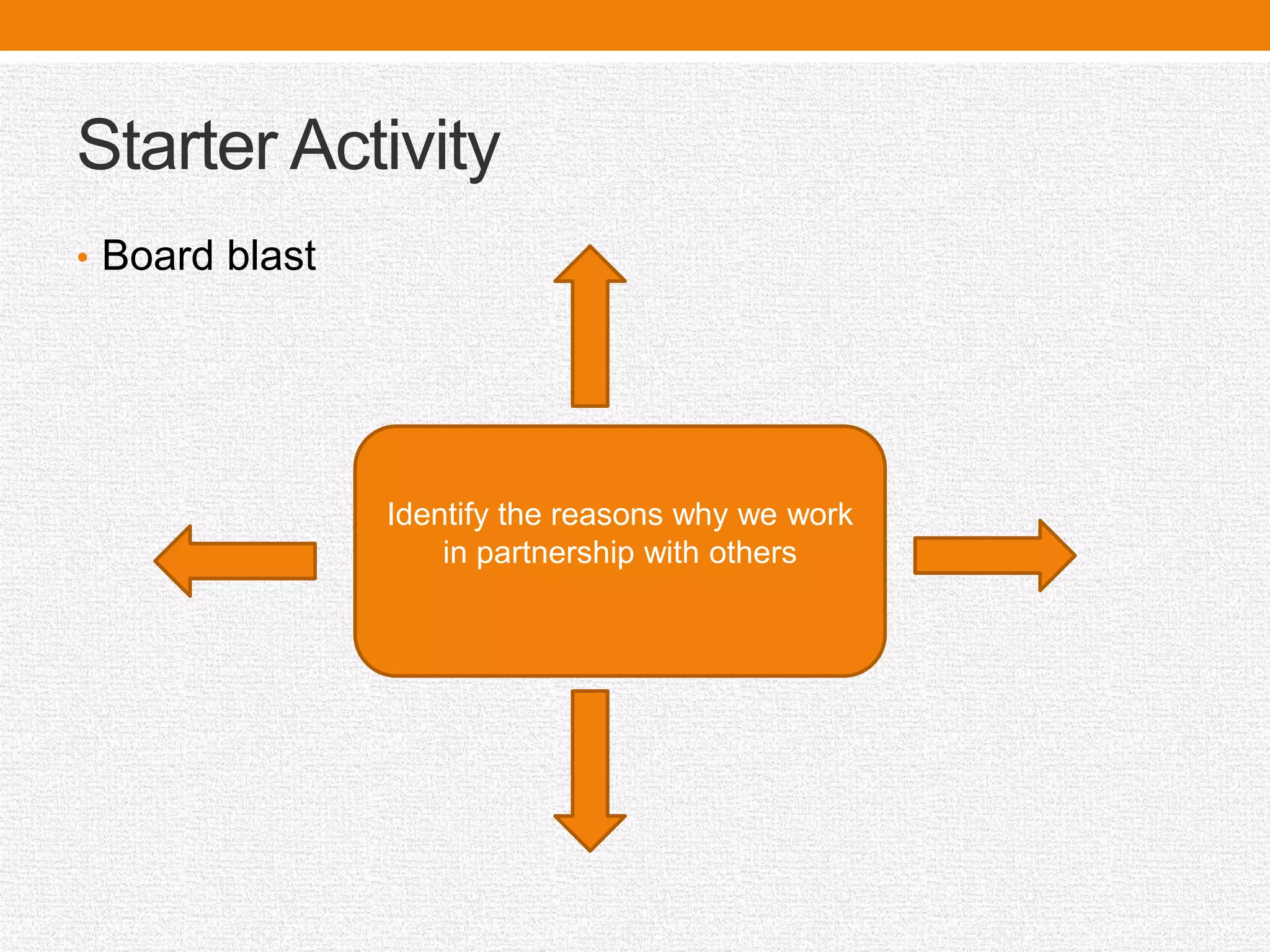
Identify the reasons why we work
in partnership with others
Learning Outcomes
• To identify reasons to work in partnership with
others
• To describe how to work in partnership with
others
• Give examples of how you work in partnership
with others
• Identify the legal requirements of working in
partnership with others
• Identify the roles of other professionals
• Describe the roles of other professionals
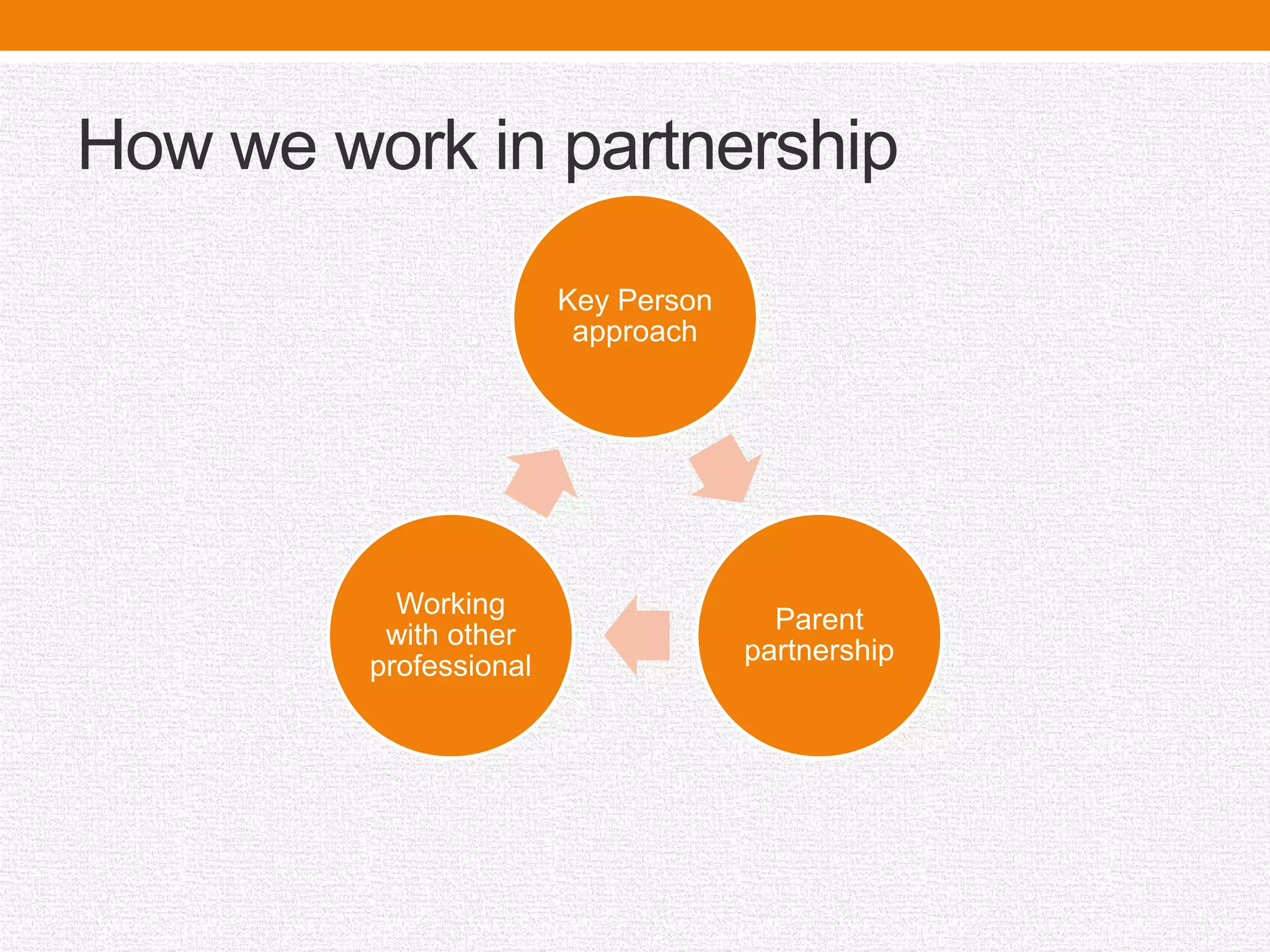
How we work in partnership
Key Person
approach
Parent
partnership
Working
with other
professional
Activity
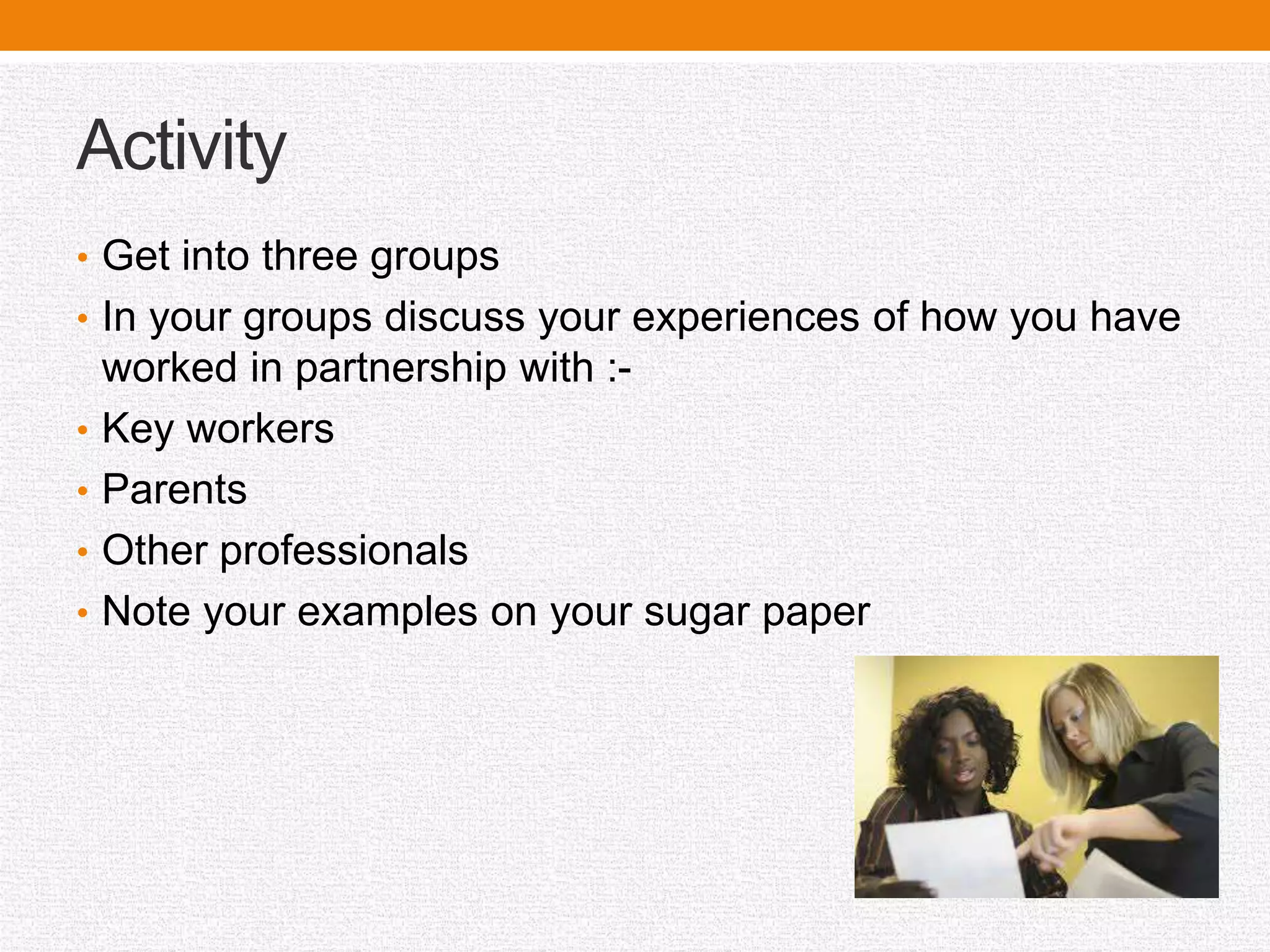
• Get into three groups
• In your groups discuss your experiences of how you have
worked in partnership with :-
• Key workers
• Parents
• Other professionals
• Note your examples on your sugar paper
Policy and procedural requirements for
working in partnership with others
• As part of the EYFS, it is one of the roles of the
key person to work with parents to understand
and meet children’s individual care and learning
needs.
• In addition parents should help to support their
child’s learning at home. All early years settings
must have a key worker system in place.
https://www.youtube.com/watch?v=CRAH9Kv_Ifs
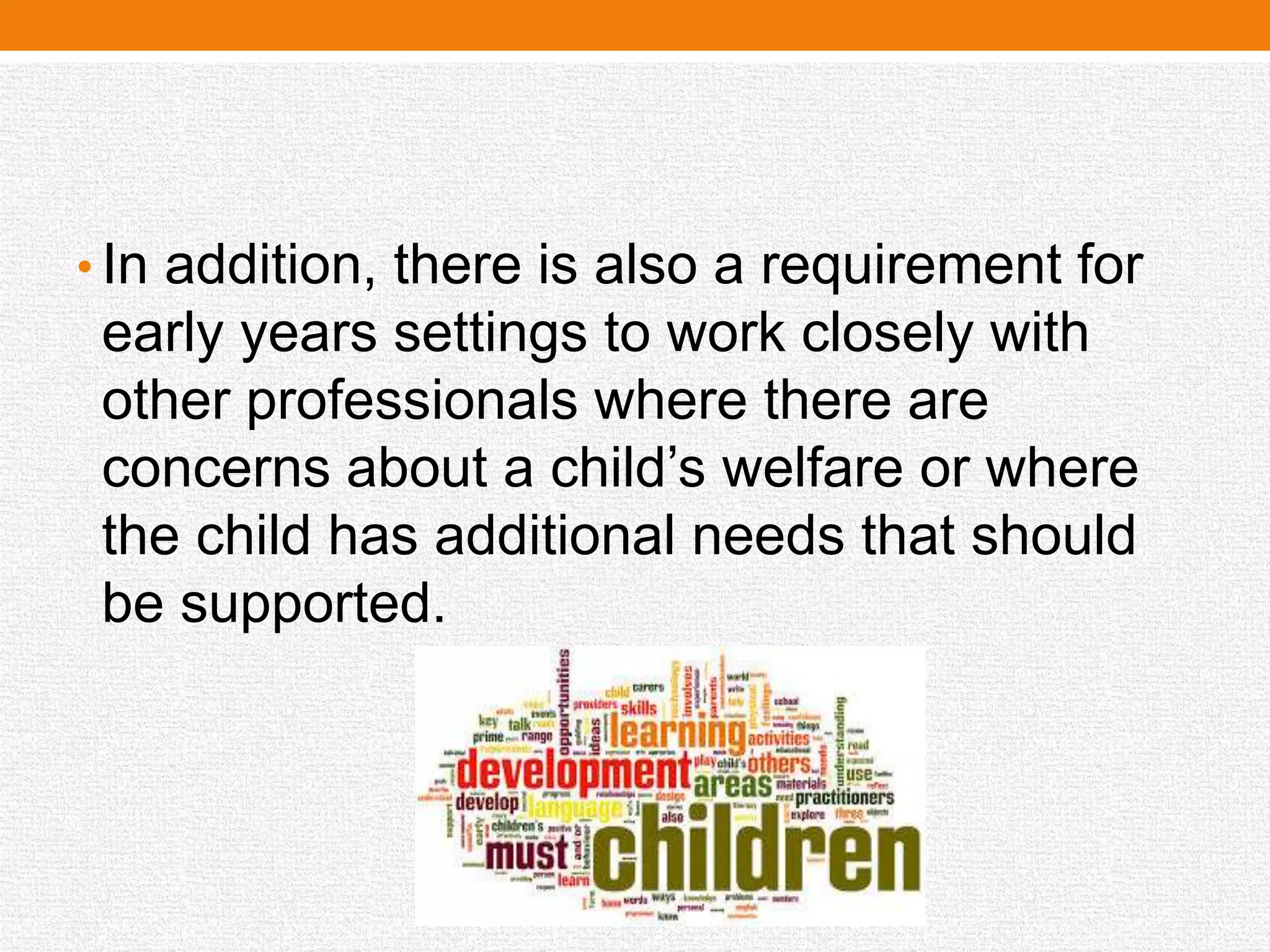
• In addition, there is also a requirement for
early years settings to work closely with
other professionals where there are
concerns about a child’s welfare or where
the child has additional needs that should
be supported.
Activity
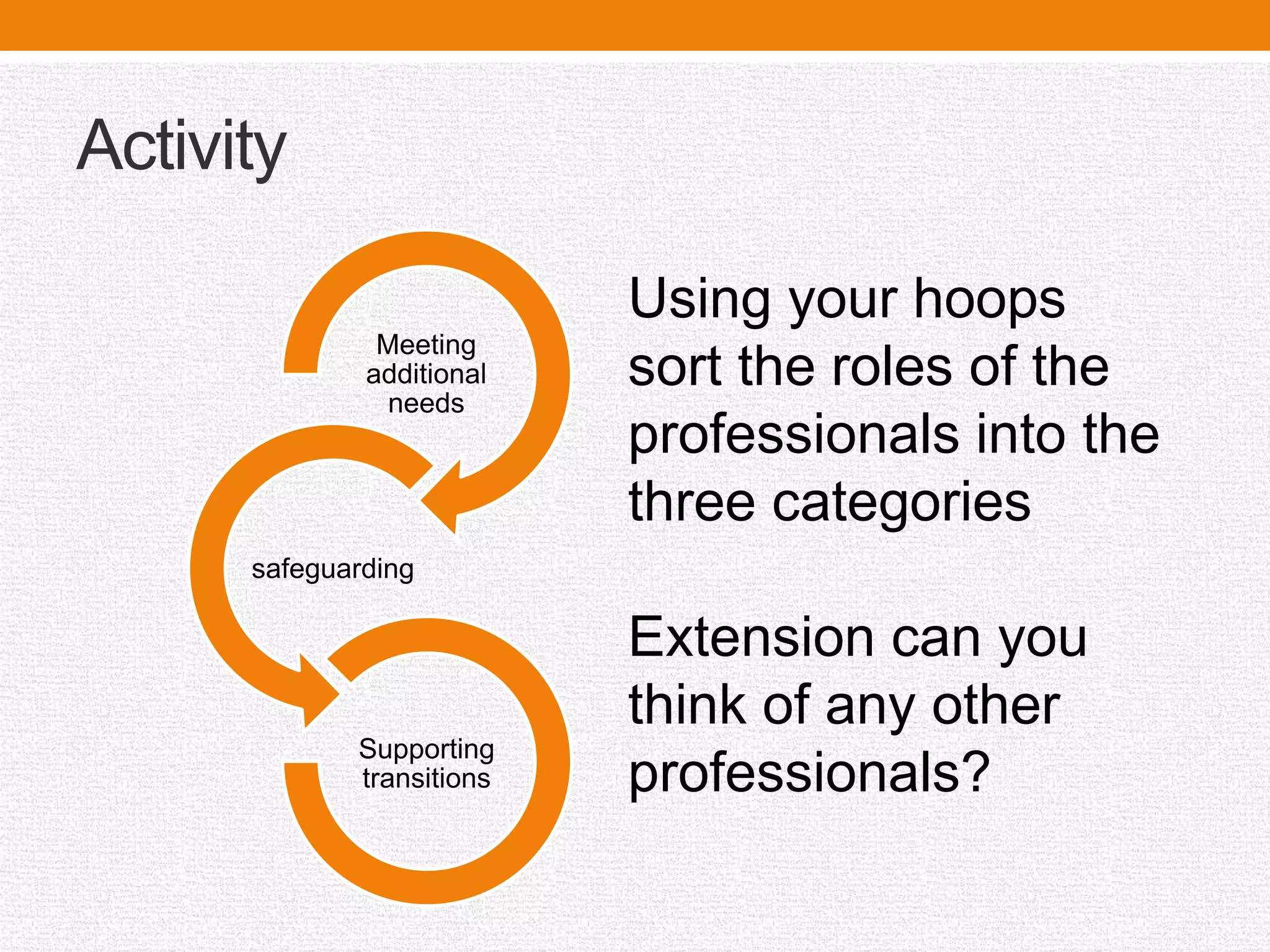
Meeting
additional
needs
safeguarding
Supporting
transitions
Using your hoops
sort the roles of the
professionals into the
three categories
Extension can you
think of any other
professionals?
Task
• Work in pairs to match the professionals to the
explanations
• Take photographs on your mobile devise or take notes to
support assignment task 2.1
• Complete assignment tasks 1.1, 1.2, 2.1, 2.2.
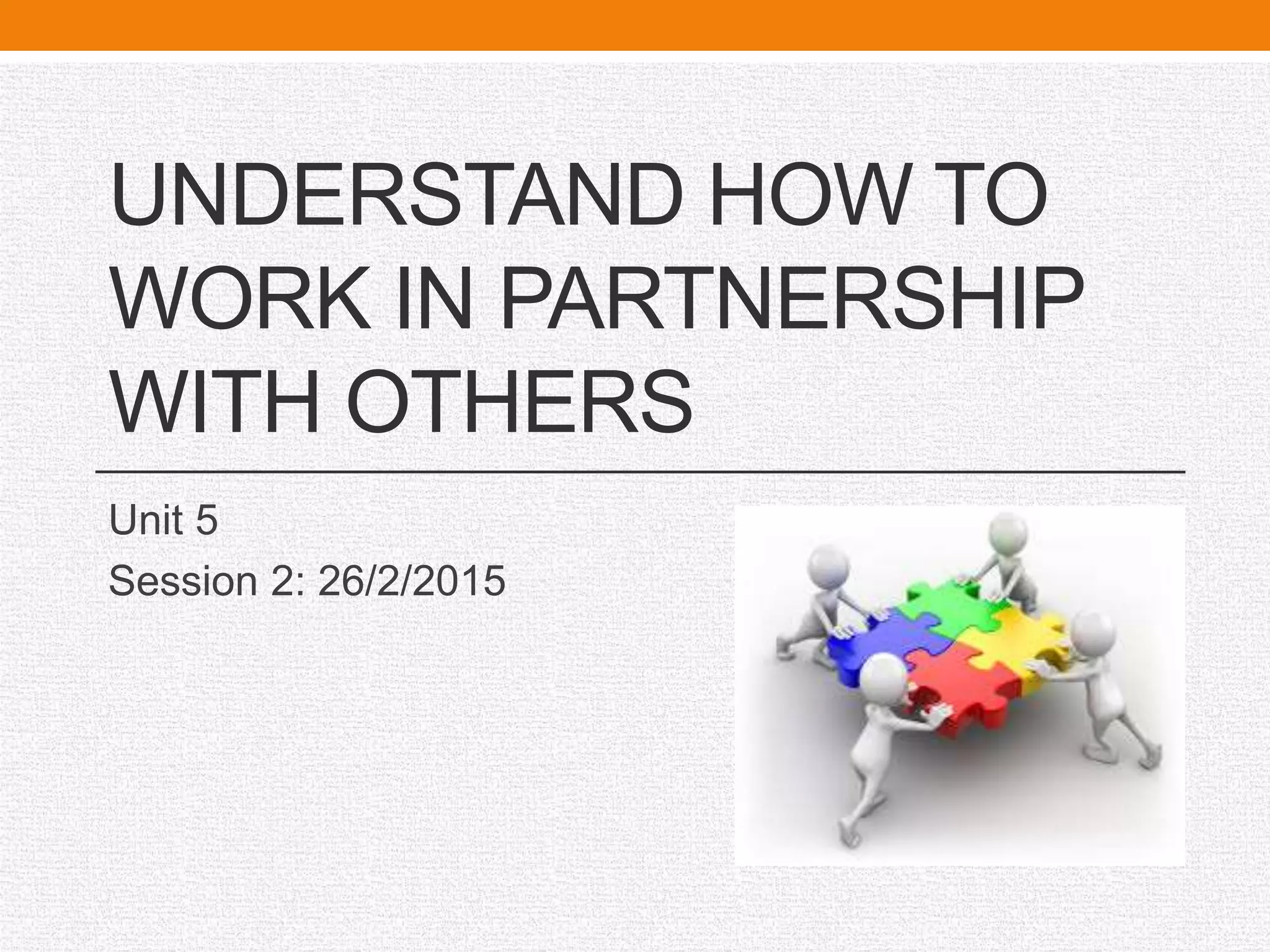
UNDERSTAND HOW TO
WORK IN PARTNERSHIP
WITH OTHERS
Unit 5
Session 2: 26/2/2015
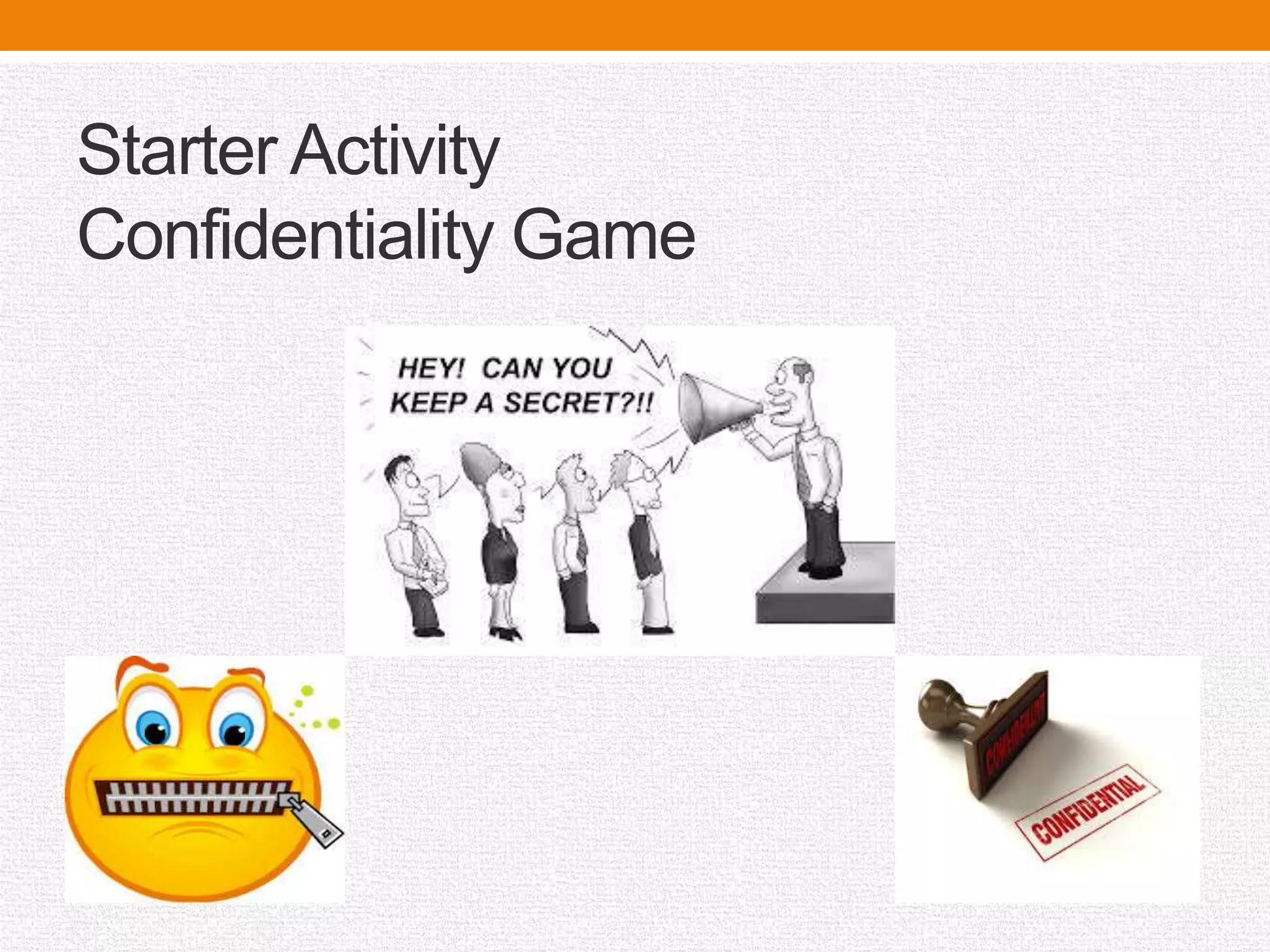
Starter Activity
Confidentiality Game
Learning Outcomes
• Identify what records must be kept within a
childcare setting
• Describe how to complete records
• Explain how to adhere to confidentiality
• Identify who can be involved in partnership
working
• Describe the benefits of working in partnership
with others
• Explain ways to overcome barriers when working
in partnership with others
Records
Think, pair, and share
What records have you
seen being completed in
your setting that might
support partnership
working?
4.1
Records
• Contact details
• Accident report forms
• Administration of medicines
• Registers
• Records of care needs
• Progress records
• 2 year old check
• Reports to other professionals
• Child Protection forms
Keeping Records Top Tips!
• Find out what exactly is required
• Ask your manager to support with accuracy
• Write a draft first and get someone to check it first
• Statements must be accurate about children's progress
research fully if unsure
• Write things down as your would be happy to see them as
a parent
• Think about whether you need any further info from
parents (contact details, care records) before completing
• Always remember to maintain confidentiality 4.3
Case Study Task 1
•Emile is 4 years old and will starting
the local primary school. He has been
attending pre school for three
afternoon per week. Emile’s key
person has spoken to his mum about
how the primary school and the pre
school are planning to work in
partnership to support Emile.
Case Study Task 2
Thomas is 2 years old he lives with his Dad and his two
older siblings. Thomas and his brothers attend the local
nursery and infant school. Whilst the older brothers used
to walk the short distance to the infant school, Thomas
was always brought into school by a child minder who
was also perceptive to the needs of the older brothers.
The child minder still comes into the school with other
children buts is no longer working with Thomas and the
siblings. One morning the child minder asked to speak to
a member of staff about her concerns for Thomas and
his brothers walking alone to school.
Case Study 3
• Miriam is 5 years old and has Downs Syndrome. She will
be moving into a new class next term whilst Miriam will
continue to work with the support of a teaching assistant
unfortunately it will not be Stephen. Stephen has been
Miriam’s teaching assistant for the past year and has
worked really hard at building positive relationships with
Miriam. Miriam is aware of the changes ahead and is
growing more and more anxious about her transition.
Miriam is also getting upset at home and her parents have
told Stephen that Miriam is finding it difficult to settle at
bed time.
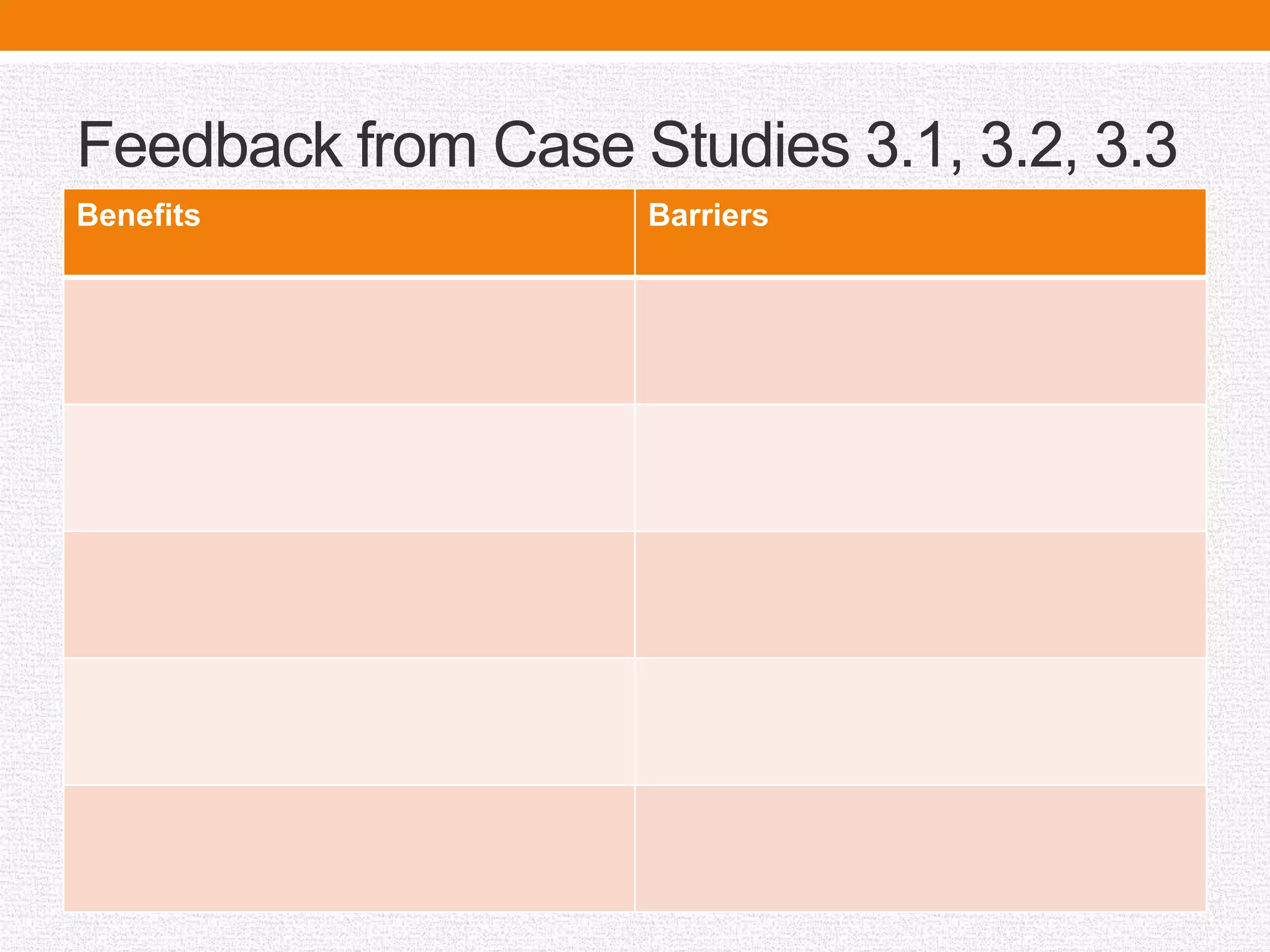
Feedback from Case Studies 3.1, 3.2, 3.3
Benefits Barriers
Assignment Deadline
• 27th March 2015
• It is essential that the early years practitioner recognises the importance
of working in partnership, and sharing relevant information with parents
and other professionals who work with the child or children. Partnership
working does not exclusively focus on safeguarding of children, working
in partnership with parents/carers, agencies and professionals can help
support children in a variety of ways.
• Produce an information booklet for parents/carers that:
• identifies reasons for working in partnership
• explains the benefits of working in partnership with parents/carers
• explains the roles of others involved in partnership working when
• - meeting children’s additional needs
• - safeguarding children
• - supporting children’s transitions
• identifies barriers to partnership working
• explains ways to overcome barriers when working in partnership.
Task 2
• Current frameworks highlight the requirements for working in
partnership and how information and records should be stored
and shared with parents/carers and other professionals who
are working with the child. As an early years practitioner you
have just attended a training update on ‘Partnership Working’,
the nursery manager has asked you to share the information:
• describe partnership working in relation to current frameworks
• identify records to be completed in relation to partnership
working
• explain reasons for accurate and coherent record keeping
• explain the reasons for confidentiality when maintaining
records
Assignment Support
Deadline: 27th March 2015
• 1.1 – Identify at least 3 reasons for working in partnership
• 1.2 - Describe at least 3 ways of working in partnership according to the
EYFS Statutory framework
• 2.1 – Explain at least 6 roles of others (2 examples for each professional)
• 2.2 – Explain at least 3 benefits of working in partnership with
parents/carers.
• 3.1 – List at least 4 barriers to partnership working
• 3.2 – Explain at least 3 ways to overcome barriers when working in
partnership
• 3.3 – Give at least 2 examples from placement of the support that may be
offered to parents/carers. Cover one for equal opportunities and one to
cover barriers communication.
• 4.1 – List at least 3 ways records that are completed in relation to
partnership working
• 4.2 – Explain at least 3 reasons for accurate and coherent record keeping
• 4.3 – Explain at least 2 reasons for confidentially when maintaining records
Next Lesson
• We will be covering unit 2 Understand legislation relating
to the safeguarding, protection and welfare of children
• Please inform your Tutor if you may find this subject
upsetting so that alternative arrangements can be put in
place to support your learning

Understand how to work in partnership with others

  • 1.
    UNDERSTAND HOW TO WORKIN PARTNERSHIP WITH OTHERS Unit 5 Session 1: 26/2/2015
  • 2.
    Starter Activity • Boardblast Identify the reasons why we work in partnership with others
  • 3.
    Learning Outcomes • Toidentify reasons to work in partnership with others • To describe how to work in partnership with others • Give examples of how you work in partnership with others • Identify the legal requirements of working in partnership with others • Identify the roles of other professionals • Describe the roles of other professionals
  • 4.
    How we workin partnership Key Person approach Parent partnership Working with other professional
  • 5.
    Activity • Get intothree groups • In your groups discuss your experiences of how you have worked in partnership with :- • Key workers • Parents • Other professionals • Note your examples on your sugar paper
  • 6.
    Policy and proceduralrequirements for working in partnership with others • As part of the EYFS, it is one of the roles of the key person to work with parents to understand and meet children’s individual care and learning needs. • In addition parents should help to support their child’s learning at home. All early years settings must have a key worker system in place. https://www.youtube.com/watch?v=CRAH9Kv_Ifs
  • 7.
    • In addition,there is also a requirement for early years settings to work closely with other professionals where there are concerns about a child’s welfare or where the child has additional needs that should be supported.
  • 8.
    Activity Meeting additional needs safeguarding Supporting transitions Using your hoops sortthe roles of the professionals into the three categories Extension can you think of any other professionals?
  • 9.
    Task • Work inpairs to match the professionals to the explanations • Take photographs on your mobile devise or take notes to support assignment task 2.1 • Complete assignment tasks 1.1, 1.2, 2.1, 2.2.
  • 10.
    UNDERSTAND HOW TO WORKIN PARTNERSHIP WITH OTHERS Unit 5 Session 2: 26/2/2015
  • 11.
  • 12.
    Learning Outcomes • Identifywhat records must be kept within a childcare setting • Describe how to complete records • Explain how to adhere to confidentiality • Identify who can be involved in partnership working • Describe the benefits of working in partnership with others • Explain ways to overcome barriers when working in partnership with others
  • 13.
    Records Think, pair, andshare What records have you seen being completed in your setting that might support partnership working? 4.1
  • 14.
    Records • Contact details •Accident report forms • Administration of medicines • Registers • Records of care needs • Progress records • 2 year old check • Reports to other professionals • Child Protection forms
  • 15.
    Keeping Records TopTips! • Find out what exactly is required • Ask your manager to support with accuracy • Write a draft first and get someone to check it first • Statements must be accurate about children's progress research fully if unsure • Write things down as your would be happy to see them as a parent • Think about whether you need any further info from parents (contact details, care records) before completing • Always remember to maintain confidentiality 4.3
  • 16.
    Case Study Task1 •Emile is 4 years old and will starting the local primary school. He has been attending pre school for three afternoon per week. Emile’s key person has spoken to his mum about how the primary school and the pre school are planning to work in partnership to support Emile.
  • 17.
    Case Study Task2 Thomas is 2 years old he lives with his Dad and his two older siblings. Thomas and his brothers attend the local nursery and infant school. Whilst the older brothers used to walk the short distance to the infant school, Thomas was always brought into school by a child minder who was also perceptive to the needs of the older brothers. The child minder still comes into the school with other children buts is no longer working with Thomas and the siblings. One morning the child minder asked to speak to a member of staff about her concerns for Thomas and his brothers walking alone to school.
  • 18.
    Case Study 3 •Miriam is 5 years old and has Downs Syndrome. She will be moving into a new class next term whilst Miriam will continue to work with the support of a teaching assistant unfortunately it will not be Stephen. Stephen has been Miriam’s teaching assistant for the past year and has worked really hard at building positive relationships with Miriam. Miriam is aware of the changes ahead and is growing more and more anxious about her transition. Miriam is also getting upset at home and her parents have told Stephen that Miriam is finding it difficult to settle at bed time.
  • 19.
    Feedback from CaseStudies 3.1, 3.2, 3.3 Benefits Barriers
  • 20.
    Assignment Deadline • 27thMarch 2015 • It is essential that the early years practitioner recognises the importance of working in partnership, and sharing relevant information with parents and other professionals who work with the child or children. Partnership working does not exclusively focus on safeguarding of children, working in partnership with parents/carers, agencies and professionals can help support children in a variety of ways. • Produce an information booklet for parents/carers that: • identifies reasons for working in partnership • explains the benefits of working in partnership with parents/carers • explains the roles of others involved in partnership working when • - meeting children’s additional needs • - safeguarding children • - supporting children’s transitions • identifies barriers to partnership working • explains ways to overcome barriers when working in partnership.
  • 21.
    Task 2 • Currentframeworks highlight the requirements for working in partnership and how information and records should be stored and shared with parents/carers and other professionals who are working with the child. As an early years practitioner you have just attended a training update on ‘Partnership Working’, the nursery manager has asked you to share the information: • describe partnership working in relation to current frameworks • identify records to be completed in relation to partnership working • explain reasons for accurate and coherent record keeping • explain the reasons for confidentiality when maintaining records
  • 22.
    Assignment Support Deadline: 27thMarch 2015 • 1.1 – Identify at least 3 reasons for working in partnership • 1.2 - Describe at least 3 ways of working in partnership according to the EYFS Statutory framework • 2.1 – Explain at least 6 roles of others (2 examples for each professional) • 2.2 – Explain at least 3 benefits of working in partnership with parents/carers. • 3.1 – List at least 4 barriers to partnership working • 3.2 – Explain at least 3 ways to overcome barriers when working in partnership • 3.3 – Give at least 2 examples from placement of the support that may be offered to parents/carers. Cover one for equal opportunities and one to cover barriers communication. • 4.1 – List at least 3 ways records that are completed in relation to partnership working • 4.2 – Explain at least 3 reasons for accurate and coherent record keeping • 4.3 – Explain at least 2 reasons for confidentially when maintaining records
  • 23.
    Next Lesson • Wewill be covering unit 2 Understand legislation relating to the safeguarding, protection and welfare of children • Please inform your Tutor if you may find this subject upsetting so that alternative arrangements can be put in place to support your learning