BIRU WAGHAMODE
3NA14EE004
Navodaya Institute Of Technology, Raichur 1
CONTENT
 RENEWABLE ENERGY
 TECHNOLOGY
 NAME JUSTIFICATION
 UNDERWATER WINDMILL
 HISTORY
 MAIN PARTS
 PRINCIPLE OF OPERATION
 WORKING
 TYPES OF UNDERWATER
WINDMILL
 ADVANTEGES
 DISADVANTAGES
 CONCLUSION
 REFERENCES
2DEPT. OF ELECTRICAL AND ELECTRONICS ENGINEERING
RENEWABLE ENERGY
 Renewable energy sources have major role in decreasing of
emission of the carbon dioxide(CO2) into atmosphere.
 Renewable energy is energy which comes from natural
resources such as sunlight, wind, rain, tides, and geothermal
heat, which are renewable (naturally replenished)
3DEPT. OF ELECTRICAL AND ELECTRONICS ENGINEERING
RENEWABLE SOURCES OF ENERGY
 SOLAR ENERGY
 TIDAL ENERGY
 WIND ENERGY
 HYDRO ENERGY
 GEOTHERMAL ENERGY
4DEPT. OF ELECTRICAL AND ELECTRONICS ENGINEERING
TECHNOLOGY
Ocean energy refers to a range of technologies that utilize the ocean
 Wave Energy Converters
 Tidal/Current
 Ocean Thermal Energy Conversion(OTEC)
 Offshore Wind
5DEPT. OF ELECTRICAL AND ELECTRONICS ENGINEERING
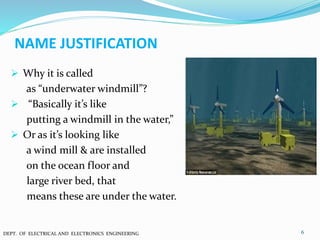
NAME JUSTIFICATION
 Why it is called
as “underwater windmill”?
 “Basically it’s like
putting a windmill in the water,”
 Or as it’s looking like
a wind mill & are installed
on the ocean floor and
large river bed, that
means these are under the water.
6DEPT. OF ELECTRICAL AND ELECTRONICS ENGINEERING
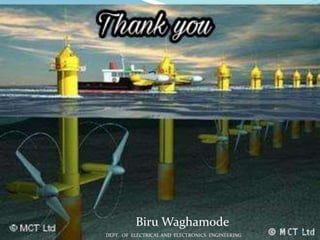
UNDERWATER MINDMILL
 An underwater windmill like a device that extract power from
the tides. Tidal energy offers a vast and reliable energy sources.
 This technology is similar to wind energy technology, with the
rotor blades driven not by wind power but by tidal currents.
 The gravitational pull of the moon produces a swift tidal
current, which spins the long blades of the turbine. Which in
turn produces electricity via different parts of underwater
windmill.
7DEPT. OF ELECTRICAL AND ELECTRONICS ENGINEERING
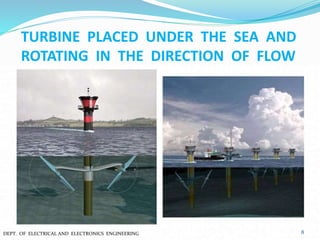
TURBINE PLACED UNDER THE SEA AND
ROTATING IN THE DIRECTION OF FLOW
8DEPT. OF ELECTRICAL AND ELECTRONICS ENGINEERING
HISTORY
 Until late nineteenth centaury windmills wound only
produce mechanical power of their task such as granting or
plumbing water.
 With the creation of electricity, wind mills make found that
wind mills could be attached to generator are used to create
power.
 The first windmill used to produce electrical energy was
created in 1888 by charles F brush
9DEPT. OF ELECTRICAL AND ELECTRONICS ENGINEERING
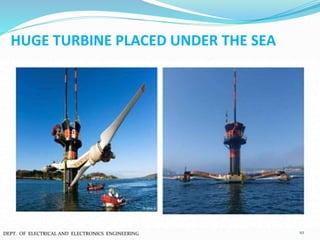
HUGE TURBINE PLACED UNDER THE SEA
10DEPT. OF ELECTRICAL AND ELECTRONICS ENGINEERING
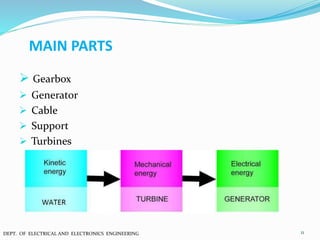
MAIN PARTS
 Gearbox
 Generator
 Cable
 Support
 Turbines
11DEPT. OF ELECTRICAL AND ELECTRONICS ENGINEERING
PRINCIPLE 0F OPERATION
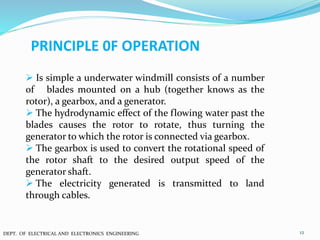
 Is simple a underwater windmill consists of a number
of blades mounted on a hub (together knows as the
rotor), a gearbox, and a generator.
 The hydrodynamic effect of the flowing water past the
blades causes the rotor to rotate, thus turning the
generator to which the rotor is connected via gearbox.
 The gearbox is used to convert the rotational speed of
the rotor shaft to the desired output speed of the
generator shaft.
 The electricity generated is transmitted to land
through cables.
12DEPT. OF ELECTRICAL AND ELECTRONICS ENGINEERING
WORKING
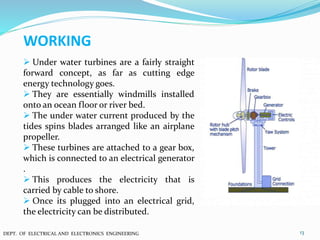
 Under water turbines are a fairly straight
forward concept, as far as cutting edge
energy technology goes.
 They are essentially windmills installed
onto an ocean floor or river bed.
 The under water current produced by the
tides spins blades arranged like an airplane
propeller.
 These turbines are attached to a gear box,
which is connected to an electrical generator
.
 This produces the electricity that is
carried by cable to shore.
 Once its plugged into an electrical grid,
the electricity can be distributed.
13DEPT. OF ELECTRICAL AND ELECTRONICS ENGINEERING
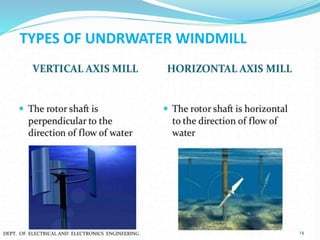
TYPES OF UNDRWATER WINDMILL
14DEPT. OF ELECTRICAL AND ELECTRONICS ENGINEERING
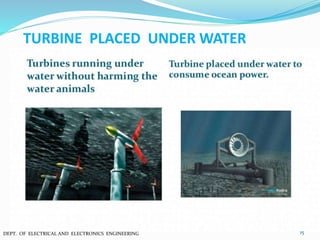
TURBINE PLACED UNDER WATER
15DEPT. OF ELECTRICAL AND ELECTRONICS ENGINEERING
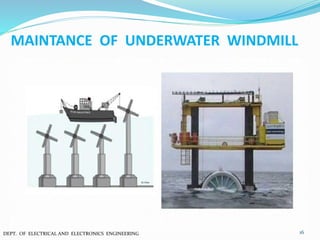
MAINTANCE OF UNDERWATER WINDMILL
16DEPT. OF ELECTRICAL AND ELECTRONICS ENGINEERING
ABOUT TURBINES
 The turbines can convert kinetic hydro energy in to
power rating from 25KW to 250KW, depending on
turbine size and current.
 Kinetic energy is converted to mechanical power in a
nacelle within the turbine.
17DEPT. OF ELECTRICAL AND ELECTRONICS ENGINEERING
ADVANTAGES
 Tidal energy is completely renewable.
 Tidal energy produces no emission.
 Hidden beneath the water.
 Have lesser impact on the environment.
 Low running cost.
 Long lifetime with little maintenance.
 Reduces the dependence upon fossil fuels.
18DEPT. OF ELECTRICAL AND ELECTRONICS ENGINEERING
DISADVANTAGES
 The initial cost is too high.
 Very difficult to install.
 The blade must be coated to avoid corrosion.
 special type material must have to used for blade.
19DEPT. OF ELECTRICAL AND ELECTRONICS ENGINEERING
CONCLUSION
 Tides and ocean current play is very important role in
the formation of global climate as well as eco system
for ocean habitats.
 we believe that the intense and predictable marine
current resource offers the possibility of clean energy
at a cost that will ultimately be competitive not only
with the other renewable.
20DEPT. OF ELECTRICAL AND ELECTRONICS ENGINEERING
REFERENCES
 K.McEnaney,.D. Kraemer, Z. Ren, and G. Chen,
"Modelling of concentrating Solar thermoelectric
generators, " J. Application.Phys., vol. 110,no 07,
pp.074502.6, Oct. 2011
 S. Jian and S. Modelling, "Numerical simulation of
electric-thermal performance of a solar concentrating
photovoltaic/thermal system," in proc. Power and Energy
Engineering Conf., Wuhan, China, 2009, pp.1-4.
21DEPT. OF ELECTRICAL AND ELECTRONICS ENGINEERING
22
Biru Waghamode
DEPT. OF ELECTRICAL AND ELECTRONICS ENGINEERING

Under water windmill

  • 1.
  • 2.
    CONTENT  RENEWABLE ENERGY TECHNOLOGY  NAME JUSTIFICATION  UNDERWATER WINDMILL  HISTORY  MAIN PARTS  PRINCIPLE OF OPERATION  WORKING  TYPES OF UNDERWATER WINDMILL  ADVANTEGES  DISADVANTAGES  CONCLUSION  REFERENCES 2DEPT. OF ELECTRICAL AND ELECTRONICS ENGINEERING
  • 3.
    RENEWABLE ENERGY  Renewableenergy sources have major role in decreasing of emission of the carbon dioxide(CO2) into atmosphere.  Renewable energy is energy which comes from natural resources such as sunlight, wind, rain, tides, and geothermal heat, which are renewable (naturally replenished) 3DEPT. OF ELECTRICAL AND ELECTRONICS ENGINEERING
  • 4.
    RENEWABLE SOURCES OFENERGY  SOLAR ENERGY  TIDAL ENERGY  WIND ENERGY  HYDRO ENERGY  GEOTHERMAL ENERGY 4DEPT. OF ELECTRICAL AND ELECTRONICS ENGINEERING
  • 5.
    TECHNOLOGY Ocean energy refersto a range of technologies that utilize the ocean  Wave Energy Converters  Tidal/Current  Ocean Thermal Energy Conversion(OTEC)  Offshore Wind 5DEPT. OF ELECTRICAL AND ELECTRONICS ENGINEERING
  • 6.
    NAME JUSTIFICATION  Whyit is called as “underwater windmill”?  “Basically it’s like putting a windmill in the water,”  Or as it’s looking like a wind mill & are installed on the ocean floor and large river bed, that means these are under the water. 6DEPT. OF ELECTRICAL AND ELECTRONICS ENGINEERING
  • 7.
    UNDERWATER MINDMILL  Anunderwater windmill like a device that extract power from the tides. Tidal energy offers a vast and reliable energy sources.  This technology is similar to wind energy technology, with the rotor blades driven not by wind power but by tidal currents.  The gravitational pull of the moon produces a swift tidal current, which spins the long blades of the turbine. Which in turn produces electricity via different parts of underwater windmill. 7DEPT. OF ELECTRICAL AND ELECTRONICS ENGINEERING
  • 8.
    TURBINE PLACED UNDERTHE SEA AND ROTATING IN THE DIRECTION OF FLOW 8DEPT. OF ELECTRICAL AND ELECTRONICS ENGINEERING
  • 9.
    HISTORY  Until latenineteenth centaury windmills wound only produce mechanical power of their task such as granting or plumbing water.  With the creation of electricity, wind mills make found that wind mills could be attached to generator are used to create power.  The first windmill used to produce electrical energy was created in 1888 by charles F brush 9DEPT. OF ELECTRICAL AND ELECTRONICS ENGINEERING
  • 10.
    HUGE TURBINE PLACEDUNDER THE SEA 10DEPT. OF ELECTRICAL AND ELECTRONICS ENGINEERING
  • 11.
    MAIN PARTS  Gearbox Generator  Cable  Support  Turbines 11DEPT. OF ELECTRICAL AND ELECTRONICS ENGINEERING
  • 12.
    PRINCIPLE 0F OPERATION Is simple a underwater windmill consists of a number of blades mounted on a hub (together knows as the rotor), a gearbox, and a generator.  The hydrodynamic effect of the flowing water past the blades causes the rotor to rotate, thus turning the generator to which the rotor is connected via gearbox.  The gearbox is used to convert the rotational speed of the rotor shaft to the desired output speed of the generator shaft.  The electricity generated is transmitted to land through cables. 12DEPT. OF ELECTRICAL AND ELECTRONICS ENGINEERING
  • 13.
    WORKING  Under waterturbines are a fairly straight forward concept, as far as cutting edge energy technology goes.  They are essentially windmills installed onto an ocean floor or river bed.  The under water current produced by the tides spins blades arranged like an airplane propeller.  These turbines are attached to a gear box, which is connected to an electrical generator .  This produces the electricity that is carried by cable to shore.  Once its plugged into an electrical grid, the electricity can be distributed. 13DEPT. OF ELECTRICAL AND ELECTRONICS ENGINEERING
  • 14.
    TYPES OF UNDRWATERWINDMILL 14DEPT. OF ELECTRICAL AND ELECTRONICS ENGINEERING
  • 15.
    TURBINE PLACED UNDERWATER 15DEPT. OF ELECTRICAL AND ELECTRONICS ENGINEERING
  • 16.
    MAINTANCE OF UNDERWATERWINDMILL 16DEPT. OF ELECTRICAL AND ELECTRONICS ENGINEERING
  • 17.
    ABOUT TURBINES  Theturbines can convert kinetic hydro energy in to power rating from 25KW to 250KW, depending on turbine size and current.  Kinetic energy is converted to mechanical power in a nacelle within the turbine. 17DEPT. OF ELECTRICAL AND ELECTRONICS ENGINEERING
  • 18.
    ADVANTAGES  Tidal energyis completely renewable.  Tidal energy produces no emission.  Hidden beneath the water.  Have lesser impact on the environment.  Low running cost.  Long lifetime with little maintenance.  Reduces the dependence upon fossil fuels. 18DEPT. OF ELECTRICAL AND ELECTRONICS ENGINEERING
  • 19.
    DISADVANTAGES  The initialcost is too high.  Very difficult to install.  The blade must be coated to avoid corrosion.  special type material must have to used for blade. 19DEPT. OF ELECTRICAL AND ELECTRONICS ENGINEERING
  • 20.
    CONCLUSION  Tides andocean current play is very important role in the formation of global climate as well as eco system for ocean habitats.  we believe that the intense and predictable marine current resource offers the possibility of clean energy at a cost that will ultimately be competitive not only with the other renewable. 20DEPT. OF ELECTRICAL AND ELECTRONICS ENGINEERING
  • 21.
    REFERENCES  K.McEnaney,.D. Kraemer,Z. Ren, and G. Chen, "Modelling of concentrating Solar thermoelectric generators, " J. Application.Phys., vol. 110,no 07, pp.074502.6, Oct. 2011  S. Jian and S. Modelling, "Numerical simulation of electric-thermal performance of a solar concentrating photovoltaic/thermal system," in proc. Power and Energy Engineering Conf., Wuhan, China, 2009, pp.1-4. 21DEPT. OF ELECTRICAL AND ELECTRONICS ENGINEERING
  • 22.
    22 Biru Waghamode DEPT. OFELECTRICAL AND ELECTRONICS ENGINEERING