



Unbundling
Rebundling
Contestations, concatenations and concerns
in higher education
Laura Czerniewicz, 14 May 2018
This talk
• Considers the components of unbundled higher
education and implications
• Reviews the value propositions for un/re bundling
• Is interested in emergent models for teaching and
learning and consequences
• Has a concern with in/equality and social justice
A brief history of unbundling
•Originally used in banking
(1970s)
•Then in computer industry
•In the legal services
(2000s)
•Understood in music
•Now in Higher Education
Unbundling
the process of disaggregating educational provision
into its component parts
may be provided in partnership with external actors
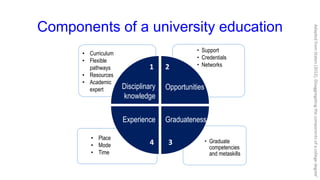
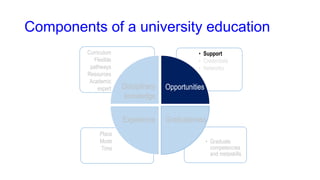
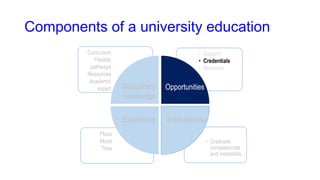
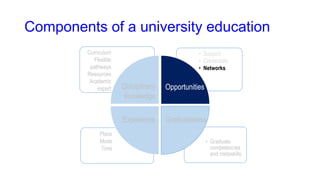
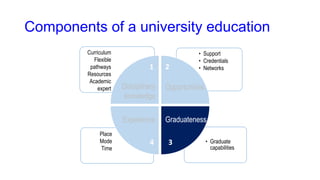
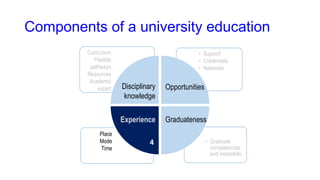
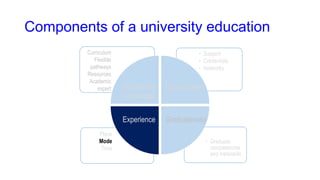
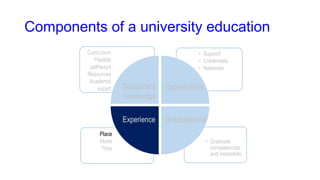
Components of a university education
• Graduate
competencies
and metaskills
• Support
• Credentials
• Networks
Disciplinary
knowledge
Opportunities
Experience Graduateness
• Place
• Mode
• Time
• Curriculum
• Flexible
pathways
• Resources
• Academic
expert
1 2
34
AdaptedfromStaten(2012),Disaggregatingthecomponentsofacollegedegree’
Unbundling
Every aspect of higher education teaching and learning can be
(and is being)
unbundled, and rebundled
Rebundling
Rebundling can serve different agendas
What does unbundling and
rebundling look like?
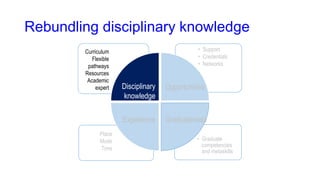
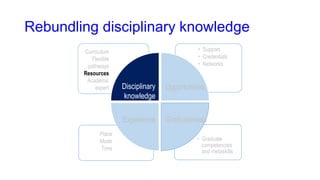
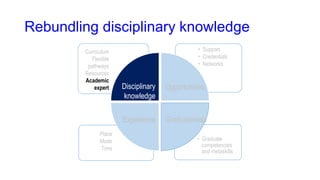
Rebundling disciplinary knowledge
• Graduate
competencies
and metaskills
• Support
• Credentials
• Networks
Opportunities
Experience Graduateness
Curriculum
Flexible
pathways
Resources
Academic
expert
Place
Mode
Time
Disciplinary
knowledge
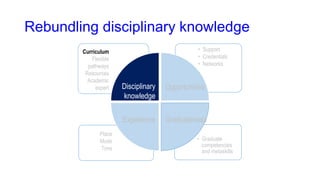
Rebundling disciplinary knowledge
• Graduate
competencies
and metaskills
• Support
• Credentials
• Networks
Opportunities
Experience Graduateness
Curriculum
Flexible
pathways
Resources
Academic
expert
Place
Mode
Time
Disciplinary
knowledge
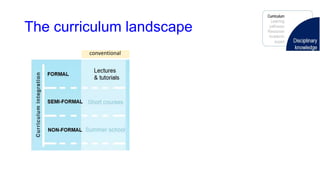
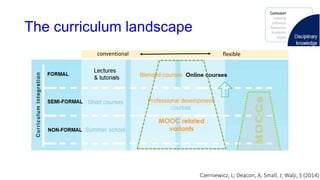
The curriculum landscape
conventional flexible
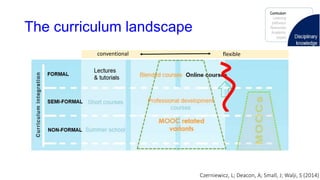
The curriculum landscape
conventional flexible
Czerniewicz, L; Deacon, A; Small, J; Walji, S (2014)
The curriculum landscape
conventional flexible
Czerniewicz, L; Deacon, A; Small, J; Walji, S (2014)
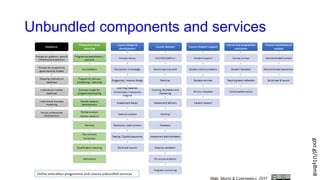
Unbundled components and services
goo.gl/U1yBm8
• The curriculum landscape is deeply entrenched and
very slow to change
• Critical shift – from the informal to the formal,
boundary crossing and fuzziness
• Whose interests do new forms of curricula serve?
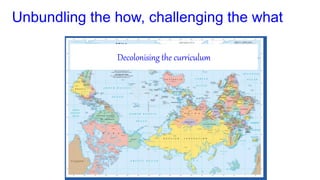
• As the “how” of the curriculum changes, so does the
“what”
Unbundling the how, challenging the what
Decolonising the curriculum
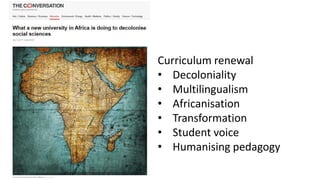
Curriculum renewal
• Decoloniality
• Multilingualism
• Africanisation
• Transformation
• Student voice
• Humanising pedagogy
Rebundling disciplinary knowledge
• Graduate
competencies
and metaskills
• Support
• Credentials
• Networks
Opportunities
Experience Graduateness
Curriculum
Flexible
pathways
Resources
Academic
expert
Place
Mode
Time
Disciplinary
knowledge
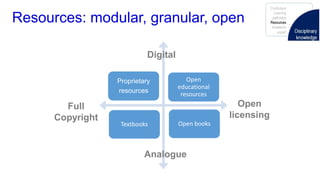
Resources: modular, granular, open
Proprietary
resources
Open
educational
resources
Textbooks Open books
Digital
Analogue
Full
Copyright
Open
licensing
New models of resource provision
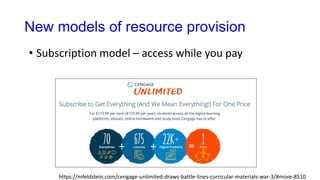
• Subscription model – access while you pay
https://mfeldstein.com/cengage-unlimited-draws-battle-lines-curricular-materials-war-3/#more-8510
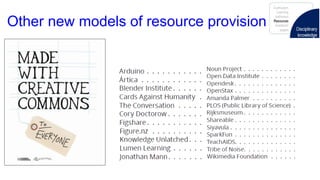
Other new models of resource provision
Whose advantage?
http://cdn1.cloudpro.co.uk/sites/cloudprod7/files/freemium.jpg
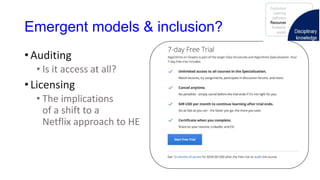
• Auditing
• Is it access at all?
• Licensing
• The implications
of a shift to a
Netflix approach to HE
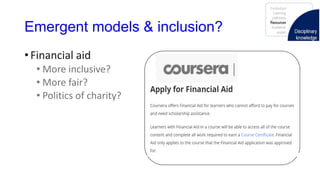
Emergent models & inclusion?
• Financial aid
• More inclusive?
• More fair?
• Politics of charity?
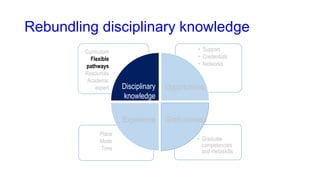
Rebundling disciplinary knowledge
• Graduate
competencies
and metaskills
• Support
• Credentials
• Networks
Opportunities
Experience Graduateness
Curriculum
Flexible
pathways
Resources
Academic
expert
Place
Mode
Time
Disciplinary
knowledge
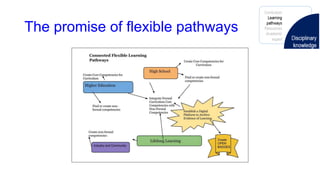
The promise of flexible pathways
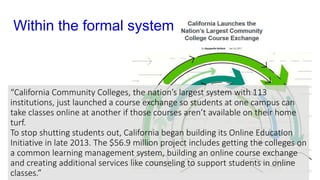
Within the formal system
“California Community Colleges, the nation’s largest system with 113
institutions, just launched a course exchange so students at one campus can
take classes online at another if those courses aren’t available on their home
turf.
To stop shutting students out, California began building its Online Education
Initiative in late 2013. The $56.9 million project includes getting the colleges on
a common learning management system, building an online course exchange
and creating additional services like counseling to support students in online
classes.”
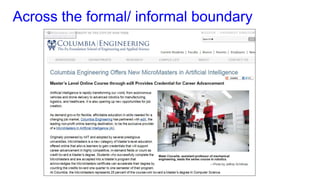
Across the formal/ informal boundary
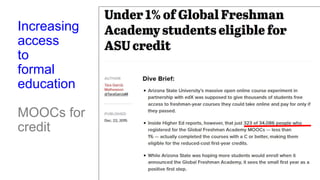
Increasing
access
to
formal
education
MOOCs for
credit
• Emergent evidence that new forms of unbundled
provision can increase access
• For whom?
• What about success?
Maximum flexibility
We already know what the college of the future will look like,
because the non-traditional students are creating it now. It’s a
hybrid of online and in-person classes, centred on the student
and not the institution, with credits accruing from multiple
schools, and adding up to a degree in alternating periods of
attendance and absence.
Shirky, C (2015)
Rebundling disciplinary knowledge
• Graduate
competencies
and metaskills
• Support
• Credentials
• Networks
Opportunities
Experience Graduateness
Curriculum
Flexible
pathways
Resources
Academic
expert
Place
Mode
Time
Disciplinary
knowledge
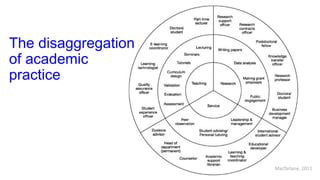
Macfarlane, 2011
The disaggregation
of academic
practice
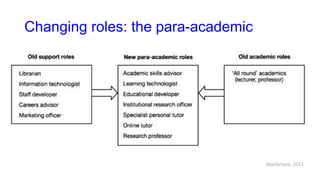
Changing roles: the para-academic
Macfarlane, 2011
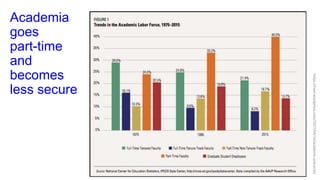
Academia
goes
part-time
and
becomes
less secure
https://rwer.wordpress.com/2017/04/16/academic-precariat/
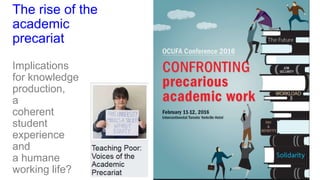
The rise of the
academic
precariat
Implications
for knowledge
production,
a
coherent
student
experience
and
a humane
working life?
The
automation
of the
professions
Disciplinary knowledge
In an age of adaptive learning
how will an increasingly fragmented, dispersed and precarious
academic/educator body share knowledge and enable a
coherent, caring and supportive learning experience to all
students?
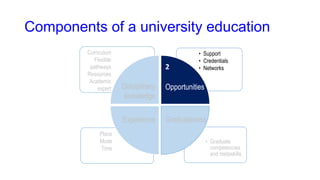
Components of a university education
• Graduate
competencies
and metaskills
• Support
• Credentials
• Networks
Disciplinary
knowledge
Opportunities
Experience Graduateness
Place
Mode
Time
Curriculum
Flexible
pathways
Resources
Academic
expert
2
Components of a university education
• Graduate
competencies
and metaskills
• Support
• Credentials
• Networks
Disciplinary
knowledge
Opportunities
Experience Graduateness
Place
Mode
Time
Curriculum
Flexible
pathways
Resources
Academic
expert
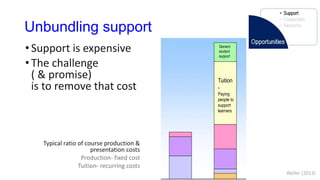
Unbundling support
•Support is expensive
•The challenge
( & promise)
is to remove that cost
Typical ratio of course production &
presentation costs
Production- fixed cost
Tuition- recurring costs
Tuition
-
Paying
people to
support
learners
Generic
student
support
Weller (2013)
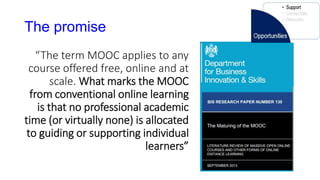
The promise
“The term MOOC applies to any
course offered free, online and at
scale. What marks the MOOC
from conventional online learning
is that no professional academic
time (or virtually none) is allocated
to guiding or supporting individual
learners”
“Access without support is not
opportunity
Effective student support does not arise by chance. It
requires intentional, structured, and proactive action
that is systematic in nature and coordinated in
application”
Tinto, V (2013)
Support is an equity issue
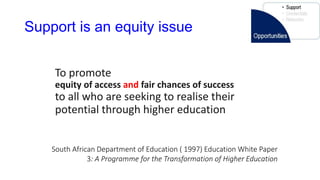
To promote
equity of access and fair chances of success
to all who are seeking to realise their
potential through higher education
South African Department of Education ( 1997) Education White Paper
3: A Programme for the Transformation of Higher Education
Support is an equity issue
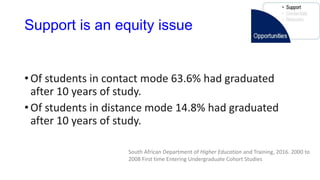
• Of students in contact mode 63.6% had graduated
after 10 years of study.
• Of students in distance mode 14.8% had graduated
after 10 years of study.
South African Department of Higher Education and Training, 2016. 2000 to
2008 First time Entering Undergraduate Cohort Studies
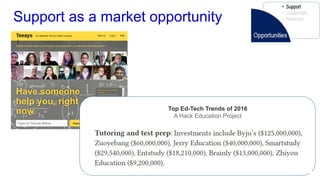
Support as a market opportunity
Top Ed-Tech Trends of 2016
A Hack Education Project
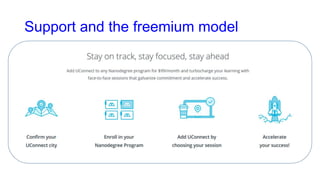
Support and the freemium model
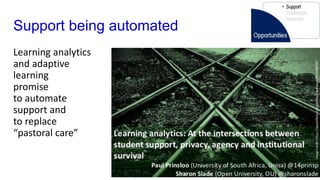
Support being automated
Learning analytics
and adaptive
learning
promise
to automate
support and
to replace
“pastoral care”
Is this the future of support?
• For the poor
• Machines and algorithms
• For the wealthy
• Face to face
• Paid for support
How can the affordances of new technologies be
exploited and leveraged to ensure appropriate,
affordable and caring support for all?
Components of a university education
• Graduate
competencies
and metaskills
• Support
• Credentials
• Networks
Disciplinary
knowledge
Opportunities
Experience Graduateness
Place
Mode
Time
Curriculum
Flexible
pathways
Resources
Academic
expert
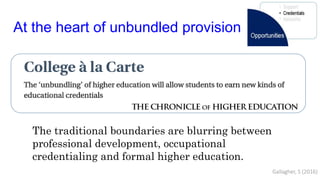
At the heart of unbundled provision
The traditional boundaries are blurring between
professional development, occupational
credentialing and formal higher education.
Gallagher, S (2016)
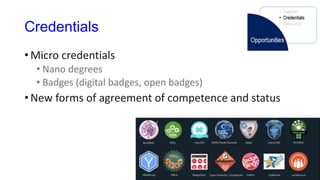
Credentials
• Micro credentials
• Nano degrees
• Badges (digital badges, open badges)
• New forms of agreement of competence and status
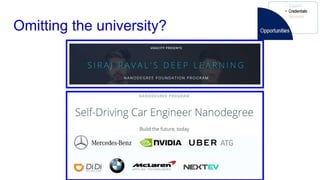
Omitting the university?
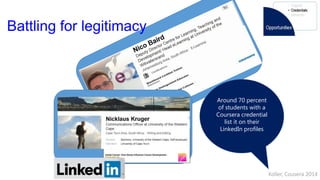
Battling for legitimacy
Around 70 percent
of students with a
Coursera credential
list it on their
LinkedIn profiles
Koller, Cousera 2014
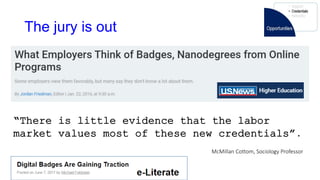
The jury is out
“There is little evidence that the labor
market values most of these new credentials”.
McMillan Cottom, Sociology Professor
Certification – an equity issue
“Free online courses are not going to change education
in Africa…because education in Africa and South Africa
is a means to an end – the qualification helps to get you
a job which puts food on the table.
Until we can get verifiable accreditation right
I don’t think there will be much traction”
de Hart, (2013) Office of the Vice Chancellor, University of South Africa
Credentials
• May prove to be equalisers in the world of work
• Raise critical questions about the function and reputation
of the university
• Raise issues about value, stigma and legitimacy
• Are an evolving unresolved and foundational issue
How can new forms of credentials increase access to both
formal education and to working opportunities?
Components of a university education
• Graduate
competencies
and metaskills
• Support
• Credentials
• Networks
Disciplinary
knowledge
Opportunities
Experience Graduateness
Place
Mode
Time
Curriculum
Flexible
pathways
Resources
Academic
expert
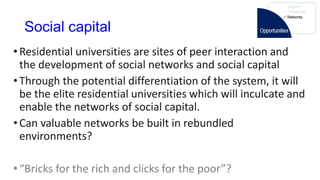
Social capital
•Residential universities are sites of peer interaction and
the development of social networks and social capital
•Through the potential differentiation of the system, it will
be the elite residential universities which will inculcate and
enable the networks of social capital.
•Can valuable networks be built in rebundled
environments?
•“Bricks for the rich and clicks for the poor”?
Components of a university education
• Graduate
capabilities
• Support
• Credentials
• Networks
Disciplinary
knowledge
Opportunities
Experience Graduateness
Place
Mode
Time
Curriculum
Flexible
pathways
Resources
Academic
expert
1 2
34
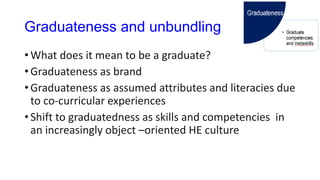
Graduateness and unbundling
• What does it mean to be a graduate?
• Graduateness as brand
• Graduateness as assumed attributes and literacies due
to co-curricular experiences
• Shift to graduatedness as skills and competencies in
an increasingly object –oriented HE culture
Components of a university education
• Graduate
competencies
and metaskills
• Support
• Credentials
• Networks
Disciplinary
knowledge
Opportunities
Experience Graduateness
Place
Mode
Time
Curriculum
Flexible
pathways
Resources
Academic
expert
4
Components of a university education
• Graduate
competencies
and metaskills
• Support
• Credentials
• Networks
Disciplinary
knowledge
Opportunities
Experience Graduateness
Place
Mode
Time
Curriculum
Flexible
pathways
Resources
Academic
expert
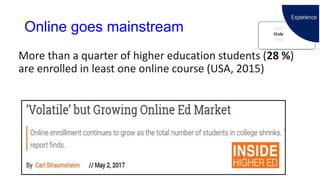
Online goes mainstream
More than a quarter of higher education students (28 %)
are enrolled in least one online course (USA, 2015)
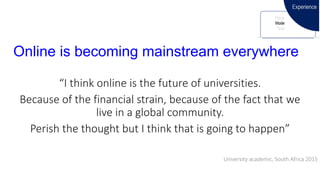
Online is becoming mainstream everywhere
“I think online is the future of universities.
Because of the financial strain, because of the fact that we
live in a global community.
Perish the thought but I think that is going to happen”
University academic, South Africa 2015
Online is creating new work
Online courses require different, expensive, components of work
These include:
faculty development
technologies
design course specifications
instructional design
learning materials
student identity verification
assessments
accessibility
accreditation
Online is creating new market opportunities
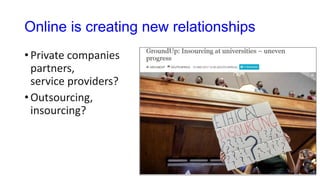
Online is creating new relationships
• Private companies
partners,
service providers?
• Outsourcing,
insourcing?
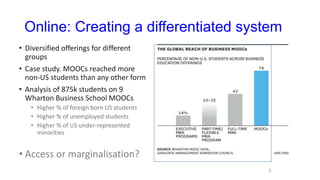
Online: Creating a differentiated system
• Diversified offerings for different
groups
• Case study. MOOCs reached more
non-US students than any other form
• Analysis of 875k students on 9
Wharton Business School MOOCs
• Higher % of foreign born US students
• Higher % of unemployed students
• Higher % of US under-represented
minorities
• Access or marginalisation?
/
Online and equity concerns
• A US surveyed of 40 000 students in nearly 500 000 online
courses found
…While all types of students in the study suffered
decrements in performance in online courses, some
struggled more than others to adapt: males, younger
students, Black students, and students with lower
grade point averages
Xu & Jaggar (2013)
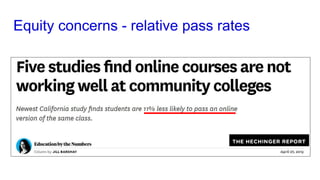
Equity concerns - relative pass rates
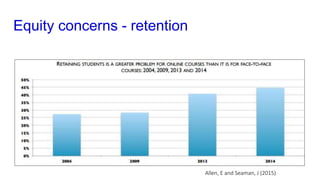
Equity concerns - retention
Allen, E and Seaman, J (2015)
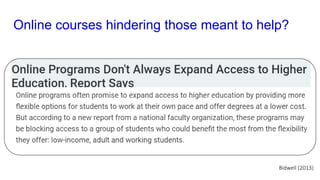
Online courses hindering those meant to help?
Bidwell (2013)
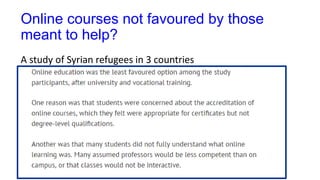
Online courses not favoured by those
meant to help?
A study of Syrian refugees in 3 countries
• The online space rife with complex and profound
issues raised by equity issues and by private – public
partnerships
• New and changing roles and responsibilities
• Ownership of the academic project
• Questions of academic identity and of responsibility
• The impact of commercial values on teaching and learning
• Poorly understood emergent models
Components of a university education
• Graduate
competencies
and metaskills
• Support
• Credentials
• Networks
Disciplinary
knowledge
Opportunities
Experience Graduateness
Place
Mode
Time
Curriculum
Flexible
pathways
Resources
Academic
expert
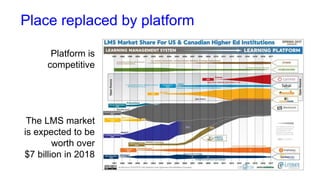
Place replaced by platform
Platform is
competitive
The LMS market
is expected to be
worth over
$7 billion in 2018
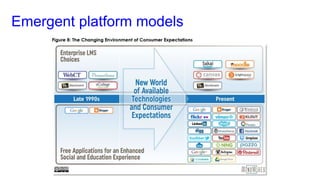
Emergent platform models
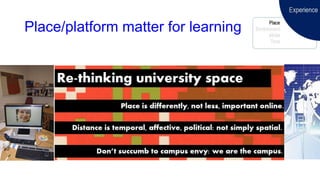
Place/platform matter for learning
Place online shifts beyond the local
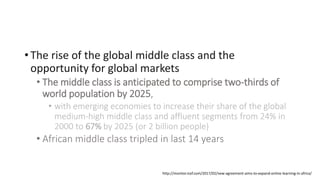
• The rise of the global middle class and the
opportunity for global markets
• The middle class is anticipated to comprise two-thirds of
world population by 2025,
• with emerging economies to increase their share of the global
medium-high middle class and affluent segments from 24% in
2000 to 67% by 2025 (or 2 billion people)
• African middle class tripled in last 14 years
http://monitor.icef.com/2017/02/new-agreement-aims-to-expand-online-learning-in-africa/
• Technology and market liberalisation open up opportunities to
pursue the broader conceptual opportunity of the borderless
2025 student. In the relatively untapped borderless skills market
of in-market, online and blended delivery – there are projected to
be in excess of one billion students around the world.
• Intense competition for capable moneyed students
anywhere and everywhere
• What about everyone else?
Australian International Education 2O25
How to make sense of
unbundling?
Opportunity or threat?
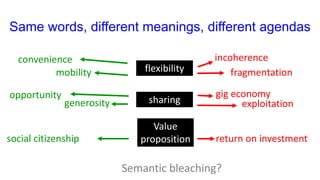
Same words, different meanings, different agendas
flexibility
sharing
Value
proposition
convenience
mobility
incoherence
fragmentation
generosity
opportunity gig economy
exploitation
social citizenship return on investment
Semantic bleaching?
The unbundling debate
Speaks to the battle for the soul of the university
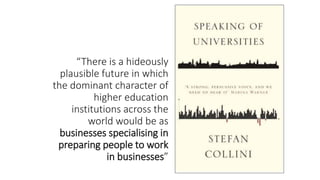
“There is a hideously
plausible future in which
the dominant character of
higher education
institutions across the
world would be as
businesses specialising in
preparing people to work
in businesses”
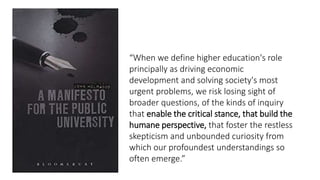
“When we define higher education's role
principally as driving economic
development and solving society's most
urgent problems, we risk losing sight of
broader questions, of the kinds of inquiry
that enable the critical stance, that build the
humane perspective, that foster the restless
skepticism and unbounded curiosity from
which our profoundest understandings so
often emerge.”
The unbundling debate
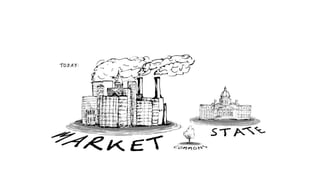
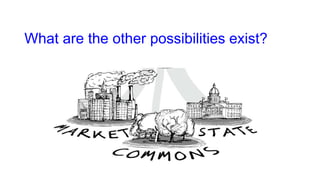
Speaks to the relationship between the market, the
state and the commons
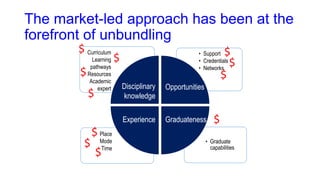
The market-led approach has been at the
forefront of unbundling
• Graduate
capabilities
• Support
• Credentials
• Networks
Disciplinary
knowledge
Opportunities
Experience Graduateness
Place
Mode
Time
Curriculum
Learning
pathways
Resources
Academic
expert
$
$
$
$
$
$
$
$
$
$
$
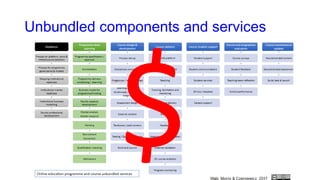
Unbundled components and services
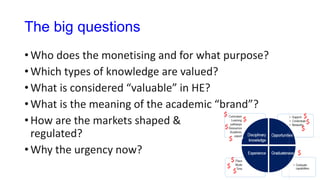
The big questions
• Who does the monetising and for what purpose?
• Which types of knowledge are valued?
• What is considered “valuable” in HE?
• What is the meaning of the academic “brand”?
• How are the markets shaped &
regulated?
• Why the urgency now?
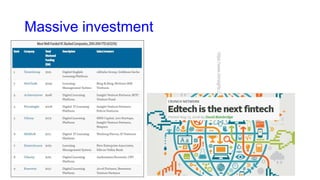
Massive investment
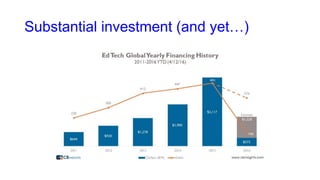
https://www.cbinsights.com/blog/ed-tech-2016-funding-drop/
Substantial investment (and yet…)
Can higher education be a “real” market?
• Knowledge is a public good
• It is non rivalrous, non –excludable, what exactly is the
product?
• The role of status competition
• the consumer brings something to the university
• Role of rankings (fixed and selective)
• Non-elite institutions cannot entice elite customers by
dropping price for the same service
• The role and responsibility of the state
• Numerous imperatives
Marginson, S (2013) The impossibility of capitalist markets in higher education
At stake – the nature of state market
relationships
“…new hybrid models of colleges and universities that
operate their core academic activities in symbiosis with
their enabling partners…a marketplace that is
increasingly driven by joint ventures, revenue sharing,
and shared risk—in a world where competitive
advantage increasingly comes from algorithms”
Gallagher, 2017
Who controls the relationship?
• There has always been a relationship between the
public (the state) and the private (the market) in
higher education
• The battle now is for control of that relationship
• Who determines priorities?
• Who defines objectives?
• Who makes decisions?
• Who regulates and shapes?
• What is gained and what is lost and by whom?
The terms of the relationship really matter
• Soft version, public sets the terms
• limited privatisation, the critical
appropriation of the market for
public ends
• Hard version, private sets the terms
• commercialisation – the
appropriation of the public for
private ends
Mamdani, 2009
Forms of privatisation
• Endogenous privatisation
• Universities being business-like or like businesses
• Assuming the discourses of privatisation
• ‘Exogenous’ privatisation - bringing the private sector
into public universities
• Multiple forms and terms of engagement
Ball and Youdell (2009)
Higher education is always a hybrid ecology
What are the other possibilities exist?
Reclaiming the Commons
• The Commons approach to education
• places educators and knowledge producers in charge
• foregrounds co-creation and participation
• develops governance mechanisms premised on shared
resources
The Commons approach shifts from a market led
higher education knowledge economy to an open
collaborative learning led knowledge society
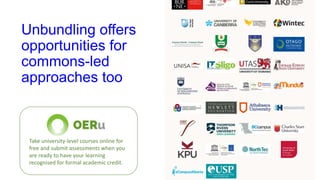
Unbundling offers
opportunities for
commons-led
approaches too
Take university-level courses online for
free and submit assessments when you
are ready to have your learning
recognised for formal academic credit.
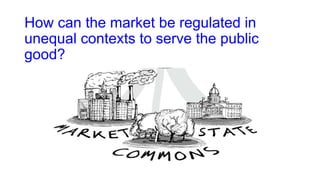
How can the market be regulated in
unequal contexts to serve the public
good?
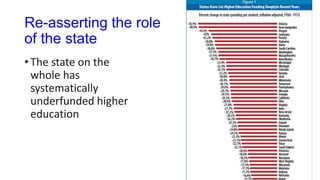
Re-asserting the role
of the state
• The state on the
whole has
systematically
underfunded higher
education
Re-asserting the role of the state
• The state too often has abdicated its role as regulator
and ensurer of higher education as a public good
• The state must mediate and shape the possibilities of
the market and the extent of the private nature of HE
• It is the state which has primary responsibility to
ensure redress, successful participation and
disadvantage are addressed
Re-asserting the role of the state
If unbundling is to serve the needs of a knowledge
society for the good of all, how can the state enable the
requirements of socially responsible public education
for a democratic citizenship?
Conclusion
• It is not inevitable that profit making will determine
how unbundling and rebundling in HE play out
• The situation is dynamic, in flux and highly contested,
it is being negotiated and renegotiated
• It is inevitably about power and contestations
• It is appropriated by different discourses and agendas
Unbundling - problem or solution?
• As part of the problem
• may serve the interests of the few and not the many
• may serve the private good at the expense of the public
good
• The risks are many
• exacerbating the fragmentation in higher education
leading to an incoherent student experience
• the monopolisation of the HE sector by a few companies
A hopeful note
• As part of the solution, unbundling and rebundling
offer opportunities for reasonable and affordable
education for all
• Unbundling is opening spaces and relationships that
were previously not available at all
• It can be harnessed to serve the interests of the many
rather than the few
• It must be critically understood and its possibilities be
fully utilised for the good of all
With grateful thanks to Sukaina Walji, Rebecca Swartz and the Leeds-University of Cape Town research project team
The Unbundled University: Researching emerging models in an unequal landscape
http://unbundleduni.com/
References
• ​​​​​Allen E and Seaman J (2015) Babson Survey Research Group (2015) Online Report Card: Tracking Online Education in the United States
• American Association of University Professors (2017) Visualising Change, the Annual Report on the Economic Status of the Profession 2016-17,
Academe, March – April 2017 https://www.aaup.org/file/FCS_2016-17_nc.pdf
• Australia, Future Unlimited, 2016 Australian International Education 2O25, Australian Trade and Investment Commission,
https://www.austrade.gov.au/Australian/Education/Services/Australian-International-Education-2025
• Ball, S and Youdell, D (2009) Hidden privatisation in public education Education Review . Spring2009, Vol. 21 Issue 2, p73-83. 11p.
• Collini, S (2017) Speaking of Universities, Verso Books
• Craig, R and Williams, A (2015) Data, Technology, and the Great Unbundling of Higher Education, Educause Review, Monday, August 17, 2015 ,
https://er.educause.edu/articles/2015/8/data-technology-and-the-great-unbundling-of-higher-education
• Czerniewicz, L; Deacon, A; Small, J; Walji, S (2014) Developing World MOOCs: a curriculum view of the MOOC landscape, in Sharma, S and Murphy, M
(Eds) Special Issue of Journal of Global Literacies, Technology, and Emerging Pedagogies, 2(3), 122- 139 Michigan State University
• Faust, D (2010) The Role of the University in a Changing World, June 30, 2010 , Royal Irish Academy, Trinity College, Dublin ,
http://www.harvard.edu/president/speech/2010/role-university-changing-world
• Gallagher, S (2017) Yes There’s ‘Disruption’ in College Market, But the Bigger Trend Is Growth of ‘Enabler’ Companies, Edusurge May 9, 2017 ,
https://www.edsurge.com/news/2017-05-09-yes-there-s-disruption-in-college-market-but-the-bigger-trend-is-growth-of-enabler-companies
• Gallagher, S (2016) From micromasters to nanodegrees, University World News 12 August 2016 Issue No:423,
http://www.universityworldnews.com/article.php?story=20160809133730588Herrero, A; Abarca, A and Turégan D (2015) Flourishing middle classes in
the emerging world to keep driving reduction in global inequality’ Eagles Economic Watch (2015). ‘, 2 March 2015, https://www.bbvaresearch.com/wp-
content/uploads/.../EW_globalMCs_feb15_vf1.pdf
• Holborow, M. (2012). Neoliberalism, Human Capital and the Skills Agenda in Higher Education The Irish Case. Journal for Critical Education Policy Studies,
10 (1), 93 – 111
• Macfarlane, B (2011) Shifting identity and roles The Morphing of Academic Practice: Unbundling and the Rise of the Para-academic Higher Education
Quarterly, 0951–5224, DOI: 10.1111/j.1468-2273.2010.00467.x 65 (1) pp 59–73
References
• Mamdani, M (2007) Scholars in the Marketplace. The Dilemmas of Neo-Liberal Reform at Makerere University, 1989-2005. Dakar, CODESRIA
• Marginson, S. (2013). The impossibility of capitalist markets in higher education. Journal of Education Policy, 28(3), 353-370.
• Poulin, R. & Straut, T. (2017). WCET (Western Interstate Commission for Higher Education Cooperative for Educational Technologies) Distance Education Price and Cost Report.
• Quality Matters & Eduventures Survey of Chief Online Officers, 2017 The Changing Landscape of Online Education (CHLOE)
• Mindwires (2017) LMS Market Historical Perspectve MindWires LLC http://www.mindwires.com/
• MOOCs Won’t Replace Business Schools — They’ll Diversify Them, June 3, 2014 http://blogs.hbr.org/2014/06/moocs-wont-replace-business-schools-theyll-diversify-them
•
• Shirky, C (2015) The digital revolution in higher education has already happened. No one noticed. https://medium.com/@cshirky/the-digital-revolution-in-higher-education-has-
already-happened-no-one-noticed-78ec0fec16c7
• South African Department of Higher Education and Training, 2016. 2000 to 2008 First time Entering Undergraduate Cohort Studies
• Stacey, P and Hinchliff, S Made with Creative Commons: A guide to sharing your knowledge and creativity with the world, and sustaining your operation while you do, Creative
Commons and Pearson, 2017 ,
• Staten, M (2012) ‘Disaggregating the Components of a College Degree’ American Enterprise Institute for Public Policy Research, Prepared for the American Enterprise Institute
Conference, “Stretching the Higher Education Dollar” August 2, 2012, available at http://www.aei.org/wp-content/uploads/2012/08/-disaggregating-the-components-of-a-college-
degree_184521175818.pdf
• Tinto, V (2013) Regional Symposia on Student Success, 19 - 23 August 2013, http://www.che.ac.za/content/regional-symposia-student-success-19-23-august-2013
• University and College Union 2016 Precarious Work in Higher Education: A Snapshot of Insecure Contracts and Institutional Attitudes
https://www.ucu.org.uk/media/7995/Precarious-work-in-higher-education-a-snapshot-of-insecure-contracts-and-institutional-attitudes-Apr-
16/pdf/ucu_precariouscontract_hereport_apr16.pdf
• University and College Union (2016) UCT Workload is an Education Issue; workload survey, Report 2016
• Weismann, J (2013) A Truly Devastating Graph on State Higher Education Spending Some states have slashed per-student spending by as much as half, The Atlantic, 20 March 2013,
https://www.theatlantic.com/business/archive/2013/03/a-truly-devastating-graph-on-state-higher-education-spending/274199/
• Weller 2013, The Cost of Support
http://nogoodreason.typepad.co.uk/no_good_reason/2013/06/the-cost-of-support.html
• Xu & Jaggar 2013 Adaptability to Online Learning: Differences Across Types of Students and Academic Subject Areas. CCRC, Working paper No 5. Retrieved from
http://academiccommons.columbia.edu/catalog/ac:157286

Unbundling Rebundling Higher Education

  • 1.
    Unbundling Rebundling Contestations, concatenations andconcerns in higher education Laura Czerniewicz, 14 May 2018
  • 2.
    This talk • Considersthe components of unbundled higher education and implications • Reviews the value propositions for un/re bundling • Is interested in emergent models for teaching and learning and consequences • Has a concern with in/equality and social justice
  • 4.
    A brief historyof unbundling •Originally used in banking (1970s) •Then in computer industry •In the legal services (2000s) •Understood in music •Now in Higher Education
  • 5.
    Unbundling the process ofdisaggregating educational provision into its component parts may be provided in partnership with external actors
  • 6.
    Components of auniversity education • Graduate competencies and metaskills • Support • Credentials • Networks Disciplinary knowledge Opportunities Experience Graduateness • Place • Mode • Time • Curriculum • Flexible pathways • Resources • Academic expert 1 2 34 AdaptedfromStaten(2012),Disaggregatingthecomponentsofacollegedegree’
  • 7.
    Unbundling Every aspect ofhigher education teaching and learning can be (and is being) unbundled, and rebundled
  • 8.
  • 9.
    What does unbundlingand rebundling look like?
  • 10.
    Rebundling disciplinary knowledge •Graduate competencies and metaskills • Support • Credentials • Networks Opportunities Experience Graduateness Curriculum Flexible pathways Resources Academic expert Place Mode Time Disciplinary knowledge
  • 11.
    Rebundling disciplinary knowledge •Graduate competencies and metaskills • Support • Credentials • Networks Opportunities Experience Graduateness Curriculum Flexible pathways Resources Academic expert Place Mode Time Disciplinary knowledge
  • 12.
  • 13.
    The curriculum landscape conventionalflexible Czerniewicz, L; Deacon, A; Small, J; Walji, S (2014)
  • 14.
    The curriculum landscape conventionalflexible Czerniewicz, L; Deacon, A; Small, J; Walji, S (2014)
  • 15.
    Unbundled components andservices goo.gl/U1yBm8
  • 16.
    • The curriculumlandscape is deeply entrenched and very slow to change • Critical shift – from the informal to the formal, boundary crossing and fuzziness • Whose interests do new forms of curricula serve? • As the “how” of the curriculum changes, so does the “what”
  • 17.
    Unbundling the how,challenging the what Decolonising the curriculum
  • 18.
    Curriculum renewal • Decoloniality •Multilingualism • Africanisation • Transformation • Student voice • Humanising pedagogy
  • 19.
    Rebundling disciplinary knowledge •Graduate competencies and metaskills • Support • Credentials • Networks Opportunities Experience Graduateness Curriculum Flexible pathways Resources Academic expert Place Mode Time Disciplinary knowledge
  • 20.
    Resources: modular, granular,open Proprietary resources Open educational resources Textbooks Open books Digital Analogue Full Copyright Open licensing
  • 21.
    New models ofresource provision • Subscription model – access while you pay https://mfeldstein.com/cengage-unlimited-draws-battle-lines-curricular-materials-war-3/#more-8510
  • 22.
    Other new modelsof resource provision
  • 23.
  • 24.
    • Auditing • Isit access at all? • Licensing • The implications of a shift to a Netflix approach to HE Emergent models & inclusion?
  • 25.
    Emergent models &inclusion? • Financial aid • More inclusive? • More fair? • Politics of charity?
  • 26.
    Rebundling disciplinary knowledge •Graduate competencies and metaskills • Support • Credentials • Networks Opportunities Experience Graduateness Curriculum Flexible pathways Resources Academic expert Place Mode Time Disciplinary knowledge
  • 27.
    The promise offlexible pathways
  • 28.
    Within the formalsystem “California Community Colleges, the nation’s largest system with 113 institutions, just launched a course exchange so students at one campus can take classes online at another if those courses aren’t available on their home turf. To stop shutting students out, California began building its Online Education Initiative in late 2013. The $56.9 million project includes getting the colleges on a common learning management system, building an online course exchange and creating additional services like counseling to support students in online classes.”
  • 29.
    Across the formal/informal boundary
  • 30.
  • 31.
    • Emergent evidencethat new forms of unbundled provision can increase access • For whom? • What about success?
  • 32.
    Maximum flexibility We alreadyknow what the college of the future will look like, because the non-traditional students are creating it now. It’s a hybrid of online and in-person classes, centred on the student and not the institution, with credits accruing from multiple schools, and adding up to a degree in alternating periods of attendance and absence. Shirky, C (2015)
  • 33.
    Rebundling disciplinary knowledge •Graduate competencies and metaskills • Support • Credentials • Networks Opportunities Experience Graduateness Curriculum Flexible pathways Resources Academic expert Place Mode Time Disciplinary knowledge
  • 34.
  • 35.
    Changing roles: thepara-academic Macfarlane, 2011
  • 36.
  • 37.
    The rise ofthe academic precariat Implications for knowledge production, a coherent student experience and a humane working life?
  • 38.
  • 39.
    Disciplinary knowledge In anage of adaptive learning how will an increasingly fragmented, dispersed and precarious academic/educator body share knowledge and enable a coherent, caring and supportive learning experience to all students?
  • 40.
    Components of auniversity education • Graduate competencies and metaskills • Support • Credentials • Networks Disciplinary knowledge Opportunities Experience Graduateness Place Mode Time Curriculum Flexible pathways Resources Academic expert 2
  • 41.
    Components of auniversity education • Graduate competencies and metaskills • Support • Credentials • Networks Disciplinary knowledge Opportunities Experience Graduateness Place Mode Time Curriculum Flexible pathways Resources Academic expert
  • 42.
    Unbundling support •Support isexpensive •The challenge ( & promise) is to remove that cost Typical ratio of course production & presentation costs Production- fixed cost Tuition- recurring costs Tuition - Paying people to support learners Generic student support Weller (2013)
  • 43.
    The promise “The termMOOC applies to any course offered free, online and at scale. What marks the MOOC from conventional online learning is that no professional academic time (or virtually none) is allocated to guiding or supporting individual learners”
  • 44.
    “Access without supportis not opportunity Effective student support does not arise by chance. It requires intentional, structured, and proactive action that is systematic in nature and coordinated in application” Tinto, V (2013)
  • 45.
    Support is anequity issue To promote equity of access and fair chances of success to all who are seeking to realise their potential through higher education South African Department of Education ( 1997) Education White Paper 3: A Programme for the Transformation of Higher Education
  • 46.
    Support is anequity issue • Of students in contact mode 63.6% had graduated after 10 years of study. • Of students in distance mode 14.8% had graduated after 10 years of study. South African Department of Higher Education and Training, 2016. 2000 to 2008 First time Entering Undergraduate Cohort Studies
  • 47.
    Support as amarket opportunity Top Ed-Tech Trends of 2016 A Hack Education Project
  • 48.
    Support and thefreemium model
  • 49.
    Support being automated Learninganalytics and adaptive learning promise to automate support and to replace “pastoral care”
  • 50.
    Is this thefuture of support? • For the poor • Machines and algorithms • For the wealthy • Face to face • Paid for support
  • 51.
    How can theaffordances of new technologies be exploited and leveraged to ensure appropriate, affordable and caring support for all?
  • 52.
    Components of auniversity education • Graduate competencies and metaskills • Support • Credentials • Networks Disciplinary knowledge Opportunities Experience Graduateness Place Mode Time Curriculum Flexible pathways Resources Academic expert
  • 53.
    At the heartof unbundled provision The traditional boundaries are blurring between professional development, occupational credentialing and formal higher education. Gallagher, S (2016)
  • 54.
    Credentials • Micro credentials •Nano degrees • Badges (digital badges, open badges) • New forms of agreement of competence and status
  • 55.
  • 56.
    Battling for legitimacy Around70 percent of students with a Coursera credential list it on their LinkedIn profiles Koller, Cousera 2014
  • 57.
    The jury isout “There is little evidence that the labor market values most of these new credentials”. McMillan Cottom, Sociology Professor
  • 58.
    Certification – anequity issue “Free online courses are not going to change education in Africa…because education in Africa and South Africa is a means to an end – the qualification helps to get you a job which puts food on the table. Until we can get verifiable accreditation right I don’t think there will be much traction” de Hart, (2013) Office of the Vice Chancellor, University of South Africa
  • 59.
    Credentials • May proveto be equalisers in the world of work • Raise critical questions about the function and reputation of the university • Raise issues about value, stigma and legitimacy • Are an evolving unresolved and foundational issue How can new forms of credentials increase access to both formal education and to working opportunities?
  • 60.
    Components of auniversity education • Graduate competencies and metaskills • Support • Credentials • Networks Disciplinary knowledge Opportunities Experience Graduateness Place Mode Time Curriculum Flexible pathways Resources Academic expert
  • 61.
    Social capital •Residential universitiesare sites of peer interaction and the development of social networks and social capital •Through the potential differentiation of the system, it will be the elite residential universities which will inculcate and enable the networks of social capital. •Can valuable networks be built in rebundled environments? •“Bricks for the rich and clicks for the poor”?
  • 62.
    Components of auniversity education • Graduate capabilities • Support • Credentials • Networks Disciplinary knowledge Opportunities Experience Graduateness Place Mode Time Curriculum Flexible pathways Resources Academic expert 1 2 34
  • 63.
    Graduateness and unbundling •What does it mean to be a graduate? • Graduateness as brand • Graduateness as assumed attributes and literacies due to co-curricular experiences • Shift to graduatedness as skills and competencies in an increasingly object –oriented HE culture
  • 64.
    Components of auniversity education • Graduate competencies and metaskills • Support • Credentials • Networks Disciplinary knowledge Opportunities Experience Graduateness Place Mode Time Curriculum Flexible pathways Resources Academic expert 4
  • 65.
    Components of auniversity education • Graduate competencies and metaskills • Support • Credentials • Networks Disciplinary knowledge Opportunities Experience Graduateness Place Mode Time Curriculum Flexible pathways Resources Academic expert
  • 66.
    Online goes mainstream Morethan a quarter of higher education students (28 %) are enrolled in least one online course (USA, 2015)
  • 67.
    Online is becomingmainstream everywhere “I think online is the future of universities. Because of the financial strain, because of the fact that we live in a global community. Perish the thought but I think that is going to happen” University academic, South Africa 2015
  • 68.
    Online is creatingnew work Online courses require different, expensive, components of work These include: faculty development technologies design course specifications instructional design learning materials student identity verification assessments accessibility accreditation
  • 69.
    Online is creatingnew market opportunities
  • 70.
    Online is creatingnew relationships • Private companies partners, service providers? • Outsourcing, insourcing?
  • 72.
    Online: Creating adifferentiated system • Diversified offerings for different groups • Case study. MOOCs reached more non-US students than any other form • Analysis of 875k students on 9 Wharton Business School MOOCs • Higher % of foreign born US students • Higher % of unemployed students • Higher % of US under-represented minorities • Access or marginalisation? /
  • 73.
    Online and equityconcerns • A US surveyed of 40 000 students in nearly 500 000 online courses found …While all types of students in the study suffered decrements in performance in online courses, some struggled more than others to adapt: males, younger students, Black students, and students with lower grade point averages Xu & Jaggar (2013)
  • 74.
    Equity concerns -relative pass rates
  • 75.
    Equity concerns -retention Allen, E and Seaman, J (2015)
  • 76.
    Online courses hinderingthose meant to help? Bidwell (2013)
  • 77.
    Online courses notfavoured by those meant to help? A study of Syrian refugees in 3 countries
  • 78.
    • The onlinespace rife with complex and profound issues raised by equity issues and by private – public partnerships • New and changing roles and responsibilities • Ownership of the academic project • Questions of academic identity and of responsibility • The impact of commercial values on teaching and learning • Poorly understood emergent models
  • 79.
    Components of auniversity education • Graduate competencies and metaskills • Support • Credentials • Networks Disciplinary knowledge Opportunities Experience Graduateness Place Mode Time Curriculum Flexible pathways Resources Academic expert
  • 80.
    Place replaced byplatform Platform is competitive The LMS market is expected to be worth over $7 billion in 2018
  • 81.
  • 82.
  • 83.
    Place online shiftsbeyond the local
  • 84.
    • The riseof the global middle class and the opportunity for global markets • The middle class is anticipated to comprise two-thirds of world population by 2025, • with emerging economies to increase their share of the global medium-high middle class and affluent segments from 24% in 2000 to 67% by 2025 (or 2 billion people) • African middle class tripled in last 14 years http://monitor.icef.com/2017/02/new-agreement-aims-to-expand-online-learning-in-africa/
  • 85.
    • Technology andmarket liberalisation open up opportunities to pursue the broader conceptual opportunity of the borderless 2025 student. In the relatively untapped borderless skills market of in-market, online and blended delivery – there are projected to be in excess of one billion students around the world. • Intense competition for capable moneyed students anywhere and everywhere • What about everyone else? Australian International Education 2O25
  • 86.
    How to makesense of unbundling? Opportunity or threat?
  • 87.
    Same words, differentmeanings, different agendas flexibility sharing Value proposition convenience mobility incoherence fragmentation generosity opportunity gig economy exploitation social citizenship return on investment Semantic bleaching?
  • 88.
    The unbundling debate Speaksto the battle for the soul of the university
  • 89.
    “There is ahideously plausible future in which the dominant character of higher education institutions across the world would be as businesses specialising in preparing people to work in businesses”
  • 90.
    “When we definehigher education's role principally as driving economic development and solving society's most urgent problems, we risk losing sight of broader questions, of the kinds of inquiry that enable the critical stance, that build the humane perspective, that foster the restless skepticism and unbounded curiosity from which our profoundest understandings so often emerge.”
  • 91.
    The unbundling debate Speaksto the relationship between the market, the state and the commons
  • 93.
    The market-led approachhas been at the forefront of unbundling • Graduate capabilities • Support • Credentials • Networks Disciplinary knowledge Opportunities Experience Graduateness Place Mode Time Curriculum Learning pathways Resources Academic expert $ $ $ $ $ $ $ $ $ $ $
  • 94.
  • 95.
    The big questions •Who does the monetising and for what purpose? • Which types of knowledge are valued? • What is considered “valuable” in HE? • What is the meaning of the academic “brand”? • How are the markets shaped & regulated? • Why the urgency now?
  • 96.
  • 97.
  • 98.
    Can higher educationbe a “real” market? • Knowledge is a public good • It is non rivalrous, non –excludable, what exactly is the product? • The role of status competition • the consumer brings something to the university • Role of rankings (fixed and selective) • Non-elite institutions cannot entice elite customers by dropping price for the same service • The role and responsibility of the state • Numerous imperatives Marginson, S (2013) The impossibility of capitalist markets in higher education
  • 99.
    At stake –the nature of state market relationships “…new hybrid models of colleges and universities that operate their core academic activities in symbiosis with their enabling partners…a marketplace that is increasingly driven by joint ventures, revenue sharing, and shared risk—in a world where competitive advantage increasingly comes from algorithms” Gallagher, 2017
  • 100.
    Who controls therelationship? • There has always been a relationship between the public (the state) and the private (the market) in higher education • The battle now is for control of that relationship • Who determines priorities? • Who defines objectives? • Who makes decisions? • Who regulates and shapes? • What is gained and what is lost and by whom?
  • 101.
    The terms ofthe relationship really matter • Soft version, public sets the terms • limited privatisation, the critical appropriation of the market for public ends • Hard version, private sets the terms • commercialisation – the appropriation of the public for private ends Mamdani, 2009
  • 102.
    Forms of privatisation •Endogenous privatisation • Universities being business-like or like businesses • Assuming the discourses of privatisation • ‘Exogenous’ privatisation - bringing the private sector into public universities • Multiple forms and terms of engagement Ball and Youdell (2009)
  • 103.
    Higher education isalways a hybrid ecology
  • 104.
    What are theother possibilities exist?
  • 105.
    Reclaiming the Commons •The Commons approach to education • places educators and knowledge producers in charge • foregrounds co-creation and participation • develops governance mechanisms premised on shared resources
  • 106.
    The Commons approachshifts from a market led higher education knowledge economy to an open collaborative learning led knowledge society
  • 107.
    Unbundling offers opportunities for commons-led approachestoo Take university-level courses online for free and submit assessments when you are ready to have your learning recognised for formal academic credit.
  • 108.
    How can themarket be regulated in unequal contexts to serve the public good?
  • 109.
    Re-asserting the role ofthe state • The state on the whole has systematically underfunded higher education
  • 110.
    Re-asserting the roleof the state • The state too often has abdicated its role as regulator and ensurer of higher education as a public good • The state must mediate and shape the possibilities of the market and the extent of the private nature of HE • It is the state which has primary responsibility to ensure redress, successful participation and disadvantage are addressed
  • 111.
    Re-asserting the roleof the state If unbundling is to serve the needs of a knowledge society for the good of all, how can the state enable the requirements of socially responsible public education for a democratic citizenship?
  • 112.
    Conclusion • It isnot inevitable that profit making will determine how unbundling and rebundling in HE play out • The situation is dynamic, in flux and highly contested, it is being negotiated and renegotiated • It is inevitably about power and contestations • It is appropriated by different discourses and agendas
  • 113.
    Unbundling - problemor solution? • As part of the problem • may serve the interests of the few and not the many • may serve the private good at the expense of the public good • The risks are many • exacerbating the fragmentation in higher education leading to an incoherent student experience • the monopolisation of the HE sector by a few companies
  • 114.
    A hopeful note •As part of the solution, unbundling and rebundling offer opportunities for reasonable and affordable education for all • Unbundling is opening spaces and relationships that were previously not available at all • It can be harnessed to serve the interests of the many rather than the few • It must be critically understood and its possibilities be fully utilised for the good of all
  • 115.
    With grateful thanksto Sukaina Walji, Rebecca Swartz and the Leeds-University of Cape Town research project team The Unbundled University: Researching emerging models in an unequal landscape http://unbundleduni.com/
  • 116.
    References • ​​​​​Allen Eand Seaman J (2015) Babson Survey Research Group (2015) Online Report Card: Tracking Online Education in the United States • American Association of University Professors (2017) Visualising Change, the Annual Report on the Economic Status of the Profession 2016-17, Academe, March – April 2017 https://www.aaup.org/file/FCS_2016-17_nc.pdf • Australia, Future Unlimited, 2016 Australian International Education 2O25, Australian Trade and Investment Commission, https://www.austrade.gov.au/Australian/Education/Services/Australian-International-Education-2025 • Ball, S and Youdell, D (2009) Hidden privatisation in public education Education Review . Spring2009, Vol. 21 Issue 2, p73-83. 11p. • Collini, S (2017) Speaking of Universities, Verso Books • Craig, R and Williams, A (2015) Data, Technology, and the Great Unbundling of Higher Education, Educause Review, Monday, August 17, 2015 , https://er.educause.edu/articles/2015/8/data-technology-and-the-great-unbundling-of-higher-education • Czerniewicz, L; Deacon, A; Small, J; Walji, S (2014) Developing World MOOCs: a curriculum view of the MOOC landscape, in Sharma, S and Murphy, M (Eds) Special Issue of Journal of Global Literacies, Technology, and Emerging Pedagogies, 2(3), 122- 139 Michigan State University • Faust, D (2010) The Role of the University in a Changing World, June 30, 2010 , Royal Irish Academy, Trinity College, Dublin , http://www.harvard.edu/president/speech/2010/role-university-changing-world • Gallagher, S (2017) Yes There’s ‘Disruption’ in College Market, But the Bigger Trend Is Growth of ‘Enabler’ Companies, Edusurge May 9, 2017 , https://www.edsurge.com/news/2017-05-09-yes-there-s-disruption-in-college-market-but-the-bigger-trend-is-growth-of-enabler-companies • Gallagher, S (2016) From micromasters to nanodegrees, University World News 12 August 2016 Issue No:423, http://www.universityworldnews.com/article.php?story=20160809133730588Herrero, A; Abarca, A and Turégan D (2015) Flourishing middle classes in the emerging world to keep driving reduction in global inequality’ Eagles Economic Watch (2015). ‘, 2 March 2015, https://www.bbvaresearch.com/wp- content/uploads/.../EW_globalMCs_feb15_vf1.pdf • Holborow, M. (2012). Neoliberalism, Human Capital and the Skills Agenda in Higher Education The Irish Case. Journal for Critical Education Policy Studies, 10 (1), 93 – 111 • Macfarlane, B (2011) Shifting identity and roles The Morphing of Academic Practice: Unbundling and the Rise of the Para-academic Higher Education Quarterly, 0951–5224, DOI: 10.1111/j.1468-2273.2010.00467.x 65 (1) pp 59–73
  • 117.
    References • Mamdani, M(2007) Scholars in the Marketplace. The Dilemmas of Neo-Liberal Reform at Makerere University, 1989-2005. Dakar, CODESRIA • Marginson, S. (2013). The impossibility of capitalist markets in higher education. Journal of Education Policy, 28(3), 353-370. • Poulin, R. & Straut, T. (2017). WCET (Western Interstate Commission for Higher Education Cooperative for Educational Technologies) Distance Education Price and Cost Report. • Quality Matters & Eduventures Survey of Chief Online Officers, 2017 The Changing Landscape of Online Education (CHLOE) • Mindwires (2017) LMS Market Historical Perspectve MindWires LLC http://www.mindwires.com/ • MOOCs Won’t Replace Business Schools — They’ll Diversify Them, June 3, 2014 http://blogs.hbr.org/2014/06/moocs-wont-replace-business-schools-theyll-diversify-them • • Shirky, C (2015) The digital revolution in higher education has already happened. No one noticed. https://medium.com/@cshirky/the-digital-revolution-in-higher-education-has- already-happened-no-one-noticed-78ec0fec16c7 • South African Department of Higher Education and Training, 2016. 2000 to 2008 First time Entering Undergraduate Cohort Studies • Stacey, P and Hinchliff, S Made with Creative Commons: A guide to sharing your knowledge and creativity with the world, and sustaining your operation while you do, Creative Commons and Pearson, 2017 , • Staten, M (2012) ‘Disaggregating the Components of a College Degree’ American Enterprise Institute for Public Policy Research, Prepared for the American Enterprise Institute Conference, “Stretching the Higher Education Dollar” August 2, 2012, available at http://www.aei.org/wp-content/uploads/2012/08/-disaggregating-the-components-of-a-college- degree_184521175818.pdf • Tinto, V (2013) Regional Symposia on Student Success, 19 - 23 August 2013, http://www.che.ac.za/content/regional-symposia-student-success-19-23-august-2013 • University and College Union 2016 Precarious Work in Higher Education: A Snapshot of Insecure Contracts and Institutional Attitudes https://www.ucu.org.uk/media/7995/Precarious-work-in-higher-education-a-snapshot-of-insecure-contracts-and-institutional-attitudes-Apr- 16/pdf/ucu_precariouscontract_hereport_apr16.pdf • University and College Union (2016) UCT Workload is an Education Issue; workload survey, Report 2016 • Weismann, J (2013) A Truly Devastating Graph on State Higher Education Spending Some states have slashed per-student spending by as much as half, The Atlantic, 20 March 2013, https://www.theatlantic.com/business/archive/2013/03/a-truly-devastating-graph-on-state-higher-education-spending/274199/ • Weller 2013, The Cost of Support http://nogoodreason.typepad.co.uk/no_good_reason/2013/06/the-cost-of-support.html • Xu & Jaggar 2013 Adaptability to Online Learning: Differences Across Types of Students and Academic Subject Areas. CCRC, Working paper No 5. Retrieved from http://academiccommons.columbia.edu/catalog/ac:157286

Editor's Notes

  • #4 A term closely linked with disaggregation, with the notion of disruption of higher education, premised on the central role played by technology and the Internet in HE
  • #5 Originally used in Higher ed, American context NB High Fees … costs of tuition….. Graduate unemployment Graphic from -https://er.educause.edu/articles/2015/8/data-technology-and-the-great-unbundling-of-higher-education
  • #16 Each part can be marketised More partners Implications for increased marketization discourses infiltrating every component of teaching and learning provision Danger of increased fragmentation of pedagogy and alienation of students Requires increased and more complex literacies from students (and academics)
  • #18 Challenges from the periphery
  • #19 https://theconversation.com/what-a-new-university-in-africa-is-doing-to-decolonise-social-sciences-77181 Relevant to the global south and north
  • #21 Granular Multimodal Different forms of IP
  • #22 Spotify comes to education Only have access while you subscribe Licensed content Lots of good enough content Less high quality content
  • #23 Open Educational Resources Access Cost savings Enable participation and empowerment (depending on license)
  • #24  Works in software, potential to disadvantage and exclude those who can’t pay for essential services in education http://cdn1.cloudpro.co.uk/sites/cloudprod7/files/freemium.jpg
  • #25 Partial access Common term – auditing. In f2f it means full attendance, online it means partial access Exchange rates, and costs in different parts of the world
  • #26 Auditing and the freemium model Shift to licences (Higher Education as Netflix?)
  • #28 Chunks and granularity Promise ease of access, and recognition of informal learning Danger of complicated bureaucracy requiring great skill to negotiate Danger of lack of recognition and a new form of educational 2nd class citizenship
  • #29 https://www.edsurge.com/news/2017-01-24-california-launches-the-nation-s-largest-community-college-course-exchange
  • #30 Students who successfully complete the MicroMasters and are accepted into a Master’s program that acknowledges the MicroMasters certificate can accelerate their degree by counting the credits toward one quarter to one semester of their program. At Columbia, the MicroMasters represents 25 percent of the coursework toward a Master’s degree in Computer Science.
  • #31 http://www.educationdive.com/news/under-1-of-global-freshman-academy-students-eligible-for-asu-credit/411241/ Are they working? For whom? Is that a lot? Is that a little?
  • #33 In this accurate? In this ultra flexible environment, what literacies are needed to engage? Who will fall off? Whose responsibility is support for these people?
  • #36 Explain what is meant by a para- academic
  • #37 https://rwer.wordpress.com/2017/04/16/academic-precariat/ In the UK 54 per cent of all academic staff are employed on “insecure contracts”, Figures are higher the more junior the position
  • #38 Staff in both HE and FE are working an average of more than two days unpaid every week https://ocufa.on.ca/assets/2016Conference_flyer.jpg https://ocufa.on.ca/conferences/confronting-precarious-academic-work/ https://www.facebook.com/TeachingPoor/
  • #39 The professions will be automated (just as craftspeople were in the past), the rise of adaptive learning Machines and algorythms for the poor and face to face for the wealthy? Mass automisation, mass customisation Implications for quality?
  • #42 MOOCs removed and brought back Learning analytics, pastoral support delegated to machines
  • #43 Below is an idealised chart showing typical ratios for course production and presentation costs over 5 presentations (you need 5 to get a clear picture as all the production costs are in year one). The big cream chunk in the second column is tuition costs. The green bit on top is student support costs (generic and specific student support services, eg support for students with disabilities, pastoral support, running regional centres, etc). The other bits are things like IT services. I've removed the actual figures, it's the relative amounts I want to focus on. This shows that by far the biggest cost is that of tuition. Paying people to support learners is where the money goes.  The other key element is that, of course, production is a fixed cost. So once we've paid it, we've paid it (more or less, we may need to produce new items). Whereas, most of the presentation costs are variable - they increase as student numbers increase. Of course, countering this is the income side of the graph, where your income increases as you get more students too. The two should balance each other out.
  • #45 Vincent Tinto is an award winning Distinguished University Professor of Sociology at Syracuse University. He is a noted theorist in the field of higher education, particularly concerning student retention and learning communities. Can support be automated?
  • #49 Udacity. Freemuium model. Pay for f2f support
  • #50 ….significant venture funding to for example Knewton (analytics), among others.
  • #54 New forms of credentials are at the heart of unbundled provision
  • #55 https://blog.mozilla.org/blog/2013/03/14/open_badges/ http://www.digitalme.co.uk/badges
  • #56 Nascent markets for unaccredited microcredentials - perhaps $250 million
  • #57 Legitimacy for professional courses Acceptable increasingly in certain professions
  • #67 The sector is shrinking but becoming more diverse  Online and unbundling go hand in hand
  • #69 Expensive v
  • #70 https://www.edsurge.com/news/2017-05-09-yes-there-s-disruption-in-college-market-but-the-bigger-trend-is-growth-of-enabler-companies
  • #71 https://www.dailymaverick.co.za/article/2017-03-15-groundup-insourcing-at-universities-uneven-progress/#.WSaRYOuGOpo
  • #72 http://www.tnjn.com/2015/09/05/staff-students-rally-against-outsourcing/ Teennessee University College of Law https://www.dailymaverick.co.za/article/2015-11-05-op-ed-outsourcing-is-fundamentally-wrong/
  • #75 http://hechingerreport.org/five-studies-find-online-courses-are-not-working-at-community-colleges/
  • #76  Blended learning better Online can benefit stronger students Higher base lower base F2f a critical success factor for poorer students There is a growing concern among academic leaders on the issue of student retention. A total of 44.6% of chief academic officers reported that they agreed that retaining students was a greater problem for online courses than for face-toface courses. This compares to rates of 40.6% in 2013, 28.4% in 2009 and 27.2% in 2004 for the same question Allen and Seaman Grade Level: Tracking Online Education in the United States 2015
  • #77 https://www.usnews.com/news/articles/2013/10/23/online-programs-do-not-expand-access-to-higher-education-report-says  Campaign for the Future of Higher Education
  • #78 https://thepienews.com/news/higher-education-opportunities-jordan-lebanon-turkey-limited-inadequate-syrian-refugees/
  • #79 Ownership of the academic project The impact of commercial values on teaching activities The nature of the relationship itself
  • #81 Platform is contested The Learning Management Systems market is expected to be worth over $7 billion in 2018
  • #82 LMS MARKET HISTORICAL PERSPECTIVE Spring 2017 Edition Provided by MindWires LLC http://www.mindwires.com/ Powered by:
  • #83 http://edinspace.weebly.com/images.html http://newsroom.au.dk/fileadmin/Artikler/Administration/Intern_Udd.dag/Sian_Bayne.pdf
  • #85  growing middle class estimates that African middle class tripled in size over the past 14 years, growing from 4.6 million households in 2000 to 15 million today in the continent’s 11 largest economies. http://monitor.icef.com/2017/02/new-agreement-aims-to-expand-online-learning-in-africa/
  • #86 Australia, Future Unlimited, 2016 Australian International Education 2O25, Australian Trade and Investment Commission International education is currently one of Australia’s top service exports, valued at $19.65 billion in 2015
  • #91 The Browne report advocates, in effect, the privatisation of higher education in England. With the proposed removal of the current cap on student fees and the removal of state funding from most undergraduate degree programmes, universities are set for a period of major reorganisation not seen since the higher education reforms in the 1960s. This book brings together some of the leading figures in Higher Education in the UK to set out what they see as the role of the university in public life. The book argues for a more balanced understanding of the value of universities than that outlined in the Browne Report. It advocates that they should not purely be seen in terms of their contribution to economic growth and the human capital of individuals but also in terms of their contribution to the public. This book responds to the key debates that the Browne review and Government statements have sparked, with essays on the cultural significance of the university, the role of the government in funding research, inequality in higher education, the role of quangos in public life and the place of social science research. It is a timely, important and considered exploration of the role of the universities in the UK and a reminder of what we should value and protect in our higher education system. http://www.harvard.edu/president/speech/2010/role-university-changing-world Harvard President Drew Faust The Role of the University in a Changing World June 30, 2010 Royal Irish Academy, Trinity College, Dublin
  • #93 Made With CC page 9
  • #95 Each part can be marketised Implications for increased marketization discourses infiltrating every component of teaching and learning provision Danger of increased fragmentation of pedagogy and alienation of students Requires increased and more complex literacies from students (and academics)
  • #98 https://www.cbinsights.com/blog/ed-tech-2016-funding-drop/ Is this the dot com bust?
  • #102 Mamdani Based on who sets the terms of the relations and who defines its objectives I outline 2 different kinds of relationships between the public and the private in the organisation of higher education. In the soft version, one I call a limited privatisation, the priorities are set by the pubic sphere. In the hard version of the relationship, one I term commercialisation it is the market who defines priorities in the functioning of a public university limited privatisation the public (including the state) leads the private (including the market). The critical appropriation of the market for public ends. Need to explore softer ways to harness the forces of the market for public ends commercialisation – the private leads the public
  • #103 Public Education for Private Profit Private Sector Supply of Education: contracting out services Private Sector Supply of Education: contracting out schools Public Private Partnerships International Capital in Public Education Commercialisation or Cola-isation Philanthropy, Subsidy, Aid
  • #105 Made With CC page 9 What is the role of the state in regulating the market in unequal contexts Resources and knowledge perceived differently Market - Private asset State - Public asset Commons - Common resource
  • #110 https://www.theatlantic.com/business/archive/2013/03/a-truly-devastating-graph-on-state-higher-education-spending/274199/  
  • #111 government and policy makers can decide about the extent to which public/private character of HE prevails (34)
  • #112 government and policy makers can decide about the extent to which public/private character of HE prevails (34)