Growth by
Gamification
in 2017
Prepared for a talk a Dojo Bali Co-Working, Bali Indonesia – March 13th 2017
with Peter Knudson
Who am I?
page
02
~10 Years Gaming: Wizards of the Coast, Zynga, Activision
Current: Consultant for Adrian Crook & Associates
Peter Knudson – Product Manager
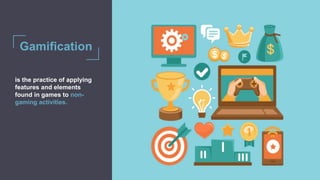
Gamification
is the practice of applying
features and elements
found in games to non-
gaming activities.
Why
Gamifiy?
page
04
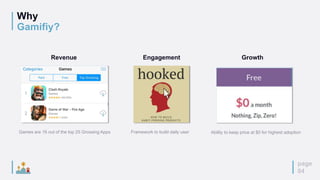
Games are 16 out of the top 25 Grossing Apps Framework to build daily user Ability to keep price at $0 for highest adoption
Revenue Engagement Growth
Presentation
Agenda
page
05
1. User Life-cycle: Thinking about what a user experienced over time
2. The Pillars of Game Design: The human behavior behind game design
3. Gamification Feature Examples: Applied Game Design to Non-Gaming
Apps
4. Live Example: Let’s build a game together!
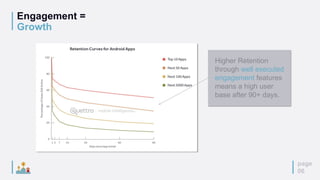
Engagement =
Growth
page
06
Higher Retention
through well executed
engagement features
means a high user
base after 90+ days.
User
Lifecycle
Design
page
08
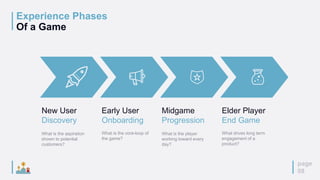
New User
Discovery
What is the aspiration
shown to potential
customers?
Early User
Onboarding
What is the core-loop of
the game?
Midgame
Progression
What is the player
working toward every
day?
Elder Player
End Game
What drives long term
engagement of a
product?
Experience Phases
Of a Game
page
09
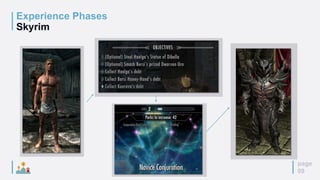
Experience Phases
Skyrim
page
010
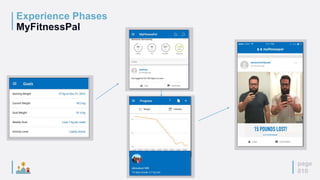
Experience Phases
MyFitnessPal
page
011
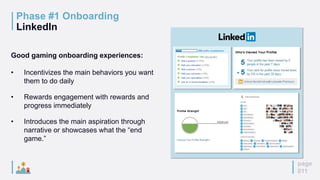
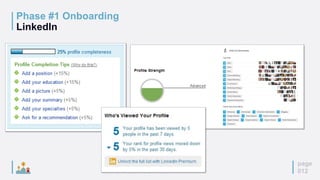
Phase #1 Onboarding
LinkedIn
Good gaming onboarding experiences:
• Incentivizes the main behaviors you want
them to do daily
• Rewards engagement with rewards and
progress immediately
• Introduces the main aspiration through
narrative or showcases what the “end
game.”
page
012
Phase #1 Onboarding
LinkedIn
page
013
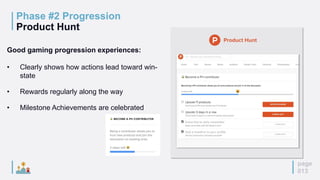
Phase #2 Progression
Product Hunt
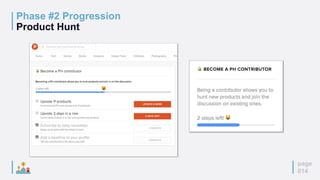
Good gaming progression experiences:
• Clearly shows how actions lead toward win-
state
• Rewards regularly along the way
• Milestone Achievements are celebrated
page
014
Phase #2 Progression
Product Hunt
page
015
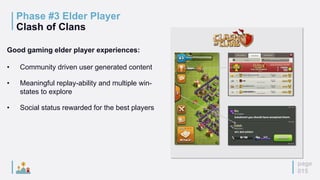
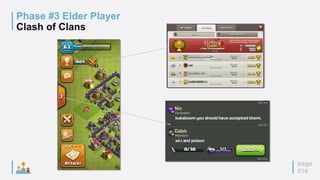
Phase #3 Elder Player
Clash of Clans
Good gaming elder player experiences:
• Community driven user generated content
• Meaningful replay-ability and multiple win-
states to explore
• Social status rewarded for the best players
page
016
Phase #3 Elder Player
Clash of Clans
page
017
Player Life Cycle
Putting it all together.
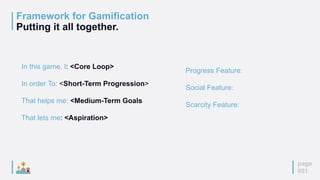
Filling in this Mad Lib-like framework will help to see if a game hits all these notes:
In this game, I: <Core Loop> (Plot plants, Track Calories)
In order To: <Short-Term Progression> (Purchase buildings, Lose Weight)
That helps me: <Medium-Term Goals> (Unlock new areas, Look + Feel Better)
That lets me: <Aspiration> (Have the best looking farm, Get a six pack)
Source: http://www.deconstructoroffun.com/2014/12/how-kim-kardashian-hollywood-made-a-list_19.html
Joe Traverso
Key Takeaway #1: Think about your product as multiple
experiences, treating users and players differently depending
on where they are in their lifecycle.
Principles
of
Game Design
Game Design
Principles
page
020
1. Core-Loop & Progression: Incentivizing the basic game actions
2. Resources & Completion: Resources, collection mechanics, and timers.
1. Ownership & Autonomy: Instilling emotional attachment to in-app thigns
1. Social Pressure & Belonging: Creating a social network to impact user
behavior
Core Loop +
Progression
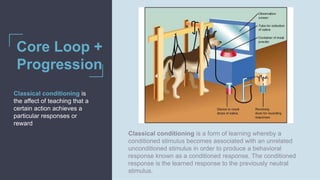
Classical conditioning is
the affect of teaching that a
certain action achieves a
particular responses or
reward
Classical conditioning is a form of learning whereby a
conditioned stimulus becomes associated with an unrelated
unconditioned stimulus in order to produce a behavioral
response known as a conditioned response. The conditioned
response is the learned response to the previously neutral
stimulus.
Core Loop + Achievement
Features Ideas
page
022
1. Core-Loop: Identify what the main actions we want to drive in the app
(Farmville, Reddit)
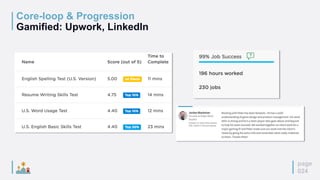
2. Rewarding progress through Milestones: Give players periodic rewards
for invested use in the product (Upwork, LinkedIn)
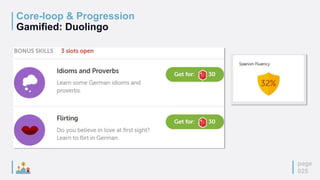
3. Unlockable Content: Make some features only available to those who invest
time into the app (Duolingo)
page
023
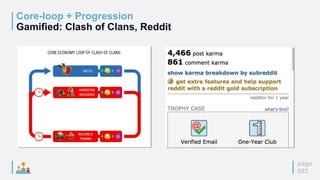
Core-loop + Progression
Gamified: Clash of Clans, Reddit
page
024
Core-loop & Progression
Gamified: Upwork, LinkedIn
page
025
Core-loop & Progression
Gamified: Duolingo
Key Takeaway #2: Identify the behavior you want to drive is.
Then incentivize that reward consistently and make sure the
user feels they are progressing.
Resources
&
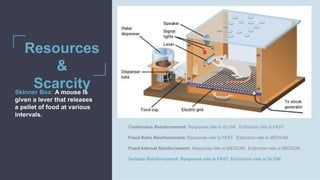
ScarcitySkinner Box: A mouse is
given a lever that releases
a pellet of food at various
intervals.
Continuous Reinforcement: Response rate is SLOW. Extinction rate is FAST
Fixed Ratio Reinforcement: Response rate is FAST. Extinction rate is MEDIUM
Fixed Interval Reinforcement: Response rate is MEDIUM. Extinction rate is MEDIUM
Variable Reinforcement: Response rate is FAST. Extinction rate is SLOW
Scarcity & Impatience
Features Ideas
page
028
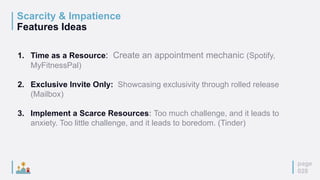
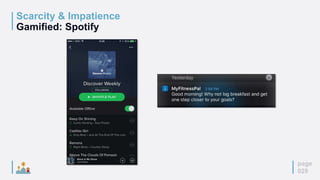
1. Time as a Resource: Create an appointment mechanic (Spotify,
MyFitnessPal)
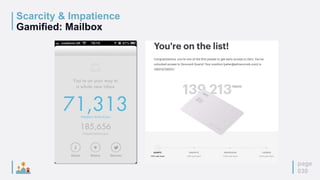
2. Exclusive Invite Only: Showcasing exclusivity through rolled release
(Mailbox)
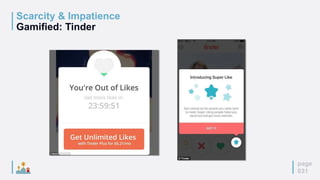
3. Implement a Scarce Resources: Too much challenge, and it leads to
anxiety. Too little challenge, and it leads to boredom. (Tinder)
page
029
Scarcity & Impatience
Gamified: Spotify
page
030
Scarcity & Impatience
Gamified: Mailbox
page
031
Scarcity & Impatience
Gamified: Tinder
Key Takeaway #3: User crave to be smart. Have them decide
how to spend their time and resources which will bestow on
them a sense of agency.
Ownership
+
Autonomy
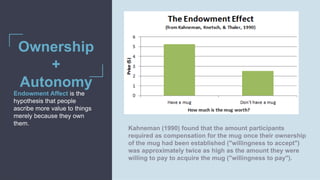
Endowment Affect is the
hypothesis that people
ascribe more value to things
merely because they own
them.
Kahneman (1990) found that the amount participants
required as compensation for the mug once their ownership
of the mug had been established ("willingness to accept")
was approximately twice as high as the amount they were
willing to pay to acquire the mug ("willingness to pay").
Possession +
Ownership
Features Ideas
page
034
1. Avatar Design: Players feel attached to an avatar they designed (BitMoji)
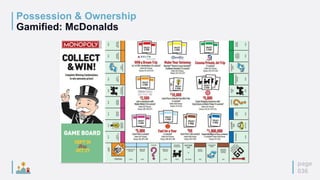
2. Collection Sets: Trying to catch them all (Pokémon, McDonalds)
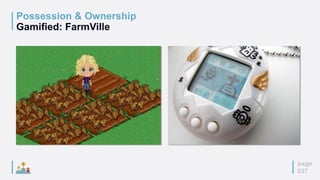
3. Loss Avoidance: Impulse to avoid losing progress (Farmville, Tamachi)
page
035
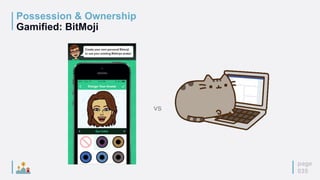
Possession & Ownership
Gamified: BitMoji
vs
page
036
Possession & Ownership
Gamified: McDonalds
page
037
Possession & Ownership
Gamified: FarmVille
Key Takeaway #4: Give the user something that they can love
and cherish, so that will be more likely to stay with your
product rather than move to a competitor.
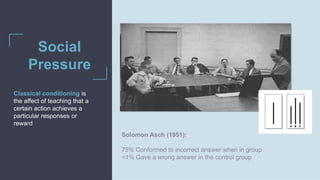
Solomon Asch (1951)
Social
Pressure
Classical conditioning is
the affect of teaching that a
certain action achieves a
particular responses or
reward
Solomon Asch (1951):
75% Conformed to incorrect answer when in group
<1% Gave a wrong answer in the control group
Social Pressure
Features Ideas
page
040
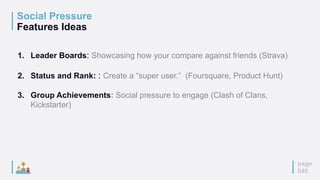
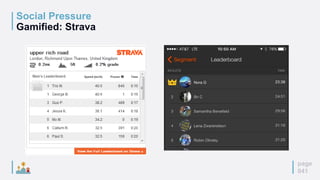
1. Leader Boards: Showcasing how your compare against friends (Strava)
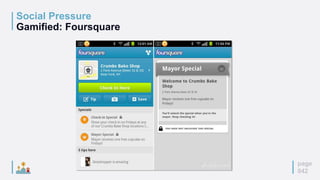
2. Status and Rank: : Create a “super user.” (Foursquare, Product Hunt)
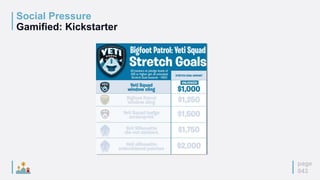
3. Group Achievements: Social pressure to engage (Clash of Clans,
Kickstarter)
page
041
Social Pressure
Gamified: Strava
page
042
Social Pressure
Gamified: Foursquare
page
043
Social Pressure
Gamified: Kickstarter
page
044
Social Pressure
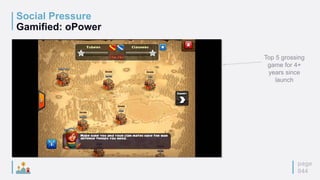
Gamified: oPower
Top 5 grossing
game for 4+
years since
launch
page
045
Social Pressure
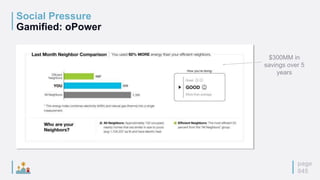
Gamified: oPower
$300MM in
savings over 5
years
Key Takeaway #5: Integrate a social element for your most
engaged users, so they can gain a sense of belonging to
your app, website, or service.
Some
Examples
page
048
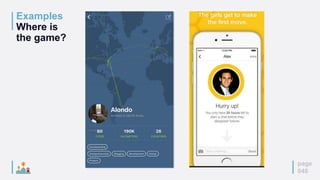
Examples
Where is
the game?
Doing it
Live
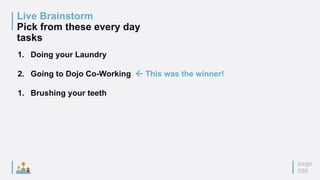
Live Brainstorm
Pick from these every day
tasks
page
050
1. Doing your Laundry
2. Going to Dojo Co-Working  This was the winner!
1. Brushing your teeth
page
051
Framework for Gamification
Putting it all together.
In this game, I: <Core Loop>
In order To: <Short-Term Progression>
That helps me: <Medium-Term Goals
That lets me: <Aspiration>
Progress Feature:
Social Feature:
Scarcity Feature:
Thank
You!

Gamification in 2017 - How to Engage Users with Game-Like Features