1
UN1001:
REACTOR CHEMISTRY AND CORROSION
Section 4: Galvanic Corrosion
By
D.H. Lister & W.G. Cook
Department of Chemical Engineering
University of New Brunswick
2
The Eight Forms of Corrosion
1. Uniform attack (general corrosion);
2. Galvanic corrosion;
3. Crevice corrosion;
4. Pitting;
5. Intergraular attack (“IGA”);
6. Selective leaching;
7. Flow-Accelerated Corrosion;
8. Stress corrosion cracking (“SCC”)
3
• Remember - electrochemistry basics in aqueous solution:
• metal dissolution is ANODIC:
M  Mn+ + n e-
(e.g. Fe  Fe 2+ + 2 e-)
4
• and there are several possible CATHODIC reactions:
• hydrogen evolution (acids) 2 H+ + 2 e-  H2
• oxygen reduction (acids) O2 + 4H+ + 4 e-  2 H2O
• oxygen reduction (neutral or base) O2 + 2 H2O + 4 e-  4 OH-
• metal ion reduction M3+ + e-  M2+
• metal deposition M+ + e-  M
• Note: More than one oxidation and more than one reduction
reaction can occur during corrosion.
5
• MULTIPLE CATHODIC REACTIONS ARE IMPORTANT.
• Thus, metals tend to dissolve more readily in aerated acids than
in pure, de-aerated acid:
• In aerated acids, oxygen reduction AND hydrogen evolution can occur
simultaneously:
2 H+ + 2 e-  H2
O2 + 4H+ + 4 e-  2 H2O
• Also, an oxidizer, such as ferric ion, as an impurity in commercial acids
makes them much more corrosive than pure acids because of the extra
cathodic reaction that may occur:
Fe3+ + e-  Fe2+
6
• Note: corrosion in sea water (or fresh water) is usually
governed by oxygen reduction.
• If water is de-aerated, it becomes much less corrosive
because the main reaction:
O2 + 2 H2O + 4 e-  4 OH-
can no longer occur.
• The cathodic reaction in absence of oxygen is hydrogen
evolution:
2 H+ + 2 e-  H2
7
• REMEMBER: the metal dissolution reaction (corrosion)
must always be balanced by one or more reduction
reactions:
• For example, in neutral or alkaline water:
2 Fe  2 Fe2+ + 4 e-
+ O2 + 2 H2O + 4 e-  4 OH-
2 Fe + O2 + 2 H2O  2 Fe2+ + 4 OH-
Fe2+ hydrolyses and precipitates, and is then oxidised to rust:
2 Fe(OH)2 ↓ + 1/2 O2 + H2O → 2 Fe(OH)3
8
• What about iron in a copper solution?
Fe  Fe2+ + 2 e-
Cu2+ + 2 e-  Cu
Fe + Cu2+  Fe2+ + Cu
• (the old “nail in copper sulphate” trick!)
• clearly, the iron wants to be in solution more than the
copper.
• the copper is more NOBLE than the iron;
• the iron is more ACTIVE than the copper.
9
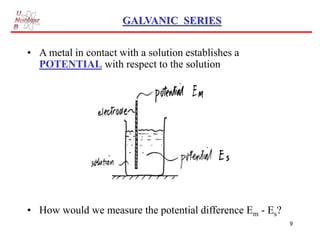
• A metal in contact with a solution establishes a
POTENTIAL with respect to the solution
• How would we measure the potential difference Em - Es?
GALVANIC SERIES
10
• Em - Es cannot be measured, we can only measure the
difference between it and Em - Es for another metal:
(Em1 - Es) - (Em2 - Es) = Em1 - Em2
11
• CHANGES in potential of one electrode can be measured
if the other electrode does not change, i.e. if it is a
reference electrode.
• There are several reference electrodes which are constant
so long as no current is drawn from them;
• Potentials relative to a reference electrode are therefore
measured with meters (e.g. milli-voltmeters) of high
impedance.
12
13
• A metal in contact with a solution of its own ions at unit activity
(thermodynamic concentration) establishes fixed potential differences
with respect to every other metal in the same condition OF
EQUILIBRIUM (potentials are reversible);
• THEREFORE, we can set up a series of standard electrode potentials
with respect to some reference electrode;
• The standard hydrogen electrode (SHE) is chosen to have a potential
of zero at 25C.
14
15
This has the accepted sign convention; however, some workers use opposite sign convention. These
potentials are listed in accordance with the Stockholm Convention. See J. O’M. Bockris and A. K. N.
Reddy, Modern Electrochemistry, Plenum Press, New York, 2002
16
COMMON REFERENCE ELECTRODES
• Ag(s)/AgCl(s) in 0.1 M KCl: + 0.288 V (SHE)
in sat. KCl: +0.192 V (SHE)
• Cu(s)/Cu SO4 (saturated): + 0.316 V (SHE)
• Hg(s)/ Hg2Cl2(s) in 0.1 M KCl: + 0.334 V (SHE)
in sat. KCl: +0.242 V (SHE)
17
• By coupling two reversible electrodes together, we get a
fixed potential difference:
e.g. Ag / Ag+ - Cu2+ / Cu = 0.799 V - 0.337 V = 0.462 V
(Discuss the possibility of making a reversible electrode out
of an alloy such as brass.)
18
• Note: If we drew current from two such electrodes
(reversible Ag, Cu) THEY WOULD NO LONGER BE
AT EQUILIBRIUM. THE REVERSIBILITY WOULD
BE DESTROYED.
• silver would be deposited more than silver ions would be
formed;
• copper ions would be formed more than copper would be
deposited;
19
• (remember, equilibrium or reversibility at an electrode
means the rate of the forward reaction equals the rate of
the back reaction).
• Another note: Corroding metals are not at equilibrium
NOR are they usually in contact with unit activity of their
own ions.
• THEREFORE the EMF series is an ideal system, which may be
used as an indicator for practical situations.
20
• IN GENERAL, as a rough guide:
• any metal in the EMF series will displace from solution
any metal above it
e.g. Fe displaces Cu from CuSO4 solution
Zn displaces H2 from acid solution.
• BUT passivation of some metals alters its behavior;
21
• Passivation is the formation of a very protective oxide
layer that makes the metal more noble than it otherwise
would be.
e.g. Cr is a fairly reactive element, but Cr metal is usually
passivated and cathodic to most common metals (hence
chrome plating).
22
• Galvanic corrosion MAY arise when dissimilar metals are in
contact in aqueous solution.
• The potential difference between them will initiate attack, the
corrosion rate depends on the surface reactions of (usually) both
metals
(i.e. we usually consider galvanic COUPLES of just two metals).
23
Galvanic potentials are made use of in batteries, e.g. the
Daniel cell.
In the Daniel cell, the zinc
electrode is 1.1V negative
with respect to the copper
electrode.
Which is the anode, the
cathode?
Which way does the
electrical current flow?
24
The sign of the voltage on the Daniel cell indicates that, upon placing a load on
the cell, a spontaneous de-electronation will occur on the zinc electrode;
and electronation, on the copper electrode.
25
• A Dry Cell:
• Dry cells are electrochemical energy storers in which the
electrolyte is immobilized in the form of a paste. A typical
dry cell is the Leclanche cell. A schematic diagram of this
cell is shown below. The reactions occurring in the cell
during discharge are:
at the anode: Zn  Zn2+ + 2 e-
at the cathode: 2 MnO2 + 2 H3O+ + 2 e-  Mn2O3 + 3 H2O
Or 2 MnO2 + H2O + 2 e-  Mn2O3 + 2 OH-
26
27
• Since hydroxide ions are produced during working (because H3O+ is
consumed), the following irreversible side reactions occur:
• OH- + NH4
+  H2O + NH3
• Zn2+ + 2 NH3 + 2 Cl-  Zn(NH3)2Cl2
• Zn2+ + 2 OH-  ZnO + H2O
• ZnO + Mn2O3  Mn2O3 ZnO
Owing to the above reactions, the cell is only partially rechargeable and
this to such a small extent that it is never done in practice.
28
• NOTE WELL:
• The analogy between aqueous corrosion processes (e.g.
galvanic couples) and cells / batteries is illuminating
but limited.
• The cathodic reaction in galvanic corrosion is usually
oxygen reduction or hydrogen evolution, not metal
deposition.
• To predict galvanic corrosion of couples in seawater, we
use the table of “Galvanic Series of some commercial
metals and alloys in seawater” that.
29
30
• EXAMPLES (from Fontana):
• A yacht with a Monel hull and steel rivets became unseaworthy
because of rapid corrosion of the rivets.
• Severe attack occurred on aluminum tubing connected to brass
return bends.
• Domestic hot-water tanks made of steel fail where copper tubing is
connected to the tank.
• Pump shafts and valve stems made of steel or more corrosion-
resistant materials fail because of contact with graphite packing.
31
32
Galvanic corrosion of painted steel auto body panel in contact with
stainless steel wheel opening molding.
33
Moisture, etc.
34
Statue of Liberty
35
• Surface oxides (e.g., “rust”) are very important in galvanic
corrosion:
• bare metal is a better cathode than oxide-covered metal;
• oxide interferes with hydrogen evolution and impedes
oxygen diffusion;
• oxide puts an additional electrical resistance in the
electrochemical circuit.
36
• Oxide film effects:
• In standard EMF series, Al is more active than Zn (-1.662 V versus
-0.763 V); we might expect that in a Zn-Al couple the Al would be
anodic to the Zn. NOT SO!
• The Al2O3 film makes the Al more noble, so that Zn is anodic to it
and actually protects it when coupled to it in solution (see
“Galvanic Series in Seawater”).
• The oxide film on stainless steel is electrically insulating and
impedes the charge flow between galvanic couples.
• The oxide film on copper is easily reduced. The resulting exposed
metal is an efficient cathode. Oxygen is readily reduced there.
Galvanic couples with copper can be very corrosive.
37
• Note: diffusion & reduction of O2 often control galvanic
corrosion, a large cathode area relative to the anode can be
disastrous; such effects common at joints, where
structures/components may be joined together with a
different metal.
38
Effects of area relationship on corrosion of rivets (steel-copper
couple) in seawater for 15 months.
39
• Discuss:
• Two different metals of approximately the same
area are joined to form a galvanic couple in a
corrosive solution; we are to reduce the corrosion
by coating (e.g., painting) one component of the
couple. Do we coat the anode or the cathode?
40
Example …
41
42
43
• Generally …
• Galvanic corrosion is under cathodic control … if we
reduce the area of the Cathode (by coating, etc.) we reduce
the corrosion; if we reduce the area of the Anode,
corrosion will continue at the same rate but over a smaller
area, so perforation etc. will occur sooner.
• TO REDUCE GALVANIC CORROSION BY
COATINGS, THE MORE CORROSION-RESISTANT
(i.e. THE MORE NOBLE OR CATHODIC)
COMPONENT OF THE COUPLE IS COATED.
44
CATHODIC PROTECTION
To reduce metallic corrosion, the component can made the CATHODE of
a galvanic cell
(a) by impressing an electric current from an external power source.
45
(b) by connecting the component to a SACRIFICIALANODE …
46
• Cathodic protection by:
• Impressed current
• Sacrificial anodes …
47
• ZINC PLATING (“ GALVANIZING”)
• Steel sheeting is coated with zinc by hot-dipping in the
molten metal, by heating with zinc dust (“Sherardizing”),
etc.
• The Zn coating acts as a sacrificial anode... at the
inevitable imperfections, holes, etc., zinc dissolves
preferentially, deposits loose, flocculant Zn(OH)2 from
aqueous solution.
48
Protection continues as long as enough Zn is left ... if large
enough areas of steel are exposed steel corrosion will occur
usually at the middle of the exposed area.
49
• If the temperature >60C, the Zn (OH)2 changes from a
loose to a hard, compact form.
• This MAY change the polarity of the steel/Zn couple by
making the Zn more noble than the steel; this CAN lead to
rapid failure of the steel.
• NOTE: Galvanized steel should only be used in pH range
6 - 12.5.. ready dissolution of Zn in acids and alkalis
quickly removes protection outside the range.
50
• CADMIUM PLATING … similar action on steels to zinc
plating:
• galvanic E less than for Zn;
• more protective than Zn in marine environments (chloride less
soluble than ZnCl2- gives more protective coat);
• better than zinc in humid conditions indoors;
• used less and less because Cd is toxic
• TIN PLATING … different action from Zn or Cd; Sn is
CATHODIC to steel; “pinhole” corrosion can occur at
imperfections in tin plate.
51
Tin plate commonly used on steel cans for foodstuffs. Organic
acids in foods, fruit juices etc., complex Sn2+ very readily ...
lower potential, make tin anodic to steel.
52
• Also, efficiency of Sn (and Fe) for H2 evolution poor; in
O2-starved environment inside a food can, only possible
cathodic reaction is H2 evolution; if evolution rate slow,
the corrosion rate is slow (tins don’t explode very often).
• NOTE: Galvanic corrosion can occur without components
of different metals actually being in electrical contact;
53
• e.g. if soft water containing CO2 (i.e. slightly acid from
carbonic acid) flows through copper pipes into a
galvanized tank, copper ions will deposit on the zinc as
metal:
Cu2+ + Zn  Cu + Zn2+
• The Cu is an efficient cathode and will rapidly destroy the
Zn coating.
54
MINIMIZE GALVANIC CORROSION
1. Select metals as close together as possible in galvanic series;
2. Avoid small-anode/large-cathode combinations . . . choose fasteners of
more noble materials;
3. Insulate dissimilar metals (e.g., sleeve bolts in flange joints, as well as
use insulating washers);
4. Apply coatings carefully, keep in good condition (esp. those on
anodes);
5. Add inhibitors, if possible, to environment;
6. Avoid threaded joints where possible;
7. Design for anodic member (make thicker, easily replaceable, etc.);
8. Install a third metal that is anodic to BOTH in the couple.

UN1001_Galvanic Corrosion.ppt

  • 1.
    1 UN1001: REACTOR CHEMISTRY ANDCORROSION Section 4: Galvanic Corrosion By D.H. Lister & W.G. Cook Department of Chemical Engineering University of New Brunswick
  • 2.
    2 The Eight Formsof Corrosion 1. Uniform attack (general corrosion); 2. Galvanic corrosion; 3. Crevice corrosion; 4. Pitting; 5. Intergraular attack (“IGA”); 6. Selective leaching; 7. Flow-Accelerated Corrosion; 8. Stress corrosion cracking (“SCC”)
  • 3.
    3 • Remember -electrochemistry basics in aqueous solution: • metal dissolution is ANODIC: M  Mn+ + n e- (e.g. Fe  Fe 2+ + 2 e-)
  • 4.
    4 • and thereare several possible CATHODIC reactions: • hydrogen evolution (acids) 2 H+ + 2 e-  H2 • oxygen reduction (acids) O2 + 4H+ + 4 e-  2 H2O • oxygen reduction (neutral or base) O2 + 2 H2O + 4 e-  4 OH- • metal ion reduction M3+ + e-  M2+ • metal deposition M+ + e-  M • Note: More than one oxidation and more than one reduction reaction can occur during corrosion.
  • 5.
    5 • MULTIPLE CATHODICREACTIONS ARE IMPORTANT. • Thus, metals tend to dissolve more readily in aerated acids than in pure, de-aerated acid: • In aerated acids, oxygen reduction AND hydrogen evolution can occur simultaneously: 2 H+ + 2 e-  H2 O2 + 4H+ + 4 e-  2 H2O • Also, an oxidizer, such as ferric ion, as an impurity in commercial acids makes them much more corrosive than pure acids because of the extra cathodic reaction that may occur: Fe3+ + e-  Fe2+
  • 6.
    6 • Note: corrosionin sea water (or fresh water) is usually governed by oxygen reduction. • If water is de-aerated, it becomes much less corrosive because the main reaction: O2 + 2 H2O + 4 e-  4 OH- can no longer occur. • The cathodic reaction in absence of oxygen is hydrogen evolution: 2 H+ + 2 e-  H2
  • 7.
    7 • REMEMBER: themetal dissolution reaction (corrosion) must always be balanced by one or more reduction reactions: • For example, in neutral or alkaline water: 2 Fe  2 Fe2+ + 4 e- + O2 + 2 H2O + 4 e-  4 OH- 2 Fe + O2 + 2 H2O  2 Fe2+ + 4 OH- Fe2+ hydrolyses and precipitates, and is then oxidised to rust: 2 Fe(OH)2 ↓ + 1/2 O2 + H2O → 2 Fe(OH)3
  • 8.
    8 • What aboutiron in a copper solution? Fe  Fe2+ + 2 e- Cu2+ + 2 e-  Cu Fe + Cu2+  Fe2+ + Cu • (the old “nail in copper sulphate” trick!) • clearly, the iron wants to be in solution more than the copper. • the copper is more NOBLE than the iron; • the iron is more ACTIVE than the copper.
  • 9.
    9 • A metalin contact with a solution establishes a POTENTIAL with respect to the solution • How would we measure the potential difference Em - Es? GALVANIC SERIES
  • 10.
    10 • Em -Es cannot be measured, we can only measure the difference between it and Em - Es for another metal: (Em1 - Es) - (Em2 - Es) = Em1 - Em2
  • 11.
    11 • CHANGES inpotential of one electrode can be measured if the other electrode does not change, i.e. if it is a reference electrode. • There are several reference electrodes which are constant so long as no current is drawn from them; • Potentials relative to a reference electrode are therefore measured with meters (e.g. milli-voltmeters) of high impedance.
  • 12.
  • 13.
    13 • A metalin contact with a solution of its own ions at unit activity (thermodynamic concentration) establishes fixed potential differences with respect to every other metal in the same condition OF EQUILIBRIUM (potentials are reversible); • THEREFORE, we can set up a series of standard electrode potentials with respect to some reference electrode; • The standard hydrogen electrode (SHE) is chosen to have a potential of zero at 25C.
  • 14.
  • 15.
    15 This has theaccepted sign convention; however, some workers use opposite sign convention. These potentials are listed in accordance with the Stockholm Convention. See J. O’M. Bockris and A. K. N. Reddy, Modern Electrochemistry, Plenum Press, New York, 2002
  • 16.
    16 COMMON REFERENCE ELECTRODES •Ag(s)/AgCl(s) in 0.1 M KCl: + 0.288 V (SHE) in sat. KCl: +0.192 V (SHE) • Cu(s)/Cu SO4 (saturated): + 0.316 V (SHE) • Hg(s)/ Hg2Cl2(s) in 0.1 M KCl: + 0.334 V (SHE) in sat. KCl: +0.242 V (SHE)
  • 17.
    17 • By couplingtwo reversible electrodes together, we get a fixed potential difference: e.g. Ag / Ag+ - Cu2+ / Cu = 0.799 V - 0.337 V = 0.462 V (Discuss the possibility of making a reversible electrode out of an alloy such as brass.)
  • 18.
    18 • Note: Ifwe drew current from two such electrodes (reversible Ag, Cu) THEY WOULD NO LONGER BE AT EQUILIBRIUM. THE REVERSIBILITY WOULD BE DESTROYED. • silver would be deposited more than silver ions would be formed; • copper ions would be formed more than copper would be deposited;
  • 19.
    19 • (remember, equilibriumor reversibility at an electrode means the rate of the forward reaction equals the rate of the back reaction). • Another note: Corroding metals are not at equilibrium NOR are they usually in contact with unit activity of their own ions. • THEREFORE the EMF series is an ideal system, which may be used as an indicator for practical situations.
  • 20.
    20 • IN GENERAL,as a rough guide: • any metal in the EMF series will displace from solution any metal above it e.g. Fe displaces Cu from CuSO4 solution Zn displaces H2 from acid solution. • BUT passivation of some metals alters its behavior;
  • 21.
    21 • Passivation isthe formation of a very protective oxide layer that makes the metal more noble than it otherwise would be. e.g. Cr is a fairly reactive element, but Cr metal is usually passivated and cathodic to most common metals (hence chrome plating).
  • 22.
    22 • Galvanic corrosionMAY arise when dissimilar metals are in contact in aqueous solution. • The potential difference between them will initiate attack, the corrosion rate depends on the surface reactions of (usually) both metals (i.e. we usually consider galvanic COUPLES of just two metals).
  • 23.
    23 Galvanic potentials aremade use of in batteries, e.g. the Daniel cell. In the Daniel cell, the zinc electrode is 1.1V negative with respect to the copper electrode. Which is the anode, the cathode? Which way does the electrical current flow?
  • 24.
    24 The sign ofthe voltage on the Daniel cell indicates that, upon placing a load on the cell, a spontaneous de-electronation will occur on the zinc electrode; and electronation, on the copper electrode.
  • 25.
    25 • A DryCell: • Dry cells are electrochemical energy storers in which the electrolyte is immobilized in the form of a paste. A typical dry cell is the Leclanche cell. A schematic diagram of this cell is shown below. The reactions occurring in the cell during discharge are: at the anode: Zn  Zn2+ + 2 e- at the cathode: 2 MnO2 + 2 H3O+ + 2 e-  Mn2O3 + 3 H2O Or 2 MnO2 + H2O + 2 e-  Mn2O3 + 2 OH-
  • 26.
  • 27.
    27 • Since hydroxideions are produced during working (because H3O+ is consumed), the following irreversible side reactions occur: • OH- + NH4 +  H2O + NH3 • Zn2+ + 2 NH3 + 2 Cl-  Zn(NH3)2Cl2 • Zn2+ + 2 OH-  ZnO + H2O • ZnO + Mn2O3  Mn2O3 ZnO Owing to the above reactions, the cell is only partially rechargeable and this to such a small extent that it is never done in practice.
  • 28.
    28 • NOTE WELL: •The analogy between aqueous corrosion processes (e.g. galvanic couples) and cells / batteries is illuminating but limited. • The cathodic reaction in galvanic corrosion is usually oxygen reduction or hydrogen evolution, not metal deposition. • To predict galvanic corrosion of couples in seawater, we use the table of “Galvanic Series of some commercial metals and alloys in seawater” that.
  • 29.
  • 30.
    30 • EXAMPLES (fromFontana): • A yacht with a Monel hull and steel rivets became unseaworthy because of rapid corrosion of the rivets. • Severe attack occurred on aluminum tubing connected to brass return bends. • Domestic hot-water tanks made of steel fail where copper tubing is connected to the tank. • Pump shafts and valve stems made of steel or more corrosion- resistant materials fail because of contact with graphite packing.
  • 31.
  • 32.
    32 Galvanic corrosion ofpainted steel auto body panel in contact with stainless steel wheel opening molding.
  • 33.
  • 34.
  • 35.
    35 • Surface oxides(e.g., “rust”) are very important in galvanic corrosion: • bare metal is a better cathode than oxide-covered metal; • oxide interferes with hydrogen evolution and impedes oxygen diffusion; • oxide puts an additional electrical resistance in the electrochemical circuit.
  • 36.
    36 • Oxide filmeffects: • In standard EMF series, Al is more active than Zn (-1.662 V versus -0.763 V); we might expect that in a Zn-Al couple the Al would be anodic to the Zn. NOT SO! • The Al2O3 film makes the Al more noble, so that Zn is anodic to it and actually protects it when coupled to it in solution (see “Galvanic Series in Seawater”). • The oxide film on stainless steel is electrically insulating and impedes the charge flow between galvanic couples. • The oxide film on copper is easily reduced. The resulting exposed metal is an efficient cathode. Oxygen is readily reduced there. Galvanic couples with copper can be very corrosive.
  • 37.
    37 • Note: diffusion& reduction of O2 often control galvanic corrosion, a large cathode area relative to the anode can be disastrous; such effects common at joints, where structures/components may be joined together with a different metal.
  • 38.
    38 Effects of arearelationship on corrosion of rivets (steel-copper couple) in seawater for 15 months.
  • 39.
    39 • Discuss: • Twodifferent metals of approximately the same area are joined to form a galvanic couple in a corrosive solution; we are to reduce the corrosion by coating (e.g., painting) one component of the couple. Do we coat the anode or the cathode?
  • 40.
  • 41.
  • 42.
  • 43.
    43 • Generally … •Galvanic corrosion is under cathodic control … if we reduce the area of the Cathode (by coating, etc.) we reduce the corrosion; if we reduce the area of the Anode, corrosion will continue at the same rate but over a smaller area, so perforation etc. will occur sooner. • TO REDUCE GALVANIC CORROSION BY COATINGS, THE MORE CORROSION-RESISTANT (i.e. THE MORE NOBLE OR CATHODIC) COMPONENT OF THE COUPLE IS COATED.
  • 44.
    44 CATHODIC PROTECTION To reducemetallic corrosion, the component can made the CATHODE of a galvanic cell (a) by impressing an electric current from an external power source.
  • 45.
    45 (b) by connectingthe component to a SACRIFICIALANODE …
  • 46.
    46 • Cathodic protectionby: • Impressed current • Sacrificial anodes …
  • 47.
    47 • ZINC PLATING(“ GALVANIZING”) • Steel sheeting is coated with zinc by hot-dipping in the molten metal, by heating with zinc dust (“Sherardizing”), etc. • The Zn coating acts as a sacrificial anode... at the inevitable imperfections, holes, etc., zinc dissolves preferentially, deposits loose, flocculant Zn(OH)2 from aqueous solution.
  • 48.
    48 Protection continues aslong as enough Zn is left ... if large enough areas of steel are exposed steel corrosion will occur usually at the middle of the exposed area.
  • 49.
    49 • If thetemperature >60C, the Zn (OH)2 changes from a loose to a hard, compact form. • This MAY change the polarity of the steel/Zn couple by making the Zn more noble than the steel; this CAN lead to rapid failure of the steel. • NOTE: Galvanized steel should only be used in pH range 6 - 12.5.. ready dissolution of Zn in acids and alkalis quickly removes protection outside the range.
  • 50.
    50 • CADMIUM PLATING… similar action on steels to zinc plating: • galvanic E less than for Zn; • more protective than Zn in marine environments (chloride less soluble than ZnCl2- gives more protective coat); • better than zinc in humid conditions indoors; • used less and less because Cd is toxic • TIN PLATING … different action from Zn or Cd; Sn is CATHODIC to steel; “pinhole” corrosion can occur at imperfections in tin plate.
  • 51.
    51 Tin plate commonlyused on steel cans for foodstuffs. Organic acids in foods, fruit juices etc., complex Sn2+ very readily ... lower potential, make tin anodic to steel.
  • 52.
    52 • Also, efficiencyof Sn (and Fe) for H2 evolution poor; in O2-starved environment inside a food can, only possible cathodic reaction is H2 evolution; if evolution rate slow, the corrosion rate is slow (tins don’t explode very often). • NOTE: Galvanic corrosion can occur without components of different metals actually being in electrical contact;
  • 53.
    53 • e.g. ifsoft water containing CO2 (i.e. slightly acid from carbonic acid) flows through copper pipes into a galvanized tank, copper ions will deposit on the zinc as metal: Cu2+ + Zn  Cu + Zn2+ • The Cu is an efficient cathode and will rapidly destroy the Zn coating.
  • 54.
    54 MINIMIZE GALVANIC CORROSION 1.Select metals as close together as possible in galvanic series; 2. Avoid small-anode/large-cathode combinations . . . choose fasteners of more noble materials; 3. Insulate dissimilar metals (e.g., sleeve bolts in flange joints, as well as use insulating washers); 4. Apply coatings carefully, keep in good condition (esp. those on anodes); 5. Add inhibitors, if possible, to environment; 6. Avoid threaded joints where possible; 7. Design for anodic member (make thicker, easily replaceable, etc.); 8. Install a third metal that is anodic to BOTH in the couple.