Learning higher-order thinking
skills in General Chemistry: Using
“ChemEd X Data” to teach
students self-regulation
Xavier Prat-Resina
Center for Learning Innovation
http://goo.gl/33xlc0
ROCHESTER
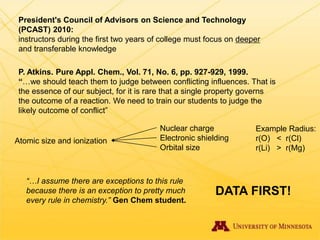
President's Council of Advisors on Science and Technology
(PCAST) 2010:
instructors during the first two years of college must focus on deeper
and transferable knowledge
P. Atkins. Pure Appl. Chem., Vol. 71, No. 6, pp. 927-929, 1999.
“…we should teach them to judge between conflicting influences. That is
the essence of our subject, for it is rare that a single property governs
the outcome of a reaction. We need to train our students to judge the
likely outcome of conflict”
“…I assume there are exceptions to this rule
because there is an exception to pretty much
every rule in chemistry.” Gen Chem student.
Atomic size and ionization
Nuclear charge
Electronic shielding
Orbital size
Example Radius:
r(O) < r(Cl)
r(Li) > r(Mg)
DATA FIRST!
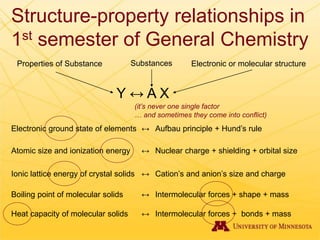
Structure-property relationships in
1st semester of General Chemistry
Y ↔ A X
Electronic or molecular structureProperties of Substance Substances
Electronic ground state of elements ↔ Aufbau principle + Hund’s rule
Atomic size and ionization energy ↔ Nuclear charge + shielding + orbital size
(it’s never one single factor
… and sometimes they come into conflict)
Ionic lattice energy of crystal solids ↔ Cation’s and anion’s size and charge
Boiling point of molecular solids ↔ Intermolecular forces + shape + mass
Heat capacity of molecular solids ↔ Intermolecular forces + bonds + mass
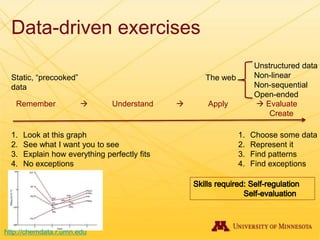
Data-driven exercises
Remember  Understand  Apply  Evaluate
Create
Unstructured data
Non-linear
Non-sequential
Open-ended
1. Choose some data
2. Represent it
3. Find patterns
4. Find exceptions
The webStatic, “precooked”
data
1. Look at this graph
2. See what I want you to see
3. Explain how everything perfectly fits
4. No exceptions
http://chemdata.r.umn.edu
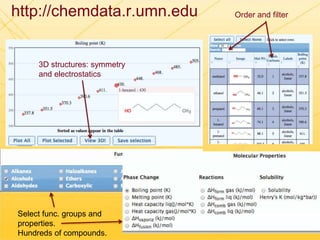
http://chemdata.r.umn.edu Order and filter
Select func. groups and
properties.
Hundreds of compounds.
3D structures: symmetry
and electrostatics
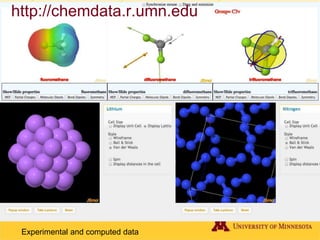
http://chemdata.r.umn.edu
Experimental and computed data
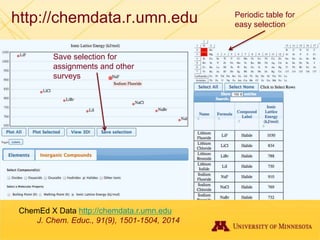
http://chemdata.r.umn.edu Periodic table for
easy selection
ChemEd X Data http://chemdata.r.umn.edu
J. Chem. Educ., 91(9), 1501-1504, 2014
Save selection for
assignments and other
surveys
Using ChemEdXData
Example 1:Boiling point of molecular solids
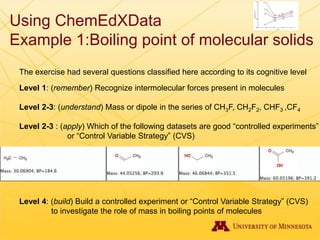
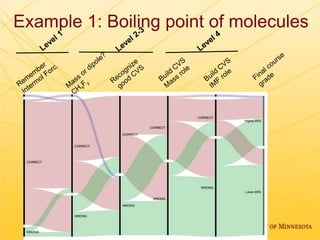
Level 1: (remember) Recognize intermolecular forces present in molecules
Level 2-3: (understand) Mass or dipole in the series of CH3F, CH2F2, CHF3 ,CF4
Level 2-3 : (apply) Which of the following datasets are good “controlled experiments”
or “Control Variable Strategy” (CVS)
Level 4: (build) Build a controlled experiment or “Control Variable Strategy” (CVS)
to investigate the role of mass in boiling points of molecules
The exercise had several questions classified here according to its cognitive level
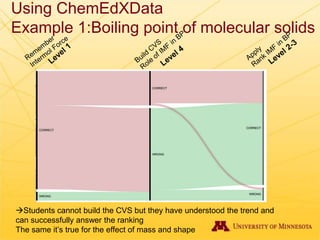
Students cannot build the CVS but they have understood the trend and
can successfully answer the ranking
The same it’s true for the effect of mass and shape
Using ChemEdXData
Example 1:Boiling point of molecular solids
Example 1: Boiling point of molecules
Using ChemEdXData
Example 2: Ionic lattice energy of
crystal solids
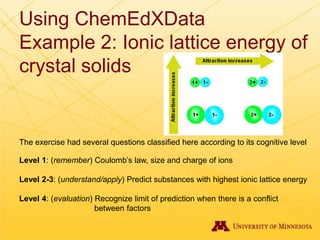
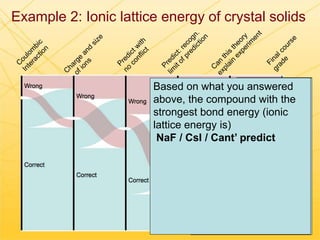
Level 1: (remember) Coulomb’s law, size and charge of ions
Level 2-3: (understand/apply) Predict substances with highest ionic lattice energy
Level 4: (evaluation) Recognize limit of prediction when there is a conflict
between factors
The exercise had several questions classified here according to its cognitive level
The melting point
of LiF is higher
than the melting
point of NaCl. In
this case the
coulombic model:
1) Can explain
2) Contradicts
observation
3) Model could
not have
predicted the
observation
Based on what you
answered above, the
compound with the
strongest bond energy
(ionic lattice energy is)
KF/NaCl/
can’t predict
Based on what you answered
above, the compound with the
strongest bond energy (ionic
lattice energy is)
NaF / CsI / Cant’ predict
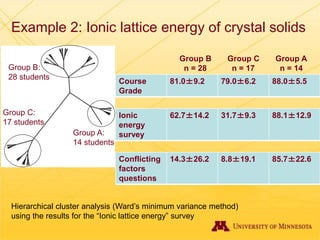
Example 2: Ionic lattice energy of crystal solids
Group B:
28 students
Group A:
14 students
Group C:
17 students
Course
Grade
81.0±9.2 79.0±6.2 88.0±5.5
Group B Group C Group A
n = 28 n = 17 n = 14
Ionic
energy
survey
62.7±14.2 31.7±9.3 88.1±12.9
Conflicting
factors
questions
14.3±26.2 8.8±19.1 85.7±22.6
Hierarchical cluster analysis (Ward’s minimum variance method)
using the results for the “Ionic lattice energy” survey
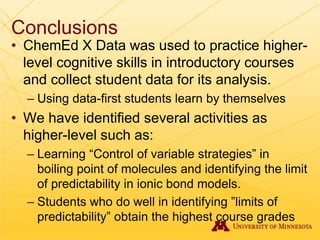
Conclusions
• ChemEd X Data was used to practice higher-
level cognitive skills in introductory courses
and collect student data for its analysis.
– Using data-first students learn by themselves
• We have identified several activities as
higher-level such as:
– Learning “Control of variable strategies” in
boiling point of molecules and identifying the limit
of predictability in ionic bond models.
– Students who do well in identifying ”limits of
predictability” obtain the highest course grades
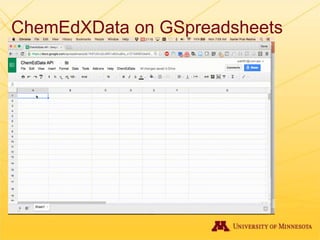
ChemEdXData on GSpreadsheets

Ecrice - ChemEd X Data - Barcelona - 2016 talk

  • 1.
    Learning higher-order thinking skillsin General Chemistry: Using “ChemEd X Data” to teach students self-regulation Xavier Prat-Resina Center for Learning Innovation http://goo.gl/33xlc0 ROCHESTER
  • 2.
    President's Council ofAdvisors on Science and Technology (PCAST) 2010: instructors during the first two years of college must focus on deeper and transferable knowledge P. Atkins. Pure Appl. Chem., Vol. 71, No. 6, pp. 927-929, 1999. “…we should teach them to judge between conflicting influences. That is the essence of our subject, for it is rare that a single property governs the outcome of a reaction. We need to train our students to judge the likely outcome of conflict” “…I assume there are exceptions to this rule because there is an exception to pretty much every rule in chemistry.” Gen Chem student. Atomic size and ionization Nuclear charge Electronic shielding Orbital size Example Radius: r(O) < r(Cl) r(Li) > r(Mg) DATA FIRST!
  • 3.
    Structure-property relationships in 1stsemester of General Chemistry Y ↔ A X Electronic or molecular structureProperties of Substance Substances Electronic ground state of elements ↔ Aufbau principle + Hund’s rule Atomic size and ionization energy ↔ Nuclear charge + shielding + orbital size (it’s never one single factor … and sometimes they come into conflict) Ionic lattice energy of crystal solids ↔ Cation’s and anion’s size and charge Boiling point of molecular solids ↔ Intermolecular forces + shape + mass Heat capacity of molecular solids ↔ Intermolecular forces + bonds + mass
  • 4.
    Data-driven exercises Remember Understand  Apply  Evaluate Create Unstructured data Non-linear Non-sequential Open-ended 1. Choose some data 2. Represent it 3. Find patterns 4. Find exceptions The webStatic, “precooked” data 1. Look at this graph 2. See what I want you to see 3. Explain how everything perfectly fits 4. No exceptions http://chemdata.r.umn.edu
  • 5.
    http://chemdata.r.umn.edu Order andfilter Select func. groups and properties. Hundreds of compounds. 3D structures: symmetry and electrostatics
  • 6.
  • 7.
    http://chemdata.r.umn.edu Periodic tablefor easy selection ChemEd X Data http://chemdata.r.umn.edu J. Chem. Educ., 91(9), 1501-1504, 2014 Save selection for assignments and other surveys
  • 8.
    Using ChemEdXData Example 1:Boilingpoint of molecular solids Level 1: (remember) Recognize intermolecular forces present in molecules Level 2-3: (understand) Mass or dipole in the series of CH3F, CH2F2, CHF3 ,CF4 Level 2-3 : (apply) Which of the following datasets are good “controlled experiments” or “Control Variable Strategy” (CVS) Level 4: (build) Build a controlled experiment or “Control Variable Strategy” (CVS) to investigate the role of mass in boiling points of molecules The exercise had several questions classified here according to its cognitive level
  • 9.
    Students cannot buildthe CVS but they have understood the trend and can successfully answer the ranking The same it’s true for the effect of mass and shape Using ChemEdXData Example 1:Boiling point of molecular solids
  • 10.
    Example 1: Boilingpoint of molecules
  • 11.
    Using ChemEdXData Example 2:Ionic lattice energy of crystal solids Level 1: (remember) Coulomb’s law, size and charge of ions Level 2-3: (understand/apply) Predict substances with highest ionic lattice energy Level 4: (evaluation) Recognize limit of prediction when there is a conflict between factors The exercise had several questions classified here according to its cognitive level
  • 12.
    The melting point ofLiF is higher than the melting point of NaCl. In this case the coulombic model: 1) Can explain 2) Contradicts observation 3) Model could not have predicted the observation Based on what you answered above, the compound with the strongest bond energy (ionic lattice energy is) KF/NaCl/ can’t predict Based on what you answered above, the compound with the strongest bond energy (ionic lattice energy is) NaF / CsI / Cant’ predict Example 2: Ionic lattice energy of crystal solids
  • 13.
    Example 2: Ioniclattice energy of crystal solids Group B: 28 students Group A: 14 students Group C: 17 students Course Grade 81.0±9.2 79.0±6.2 88.0±5.5 Group B Group C Group A n = 28 n = 17 n = 14 Ionic energy survey 62.7±14.2 31.7±9.3 88.1±12.9 Conflicting factors questions 14.3±26.2 8.8±19.1 85.7±22.6 Hierarchical cluster analysis (Ward’s minimum variance method) using the results for the “Ionic lattice energy” survey
  • 14.
    Conclusions • ChemEd XData was used to practice higher- level cognitive skills in introductory courses and collect student data for its analysis. – Using data-first students learn by themselves • We have identified several activities as higher-level such as: – Learning “Control of variable strategies” in boiling point of molecules and identifying the limit of predictability in ionic bond models. – Students who do well in identifying ”limits of predictability” obtain the highest course grades
  • 15.

Editor's Notes

  • #4 They all require an understanding of energy (pop up all circles) we will need to pay attention when assessing HOCS if they really understand energy So where’s the HOCS? Well, notice that there’s more than one factor and it may come into conflict.