International Journal of Software Engineering & Applications (IJSEA), Vol.3, No.3, May 2012
DOI : 10.5121/ijsea.2012.3304 35
UML2SAN: TOWARD A NEW SOFTWARE
PERFORMANCE ENGINEERING APPROACH
Ihab Sbeity1
, Mohamed Dbouk1
and Ilfat Ghamlouche2
1
Faculty of Sciences, Lebanese University, Lebanon
2
Faculty of Economical Sciences and Management, Lebanese University, Lebanon
ABSTRACT
Software Performance Engineering (SPE) has recently considered as an important issue in the software
development process. It consists on evaluate the performance of a system during the design phase. We have
recently proposed a new methodology to generate a Stochastic Automata Network (SAN) model from a
UML model, to consequently obtain performance predications from UML specifications. In this paper, we
expand our idea to cover more complex UML models taking in advantage the modularity of SAN in
modeling large systems. A formal description of the generation process is presented. The new extension
gives rise to a serious approach in SPE that we call UML2SAN.
KEYWORD
Software engineering, Performance software engineering, UML, Stochastic Automata Network.
1. INTRODUCTION
Software engineering has traditionally focused on functional requirements and how to build
software that has few bugs and can be easily maintained. Most design approaches include non-
functional requirements among the elements of the analysis of a system, but little attention has
usually been paid to how these requirements can be dealt with through the development life-cycle
[9].
Over the two last decades, the performance analysis of software systems during the design
process is becoming widely suitable. The benefit comes from getting quantitative predications
about the system before being implemented. That reduces the possibility of unexpected
shortcoming on the system functionality. .Moreover, an important methodology, initially
introduced by Smith [11], starts today to cover a large place in the software engineering area.
This methodology, called Performance Software Engineering (SPE), consists essentially on
introducing some techniques allowing obtaining performance predictions of the system basing on
the design model.
Several approaches have been introduced to provide SPE techniques. Some of them propose to
derive from a UML (Unified Modeling Language) model a separate performance model [5, 8,
International Journal of Software Engineering & Applications (IJSEA), Vol.3, No.3, May 2012
36
10]. In addition to the classification of UML as a universal modeling language widely used by
designers, it is apparently possible to attach performance analysis tools to UML notations in a
relatively straightforward manner. Our recent work in [10], initiates a preliminary methodology to
derive from UML a Stochastic Automata Network (SAN) model, a Markov-based model used to
generate performance predictions. The SAN formalism [7] is usually quite attractive when
modeling a system with several parallel cooperative activities. In addition, SAN permits to
represent a system in modular way. A SAN model is a state-transition graph having a strong
likeness with the UML state-chart diagram.
The purpose of this work is to make a step forward toward proposing a general heuristic to derive
a SAN model from complex UML model. In [10], our methodology is based on the UML state-
diagram, with transitions’ edges only labeled by unconditional triggers and actions. In this paper,
we show how to deal with conditional triggers. In addition, we show the impact of the
collaboration diagram in the derivation process. The demarche is also informally presented,
however, this works enlarge the possibility to propose a formal demarche.
The rest of this paper is organized as follows. Section 2 recalls the definition of the SAN as
modular formalism. Section 3 presents a UML producer/consumer example with conditional
triggers in the stat-chat diagram. This section shows the essential UML diagrams need for the
derivation of the SAN model. Section 4 explores how the UML model maps into SAN basing on
our case study. Section 5 concludes our paper and describes our ongoing works.
2. STOCHASTIC AUTOMATA NETWORKS
Stochastic Automata Networks (SAN) is a structured Markovian formalism, i.e., it describes
continuous-time Markovian models not as a flat system, but as a structured (modular and
organized) collection of subsystems. The basic modeling principle of SAN is to describe a whole
system by a collection of subsystems with an independent behavior and occasional
interdependencies. Each subsystem is described as a stochastic automaton, i.e., an automaton in
which the transitions are labeled with probabilistic and timing information. Hence, one can
always build a continuous-time stochastic process related to SAN [2, 12].
The global state of a SAN model is defined by the cartesian product of the local states of all
automata. There are two types of events that change the global state: local and synchronizing
events. Local events change the SAN global state passing from a global state to another that
differs only by one local state. Synchronizing events can change simultaneously more than one
local state, i.e., two or more automata can change their local states simultaneously. In other
words, the occurrence of a synchronizing event forces all concerned automata to fire a transition
corresponding to this event.
Each event is represented by an identifier and a rate of occurrence, which describes how often a
given event will occur. Each transition may be fired as result of the occurrence of any number of
events. In general, non-determinism among possible different events is dealt with according to
Markovian behavior, i.e., any of the events may occur and their occurrence rates define the
relative frequency with which each of them will occur. However, if, from a given local state, the
occurrence of a given event can lead to more than one state, then an additional routing probability
International Journal of Software Engineering & Applications (IJSEA), Vol.3, No.3, May 2012
37
must be informed to each possible destination state. The absence of routing probability is
tolerated if only one transition can be fired by an event from a given local state.
The other possibility of interaction among automata is the use of functional rates. Any event
occurrence rate may be expressed by a constant value or a function of the state of other automata.
By contrast with synchronizing events, functional rates are one-way interaction among automata,
since it affects only the automaton where it appears.
Figure 1 presents a SAN model with two automata, one synchronizing event (e2) with a constant
rate, and four local events, being three with constant rates (e3, e4 and e5) and one with a
functional rate (e1). In this model the rate of the event e1 is a functional rate f semantically
explained below, and described inside Figure 1 using the SAN notation. The interpretation of
such a function can be viewed as the evaluation of an expression of non-typed programming
languages, e.g., C language, where each comparison is evaluated to value 1 (true) or value 0
(false).
Figure 1 : Example of a SAN model
The firing of the transition from states 0(1)
to 1(1)
occurs with rate λ if
automaton A(2)
is in state 0(2)
, or γ if automaton A(2)
is in state 2(2)
. If
automaton A(2)
is in state 1(2)
, the transition from states 0(1)
to 1(1)
does not
occur (rate equal to 0). It is important to observe that the use of functions
allows a compact and flexible way to describe in one single event (local or
synchronized) alternative behaviors [2]. The advantage of using functions will
be obviously clear in our demarche of derivation a SAN model from UML
model.
International Journal of Software Engineering & Applications (IJSEA), Vol.3, No.3, May 2012
38
Figure 2: Equivalent Markov chain
Figure 2 shows the equivalent Markov chain model of the SAN model in Figure 1. Assuming the
state 0(1)
0(2)
is an initial state, only 5 of the 6 states in this Markov chain model are reachable. In
order to express the reachable global states of a SAN model, it is possible to define a
(reachability) function. The reachable states could also be computed by analyzing all possible
firing sequences, starting from a given reachable initial state. For the model in Figure 1, the
reachability function excludes the global state 1(1)
1(2)
, thus:
One of greatest advantages of the SAN formalism in comparison with straightforward Markov
chain, and even other structured formalism is to have since its first definition [7] a compact form
to store the infinitesimal generator of the equivalent Markov chain. Instead of storing an (usually)
huge matrix, the SAN formalism defines a storage based on a tensor formula of considerably
smaller matrices. Tensor, or Kronecker, algebra [3,4] is defined as a set of multi-dimensional
structures (tensors) and algebraic operations. It usually allows the very compact description of
quite large and complex matrices. Also, computation can be handled without ever generating
extensively the equivalent Markov chain.
3. A UML PRODUCER/CONSUMER MODEL
The Unified Modeling Language (UML) [6] is a graphically based notation, which is being
developed by the Object Management Group as a standard means of describing software oriented
designs. It contains several different types of diagram, which allow different aspects and
properties of a system design to be expressed. Diagrams must be supplemented by textual and
other descriptions to produce complete models. For example, a use case is really the description
of what lies inside the ovals of a use case diagram, rather than just the diagram itself.
Our concern in the approach we propose is basically UML models where the use of time has
significance. In fact, it is evident to say that the need to predict performance is applied only to
time-driven application, i.e. applications where objects actions are triggered by time progress.
International Journal of Software Engineering & Applications (IJSEA), Vol.3, No.3, May 2012
Thus, here we present an example of such time
producer/consumer model. The model we propose is
in [8]. In our model presentation we only focus o
behavior of the system, i.e. the class diagram (section 3.1),
diagrams (section 3.2).
3.1. The class diagram
A UML class model defines the essential types of object available to build a system; each class is
described by a rectangle with a name. This can be refined by adding compartments below the
name which list the attributes and operations contained in each instanc
this class. Classes are linked by lines known as
knows about the other. The direction of this knowledge is known as the
association. In an implementation an
reference variable of the type of the other class. Sometimes navigability has to be two ways, but it
more often one way. This can be shown by adding arrow head t
Figure 3: Producer/Consumer model
The class model of our producer/consumer application is presented in Figure 3.
system with two kinds of processes, producer and consumer that communicate via a buffer.
A producer spends time producing
Plus().
A consumer picks a message from the buffer, via the method
consuming it.
International Journal of Software Engineering & Applications (IJSEA), Vol.3, No.3, May 2012
an example of such time-driven applications which describes a
producer/consumer model. The model we propose is a more detailed extension of the model seen
]. In our model presentation we only focus of diagrams that describe the structure and the
e class diagram (section 3.1), and collaboration and state
class model defines the essential types of object available to build a system; each class is
described by a rectangle with a name. This can be refined by adding compartments below the
name which list the attributes and operations contained in each instance of (object derived from)
Classes are linked by lines known as associations which indicate that one of the classes
knows about the other. The direction of this knowledge is known as the navigability
association. In an implementation an association typically corresponds to one class having a
reference variable of the type of the other class. Sometimes navigability has to be two ways, but it
more often one way. This can be shown by adding arrow head to the end(s) of the association [
: Producer/Consumer model - the class diagram
producer/consumer application is presented in Figure 3. We assu
system with two kinds of processes, producer and consumer that communicate via a buffer.
A producer spends time producing a message before sending it to the buffer due to the method
consumer picks a message from the buffer, via the method Minus(), and then spends some time
International Journal of Software Engineering & Applications (IJSEA), Vol.3, No.3, May 2012
39
which describes a
extension of the model seen
f diagrams that describe the structure and the
and state-chart
class model defines the essential types of object available to build a system; each class is
described by a rectangle with a name. This can be refined by adding compartments below the
e of (object derived from)
which indicate that one of the classes
navigability of the
association typically corresponds to one class having a
reference variable of the type of the other class. Sometimes navigability has to be two ways, but it
o the end(s) of the association [8].
We assume a
system with two kinds of processes, producer and consumer that communicate via a buffer.
the buffer due to the method
, and then spends some time
International Journal of Software Engineering & Applications (IJSEA), Vol.3, No.3, May 2012
The variable t of the super-class
a producer, respectively a consumer. Of course, the value of this variable may be different for
each process (producer and consumer).
The buffer has some capacity, described by its variable
implies that it may to receive new message from the producer. The value of the attribute
is set to true when the buffer is full. On the other hand, the attribute available is set to false when
the buffer is empty, meaning that the consumer cannot pick messages from the buffer.
We also assume the existence of the two methods
the attributes Available and Blocked
demarche intending to derive a SAN model as i
3.2. Collaboration and State
Collaborations describe the way the objects interact
instances of classes behave internally
full description of how the system works.
3.2.1. Collaboration Diagram
Collaborations are collections of objects, linked to show the relevant associations between their
classes. Here “time” is not represented explicitly. Instead the emphasis is on showing which
objects communicate with which others.
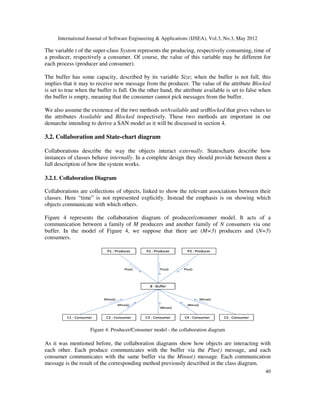
Figure 4 represents the collaboration diagram of
communication between a family of
buffer. In the model of Figure 4, we suppose that there are (
consumers.
Figure 4: Producer/Consumer model
As it was mentioned before, the collaboration diagrams show how objects are interacting with
each other. Each produce communicates with the buffer via the
consumer communicates with the same buffer via the
message is the result of the corresponding method previously described in the class diagram.
International Journal of Software Engineering & Applications (IJSEA), Vol.3, No.3, May 2012
class System represents the producing, respectively consuming, time of
a producer, respectively a consumer. Of course, the value of this variable may be different for
s (producer and consumer).
The buffer has some capacity, described by its variable Size; when the buffer is not full, this
receive new message from the producer. The value of the attribute
is set to true when the buffer is full. On the other hand, the attribute available is set to false when
the buffer is empty, meaning that the consumer cannot pick messages from the buffer.
We also assume the existence of the two methods setAvailable and setBlocked that gives values to
Blocked respectively. These two methods are important in our
demarche intending to derive a SAN model as it will be discussed in section 4.
and State-chart diagram
tions describe the way the objects interact externally. Statescharts describe how
internally. In a complete design they should provide between them a
full description of how the system works.
Collaborations are collections of objects, linked to show the relevant associations between their
classes. Here “time” is not represented explicitly. Instead the emphasis is on showing which
objects communicate with which others.
collaboration diagram of producer/consumer model.
a family of M producers and another family of N consumers via one
buffer. In the model of Figure 4, we suppose that there are (M=3) producers and (
: Producer/Consumer model - the collaboration diagram
As it was mentioned before, the collaboration diagrams show how objects are interacting with
each other. Each produce communicates with the buffer via the Plus() messag
consumer communicates with the same buffer via the Minus() message. Each communication
message is the result of the corresponding method previously described in the class diagram.
International Journal of Software Engineering & Applications (IJSEA), Vol.3, No.3, May 2012
40
represents the producing, respectively consuming, time of
a producer, respectively a consumer. Of course, the value of this variable may be different for
; when the buffer is not full, this
receive new message from the producer. The value of the attribute Blocked
is set to true when the buffer is full. On the other hand, the attribute available is set to false when
the buffer is empty, meaning that the consumer cannot pick messages from the buffer.
that gives values to
respectively. These two methods are important in our
. Statescharts describe how
. In a complete design they should provide between them a
Collaborations are collections of objects, linked to show the relevant associations between their
classes. Here “time” is not represented explicitly. Instead the emphasis is on showing which
It acts of a
consumers via one
) producers and (N=5)
As it was mentioned before, the collaboration diagrams show how objects are interacting with
message, and each
message. Each communication
message is the result of the corresponding method previously described in the class diagram.
International Journal of Software Engineering & Applications (IJSEA), Vol.3, No.3, May 2012
3.2.2. State-chart Diagram
On the other hand, state-charts d
provide a full description of how the system works. We insert the state
its box in the collaboration. At any point in the lifetime of this system, each object must b
and only one, of its internal states. Each time a message (event) is passed, it may
change in the receiving object and this may cause a further message to be passed
object and another with which it has an association.
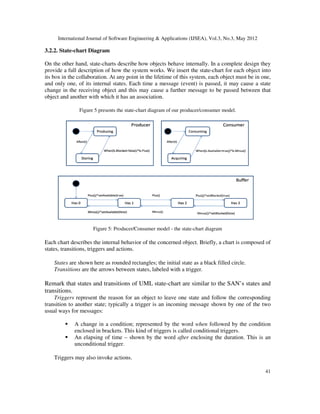
Figure 5 presents the
Figure 5: Producer/Consumer model
Each chart describes the internal behavior of the concerned object. Briefly, a chart is com
states, transitions, triggers and actions.
States are shown here as rounded rectangles
Transitions are the arrows between states, labeled with a trigger.
Remark that states and transition
transitions.
Triggers represent the reason for an object to leave one state and follow the correspond
transition to another state; typically a trigger is an incoming message shown by one of the two
usual ways for messages:
 A change in a condition; represented by the word
enclosed in brackets.
 An elapsing of time
unconditional trigger.
Triggers may also invoke actions
International Journal of Software Engineering  Applications (IJSEA), Vol.3, No.3, May 2012
charts describe how objects behave internally. In a complete design they
provide a full description of how the system works. We insert the state-chart for each object into
its box in the collaboration. At any point in the lifetime of this system, each object must b
and only one, of its internal states. Each time a message (event) is passed, it may
change in the receiving object and this may cause a further message to be passed
object and another with which it has an association.
igure 5 presents the state-chart diagram of our producer/consumer model.
: Producer/Consumer model - the state-chart diagram
Each chart describes the internal behavior of the concerned object. Briefly, a chart is com
states, transitions, triggers and actions.
here as rounded rectangles; the initial state as a black filled circle.
are the arrows between states, labeled with a trigger.
that states and transitions of UML state-chart are similar to the SAN’s states and
represent the reason for an object to leave one state and follow the correspond
transition to another state; typically a trigger is an incoming message shown by one of the two
A change in a condition; represented by the word when followed by the condition
enclosed in brackets. This kind of triggers is called conditional triggers.
An elapsing of time – shown by the word after enclosing the duration.
unconditional trigger.
ctions.
International Journal of Software Engineering  Applications (IJSEA), Vol.3, No.3, May 2012
41
behave internally. In a complete design they
chart for each object into
its box in the collaboration. At any point in the lifetime of this system, each object must be in one,
and only one, of its internal states. Each time a message (event) is passed, it may cause a state
change in the receiving object and this may cause a further message to be passed between that
Each chart describes the internal behavior of the concerned object. Briefly, a chart is composed of
; the initial state as a black filled circle.
chart are similar to the SAN’s states and
represent the reason for an object to leave one state and follow the corresponding
transition to another state; typically a trigger is an incoming message shown by one of the two
followed by the condition
This kind of triggers is called conditional triggers.
enclosing the duration. This is an
International Journal of Software Engineering  Applications (IJSEA), Vol.3, No.3, May 2012
42
Actions are prefixed with a forward slash and carried out before entering the new state. These
actions may be local method of the object where the trigger is fired, or a method of another
object. In the second case, the invoked action represents then a trigger in the chart corresponding
to the concerned object.
In order to simplify the process of derivation in section 5, we propose some definitions.
Definition 1
A trigger is called of type T1, if it does not fire an action.
Definition 2
A trigger is called of type T2, if it fires one or more actions.
Back to Figure 5, the behavior of each object type is described by a chart. For example, a
producer alternates between two states: the state where it is producing a message and the state
where it is storing the message in the buffer. The transition from the Producing state to the
Storing state is labeled by the trigger after(t), e.g. t is the class variable. This trigger does not fire
any action, it is of type T1. The trigger when[b.Blocked = false], labeling the reverse transition,
invoke the action b.Plus() in the chart corresponding to buffer. This trigger is of type T2.
It is important to notice that triggers of type T1 look like local events in a SAN model. A trigger
of type T2 seems resembling SAN synchronizing event.
Definition 3
Let t be a trigger of type T2, we call Seq(t) the set of different action sequences that may be fired
by t.
Card(Seq(t)) is the cardinality of Seq(t) and it is equal to the number of sequences in Seq(t).
According to definition 3, consider the type T2 trigger t = when[b.Blocked = false], the set
Seq(t), is identified by taking into consideration the different sequence of actions that the trigger
may fire. In our example, Seq(t) is composed of three sequences S1, S2 amd S3 such that:
Seq(t) = { S1: when[b.Blocked = false]  b.Plus()  setAvailable(True)
S2: when[b.Blocked = false]  b.Plus()
S3: when[b.Blocked = false]  b.Plus() setBlocked(True) }
In fact, when the event when[b.Blocked = false] is invoked, it fires the action b.Plus(). However
the firing of this action may also fires another action depending on the state of the the state-chart
Buffer. If the local state is Has0, setAvailable(True) is fired, if the local state is Has1 no other
action is fired, and if the local state is Has2, the setBlocked(True) is fired. Card(Seq(t)) is equal to
3.
International Journal of Software Engineering  Applications (IJSEA), Vol.3, No.3, May 2012
43
Moreover, states of the buffer represent the number of messages available in the buffer. The
number of these states is equal to the buffer size (here, size = 3). Triggers labeling transitions of
the chart buffer, i.e. Plus() and Minus(), are actions invoked by a producer or a consumer. We
underline that the action setAvailable(), respectively setBlocked(), change the value of the
Boolean variable Available, respectively Blocked, that affects the firing of the trigger
when[b.Available= true] in the chart consumer, respectively the trigger when[b.Blocked = false]
in the char producer. This means that at any time, we need to know the value of the variable in
order to enable or disable the firing of the trigger. Recalling a SAN model, this phenomenon
gives the impression to be similar to a functional rate that depends on the variable’s value. We
call such variables, i.e. which affect the firing of a trigger, affecting variables.
The overall state of a system will be the combination of all the current internal state of its objects,
plus the current values of any relevant attributes, i.e. Blocked and Available. As we mentioned
before, intuitively, readers may sense a strong similarity to the stochastic automata networks
behavior. A SAN automaton is a set of states, transitions and events. The global state of a SAN is
a combination of the local states of its automata. The powerful point of mapping the state-chart
diagram into a SAN model is that the mapping process will not produce fundamental changes in
the graph structure, only some information needed to represent relevant attributes and the time
spent in a state is required. That may help designers to better understand the SAN performance
model which is an emphasized advantage of our approach.
4. Generating the SAN model
In the previous section, we highlighted the basic elements on which our generation process is
principally based. In this section, we present how a SAN model is directly generated for the UML
producer/consumer, giving a sense for a systematical generation process. The SAN automata are
these corresponding to UML state-charts and these necessary to represent the affecting variables
value. The generation process is composed of multiple steps. As it is shown in [10], it is
important to see that there is an intuitive mapping of the UML state-chat into SAN. A state-chart
automaton is mapped into SAN automaton (states and transitions). The state-chart events are
translated as SAN events. However, there is still some work to achieve in order to take into
consideration the affecting variables. In the following, we formally describe the procedure of the
generation of the SAN model and we illustrate each step of the procedure basing on our
producer/consumer model. In the following, each subsection represents a step in our generation
process. Some of these steps are formally described; however others are presented basing on
intuitive observations.
4.1. Step 1: States/transitions mapping
The first step is to create SAN automata that correspond to state-charts. Only states and
transitions are created in this step. The labels of SAN transitions, i.e. events, are created in step 3.
Step 1: Statechart -- States/Transitions Mapping
For each automaton X of the UML state-chart, create a SAN automata Y as following:
Omit the initial state.
For each state IX in X, create the state IY in Y.
For each transition in X from state IX to state JX, create a transition from IY to JY in Y.
International Journal of Software Engineering  Applications (IJSEA), Vol.3, No.3, May 2012
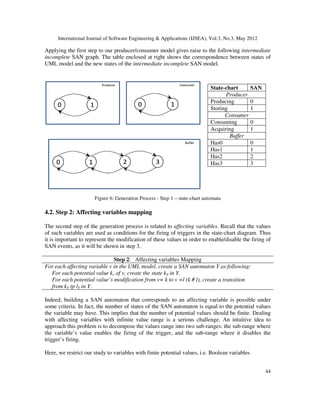
Applying the first step to our producer/consumer model gives raise to the
incomplete SAN graph. The table enclosed at right shows the correspondence between states of
UML model and the new states of the
Figure 6: Generation Process
4.2. Step 2: Affecting variables mapping
The second step of the generation process is related to
of such variables are used as conditions for the firing of triggers
it is important to represent the modification of these values in order to enable/disable th
SAN events, as it will be shown in step 3.
Step 2
For each affecting variable v in the UML model
For each potential value kv of v, create the state k
For each potential value’s modification from v= k to v =
from kY tp lY in Y.
Indeed, building a SAN automaton that corresponds to
some criteria. In fact, the number of states of the SAN automaton
the variable may have. This implies
with affecting variables with infinite value range is a serious challenge. An intuitive idea
approach this problem is to decompose the values
the variable’s value enables the firing of the trigger, and the sub
trigger’s firing.
Here, we restrict our study to variables with finite potential va
International Journal of Software Engineering  Applications (IJSEA), Vol.3, No.3, May 2012
Applying the first step to our producer/consumer model gives raise to the following
The table enclosed at right shows the correspondence between states of
UML model and the new states of the intermediate incomplete SAN model.
State-chart
Producer
Producing
Storing
Consumer
Consuming
Acquiring
Buffer
Has0
Has1
Has2
Has3
: Generation Process - Step 1 – state-chart automata
Step 2: Affecting variables mapping
The second step of the generation process is related to affecting variables. Recall that the values
of such variables are used as conditions for the firing of triggers in the state-chart diagram
he modification of these values in order to enable/disable th
shown in step 3.
Step 2: Affecting variables Mapping
For each affecting variable v in the UML model, create a SAN automaton Y as following:
of v, create the state kY in Y.
value’s modification from v= k to v =l (k # l), create a transition
, building a SAN automaton that corresponds to an affecting variable is possible under
he number of states of the SAN automaton is equal to the potential values
the variable may have. This implies that the number of potential values should be finite. Dealing
with affecting variables with infinite value range is a serious challenge. An intuitive idea
ecompose the values range into two sub-ranges: the sub
the variable’s value enables the firing of the trigger, and the sub-range where it disables the
to variables with finite potential values, i.e. Boolean variables.
International Journal of Software Engineering  Applications (IJSEA), Vol.3, No.3, May 2012
44
following intermediate
The table enclosed at right shows the correspondence between states of
SAN
Producer
0
1
Consumer
0
1
Buffer
0
1
2
3
. Recall that the values
chart diagram. Thus
he modification of these values in order to enable/disable the firing of
Y as following:
transition
affecting variable is possible under
is equal to the potential values
that the number of potential values should be finite. Dealing
with affecting variables with infinite value range is a serious challenge. An intuitive idea to
ranges: the sub-range where
range where it disables the
e. Boolean variables.
International Journal of Software Engineering  Applications (IJSEA), Vol.3, No.3, May 2012
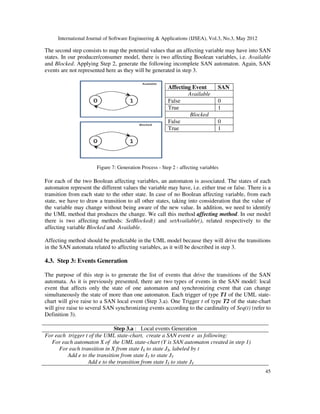
The second step consists to map the potential values that an affecting variable may have into
states. In our producer/consumer model, there is two
and Blocked. Applying Step 2, generat
events are not represented here as they will be generated in step 3.
Figure 7: Generation
For each of the two Boolean affecting variables, an automaton is associated. The states of each
automaton represent the different values the variable may have, i.e. either true or false. There is a
transition from each state to the other state. In case of no Boolean affecting variable, from each
state, we have to draw a transition to all other states, taking into consideration that the value of
the variable may change without being aware of the new value. In additio
the UML method that produces the change.
there is two affecting methods:
affecting variable Blocked and Available
Affecting method should be predictable in the UML model because they will drive the transitions
in the SAN automata related to affecting variables, a
4.3. Step 3: Events Generation
The purpose of this step is to generate the list of events that drive the trans
automata. As it is previously presented, there are two types of events in the SAN model: local
event that affects only the state of one automaton and synchronizing event that can change
simultaneously the state of more than one automaton.
chart will give raise to a SAN local event (Step 3.a). One Trigger
will give raise to several SAN synchronizing events according to th
Definition 3).
Step 3
For each trigger t of the UML state
For each automaton X of the UML state
For each transition in X from state I
Add e to the transition from state I
International Journal of Software Engineering  Applications (IJSEA), Vol.3, No.3, May 2012
The second step consists to map the potential values that an affecting variable may have into
cer/consumer model, there is two affecting Boolean variables, i.e.
. Applying Step 2, generate the following incomplete SAN automaton.
events are not represented here as they will be generated in step 3.
Affecting Event SAN
Available
False 0
True 1
Blocked
False 0
True 1
: Generation Process - Step 2 - affecting variables
For each of the two Boolean affecting variables, an automaton is associated. The states of each
automaton represent the different values the variable may have, i.e. either true or false. There is a
each state to the other state. In case of no Boolean affecting variable, from each
state, we have to draw a transition to all other states, taking into consideration that the value of
the variable may change without being aware of the new value. In addition, we need to identify
the UML method that produces the change. We call this method affecting method.
there is two affecting methods: SetBlocked() and setAvailable(), related respectively to the
Available.
Affecting method should be predictable in the UML model because they will drive the transitions
in the SAN automata related to affecting variables, as it will be described in step 3.
Step 3: Events Generation
generate the list of events that drive the transitions of the SAN
t is previously presented, there are two types of events in the SAN model: local
event that affects only the state of one automaton and synchronizing event that can change
te of more than one automaton. Each trigger of type T1 of the UML state
chart will give raise to a SAN local event (Step 3.a). One Trigger t of type T2 of the state
will give raise to several SAN synchronizing events according to the cardinality of Seq(t)
Step 3.a : Local events Generation
state-chart, create a SAN event e as following:
For each automaton X of the UML state-chart (Y is SAN automaton created in step 1)
each transition in X from state IX to state JX, labeled by t
Add e to the transition from state IY to state JY
International Journal of Software Engineering  Applications (IJSEA), Vol.3, No.3, May 2012
45
The second step consists to map the potential values that an affecting variable may have into SAN
s, i.e. Available
SAN automaton. Again, SAN
For each of the two Boolean affecting variables, an automaton is associated. The states of each
automaton represent the different values the variable may have, i.e. either true or false. There is a
each state to the other state. In case of no Boolean affecting variable, from each
state, we have to draw a transition to all other states, taking into consideration that the value of
n, we need to identify
In our model
, related respectively to the
Affecting method should be predictable in the UML model because they will drive the transitions
itions of the SAN
t is previously presented, there are two types of events in the SAN model: local
event that affects only the state of one automaton and synchronizing event that can change
of the UML state-
of the state-chart
Seq(t) (refer to
chart (Y is SAN automaton created in step 1)
International Journal of Software Engineering  Applications (IJSEA), Vol.3, No.3, May 2012
Step 3.b
For each trigger t of the UML state
For each sequence of actions
create a SAN event eS as following:
For each automaton X of the UML state
automaton created in step 1)
For each transition in X
Add eS to the transition from state I
For each action a in S
If a is an affecting method then
Add eS to the corresponding automata (of the affecting variable)
Else
For each automaton X of the UML state
SAN automaton created in step 1)
For each transition in X from state I
Add eS to the transition from state I
Applying the third step to our producer/consumer example gives raise to the graph
The automata presented in this figure are the set of aut
Figure 8: Generation Process
For example, the local event e1
trigger after(t) of the Producer state
trigger is of type T1. The trigger
SAN events, i.e. e31, e32 and e3
actions (see section 3.2.2). Each
corresponds to the sequence S1:
sequence involves methods in the state
state-chart Buffer, i.e. b.Plus() , and a method that invoques a change in the value of the affecting
International Journal of Software Engineering  Applications (IJSEA), Vol.3, No.3, May 2012
Step 3.b : Synchronizing events Generation
For each trigger t of the UML state-chart
For each sequence of actions S in Seq (t)
as following:
For each automaton X of the UML state-chart and Y its corresponding SAN
automaton created in step 1)
For each transition in X from state IX to state JX, labeled by t
to the transition from state IY to state JY
If a is an affecting method then
to the corresponding automata (of the affecting variable)
For each automaton X of the UML state-chart and Y its corresponding
SAN automaton created in step 1)
For each transition in X from state IX to state JX, labeled by a
to the transition from state IY to state JY
Applying the third step to our producer/consumer example gives raise to the graph
The automata presented in this figure are the set of automata created in step 1 and 2.
: Generation Process - Step 3 - events generation
e1 of the SAN automaton Producer is the corresponding of the
of the Producer state-chart. This event is generated according to Step 3.a, as the
The trigger t = when[b.Blocked = false], of type T2, gives raise for three
e33. Recall that the set Seq(t) contains three different sequences of
Each event corresponds to a sequence. For example, The event
corresponds to the sequence S1: when[b.Blocked = false]  b.Plus()  setAvailable(True
sequence involves methods in the state-chart Producer, i.e. when[b.Blocked = false]
, and a method that invoques a change in the value of the affecting
International Journal of Software Engineering  Applications (IJSEA), Vol.3, No.3, May 2012
46
SAN
chart and Y its corresponding
Applying the third step to our producer/consumer example gives raise to the graph of figure 8.
omata created in step 1 and 2.
is the corresponding of the
chart. This event is generated according to Step 3.a, as the
, gives raise for three
contains three different sequences of
event corresponds to a sequence. For example, The event e31
setAvailable(True). This
when[b.Blocked = false], and the
, and a method that invoques a change in the value of the affecting
International Journal of Software Engineering  Applications (IJSEA), Vol.3, No.3, May 2012
variable Available. Thus, the event e3
and Available, and it labels the corresponding transitions.
4.4. Step 4: Events’ rates
Basing on Step 3, it may be noticed that two categories of events may be underlined: events
corresponding to the “when” methods, e.g. the event e3
“when” method, e.g. the event e1
occurrence of a sequence of methods.
For each event e that does not correspond to the
an event corresponding to the when
event e31 that corresponds to the sequence
setAvailable(True). The event e3
local state 0, i.e. the state that corresponds to the value False of the affecting variable Blocked.
Thus the rate assigned to the event
fe3= 

It is obvious to see that the concept of functional rate is a powerful point of using stochastic
automata network.
Finally, recall that events e31, e3
assigned the same rate, i.e. fe3.
Producer/Consumer model is given by figure 9.
Figure 9
International Journal of Software Engineering  Applications (IJSEA), Vol.3, No.3, May 2012
. Thus, the event e31 synchronizes the three SAN automata Producer, Buffer
and Available, and it labels the corresponding transitions.
Basing on Step 3, it may be noticed that two categories of events may be underlined: events
methods, e.g. the event e31, and events that do not correspond to the
e1. Recall that the method when has a condition and it controls the
occurrence of a sequence of methods.
that does not correspond to the when method, the rate λe is assigned. However,
when method is assigned a functional rate. Let us reconsider the
that corresponds to the sequence when[b.Blocked = false] 
e31 should be eligible to fire only if the automaton Blocked is in its
local state 0, i.e. the state that corresponds to the value False of the affecting variable Blocked.
Thus the rate assigned to the event e31 is the function rate fe3 described as following:
0


It is obvious to see that the concept of functional rate is a powerful point of using stochastic
e32 and e33 are basically related to the same trigger, they should be
fe3. Thus, the typical SAN model corresponding to the UML
Producer/Consumer model is given by figure 9.
9: Generation Process - Step 4 - events rates
International Journal of Software Engineering  Applications (IJSEA), Vol.3, No.3, May 2012
47
the three SAN automata Producer, Buffer
Basing on Step 3, it may be noticed that two categories of events may be underlined: events
and events that do not correspond to the
has a condition and it controls the
e is assigned. However,
functional rate. Let us reconsider the
b.Plus() 
should be eligible to fire only if the automaton Blocked is in its
local state 0, i.e. the state that corresponds to the value False of the affecting variable Blocked.
described as following:
It is obvious to see that the concept of functional rate is a powerful point of using stochastic
are basically related to the same trigger, they should be
SAN model corresponding to the UML
International Journal of Software Engineering  Applications (IJSEA), Vol.3, No.3, May 2012
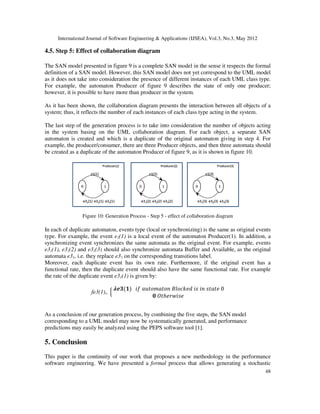
4.5. Step 5: Effect of collaboration diagram
The SAN model presented in figure 9
definition of a SAN model. However, this SAN model does not yet correspond to the UML model
as it does not take into consideration the presence of differe
For example, the automaton Producer of figure 9 describes the state of only one producer;
however, it is possible to have more than producer in the system.
As it has been shown, the collaboration diagram presents the interaction between all objects of a
system; thus, it reflects the number of each instances of each class type acting in the system.
The last step of the generation process is to take into consideration the number of objects acting
in the system basing on the UML collaboration diagram. For each object, a separate SAN
automaton is created and which is a duplicate of the original automaton giving in step 4. For
example, the producer/consumer, there are three Producer objects, and then three automata should
be created as a duplicate of the automaton Producer of figure 9,
Figure 10: Generation Process
In each of duplicate automaton, events type (local or synchronizing) is the same as original events
type. For example, the event e1(1)
synchronizing event synchronizes the same automata as the original event. For example, events
e31(1), e31(2) and e31(3) should also synchronize automata Buffer and Available, as the original
automata e31, i.e. they replace e3
Moreover, each duplicate event has its own rate. Furthermore, if the original event has a
functional rate, then the duplicate event should also have the same functional rate. For example
the rate of the duplicate event e3
fe3(1)= 

As a conclusion of our generation process, by combining the five steps, the SAN model
corresponding to a UML model may now be systematically generated, and performan
predictions may easily be analyzed using the PEPS software tool [
5. Conclusion
This paper is the continuity of
software engineering. We have presented a
International Journal of Software Engineering  Applications (IJSEA), Vol.3, No.3, May 2012
Step 5: Effect of collaboration diagram
SAN model presented in figure 9 is a complete SAN model in the sense it respects the formal
definition of a SAN model. However, this SAN model does not yet correspond to the UML model
t does not take into consideration the presence of different instances of each UML class type.
roducer of figure 9 describes the state of only one producer;
however, it is possible to have more than producer in the system.
As it has been shown, the collaboration diagram presents the interaction between all objects of a
e number of each instances of each class type acting in the system.
The last step of the generation process is to take into consideration the number of objects acting
in the system basing on the UML collaboration diagram. For each object, a separate SAN
automaton is created and which is a duplicate of the original automaton giving in step 4. For
example, the producer/consumer, there are three Producer objects, and then three automata should
be created as a duplicate of the automaton Producer of figure 9, as it is shown in figure 10.
: Generation Process - Step 5 - effect of collaboration diagram
In each of duplicate automaton, events type (local or synchronizing) is the same as original events
(1) is a local event of the automaton Producer(1). In addition, a
synchronizing event synchronizes the same automata as the original event. For example, events
should also synchronize automata Buffer and Available, as the original
e31 on the corresponding transitions label.
Moreover, each duplicate event has its own rate. Furthermore, if the original event has a
functional rate, then the duplicate event should also have the same functional rate. For example
e31(1) is given by:

UML2SAN: Toward A New Software Performance Engineering Approach

  • 1.
    International Journal ofSoftware Engineering & Applications (IJSEA), Vol.3, No.3, May 2012 DOI : 10.5121/ijsea.2012.3304 35 UML2SAN: TOWARD A NEW SOFTWARE PERFORMANCE ENGINEERING APPROACH Ihab Sbeity1 , Mohamed Dbouk1 and Ilfat Ghamlouche2 1 Faculty of Sciences, Lebanese University, Lebanon 2 Faculty of Economical Sciences and Management, Lebanese University, Lebanon ABSTRACT Software Performance Engineering (SPE) has recently considered as an important issue in the software development process. It consists on evaluate the performance of a system during the design phase. We have recently proposed a new methodology to generate a Stochastic Automata Network (SAN) model from a UML model, to consequently obtain performance predications from UML specifications. In this paper, we expand our idea to cover more complex UML models taking in advantage the modularity of SAN in modeling large systems. A formal description of the generation process is presented. The new extension gives rise to a serious approach in SPE that we call UML2SAN. KEYWORD Software engineering, Performance software engineering, UML, Stochastic Automata Network. 1. INTRODUCTION Software engineering has traditionally focused on functional requirements and how to build software that has few bugs and can be easily maintained. Most design approaches include non- functional requirements among the elements of the analysis of a system, but little attention has usually been paid to how these requirements can be dealt with through the development life-cycle [9]. Over the two last decades, the performance analysis of software systems during the design process is becoming widely suitable. The benefit comes from getting quantitative predications about the system before being implemented. That reduces the possibility of unexpected shortcoming on the system functionality. .Moreover, an important methodology, initially introduced by Smith [11], starts today to cover a large place in the software engineering area. This methodology, called Performance Software Engineering (SPE), consists essentially on introducing some techniques allowing obtaining performance predictions of the system basing on the design model. Several approaches have been introduced to provide SPE techniques. Some of them propose to derive from a UML (Unified Modeling Language) model a separate performance model [5, 8,
  • 2.
    International Journal ofSoftware Engineering & Applications (IJSEA), Vol.3, No.3, May 2012 36 10]. In addition to the classification of UML as a universal modeling language widely used by designers, it is apparently possible to attach performance analysis tools to UML notations in a relatively straightforward manner. Our recent work in [10], initiates a preliminary methodology to derive from UML a Stochastic Automata Network (SAN) model, a Markov-based model used to generate performance predictions. The SAN formalism [7] is usually quite attractive when modeling a system with several parallel cooperative activities. In addition, SAN permits to represent a system in modular way. A SAN model is a state-transition graph having a strong likeness with the UML state-chart diagram. The purpose of this work is to make a step forward toward proposing a general heuristic to derive a SAN model from complex UML model. In [10], our methodology is based on the UML state- diagram, with transitions’ edges only labeled by unconditional triggers and actions. In this paper, we show how to deal with conditional triggers. In addition, we show the impact of the collaboration diagram in the derivation process. The demarche is also informally presented, however, this works enlarge the possibility to propose a formal demarche. The rest of this paper is organized as follows. Section 2 recalls the definition of the SAN as modular formalism. Section 3 presents a UML producer/consumer example with conditional triggers in the stat-chat diagram. This section shows the essential UML diagrams need for the derivation of the SAN model. Section 4 explores how the UML model maps into SAN basing on our case study. Section 5 concludes our paper and describes our ongoing works. 2. STOCHASTIC AUTOMATA NETWORKS Stochastic Automata Networks (SAN) is a structured Markovian formalism, i.e., it describes continuous-time Markovian models not as a flat system, but as a structured (modular and organized) collection of subsystems. The basic modeling principle of SAN is to describe a whole system by a collection of subsystems with an independent behavior and occasional interdependencies. Each subsystem is described as a stochastic automaton, i.e., an automaton in which the transitions are labeled with probabilistic and timing information. Hence, one can always build a continuous-time stochastic process related to SAN [2, 12]. The global state of a SAN model is defined by the cartesian product of the local states of all automata. There are two types of events that change the global state: local and synchronizing events. Local events change the SAN global state passing from a global state to another that differs only by one local state. Synchronizing events can change simultaneously more than one local state, i.e., two or more automata can change their local states simultaneously. In other words, the occurrence of a synchronizing event forces all concerned automata to fire a transition corresponding to this event. Each event is represented by an identifier and a rate of occurrence, which describes how often a given event will occur. Each transition may be fired as result of the occurrence of any number of events. In general, non-determinism among possible different events is dealt with according to Markovian behavior, i.e., any of the events may occur and their occurrence rates define the relative frequency with which each of them will occur. However, if, from a given local state, the occurrence of a given event can lead to more than one state, then an additional routing probability
  • 3.
    International Journal ofSoftware Engineering & Applications (IJSEA), Vol.3, No.3, May 2012 37 must be informed to each possible destination state. The absence of routing probability is tolerated if only one transition can be fired by an event from a given local state. The other possibility of interaction among automata is the use of functional rates. Any event occurrence rate may be expressed by a constant value or a function of the state of other automata. By contrast with synchronizing events, functional rates are one-way interaction among automata, since it affects only the automaton where it appears. Figure 1 presents a SAN model with two automata, one synchronizing event (e2) with a constant rate, and four local events, being three with constant rates (e3, e4 and e5) and one with a functional rate (e1). In this model the rate of the event e1 is a functional rate f semantically explained below, and described inside Figure 1 using the SAN notation. The interpretation of such a function can be viewed as the evaluation of an expression of non-typed programming languages, e.g., C language, where each comparison is evaluated to value 1 (true) or value 0 (false). Figure 1 : Example of a SAN model The firing of the transition from states 0(1) to 1(1) occurs with rate λ if automaton A(2) is in state 0(2) , or γ if automaton A(2) is in state 2(2) . If automaton A(2) is in state 1(2) , the transition from states 0(1) to 1(1) does not occur (rate equal to 0). It is important to observe that the use of functions allows a compact and flexible way to describe in one single event (local or synchronized) alternative behaviors [2]. The advantage of using functions will be obviously clear in our demarche of derivation a SAN model from UML model.
  • 4.
    International Journal ofSoftware Engineering & Applications (IJSEA), Vol.3, No.3, May 2012 38 Figure 2: Equivalent Markov chain Figure 2 shows the equivalent Markov chain model of the SAN model in Figure 1. Assuming the state 0(1) 0(2) is an initial state, only 5 of the 6 states in this Markov chain model are reachable. In order to express the reachable global states of a SAN model, it is possible to define a (reachability) function. The reachable states could also be computed by analyzing all possible firing sequences, starting from a given reachable initial state. For the model in Figure 1, the reachability function excludes the global state 1(1) 1(2) , thus: One of greatest advantages of the SAN formalism in comparison with straightforward Markov chain, and even other structured formalism is to have since its first definition [7] a compact form to store the infinitesimal generator of the equivalent Markov chain. Instead of storing an (usually) huge matrix, the SAN formalism defines a storage based on a tensor formula of considerably smaller matrices. Tensor, or Kronecker, algebra [3,4] is defined as a set of multi-dimensional structures (tensors) and algebraic operations. It usually allows the very compact description of quite large and complex matrices. Also, computation can be handled without ever generating extensively the equivalent Markov chain. 3. A UML PRODUCER/CONSUMER MODEL The Unified Modeling Language (UML) [6] is a graphically based notation, which is being developed by the Object Management Group as a standard means of describing software oriented designs. It contains several different types of diagram, which allow different aspects and properties of a system design to be expressed. Diagrams must be supplemented by textual and other descriptions to produce complete models. For example, a use case is really the description of what lies inside the ovals of a use case diagram, rather than just the diagram itself. Our concern in the approach we propose is basically UML models where the use of time has significance. In fact, it is evident to say that the need to predict performance is applied only to time-driven application, i.e. applications where objects actions are triggered by time progress.
  • 5.
    International Journal ofSoftware Engineering & Applications (IJSEA), Vol.3, No.3, May 2012 Thus, here we present an example of such time producer/consumer model. The model we propose is in [8]. In our model presentation we only focus o behavior of the system, i.e. the class diagram (section 3.1), diagrams (section 3.2). 3.1. The class diagram A UML class model defines the essential types of object available to build a system; each class is described by a rectangle with a name. This can be refined by adding compartments below the name which list the attributes and operations contained in each instanc this class. Classes are linked by lines known as knows about the other. The direction of this knowledge is known as the association. In an implementation an reference variable of the type of the other class. Sometimes navigability has to be two ways, but it more often one way. This can be shown by adding arrow head t Figure 3: Producer/Consumer model The class model of our producer/consumer application is presented in Figure 3. system with two kinds of processes, producer and consumer that communicate via a buffer. A producer spends time producing Plus(). A consumer picks a message from the buffer, via the method consuming it. International Journal of Software Engineering & Applications (IJSEA), Vol.3, No.3, May 2012 an example of such time-driven applications which describes a producer/consumer model. The model we propose is a more detailed extension of the model seen ]. In our model presentation we only focus of diagrams that describe the structure and the e class diagram (section 3.1), and collaboration and state class model defines the essential types of object available to build a system; each class is described by a rectangle with a name. This can be refined by adding compartments below the name which list the attributes and operations contained in each instance of (object derived from) Classes are linked by lines known as associations which indicate that one of the classes knows about the other. The direction of this knowledge is known as the navigability association. In an implementation an association typically corresponds to one class having a reference variable of the type of the other class. Sometimes navigability has to be two ways, but it more often one way. This can be shown by adding arrow head to the end(s) of the association [ : Producer/Consumer model - the class diagram producer/consumer application is presented in Figure 3. We assu system with two kinds of processes, producer and consumer that communicate via a buffer. A producer spends time producing a message before sending it to the buffer due to the method consumer picks a message from the buffer, via the method Minus(), and then spends some time International Journal of Software Engineering & Applications (IJSEA), Vol.3, No.3, May 2012 39 which describes a extension of the model seen f diagrams that describe the structure and the and state-chart class model defines the essential types of object available to build a system; each class is described by a rectangle with a name. This can be refined by adding compartments below the e of (object derived from) which indicate that one of the classes navigability of the association typically corresponds to one class having a reference variable of the type of the other class. Sometimes navigability has to be two ways, but it o the end(s) of the association [8]. We assume a system with two kinds of processes, producer and consumer that communicate via a buffer. the buffer due to the method , and then spends some time
  • 6.
    International Journal ofSoftware Engineering & Applications (IJSEA), Vol.3, No.3, May 2012 The variable t of the super-class a producer, respectively a consumer. Of course, the value of this variable may be different for each process (producer and consumer). The buffer has some capacity, described by its variable implies that it may to receive new message from the producer. The value of the attribute is set to true when the buffer is full. On the other hand, the attribute available is set to false when the buffer is empty, meaning that the consumer cannot pick messages from the buffer. We also assume the existence of the two methods the attributes Available and Blocked demarche intending to derive a SAN model as i 3.2. Collaboration and State Collaborations describe the way the objects interact instances of classes behave internally full description of how the system works. 3.2.1. Collaboration Diagram Collaborations are collections of objects, linked to show the relevant associations between their classes. Here “time” is not represented explicitly. Instead the emphasis is on showing which objects communicate with which others. Figure 4 represents the collaboration diagram of communication between a family of buffer. In the model of Figure 4, we suppose that there are ( consumers. Figure 4: Producer/Consumer model As it was mentioned before, the collaboration diagrams show how objects are interacting with each other. Each produce communicates with the buffer via the consumer communicates with the same buffer via the message is the result of the corresponding method previously described in the class diagram. International Journal of Software Engineering & Applications (IJSEA), Vol.3, No.3, May 2012 class System represents the producing, respectively consuming, time of a producer, respectively a consumer. Of course, the value of this variable may be different for s (producer and consumer). The buffer has some capacity, described by its variable Size; when the buffer is not full, this receive new message from the producer. The value of the attribute is set to true when the buffer is full. On the other hand, the attribute available is set to false when the buffer is empty, meaning that the consumer cannot pick messages from the buffer. We also assume the existence of the two methods setAvailable and setBlocked that gives values to Blocked respectively. These two methods are important in our demarche intending to derive a SAN model as it will be discussed in section 4. and State-chart diagram tions describe the way the objects interact externally. Statescharts describe how internally. In a complete design they should provide between them a full description of how the system works. Collaborations are collections of objects, linked to show the relevant associations between their classes. Here “time” is not represented explicitly. Instead the emphasis is on showing which objects communicate with which others. collaboration diagram of producer/consumer model. a family of M producers and another family of N consumers via one buffer. In the model of Figure 4, we suppose that there are (M=3) producers and ( : Producer/Consumer model - the collaboration diagram As it was mentioned before, the collaboration diagrams show how objects are interacting with each other. Each produce communicates with the buffer via the Plus() messag consumer communicates with the same buffer via the Minus() message. Each communication message is the result of the corresponding method previously described in the class diagram. International Journal of Software Engineering & Applications (IJSEA), Vol.3, No.3, May 2012 40 represents the producing, respectively consuming, time of a producer, respectively a consumer. Of course, the value of this variable may be different for ; when the buffer is not full, this receive new message from the producer. The value of the attribute Blocked is set to true when the buffer is full. On the other hand, the attribute available is set to false when the buffer is empty, meaning that the consumer cannot pick messages from the buffer. that gives values to respectively. These two methods are important in our . Statescharts describe how . In a complete design they should provide between them a Collaborations are collections of objects, linked to show the relevant associations between their classes. Here “time” is not represented explicitly. Instead the emphasis is on showing which It acts of a consumers via one ) producers and (N=5) As it was mentioned before, the collaboration diagrams show how objects are interacting with message, and each message. Each communication message is the result of the corresponding method previously described in the class diagram.
  • 7.
    International Journal ofSoftware Engineering & Applications (IJSEA), Vol.3, No.3, May 2012 3.2.2. State-chart Diagram On the other hand, state-charts d provide a full description of how the system works. We insert the state its box in the collaboration. At any point in the lifetime of this system, each object must b and only one, of its internal states. Each time a message (event) is passed, it may change in the receiving object and this may cause a further message to be passed object and another with which it has an association. Figure 5 presents the Figure 5: Producer/Consumer model Each chart describes the internal behavior of the concerned object. Briefly, a chart is com states, transitions, triggers and actions. States are shown here as rounded rectangles Transitions are the arrows between states, labeled with a trigger. Remark that states and transition transitions. Triggers represent the reason for an object to leave one state and follow the correspond transition to another state; typically a trigger is an incoming message shown by one of the two usual ways for messages: A change in a condition; represented by the word enclosed in brackets. An elapsing of time unconditional trigger. Triggers may also invoke actions International Journal of Software Engineering Applications (IJSEA), Vol.3, No.3, May 2012 charts describe how objects behave internally. In a complete design they provide a full description of how the system works. We insert the state-chart for each object into its box in the collaboration. At any point in the lifetime of this system, each object must b and only one, of its internal states. Each time a message (event) is passed, it may change in the receiving object and this may cause a further message to be passed object and another with which it has an association. igure 5 presents the state-chart diagram of our producer/consumer model. : Producer/Consumer model - the state-chart diagram Each chart describes the internal behavior of the concerned object. Briefly, a chart is com states, transitions, triggers and actions. here as rounded rectangles; the initial state as a black filled circle. are the arrows between states, labeled with a trigger. that states and transitions of UML state-chart are similar to the SAN’s states and represent the reason for an object to leave one state and follow the correspond transition to another state; typically a trigger is an incoming message shown by one of the two A change in a condition; represented by the word when followed by the condition enclosed in brackets. This kind of triggers is called conditional triggers. An elapsing of time – shown by the word after enclosing the duration. unconditional trigger. ctions. International Journal of Software Engineering Applications (IJSEA), Vol.3, No.3, May 2012 41 behave internally. In a complete design they chart for each object into its box in the collaboration. At any point in the lifetime of this system, each object must be in one, and only one, of its internal states. Each time a message (event) is passed, it may cause a state change in the receiving object and this may cause a further message to be passed between that Each chart describes the internal behavior of the concerned object. Briefly, a chart is composed of ; the initial state as a black filled circle. chart are similar to the SAN’s states and represent the reason for an object to leave one state and follow the corresponding transition to another state; typically a trigger is an incoming message shown by one of the two followed by the condition This kind of triggers is called conditional triggers. enclosing the duration. This is an
  • 8.
    International Journal ofSoftware Engineering Applications (IJSEA), Vol.3, No.3, May 2012 42 Actions are prefixed with a forward slash and carried out before entering the new state. These actions may be local method of the object where the trigger is fired, or a method of another object. In the second case, the invoked action represents then a trigger in the chart corresponding to the concerned object. In order to simplify the process of derivation in section 5, we propose some definitions. Definition 1 A trigger is called of type T1, if it does not fire an action. Definition 2 A trigger is called of type T2, if it fires one or more actions. Back to Figure 5, the behavior of each object type is described by a chart. For example, a producer alternates between two states: the state where it is producing a message and the state where it is storing the message in the buffer. The transition from the Producing state to the Storing state is labeled by the trigger after(t), e.g. t is the class variable. This trigger does not fire any action, it is of type T1. The trigger when[b.Blocked = false], labeling the reverse transition, invoke the action b.Plus() in the chart corresponding to buffer. This trigger is of type T2. It is important to notice that triggers of type T1 look like local events in a SAN model. A trigger of type T2 seems resembling SAN synchronizing event. Definition 3 Let t be a trigger of type T2, we call Seq(t) the set of different action sequences that may be fired by t. Card(Seq(t)) is the cardinality of Seq(t) and it is equal to the number of sequences in Seq(t). According to definition 3, consider the type T2 trigger t = when[b.Blocked = false], the set Seq(t), is identified by taking into consideration the different sequence of actions that the trigger may fire. In our example, Seq(t) is composed of three sequences S1, S2 amd S3 such that: Seq(t) = { S1: when[b.Blocked = false] b.Plus() setAvailable(True) S2: when[b.Blocked = false] b.Plus() S3: when[b.Blocked = false] b.Plus() setBlocked(True) } In fact, when the event when[b.Blocked = false] is invoked, it fires the action b.Plus(). However the firing of this action may also fires another action depending on the state of the the state-chart Buffer. If the local state is Has0, setAvailable(True) is fired, if the local state is Has1 no other action is fired, and if the local state is Has2, the setBlocked(True) is fired. Card(Seq(t)) is equal to 3.
  • 9.
    International Journal ofSoftware Engineering Applications (IJSEA), Vol.3, No.3, May 2012 43 Moreover, states of the buffer represent the number of messages available in the buffer. The number of these states is equal to the buffer size (here, size = 3). Triggers labeling transitions of the chart buffer, i.e. Plus() and Minus(), are actions invoked by a producer or a consumer. We underline that the action setAvailable(), respectively setBlocked(), change the value of the Boolean variable Available, respectively Blocked, that affects the firing of the trigger when[b.Available= true] in the chart consumer, respectively the trigger when[b.Blocked = false] in the char producer. This means that at any time, we need to know the value of the variable in order to enable or disable the firing of the trigger. Recalling a SAN model, this phenomenon gives the impression to be similar to a functional rate that depends on the variable’s value. We call such variables, i.e. which affect the firing of a trigger, affecting variables. The overall state of a system will be the combination of all the current internal state of its objects, plus the current values of any relevant attributes, i.e. Blocked and Available. As we mentioned before, intuitively, readers may sense a strong similarity to the stochastic automata networks behavior. A SAN automaton is a set of states, transitions and events. The global state of a SAN is a combination of the local states of its automata. The powerful point of mapping the state-chart diagram into a SAN model is that the mapping process will not produce fundamental changes in the graph structure, only some information needed to represent relevant attributes and the time spent in a state is required. That may help designers to better understand the SAN performance model which is an emphasized advantage of our approach. 4. Generating the SAN model In the previous section, we highlighted the basic elements on which our generation process is principally based. In this section, we present how a SAN model is directly generated for the UML producer/consumer, giving a sense for a systematical generation process. The SAN automata are these corresponding to UML state-charts and these necessary to represent the affecting variables value. The generation process is composed of multiple steps. As it is shown in [10], it is important to see that there is an intuitive mapping of the UML state-chat into SAN. A state-chart automaton is mapped into SAN automaton (states and transitions). The state-chart events are translated as SAN events. However, there is still some work to achieve in order to take into consideration the affecting variables. In the following, we formally describe the procedure of the generation of the SAN model and we illustrate each step of the procedure basing on our producer/consumer model. In the following, each subsection represents a step in our generation process. Some of these steps are formally described; however others are presented basing on intuitive observations. 4.1. Step 1: States/transitions mapping The first step is to create SAN automata that correspond to state-charts. Only states and transitions are created in this step. The labels of SAN transitions, i.e. events, are created in step 3. Step 1: Statechart -- States/Transitions Mapping For each automaton X of the UML state-chart, create a SAN automata Y as following: Omit the initial state. For each state IX in X, create the state IY in Y. For each transition in X from state IX to state JX, create a transition from IY to JY in Y.
  • 10.
    International Journal ofSoftware Engineering Applications (IJSEA), Vol.3, No.3, May 2012 Applying the first step to our producer/consumer model gives raise to the incomplete SAN graph. The table enclosed at right shows the correspondence between states of UML model and the new states of the Figure 6: Generation Process 4.2. Step 2: Affecting variables mapping The second step of the generation process is related to of such variables are used as conditions for the firing of triggers it is important to represent the modification of these values in order to enable/disable th SAN events, as it will be shown in step 3. Step 2 For each affecting variable v in the UML model For each potential value kv of v, create the state k For each potential value’s modification from v= k to v = from kY tp lY in Y. Indeed, building a SAN automaton that corresponds to some criteria. In fact, the number of states of the SAN automaton the variable may have. This implies with affecting variables with infinite value range is a serious challenge. An intuitive idea approach this problem is to decompose the values the variable’s value enables the firing of the trigger, and the sub trigger’s firing. Here, we restrict our study to variables with finite potential va International Journal of Software Engineering Applications (IJSEA), Vol.3, No.3, May 2012 Applying the first step to our producer/consumer model gives raise to the following The table enclosed at right shows the correspondence between states of UML model and the new states of the intermediate incomplete SAN model. State-chart Producer Producing Storing Consumer Consuming Acquiring Buffer Has0 Has1 Has2 Has3 : Generation Process - Step 1 – state-chart automata Step 2: Affecting variables mapping The second step of the generation process is related to affecting variables. Recall that the values of such variables are used as conditions for the firing of triggers in the state-chart diagram he modification of these values in order to enable/disable th shown in step 3. Step 2: Affecting variables Mapping For each affecting variable v in the UML model, create a SAN automaton Y as following: of v, create the state kY in Y. value’s modification from v= k to v =l (k # l), create a transition , building a SAN automaton that corresponds to an affecting variable is possible under he number of states of the SAN automaton is equal to the potential values the variable may have. This implies that the number of potential values should be finite. Dealing with affecting variables with infinite value range is a serious challenge. An intuitive idea ecompose the values range into two sub-ranges: the sub the variable’s value enables the firing of the trigger, and the sub-range where it disables the to variables with finite potential values, i.e. Boolean variables. International Journal of Software Engineering Applications (IJSEA), Vol.3, No.3, May 2012 44 following intermediate The table enclosed at right shows the correspondence between states of SAN Producer 0 1 Consumer 0 1 Buffer 0 1 2 3 . Recall that the values chart diagram. Thus he modification of these values in order to enable/disable the firing of Y as following: transition affecting variable is possible under is equal to the potential values that the number of potential values should be finite. Dealing with affecting variables with infinite value range is a serious challenge. An intuitive idea to ranges: the sub-range where range where it disables the e. Boolean variables.
  • 11.
    International Journal ofSoftware Engineering Applications (IJSEA), Vol.3, No.3, May 2012 The second step consists to map the potential values that an affecting variable may have into states. In our producer/consumer model, there is two and Blocked. Applying Step 2, generat events are not represented here as they will be generated in step 3. Figure 7: Generation For each of the two Boolean affecting variables, an automaton is associated. The states of each automaton represent the different values the variable may have, i.e. either true or false. There is a transition from each state to the other state. In case of no Boolean affecting variable, from each state, we have to draw a transition to all other states, taking into consideration that the value of the variable may change without being aware of the new value. In additio the UML method that produces the change. there is two affecting methods: affecting variable Blocked and Available Affecting method should be predictable in the UML model because they will drive the transitions in the SAN automata related to affecting variables, a 4.3. Step 3: Events Generation The purpose of this step is to generate the list of events that drive the trans automata. As it is previously presented, there are two types of events in the SAN model: local event that affects only the state of one automaton and synchronizing event that can change simultaneously the state of more than one automaton. chart will give raise to a SAN local event (Step 3.a). One Trigger will give raise to several SAN synchronizing events according to th Definition 3). Step 3 For each trigger t of the UML state For each automaton X of the UML state For each transition in X from state I Add e to the transition from state I Add e to the transition from state I International Journal of Software Engineering Applications (IJSEA), Vol.3, No.3, May 2012 The second step consists to map the potential values that an affecting variable may have into cer/consumer model, there is two affecting Boolean variables, i.e. . Applying Step 2, generate the following incomplete SAN automaton. events are not represented here as they will be generated in step 3. Affecting Event SAN Available False 0 True 1 Blocked False 0 True 1 : Generation Process - Step 2 - affecting variables For each of the two Boolean affecting variables, an automaton is associated. The states of each automaton represent the different values the variable may have, i.e. either true or false. There is a each state to the other state. In case of no Boolean affecting variable, from each state, we have to draw a transition to all other states, taking into consideration that the value of the variable may change without being aware of the new value. In addition, we need to identify the UML method that produces the change. We call this method affecting method. there is two affecting methods: SetBlocked() and setAvailable(), related respectively to the Available. Affecting method should be predictable in the UML model because they will drive the transitions in the SAN automata related to affecting variables, as it will be described in step 3. Step 3: Events Generation generate the list of events that drive the transitions of the SAN t is previously presented, there are two types of events in the SAN model: local event that affects only the state of one automaton and synchronizing event that can change te of more than one automaton. Each trigger of type T1 of the UML state chart will give raise to a SAN local event (Step 3.a). One Trigger t of type T2 of the state will give raise to several SAN synchronizing events according to the cardinality of Seq(t) Step 3.a : Local events Generation state-chart, create a SAN event e as following: For each automaton X of the UML state-chart (Y is SAN automaton created in step 1) each transition in X from state IX to state JX, labeled by t Add e to the transition from state IY to state JY Add e to the transition from state IY to state JY International Journal of Software Engineering Applications (IJSEA), Vol.3, No.3, May 2012 45 The second step consists to map the potential values that an affecting variable may have into SAN s, i.e. Available SAN automaton. Again, SAN For each of the two Boolean affecting variables, an automaton is associated. The states of each automaton represent the different values the variable may have, i.e. either true or false. There is a each state to the other state. In case of no Boolean affecting variable, from each state, we have to draw a transition to all other states, taking into consideration that the value of n, we need to identify In our model , related respectively to the Affecting method should be predictable in the UML model because they will drive the transitions itions of the SAN t is previously presented, there are two types of events in the SAN model: local event that affects only the state of one automaton and synchronizing event that can change of the UML state- of the state-chart Seq(t) (refer to chart (Y is SAN automaton created in step 1)
  • 12.
    International Journal ofSoftware Engineering Applications (IJSEA), Vol.3, No.3, May 2012 Step 3.b For each trigger t of the UML state For each sequence of actions create a SAN event eS as following: For each automaton X of the UML state automaton created in step 1) For each transition in X Add eS to the transition from state I For each action a in S If a is an affecting method then Add eS to the corresponding automata (of the affecting variable) Else For each automaton X of the UML state SAN automaton created in step 1) For each transition in X from state I Add eS to the transition from state I Applying the third step to our producer/consumer example gives raise to the graph The automata presented in this figure are the set of aut Figure 8: Generation Process For example, the local event e1 trigger after(t) of the Producer state trigger is of type T1. The trigger SAN events, i.e. e31, e32 and e3 actions (see section 3.2.2). Each corresponds to the sequence S1: sequence involves methods in the state state-chart Buffer, i.e. b.Plus() , and a method that invoques a change in the value of the affecting International Journal of Software Engineering Applications (IJSEA), Vol.3, No.3, May 2012 Step 3.b : Synchronizing events Generation For each trigger t of the UML state-chart For each sequence of actions S in Seq (t) as following: For each automaton X of the UML state-chart and Y its corresponding SAN automaton created in step 1) For each transition in X from state IX to state JX, labeled by t to the transition from state IY to state JY If a is an affecting method then to the corresponding automata (of the affecting variable) For each automaton X of the UML state-chart and Y its corresponding SAN automaton created in step 1) For each transition in X from state IX to state JX, labeled by a to the transition from state IY to state JY Applying the third step to our producer/consumer example gives raise to the graph The automata presented in this figure are the set of automata created in step 1 and 2. : Generation Process - Step 3 - events generation e1 of the SAN automaton Producer is the corresponding of the of the Producer state-chart. This event is generated according to Step 3.a, as the The trigger t = when[b.Blocked = false], of type T2, gives raise for three e33. Recall that the set Seq(t) contains three different sequences of Each event corresponds to a sequence. For example, The event corresponds to the sequence S1: when[b.Blocked = false] b.Plus() setAvailable(True sequence involves methods in the state-chart Producer, i.e. when[b.Blocked = false] , and a method that invoques a change in the value of the affecting International Journal of Software Engineering Applications (IJSEA), Vol.3, No.3, May 2012 46 SAN chart and Y its corresponding Applying the third step to our producer/consumer example gives raise to the graph of figure 8. omata created in step 1 and 2. is the corresponding of the chart. This event is generated according to Step 3.a, as the , gives raise for three contains three different sequences of event corresponds to a sequence. For example, The event e31 setAvailable(True). This when[b.Blocked = false], and the , and a method that invoques a change in the value of the affecting
  • 13.
    International Journal ofSoftware Engineering Applications (IJSEA), Vol.3, No.3, May 2012 variable Available. Thus, the event e3 and Available, and it labels the corresponding transitions. 4.4. Step 4: Events’ rates Basing on Step 3, it may be noticed that two categories of events may be underlined: events corresponding to the “when” methods, e.g. the event e3 “when” method, e.g. the event e1 occurrence of a sequence of methods. For each event e that does not correspond to the an event corresponding to the when event e31 that corresponds to the sequence setAvailable(True). The event e3 local state 0, i.e. the state that corresponds to the value False of the affecting variable Blocked. Thus the rate assigned to the event fe3= It is obvious to see that the concept of functional rate is a powerful point of using stochastic automata network. Finally, recall that events e31, e3 assigned the same rate, i.e. fe3. Producer/Consumer model is given by figure 9. Figure 9 International Journal of Software Engineering Applications (IJSEA), Vol.3, No.3, May 2012 . Thus, the event e31 synchronizes the three SAN automata Producer, Buffer and Available, and it labels the corresponding transitions. Basing on Step 3, it may be noticed that two categories of events may be underlined: events methods, e.g. the event e31, and events that do not correspond to the e1. Recall that the method when has a condition and it controls the occurrence of a sequence of methods. that does not correspond to the when method, the rate λe is assigned. However, when method is assigned a functional rate. Let us reconsider the that corresponds to the sequence when[b.Blocked = false] e31 should be eligible to fire only if the automaton Blocked is in its local state 0, i.e. the state that corresponds to the value False of the affecting variable Blocked. Thus the rate assigned to the event e31 is the function rate fe3 described as following:
  • 14.
    0 It isobvious to see that the concept of functional rate is a powerful point of using stochastic e32 and e33 are basically related to the same trigger, they should be fe3. Thus, the typical SAN model corresponding to the UML Producer/Consumer model is given by figure 9. 9: Generation Process - Step 4 - events rates International Journal of Software Engineering Applications (IJSEA), Vol.3, No.3, May 2012 47 the three SAN automata Producer, Buffer Basing on Step 3, it may be noticed that two categories of events may be underlined: events and events that do not correspond to the has a condition and it controls the e is assigned. However, functional rate. Let us reconsider the b.Plus() should be eligible to fire only if the automaton Blocked is in its local state 0, i.e. the state that corresponds to the value False of the affecting variable Blocked. described as following: It is obvious to see that the concept of functional rate is a powerful point of using stochastic are basically related to the same trigger, they should be SAN model corresponding to the UML
  • 15.
    International Journal ofSoftware Engineering Applications (IJSEA), Vol.3, No.3, May 2012 4.5. Step 5: Effect of collaboration diagram The SAN model presented in figure 9 definition of a SAN model. However, this SAN model does not yet correspond to the UML model as it does not take into consideration the presence of differe For example, the automaton Producer of figure 9 describes the state of only one producer; however, it is possible to have more than producer in the system. As it has been shown, the collaboration diagram presents the interaction between all objects of a system; thus, it reflects the number of each instances of each class type acting in the system. The last step of the generation process is to take into consideration the number of objects acting in the system basing on the UML collaboration diagram. For each object, a separate SAN automaton is created and which is a duplicate of the original automaton giving in step 4. For example, the producer/consumer, there are three Producer objects, and then three automata should be created as a duplicate of the automaton Producer of figure 9, Figure 10: Generation Process In each of duplicate automaton, events type (local or synchronizing) is the same as original events type. For example, the event e1(1) synchronizing event synchronizes the same automata as the original event. For example, events e31(1), e31(2) and e31(3) should also synchronize automata Buffer and Available, as the original automata e31, i.e. they replace e3 Moreover, each duplicate event has its own rate. Furthermore, if the original event has a functional rate, then the duplicate event should also have the same functional rate. For example the rate of the duplicate event e3 fe3(1)= As a conclusion of our generation process, by combining the five steps, the SAN model corresponding to a UML model may now be systematically generated, and performan predictions may easily be analyzed using the PEPS software tool [ 5. Conclusion This paper is the continuity of software engineering. We have presented a International Journal of Software Engineering Applications (IJSEA), Vol.3, No.3, May 2012 Step 5: Effect of collaboration diagram SAN model presented in figure 9 is a complete SAN model in the sense it respects the formal definition of a SAN model. However, this SAN model does not yet correspond to the UML model t does not take into consideration the presence of different instances of each UML class type. roducer of figure 9 describes the state of only one producer; however, it is possible to have more than producer in the system. As it has been shown, the collaboration diagram presents the interaction between all objects of a e number of each instances of each class type acting in the system. The last step of the generation process is to take into consideration the number of objects acting in the system basing on the UML collaboration diagram. For each object, a separate SAN automaton is created and which is a duplicate of the original automaton giving in step 4. For example, the producer/consumer, there are three Producer objects, and then three automata should be created as a duplicate of the automaton Producer of figure 9, as it is shown in figure 10. : Generation Process - Step 5 - effect of collaboration diagram In each of duplicate automaton, events type (local or synchronizing) is the same as original events (1) is a local event of the automaton Producer(1). In addition, a synchronizing event synchronizes the same automata as the original event. For example, events should also synchronize automata Buffer and Available, as the original e31 on the corresponding transitions label. Moreover, each duplicate event has its own rate. Furthermore, if the original event has a functional rate, then the duplicate event should also have the same functional rate. For example e31(1) is given by: