

Model Evolution and VersioningAlfonso PierantonioDipartimento di InformaticaUniversità degli Studi dell’Aquilaalfonso.pierantonio@univaq.it
2ObjectivesModel-DrivenEngineeringrequires mature and adequatemodel management in ordertoachieveits full potential. Thiscannotleaveaside the problemofmodeldifferencing.Thislecturewillprovideinsights on the problemofmodeldifferencingoutlining the potentialsofitsapplication.
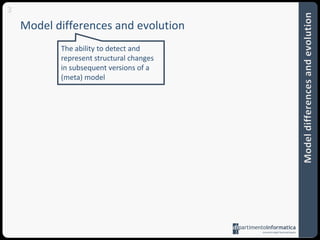
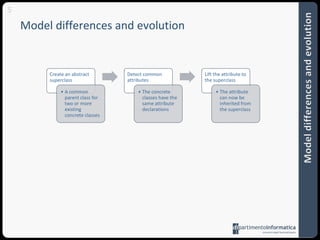
3Modeldifferences and evolutionModeldifferences and evolutionThe ability to detect and represent structural changes in subsequent versions of a (meta) model
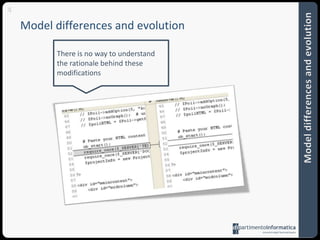
4Modeldifferences and evolutionModeldifferences and evolutionThere is no way to understand the rationale behind these modifications
5Modeldifferences and evolutionModeldifferences and evolution
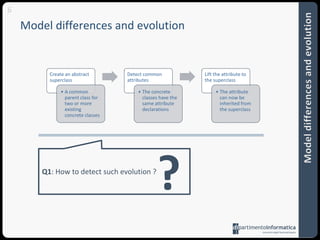
6Modeldifferences and evolutionModeldifferences and evolution?Q1: How to detect such evolution ?
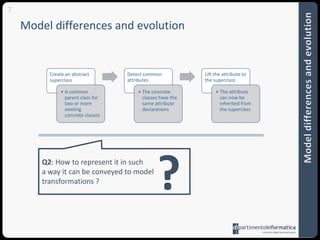
7Modeldifferences and evolutionModeldifferences and evolution?Q2: How to represent it in sucha way it can be conveyed to model transformations ?
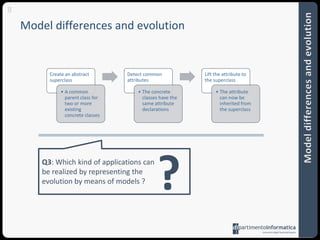
8Modeldifferences and evolutionModeldifferences and evolution?Q3: Which kind of applications can be realized by representing the evolution by means of models ?
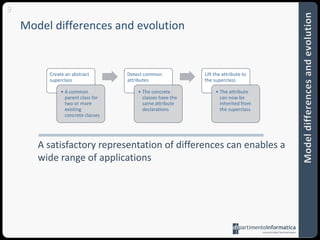
9Modeldifferences and evolutionA satisfactory representation of differences can enables a wide range of applicationsModeldifferences and evolution
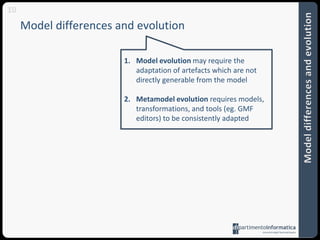
10Modeldifferences and evolutionModeldifferences and evolutionModel evolution may require the adaptation of artefacts which are not directly generable from the model Metamodel evolution requires models, transformations, and tools (eg. GMF editors) to be consistently adapted
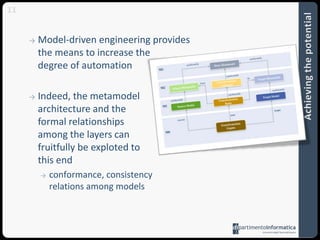
11Model-drivenengineeringprovidesthe meanstoincrease the degreeofautomation
Indeed, the metamodelarchitecture and the formalrelationshipsamongthe layers can fruitfullybeexplotedtothisend
conformance, consistencyrelations amongmodelsAchieving the potential
Achieving the potential12Achievingthe greatPotential.
13Achieving the potentialTurninginto a nightmare!
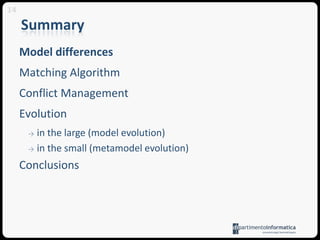
SummaryModel differencesMatching AlgorithmConflict ManagementEvolution in the large (model evolution)in the small (metamodel evolution)Conclusions14
ModeldifferencesModel Evolution and Versioning15
Model DifferencesIntroductionRepresentation RequirementsModel Difference ApproachesEdit Script, ColoringRepresenting Model DifferencesDifference Metamodel, Difference ModelsDifference ApplicationPatchesOperations with DifferencesDual, Sequential and Parallel CompositionConclusions and Future Work
IntroductionThe problem of model differences is intrinsically complex and requires specialized algorithms and notationsAny solution should necessarily present a high degree of separation between three relevant aspectscalculation, a procedure, method or algorithm able to compare two distinct models representation, the outcome of the calculation must be represented in some formvisualization, model differences often requires to be visualized in a human-readable notationIn currentproposals the distinctionbetween the three aspects are often blurred thus compromising the adoption of generic modelling techniques
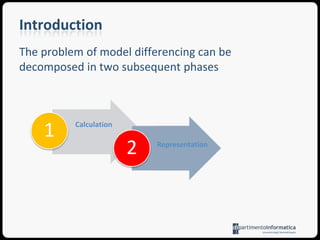
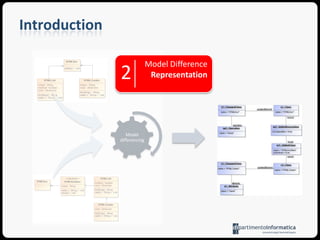
IntroductionThe problem of model differencing can be decomposed in two subsequent phases
IntroductionThe problem of model differencing can be decomposed in two subsequent phases1Calculation
IntroductionThe problem of model differencing can be decomposed in two subsequent phases12CalculationRepresentation
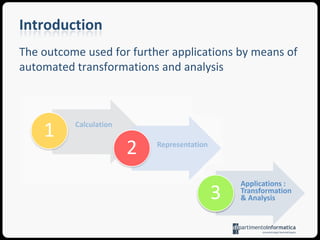
IntroductionThe outcome used for further applications by means of automated transformations and analysis123CalculationRepresentationApplications : Transformation & Analysis
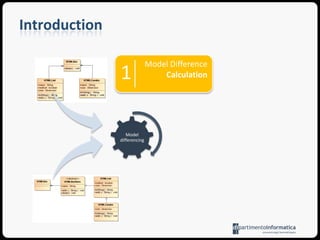
IntroductionModel Difference Calculation1
IntroductionModel DifferenceRepresentation2
IntroductionThus, the aim is to find a suitable representation for model differences whichis independent from the metamodel the models are conforming toabstracts from the calculation method used for differencing the models, regardless whether it is based on persistent ids or structural similaritythe outcome of a differencing operation must be usable in automated transformation or analysis
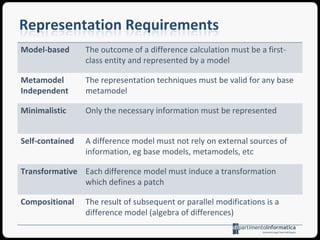
Representation Requirements
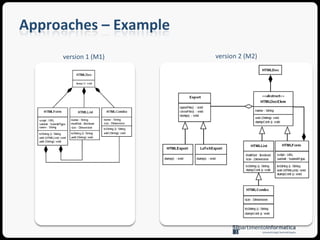
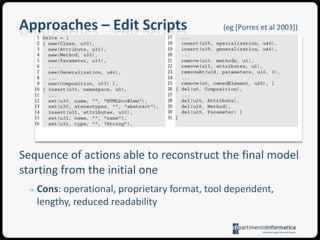
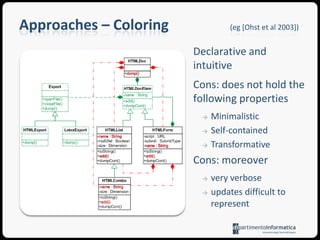
ApproachesThe representation of model differences can be divided into two main techniquesDirected deltas, represent delta documents as the sequence of the operations needed to obtain the new version from the old oneeg. edit scripts Symmetric deltas, show the result as the set of differences between the two compared versionseg. coloring  [Mens 2002]
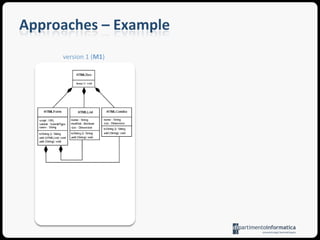
Approaches – Example version 1 (M1)
Approaches – Example version 2 (M2)version 1 (M1)
Approaches – Example version 2 (M2) version 1 (M1)
Approaches – Edit Scripts          (eg [Porres et al 2003])Sequence of actions able to reconstruct the final model starting from the initial oneCons: operational, proprietary format, tool dependent, lengthy, reduced readability
Approaches – Coloring                 (eg [Ohst et al 2003])Declarative and intuitiveCons: does not hold the following propertiesMinimalisticSelf-containedTransformativeCons: moreoververy verboseupdates difficult to represent
Approaches – Summary
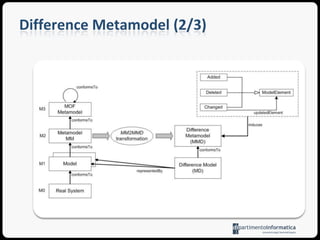
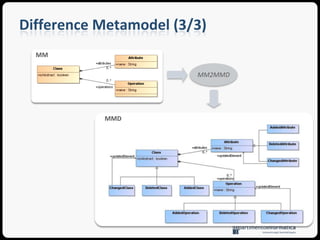
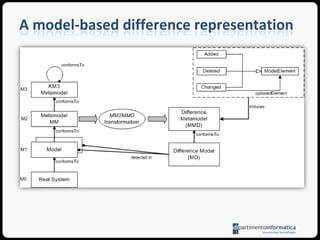
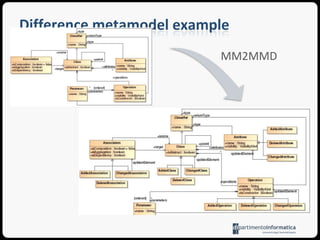
Difference Metamodel (1/3)Given two models M1 and M2 conforming to a metamodelMM, their difference (M2 – M1) conforms to a metamodelMMD that is derived from MMThe approach permits the representation of the following modificationsadditions: new elements are added to the final model deletions: some of the existing elements are deletedchanges: a new version of the model can consist of some updates of already existing elements
Difference Metamodel (2/3)
Difference Metamodel (3/3)MMMM2MMDMMD
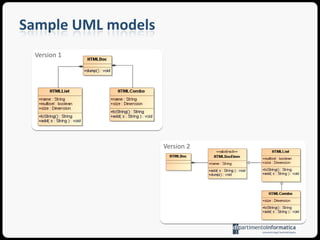
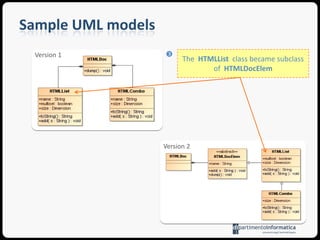
Sample UML modelsVersion 1Version 2
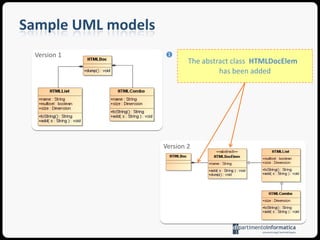
Sample UML modelsuVersion 1The abstract class  HTMLDocElemhas been addedVersion 2
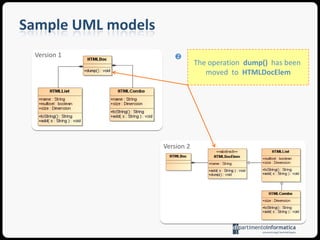
Sample UML modelsVersion 1The operation dump()  has been moved  to  HTMLDocElemvVersion 2
Sample UML modelswVersion 1The  HTMLList  class became subclassof  HTMLDocElemVersion 2
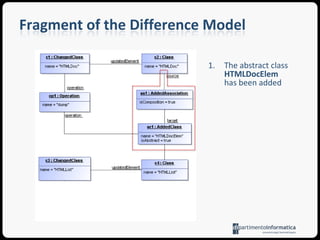
Fragment of the Difference Model The abstract class HTMLDocElemhas been added
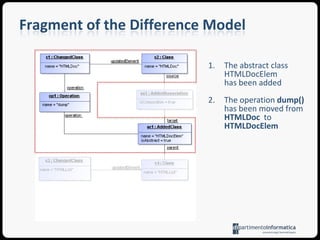
Fragment of the Difference ModelThe abstract class HTMLDocElemhas been addedThe operation dump()has been moved from HTMLDocto  HTMLDocElem
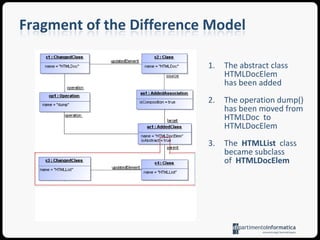
Fragment of the Difference ModelThe abstract class HTMLDocElemhas been addedThe operation dump() has been moved from HTMLDoc  to  HTMLDocElemThe  HTMLList  class became subclassof  HTMLDocElem
Difference ApplicationOnce differences are calculated and represented, they can be applied over models as patchesThe difference application is intended to “reconstruct” the final model starting from the initial one“patch” any model conforming to the base metamodel for reproducing the modifications
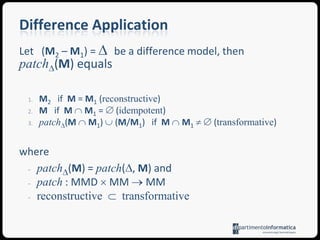
Difference ApplicationLet   (M2 – M1) =   be a difference model, then patch(M) equalsM2   if  M = M1 (reconstructive)M   if  M  M1 =  (idempotent)patch(M  M1)  (M/M1)   if  M  M1   (transformative)where patch(M) = patch(, M) and
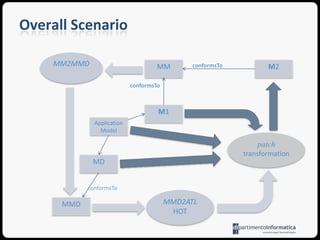
patch: MMD  MM  MM
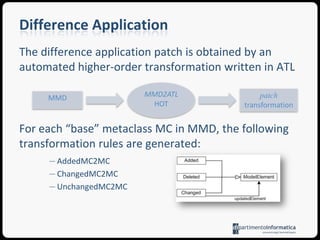
reconstructive    transformativeDifference ApplicationThe difference application patch is obtained by an automated higher-order transformation written in ATLFor each “base” metaclass MC in MMD, the following transformation rules are generated:AddedMC2MCChangedMC2MC UnchangedMC2MCMMD2ATLHOTpatchtransformationMMD
Difference ApplicationRule AddedMC2MCEach AddedMC induces a new MC instance in M2 and the corresponding structural features according to Rule ChangedMC2MCIt updates MC elements in M1 according to the ChangedMCelements in Rule UnchangedMC2MC It serves for propagating in M2 the context of M1, ie what is left unchanged by No rules are required for DeletedMC elements since they are simply ignored by the UnchangedMC2MCrule
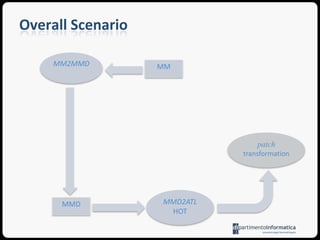
Overall ScenarioMM2MMDMMpatchtransformationMMD2ATLHOTMMD
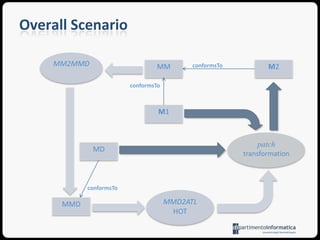
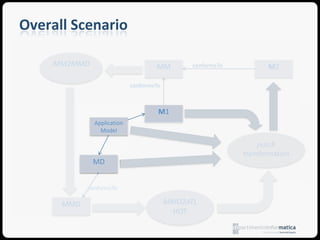
Overall ScenarioMM2MMDMMM2conformsToconformsToM1patchtransformationMDconformsToMMD2ATLHOTMMD
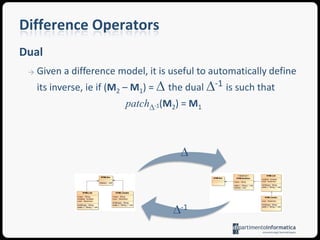
Difference OperatorsDualGiven a difference model, it is useful to automatically define its inverse, ie if (M2 – M1) =  the dual -1is such that patch-1(M2) = M1-1
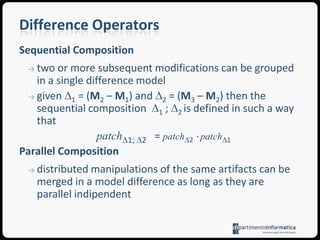
Difference OperatorsSequential Composition two or more subsequent modifications can be grouped in a single difference modelgiven 1 = (M2 – M1) and 2 = (M3 – M2) then the sequential composition  1 ; 2 is defined in such a way that patch1; 2    = patch2 patch1Parallel Compositiondistributed manipulations of the same artifacts can be merged in a model difference as long as they are parallel indipendent
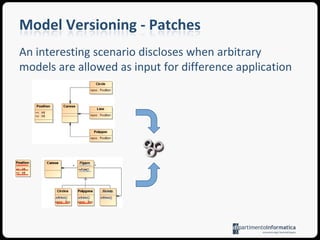
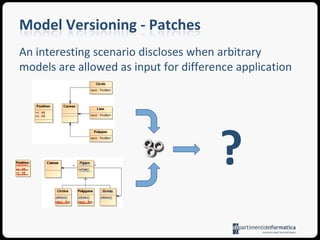
Model Versioning - PatchesAn interesting scenario discloses when arbitrary models are allowed as input for difference application
Model Versioning - PatchesAn interesting scenario discloses when arbitrary models are allowed as input for difference application?
Model Versioning - PatchesThe application of manipulations as patches demands for several propertiesSelf-containedness: The representation of differences should contain enough information to be applied to arbitrary inputsMinimality: The representation should not contain too much information thus locking the application to the initial contextTransformability: The application engine should allow several degrees of fuzziness, i.e. it should be able to reproduce a certain modification to appropriate arbitrary entities
Overall ScenarioMM2MMDMMM2conformsToconformsToM1Application ModelpatchtransformationMDconformsToMMD2ATLHOTMMD
Model DifferencesModel differences are crucial for general model management and can disclose numerous opportunitiesOnce differences are represented as first-class entities, a number of operations can be defined on thempatches, dual, binary compositions, impact evaluation, etcA proof of concept has been implemented on the Eclipse/AMMA platform (http://www.eclipse.org/m2m/atl/usecases/MMIndApproachtoDiffRep)
What comes next ?One of the problems of generic differencing methods is that matching algorithms are not always accurate since they are agnostic of the metamodel underlying semanticsFormalizing semantics is difficult, thus heuristics can provide some ad-hoc improvementAs soon we consider parallel composition the problem conflict specification, detection, and resolutionParallel composition may give place to conflicts whenever the differences are not parallel independentDepending on the process stage we may be interested in tuning false positives and negatives
SummaryModel differencesMatching AlgorithmConflict ManagementEvolution in the large (model evolution)in the small (metamodel evolution)Conclusions60
Model matchingModel Evolution and Versioning61
OutlineIntroductionModel matchingStatic Identity-Based MatchingSignature-Based MatchingSimilarity-Based MatchingLanguage-SpecificCase studyConclusions
IntroductionDifferencing mechanisms for supporting the evolution of model-based artifacts are becoming crucialDocument comparison algorithms provided by version control systems like CVS, and SVN have been shown to be inadequateCalculating model differences is a difficult task since it relies on model matching which can be reduced to the graph isomorphism problemNo efficient (i.e., polynomial-bound) algorithm for graph isomorphism is known and it has been conjectured that no such algorithm can exist	[Ronald C. Read, Derek G. Corneil. The graph isomorphism disease. Journal of Graph Theory, 1(4):339-363, 2006]
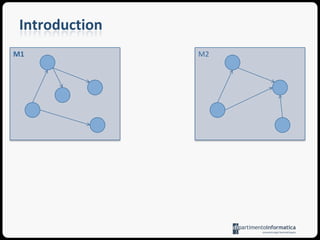
M1IntroductionM2
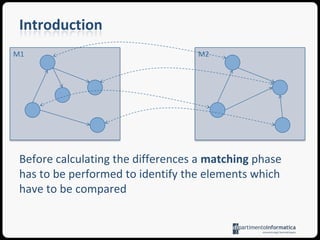
M1IntroductionM2Before calculating the differences a matching phase has to be performed to identify the elements which have to be compared
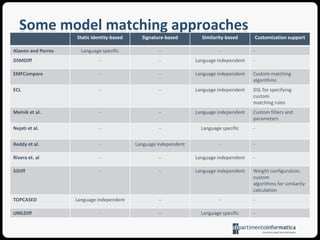
Model matchingThere are several requirements for model matching approaches including accuracylevel of abstractiontool independenceefficiencyuser effortExisting model matching approaches can be distinguished according to the following classificationStatic Identity-Based MatchingSignature-Based MatchingSimilarity-Based MatchingCustom Language-Specific Matching AlgorithmsThere is no single best solution to model matching
Static Identity-Based MatchingIt is assumed that each model element has a persistent and non-volatile unique identifier that is assigned to it upon creationA basic approach for matching models is to identify matching model elements based on their corresponding identitiesProsit requires no configuration from the user perspective
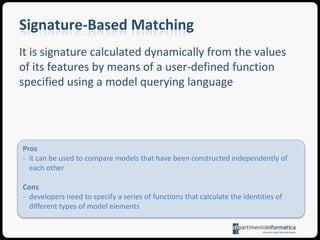
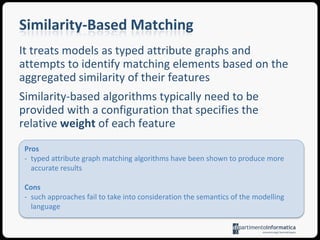
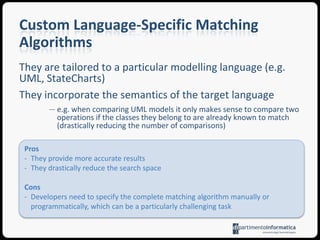
it is particularly fastConsit does not apply to models constructed independently of each other, and to model representation technologies that do not support maintenance of unique identitiesSignature-Based MatchingIt is signature calculated dynamically from the values of its features by means of a user-defined function specified using a model querying languageProsit can be used to compare models that have been constructed independently of each otherConsdevelopers need to specify a series of functions that calculate the identities of different types of model elementsSimilarity-Based MatchingIt treats models as typed attribute graphs and attempts to identify matching elements based on the aggregated similarity of their featuresSimilarity-based algorithms typically need to be provided with a configuration that specifies the relative weight of each featureProstyped attribute graph matching algorithms have been shown to produce more accurate resultsConssuch approaches fail to take into consideration the semantics of the modelling languageCustom Language-Specific Matching AlgorithmsThey are tailored to a particular modelling language (e.g. UML, StateCharts)They incorporate the semantics of the target languagee.g. when comparing UML models it only makes sense to compare two operations if the classes they belong to are already known to match (drastically reducing the number of comparisons)ProsThey provide more accurate results
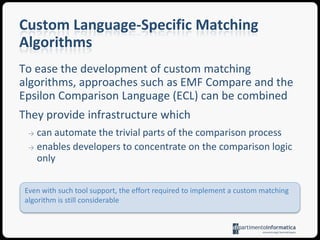
They drastically reduce the search spaceConsDevelopers need to specify the complete matching algorithm manually or programmatically, which can be a particularly challenging taskCustom Language-Specific Matching AlgorithmsTo ease the development of custom matching algorithms, approaches such as EMF Compare and the Epsilon Comparison Language (ECL) can be combinedThey provide infrastructure whichcan automate the trivial parts of the comparison processenables developers to concentrate on the comparison logic onlyEven with such tool support, the effort required to implement a custom matching algorithm is still considerable
Some model matching approaches
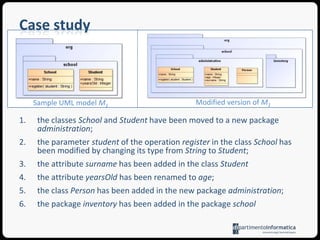
Case studyModified version of M1Sample UML model M1the classes School and Student have been moved to a new package administration;the parameter student of the operation register in the class School has been modified by changing its type from String to Student;the attribute surname has been added in the class Studentthe attribute yearsOld has been renamed to age;the class Person has been added in the new package administration;the package inventory has been added in the package school
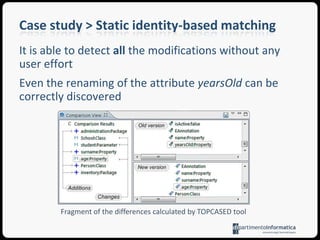
Case study > Static identity-based matching It is able to detect all the modifications without any user effortEven the renaming of the attribute yearsOld can be correctly discoveredFragment of the differences calculated by TOPCASED tool
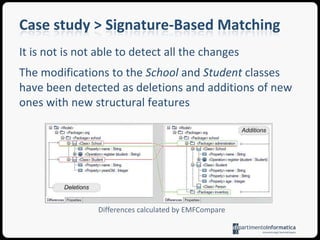
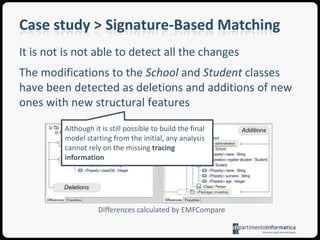
Case study > Signature-Based MatchingIt is not is not able to detect all the changesThe modifications to the School and Student classes have been detected as deletions and additions of new ones with new structural featuresDifferences calculated by EMFCompare
Case study > Signature-Based MatchingIt is not is not able to detect all the changesThe modifications to the School and Student classes have been detected as deletions and additions of new ones with new structural featuresAlthough it is still possible to build the final model starting from the initial, any analysis cannot rely on the missing tracing informationDifferences calculated by EMFCompare
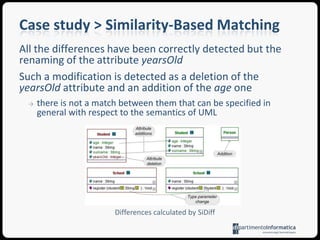
Case study > Similarity-Based MatchingAll the differences have been correctly detected but the renaming of the attribute yearsOldSuch a modification is detected as a deletion of the yearsOld attribute and an addition of the age onethere is not a match between them that can be specified in general with respect to the semantics of UMLDifferences calculated by SiDiff
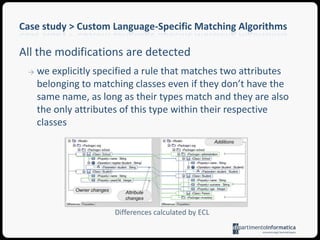
Case study > Custom Language-Specific Matching AlgorithmsAll the modifications are detectedwe explicitly specified a rule that matches two attributes belonging to matching classes even if they don’t have the same name, as long as their types match and they are also the only attributes of this type within their respective classesDifferences calculated by ECL
EMF CompareEMF Compare is an EMFT component providing out-of-the-box model comparison and merging capabilities
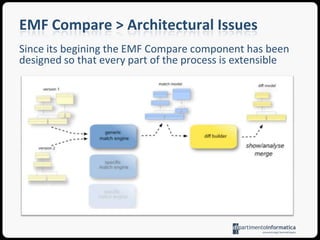
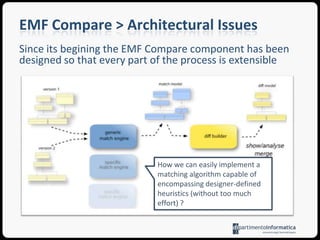
EMF Compare > Architectural IssuesSince its begining the EMF Compare component has been designed so that every part of the process is extensible
EMF Compare > Architectural IssuesSince its begining the EMF Compare component has been designed so that every part of the process is extensibleHow we can easily implement a matching algorithm capable of encompassing designer-defined heuristics (without too much effort) ?
ECL: Epsilon Comparison LanguageThe aim of the Epsilon Comparison Language (ECL) is to enable users to specify comparison algorithms in a rule-based manner ECL is a hybrid rule-based language which is used in combination with EMF CompareA ECL specification defines a matching algorithm for EMF CompareThe specified rules permit to identify pairs of matching elements between two modelsECL is part of the Eclipse GMT project: http://www.eclipse.org/gmt/epsilon/doc/ecl/
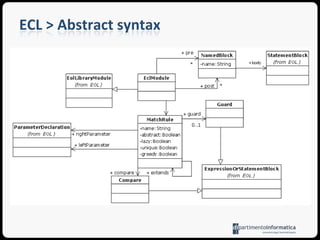
ECL > Abstractsyntax
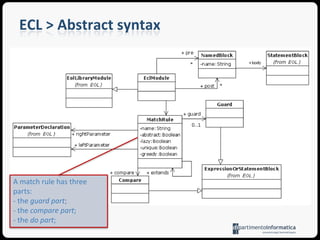
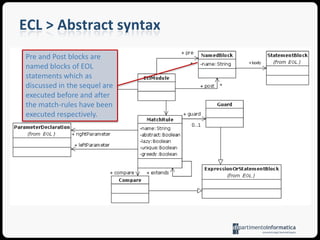
ECL > AbstractsyntaxA match rule has three parts: - the guard part;- the compare part; - the do part;
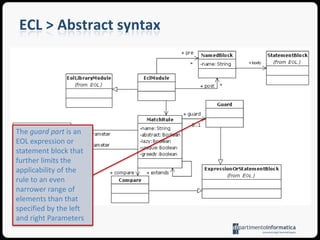
ECL > AbstractsyntaxThe guard part is an EOL expression or statement block that further limits the applicability of the rule to an even narrower range of elements than that specified by the left and right Parameters
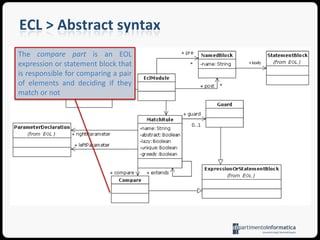
ECL > AbstractsyntaxThe compare part is an EOL expression or statement block that is responsible for comparing a pair of elements and deciding if they match or not
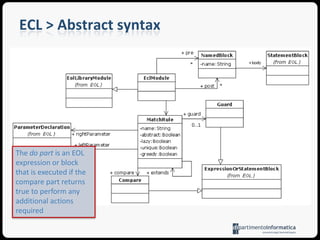
ECL > AbstractsyntaxThe do part is an EOL expression or block that is executed if the compare part returns true to perform any additional actions required
ECL > AbstractsyntaxPre and Post blocks are named blocks of EOL statements which as discussed in the sequel are executed before and after the match-rules have been executed respectively.
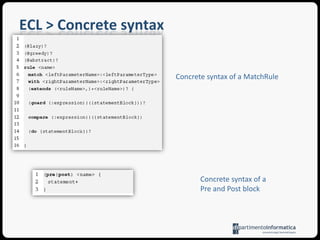
ECL > Concrete syntaxConcrete syntaxof a MatchRuleConcrete syntaxof a Pre and Post block
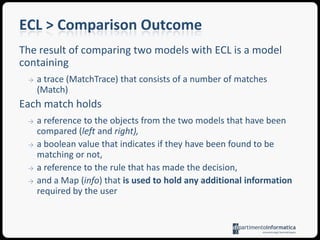
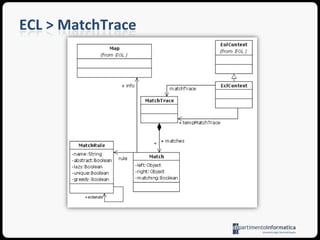
ECL > Comparison OutcomeThe result of comparing two models with ECL is a model containing a trace (MatchTrace) that consists of a number of matches (Match)Each match holds a reference to the objects from the two models that have been compared (left and right), a boolean value that indicates if they have been found to be matching or not, a reference to the rule that has made the decision, and a Map (info) thatis used to hold any additional information required by the user
ECL > MatchTrace
Example (1)
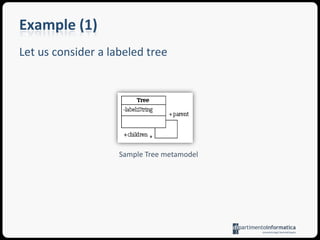
Example (1)Let us consider a labeled treeSample Treemetamodel
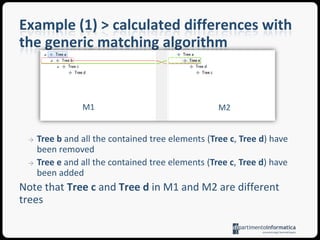
Example (1) > calculated differences with the generic matching algorithmM1M2Tree b and all the containedtreeelements (Tree c, Tree d) havebeenremovedTree e and all the containedtreeelements (Tree c, Tree d) havebeenaddedNote that Tree c and Tree d in M1 and M2 are different trees
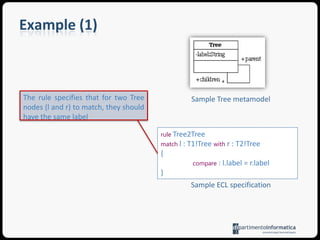
Example (1)The rule specifies that for two Tree nodes (l and r) to match, they should have the same labelSample Treemetamodelrule Tree2Treematch l : T1!Treewith r : T2!Tree{compare : l.label = r.label}Sample ECL specification
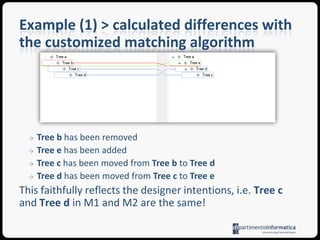
Example (1) > calculated differences with the customized matching algorithmTree bhasbeenremovedTree ehasbeenaddedTreechasbeenmovedfromTree b toTreedTreed hasbeenmovedfromTreectoTreeeThis faithfully reflects the designer intentions, i.e. Tree c and Tree d in M1 and M2 are the same!
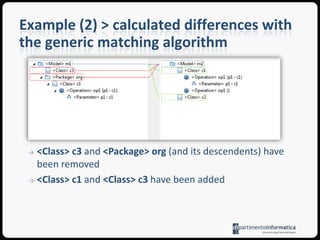
Example (2) > calculated differences with the generic matching algorithm<Class> c3 and <Package> org (and itsdescendents) havebeenremoved<Class> c1 and <Class> c3 havebeenadded
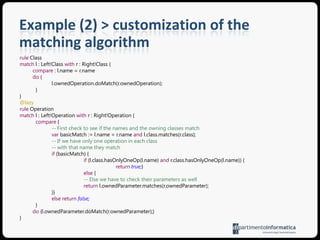
Example (2) > customizationof the matchingalgorithmruleClassmatch l : Left!Classwith r : Right!Class {compare : l.name = r.namedo {l.ownedOperation.doMatch(r.ownedOperation);}}@lazyruleOperationmatch l : Left!Operationwithr : Right!Operation {compare {-- First check to see if the names and the owning classes matchvarbasicMatch := l.name = r.name andl.class.matches(r.class);-- If we have only one operation in each class -- with that name they matchif (basicMatch) {if (l.class.hasOnlyOneOp(l.name) andr.class.hasOnlyOneOp(l.name)) {returntrue;}	else {	-- Else we have to check their parameters as wellreturnl.ownedParameter.matches(r.ownedParameter);}}elsereturnfalse;}do {l.ownedParameter.doMatch(r.ownedParameter);}}
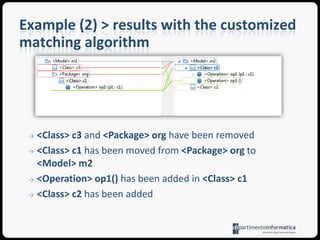
Example(2) > results with the customized matching algorithm<Class> c3 and <Package> org havebeenremoved<Class> c1hasbeenmovedfrom<Package> org to<Model> m2<Operation> op1() hasbeenadded in <Class> c1 <Class> c2 hasbeenadded
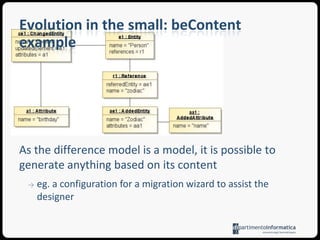
Example(3) > beContentbeContent is an model-driven platform for designing and maintaining web applicationsA beContent model consists mainly of the declarative and coordinated specification of three different concerns:the data view is the description of the relational model of the data, in essence it describes the metadata of the application;the content view describes the data sources and how the content is retrieved and aggregated in pages; and finallythe interaction view specifies how to manipulate the information entered in the forms, the validation constraints, and additional information which may affect the interaction between the user and the application.
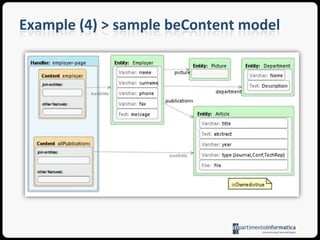
Example (4) > sample beContentmodel
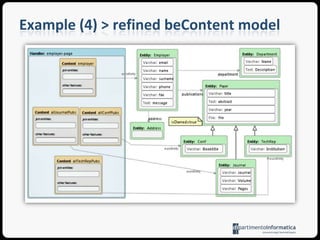
Example (4) > refinedbeContentmodel
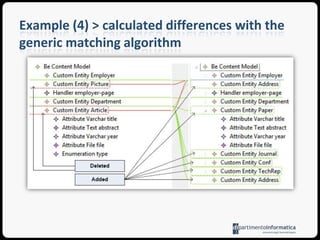
Example (4) > calculated differences with the generic matching algorithm
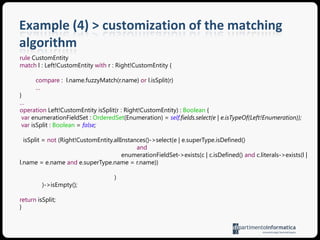
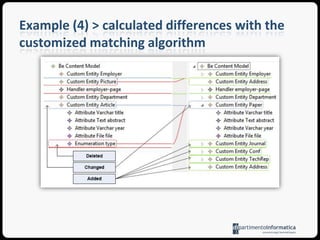
Example (4) > customizationof the matchingalgorithmruleCustomEntitymatch l : Left!CustomEntitywith r : Right!CustomEntity {compare :  l.name.fuzzyMatch(r.name) orl.isSplit(r)…}…operationLeft!CustomEntityisSplit(r : Right!CustomEntity) : Boolean {varenumerationFieldSet : OrderedSet(Enumeration) = self.fields.select(e | e.isTypeOf(Left!Enumeration));varisSplit : Boolean = false;isSplit = not (Right!CustomEntity.allInstances()->select(e | e.superType.isDefined()  andenumerationFieldSet->exists(c | c.isDefined() andc.literals->exists(l | l.name = e.nameande.superType.name = r.name))                                                       )             )->isEmpty();returnisSplit;                     }
Example (4) > calculated differences with the customized matching algorithm
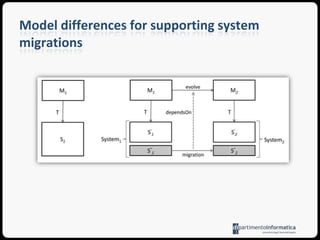
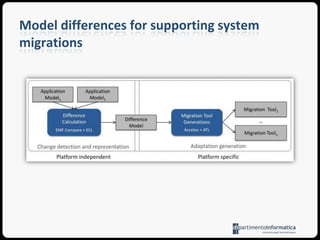
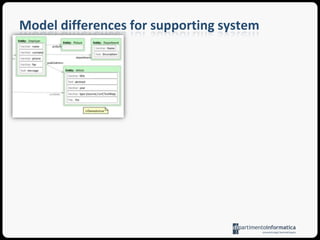
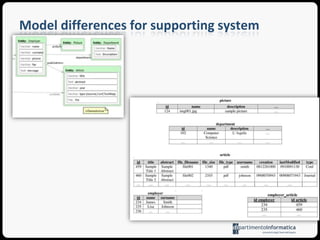
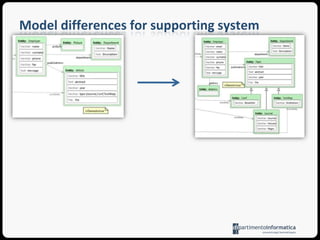
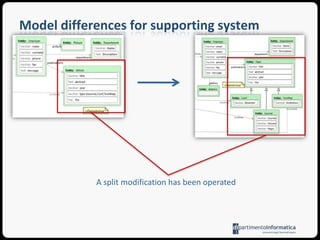
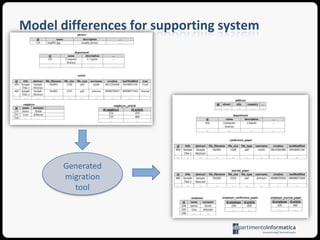
Modeldifferencesforsupporting system migrations
Modeldifferencesforsupporting system migrationsA splitmodificationhasbeenoperated
Modeldifferencesforsupporting system migrationsGeneratedmigrationtool
Model MatchingThere is no single best solution to model matchingSelecting a model matching approach for the problem at stake involves deciding on a trade-off between the required accuracy and the effort necessary to accomplish the differencingAccording to our experience, a custom matching algorithm based on infrastructure such as EMF Compare or ECL is deemed appropriate for high accuracy and performanceOur arguments are based on practical experience obtained through experimentation with several implementations of matching algorithms and tools
DiscussionEspecially when dealing with general purpose modeling language, it might be interesting to use also taxonomic/ontology systems, such as WordNetThis would have two advantagesEase the task of defining correspondences among names whose meaning is “close” enoughWould permit to discover relations which are otherwise hidden in the model
SummaryModel differencesMatching AlgorithmConflict ManagementEvolution in the large (model evolution)in the small (metamodel evolution)Conclusions115
Managing model conflicts in distributed development
Conflict ManagementIntroductionModel versioningDistributed developmentConflict management in MDERepresentation of model differencesA DSL for conflict specificationSyntaxSemanticsConclusions and future work
IntroductionModel Driven Engineering (MDE) aims at shifting the focus of software development from coding to modeling and considers models as primary artifactsComplex software systems are developed in distributed environments which demands a precise discipline in the management of model versionsConflict management is an unavoidable aspect when dealing with distributed versions of the same artifact
IntroductionWe propose a Domain-Specific Language for conflict management which is intended to define conflicts related to the underlying domain-specific semantics andprovide different tolerance degree to collisions depending on the particular stage of modeling process
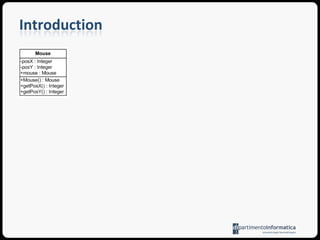
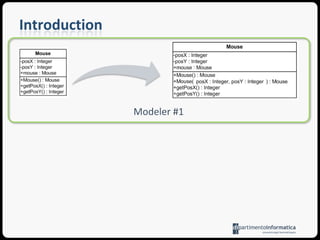
Introduction
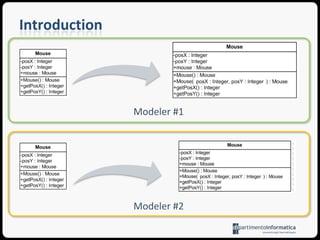
IntroductionModeler #1
IntroductionModeler #1Modeler #2
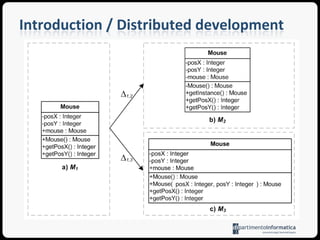
Introduction / Distributed development
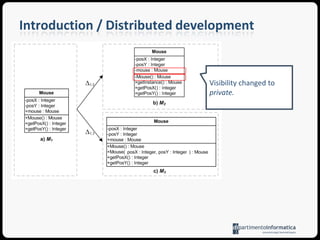
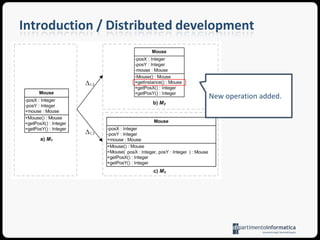
Introduction / Distributed developmentVisibility changed to private.
Introduction / Distributed developmentNew operation added.
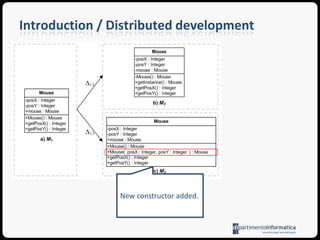
Introduction / Distributed developmentNew constructor added.
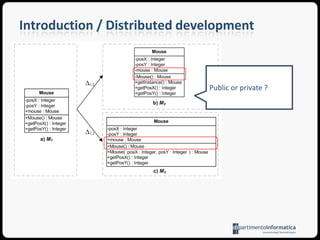
Introduction / Distributed developmentPublic or private ?
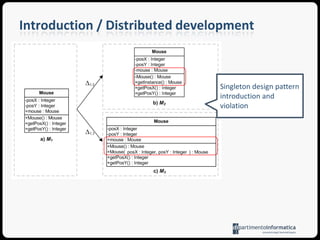
Introduction / Distributed developmentSingleton design pattern introduction and violation
Conflict managementIdentification of changes occurred in each concurrent model version by means of some evolution representation approach
Conflict managementIdentification of changes occurred in each concurrent model version by means of some evolution representation approachConflict detection is based on the comparison between concurrent versions of the modifications It usually relies on a priori analyses of the domain entailing a predefined set of problems and thus admitting false positive and false negative occurrences
Conflict managementIdentification of changes occurred in each concurrent model version by means of some evolution representation approachConflict detection is based on the comparison between concurrent versions and usually relies on a priori analyses of the domain entailing a predefined set of problems and thus admitting false positive and false negative occurrencesConflict resolution is a strategy given to reconcile colliding manipulations, in general provided by the developer
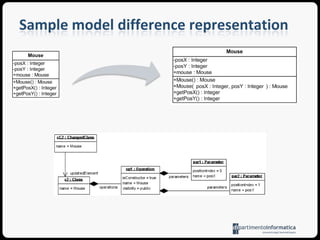
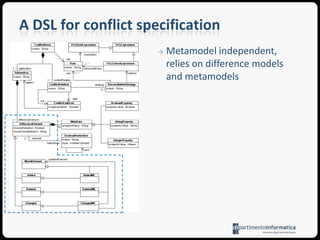
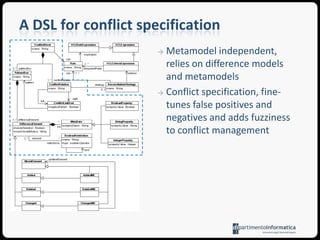
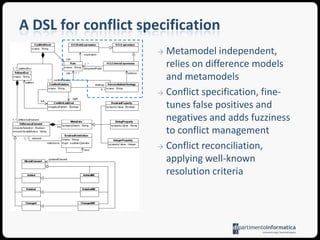
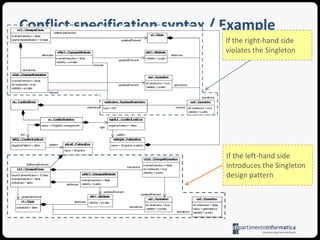
A DSL for conflict specificationIt is relies on the model-based difference representation seen beforeThe conflicts are specified as a left-hand side and a right-hand side representing delta pattern pairs which can not occur in the concurrent modifications at the same timeThe pattern language allows to specify regular expressions as names of the involved entitiesPatterns can declare and recall bound variables making it possible to refer to the properties of the current matchOther useful features are negative patterns and multiplicity of matches
A model-baseddifferencerepresentation[TOOLS07]
Difference metamodel example
Difference metamodel exampleMM2MMD
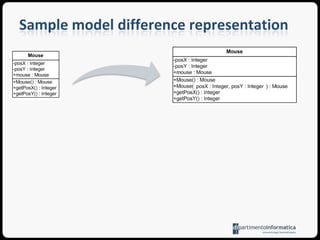
Sample modeldifferencerepresentation
A DSL for conflict specificationMetamodel independent, relies on difference models and metamodels
A DSL for conflict specificationMetamodelindependent, relies on difference models and metamodelsConflict specification, fine-tunes false positives and negatives and adds fuzziness to conflict management
A DSL for conflict specificationMetamodel independent, relies on difference models and metamodels
Conflict specification, fine-tunes false positives and negatives and adds fuzziness to conflict management
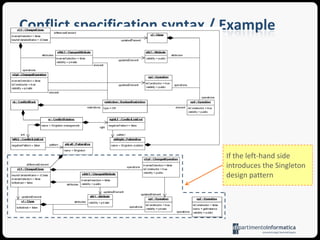
Conflict reconciliation, applying well-known resolution criteriaConflict specification syntax / ExampleIf the left-hand side introduces the Singleton design pattern
Conflict specification syntax / ExampleIf the right-hand side violates the SingletonIf the left-hand side introduces the Singleton design pattern
Interpreting conflict specificationsThe definitions of conflicts are given precise semantics by means of OCLThe graphical representation of OCL expressions is not new and has taken inspiration from the work on Join Point Designation Diagrams (JPDDs)  [SHU05]OCL constructs are embedded in ATL transformations to build rules able to detect interfering modificationsOther possible semantics can be given mapping the diagrammatic definition of conflicts toward corresponding rules for instance by graph transformations or declarative techniques
Conflict specification semantics
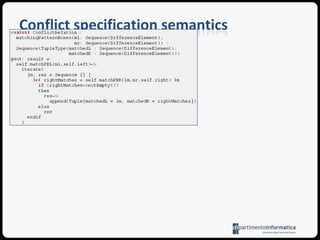
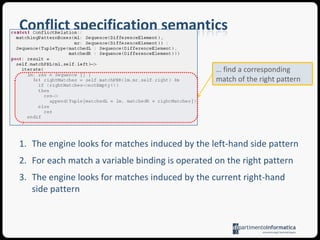
Conflict specification semanticsFor each match of the left pattern …
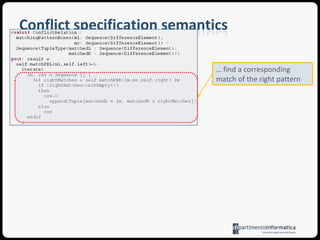
Conflict specification semantics… find a corresponding match of the right pattern
Conflict specification semantics… find a corresponding match of the right patternThe engine looks for matches induced by the left-hand side patternFor each match a variable binding is operated on the right patternThe engine looks for matches induced by the current right-hand side pattern
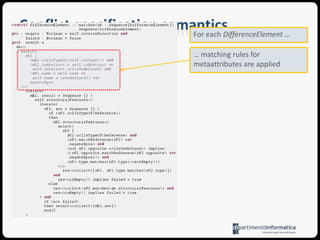
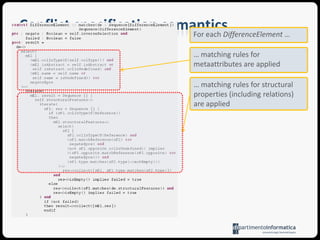
Conflict specification semanticsFor each DifferenceElement…… matching rules for metaattributes are applied
Conflict specification semanticsFor each DifferenceElement…… matching rules for metaattributes are applied… matching rules for structural properties (including relations) are applied
Conflict ManagementThe proposed work is an excerpt of the dissertation of Antonio Cicchetti defended in 2007 and proposes a structural approach for dealing with conflicts not detectable from the syntax levelA model-based difference representation approach and a pattern language relying on it enable the management of distributed developmentModeling activities requires different levels of strictness in detecting conflicts depending on the stage of the development: for instance at the beginning it might be preferable to be looserLibraries of conflict specifications
Conflict ManagementA prototypical implementation of the approach based on the AMMA platform is available at http://www.di.univaq.it/cicchetti/conflictManagement.phpThe approach needs a usability validation which encompasses larger population of conflict casesThe DSL could be improved introducing unary conflictsThe specification of resolution strategies have to be further investigated, like defining a reconciliation process or minimizing the conflicting portions
SummaryModel differencesCalculationRepresentationVisualizationMatching AlgorithmConflict ManagementEvolution in the large (model evolution)in the small (metamodel evolution)Conclusions152
Evolution in the large and in the smallModel Evolution and Versioning
Introduction Model Driven Engineering (MDE) is increasingly gaining acceptance in the development of software as a mean to leverage abstraction and render business logic resilient to technological changesCoordinated collections of models and modeling languages are used to describe web applications on different abstraction levels and from different perspectives Models and metamodels are not preserved from the evolutionary pressure which inevitably affects almost any artifacts, possibly causing a cascade of adaptations154
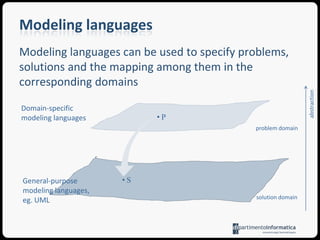
Modeling languagesModeling languages can be used to specify problems, solutions and the mapping among them in the corresponding domainsabstractionDomain-specific modeling languagesPproblem domainSGeneral-purpose modeling languages,eg. UML solution domain
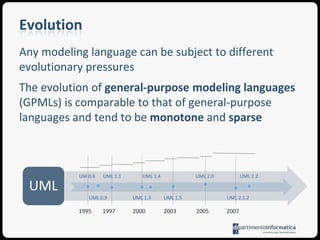
EvolutionAny modeling language can be subject to different evolutionary pressures The evolution of general-purpose modeling languages (GPMLs) is comparable to that of general-purpose languages and tend to be monotone and sparse
EvolutionAny modeling language can be subject to different evolutionary pressures The evolution of general-purpose modeling languages (GPMLs) is comparable to that of general-purpose languages and tend to be monotone and sparseUM 0.8UML 1.1UML 1.4UML 2.0UML 2.2UML 0.9UML 1.3UML 1.5UML 2.1.2199519972005200020032007
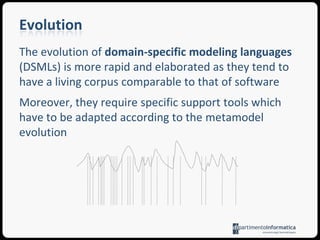
EvolutionThe evolution of domain-specific modeling languages (DSMLs) is more rapid and elaborated as they tend to have a living corpus comparable to that of softwareMoreover, they require specific support tools which have to be adapted according to the metamodel evolution
EvolutionI would like to discuss the problem of the evolution in model-driven development
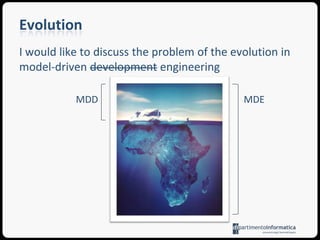
EvolutionI would like to discuss the problem of the evolution in model-driven development engineeringMDDMDE
EvolutionI would like to discuss the problem of the evolution in model-driven development engineeringThis talk analyzes the different kinds of co-adaptations distinguishing among co-evolution in the large and in the smallwhen a metamodel undergoes a modification, the conforming models require to be accordingly co-adaptedwhen a new version of a model is produced, the application may require an explicit adaptation of those assets which are not directly reflected by the models and transformations
SummaryIntroductionEvolution in the Large: MetamodelEvolutionProblem-based adaptationSolution-based adaptationMetamodel change classificationTransformationaladaptationofmodelsEvolution in the Small: Application Model EvolutionData migrationAdaptation of specific assetsConclusions and future work
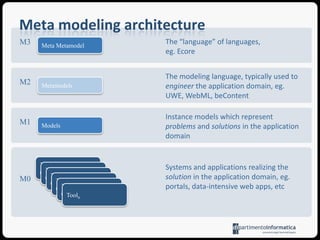
M3The “language” oflanguages,eg. EcoreMeta MetamodelThe modelinglanguage, typicallyusedtoengineerthe applicationdomain, eg. UWE, WebML, beContentM2Meta modeling architectureMetamodelsInstancemodelswhichrepresentproblems and solutions in the application domainM1ModelsTools(VisualEditors)Systems and applicationsrealizing the solutionin the applicationdomain, eg. portals, data-intensive web apps, etcTools(VisualEditors)Tools(VisualEditors)M0Tools(VisualEditors)Tools(VisualEditors)Tooln
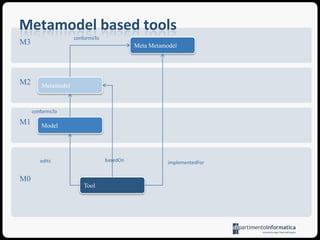
M3M2M1M0Metamodel based toolsconformsToMeta MetamodelMetamodelconformsToModelbasedOneditsimplementedForTool
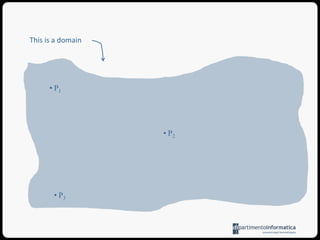
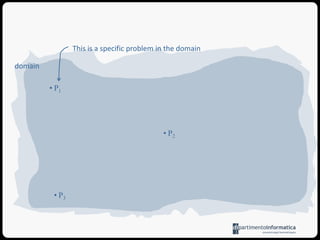
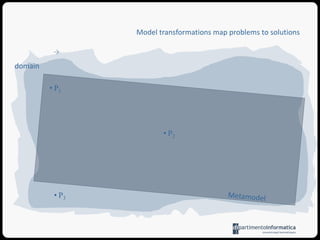
This is a domainP1
P2
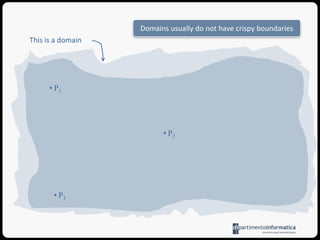
P3Domainsusually do nothavecrispyboundariesThis is a domainP1
P2
P3This is a specific problem in the domaindomainP1
P2
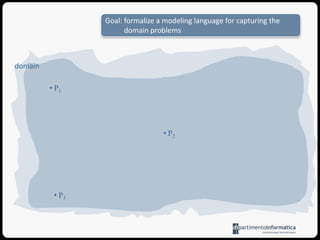
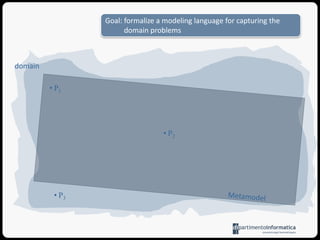
P3Goal: formalize a modeling language for capturing the domain problemsdomainP1
P2
P3MetamodelGoal: formalize a modeling language for capturing the domain problemsdomainP1
P2
P3MetamodelGoal: formalize a modeling language for capturing the domain problemsdomainP1
P2
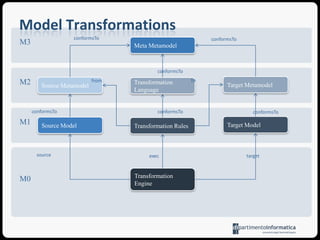
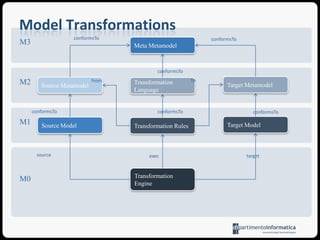
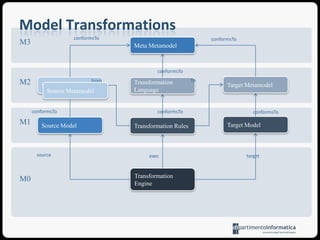
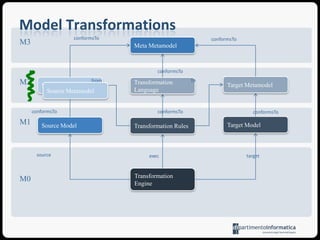
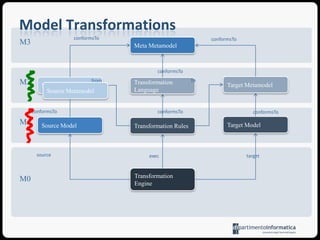
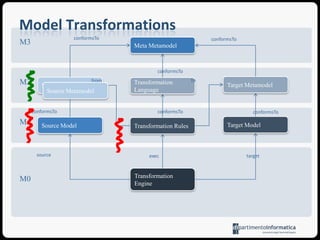
P3M3Model TransformationsconformsToconformsToMeta MetamodelconformsToM2tofromTarget MetamodelSource MetamodelTransformationLanguageconformsToconformsToconformsToM1Target ModelSource ModelTransformationRulessourcetargetexecTransformationEngineM0
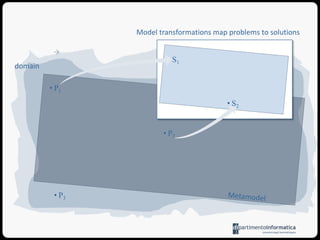
MetamodelModel transformations map problems to solutionsdomainP1
P2
P3Model transformations map problems to solutionsS1domainP1
S2
P2
P3Metamodel
Metamodel evolutionSometimes metamodels must be adapted, extended or amended to better capture the problems
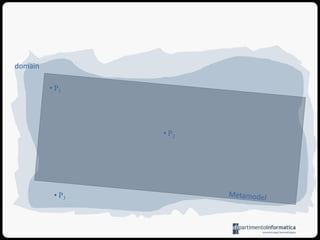
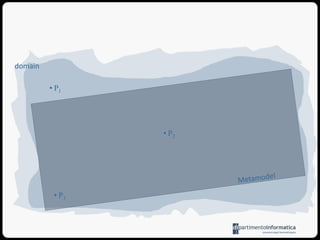
Metamodel evolutionSometimes metamodels must be adapted, extended or amended to better capture the problemsThis may happen because the domains are often only partially analyzed and several instances may be left outnew requirements must be considered which will result in a domain refinement or enlargementa more complete understanding of the domain is at hand
MetamodeldomainP1
P2
P3MetamodeldomainP1
P2
P3M3Model TransformationsconformsToconformsToMeta MetamodelconformsToM2tofromTarget MetamodelSource MetamodelTransformationLanguageconformsToconformsToconformsToM1Target ModelSource ModelTransformationRulessourcetargetexecTransformationEngineM0
M3Model TransformationsconformsToconformsToMeta MetamodelconformsToM2tofromTarget MetamodelSource MetamodelTransformationLanguageSource MetamodelconformsToconformsToconformsToM1Target ModelSource ModelTransformationRulessourcetargetexecTransformationEngineM0
Model TransformationsconformsToconformsToM3Meta MetamodelconformsToM2tofromTarget MetamodelSource MetamodelTransformationLanguageSource MetamodelconformsToconformsToconformsToM1Target ModelSource ModelTransformationRulessourcetargetexecTransformationEngineM0
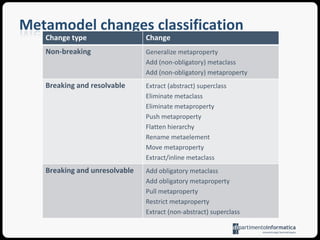
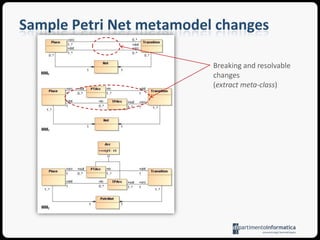
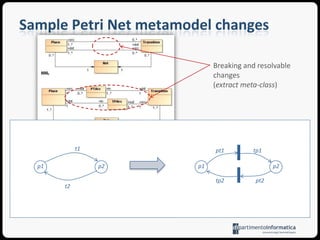
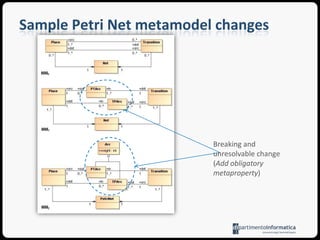
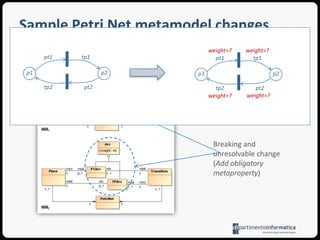
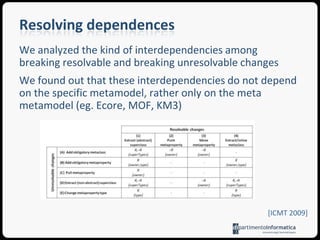
Metamodel changesA metamodel can undergo a number of different kinds of modifications which are classified in Non-breakingBreaking The breaking modifications can be divided intoBreaking and resolvable: existing instances need to be co-adapted to conform to the new metamodel version. The co-evolution can be automatically operatedBreaking and unresolvable: the necessary co-adaptation of existing models can not be automatically computed due to the need of further information[Paige at al 2007]
Metamodel changes classification
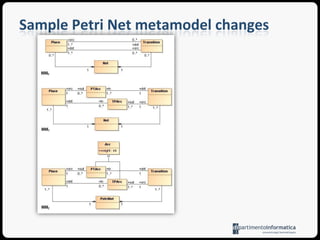
Sample Petri Net metamodel changes
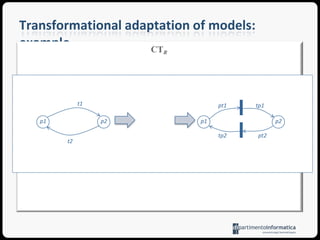
Sample Petri Net metamodel changesBreaking and resolvable changes(extract meta-class)
Sample Petri Net metamodel changesBreaking and resolvable changes(extract meta-class)t1pt1tp1p1p2p1p2pt2tp2t2
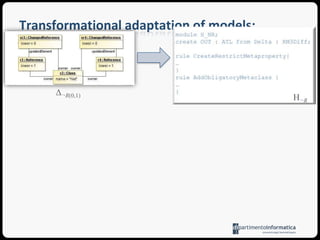
Sample Petri Net metamodel changesBreaking and unresolvablechange(Addobligatorymetaproperty)
Sample Petri Net metamodel changesweight=?weight=?pt1tp1pt1tp1p1p2p1p2pt2tp2pt2tp2weight=?weight=?Breaking and unresolvablechange(Addobligatorymetaproperty)
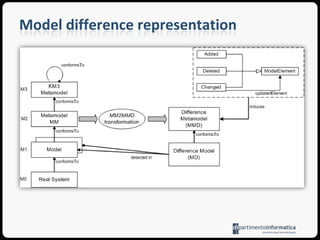
Model difference representation
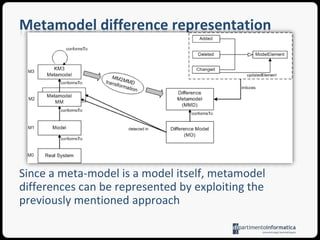
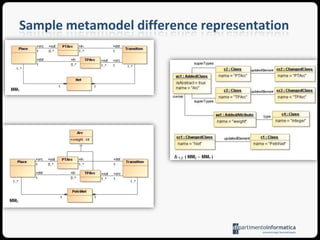
Metamodel difference representationSince a meta-model is a model itself, metamodel differences can be represented by exploiting the previously mentioned approach
Sample metamodeldifferencerepresentation
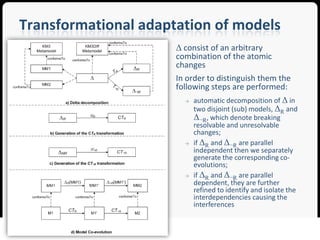
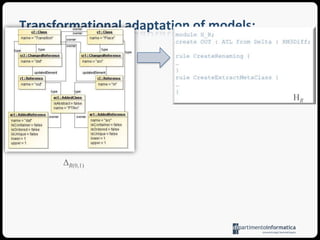
Transformational adaptation of modelsΔ consist of an arbitrary combination of the atomic changesIn order to distinguish them the following steps are performed:automatic decomposition of Δ in two disjoint (sub) models, ΔR and Δ¬R, which denote breaking resolvable and unresolvable changes;if ΔR and Δ¬R are parallel independent then we separately generate the corresponding co-evolutions;if ΔR and Δ¬R are parallel dependent, they are further refined to identify and isolate the interdependencies causing the interferences
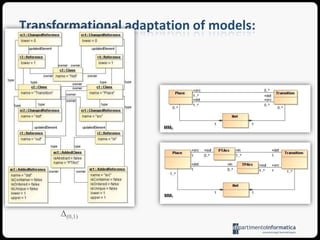
Transformationaladaptationofmodels: exampleΔ(0,1)
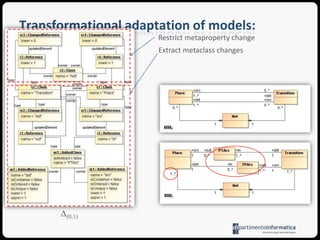
Transformationaladaptationofmodels: exampleRestrictmetapropertychangeExtractmetaclasschangesΔ(0,1)
Transformationaladaptationofmodels: examplemoduleH_R;createOUT : ATL from Delta : KM3Diff;ruleCreateRenaming {…}ruleCreateExtractMetaClass{…}…HRΔR(0,1)
Transformationaladaptationofmodels: examplemoduleH_R;createOUT : ATL from Delta : KM3Diff;ruleCreateRenaming {…}ruleCreateExtractMetaClass{…}…HRmodule CTR;create OUT : MM1 from IN : MM0;…rulecreatePTArc(s : OclAny, n : OclAny) {…}rulecreateTPArc(s : OclAny, n : OclAny) {…}ΔR(0,1)CTR
Transformationaladaptationofmodels: exampleCTRt1pt1tp1p1p2p1p2pt2tp2t2
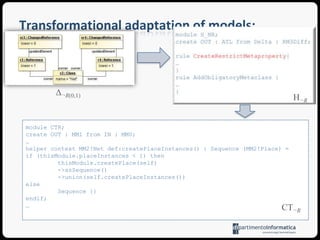
Transformationaladaptationofmodels: examplemodule H_NR;createOUT : ATL from Delta : KM3Diff;rule CreateRestrictMetaproperty{ …}ruleAddObligatoryMetaclass{…}…Δ¬R(0,1)H¬R
Transformationaladaptationofmodels: examplemodule H_NR;createOUT : ATL from Delta : KM3Diff;rule CreateRestrictMetaproperty{ …}ruleAddObligatoryMetaclass{…}…Δ¬R(0,1)H¬Rmodule CTR;create OUT : MM1 from IN : MM0;…helper context MM2!Net def:createPlaceInstances() : Sequence (MM2!Place) =if (thisModule.placeInstances < 1) thenthisModule.createPlace(self)	->asSequence()	->union(self.createPlaceInstances())elseSequence{}endif;…CT¬R
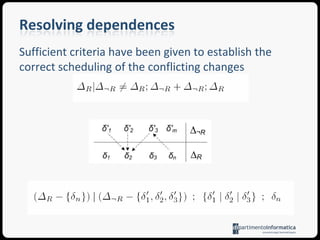
Parallel dependent modificationsThe automatic co-adaptation of models relies on the parallel independence of breaking resolvable and unresolvable modifications, or more formallyΔR|Δ¬R = ΔR;Δ¬R +Δ¬R;ΔRwhere + denotes the non-deterministic choice
Parallel dependent modificationsThe automatic co-adaptation of models relies on the parallel independence of breaking resolvable and unresolvable modifications, or more formallyΔR|Δ¬R = ΔR;Δ¬R +Δ¬R;ΔRwhere + denotes the non-deterministic choiceBad news: the parallel independence of changes is not assured, ie. multiple changes can be interdependent one another
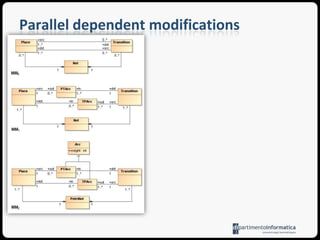
Parallel dependent modifications
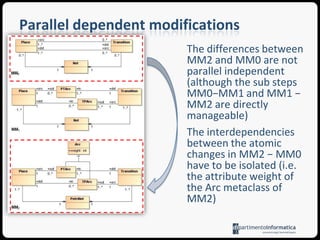
Parallel dependent modificationsThe differences between MM2 and MM0 are not parallel independent (although the sub steps MM0−MM1 and MM1 − MM2 are directly manageable)The interdependenciesbetween the atomic changes in MM2 − MM0 have to be isolated (i.e. the attribute weight of the Arc metaclass of MM2)
Resolving dependencesWe analyzed the kind of interdependencies among breaking resolvable and breaking unresolvable changesWe found out that these interdependencies do not depend on the specific metamodel, rather only on the meta metamodel (eg. Ecore, MOF, KM3)[ICMT 2009]
Resolving dependencesSufficient criteria have been given to establish the correct scheduling of the conflicting changes
Resolving dependencesAn alternative approach ([1]) is based on a lazy evaluation mechanism which queues up adaptations which require unavailable informationWe have found that for KM3, Ecore, and MOF interdependencies are not circular and that they only depend on the meta metamodelThis implies that it is possible to find the exact scheduling of the adaptation steps w/o queuing them[1] Narayanan, Levendovszky, Balasubramanian, Karsai: Domain ModelMigrationtoManageMetamodelEvolution, MoDELS 2009
ApproachThis is a general approach which can be applied to any metamodel (so far it works for KM3 metamodels, Ecore and MOF are under study), it permitsthe management of complex metamodel modifications (in contrast with current approaches)the complete automatic adaptation of models (breaking non resolvable via transformation refinements)We are currently working on the migration of UWE models
SummaryIntroductionEvolution in the Large: Metamodel Evolution (XLE)Problem-based adaptationSolution-based adaptationMetamodel change classificationTransformationaladaptationofmodelsEvolution in the Small: Application Model Evolution (XSE)Data migrationAdaptation of specific assetsConclusions and future work
Solution-based adaptationThe chosen generic modeling platform – intended as a set of languages, systems, and transformation paradigms – may affect the metamodel life-cycleIn fact, sometimes metamodels must be changed in order to permit solutions which are otherwise not admissible
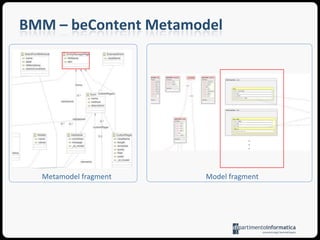
beContentbeContent is an model-driven platform for designing and maintaining web applicationsA beContent model consists mainly of the declarative and coordinated specification of three different concerns:the data view is the description of the relational model of the data, in essence it describes the metadata of the application;the content view describes the data sources and how the content is retrieved and aggregated in pages; and finallythe interaction view specifies how to manipulate the information entered in the forms, the validation constraints, and additional information which may affect the interaction between the user and the application.
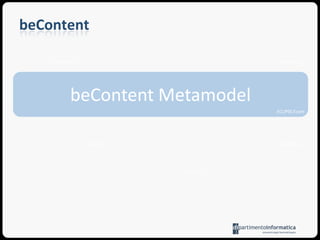
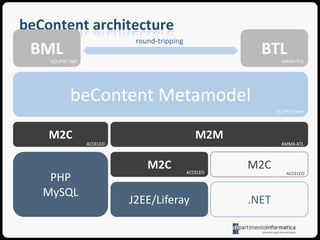
beContentECLIPSE GMFAMMA TCSbeContentMetamodelECLIPSE EcoreACCELEOAMMA ATLACCELEO
beContent architectureBMLBTLround-trippingECLIPSE GMFAMMA TCSECLIPSE GMFAMMA TCSbeContentMetamodelbeContentMetamodelECLIPSE EcoreECLIPSE EcoreM2CM2MACCELEOAMMA ATLACCELEOAMMA ATLM2CM2CPHPMySQLACCELEOACCELEOACCELEOJ2EE/Liferay.NET
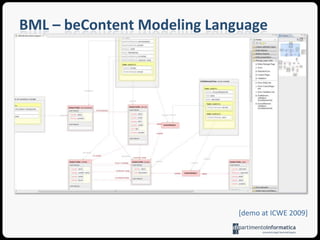
BML – beContent Modeling Language[demo at ICWE 2009]
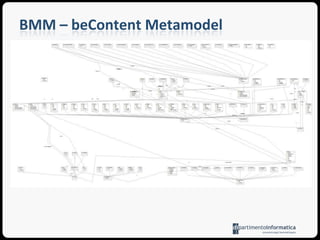
BMM – beContentMetamodel
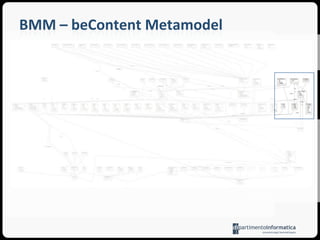
BMM – beContentMetamodel. . .Metamodel fragmentModel fragment
Problem: a simple text generationGenerate a text file containing source code based on information which is retrieved from different instances of the same metaclass
Problem: a simple text generation. . ....
Problem: a simple text generationGenerate a text file containing source code based on information which is retrieved from different instances of the same metaclassThis is not easy as it may appear as templating languages (in contrast with M2M languages) do not always have the querying power of OCLIn particular, this can be achieved either using external Java helpers or changing the metamodel in such a way these instances must be within a container
Refactoring the metamodelMM v1.0MM v2.0
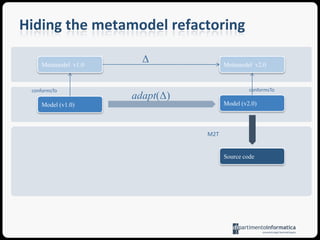
Problem: a simple text generationIn this scenario, a simple change of the metamodel from v1.0 to v2.0 is already pretty troublesome as it would require the adaptation of the models, which can be performed automatically as shown beforethe manual adaptation of the toolsA possible workaround …
Hiding the metamodel refactoringΔMetamodel  v1.0Metamodel  v2.0conformsToconformsToadapt(Δ)Model (v2.0)Model (v1.0)M2TSource code
Evolution in the large – open questionsAutomating the co-adaptation of models is only one aspect of the evolution of metamodels, nevertheless it is already very complex and presents open questionsMetamodel difference calculation: it is very difficult, none of the available approaches are really satisfactory because of domain semantics, similarity metrics, etcUpdate: we are having interesting result by combining EMF Compare and ECL for Ecoremetamodels differencingOverriding default adaptation with ad-hoc refactoringsSemantics preserving ?Validation, everybody is very keen on keeping her/his models secret :-)
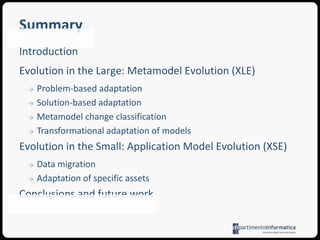
SummaryIntroductionEvolution in the Large: Metamodel Evolution (XLE)Problem-based adaptationSolution-based adaptationMetamodel change classificationTransformationaladaptationofmodelsEvolution in the Small: Application Model Evolution (XSE)Data migrationAdaptation of specific assetsConclusions and future work
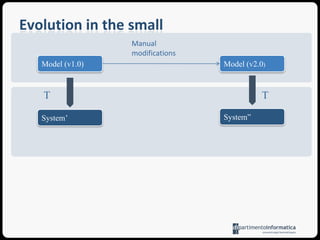
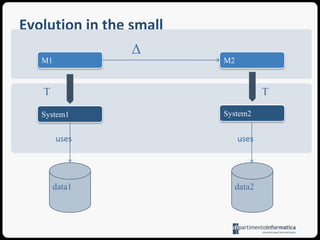
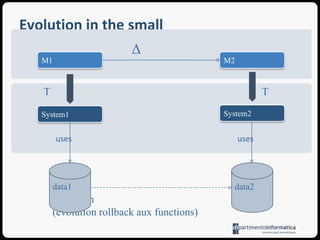
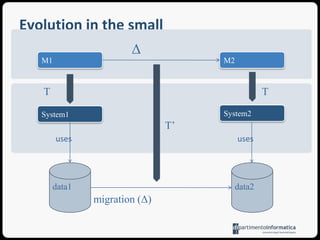
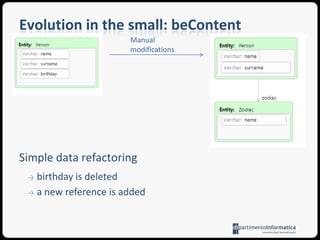
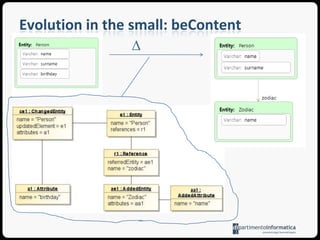
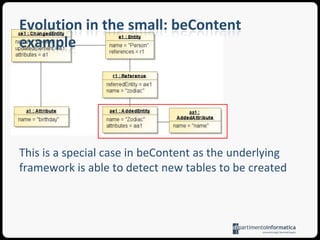
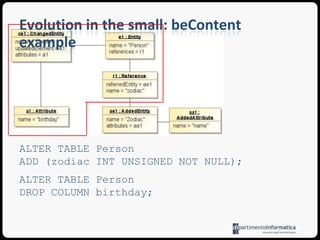
Evolution in the smallManual modificationsModel (v1.0)Model (v2.0)TTSystem”System’

Model evolution and versioning

  • 1.
    Model Evolution andVersioningAlfonso PierantonioDipartimento di InformaticaUniversità degli Studi dell’Aquilaalfonso.pierantonio@univaq.it
  • 2.
    2ObjectivesModel-DrivenEngineeringrequires mature andadequatemodel management in ordertoachieveits full potential. Thiscannotleaveaside the problemofmodeldifferencing.Thislecturewillprovideinsights on the problemofmodeldifferencingoutlining the potentialsofitsapplication.
  • 3.
    3Modeldifferences and evolutionModeldifferencesand evolutionThe ability to detect and represent structural changes in subsequent versions of a (meta) model
  • 4.
    4Modeldifferences and evolutionModeldifferencesand evolutionThere is no way to understand the rationale behind these modifications
  • 5.
  • 6.
    6Modeldifferences and evolutionModeldifferencesand evolution?Q1: How to detect such evolution ?
  • 7.
    7Modeldifferences and evolutionModeldifferencesand evolution?Q2: How to represent it in sucha way it can be conveyed to model transformations ?
  • 8.
    8Modeldifferences and evolutionModeldifferencesand evolution?Q3: Which kind of applications can be realized by representing the evolution by means of models ?
  • 9.
    9Modeldifferences and evolutionAsatisfactory representation of differences can enables a wide range of applicationsModeldifferences and evolution
  • 10.
    10Modeldifferences and evolutionModeldifferencesand evolutionModel evolution may require the adaptation of artefacts which are not directly generable from the model Metamodel evolution requires models, transformations, and tools (eg. GMF editors) to be consistently adapted
  • 11.
  • 12.
    Indeed, the metamodelarchitectureand the formalrelationshipsamongthe layers can fruitfullybeexplotedtothisend
  • 13.
  • 14.
  • 15.
  • 16.
    SummaryModel differencesMatching AlgorithmConflictManagementEvolution in the large (model evolution)in the small (metamodel evolution)Conclusions14
  • 17.
  • 18.
    Model DifferencesIntroductionRepresentation RequirementsModelDifference ApproachesEdit Script, ColoringRepresenting Model DifferencesDifference Metamodel, Difference ModelsDifference ApplicationPatchesOperations with DifferencesDual, Sequential and Parallel CompositionConclusions and Future Work
  • 19.
    IntroductionThe problem ofmodel differences is intrinsically complex and requires specialized algorithms and notationsAny solution should necessarily present a high degree of separation between three relevant aspectscalculation, a procedure, method or algorithm able to compare two distinct models representation, the outcome of the calculation must be represented in some formvisualization, model differences often requires to be visualized in a human-readable notationIn currentproposals the distinctionbetween the three aspects are often blurred thus compromising the adoption of generic modelling techniques
  • 20.
    IntroductionThe problem ofmodel differencing can be decomposed in two subsequent phases
  • 21.
    IntroductionThe problem ofmodel differencing can be decomposed in two subsequent phases1Calculation
  • 22.
    IntroductionThe problem ofmodel differencing can be decomposed in two subsequent phases12CalculationRepresentation
  • 23.
    IntroductionThe outcome usedfor further applications by means of automated transformations and analysis123CalculationRepresentationApplications : Transformation & Analysis
  • 24.
  • 25.
  • 26.
    IntroductionThus, the aimis to find a suitable representation for model differences whichis independent from the metamodel the models are conforming toabstracts from the calculation method used for differencing the models, regardless whether it is based on persistent ids or structural similaritythe outcome of a differencing operation must be usable in automated transformation or analysis
  • 27.
  • 28.
    ApproachesThe representation ofmodel differences can be divided into two main techniquesDirected deltas, represent delta documents as the sequence of the operations needed to obtain the new version from the old oneeg. edit scripts Symmetric deltas, show the result as the set of differences between the two compared versionseg. coloring [Mens 2002]
  • 29.
    Approaches – Exampleversion 1 (M1)
  • 30.
    Approaches – Exampleversion 2 (M2)version 1 (M1)
  • 31.
    Approaches – Exampleversion 2 (M2) version 1 (M1)
  • 32.
    Approaches – EditScripts (eg [Porres et al 2003])Sequence of actions able to reconstruct the final model starting from the initial oneCons: operational, proprietary format, tool dependent, lengthy, reduced readability
  • 33.
    Approaches – Coloring (eg [Ohst et al 2003])Declarative and intuitiveCons: does not hold the following propertiesMinimalisticSelf-containedTransformativeCons: moreoververy verboseupdates difficult to represent
  • 34.
  • 35.
    Difference Metamodel (1/3)Giventwo models M1 and M2 conforming to a metamodelMM, their difference (M2 – M1) conforms to a metamodelMMD that is derived from MMThe approach permits the representation of the following modificationsadditions: new elements are added to the final model deletions: some of the existing elements are deletedchanges: a new version of the model can consist of some updates of already existing elements
  • 36.
  • 37.
  • 38.
  • 39.
    Sample UML modelsuVersion1The abstract class HTMLDocElemhas been addedVersion 2
  • 40.
    Sample UML modelsVersion1The operation dump() has been moved to HTMLDocElemvVersion 2
  • 41.
    Sample UML modelswVersion1The HTMLList class became subclassof HTMLDocElemVersion 2
  • 42.
    Fragment of theDifference Model The abstract class HTMLDocElemhas been added
  • 43.
    Fragment of theDifference ModelThe abstract class HTMLDocElemhas been addedThe operation dump()has been moved from HTMLDocto HTMLDocElem
  • 44.
    Fragment of theDifference ModelThe abstract class HTMLDocElemhas been addedThe operation dump() has been moved from HTMLDoc to HTMLDocElemThe HTMLList class became subclassof HTMLDocElem
  • 45.
    Difference ApplicationOnce differencesare calculated and represented, they can be applied over models as patchesThe difference application is intended to “reconstruct” the final model starting from the initial one“patch” any model conforming to the base metamodel for reproducing the modifications
  • 46.
    Difference ApplicationLet (M2 – M1) =  be a difference model, then patch(M) equalsM2 if M = M1 (reconstructive)M if M  M1 =  (idempotent)patch(M  M1)  (M/M1) if M  M1   (transformative)where patch(M) = patch(, M) and
  • 47.
  • 48.
    reconstructive  transformativeDifference ApplicationThe difference application patch is obtained by an automated higher-order transformation written in ATLFor each “base” metaclass MC in MMD, the following transformation rules are generated:AddedMC2MCChangedMC2MC UnchangedMC2MCMMD2ATLHOTpatchtransformationMMD
  • 49.
    Difference ApplicationRule AddedMC2MCEachAddedMC induces a new MC instance in M2 and the corresponding structural features according to Rule ChangedMC2MCIt updates MC elements in M1 according to the ChangedMCelements in Rule UnchangedMC2MC It serves for propagating in M2 the context of M1, ie what is left unchanged by No rules are required for DeletedMC elements since they are simply ignored by the UnchangedMC2MCrule
  • 50.
  • 51.
  • 52.
    Difference OperatorsDualGiven adifference model, it is useful to automatically define its inverse, ie if (M2 – M1) =  the dual -1is such that patch-1(M2) = M1-1
  • 53.
    Difference OperatorsSequential Compositiontwo or more subsequent modifications can be grouped in a single difference modelgiven 1 = (M2 – M1) and 2 = (M3 – M2) then the sequential composition 1 ; 2 is defined in such a way that patch1; 2 = patch2 patch1Parallel Compositiondistributed manipulations of the same artifacts can be merged in a model difference as long as they are parallel indipendent
  • 54.
    Model Versioning -PatchesAn interesting scenario discloses when arbitrary models are allowed as input for difference application
  • 55.
    Model Versioning -PatchesAn interesting scenario discloses when arbitrary models are allowed as input for difference application
  • 56.
    Model Versioning -PatchesAn interesting scenario discloses when arbitrary models are allowed as input for difference application?
  • 57.
    Model Versioning -PatchesThe application of manipulations as patches demands for several propertiesSelf-containedness: The representation of differences should contain enough information to be applied to arbitrary inputsMinimality: The representation should not contain too much information thus locking the application to the initial contextTransformability: The application engine should allow several degrees of fuzziness, i.e. it should be able to reproduce a certain modification to appropriate arbitrary entities
  • 58.
  • 59.
  • 61.
    Model DifferencesModel differencesare crucial for general model management and can disclose numerous opportunitiesOnce differences are represented as first-class entities, a number of operations can be defined on thempatches, dual, binary compositions, impact evaluation, etcA proof of concept has been implemented on the Eclipse/AMMA platform (http://www.eclipse.org/m2m/atl/usecases/MMIndApproachtoDiffRep)
  • 62.
    What comes next?One of the problems of generic differencing methods is that matching algorithms are not always accurate since they are agnostic of the metamodel underlying semanticsFormalizing semantics is difficult, thus heuristics can provide some ad-hoc improvementAs soon we consider parallel composition the problem conflict specification, detection, and resolutionParallel composition may give place to conflicts whenever the differences are not parallel independentDepending on the process stage we may be interested in tuning false positives and negatives
  • 63.
    SummaryModel differencesMatching AlgorithmConflictManagementEvolution in the large (model evolution)in the small (metamodel evolution)Conclusions60
  • 64.
  • 65.
    OutlineIntroductionModel matchingStatic Identity-BasedMatchingSignature-Based MatchingSimilarity-Based MatchingLanguage-SpecificCase studyConclusions
  • 66.
    IntroductionDifferencing mechanisms forsupporting the evolution of model-based artifacts are becoming crucialDocument comparison algorithms provided by version control systems like CVS, and SVN have been shown to be inadequateCalculating model differences is a difficult task since it relies on model matching which can be reduced to the graph isomorphism problemNo efficient (i.e., polynomial-bound) algorithm for graph isomorphism is known and it has been conjectured that no such algorithm can exist [Ronald C. Read, Derek G. Corneil. The graph isomorphism disease. Journal of Graph Theory, 1(4):339-363, 2006]
  • 67.
  • 68.
    M1IntroductionM2Before calculating thedifferences a matching phase has to be performed to identify the elements which have to be compared
  • 69.
    Model matchingThere areseveral requirements for model matching approaches including accuracylevel of abstractiontool independenceefficiencyuser effortExisting model matching approaches can be distinguished according to the following classificationStatic Identity-Based MatchingSignature-Based MatchingSimilarity-Based MatchingCustom Language-Specific Matching AlgorithmsThere is no single best solution to model matching
  • 70.
    Static Identity-Based MatchingItis assumed that each model element has a persistent and non-volatile unique identifier that is assigned to it upon creationA basic approach for matching models is to identify matching model elements based on their corresponding identitiesProsit requires no configuration from the user perspective
  • 71.
    it is particularlyfastConsit does not apply to models constructed independently of each other, and to model representation technologies that do not support maintenance of unique identitiesSignature-Based MatchingIt is signature calculated dynamically from the values of its features by means of a user-defined function specified using a model querying languageProsit can be used to compare models that have been constructed independently of each otherConsdevelopers need to specify a series of functions that calculate the identities of different types of model elementsSimilarity-Based MatchingIt treats models as typed attribute graphs and attempts to identify matching elements based on the aggregated similarity of their featuresSimilarity-based algorithms typically need to be provided with a configuration that specifies the relative weight of each featureProstyped attribute graph matching algorithms have been shown to produce more accurate resultsConssuch approaches fail to take into consideration the semantics of the modelling languageCustom Language-Specific Matching AlgorithmsThey are tailored to a particular modelling language (e.g. UML, StateCharts)They incorporate the semantics of the target languagee.g. when comparing UML models it only makes sense to compare two operations if the classes they belong to are already known to match (drastically reducing the number of comparisons)ProsThey provide more accurate results
  • 72.
    They drastically reducethe search spaceConsDevelopers need to specify the complete matching algorithm manually or programmatically, which can be a particularly challenging taskCustom Language-Specific Matching AlgorithmsTo ease the development of custom matching algorithms, approaches such as EMF Compare and the Epsilon Comparison Language (ECL) can be combinedThey provide infrastructure whichcan automate the trivial parts of the comparison processenables developers to concentrate on the comparison logic onlyEven with such tool support, the effort required to implement a custom matching algorithm is still considerable
  • 73.
  • 74.
    Case studyModified versionof M1Sample UML model M1the classes School and Student have been moved to a new package administration;the parameter student of the operation register in the class School has been modified by changing its type from String to Student;the attribute surname has been added in the class Studentthe attribute yearsOld has been renamed to age;the class Person has been added in the new package administration;the package inventory has been added in the package school
  • 75.
    Case study >Static identity-based matching It is able to detect all the modifications without any user effortEven the renaming of the attribute yearsOld can be correctly discoveredFragment of the differences calculated by TOPCASED tool
  • 76.
    Case study >Signature-Based MatchingIt is not is not able to detect all the changesThe modifications to the School and Student classes have been detected as deletions and additions of new ones with new structural featuresDifferences calculated by EMFCompare
  • 77.
    Case study >Signature-Based MatchingIt is not is not able to detect all the changesThe modifications to the School and Student classes have been detected as deletions and additions of new ones with new structural featuresAlthough it is still possible to build the final model starting from the initial, any analysis cannot rely on the missing tracing informationDifferences calculated by EMFCompare
  • 78.
    Case study >Similarity-Based MatchingAll the differences have been correctly detected but the renaming of the attribute yearsOldSuch a modification is detected as a deletion of the yearsOld attribute and an addition of the age onethere is not a match between them that can be specified in general with respect to the semantics of UMLDifferences calculated by SiDiff
  • 79.
    Case study >Custom Language-Specific Matching AlgorithmsAll the modifications are detectedwe explicitly specified a rule that matches two attributes belonging to matching classes even if they don’t have the same name, as long as their types match and they are also the only attributes of this type within their respective classesDifferences calculated by ECL
  • 80.
    EMF CompareEMF Compareis an EMFT component providing out-of-the-box model comparison and merging capabilities
  • 81.
    EMF Compare >Architectural IssuesSince its begining the EMF Compare component has been designed so that every part of the process is extensible
  • 82.
    EMF Compare >Architectural IssuesSince its begining the EMF Compare component has been designed so that every part of the process is extensibleHow we can easily implement a matching algorithm capable of encompassing designer-defined heuristics (without too much effort) ?
  • 83.
    ECL: Epsilon ComparisonLanguageThe aim of the Epsilon Comparison Language (ECL) is to enable users to specify comparison algorithms in a rule-based manner ECL is a hybrid rule-based language which is used in combination with EMF CompareA ECL specification defines a matching algorithm for EMF CompareThe specified rules permit to identify pairs of matching elements between two modelsECL is part of the Eclipse GMT project: http://www.eclipse.org/gmt/epsilon/doc/ecl/
  • 84.
  • 85.
    ECL > AbstractsyntaxAmatch rule has three parts: - the guard part;- the compare part; - the do part;
  • 86.
    ECL > AbstractsyntaxTheguard part is an EOL expression or statement block that further limits the applicability of the rule to an even narrower range of elements than that specified by the left and right Parameters
  • 87.
    ECL > AbstractsyntaxThecompare part is an EOL expression or statement block that is responsible for comparing a pair of elements and deciding if they match or not
  • 88.
    ECL > AbstractsyntaxThedo part is an EOL expression or block that is executed if the compare part returns true to perform any additional actions required
  • 89.
    ECL > AbstractsyntaxPreand Post blocks are named blocks of EOL statements which as discussed in the sequel are executed before and after the match-rules have been executed respectively.
  • 90.
    ECL > ConcretesyntaxConcrete syntaxof a MatchRuleConcrete syntaxof a Pre and Post block
  • 91.
    ECL > ComparisonOutcomeThe result of comparing two models with ECL is a model containing a trace (MatchTrace) that consists of a number of matches (Match)Each match holds a reference to the objects from the two models that have been compared (left and right), a boolean value that indicates if they have been found to be matching or not, a reference to the rule that has made the decision, and a Map (info) thatis used to hold any additional information required by the user
  • 92.
  • 93.
  • 94.
    Example (1)Let usconsider a labeled treeSample Treemetamodel
  • 95.
    Example (1) >calculated differences with the generic matching algorithmM1M2Tree b and all the containedtreeelements (Tree c, Tree d) havebeenremovedTree e and all the containedtreeelements (Tree c, Tree d) havebeenaddedNote that Tree c and Tree d in M1 and M2 are different trees
  • 96.
    Example (1)The rulespecifies that for two Tree nodes (l and r) to match, they should have the same labelSample Treemetamodelrule Tree2Treematch l : T1!Treewith r : T2!Tree{compare : l.label = r.label}Sample ECL specification
  • 97.
    Example (1) >calculated differences with the customized matching algorithmTree bhasbeenremovedTree ehasbeenaddedTreechasbeenmovedfromTree b toTreedTreed hasbeenmovedfromTreectoTreeeThis faithfully reflects the designer intentions, i.e. Tree c and Tree d in M1 and M2 are the same!
  • 98.
    Example (2) >calculated differences with the generic matching algorithm<Class> c3 and <Package> org (and itsdescendents) havebeenremoved<Class> c1 and <Class> c3 havebeenadded
  • 99.
    Example (2) >customizationof the matchingalgorithmruleClassmatch l : Left!Classwith r : Right!Class {compare : l.name = r.namedo {l.ownedOperation.doMatch(r.ownedOperation);}}@lazyruleOperationmatch l : Left!Operationwithr : Right!Operation {compare {-- First check to see if the names and the owning classes matchvarbasicMatch := l.name = r.name andl.class.matches(r.class);-- If we have only one operation in each class -- with that name they matchif (basicMatch) {if (l.class.hasOnlyOneOp(l.name) andr.class.hasOnlyOneOp(l.name)) {returntrue;} else { -- Else we have to check their parameters as wellreturnl.ownedParameter.matches(r.ownedParameter);}}elsereturnfalse;}do {l.ownedParameter.doMatch(r.ownedParameter);}}
  • 100.
    Example(2) > resultswith the customized matching algorithm<Class> c3 and <Package> org havebeenremoved<Class> c1hasbeenmovedfrom<Package> org to<Model> m2<Operation> op1() hasbeenadded in <Class> c1 <Class> c2 hasbeenadded
  • 101.
    Example(3) > beContentbeContentis an model-driven platform for designing and maintaining web applicationsA beContent model consists mainly of the declarative and coordinated specification of three different concerns:the data view is the description of the relational model of the data, in essence it describes the metadata of the application;the content view describes the data sources and how the content is retrieved and aggregated in pages; and finallythe interaction view specifies how to manipulate the information entered in the forms, the validation constraints, and additional information which may affect the interaction between the user and the application.
  • 102.
    Example (4) >sample beContentmodel
  • 103.
    Example (4) >refinedbeContentmodel
  • 104.
    Example (4) >calculated differences with the generic matching algorithm
  • 105.
    Example (4) >customizationof the matchingalgorithmruleCustomEntitymatch l : Left!CustomEntitywith r : Right!CustomEntity {compare : l.name.fuzzyMatch(r.name) orl.isSplit(r)…}…operationLeft!CustomEntityisSplit(r : Right!CustomEntity) : Boolean {varenumerationFieldSet : OrderedSet(Enumeration) = self.fields.select(e | e.isTypeOf(Left!Enumeration));varisSplit : Boolean = false;isSplit = not (Right!CustomEntity.allInstances()->select(e | e.superType.isDefined() andenumerationFieldSet->exists(c | c.isDefined() andc.literals->exists(l | l.name = e.nameande.superType.name = r.name)) ) )->isEmpty();returnisSplit; }
  • 106.
    Example (4) >calculated differences with the customized matching algorithm
  • 107.
  • 108.
  • 109.
  • 110.
  • 111.
  • 112.
    Modeldifferencesforsupporting system migrationsAsplitmodificationhasbeenoperated
  • 113.
  • 114.
    Model MatchingThere isno single best solution to model matchingSelecting a model matching approach for the problem at stake involves deciding on a trade-off between the required accuracy and the effort necessary to accomplish the differencingAccording to our experience, a custom matching algorithm based on infrastructure such as EMF Compare or ECL is deemed appropriate for high accuracy and performanceOur arguments are based on practical experience obtained through experimentation with several implementations of matching algorithms and tools
  • 115.
    DiscussionEspecially when dealingwith general purpose modeling language, it might be interesting to use also taxonomic/ontology systems, such as WordNetThis would have two advantagesEase the task of defining correspondences among names whose meaning is “close” enoughWould permit to discover relations which are otherwise hidden in the model
  • 116.
    SummaryModel differencesMatching AlgorithmConflictManagementEvolution in the large (model evolution)in the small (metamodel evolution)Conclusions115
  • 117.
    Managing model conflictsin distributed development
  • 118.
    Conflict ManagementIntroductionModel versioningDistributeddevelopmentConflict management in MDERepresentation of model differencesA DSL for conflict specificationSyntaxSemanticsConclusions and future work
  • 119.
    IntroductionModel Driven Engineering(MDE) aims at shifting the focus of software development from coding to modeling and considers models as primary artifactsComplex software systems are developed in distributed environments which demands a precise discipline in the management of model versionsConflict management is an unavoidable aspect when dealing with distributed versions of the same artifact
  • 120.
    IntroductionWe propose aDomain-Specific Language for conflict management which is intended to define conflicts related to the underlying domain-specific semantics andprovide different tolerance degree to collisions depending on the particular stage of modeling process
  • 121.
  • 122.
  • 123.
  • 124.
  • 125.
    Introduction / DistributeddevelopmentVisibility changed to private.
  • 126.
    Introduction / DistributeddevelopmentNew operation added.
  • 127.
    Introduction / DistributeddevelopmentNew constructor added.
  • 128.
    Introduction / DistributeddevelopmentPublic or private ?
  • 129.
    Introduction / DistributeddevelopmentSingleton design pattern introduction and violation
  • 130.
    Conflict managementIdentification ofchanges occurred in each concurrent model version by means of some evolution representation approach
  • 131.
    Conflict managementIdentification ofchanges occurred in each concurrent model version by means of some evolution representation approachConflict detection is based on the comparison between concurrent versions of the modifications It usually relies on a priori analyses of the domain entailing a predefined set of problems and thus admitting false positive and false negative occurrences
  • 132.
    Conflict managementIdentification ofchanges occurred in each concurrent model version by means of some evolution representation approachConflict detection is based on the comparison between concurrent versions and usually relies on a priori analyses of the domain entailing a predefined set of problems and thus admitting false positive and false negative occurrencesConflict resolution is a strategy given to reconcile colliding manipulations, in general provided by the developer
  • 133.
    A DSL forconflict specificationIt is relies on the model-based difference representation seen beforeThe conflicts are specified as a left-hand side and a right-hand side representing delta pattern pairs which can not occur in the concurrent modifications at the same timeThe pattern language allows to specify regular expressions as names of the involved entitiesPatterns can declare and recall bound variables making it possible to refer to the properties of the current matchOther useful features are negative patterns and multiplicity of matches
  • 134.
  • 135.
  • 136.
  • 137.
  • 138.
  • 139.
    A DSL forconflict specificationMetamodel independent, relies on difference models and metamodels
  • 140.
    A DSL forconflict specificationMetamodelindependent, relies on difference models and metamodelsConflict specification, fine-tunes false positives and negatives and adds fuzziness to conflict management
  • 141.
    A DSL forconflict specificationMetamodel independent, relies on difference models and metamodels
  • 142.
    Conflict specification, fine-tunesfalse positives and negatives and adds fuzziness to conflict management
  • 143.
    Conflict reconciliation, applyingwell-known resolution criteriaConflict specification syntax / ExampleIf the left-hand side introduces the Singleton design pattern
  • 144.
    Conflict specification syntax/ ExampleIf the right-hand side violates the SingletonIf the left-hand side introduces the Singleton design pattern
  • 145.
    Interpreting conflict specificationsThedefinitions of conflicts are given precise semantics by means of OCLThe graphical representation of OCL expressions is not new and has taken inspiration from the work on Join Point Designation Diagrams (JPDDs) [SHU05]OCL constructs are embedded in ATL transformations to build rules able to detect interfering modificationsOther possible semantics can be given mapping the diagrammatic definition of conflicts toward corresponding rules for instance by graph transformations or declarative techniques
  • 146.
  • 147.
    Conflict specification semanticsForeach match of the left pattern …
  • 148.
    Conflict specification semantics…find a corresponding match of the right pattern
  • 149.
    Conflict specification semantics…find a corresponding match of the right patternThe engine looks for matches induced by the left-hand side patternFor each match a variable binding is operated on the right patternThe engine looks for matches induced by the current right-hand side pattern
  • 150.
    Conflict specification semanticsForeach DifferenceElement…… matching rules for metaattributes are applied
  • 151.
    Conflict specification semanticsForeach DifferenceElement…… matching rules for metaattributes are applied… matching rules for structural properties (including relations) are applied
  • 152.
    Conflict ManagementThe proposedwork is an excerpt of the dissertation of Antonio Cicchetti defended in 2007 and proposes a structural approach for dealing with conflicts not detectable from the syntax levelA model-based difference representation approach and a pattern language relying on it enable the management of distributed developmentModeling activities requires different levels of strictness in detecting conflicts depending on the stage of the development: for instance at the beginning it might be preferable to be looserLibraries of conflict specifications
  • 153.
    Conflict ManagementA prototypicalimplementation of the approach based on the AMMA platform is available at http://www.di.univaq.it/cicchetti/conflictManagement.phpThe approach needs a usability validation which encompasses larger population of conflict casesThe DSL could be improved introducing unary conflictsThe specification of resolution strategies have to be further investigated, like defining a reconciliation process or minimizing the conflicting portions
  • 154.
    SummaryModel differencesCalculationRepresentationVisualizationMatching AlgorithmConflictManagementEvolution in the large (model evolution)in the small (metamodel evolution)Conclusions152
  • 155.
    Evolution in thelarge and in the smallModel Evolution and Versioning
  • 156.
    Introduction Model DrivenEngineering (MDE) is increasingly gaining acceptance in the development of software as a mean to leverage abstraction and render business logic resilient to technological changesCoordinated collections of models and modeling languages are used to describe web applications on different abstraction levels and from different perspectives Models and metamodels are not preserved from the evolutionary pressure which inevitably affects almost any artifacts, possibly causing a cascade of adaptations154
  • 157.
    Modeling languagesModeling languagescan be used to specify problems, solutions and the mapping among them in the corresponding domainsabstractionDomain-specific modeling languagesPproblem domainSGeneral-purpose modeling languages,eg. UML solution domain
  • 158.
    EvolutionAny modeling languagecan be subject to different evolutionary pressures The evolution of general-purpose modeling languages (GPMLs) is comparable to that of general-purpose languages and tend to be monotone and sparse
  • 159.
    EvolutionAny modeling languagecan be subject to different evolutionary pressures The evolution of general-purpose modeling languages (GPMLs) is comparable to that of general-purpose languages and tend to be monotone and sparseUM 0.8UML 1.1UML 1.4UML 2.0UML 2.2UML 0.9UML 1.3UML 1.5UML 2.1.2199519972005200020032007
  • 160.
    EvolutionThe evolution ofdomain-specific modeling languages (DSMLs) is more rapid and elaborated as they tend to have a living corpus comparable to that of softwareMoreover, they require specific support tools which have to be adapted according to the metamodel evolution
  • 161.
    EvolutionThe evolution ofdomain-specific modeling languages (DSMLs) is more rapid and elaborated as they tend to have a living corpus comparable to that of softwareMoreover, they require specific support tools which have to be adapted according to the metamodel evolution
  • 162.
    EvolutionI would liketo discuss the problem of the evolution in model-driven development
  • 163.
    EvolutionI would liketo discuss the problem of the evolution in model-driven development engineeringMDDMDE
  • 164.
    EvolutionI would liketo discuss the problem of the evolution in model-driven development engineeringThis talk analyzes the different kinds of co-adaptations distinguishing among co-evolution in the large and in the smallwhen a metamodel undergoes a modification, the conforming models require to be accordingly co-adaptedwhen a new version of a model is produced, the application may require an explicit adaptation of those assets which are not directly reflected by the models and transformations
  • 165.
    SummaryIntroductionEvolution in theLarge: MetamodelEvolutionProblem-based adaptationSolution-based adaptationMetamodel change classificationTransformationaladaptationofmodelsEvolution in the Small: Application Model EvolutionData migrationAdaptation of specific assetsConclusions and future work
  • 166.
    M3The “language” oflanguages,eg.EcoreMeta MetamodelThe modelinglanguage, typicallyusedtoengineerthe applicationdomain, eg. UWE, WebML, beContentM2Meta modeling architectureMetamodelsInstancemodelswhichrepresentproblems and solutions in the application domainM1ModelsTools(VisualEditors)Systems and applicationsrealizing the solutionin the applicationdomain, eg. portals, data-intensive web apps, etcTools(VisualEditors)Tools(VisualEditors)M0Tools(VisualEditors)Tools(VisualEditors)Tooln
  • 167.
    M3M2M1M0Metamodel based toolsconformsToMetaMetamodelMetamodelconformsToModelbasedOneditsimplementedForTool
  • 168.
    This is adomainP1
  • 169.
  • 170.
  • 171.
  • 172.
    P3This is aspecific problem in the domaindomainP1
  • 173.
  • 174.
    P3Goal: formalize amodeling language for capturing the domain problemsdomainP1
  • 175.
  • 176.
    P3MetamodelGoal: formalize amodeling language for capturing the domain problemsdomainP1
  • 177.
  • 178.
    P3MetamodelGoal: formalize amodeling language for capturing the domain problemsdomainP1
  • 179.
  • 180.
    P3M3Model TransformationsconformsToconformsToMeta MetamodelconformsToM2tofromTargetMetamodelSource MetamodelTransformationLanguageconformsToconformsToconformsToM1Target ModelSource ModelTransformationRulessourcetargetexecTransformationEngineM0
  • 181.
    MetamodelModel transformations mapproblems to solutionsdomainP1
  • 182.
  • 183.
    P3Model transformations mapproblems to solutionsS1domainP1
  • 184.
  • 185.
  • 186.
  • 187.
    Metamodel evolutionSometimes metamodelsmust be adapted, extended or amended to better capture the problems
  • 188.
    Metamodel evolutionSometimes metamodelsmust be adapted, extended or amended to better capture the problemsThis may happen because the domains are often only partially analyzed and several instances may be left outnew requirements must be considered which will result in a domain refinement or enlargementa more complete understanding of the domain is at hand
  • 189.
  • 190.
  • 191.
  • 192.
  • 193.
    P3M3Model TransformationsconformsToconformsToMeta MetamodelconformsToM2tofromTargetMetamodelSource MetamodelTransformationLanguageconformsToconformsToconformsToM1Target ModelSource ModelTransformationRulessourcetargetexecTransformationEngineM0
  • 194.
    M3Model TransformationsconformsToconformsToMeta MetamodelconformsToM2tofromTargetMetamodelSource MetamodelTransformationLanguageSource MetamodelconformsToconformsToconformsToM1Target ModelSource ModelTransformationRulessourcetargetexecTransformationEngineM0
  • 195.
    Model TransformationsconformsToconformsToM3Meta MetamodelconformsToM2tofromTargetMetamodelSource MetamodelTransformationLanguageSource MetamodelconformsToconformsToconformsToM1Target ModelSource ModelTransformationRulessourcetargetexecTransformationEngineM0
  • 196.
    Model TransformationsconformsToconformsToM3Meta MetamodelconformsToM2tofromTargetMetamodelSource MetamodelTransformationLanguageSource MetamodelconformsToconformsToconformsToM1Target ModelSource ModelTransformationRulessourcetargetexecTransformationEngineM0
  • 197.
    Model TransformationsconformsToconformsToM3Meta MetamodelconformsToM2tofromTargetMetamodelSource MetamodelTransformationLanguageSource MetamodelconformsToconformsToconformsToM1Target ModelSource ModelTransformationRulessourcetargetexecTransformationEngineM0
  • 198.
    Metamodel changesA metamodelcan undergo a number of different kinds of modifications which are classified in Non-breakingBreaking The breaking modifications can be divided intoBreaking and resolvable: existing instances need to be co-adapted to conform to the new metamodel version. The co-evolution can be automatically operatedBreaking and unresolvable: the necessary co-adaptation of existing models can not be automatically computed due to the need of further information[Paige at al 2007]
  • 199.
  • 200.
    Sample Petri Netmetamodel changes
  • 201.
    Sample Petri Netmetamodel changesBreaking and resolvable changes(extract meta-class)
  • 202.
    Sample Petri Netmetamodel changesBreaking and resolvable changes(extract meta-class)t1pt1tp1p1p2p1p2pt2tp2t2
  • 203.
    Sample Petri Netmetamodel changesBreaking and unresolvablechange(Addobligatorymetaproperty)
  • 204.
    Sample Petri Netmetamodel changesweight=?weight=?pt1tp1pt1tp1p1p2p1p2pt2tp2pt2tp2weight=?weight=?Breaking and unresolvablechange(Addobligatorymetaproperty)
  • 205.
  • 206.
    Metamodel difference representationSincea meta-model is a model itself, metamodel differences can be represented by exploiting the previously mentioned approach
  • 207.
  • 208.
    Transformational adaptation ofmodelsΔ consist of an arbitrary combination of the atomic changesIn order to distinguish them the following steps are performed:automatic decomposition of Δ in two disjoint (sub) models, ΔR and Δ¬R, which denote breaking resolvable and unresolvable changes;if ΔR and Δ¬R are parallel independent then we separately generate the corresponding co-evolutions;if ΔR and Δ¬R are parallel dependent, they are further refined to identify and isolate the interdependencies causing the interferences
  • 209.
  • 210.
  • 211.
    Transformationaladaptationofmodels: examplemoduleH_R;createOUT :ATL from Delta : KM3Diff;ruleCreateRenaming {…}ruleCreateExtractMetaClass{…}…HRΔR(0,1)
  • 212.
    Transformationaladaptationofmodels: examplemoduleH_R;createOUT :ATL from Delta : KM3Diff;ruleCreateRenaming {…}ruleCreateExtractMetaClass{…}…HRmodule CTR;create OUT : MM1 from IN : MM0;…rulecreatePTArc(s : OclAny, n : OclAny) {…}rulecreateTPArc(s : OclAny, n : OclAny) {…}ΔR(0,1)CTR
  • 213.
  • 214.
    Transformationaladaptationofmodels: examplemodule H_NR;createOUT: ATL from Delta : KM3Diff;rule CreateRestrictMetaproperty{ …}ruleAddObligatoryMetaclass{…}…Δ¬R(0,1)H¬R
  • 215.
    Transformationaladaptationofmodels: examplemodule H_NR;createOUT: ATL from Delta : KM3Diff;rule CreateRestrictMetaproperty{ …}ruleAddObligatoryMetaclass{…}…Δ¬R(0,1)H¬Rmodule CTR;create OUT : MM1 from IN : MM0;…helper context MM2!Net def:createPlaceInstances() : Sequence (MM2!Place) =if (thisModule.placeInstances < 1) thenthisModule.createPlace(self) ->asSequence() ->union(self.createPlaceInstances())elseSequence{}endif;…CT¬R
  • 216.
    Parallel dependent modificationsTheautomatic co-adaptation of models relies on the parallel independence of breaking resolvable and unresolvable modifications, or more formallyΔR|Δ¬R = ΔR;Δ¬R +Δ¬R;ΔRwhere + denotes the non-deterministic choice
  • 217.
    Parallel dependent modificationsTheautomatic co-adaptation of models relies on the parallel independence of breaking resolvable and unresolvable modifications, or more formallyΔR|Δ¬R = ΔR;Δ¬R +Δ¬R;ΔRwhere + denotes the non-deterministic choiceBad news: the parallel independence of changes is not assured, ie. multiple changes can be interdependent one another
  • 218.
  • 219.
    Parallel dependent modificationsThedifferences between MM2 and MM0 are not parallel independent (although the sub steps MM0−MM1 and MM1 − MM2 are directly manageable)The interdependenciesbetween the atomic changes in MM2 − MM0 have to be isolated (i.e. the attribute weight of the Arc metaclass of MM2)
  • 220.
    Resolving dependencesWe analyzedthe kind of interdependencies among breaking resolvable and breaking unresolvable changesWe found out that these interdependencies do not depend on the specific metamodel, rather only on the meta metamodel (eg. Ecore, MOF, KM3)[ICMT 2009]
  • 221.
    Resolving dependencesSufficient criteriahave been given to establish the correct scheduling of the conflicting changes
  • 222.
    Resolving dependencesAn alternativeapproach ([1]) is based on a lazy evaluation mechanism which queues up adaptations which require unavailable informationWe have found that for KM3, Ecore, and MOF interdependencies are not circular and that they only depend on the meta metamodelThis implies that it is possible to find the exact scheduling of the adaptation steps w/o queuing them[1] Narayanan, Levendovszky, Balasubramanian, Karsai: Domain ModelMigrationtoManageMetamodelEvolution, MoDELS 2009
  • 223.
    ApproachThis is ageneral approach which can be applied to any metamodel (so far it works for KM3 metamodels, Ecore and MOF are under study), it permitsthe management of complex metamodel modifications (in contrast with current approaches)the complete automatic adaptation of models (breaking non resolvable via transformation refinements)We are currently working on the migration of UWE models
  • 224.
    SummaryIntroductionEvolution in theLarge: Metamodel Evolution (XLE)Problem-based adaptationSolution-based adaptationMetamodel change classificationTransformationaladaptationofmodelsEvolution in the Small: Application Model Evolution (XSE)Data migrationAdaptation of specific assetsConclusions and future work
  • 225.
    Solution-based adaptationThe chosengeneric modeling platform – intended as a set of languages, systems, and transformation paradigms – may affect the metamodel life-cycleIn fact, sometimes metamodels must be changed in order to permit solutions which are otherwise not admissible
  • 226.
    beContentbeContent is anmodel-driven platform for designing and maintaining web applicationsA beContent model consists mainly of the declarative and coordinated specification of three different concerns:the data view is the description of the relational model of the data, in essence it describes the metadata of the application;the content view describes the data sources and how the content is retrieved and aggregated in pages; and finallythe interaction view specifies how to manipulate the information entered in the forms, the validation constraints, and additional information which may affect the interaction between the user and the application.
  • 227.
  • 228.
    beContent architectureBMLBTLround-trippingECLIPSE GMFAMMATCSECLIPSE GMFAMMA TCSbeContentMetamodelbeContentMetamodelECLIPSE EcoreECLIPSE EcoreM2CM2MACCELEOAMMA ATLACCELEOAMMA ATLM2CM2CPHPMySQLACCELEOACCELEOACCELEOJ2EE/Liferay.NET
  • 229.
    BML – beContentModeling Language[demo at ICWE 2009]
  • 230.
  • 231.
  • 232.
    BMM – beContentMetamodel.. .Metamodel fragmentModel fragment
  • 233.
    Problem: a simpletext generationGenerate a text file containing source code based on information which is retrieved from different instances of the same metaclass
  • 234.
    Problem: a simpletext generation. . ....
  • 235.
    Problem: a simpletext generationGenerate a text file containing source code based on information which is retrieved from different instances of the same metaclassThis is not easy as it may appear as templating languages (in contrast with M2M languages) do not always have the querying power of OCLIn particular, this can be achieved either using external Java helpers or changing the metamodel in such a way these instances must be within a container
  • 236.
  • 237.
    Problem: a simpletext generationIn this scenario, a simple change of the metamodel from v1.0 to v2.0 is already pretty troublesome as it would require the adaptation of the models, which can be performed automatically as shown beforethe manual adaptation of the toolsA possible workaround …
  • 238.
    Hiding the metamodelrefactoringΔMetamodel v1.0Metamodel v2.0conformsToconformsToadapt(Δ)Model (v2.0)Model (v1.0)M2TSource code
  • 239.
    Evolution in thelarge – open questionsAutomating the co-adaptation of models is only one aspect of the evolution of metamodels, nevertheless it is already very complex and presents open questionsMetamodel difference calculation: it is very difficult, none of the available approaches are really satisfactory because of domain semantics, similarity metrics, etcUpdate: we are having interesting result by combining EMF Compare and ECL for Ecoremetamodels differencingOverriding default adaptation with ad-hoc refactoringsSemantics preserving ?Validation, everybody is very keen on keeping her/his models secret :-)
  • 240.
    SummaryIntroductionEvolution in theLarge: Metamodel Evolution (XLE)Problem-based adaptationSolution-based adaptationMetamodel change classificationTransformationaladaptationofmodelsEvolution in the Small: Application Model Evolution (XSE)Data migrationAdaptation of specific assetsConclusions and future work
  • 241.
    Evolution in thesmallManual modificationsModel (v1.0)Model (v2.0)TTSystem”System’

Editor's Notes