ELECTRONI
C
MATERIALS
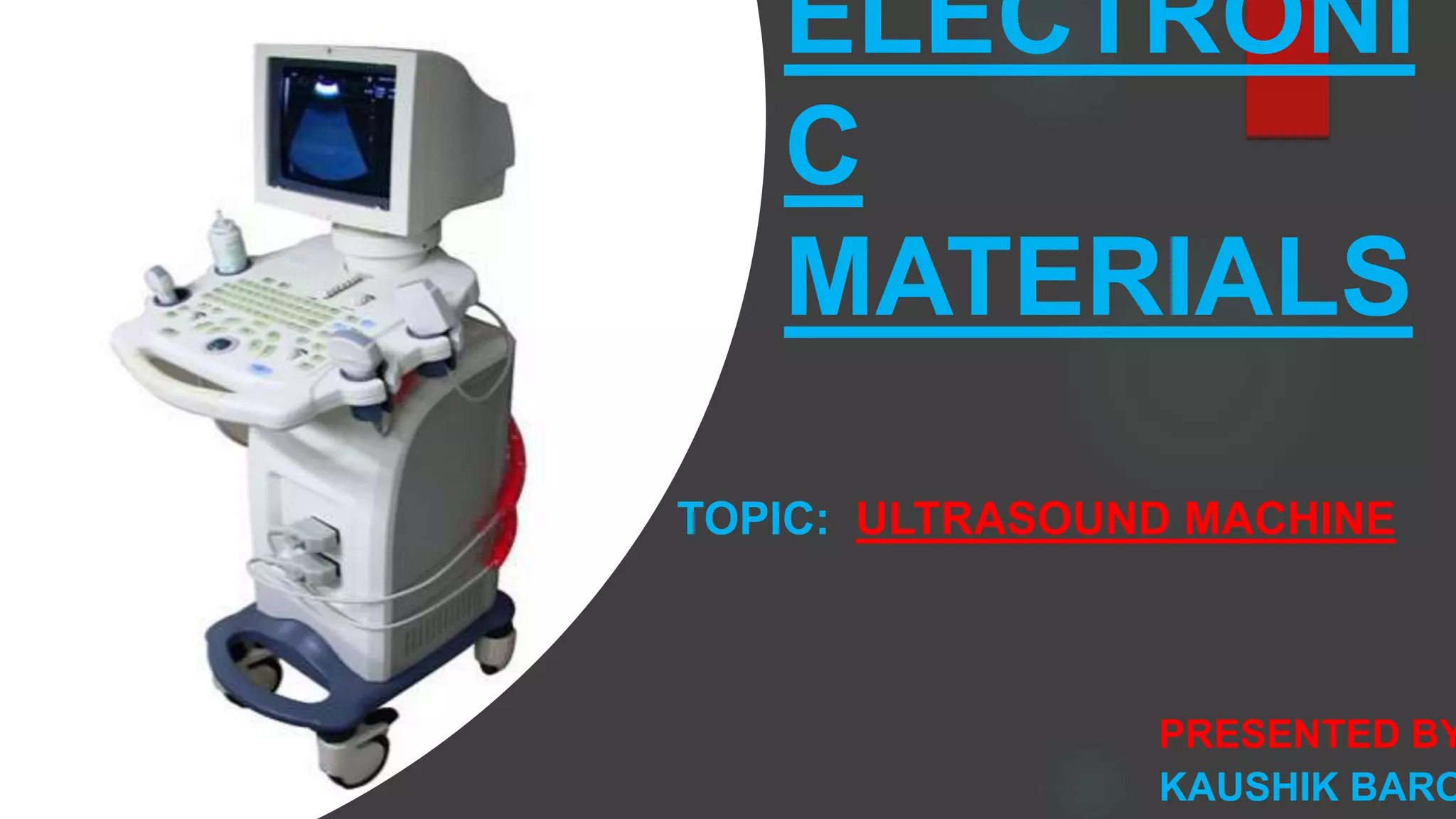
TOPIC: ULTRASOUND MACHINE
PRESENTED BY
KAUSHIK BARO
CONTENTS:
 INTRODUCTION
 ITS WORKING
 TYPES
 APPLICATIONS
 ADVANTAGES
and
DISADVANTAGES
 SUMMARY
INTRODUCTION:
Ultrasound or ultrasonography is a medical imaging technique that uses high
frequency sound waves and their echoes.
WORKING :
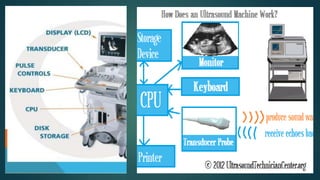
A basic ultrasound machine has the following parts:
 transducer probe : probe that sends and receives the sound waves.
 central processing unit (CPU) : computer that does all of the calculations and
contains the electrical power supplies for itself and the transducer probe.
 transducer pulse controls : changes the amplitude, frequency and duration of
the pulses emitted from the transducer probe.
 display: displays the image from the ultrasound data processed by the CPU.
 keyboard/cursor : inputs data and takes measurements from the display.
 disk storage device : stores the acquired images.
 printer : prints the image from the displayed data.
TYPES OF ULTRASOUND :
The ultrasound that we have described so
far presents a two dimensional image, of a
three dimensional object (fetus, organ). Two
other types of ultrasound are currently in use,
A. 3D ultrasound imaging and
B. Doppler ultrasound.
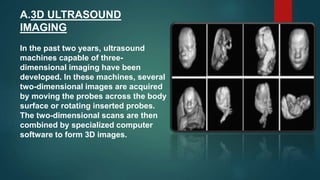
A.3D ULTRASOUND
IMAGING
In the past two years, ultrasound
machines capable of three-
dimensional imaging have been
developed. In these machines, several
two-dimensional images are acquired
by moving the probes across the body
surface or rotating inserted probes.
The two-dimensional scans are then
combined by specialized computer
software to form 3D images.
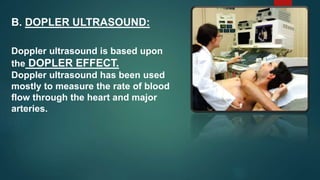
B. DOPLER ULTRASOUND:
Doppler ultrasound is based upon
the DOPLER EFFECT.
Doppler ultrasound has been used
mostly to measure the rate of blood
flow through the heart and major
arteries.
MAJOR APPLICATIONS OF
ULTRASOUND
A. OBSTETRICS and GYNECOLOGY
B. CARDIOLOGY
C. UROLOGY
ADVANTAGES :
 The main advantage of ultrasound is that certain
structures can be observed without using radiation.
 Ultrasound can be done much faster than X-rays or other
radiographic techniques.
DISADVANTAGES:
• Development of heat - tissues or water absorb the
ultrasound energy which increases their temperature
locally.
• Formation of bubbles (cavitation) - when dissolved gases
come out of solution due to local heat caused by
ultrasound.
SUMMARY:
TODAY FROM THE SLIDE WE LEARNED ABOUT:
ULTRASOUND
WORKING
TYPES
APPLICATIONS
ADVANTAGES and DISADVANTAGES
THANK YOU

ULTRASOUND MACHINE

  • 1.
  • 2.
    CONTENTS:  INTRODUCTION  ITSWORKING  TYPES  APPLICATIONS  ADVANTAGES and DISADVANTAGES  SUMMARY
  • 3.
    INTRODUCTION: Ultrasound or ultrasonographyis a medical imaging technique that uses high frequency sound waves and their echoes. WORKING : A basic ultrasound machine has the following parts:  transducer probe : probe that sends and receives the sound waves.  central processing unit (CPU) : computer that does all of the calculations and contains the electrical power supplies for itself and the transducer probe.  transducer pulse controls : changes the amplitude, frequency and duration of the pulses emitted from the transducer probe.  display: displays the image from the ultrasound data processed by the CPU.  keyboard/cursor : inputs data and takes measurements from the display.  disk storage device : stores the acquired images.  printer : prints the image from the displayed data.
  • 5.
    TYPES OF ULTRASOUND: The ultrasound that we have described so far presents a two dimensional image, of a three dimensional object (fetus, organ). Two other types of ultrasound are currently in use, A. 3D ultrasound imaging and B. Doppler ultrasound.
  • 6.
    A.3D ULTRASOUND IMAGING In thepast two years, ultrasound machines capable of three- dimensional imaging have been developed. In these machines, several two-dimensional images are acquired by moving the probes across the body surface or rotating inserted probes. The two-dimensional scans are then combined by specialized computer software to form 3D images.
  • 7.
    B. DOPLER ULTRASOUND: Dopplerultrasound is based upon the DOPLER EFFECT. Doppler ultrasound has been used mostly to measure the rate of blood flow through the heart and major arteries.
  • 8.
    MAJOR APPLICATIONS OF ULTRASOUND A.OBSTETRICS and GYNECOLOGY B. CARDIOLOGY C. UROLOGY
  • 9.
    ADVANTAGES :  Themain advantage of ultrasound is that certain structures can be observed without using radiation.  Ultrasound can be done much faster than X-rays or other radiographic techniques. DISADVANTAGES: • Development of heat - tissues or water absorb the ultrasound energy which increases their temperature locally. • Formation of bubbles (cavitation) - when dissolved gases come out of solution due to local heat caused by ultrasound.
  • 10.
    SUMMARY: TODAY FROM THESLIDE WE LEARNED ABOUT: ULTRASOUND WORKING TYPES APPLICATIONS ADVANTAGES and DISADVANTAGES
  • 11.