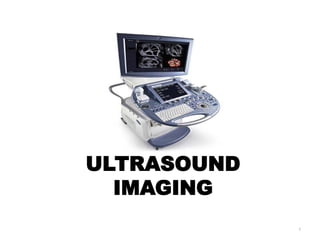
ULTRASOUND
IMAGING
1
Learning objectives
• Present an introduction to medical
ultrasonography at the level of a third or
fourth year medical student.
• After the brief course, the student should be
able to:
– Understand basic physics and terminology of
ultrasound
– State the advantages and disadvantages of
ultrasound
– Understand how the images are obtained
– Begin to interpret simple ultrasound images.
Outline
• Brief history of ultrasound technology
• Advantages, disadvantages
• What is ultrasound?
• Physics
• Probes, controls, machine, Doppler
• Terminology
• What structures look like
• Abdominal ultrasound
• Example of liver/gallbladder
• Quick review questions
History
• Medical use – 1940s
• Developing technology – 1950s
• Advancements – 1960s/1970s
• Real time ultrasound – 1980s
• 3D and 4D images – 1990s
Advantages
• Lack of radiation
• Quick, adaptable
• Looking at different layers/planes
• High resolution in low fat areas
• Portable
• Less expensive
Disadvantages
• Operator-dependent
• Depends on area to view
• Depends on body habitus of patient
• Artifact
• Location
What is ultrasound?
• Sound waves
• Waves have amplitude and frequency
• Frequency – measured in Hz
• Pulse-echo principle – crystals respond to
sound waves
• Ultrasound waves – transmitted well through
fluids and poorly through gases
What is Ultrasound?
• Ultrasound or ultrasonography is a medical
imaging technique that uses high frequency
sound waves and their echoes. The technique
is similar to the echolocation used by bats,
whales and dolphins, as well as SONAR used
by submarines.
In ultrasound, the following events
happen:
• The ultrasound machine transmits high-frequency (1 to 5 megahertz)
sound pulses into your body using a probe.
• The sound waves travel into your body and hit a boundary between
tissues (e.g. between fluid and soft tissue, soft tissue and bone).
• Some of the sound waves get reflected back to the probe, while some
travel on further until they reach another boundary and get reflected.
• The reflected waves are picked up by the probe and relayed to the
machine.
• The machine calculates the distance from the probe to the tissue or organ
(boundaries) using the speed of sound in tissue (5,005 ft/s or1,540 m/s)
and the time of the each echo's return (usually on the order of millionths
of a second).
• The machine displays the distances and intensities of the echoes on the
screen, forming a two dimensional image like the one shown below.
The Ultrasound Machine
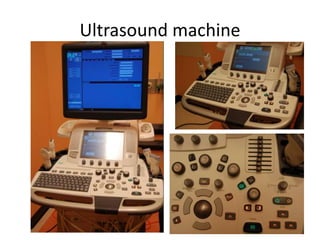
• Transducer probe - probe that sends and receives the sound waves
• Central processing unit (CPU) - computer that does all of the calculations
and contains the electrical power supplies for itself and the transducer
probe
• Transducer pulse controls - changes the amplitude, frequency and
duration of the pulses emitted from the transducer probe
• Display - displays the image from the ultrasound data processed by the
CPU
• Keyboard/cursor - inputs data and takes measurements from the display
• Disk storage device (hard, floppy, CD) - stores the acquired images
• Printer - prints the image from the displayed data
Transducer probe
• Is the main part of the ultrasound machine.
• The transducer probe makes the sound waves and receives the echoes.
• The mouth and ears of the ultrasound machine. The transducer probe
generates and receives sound waves using a principle called the
piezoelectric (pressure electricity) effect, which was discovered by Pierre
and Jacques Curie in 1880.
• In the probe, there are one or more quartz crystals called piezoelectric
crystals.
• When an electric current is applied to these crystals, they change shape
rapidly. The rapid shape changes, or vibrations, of the crystals produce
sound waves that travel outward. Conversely, when sound or pressure
waves hit the crystals, they emit electrical currents.
• Therefore, the same crystals can be used to send and receive sound
waves. The probe also has a sound absorbing substance to eliminate back
reflections from the probe itself, and an acoustic lens to help focus the
emitted sound waves.
Physics
• Speed of ultrasound – average 1,540
m/second, but depends on tissue
• Acoustic impedance – density of tissue
multiplied by velocity of sound; harder
substances (like bone) usually have higher
acoustic impedance (than substances like
water or fat)
Terminology
• Echogenicity – measure of jumps in
impedance of an organ (NOT density)
• Hyperechoic – bright; many echos
• Hypoechoic – dark; few echos
• Anechoic – black; no echoes
• Shadowing
Frequencies
• Higher frequencies – better resolution but less
penetration [useful for thyroid, testes,
superficial blood vessels]
• Lower frequencies – better penetration but
worse resolution [useful for the abdomen,
aorta]
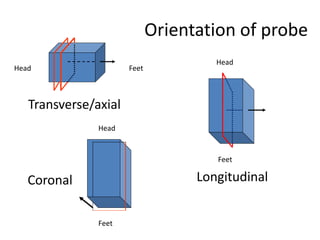
Orientation of probe
Head Feet
Transverse/axial
Head
Feet
Feet
Head
Coronal Longitudinal
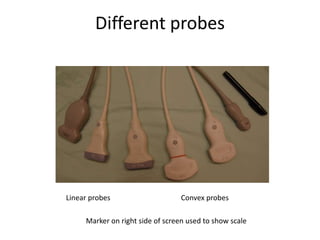
Different probes
Linear probes Convex probes
Marker on right side of screen used to show scale
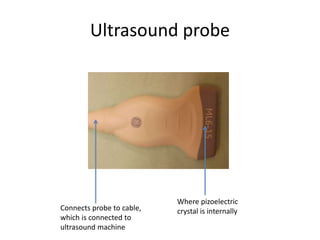
Ultrasound probe
Where pizoelectric
crystal is internally
Connects probe to cable,
which is connected to
ultrasound machine
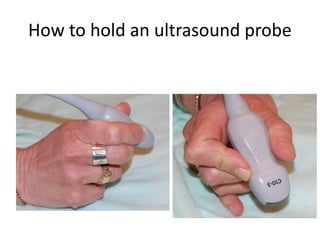
How to hold an ultrasound probe
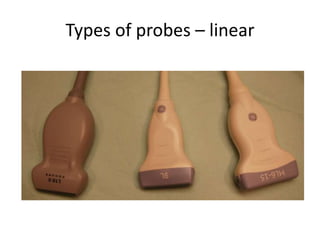
Types of probes – linear
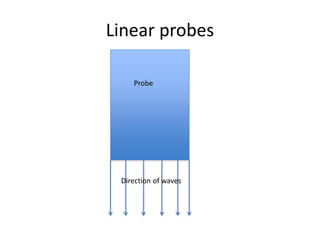
Linear probes
Probe
Direction of waves
Linear
Image from UCMC
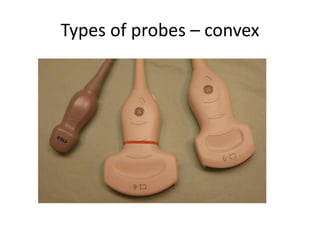
Types of probes – convex
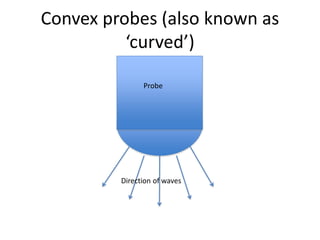
Convex probes (also known as
‘curved’)
Direction of waves
Probe
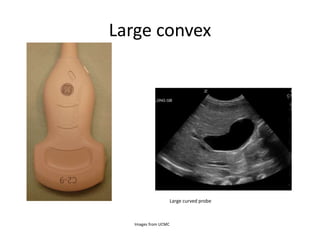
Large convex
Large curved probe
Images from UCMC
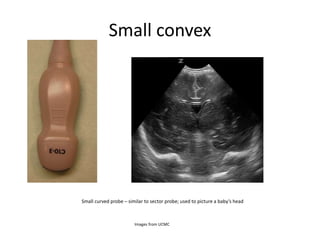
Small convex
Small curved probe – similar to sector probe; used to picture a baby’s head
Images from UCMC
Ultrasound machine
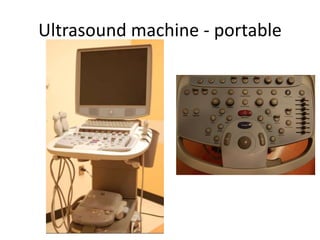
Ultrasound machine - portable
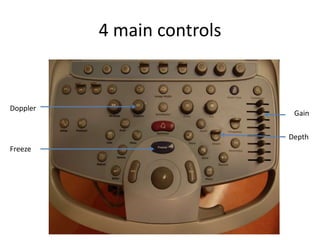
4 main controls
Doppler
Freeze
Depth
Gain
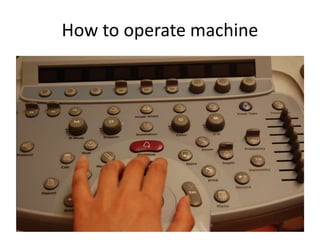
How to operate machine
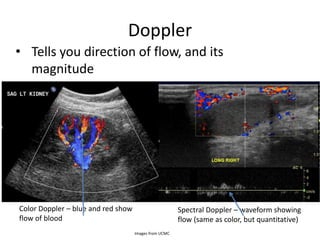
Doppler
Images from UCMC
Color Doppler – blue and red show
flow of blood
Spectral Doppler – waveform showing
flow (same as color, but quantitative)
• Tells you direction of flow, and its
magnitude
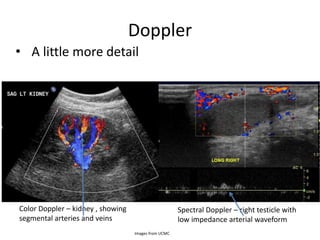
Doppler
Images from UCMC
Color Doppler – kidney , showing
segmental arteries and veins
Spectral Doppler – right testicle with
low impedance arterial waveform
• A little more detail
What structures look like. . .
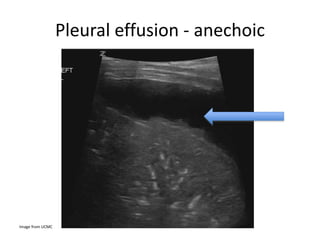
Pleural effusion - anechoic
Image from UCMC
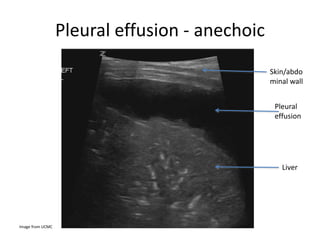
Pleural effusion - anechoic
Image from UCMC
Pleural
effusion
Liver
Skin/abdo
minal wall
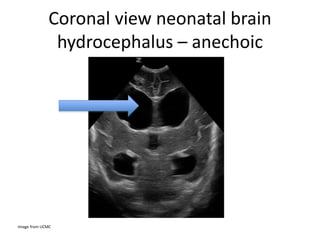
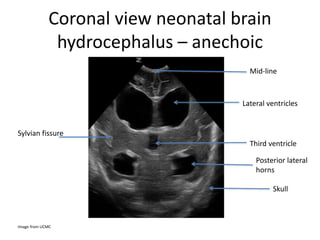
Coronal view neonatal brain
hydrocephalus – anechoic
Image from UCMC
Coronal view neonatal brain
hydrocephalus – anechoic
Image from UCMC
Mid-line
Lateral ventricles
Third ventricle
Posterior lateral
horns
Skull
Sylvian fissure
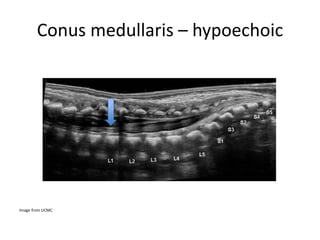
Conus medullaris – hypoechoic
Image from UCMC
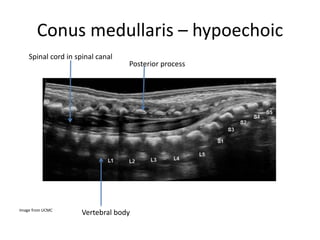
Conus medullaris – hypoechoic
Image from UCMC
Vertebral body
Spinal cord in spinal canal
Posterior process
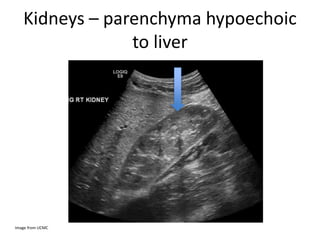
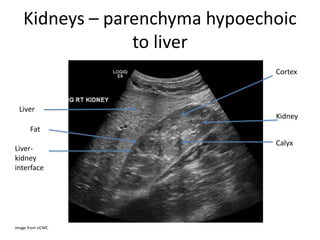
Kidneys – parenchyma hypoechoic
to liver
Image from UCMC
Kidneys – parenchyma hypoechoic
to liver
Image from UCMC
Liver
Kidney
Liver-
kidney
interface
Calyx
Cortex
Fat
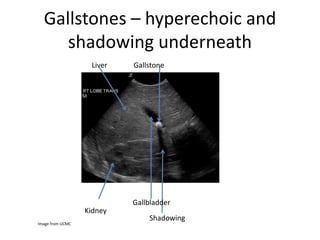
Gallstones – hyperechoic and
shadowing underneath
Image from UCMC
Gallstones – hyperechoic and
shadowing underneath
Image from UCMC
Kidney
Gallstone
Gallbladder
Shadowing
Liver
Liver/gallbladder example
• Now – try to think of an ultrasound from start
to finish; we will take the example of a
liver/gallbladder ultrasound
• Liver parenchyma
• Ducts
• Vascular system
• Gallbladder, stones
Indications
• Hernia
• Tumors/cancers/metastasis
• Ascites
• Organomegaly
• Free peritoneal fluid s/p trauma
• Gallbladder or kidney stones
• Evaluation of liver anatomy and ducts
• Pancreatitis
• Abscess
• Appendicitis
• Ultrasound guided biopsy
Liver/gallbladder example
• NPO 4-6 hours – gallbladder distended and
bowel gas minimal
• Longitudinal, transverse, and coronal scans in
supine and left posterior oblique positions
• Subcostal approach good for most of liver, but
may need intercostal approach for most
superior part
• Use Doppler to distinguish blood vessels and
ducts
Abdominal ultrasound
• Layperson description (what your patient gets
told):
http://www.nlm.nih.gov/medlineplus/ency/ar
ticle/003777.htm
• Example of how to do an abdominal
ultrasound:
http://www.youtube.com/watch?v=7Y6wFXf
muvg
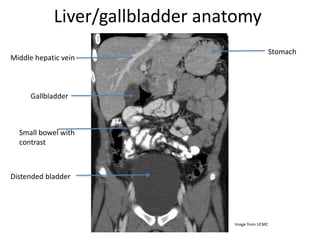
Liver/gallbladder anatomy
Middle hepatic vein
Gallbladder
Small bowel with
contrast
Distended bladder
Stomach
Image from UCMC
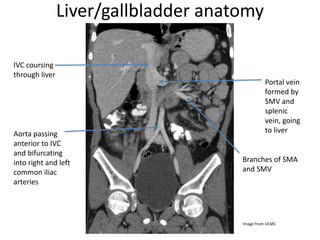
Liver/gallbladder anatomy
IVC coursing
through liver
Aorta passing
anterior to IVC
and bifurcating
into right and left
common iliac
arteries
Portal vein
formed by
SMV and
splenic
vein, going
to liver
Branches of SMA
and SMV
Image from UCMC
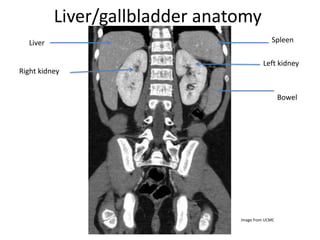
Liver/gallbladder anatomy
Spleen
Bowel
Liver
Right kidney
Left kidney
Image from UCMC
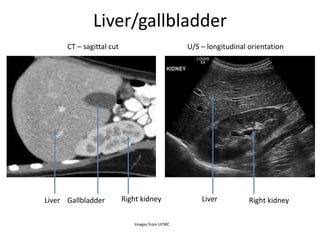
Liver/gallbladder
CT – sagittal cut U/S – longitudinal orientation
Liver Gallbladder Right kidney Liver Right kidney
Images from UCMC
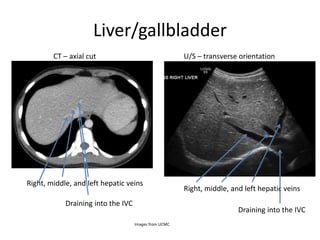
Liver/gallbladder
CT – axial cut
Right, middle, and left hepatic veins
Draining into the IVC
U/S – transverse orientation
Images from UCMC
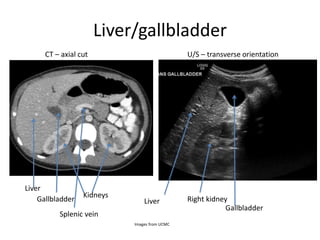
Liver/gallbladder
Liver
CT – axial cut
Kidneys
Gallbladder
U/S – transverse orientation
Liver Right kidney
Gallbladder
Splenic vein
Images from UCMC
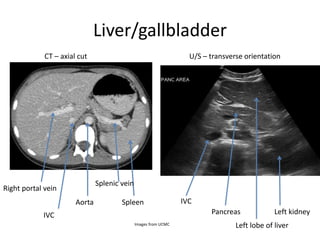
Liver/gallbladder
U/S – transverse orientation
IVC
Pancreas
Left lobe of liver
Left kidney
Spleen
Splenic vein
CT – axial cut
Right portal vein
IVC
Aorta
Images from UCMC
Summary
• You should now understand ultrasound basics
• Physics, orientation, probes
• Terms, anatomy
• Much more to learn
Quick review questions
1. What is ultrasound? What types of tissues
does it travel well through? Poorly through?
Quick review questions
2. How does the frequency of the ultrasound
affect resolution and penetration?
Quick review questions
3. Name some types of hyperechoic,
hypoechoic, and anechoic tissues. Can you
picture them as they would appear on an
ultrasound image?
Quick review questions
4. What are some pros and cons of using
ultrasound?
Quick review questions
5. What shapes do the probes come in? Can you
describe a few of the differences of the probe
types?
Quick review questions
6. What are the three main ways in which the
ultrasound probe can be held (i.e. the
orientations of the probes)?
Quick review questions
7. Name at least three indications for an
abdominal ultrasound.
What are some of the things you could tell a
patient when they are preparing for an
abdominal ultrasound and orders you might
need to write?
Quick review questions
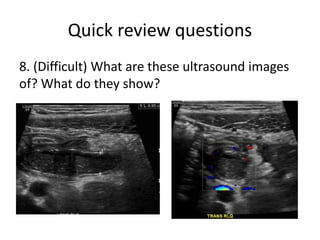
8. (Difficult) What are these ultrasound images
of? What do they show?
References
• Pediatric Sonography, by Siegel, 4th edition
• Ultrasound Teaching Manual, by Hofer: Thieme medical
publishers
• Abdominal Ultrasound: Step by Step, by Block, Thieme
medical publishers
• ACS Ultrasound for Surgeons, 1998
• http://www.ultrasound-images.com/liver.htm
• http://www.ultrasoundcases.info/
• http://www.genesis.net.au/~ajs/projects/medical_physics/ult
rasound/index.html
• http://www.radiologytoday.net/archive/rt_120108p28.shtml
• http://www.ultrasoundpaedia.com/
Questions?

Ultrasound Basics.ppt

  • 1.
  • 2.
    Learning objectives • Presentan introduction to medical ultrasonography at the level of a third or fourth year medical student. • After the brief course, the student should be able to: – Understand basic physics and terminology of ultrasound – State the advantages and disadvantages of ultrasound – Understand how the images are obtained – Begin to interpret simple ultrasound images.
  • 3.
    Outline • Brief historyof ultrasound technology • Advantages, disadvantages • What is ultrasound? • Physics • Probes, controls, machine, Doppler • Terminology • What structures look like • Abdominal ultrasound • Example of liver/gallbladder • Quick review questions
  • 4.
    History • Medical use– 1940s • Developing technology – 1950s • Advancements – 1960s/1970s • Real time ultrasound – 1980s • 3D and 4D images – 1990s
  • 5.
    Advantages • Lack ofradiation • Quick, adaptable • Looking at different layers/planes • High resolution in low fat areas • Portable • Less expensive
  • 6.
    Disadvantages • Operator-dependent • Dependson area to view • Depends on body habitus of patient • Artifact • Location
  • 7.
    What is ultrasound? •Sound waves • Waves have amplitude and frequency • Frequency – measured in Hz • Pulse-echo principle – crystals respond to sound waves • Ultrasound waves – transmitted well through fluids and poorly through gases
  • 8.
    What is Ultrasound? •Ultrasound or ultrasonography is a medical imaging technique that uses high frequency sound waves and their echoes. The technique is similar to the echolocation used by bats, whales and dolphins, as well as SONAR used by submarines.
  • 9.
    In ultrasound, thefollowing events happen: • The ultrasound machine transmits high-frequency (1 to 5 megahertz) sound pulses into your body using a probe. • The sound waves travel into your body and hit a boundary between tissues (e.g. between fluid and soft tissue, soft tissue and bone). • Some of the sound waves get reflected back to the probe, while some travel on further until they reach another boundary and get reflected. • The reflected waves are picked up by the probe and relayed to the machine. • The machine calculates the distance from the probe to the tissue or organ (boundaries) using the speed of sound in tissue (5,005 ft/s or1,540 m/s) and the time of the each echo's return (usually on the order of millionths of a second). • The machine displays the distances and intensities of the echoes on the screen, forming a two dimensional image like the one shown below.
  • 10.
    The Ultrasound Machine •Transducer probe - probe that sends and receives the sound waves • Central processing unit (CPU) - computer that does all of the calculations and contains the electrical power supplies for itself and the transducer probe • Transducer pulse controls - changes the amplitude, frequency and duration of the pulses emitted from the transducer probe • Display - displays the image from the ultrasound data processed by the CPU • Keyboard/cursor - inputs data and takes measurements from the display • Disk storage device (hard, floppy, CD) - stores the acquired images • Printer - prints the image from the displayed data
  • 11.
    Transducer probe • Isthe main part of the ultrasound machine. • The transducer probe makes the sound waves and receives the echoes. • The mouth and ears of the ultrasound machine. The transducer probe generates and receives sound waves using a principle called the piezoelectric (pressure electricity) effect, which was discovered by Pierre and Jacques Curie in 1880. • In the probe, there are one or more quartz crystals called piezoelectric crystals. • When an electric current is applied to these crystals, they change shape rapidly. The rapid shape changes, or vibrations, of the crystals produce sound waves that travel outward. Conversely, when sound or pressure waves hit the crystals, they emit electrical currents. • Therefore, the same crystals can be used to send and receive sound waves. The probe also has a sound absorbing substance to eliminate back reflections from the probe itself, and an acoustic lens to help focus the emitted sound waves.
  • 15.
    Physics • Speed ofultrasound – average 1,540 m/second, but depends on tissue • Acoustic impedance – density of tissue multiplied by velocity of sound; harder substances (like bone) usually have higher acoustic impedance (than substances like water or fat)
  • 16.
    Terminology • Echogenicity –measure of jumps in impedance of an organ (NOT density) • Hyperechoic – bright; many echos • Hypoechoic – dark; few echos • Anechoic – black; no echoes • Shadowing
  • 17.
    Frequencies • Higher frequencies– better resolution but less penetration [useful for thyroid, testes, superficial blood vessels] • Lower frequencies – better penetration but worse resolution [useful for the abdomen, aorta]
  • 18.
    Orientation of probe HeadFeet Transverse/axial Head Feet Feet Head Coronal Longitudinal
  • 19.
    Different probes Linear probesConvex probes Marker on right side of screen used to show scale
  • 20.
    Ultrasound probe Where pizoelectric crystalis internally Connects probe to cable, which is connected to ultrasound machine
  • 21.
    How to holdan ultrasound probe
  • 22.
    Types of probes– linear
  • 23.
  • 24.
  • 25.
    Types of probes– convex
  • 26.
    Convex probes (alsoknown as ‘curved’) Direction of waves Probe
  • 27.
    Large convex Large curvedprobe Images from UCMC
  • 28.
    Small convex Small curvedprobe – similar to sector probe; used to picture a baby’s head Images from UCMC
  • 29.
  • 30.
  • 31.
  • 32.
  • 33.
    Doppler Images from UCMC ColorDoppler – blue and red show flow of blood Spectral Doppler – waveform showing flow (same as color, but quantitative) • Tells you direction of flow, and its magnitude
  • 34.
    Doppler Images from UCMC ColorDoppler – kidney , showing segmental arteries and veins Spectral Doppler – right testicle with low impedance arterial waveform • A little more detail
  • 35.
  • 36.
    Pleural effusion -anechoic Image from UCMC
  • 37.
    Pleural effusion -anechoic Image from UCMC Pleural effusion Liver Skin/abdo minal wall
  • 38.
    Coronal view neonatalbrain hydrocephalus – anechoic Image from UCMC
  • 39.
    Coronal view neonatalbrain hydrocephalus – anechoic Image from UCMC Mid-line Lateral ventricles Third ventricle Posterior lateral horns Skull Sylvian fissure
  • 40.
    Conus medullaris –hypoechoic Image from UCMC
  • 41.
    Conus medullaris –hypoechoic Image from UCMC Vertebral body Spinal cord in spinal canal Posterior process
  • 42.
    Kidneys – parenchymahypoechoic to liver Image from UCMC
  • 43.
    Kidneys – parenchymahypoechoic to liver Image from UCMC Liver Kidney Liver- kidney interface Calyx Cortex Fat
  • 44.
    Gallstones – hyperechoicand shadowing underneath Image from UCMC
  • 45.
    Gallstones – hyperechoicand shadowing underneath Image from UCMC Kidney Gallstone Gallbladder Shadowing Liver
  • 46.
    Liver/gallbladder example • Now– try to think of an ultrasound from start to finish; we will take the example of a liver/gallbladder ultrasound • Liver parenchyma • Ducts • Vascular system • Gallbladder, stones
  • 47.
    Indications • Hernia • Tumors/cancers/metastasis •Ascites • Organomegaly • Free peritoneal fluid s/p trauma • Gallbladder or kidney stones • Evaluation of liver anatomy and ducts • Pancreatitis • Abscess • Appendicitis • Ultrasound guided biopsy
  • 48.
    Liver/gallbladder example • NPO4-6 hours – gallbladder distended and bowel gas minimal • Longitudinal, transverse, and coronal scans in supine and left posterior oblique positions • Subcostal approach good for most of liver, but may need intercostal approach for most superior part • Use Doppler to distinguish blood vessels and ducts
  • 49.
    Abdominal ultrasound • Laypersondescription (what your patient gets told): http://www.nlm.nih.gov/medlineplus/ency/ar ticle/003777.htm • Example of how to do an abdominal ultrasound: http://www.youtube.com/watch?v=7Y6wFXf muvg
  • 50.
    Liver/gallbladder anatomy Middle hepaticvein Gallbladder Small bowel with contrast Distended bladder Stomach Image from UCMC
  • 51.
    Liver/gallbladder anatomy IVC coursing throughliver Aorta passing anterior to IVC and bifurcating into right and left common iliac arteries Portal vein formed by SMV and splenic vein, going to liver Branches of SMA and SMV Image from UCMC
  • 52.
  • 53.
    Liver/gallbladder CT – sagittalcut U/S – longitudinal orientation Liver Gallbladder Right kidney Liver Right kidney Images from UCMC
  • 54.
    Liver/gallbladder CT – axialcut Right, middle, and left hepatic veins Right, middle, and left hepatic veins Draining into the IVC Draining into the IVC U/S – transverse orientation Images from UCMC
  • 55.
    Liver/gallbladder Liver CT – axialcut Kidneys Gallbladder U/S – transverse orientation Liver Right kidney Gallbladder Splenic vein Images from UCMC
  • 56.
    Liver/gallbladder U/S – transverseorientation IVC Pancreas Left lobe of liver Left kidney Spleen Splenic vein CT – axial cut Right portal vein IVC Aorta Images from UCMC
  • 57.
    Summary • You shouldnow understand ultrasound basics • Physics, orientation, probes • Terms, anatomy • Much more to learn
  • 58.
    Quick review questions 1.What is ultrasound? What types of tissues does it travel well through? Poorly through?
  • 59.
    Quick review questions 2.How does the frequency of the ultrasound affect resolution and penetration?
  • 60.
    Quick review questions 3.Name some types of hyperechoic, hypoechoic, and anechoic tissues. Can you picture them as they would appear on an ultrasound image?
  • 61.
    Quick review questions 4.What are some pros and cons of using ultrasound?
  • 62.
    Quick review questions 5.What shapes do the probes come in? Can you describe a few of the differences of the probe types?
  • 63.
    Quick review questions 6.What are the three main ways in which the ultrasound probe can be held (i.e. the orientations of the probes)?
  • 64.
    Quick review questions 7.Name at least three indications for an abdominal ultrasound. What are some of the things you could tell a patient when they are preparing for an abdominal ultrasound and orders you might need to write?
  • 65.
    Quick review questions 8.(Difficult) What are these ultrasound images of? What do they show?
  • 66.
    References • Pediatric Sonography,by Siegel, 4th edition • Ultrasound Teaching Manual, by Hofer: Thieme medical publishers • Abdominal Ultrasound: Step by Step, by Block, Thieme medical publishers • ACS Ultrasound for Surgeons, 1998 • http://www.ultrasound-images.com/liver.htm • http://www.ultrasoundcases.info/ • http://www.genesis.net.au/~ajs/projects/medical_physics/ult rasound/index.html • http://www.radiologytoday.net/archive/rt_120108p28.shtml • http://www.ultrasoundpaedia.com/
  • 67.