PERIAPICAL RADIOLUCENCIES
DR SHABIL MOHAMED MUSTAFA
ASSOCIATE PROFESSOR
MALABAR DENTAL COLLEGE AND RESEARCH CENTRE
contents
• INTRODUCTION
• CLASSIFICATION
• ANATOMIC PERIAPICAL RADIOLUCENCY
• TRUE PERIAPICAL RADIOLUCENT LESION
• PULPOPERIAPICAL RADIOLUCENCIES
INTRODUCTION
• Radiolucent shadows are cast over the
periapical regions of teeth in practically all oral
radiographic surveys of dentulous patients
• Some of this periapical radiolucencies
represent innocent anatomic variations,
• Others caused by benign condition
• Still others represent systemic disease
• Malignancies represent a small group of these
periapical shadows
CLASSIFICATION
• Anatomical pseudoperiapical radiolucencies
• True periapical radiolucent lesions
1. Pulpoperiapical radiolucencies
2.Dentigerous cyst
3.Periapical cementoosseous
4.dysplasia(periapical cementoma)
5.Periodontal disease
6.Traumatic bone cyst
7.Non radicular cyst
8.Malignant tumors
9.rarities
ANATOMICAL PERIAPICAL
RADIOLUCENCIES
1. TRUE
• Lesions truly in
contact with tooth
apex
• shadow can’t be
shifted from the
periapex by taking
additional
radiographs on
different angles
2.FALSE
• Do not contact the
apex of a tooth
• Shadow can be
shifted
ANATOMIC PSEUDOPERIAPICAL
RADIOLUCENCIES/FALSE PAR
• Mandible foramen
• Mandibular canal
• Mental foramen
• Lingual foramen
• Submandibular fossa
• Bone marrow spaces
• Intermaxillary suture
• Nasal cavity
• Maxillary sinus
• Incisive foramen
• Developing tooth
crypt
• Greater palatine
foramen
TRUE PERIAPICAL RADIOLUCENT LESIONS
1. Periapical granuloma
2. Radicular cyst
3. Scar
4. Abscess
5. Surgical defect
6. Osteomyelitis
7. Hyperplasia of sinus mucosa
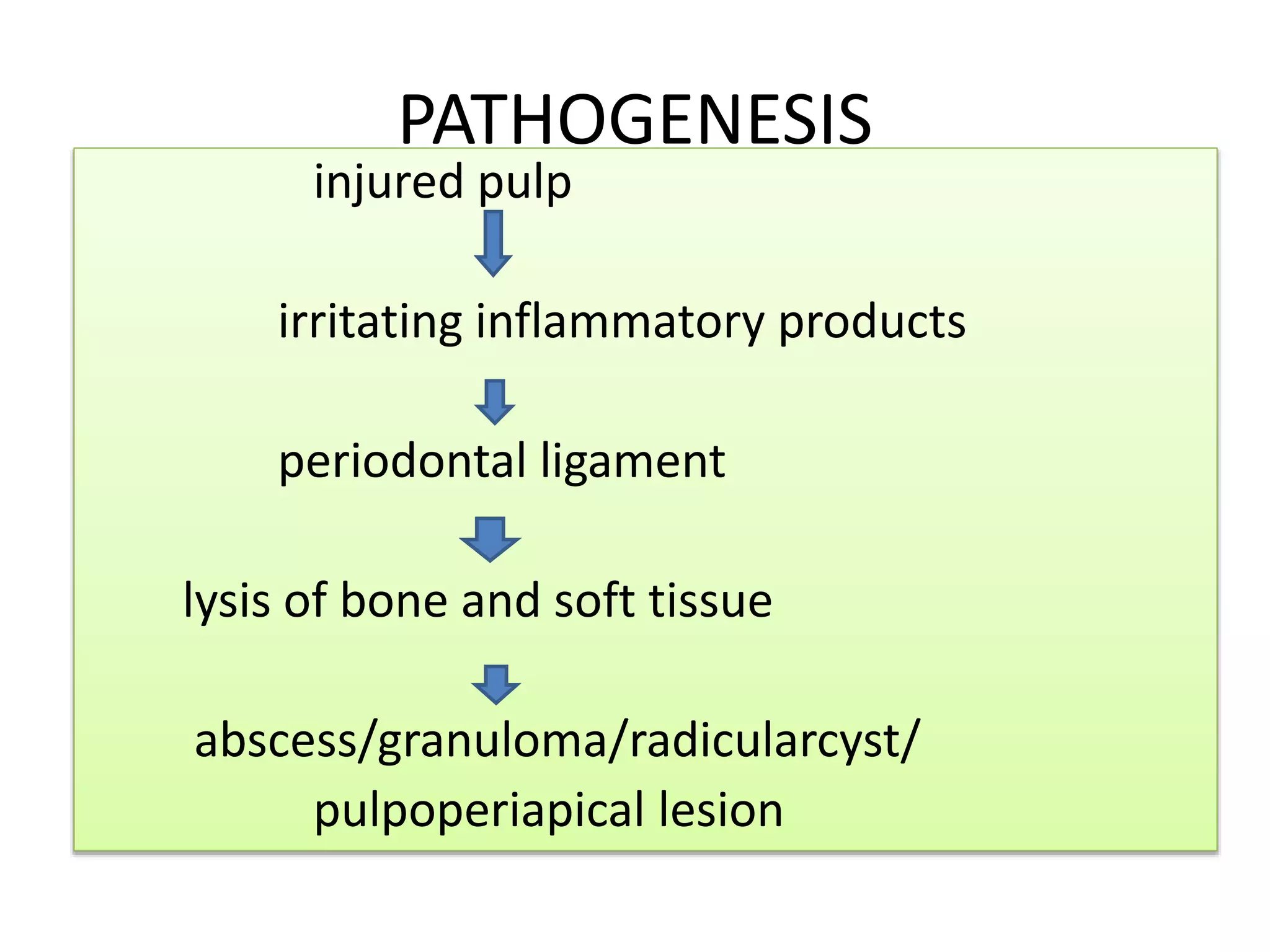
PATHOGENESIS
injured pulp
irritating inflammatory products
periodontal ligament
lysis of bone and soft tissue
abscess/granuloma/radicularcyst/
pulpoperiapical lesion
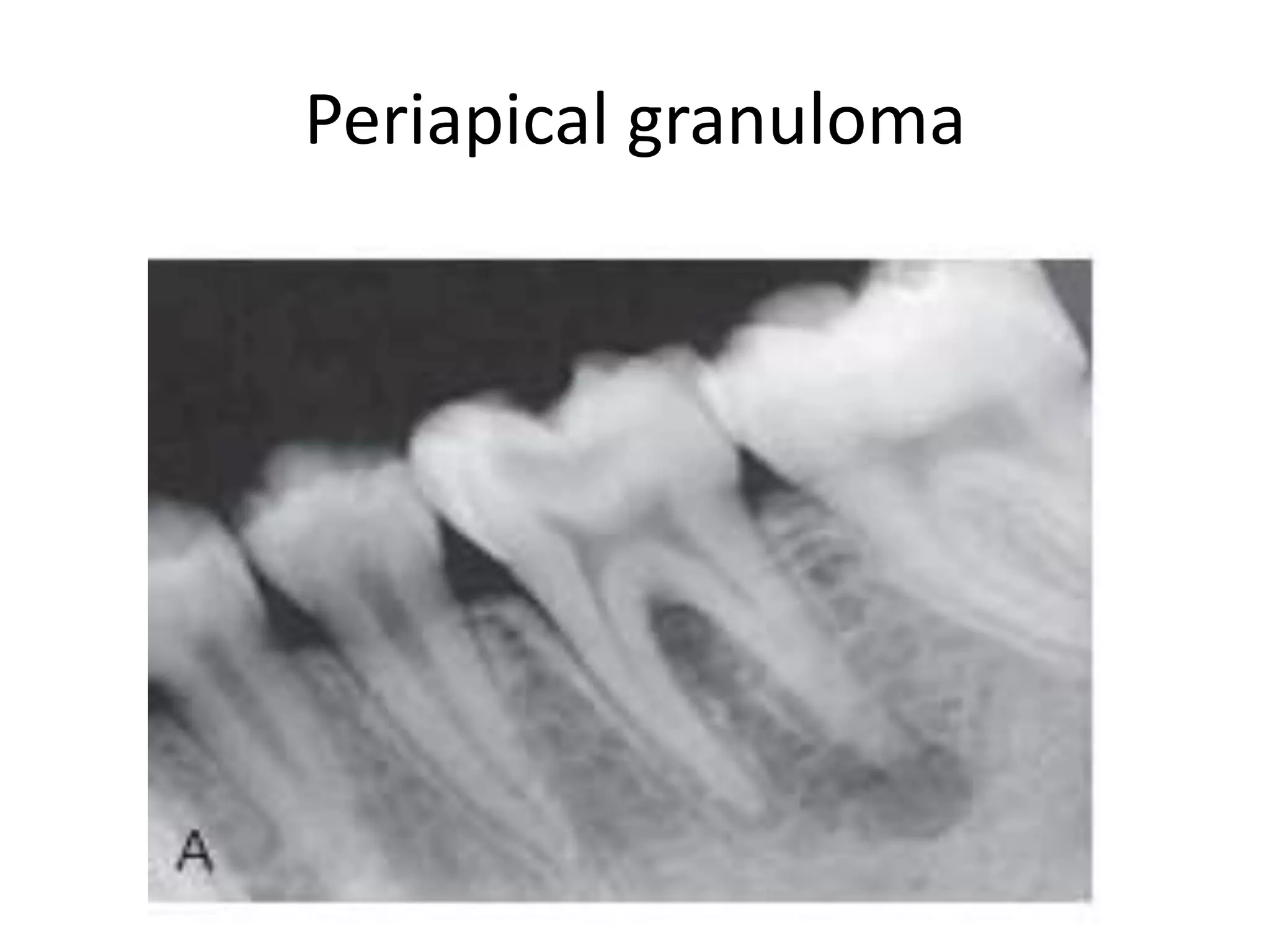
2.Periapical granuloma
• Common pathologic radiolucency
• result from Periapical tissues, neutralize and
confine toxic products from root canal.
• Microstructure: proliferating endothelial
cells,capillaries,young fibroblast,few
collagen,chronic inflammatory cells.
Periapical granuloma
Clinical features
• Asymptomatic
• occasional severe toothache With/Without
facial swelling
• Fever
• Lymphadenopathy
• Non-vital pulp
• Swelling/expansion of cortical plates
Radiographic features
• Well-circumscribed radiolucency around the
apex of the tooth
• With thin radiopaque border
• Cannot be differentiated from radicular cyst
• Usually within a range of 2.5 cm
• LOCATION: epicenter at the apex of the
involved tooth
• PERIPHERY: ill-defined
• INTERNAL STRUCTURE: initially loss of bone
density,later,a mixture of sclerosis and
rarefraction,i.e ,periapical sclerosing osteitis
and periapical rarefying osteitis
• EFFECTS ON SURROUNDING STRUCTURES:
Loss of lamina dura,nearby cortical boundaries
can be destroyedfloor of nasal fossa ,buccal and
lingual plates of alveolar process
• Thin layer of new bone formed-halow shadow
Differential diagnosis
• Periapical cemental dysplasia
• Enostosis
• Radicular cyst
management
• Root canal treament
• extraction
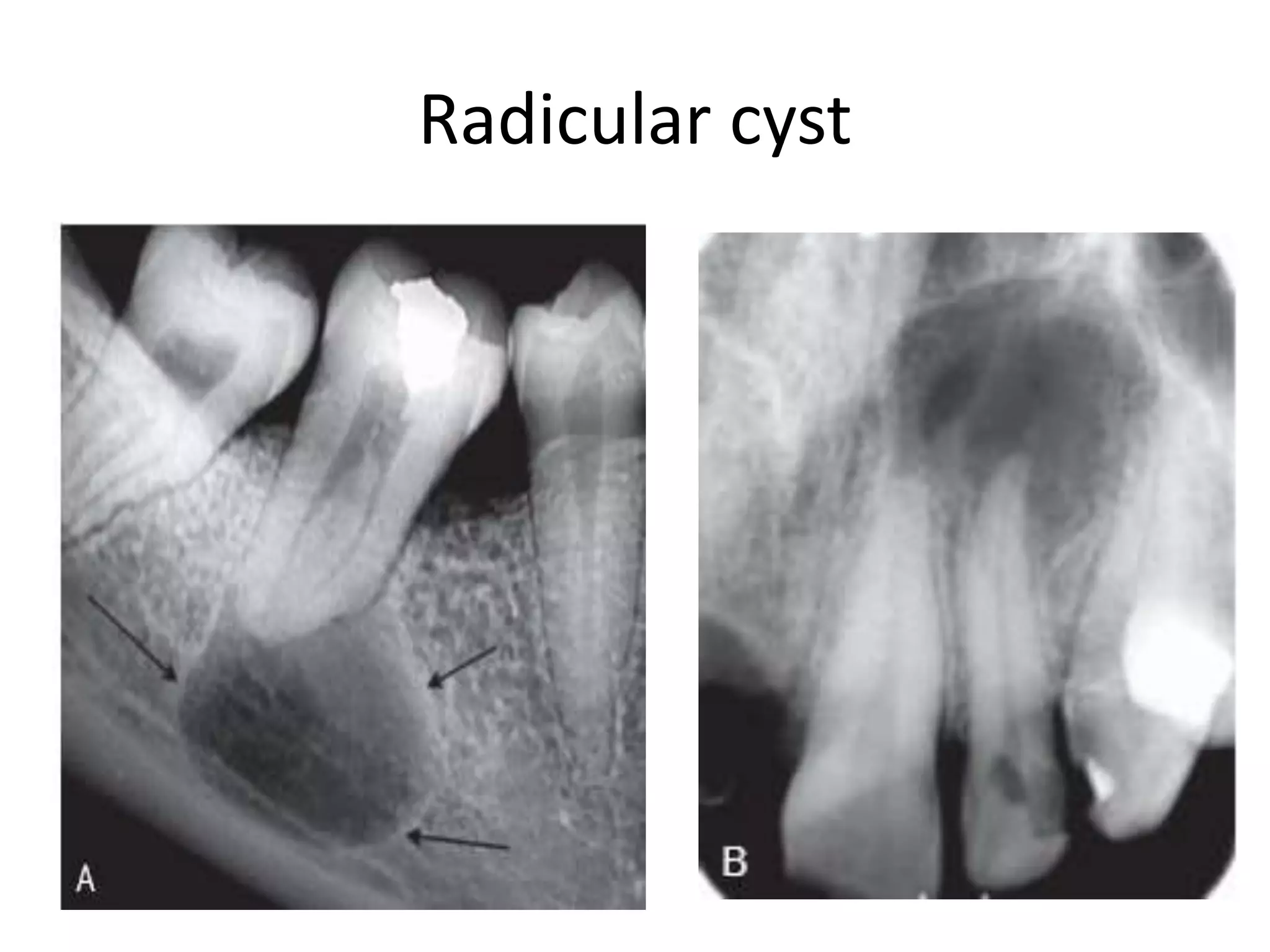
2.Radicular cyst
• 2 nd most common pulpoperiapical
• Most common of all odontogenic cyst
• Inflammatory cyst
Inflammatory products initiate the growth of
the epithelial component
• Odontogenic cyst
Origin in malassez rests,PDL cells,remnants of
epithelial root sheath
pre-existing periapical granuloma
proliferating epithelial cell nest
cell nest size increases
central cells degenerate and liquify
fluid filled cavity lined with epithelium
enlarging cyst on alveolar bone
osteoclastic activity
bone resorption
CLINICAL FEATURES
• Identical to periapical granuloma
• If periapical radiolucency >1.6 cm in dm
more likely radicular cyst
• if untreared,expand cortical plates
• Initially bony hard swelling to palpate
• Later, rubbery and fluctuant due to fluid
• Large cyst involves complete quadrant
• Occasionally tooth mobility,non-vital pulp
• If infected,painfull symptoms of an abscess
• Microscopic features:
Periphery is fibrous,
Inner region –granulation tissue where foci of
chronic inflammatory cells,foam cells, russell
bodies,cholesterol clefts
• Cholesterol crystal: shiny crystals from
aspirated noninfected cyst
Radiographic features
• Location: apex of the non-vital tooth,
Maxilla,around incisors and canine
Due to distal inclination of maxillary lateral
incisor,may invaginate the maxillary antrum
• Periphery and shape: well-defined cortical
border
• Internal structure:radiolucent
Dystrophic calcification in long standing cases
• Effects on internal structures:
Displacement and resorption of adjacent teeth
may occur
Invagination in to antrum
Outer cortical plates of maxilla and mandible
may expand in a curved or circular shape
Displace mandibular alveolar nerve canal in an
inferior direction
Radicular cyst
Differential diagnosis
• Periapical granuloma
• Periapical scars and surgical defects
• PCOD
• Traumatic bone cyst
management
• Non-surgical endodontics
• If extraction ,curettage of periapical area should
be judiciously curetted
• Large radicular cyst:6 approaches
1. Surgical enucleation
2. Surgical enucleation and restoration with graft
3. Marsupialization
4. Decompression
5. Decompression with delayed enucleation
6. Creating common chamber with maxillary sinus
• Post surgical radiographs :
Average healing time for cyst of more than
10mm in diameter is approximately 2 and half
years .
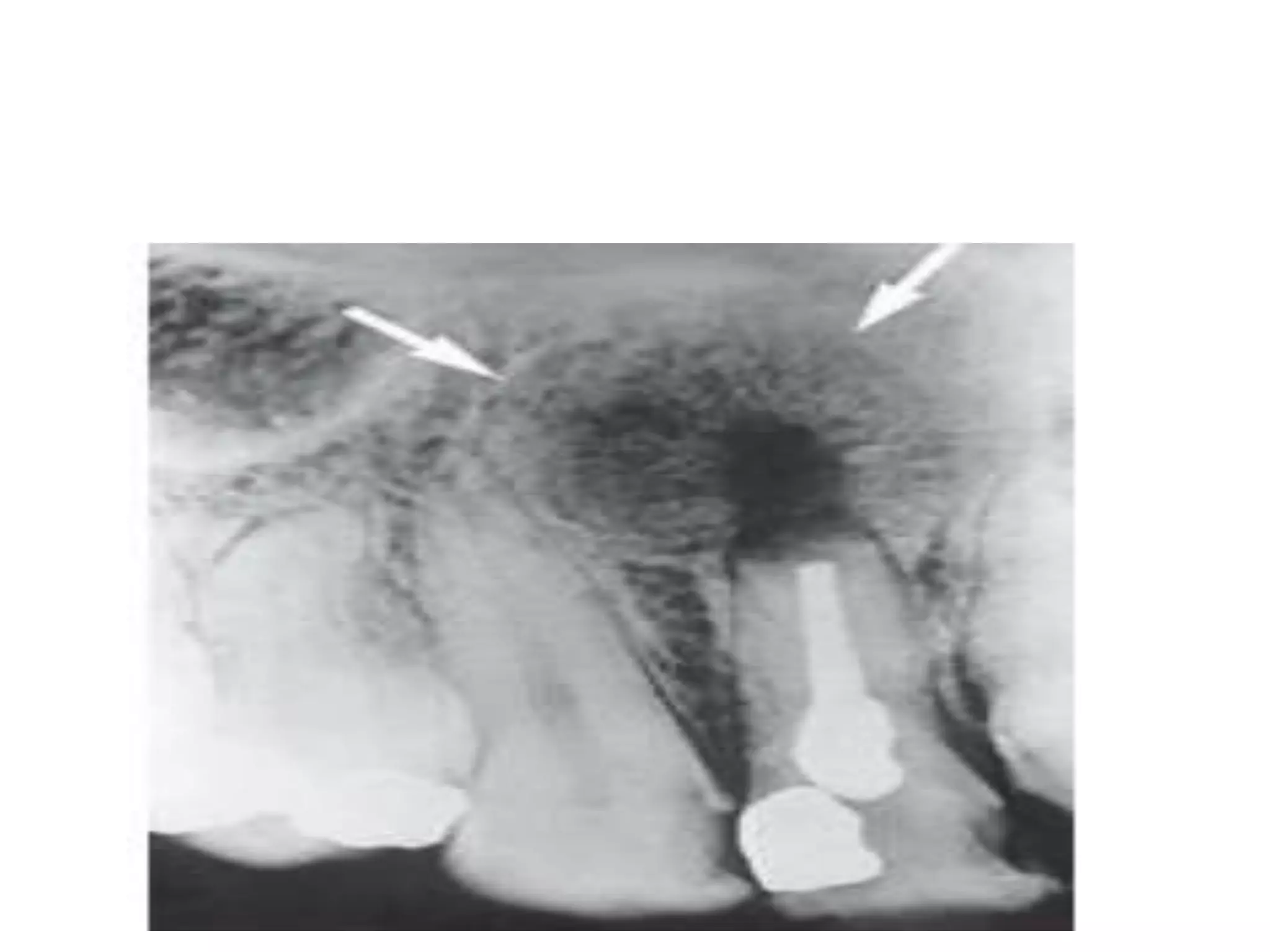
3.Periapical scar
• Composed of dense fibrous tissue
• In periapex of pulpless root canal filled teeth
• Represents previous periapical
granuloma/cyst/abscess,whose healing is
completed by dense scar formation
Clinical features
• Resemples periapical granuloma and cyst
• Causes well circumscribed radiolucency
• Asymptomatic
• Anterior region of maxilla
• Endodontically treated tooth
Differential diagnosis
• Surgical defect
Chronic and acute dentoalveolar
abscess
Sudivided based on whether they are
radiolucent
1. Primary/neoteric abscess
2. Secondary/recrudescent abscess
Primary abscess
1. Normal on radiograph
2. Acute and exudative
3. Involving PDL tissues,at the tooth apex,
4. Necrotic pulp
5. Acute apical periodontitis
6. Very sensitive tooth
7. Alveolar swelling
8. Onset and course of infection are same
9. Sudden bone resorption
Secondary abscess
• Chronic/acute type,
• depending on organisms ,host,type and
timing of treatment
• Microflora is polymicrobial
• Majorly anerobes,co2 dependent
streptococci,and bacilli
Clinical features
• Periapical radiolucency in secondary abscess
• Depending on duration,margins of
radiolucency may vary
1.Well defined with hyperostotic border
2.Poorly defined in chronic abscess
• Root resorption
• Pain on percussion in acute abscess
• Non-vital
• Tooth mobility
• On progress,Space infection
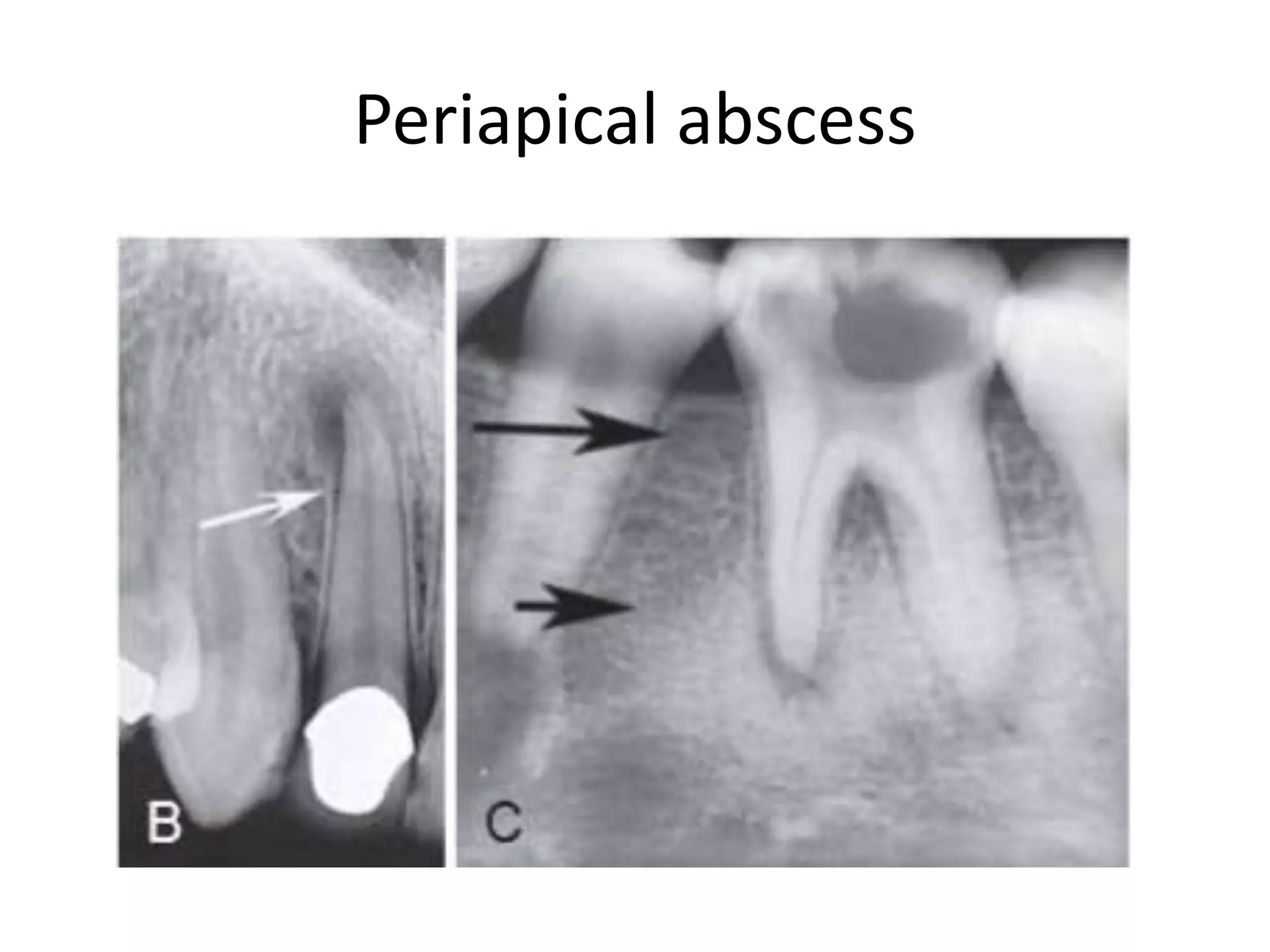
Periapical abscess
• Parulis
Chronic absces
sinus tract
granulation tissue proliferation
parulis
pain relieved
Differential diagnosis
• Incisive canal
• Globulomaxillary cyst
management
• Root canal
• Extraction
• Drainage
• Oral penicillin+metranidazole
Surgical defect
• Area where osseous tissue fail to fill after
surgery
• After root resection
• When labial and lingual plates are distroyed
• Clinically:
Mucosal scar from previous surgery
Palpated if large enough
Radiographic features
Periapical radiolucency with:
• Rounded appearance
• Smoothly contoured
• Well-defined borders
• <1 cm in diameter
Resolve to certain size,then remains constant
Differential diagnosis
Any periapical lesion
Management
Correct identification and periodic surveillance
with radiographs are required.
Osteomyelitis
• Defined as an infection of bone that involves:
1. Periosteum
2. Cortex
3. Marrow
Osteomyelitis –more aggressive diffuse
Osteitis-localized condition
2 major phases:acute and chronic
• Acute phase:
1. Synonyms:acute supportive osteomyelitis, garres
osteomyelitis,proliferative periostitis
2. caused by infection that has spread to bone
marrow
3. Medullary spaces of bone contain inflammatory
infiltrate consisting predominantly of neutrophils
4. Infection spread periosteally
elevating periosteum
stimulating bone formation
• Clinical features:
 Affect any age
 Strong male predilection
 Mandible> maxilla (poor vascular supply)
 Rapid onset,pain,swelling of adjacent soft
tissue,fever,lymphadenopathy,leukocytosis,
 associated teeth may be mobile ,sensitive to
percussion,purulent drainage,paresthesia of
lower lip third division of 5 th cranial nerve is
not uncommon
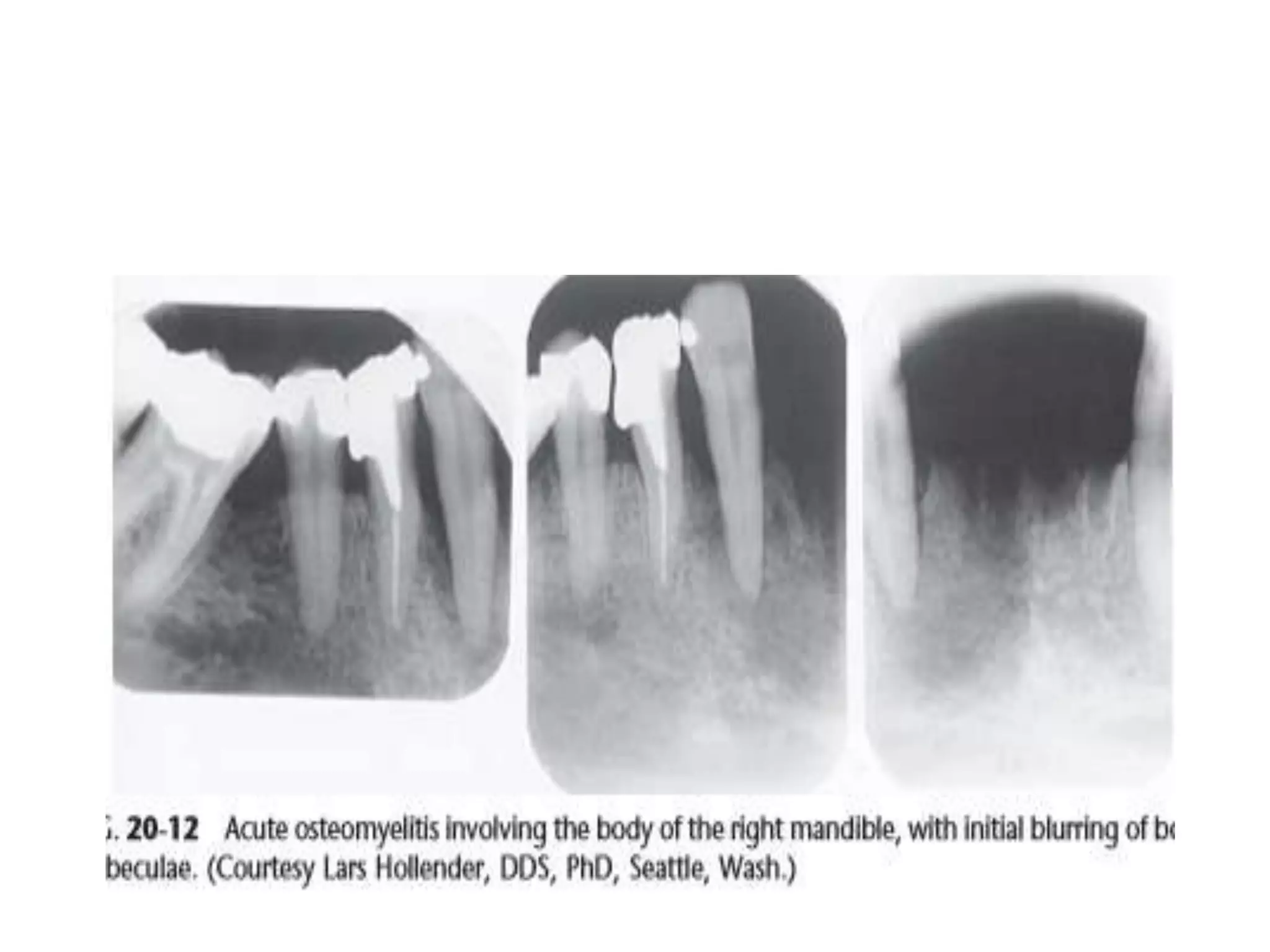
• Radiological examination
Location: posterior body of the mandible
Periphery: ill defined periphery with a gradual
transition to normal trabeculae
Internal structure:slight decrease in density of
involved bone with loss of sharpness of existing
trabaculae
bone distruction,radiolucency in one focal
area/scattered regions throughout the involved
bone
sclerotic regions,sequestration formation
effects on surrounding structures
stimulate bone resorption/formation
cortical bone may be resorbed
inflammatory exudate lift the periosteum
stimulate bone formation
Radiographically,faint radiopaque line separated
from bone surface
onion skin appearance
,chronic phase
Differential diagnosis
• Fibrous dysplasia
(in osteomyelitis, new bone formation is on
the periosteum,outer cortical plates get
thickened)
(But in fibrous dysplasia,new bone inside
mandible and outer cortex may be thinned)
• Malignant neoplasia (scc,osteosarcoma)
• Langerhans cells histiocytosis:rarely show a
sclerotic bone reaction
Chronic phase
• Synonyms
Chronic diffuse sclerosing osteomyelitis
Chronic non suppurative osteomyelitis
Chronic osteomyelitis with proliferative
periostitis
• A sequelae of inadequately treated acute
phase
• Symptoms are less severe and have longer
history
Radiographic features
• LOCATION:posterior mandible
• PERIPHERY :gradual transition is seen b/w
normal surrounding trabecular pattern and
dense granular pattern
• When disease is active,spread through
bone,periphery may be radiolucent and have
poorly defined borders
• INTERNAL STRUCTURE:
Lesion composed of more radiopaque
/sclerotic bone pattern
In older,internal density can be
radiopaque,equivalent to cortical bone.no
radiolucencies is evident.
Small regions of radiolucency may be
scattered through out the radiopaque bone
Island of sequestrum within the centre
• EFFECT ON SURROUNDING STRUCTURE:
Stimulate formation of periosteal new
bone,seen as single radiopaque line /series of
radiopaque line parallel to surface of cortical
bone/onion skin
• Over time,radiolucent strips that separates new
bone from outer cortical bone.when this occurs,it
may not be possible to identify the original
cortex,which makes it difficult to determine
whether the new bone is formed is formed from
periosteum
• Roots of teeth may undergo external resorption
,lamina dura become less apparent as it blends
with surrounding granular sclerotic bone
• If tooth is non-vital ,the PDL space usually
enlarged in the apical region .in patients with
extensive chronic osteomyelitis,disease may
slowly spread to mandible condyle and in to the
joint ,resulting in a septic arthritis
• Spread involve inner ear and mastoid air cells
• Chronic lesions develop a draining
fistula,appear as a well defined break in the
outer cortex in the periosteal new bone .
Differential diagnosis
• Fibrous dysplasia
• Pagets disease
• osteosarcoma
management
• Hyperbarric oxygenation therapy
• Surgical intervention-
sequestromy,decortication or resection
• NSAIDs
• bisphosphonates
Hyperplasia of maxillary sinus lining
• Pulpo periapical inflammation and
periodontal conditions frequantly produce
local inflammatory hyperplasia of adjacent
antral soft tissue floor.
• These appear as gray shadows that may be
dome shaped in the maxillary sinus floor or
gray radiopacity that appears as a cap over
adjacent troublesome root
• The free margin of soft tissue shadow is
usually smoothly contoured and distinct
although the soft tissue shadow may show
varying degree of grayness
• Soft tissue shadows disappear after treatment
Differential diagnosis
• Benign mucosal cyst
• Buccal exostosis
• Polyps of maxillary sinus
• Malignant tumours
• Antral exostosis
Dentigerous cyst
• Follicular cyst
• Cyst forms the crown of an erupted tooth
• It begins when fluid accumulates in the layers
of reduced enamel epithelium /b/w the
epithelium and crown of an erupted tooth
• An eruption cyst is the soft tissue counterpart
of unerupted tooth
• An eruption cyst is the soft tissue counterpart
of a dentigerous cyst
Clinical features
• 2 nd most common type of cyst in jaw
• Develop around crown of an unerupted or
supernumerary tooth
• Clinical examination reveals a missing tooth
/teeth,possibly a hard swelling occasionally
resulting in facial asymmetry
• Patient has no pain /discomfort
Radiographic features
• Location
Just above the involved tooth
Mandibular/maxillary 3 rd molar/maxillary
canine
This cyst attaches to cementoenamel junction
Some are eccentric, developing from lateral
aspect of follicle so that they occupy an area
beside crown instead of above crown
• Cyst related to maxillary 3 rd molar grow to
maxillary antrum
• Mandibular molar-extend in to ramus
Periphery and shape
• Well-defined cortex with curved outline
• Infection if present ,cortex may be missing
Internal structure
Completely radiolucency exept for the crown of
involved tooth
• Effects on surrounding structures
Displace and resorb adjacent teeth
Floor of maxillary antrum may displace as the
cyst invaginate the antrum and the cyst may
displace the inferior alveolar nerve canal in an
inferior direction
Slow growing—expands the outer cortical
boundary of the involved jaw
Differential diagnosis
• Hyperplastic follicle(cyst cause tooth
displacement and some degree of bone
expansion,if follicular space exeeds 5mm,a
dentigerous cyst is more likely)
• OKC
• Adenomatoid odantodenic tumour
Periapical cementosseous dysplasia
• Periapical cementoma
• most common fibrocementosseous lesion
• Reactive fibroosseous lesion
• Thought to arise from elements in the
versatile PDL,where mature osteoblasts,and
precursor cells reside
Radiographic features
• The early stage:osteolytic/osteoblastic
Radiolucent
Microstructure:cellular fibroblastic stroma
that may contain a few small foci of calcified
material
• Intermediate stage:radiolucent area
containingradiopaque foci
• The final stage:mature lesion
completely calcified,Welldefined,solid,
homogeneous radiopacity surounded by a thin
radiolucent border
• Calcified material in periapical lesions may be
entirely cementum,entirely
osseous/combination
• Well defined borders
• Non vital teeth
• Mandible predilection
• Periapical region of incisors
• Solitary/multiple exeeding 1cm
• Asymptomatic,cortical plate expansion
Differential diagnosis
• Anatomic radiolucency
• Pulpoperiapical radiolucency
• Traumatic bone cyst
• Focal cementosseous dysplasia
• Cementossifying fibroma
• Cementoblastoma
• malignancy
management
• observation
Periodontal disease
• Radiolucency caused by advanced periodontal
bone loss involving one teeth more severly
than the teeth immediately adjacent
• Appear to be floating in a radiolucency
• Apex is well defined radiolucencywhich in one
projection seems to surrounded by bone
• Pocket depth relative to root length of
associated tooth can be demonstrated by
placing gutta –percha points in the pockets to
their full depth.
• Teeth with advanced pdl distruction are
mobile
• Sensitive to percussion
• Vitality positive
Traumatic bone cyst
• Hemorrhagic bone cyst
• Extravasation cyst
• Simple bone cyst
• Solitary bone cyst
• Progressive bony cyst
• Blood cyst
• False cyst of bone because it does not have an
epithelial lining
Clinical features
• Asymptomatic
• Mandible
• Commonly in premolar and molar regions
• Symphysis is frequently involved
• teeth : vital,intact lamina dura
• Usually in patient under 25 yrs of age
Radiographic examination
• Well-defined(cyst like) radiolucency above the
mandibular canal
• Location:Predominantly round to oval
positioned somewhat symmetrically about
the periapex of a root
o Ramus and posterior mandible
o Frequantly occurs in cemento-osseous and
fibrous dysplasia
• Periphery and shape:
Margin vary from well-defined to ill-defined
Often scallops blw the roots
• Internal structure:
Totally radiolucent
Multilocular although the lesion doesn’t
contain true septa
Pronounced scalloping of the endosteal
surface of either buccal and lingual plates
• Effects on surrounding structure:
Intact lamina dura,/partly disrupted
Sparing of cortical boundary of the crypt
around a developing tooth
Tendency to scallop endosteal surface of the
outer cortex of the mandible
Tendency to grow along the long axis of the
bone,causing minimal expansion
Differential diagnosis
• Radicular cyst
• PCOD
Management:
Open the area surgically,remove the tissue
debris,curette the walls of the bony cavity to
induce bleeding ,close the soft tissue flap
securely
Non-radicular cysts
• May be projected over the apices of teeth
• Incisive canal,midpalatine cyst,median
mandibular cyst,primordial cyst
• Specific regions of the jawbone(expn for
primordial cyst)
• Teeth associated are vital
Differential diagnosis
• Incisive canal cyst
• Midpalatine cyst
Malignant tumours
• Single periapical radiolucency
• Malignant tumours may be primary or secondary
• Mistaken as pulpoperiapical lesions
• Biopsy is mandatory for periapical lesions that do
not respond to endodontic treatment
• SCC,malignant tumour if minor salivary gland
,metastatic tumours ,osteolytic
sarcamo,chondrosarcoma,
melanoma,fibrosarcoma,reticulum cell sarcoma
and multiple myeloma
• Granted enlarging lesions with ragged,moth
eaten borders
• Mesenchymal malignant tumours and
metastatic tumours originating within bone
are more apt to produce a localized
radiolucency than a peripheral SCC which
originates in the surface and erodes through
alveolar bone to arrive at the apex
• SCC originating within a cyst could be seen as
localized periapical radiolucency
• They may produce
1. Well-defined periapical radiolucency
2. Poorly defined periapical radiolucency
3. A large ragged,well defined radiolucent
tumour that has destroyed a large segment
of surface bone and has widening of PDL
spacing
features
• More common in patients of middle and old
age
• Pain may be a feature,involved teeth may
retain their vitality
• If tumour is
advanced,migration,loosening,tipping,and
spreading of teeth .
• Gingival bleeding
• Paresthesia or anesthesia of soft tissues is
sometimes present
• Expansion of jaw in advanced lesions
Differential diagnosis
Early lesions mimic benign condns
Management
2 basic principles
First:tooth and area in question are observed
with periodic clinical and radiographic
examination,the lesion and tooth are treated
with conservative endodontic techniques
Second:if clinician chooses to perform a root
resection in addition to root canal filling
Periapical radiolucencies

Periapical radiolucencies

  • 1.
    PERIAPICAL RADIOLUCENCIES DR SHABILMOHAMED MUSTAFA ASSOCIATE PROFESSOR MALABAR DENTAL COLLEGE AND RESEARCH CENTRE
  • 2.
    contents • INTRODUCTION • CLASSIFICATION •ANATOMIC PERIAPICAL RADIOLUCENCY • TRUE PERIAPICAL RADIOLUCENT LESION • PULPOPERIAPICAL RADIOLUCENCIES
  • 3.
    INTRODUCTION • Radiolucent shadowsare cast over the periapical regions of teeth in practically all oral radiographic surveys of dentulous patients • Some of this periapical radiolucencies represent innocent anatomic variations, • Others caused by benign condition • Still others represent systemic disease • Malignancies represent a small group of these periapical shadows
  • 4.
    CLASSIFICATION • Anatomical pseudoperiapicalradiolucencies • True periapical radiolucent lesions 1. Pulpoperiapical radiolucencies 2.Dentigerous cyst 3.Periapical cementoosseous 4.dysplasia(periapical cementoma) 5.Periodontal disease 6.Traumatic bone cyst 7.Non radicular cyst 8.Malignant tumors 9.rarities
  • 5.
    ANATOMICAL PERIAPICAL RADIOLUCENCIES 1. TRUE •Lesions truly in contact with tooth apex • shadow can’t be shifted from the periapex by taking additional radiographs on different angles 2.FALSE • Do not contact the apex of a tooth • Shadow can be shifted
  • 6.
    ANATOMIC PSEUDOPERIAPICAL RADIOLUCENCIES/FALSE PAR •Mandible foramen • Mandibular canal • Mental foramen • Lingual foramen • Submandibular fossa • Bone marrow spaces • Intermaxillary suture • Nasal cavity • Maxillary sinus • Incisive foramen • Developing tooth crypt • Greater palatine foramen
  • 7.
    TRUE PERIAPICAL RADIOLUCENTLESIONS 1. Periapical granuloma 2. Radicular cyst 3. Scar 4. Abscess 5. Surgical defect 6. Osteomyelitis 7. Hyperplasia of sinus mucosa
  • 8.
    PATHOGENESIS injured pulp irritating inflammatoryproducts periodontal ligament lysis of bone and soft tissue abscess/granuloma/radicularcyst/ pulpoperiapical lesion
  • 9.
    2.Periapical granuloma • Commonpathologic radiolucency • result from Periapical tissues, neutralize and confine toxic products from root canal. • Microstructure: proliferating endothelial cells,capillaries,young fibroblast,few collagen,chronic inflammatory cells.
  • 10.
  • 11.
    Clinical features • Asymptomatic •occasional severe toothache With/Without facial swelling • Fever • Lymphadenopathy • Non-vital pulp • Swelling/expansion of cortical plates
  • 12.
    Radiographic features • Well-circumscribedradiolucency around the apex of the tooth • With thin radiopaque border • Cannot be differentiated from radicular cyst • Usually within a range of 2.5 cm
  • 13.
    • LOCATION: epicenterat the apex of the involved tooth • PERIPHERY: ill-defined • INTERNAL STRUCTURE: initially loss of bone density,later,a mixture of sclerosis and rarefraction,i.e ,periapical sclerosing osteitis and periapical rarefying osteitis
  • 14.
    • EFFECTS ONSURROUNDING STRUCTURES: Loss of lamina dura,nearby cortical boundaries can be destroyedfloor of nasal fossa ,buccal and lingual plates of alveolar process • Thin layer of new bone formed-halow shadow
  • 15.
    Differential diagnosis • Periapicalcemental dysplasia • Enostosis • Radicular cyst
  • 16.
    management • Root canaltreament • extraction
  • 17.
    2.Radicular cyst • 2nd most common pulpoperiapical • Most common of all odontogenic cyst • Inflammatory cyst Inflammatory products initiate the growth of the epithelial component • Odontogenic cyst Origin in malassez rests,PDL cells,remnants of epithelial root sheath
  • 18.
    pre-existing periapical granuloma proliferatingepithelial cell nest cell nest size increases central cells degenerate and liquify fluid filled cavity lined with epithelium enlarging cyst on alveolar bone osteoclastic activity bone resorption
  • 19.
    CLINICAL FEATURES • Identicalto periapical granuloma • If periapical radiolucency >1.6 cm in dm more likely radicular cyst • if untreared,expand cortical plates • Initially bony hard swelling to palpate • Later, rubbery and fluctuant due to fluid • Large cyst involves complete quadrant • Occasionally tooth mobility,non-vital pulp • If infected,painfull symptoms of an abscess
  • 20.
    • Microscopic features: Peripheryis fibrous, Inner region –granulation tissue where foci of chronic inflammatory cells,foam cells, russell bodies,cholesterol clefts • Cholesterol crystal: shiny crystals from aspirated noninfected cyst
  • 21.
    Radiographic features • Location:apex of the non-vital tooth, Maxilla,around incisors and canine Due to distal inclination of maxillary lateral incisor,may invaginate the maxillary antrum • Periphery and shape: well-defined cortical border • Internal structure:radiolucent Dystrophic calcification in long standing cases
  • 22.
    • Effects oninternal structures: Displacement and resorption of adjacent teeth may occur Invagination in to antrum Outer cortical plates of maxilla and mandible may expand in a curved or circular shape Displace mandibular alveolar nerve canal in an inferior direction
  • 23.
  • 24.
    Differential diagnosis • Periapicalgranuloma • Periapical scars and surgical defects • PCOD • Traumatic bone cyst
  • 25.
    management • Non-surgical endodontics •If extraction ,curettage of periapical area should be judiciously curetted • Large radicular cyst:6 approaches 1. Surgical enucleation 2. Surgical enucleation and restoration with graft 3. Marsupialization 4. Decompression 5. Decompression with delayed enucleation 6. Creating common chamber with maxillary sinus
  • 26.
    • Post surgicalradiographs : Average healing time for cyst of more than 10mm in diameter is approximately 2 and half years .
  • 27.
    3.Periapical scar • Composedof dense fibrous tissue • In periapex of pulpless root canal filled teeth • Represents previous periapical granuloma/cyst/abscess,whose healing is completed by dense scar formation
  • 28.
    Clinical features • Resemplesperiapical granuloma and cyst • Causes well circumscribed radiolucency • Asymptomatic • Anterior region of maxilla • Endodontically treated tooth
  • 30.
  • 31.
    Chronic and acutedentoalveolar abscess Sudivided based on whether they are radiolucent 1. Primary/neoteric abscess 2. Secondary/recrudescent abscess
  • 32.
    Primary abscess 1. Normalon radiograph 2. Acute and exudative 3. Involving PDL tissues,at the tooth apex, 4. Necrotic pulp 5. Acute apical periodontitis 6. Very sensitive tooth 7. Alveolar swelling 8. Onset and course of infection are same 9. Sudden bone resorption
  • 33.
    Secondary abscess • Chronic/acutetype, • depending on organisms ,host,type and timing of treatment • Microflora is polymicrobial • Majorly anerobes,co2 dependent streptococci,and bacilli
  • 34.
    Clinical features • Periapicalradiolucency in secondary abscess • Depending on duration,margins of radiolucency may vary 1.Well defined with hyperostotic border 2.Poorly defined in chronic abscess • Root resorption • Pain on percussion in acute abscess • Non-vital • Tooth mobility • On progress,Space infection
  • 35.
  • 36.
    • Parulis Chronic absces sinustract granulation tissue proliferation parulis pain relieved
  • 37.
    Differential diagnosis • Incisivecanal • Globulomaxillary cyst
  • 38.
    management • Root canal •Extraction • Drainage • Oral penicillin+metranidazole
  • 39.
    Surgical defect • Areawhere osseous tissue fail to fill after surgery • After root resection • When labial and lingual plates are distroyed • Clinically: Mucosal scar from previous surgery Palpated if large enough
  • 40.
    Radiographic features Periapical radiolucencywith: • Rounded appearance • Smoothly contoured • Well-defined borders • <1 cm in diameter Resolve to certain size,then remains constant
  • 41.
    Differential diagnosis Differential diagnosis Anyperiapical lesion Management Correct identification and periodic surveillance with radiographs are required.
  • 42.
    Osteomyelitis • Defined asan infection of bone that involves: 1. Periosteum 2. Cortex 3. Marrow Osteomyelitis –more aggressive diffuse Osteitis-localized condition 2 major phases:acute and chronic
  • 43.
    • Acute phase: 1.Synonyms:acute supportive osteomyelitis, garres osteomyelitis,proliferative periostitis 2. caused by infection that has spread to bone marrow 3. Medullary spaces of bone contain inflammatory infiltrate consisting predominantly of neutrophils 4. Infection spread periosteally elevating periosteum stimulating bone formation
  • 44.
    • Clinical features: Affect any age  Strong male predilection  Mandible> maxilla (poor vascular supply)  Rapid onset,pain,swelling of adjacent soft tissue,fever,lymphadenopathy,leukocytosis,  associated teeth may be mobile ,sensitive to percussion,purulent drainage,paresthesia of lower lip third division of 5 th cranial nerve is not uncommon
  • 45.
    • Radiological examination Location:posterior body of the mandible Periphery: ill defined periphery with a gradual transition to normal trabeculae Internal structure:slight decrease in density of involved bone with loss of sharpness of existing trabaculae bone distruction,radiolucency in one focal area/scattered regions throughout the involved bone sclerotic regions,sequestration formation
  • 46.
    effects on surroundingstructures stimulate bone resorption/formation cortical bone may be resorbed inflammatory exudate lift the periosteum stimulate bone formation Radiographically,faint radiopaque line separated from bone surface onion skin appearance ,chronic phase
  • 48.
    Differential diagnosis • Fibrousdysplasia (in osteomyelitis, new bone formation is on the periosteum,outer cortical plates get thickened) (But in fibrous dysplasia,new bone inside mandible and outer cortex may be thinned) • Malignant neoplasia (scc,osteosarcoma) • Langerhans cells histiocytosis:rarely show a sclerotic bone reaction
  • 49.
    Chronic phase • Synonyms Chronicdiffuse sclerosing osteomyelitis Chronic non suppurative osteomyelitis Chronic osteomyelitis with proliferative periostitis • A sequelae of inadequately treated acute phase • Symptoms are less severe and have longer history
  • 50.
    Radiographic features • LOCATION:posteriormandible • PERIPHERY :gradual transition is seen b/w normal surrounding trabecular pattern and dense granular pattern • When disease is active,spread through bone,periphery may be radiolucent and have poorly defined borders
  • 51.
    • INTERNAL STRUCTURE: Lesioncomposed of more radiopaque /sclerotic bone pattern In older,internal density can be radiopaque,equivalent to cortical bone.no radiolucencies is evident. Small regions of radiolucency may be scattered through out the radiopaque bone Island of sequestrum within the centre
  • 52.
    • EFFECT ONSURROUNDING STRUCTURE: Stimulate formation of periosteal new bone,seen as single radiopaque line /series of radiopaque line parallel to surface of cortical bone/onion skin
  • 54.
    • Over time,radiolucentstrips that separates new bone from outer cortical bone.when this occurs,it may not be possible to identify the original cortex,which makes it difficult to determine whether the new bone is formed is formed from periosteum • Roots of teeth may undergo external resorption ,lamina dura become less apparent as it blends with surrounding granular sclerotic bone • If tooth is non-vital ,the PDL space usually enlarged in the apical region .in patients with extensive chronic osteomyelitis,disease may slowly spread to mandible condyle and in to the joint ,resulting in a septic arthritis • Spread involve inner ear and mastoid air cells
  • 55.
    • Chronic lesionsdevelop a draining fistula,appear as a well defined break in the outer cortex in the periosteal new bone .
  • 56.
    Differential diagnosis • Fibrousdysplasia • Pagets disease • osteosarcoma
  • 57.
    management • Hyperbarric oxygenationtherapy • Surgical intervention- sequestromy,decortication or resection • NSAIDs • bisphosphonates
  • 58.
    Hyperplasia of maxillarysinus lining • Pulpo periapical inflammation and periodontal conditions frequantly produce local inflammatory hyperplasia of adjacent antral soft tissue floor. • These appear as gray shadows that may be dome shaped in the maxillary sinus floor or gray radiopacity that appears as a cap over adjacent troublesome root
  • 59.
    • The freemargin of soft tissue shadow is usually smoothly contoured and distinct although the soft tissue shadow may show varying degree of grayness • Soft tissue shadows disappear after treatment
  • 60.
    Differential diagnosis • Benignmucosal cyst • Buccal exostosis • Polyps of maxillary sinus • Malignant tumours • Antral exostosis
  • 61.
    Dentigerous cyst • Follicularcyst • Cyst forms the crown of an erupted tooth • It begins when fluid accumulates in the layers of reduced enamel epithelium /b/w the epithelium and crown of an erupted tooth • An eruption cyst is the soft tissue counterpart of unerupted tooth • An eruption cyst is the soft tissue counterpart of a dentigerous cyst
  • 62.
    Clinical features • 2nd most common type of cyst in jaw • Develop around crown of an unerupted or supernumerary tooth • Clinical examination reveals a missing tooth /teeth,possibly a hard swelling occasionally resulting in facial asymmetry • Patient has no pain /discomfort
  • 63.
    Radiographic features • Location Justabove the involved tooth Mandibular/maxillary 3 rd molar/maxillary canine This cyst attaches to cementoenamel junction Some are eccentric, developing from lateral aspect of follicle so that they occupy an area beside crown instead of above crown
  • 64.
    • Cyst relatedto maxillary 3 rd molar grow to maxillary antrum • Mandibular molar-extend in to ramus Periphery and shape • Well-defined cortex with curved outline • Infection if present ,cortex may be missing Internal structure Completely radiolucency exept for the crown of involved tooth
  • 65.
    • Effects onsurrounding structures Displace and resorb adjacent teeth Floor of maxillary antrum may displace as the cyst invaginate the antrum and the cyst may displace the inferior alveolar nerve canal in an inferior direction Slow growing—expands the outer cortical boundary of the involved jaw
  • 67.
    Differential diagnosis • Hyperplasticfollicle(cyst cause tooth displacement and some degree of bone expansion,if follicular space exeeds 5mm,a dentigerous cyst is more likely) • OKC • Adenomatoid odantodenic tumour
  • 68.
    Periapical cementosseous dysplasia •Periapical cementoma • most common fibrocementosseous lesion • Reactive fibroosseous lesion • Thought to arise from elements in the versatile PDL,where mature osteoblasts,and precursor cells reside
  • 69.
    Radiographic features • Theearly stage:osteolytic/osteoblastic Radiolucent Microstructure:cellular fibroblastic stroma that may contain a few small foci of calcified material • Intermediate stage:radiolucent area containingradiopaque foci • The final stage:mature lesion completely calcified,Welldefined,solid, homogeneous radiopacity surounded by a thin radiolucent border
  • 70.
    • Calcified materialin periapical lesions may be entirely cementum,entirely osseous/combination • Well defined borders • Non vital teeth • Mandible predilection • Periapical region of incisors • Solitary/multiple exeeding 1cm • Asymptomatic,cortical plate expansion
  • 72.
    Differential diagnosis • Anatomicradiolucency • Pulpoperiapical radiolucency • Traumatic bone cyst • Focal cementosseous dysplasia • Cementossifying fibroma • Cementoblastoma • malignancy
  • 73.
  • 74.
    Periodontal disease • Radiolucencycaused by advanced periodontal bone loss involving one teeth more severly than the teeth immediately adjacent • Appear to be floating in a radiolucency • Apex is well defined radiolucencywhich in one projection seems to surrounded by bone • Pocket depth relative to root length of associated tooth can be demonstrated by placing gutta –percha points in the pockets to their full depth.
  • 75.
    • Teeth withadvanced pdl distruction are mobile • Sensitive to percussion • Vitality positive
  • 77.
    Traumatic bone cyst •Hemorrhagic bone cyst • Extravasation cyst • Simple bone cyst • Solitary bone cyst • Progressive bony cyst • Blood cyst • False cyst of bone because it does not have an epithelial lining
  • 78.
    Clinical features • Asymptomatic •Mandible • Commonly in premolar and molar regions • Symphysis is frequently involved • teeth : vital,intact lamina dura • Usually in patient under 25 yrs of age
  • 79.
    Radiographic examination • Well-defined(cystlike) radiolucency above the mandibular canal • Location:Predominantly round to oval positioned somewhat symmetrically about the periapex of a root o Ramus and posterior mandible o Frequantly occurs in cemento-osseous and fibrous dysplasia
  • 80.
    • Periphery andshape: Margin vary from well-defined to ill-defined Often scallops blw the roots • Internal structure: Totally radiolucent Multilocular although the lesion doesn’t contain true septa Pronounced scalloping of the endosteal surface of either buccal and lingual plates
  • 81.
    • Effects onsurrounding structure: Intact lamina dura,/partly disrupted Sparing of cortical boundary of the crypt around a developing tooth Tendency to scallop endosteal surface of the outer cortex of the mandible Tendency to grow along the long axis of the bone,causing minimal expansion
  • 83.
    Differential diagnosis • Radicularcyst • PCOD Management: Open the area surgically,remove the tissue debris,curette the walls of the bony cavity to induce bleeding ,close the soft tissue flap securely
  • 84.
    Non-radicular cysts • Maybe projected over the apices of teeth • Incisive canal,midpalatine cyst,median mandibular cyst,primordial cyst • Specific regions of the jawbone(expn for primordial cyst) • Teeth associated are vital
  • 86.
    Differential diagnosis • Incisivecanal cyst • Midpalatine cyst
  • 87.
    Malignant tumours • Singleperiapical radiolucency • Malignant tumours may be primary or secondary • Mistaken as pulpoperiapical lesions • Biopsy is mandatory for periapical lesions that do not respond to endodontic treatment • SCC,malignant tumour if minor salivary gland ,metastatic tumours ,osteolytic sarcamo,chondrosarcoma, melanoma,fibrosarcoma,reticulum cell sarcoma and multiple myeloma
  • 88.
    • Granted enlarginglesions with ragged,moth eaten borders • Mesenchymal malignant tumours and metastatic tumours originating within bone are more apt to produce a localized radiolucency than a peripheral SCC which originates in the surface and erodes through alveolar bone to arrive at the apex • SCC originating within a cyst could be seen as localized periapical radiolucency
  • 89.
    • They mayproduce 1. Well-defined periapical radiolucency 2. Poorly defined periapical radiolucency 3. A large ragged,well defined radiolucent tumour that has destroyed a large segment of surface bone and has widening of PDL spacing
  • 90.
    features • More commonin patients of middle and old age • Pain may be a feature,involved teeth may retain their vitality • If tumour is advanced,migration,loosening,tipping,and spreading of teeth . • Gingival bleeding • Paresthesia or anesthesia of soft tissues is sometimes present
  • 91.
    • Expansion ofjaw in advanced lesions Differential diagnosis Early lesions mimic benign condns Management 2 basic principles First:tooth and area in question are observed with periodic clinical and radiographic examination,the lesion and tooth are treated with conservative endodontic techniques Second:if clinician chooses to perform a root resection in addition to root canal filling