In ultrasonic welding, frictional heat produced by
the ultrasonic waves and force is used for the joining
process. Ultrasonic waves(15 to 60 kHz) are transferred
to the material under pressure with a sonometer.
Welding times are lower than 3 s .The welding can
proceed with or without the application of external
heat.
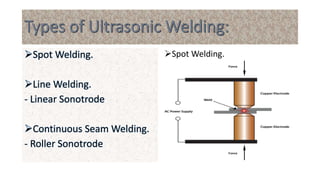
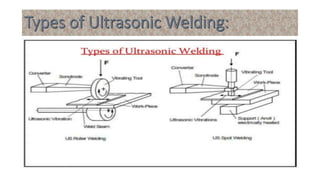
Spot Welding.
Line Welding.
- Linear Sonotrode
Continuous Seam Welding.
- Roller Sonotrode
Spot Welding.
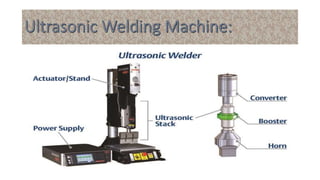
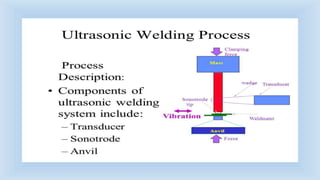
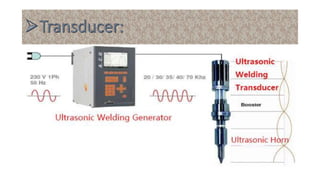
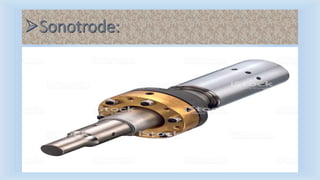
Produce high frequency ultrasonic vibrations.
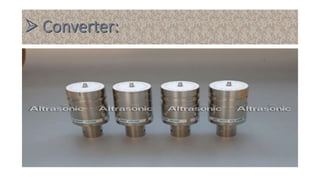
Converts the electrical signal in to a mechanical vibration.
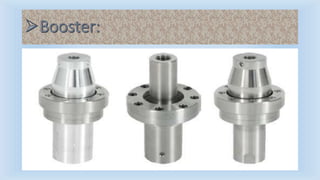
Modifies the amplitude of vibrations.
Applies the mechanical vibrations to the parts to be welded.
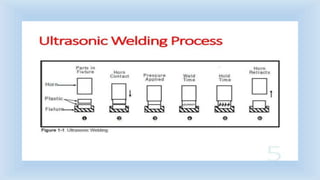
The parts are placed between a fixed shaped nest(anvil) and
a sonotrode (horn) connected to a transducer, and a 20kHz
low – amplitude acoustic vibration is emitted.
Common frequencies used in ultrasonic welding of thermos
plastics are 15kHz, 20kHz, 30kHz, 35kHz, 40kHz and 70kHz.
The ultrasonic energy melts the point between the parts
creating a joint.
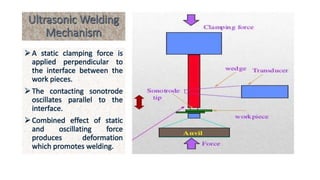
A static clamping force is
applied perpendicular to
the interface between the
work pieces.
The contacting sonotrode
oscillates parallel to the
interface.
Combined effect of static
and oscillating force
produces deformation
which promotes welding.
Heat affected zone is minimized.
Very thin materials can be welded.
Surface deformation is minimum.
Welding of glass is also possible.
No defects due to gases, arc and filler metal.
Pressure uses are lower, and welding time are shorter.
Dissimilar materials can be joined.
Welding can be made through some surface coating.
Restricted to join thin materials.
Competitively not economical.
Materials being welded may tend to the tip(sonotrode) and anvil.
Manufacturing of toys.
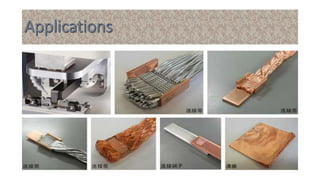
Joining of electrical and electronic components.
Welding aluminium wire and sheet.
Mobiles, sports shoes, laminations, cars, etc.
Packing, medical industries, computers.
Ultrasonic welding
Ultrasonic welding

Ultrasonic welding

  • 5.
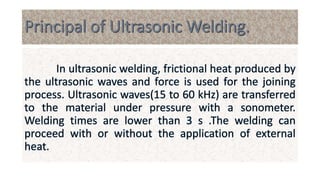
    In ultrasonic welding,frictional heat produced by the ultrasonic waves and force is used for the joining process. Ultrasonic waves(15 to 60 kHz) are transferred to the material under pressure with a sonometer. Welding times are lower than 3 s .The welding can proceed with or without the application of external heat.
  • 7.
    Spot Welding. Line Welding. -Linear Sonotrode Continuous Seam Welding. - Roller Sonotrode Spot Welding.
  • 9.
    Produce high frequencyultrasonic vibrations. Converts the electrical signal in to a mechanical vibration. Modifies the amplitude of vibrations. Applies the mechanical vibrations to the parts to be welded.
  • 14.
    The parts areplaced between a fixed shaped nest(anvil) and a sonotrode (horn) connected to a transducer, and a 20kHz low – amplitude acoustic vibration is emitted. Common frequencies used in ultrasonic welding of thermos plastics are 15kHz, 20kHz, 30kHz, 35kHz, 40kHz and 70kHz. The ultrasonic energy melts the point between the parts creating a joint.
  • 15.
    A static clampingforce is applied perpendicular to the interface between the work pieces. The contacting sonotrode oscillates parallel to the interface. Combined effect of static and oscillating force produces deformation which promotes welding.
  • 17.
    Heat affected zoneis minimized. Very thin materials can be welded. Surface deformation is minimum. Welding of glass is also possible. No defects due to gases, arc and filler metal. Pressure uses are lower, and welding time are shorter. Dissimilar materials can be joined. Welding can be made through some surface coating.
  • 18.
    Restricted to jointhin materials. Competitively not economical. Materials being welded may tend to the tip(sonotrode) and anvil.
  • 19.
    Manufacturing of toys. Joiningof electrical and electronic components. Welding aluminium wire and sheet. Mobiles, sports shoes, laminations, cars, etc. Packing, medical industries, computers.