Li-Fi Technology
By Debabrata Mohanta
Introduction
Light-Fidelity
 Li-Fi is a wireless optical networking technology that uses light-emitting
diodes (LEDs) for data transmission.
 Li-Fi is designed to use LED light bulbs similar to those currently in use
in many energy-conscious homes and offices.
 Li-Fi data is transmitted by the LED bulbs and received by
photoreceptors.
History
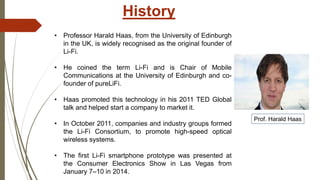
• Professor Harald Haas, from the University of Edinburgh
in the UK, is widely recognised as the original founder of
Li-Fi.
• He coined the term Li-Fi and is Chair of Mobile
Communications at the University of Edinburgh and co-
founder of pureLiFi.
• Haas promoted this technology in his 2011 TED Global
talk and helped start a company to market it.
• In October 2011, companies and industry groups formed
the Li-Fi Consortium, to promote high-speed optical
wireless systems.
• The first Li-Fi smartphone prototype was presented at
the Consumer Electronics Show in Las Vegas from
January 7–10 in 2014.
Prof. Harald Haas
Present Scenario
1.4 millions + 6.8 billion +
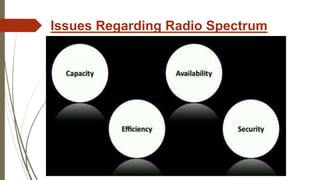
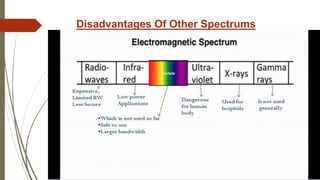
Issues Regarding Radio Spectrum
Capacity
Radio waves
Cost and Expensive
Less Bandwidth compared to other spectrums
Insufficient spectrum for increasing data
Efficiency
Millions of base stations consume huge amount of energy for
1. Transmitting the radio waves
2. To cool the base station cabin
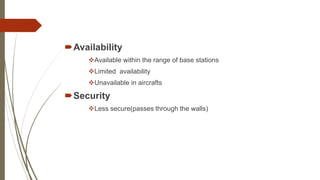
Availability
Available within the range of base stations
Limited availability
Unavailable in aircrafts
Security
Less secure(passes through the walls)
Disadvantages Of Other Spectrums
Working of LI-FI
 The LEDs can be switched on and off very quickly which gives nice
opportunity for data transfer in the form of Binary code.
 Switching ON an LED is logical ‘1’,switching OFF an LED is logical ‘0’.
 Hence it is possible to encode the data into the LED’s by using a
controller ,we just have to vary at which LED’s flicker depending on the
data we want to encode to give different strings of 0’s and 1’s.
 UK researches say that using a micro-LED light bulb they have achieved
a data transmission speed of 10Gbps using LI-FI.
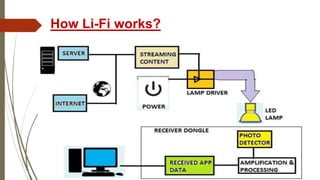
How Li-Fi works?
Main Components Of
Communication System
 A high brightness white LED, Which act as a communication source.
 A silicon photodiode which shows good response to visible wavelength
region serving as the receiving element.
Receiving elements
Transmitting elements
Parallel Data Transmission.
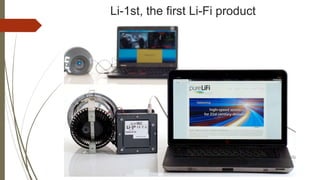
Li-1st, the first Li-Fi product
Application Areas
Li-fi technology is still in its infancy. However some areas
where it seems perfectly applicable are:-
POTENTIAL APPLICATION OF LI-FI
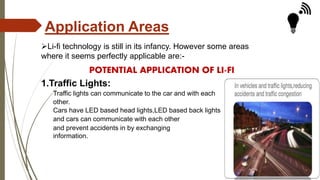
1.Traffic Lights:
Traffic lights can communicate to the car and with each
other.
Cars have LED based head lights,LED based back lights
and cars can communicate with each other
and prevent accidents in by exchanging
information.
2.Industrial use:
Used in RF restricted
environments like
chemical industries,
nuclear power plants,
petrol pumps
Visible Light is more safe than RF,
hence it can be used in places
where RF can't be used
such as petrochemical plants
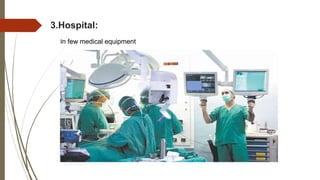
3.Hospital:
In few medical equipment
4.Airlines:
Whenever we travel through airways we face the problem in communication media ,
because the whole airways communication are performed on the basis of radio waves.
To overcome this drawback on radio waves , li-fi is introduced.
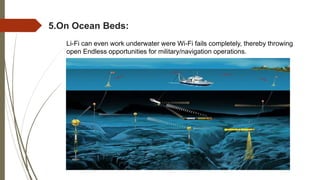
5.On Ocean Beds:
Li-Fi can even work underwater were Wi-Fi fails completely, thereby throwing
open Endless opportunities for military/navigation operations.
Advantages
 Higher speeds than Wi-Fi.
 10000 times the frequency spectrum of radio.
 More secure because data cannot be intercepted without a clear line of sight.
 Prevents piggybacking.
 Eliminates neighboring network interference.
 Does not create interference in sensitive electronics, making it better for use in
environments like hospitals and aircraft.
Disadvantages
 Light can't pass through objects.
 A major challenge facing Li-Fi is how the receiving device will
transmit back to transmitter.
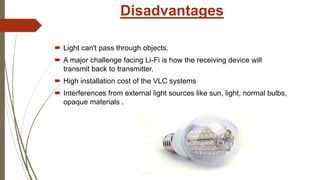
 High installation cost of the VLC systems
 Interferences from external light sources like sun, light, normal bulbs,
opaque materials .
Conclusion
 By using Li-Fi in all the lights in and around a building, the technology
could enable greater area of coverage than a single Wi-Fi router.
Drawbacks to the technology include the need for a clear line of sight,
difficulties with mobility and the requirement that lights stay on for
operation.
Lifi technology

Lifi technology

  • 1.
  • 2.
    Introduction Light-Fidelity  Li-Fi isa wireless optical networking technology that uses light-emitting diodes (LEDs) for data transmission.  Li-Fi is designed to use LED light bulbs similar to those currently in use in many energy-conscious homes and offices.  Li-Fi data is transmitted by the LED bulbs and received by photoreceptors.
  • 3.
    History • Professor HaraldHaas, from the University of Edinburgh in the UK, is widely recognised as the original founder of Li-Fi. • He coined the term Li-Fi and is Chair of Mobile Communications at the University of Edinburgh and co- founder of pureLiFi. • Haas promoted this technology in his 2011 TED Global talk and helped start a company to market it. • In October 2011, companies and industry groups formed the Li-Fi Consortium, to promote high-speed optical wireless systems. • The first Li-Fi smartphone prototype was presented at the Consumer Electronics Show in Las Vegas from January 7–10 in 2014. Prof. Harald Haas
  • 4.
  • 5.
  • 6.
    Capacity Radio waves Cost andExpensive Less Bandwidth compared to other spectrums Insufficient spectrum for increasing data Efficiency Millions of base stations consume huge amount of energy for 1. Transmitting the radio waves 2. To cool the base station cabin
  • 7.
    Availability Available within therange of base stations Limited availability Unavailable in aircrafts Security Less secure(passes through the walls)
  • 8.
  • 9.
    Working of LI-FI The LEDs can be switched on and off very quickly which gives nice opportunity for data transfer in the form of Binary code.  Switching ON an LED is logical ‘1’,switching OFF an LED is logical ‘0’.  Hence it is possible to encode the data into the LED’s by using a controller ,we just have to vary at which LED’s flicker depending on the data we want to encode to give different strings of 0’s and 1’s.  UK researches say that using a micro-LED light bulb they have achieved a data transmission speed of 10Gbps using LI-FI.
  • 10.
  • 11.
    Main Components Of CommunicationSystem  A high brightness white LED, Which act as a communication source.  A silicon photodiode which shows good response to visible wavelength region serving as the receiving element. Receiving elements Transmitting elements
  • 12.
  • 13.
    Li-1st, the firstLi-Fi product
  • 16.
    Application Areas Li-fi technologyis still in its infancy. However some areas where it seems perfectly applicable are:- POTENTIAL APPLICATION OF LI-FI 1.Traffic Lights: Traffic lights can communicate to the car and with each other. Cars have LED based head lights,LED based back lights and cars can communicate with each other and prevent accidents in by exchanging information.
  • 17.
    2.Industrial use: Used inRF restricted environments like chemical industries, nuclear power plants, petrol pumps Visible Light is more safe than RF, hence it can be used in places where RF can't be used such as petrochemical plants
  • 18.
  • 19.
    4.Airlines: Whenever we travelthrough airways we face the problem in communication media , because the whole airways communication are performed on the basis of radio waves. To overcome this drawback on radio waves , li-fi is introduced.
  • 20.
    5.On Ocean Beds: Li-Fican even work underwater were Wi-Fi fails completely, thereby throwing open Endless opportunities for military/navigation operations.
  • 21.
    Advantages  Higher speedsthan Wi-Fi.  10000 times the frequency spectrum of radio.  More secure because data cannot be intercepted without a clear line of sight.  Prevents piggybacking.  Eliminates neighboring network interference.  Does not create interference in sensitive electronics, making it better for use in environments like hospitals and aircraft.
  • 22.
    Disadvantages  Light can'tpass through objects.  A major challenge facing Li-Fi is how the receiving device will transmit back to transmitter.  High installation cost of the VLC systems  Interferences from external light sources like sun, light, normal bulbs, opaque materials .
  • 23.
    Conclusion  By usingLi-Fi in all the lights in and around a building, the technology could enable greater area of coverage than a single Wi-Fi router. Drawbacks to the technology include the need for a clear line of sight, difficulties with mobility and the requirement that lights stay on for operation.