LTE Radio Access, Rel. RL50,
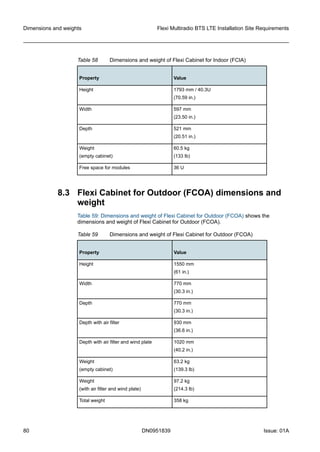
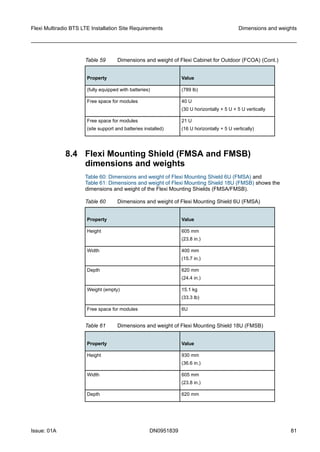
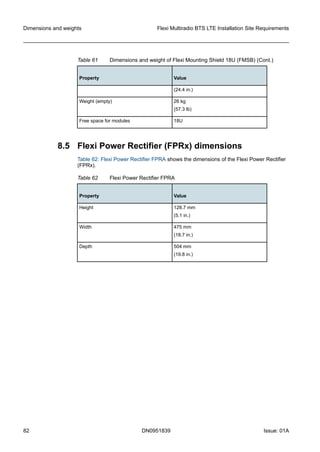
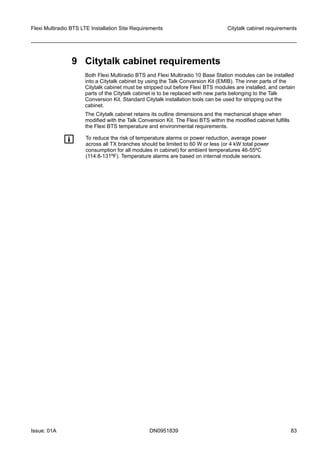
Operating Documentation,
Issue 02
Flexi Multiradio BTS LTE
Installation Site
Requirements
DN0951839
Issue 01A
Approval Date 2013-11-29
 
The information in this document is subject to change without notice and describes only the product
defined  in  the  introduction  of  this  documentation.  This  documentation  is  intended  for  the  use  of
Nokia Solutions and Networks customers only for the purposes of the agreement under which the
document is submitted, and no part of it may be used, reproduced, modified or transmitted in any
form or means without the prior written permission of Nokia Solutions and Networks. The documen-
tation has been prepared to be used by professional and properly trained personnel, and the cus-
tomer assumes full responsibility when using it. Nokia Solutions and Networks welcomes customer
comments as part of the process of continuous development and improvement of the documenta-
tion.
The information or statements given in this documentation concerning the suitability, capacity, or
performance of the mentioned hardware or software products are given "as is" and all liability aris-
ing in connection with such hardware or software products shall be defined conclusively and finally
in  a  separate  agreement  between  Nokia  Solutions  and  Networks  and  the  customer.  However,
Nokia Solutions and Networks has made all reasonable efforts to ensure that the instructions con-
tained in the document are adequate and free of material errors and omissions. Nokia Solutions
and Networks will, if deemed necessary by Nokia Solutions and Networks, explain issues which
may not be covered by the document.
Nokia Solutions and Networks will correct errors in this documentation as soon as possible. IN NO
EVENT WILL Nokia Solutions and Networks BE LIABLE FOR ERRORS IN THIS DOCUMENTA-
TION OR FOR ANY DAMAGES, INCLUDING BUT NOT LIMITED TO SPECIAL, DIRECT, INDI-
RECT, INCIDENTAL OR CONSEQUENTIAL OR ANY LOSSES, SUCH AS BUT NOT LIMITED TO
LOSS OF PROFIT, REVENUE, BUSINESS INTERRUPTION, BUSINESS OPPORTUNITY OR DA-
TA,THAT MAY ARISE FROM THE USE OF THIS DOCUMENT OR THE INFORMATION IN IT.
This documentation and the product it describes are considered protected by copyrights and other
intellectual property rights according to the applicable laws.
NSN is a trademark of Nokia Solutions and Networks. Nokia is a registered trademark of Nokia
Corporation. Other product names mentioned in this document may be trademarks of their respec-
tive owners, and they are mentioned for identification purposes only.
Copyright © Nokia Solutions and Networks 2013. All rights reserved
f Important Notice on Product Safety
  This product may present safety risks due to laser, electricity, heat, and other sources of
danger.
Only  trained  and  qualified  personnel  may  install,  operate,  maintain  or  otherwise  handle
this product and only after having carefully read the safety information applicable to this
product.
The safety information is provided in the Safety Information section in the “Legal, Safety
and Environmental Information” part of this document or documentation set.
Nokia Solutions and Networks is continually striving to reduce the adverse environmental effects of
its products and services. We would like to encourage you as our customers and users to join us in
working  towards  a  cleaner,  safer  environment.  Please  recycle  product  packaging  and  follow  the
recommendations for power use and proper disposal of our products and their components.
If you should have questions regarding our Environmental Policy or any of the environmental ser-
vices we offer, please contact us at Nokia Solutions and Networks for any additional information.
Flexi Multiradio BTS LTE Installation Site Requirements
2 DN0951839 Issue: 01A
Table of Contents
This document has 86 pages
   
Summary of changes..................................................................... 8
   
1 CE marking.................................................................................... 9
   
2 FCC Part 15 compliance.............................................................. 10
   
3 RSS-310 compliance....................................................................11
   
4 EU RoHS statement.....................................................................12
   
5 Environmental requirements........................................................ 13
5.1 Environmental specifications and requirements for a standalone
BTS.............................................................................................. 13
5.2 Installations with cabinet ............................................................. 15
5.3 Environmental specifications and requirements for modules in
Flexi Cabinet for Indoor (FCIA).................................................... 16
5.4 Environmental specifications and requirements for modules in
Flexi Cabinet for Outdoor (FCOA) without air filter...................... 17
5.5 Environmental specifications and requirements for modules in
Flexi Cabinet for Outdoor (FCOA) with air filter........................... 19
5.6 Environmental specifications and requirements for modules in
Flexi Mounting Shield (FMSA/FMSB).......................................... 20
5.7 Environmental specifications and requirements for Remote Radio
Head.............................................................................................22
5.8 Safety distance requirements (compliance boundaries).............. 23
5.9 Compliance with EMC, RF and safety......................................... 31
   
6 Site requirements......................................................................... 33
6.1 Planning and preparing the site................................................... 33
6.2 General site requirements............................................................33
6.2.1 Indoor site requirements.............................................................. 34
6.2.2 Choosing site for the Remote Radio Heads.................................34
6.3 Feederless site and Distributed site solution requirements..........35
6.3.1 NSN SFPs properties...................................................................35
6.3.2 DC cable lengths of the Feederless Site Concept....................... 37
6.3.3 DC cabling principles and shielding............................................. 47
6.4 Pole installation requirements...................................................... 47
6.5 Floor installation requirements..................................................... 49
6.6 Wall installation requirements...................................................... 51
6.7 Module clearances....................................................................... 51
6.8 Remote Radio Head clearances.................................................. 52
6.9 FPAD clearances..........................................................................53
6.10 Flexi Cabinet for Indoor (FCIA) clearances and anchoring holes....
53
Flexi Multiradio BTS LTE Installation Site Requirements
Issue: 01A DN0951839 3
6.11 Flexi Cabinet for Outdoor (FCOA) clearances and anchoring holes
..................................................................................................... 55
6.12 Flexi Mounting Shield (FMSA and FMSB) clearances and
anchoring holes............................................................................57
   
7 Power requirements..................................................................... 60
7.1 Site earth and BTS grounding requirements................................60
7.2 Mains power requirements...........................................................61
7.2.1 Circuit breakers............................................................................ 61
7.2.2 FPMA Battery backup times.........................................................62
7.2.3 FPMA AC wiring and Fuse requirements.....................................63
7.3 RF Module and RRH DC cable requirements.............................. 64
7.3.1 DC cable requirements for 80 W RF Modules............................. 64
7.3.2 DC cable requirements for 6TX 40W RF Modules.......................64
7.4 BTS power consumption.............................................................. 66
7.4.1 Power consumption of various FDD Flexi Multiradio BTS
configurations...............................................................................66
7.4.2 Power consumption of TDD Flexi RF Modules and RRHs
configurations...............................................................................68
7.5 Lightning surge requirements.......................................................69
   
8 Dimensions and weights.............................................................. 75
8.1 Module dimensions and weights.................................................. 75
8.1.1 RF Module dimensions and weight.............................................. 75
8.1.2 RRH Module dimensions and weight........................................... 76
8.2 FCIA dimensions and weight....................................................... 79
8.3 Flexi Cabinet for Outdoor (FCOA) dimensions and weight..........80
8.4 Flexi Mounting Shield (FMSA and FMSB) dimensions and weights
..................................................................................................... 81
8.5 Flexi Power Rectifier (FPRx) dimensions.....................................82
   
9 Citytalk cabinet requirements.......................................................83
   
10 Third-party cabinet requirements................................................. 84
   
11 19-inch open rack requirements...................................................86
Flexi Multiradio BTS LTE Installation Site Requirements
4 DN0951839 Issue: 01A
List of Figures
Figure 1 List of countries respecting EU Directive 1999/5/EC............................9
Figure 2 Sea salt distribution over land masses...............................................16
Figure 3 Area around the antenna....................................................................25
Figure 4 Antenna side and top view................................................................. 25
Figure 5 Antenna connection to the BTS..........................................................28
Figure 6 Formula for safety distances.............................................................. 30
Figure 7 DC cable lengths of the Feederless Site Concept..............................38
Figure 8 Example DC Power Feeder Graph.....................................................40
Figure 9 50 mm2 cable length as function of load............................................41
Figure 10 35 mm2 cable length as function of load............................................ 42
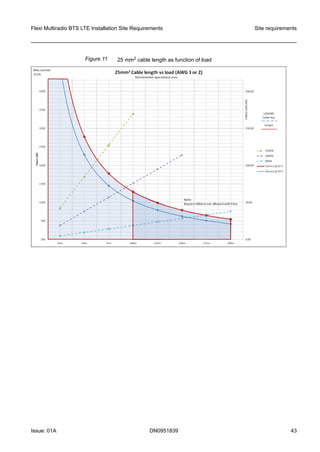
Figure 11 25 mm2 cable length as function of load............................................ 43
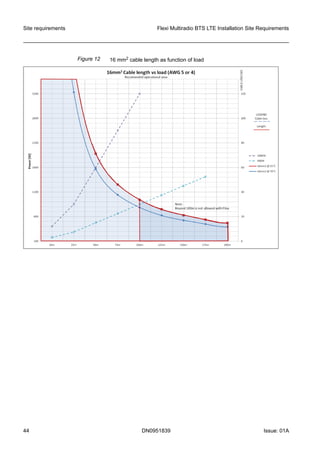
Figure 12 16 mm2 cable length as function of load............................................ 44
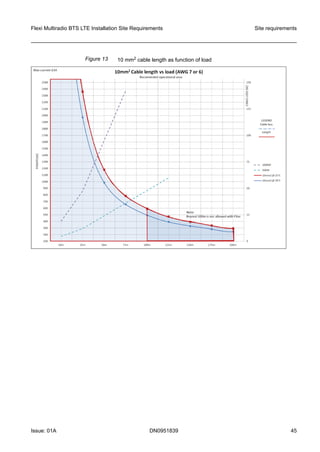
Figure 13 10 mm2 cable length as function of load............................................ 45
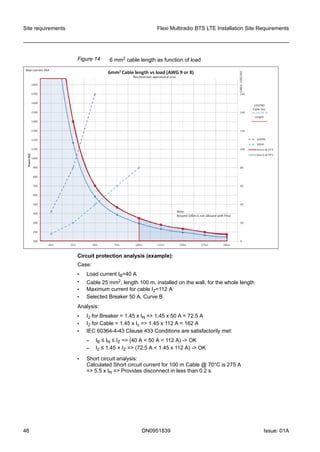
Figure 14 6 mm2 cable length as function of load...............................................46
Figure 15 Wind load calculations, side view.......................................................48
Figure 16 Wind load calculations, front view...................................................... 49
Figure 17 Anchoring the plinth on the floor.........................................................50
Figure 18 Anchoring the plinth on base with maintenance space in the back....51
Figure 19 Minimum RRH clearances for cooling purposes................................ 52
Figure 20 FPAD clearances for cooling purposes.............................................. 53
Figure 21 Clearances around FCIA....................................................................54
Figure 22 FCIA fixing points, minimum clearances............................................ 54
Figure 23 FCIA fixing points with maintenance space in the back..................... 55
Figure 24 Cabinet clearances and anchoring holes........................................... 56
Figure 25 FCOA cabinet bottom cable entry...................................................... 57
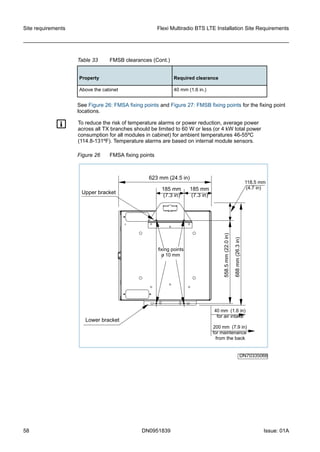
Figure 26 FMSA fixing points..............................................................................58
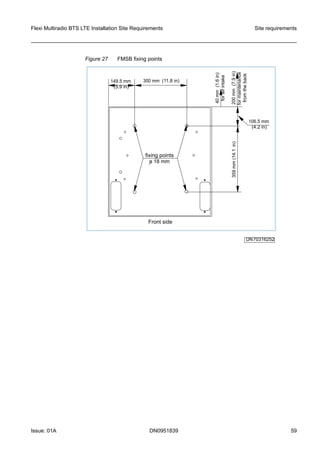
Figure 27 FMSB fixing points..............................................................................59
Figure 28 3U module dimensions without covers...............................................75
Figure 29 3U module dimensions with covers....................................................76
Figure 30 Isometric view of the RF Module FRGT............................................. 76
Figure 31 Isometric view of the Remote Radio Head (FRIG)............................. 78
Figure 32 Isometric view of the Remote Radio Head (FHDB)............................79
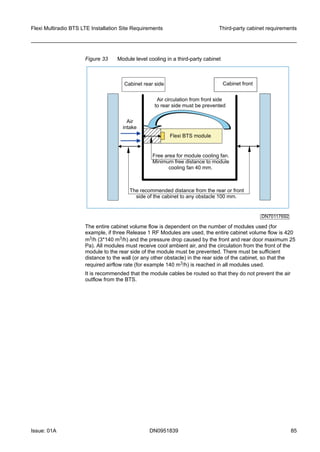
Figure 33 Module level cooling in a third-party cabinet...................................... 85
Figure 34 19-inch open rack...............................................................................86
Flexi Multiradio BTS LTE Installation Site Requirements
Issue: 01A DN0951839 5
List of Tables
Table 1 Climatic conditions for operation........................................................ 13
Table 2 Temperature and humidity values ......................................................14
Table 3 Flexi Multiradio BTS sound power levels (measured according to ISO
3744).................................................................................................. 14
Table 4 Climatic conditions for operation........................................................ 16
Table 5 Climatic conditions for operation........................................................ 17
Table 6 FCOA (without air filter) sound power level........................................18
Table 7 Temperature and humidity values ......................................................18
Table 8 Climatic conditions for operation........................................................ 19
Table 9 FCOA (with air filter) sound power level.............................................19
Table 10 Temperature and humidity values ......................................................20
Table 11 Climatic conditions for operation........................................................ 21
Table 12 Temperature and humidity values ......................................................21
Table 13 FMSA/FMSB sound power levels (measured according to ISO 3744)...
21
Table 14 Climatic conditions for operation........................................................ 22
Table 15 Remote Radio Head temperature range............................................ 23
Table 16 Whole body SAR exclusion power levels........................................... 24
Table 17 Dimensions of compliance boundary (General Public).......................26
Table 18 Dimensions of compliance boundary (occupational)..........................26
Table 19 A detailed description of the components...........................................28
Table 20 A typical antenna specification........................................................... 28
Table 21 Basic restrictions................................................................................ 29
Table 22 Reference values calculated from basic restrictions.......................... 30
Table 23 3 Gbps SFPs properties..................................................................... 35
Table 24 6 Gbps SFPs properties..................................................................... 36
Table 25 Conductors maximum current and circuit protection.......................... 38
Table 26 NSN requirements for a shielded, locally sourced DC cable (3U RF
Module), T=20ºC (68ºF)..................................................................... 47
Table 27 Area for wind load calculations...........................................................49
Table 28 Area for wind load calculations (FMSA)............................................. 49
Table 29 Required minimum clearances...........................................................52
Table 30 Cabinet clearances.............................................................................53
Table 31 Cabinet clearances.............................................................................55
Table 32 FMSA clearances............................................................................... 57
Table 33 FMSB clearances............................................................................... 57
Table 34 Permitted operating voltage................................................................61
Table 35 Battery backup times..........................................................................62
Table 36 Fuse and wire cross section requirements single phase AC..............63
Flexi Multiradio BTS LTE Installation Site Requirements
6 DN0951839 Issue: 01A
Table 37 Fuse and wire cross section requirements three phase AC...............63
Table 38 Fuse and wire cross section requirements three phase AC for dual
FPMA..................................................................................................63
Table 39 DC Cable Requirements for 80 W RF Modules..................................64
Table 40 DC cable requirements for 6TX 40W FRMC, FRPA, FRPB Modules.65
Table 41 DC cable requirements for 6TX 40W FRHC, FRHF Modules............ 65
Table 42 Typical and maximum power consumptions for Flexi Multiradio BTS
configurations in LTE FDD..................................................................66
Table 43 Power consumption of Flexi Outdoor Cabinet fans FCFA, FCSA, and
FCOS..................................................................................................67
Table 44 Typical power consumptions for Flexi Multiradio BTS configurations in
LTE TDD.............................................................................................68
Table 45 Switching and lightning transient requirements for AC power port ....69
Table 46 Surge immunity requirements for DC power port............................... 69
Table 47 Lightning surge requirements for antenna ports.................................70
Table 48 Lightning surge requirements for telecom ports................................. 70
Table 49 Surge requirements for alarm and control ports.................................71
Table 50 Lightning surge requirements for Ethernet ports................................ 71
Table 51 Lightning surge requirements for FSEC/FSES...................................72
Table 52 Lightning surge requirements (DC power port) FPFD........................72
Table 53 Lightning surge requirements for FPFC............................................. 73
Table 54 Lightning surge requirements for selected RF Modules.....................73
Table 55 Lightning surge requirements for selected RRHs...............................74
Table 56 RF Module dimensions and weight.................................................... 75
Table 57 Dimensions and weight of the Remote Radio Head...........................76
Table 58 Dimensions and weight of Flexi Cabinet for Indoor (FCIA)................ 80
Table 59 Dimensions and weight of Flexi Cabinet for Outdoor (FCOA)............80
Table 60 Dimensions and weight of Flexi Mounting Shield 6U (FMSA)............81
Table 61 Dimensions and weight of Flexi Mounting Shield 18U (FMSB)..........81
Table 62 Flexi Power Rectifier FPRA................................................................82
Table 63 Air volume flow and cabinet pressure drop........................................ 84
Flexi Multiradio BTS LTE Installation Site Requirements
Issue: 01A DN0951839 7
Summary of changes
Changes between document issues are cumulative. Therefore, the latest document
issue contains all changes made to previous issues.
Changes between issues 01 (2013-09-18, RL50) and 01A (2013-11-29,
RL50)
• Tables: Dimensions of compliance boundary (General Public) and Dimensions of
compliance boundary (occupational) have been updated.
• Section Battery backup times has been renamed to FPMA Battery backup times.
• Section DC cable requirements for 80 W RF Modules has been updated with the
FRGT information.
• Sections: DC cable requirements for 80 W RF Modules and Lightning surge
requirements have been updated with the FPFC information.
• The following sections have been added:
– FPAD clearances
– FPMA AC wiring and Fuse requirements
– DC cable requirements for 6TX 40W RF Modules
– Flexi Power Distribution and Fuses (FPFC)
• The following sections have been updated:
– Circuit breakers
– Third-party cabinet requirements
– FPMA Battery backup times
This is the first issue of the document.
This document is a combined version of two documents, Flexi Multiradio BTS LTE
Installation Site Requirements (DN09123378, issue 01, 2013-05-24) and Flexi Multiradio
BTS LTE Installation Site Requirements (DN0951839, issue 03C, 2013-07-11), which
were available respectively in RL25TD library and RL40 library in the previous releases.
Summary of changes Flexi Multiradio BTS LTE Installation Site Requirements
8 DN0951839 Issue: 01A
   
1 CE marking
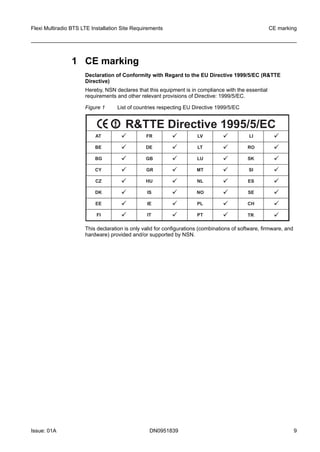
Declaration of Conformity with Regard to the EU Directive 1999/5/EC (R&TTE
Directive)
Hereby, NSN declares that this equipment is in compliance with the essential
requirements and other relevant provisions of Directive: 1999/5/EC.
Figure 1 List of countries respecting EU Directive 1999/5/EC
AT ü FR ü LV ü LI ü
BE ü DE ü LT ü RO ü
BG ü GB ü LU ü SK ü
CY ü GR ü MT ü SI ü
CZ ü HU ü NL ü ES ü
DK ü IS ü NO ü SE ü
EE ü IE ü PL ü CH ü
FI ü IT ü PT
R&TTEDirective1995/5/EC
ü TR ü
This declaration is only valid for configurations (combinations of software, firmware, and
hardware) provided and/or supported by NSN.
Flexi Multiradio BTS LTE Installation Site Requirements CE marking
Issue: 01A DN0951839 9
   
2 FCC Part 15 compliance
This equipment has been tested and found to comply with the limits for a Class A digital
device, pursuant to Part 15 of the FCC Rules. These limits are designed to provide
reasonable protection against harmful interference in a commercial environment. This
equipment generates, uses, and can radiate radio frequency energy and, if not installed
and used in accordance with the instruction manuals, may cause harmful interference to
radio communications. Operation of this equipment in a residential area is likely to cause
harmful interference in which case the user will be required to correct the interference at
his own expense. Changes or modifications not expressly approved by the party
responsible for compliance could void the user´s authority to operate the equipment.
FCC Part 15 compliance Flexi Multiradio BTS LTE Installation Site Requirements
10 DN0951839 Issue: 01A
   
3 RSS-310 compliance
This device complies with RSS-310 of Industry Canada. Operation is subject to the
condition that this device does not cause harmful interference.
Flexi Multiradio BTS LTE Installation Site Requirements RSS-310 compliance
Issue: 01A DN0951839 11
   
4 EU RoHS statement
This equipment complies with the European Union RoHS Directive 2011/65/EU on the
restriction of the use of certain hazardous substances in electrical and electronic
equipment. The directive applies to the use of lead, mercury, cadmium, hexavalent
chromium, polybrominated biphenyls (PBB), and polybrominated diphenyl ethers (PBDE)
in electrical and electronic equipment.
EU RoHS statement Flexi Multiradio BTS LTE Installation Site Requirements
12 DN0951839 Issue: 01A
   
5 Environmental requirements
5.1 Environmental specifications and requirements for
a standalone BTS
w NOTICE:
Unprotected equipment might be damaged during transportation. Transport the
equipment to the installation site in its original transportation package.
Flexi Multiradio stand-alone BTS (modules installed without a cabinet) can operate under
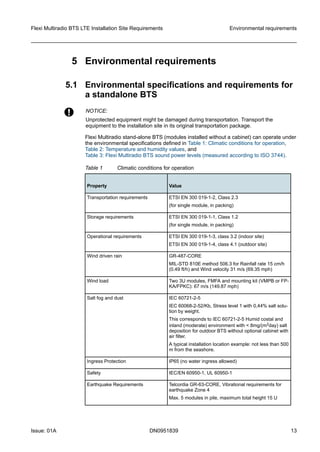
the environmental specifications defined in Table 1: Climatic conditions for operation,
Table 2: Temperature and humidity values, and
Table 3: Flexi Multiradio BTS sound power levels (measured according to ISO 3744).
Table 1 Climatic conditions for operation
Property Value
Transportation requirements ETSI EN 300 019-1-2, Class 2.3
(for single module, in packing)
Storage requirements ETSI EN 300 019-1-1, Class 1.2
(for single module, in packing)
Operational requirements ETSI EN 300 019-1-3, class 3.2 (indoor site)
ETSI EN 300 019-1-4, class 4.1 (outdoor site)
Wind driven rain GR-487-CORE
MIL-STD 810E method 506.3 for Rainfall rate 15 cm/h
(0.49 ft/h) and Wind velocity 31 m/s (69.35 mph)
Wind load Two 3U modules, FMFA and mounting kit (VMPB or FP-
KA/FPKC): 67 m/s (149.87 mph)
Salt fog and dust IEC 60721-2-5
IEC 60068-2-52/Kb, Stress level 1 with 0,44% salt solu-
tion by weight.
This corresponds to IEC 60721-2-5 Humid costal and
inland (moderate) environment with < 8mg/(m2day) salt
deposition for outdoor BTS without optional cabinet with
air filter.
A typical installation location example: not less than 500
m from the seashore.
Ingress Protection IP65 (no water ingress allowed)
Safety IEC/EN 60950-1, UL 60950-1
Earthquake Requirements Telcordia GR-63-CORE, Vibrational requirements for
earthquake Zone 4
Max. 5 modules in pile, maximum total height 15 U
Flexi Multiradio BTS LTE Installation Site Requirements Environmental requirements
Issue: 01A DN0951839 13
   
Table 1 Climatic conditions for operation (Cont.)
Property Value
Telcordia GR-63-CORE, Vibrational requirements for
earthquake Zone 2
Max. 9 modules in pile, maximum total height 22 U
Table 2 Temperature and humidity values
Property Temperature Humidity, relative
Transportation -40°C - +70°C (-40°F - +158°F) Max. 95%
Storage -33°C - +40°C (-27.4°F - +104°F) 15 - 100%
High ambient air temperature
limit
+55°C (+131°F) in shade with guar-
anteed minimum performance of
3GPP specification
+50°C (+122°F) in shade with guar-
anteed performance (that is better
than 3GPP)
+50°C (+122°F) in direct sunlight
with guaranteed minimum perfor-
mance of 3GPP specification
+45°C (+113°F) in direct sunlight
with guaranteed performance (that
is better than 3GPP)
15 - 100%
Operational -35°C - +55°C (-31°F - +131°F) ~95%
Table 3: Flexi Multiradio BTS sound power levels (measured according to ISO 3744)
shows the sound power levels measured with linear curve control.
Table 3 Flexi Multiradio BTS sound power levels (measured according to ISO
3744)
Configuration Minimum
[dBA]
(15°C (59°F),
10% RF load)
Typical [dBA]
(23°C (73.4°F),
50% RF load)
Max [dBA]
(40°C (104°F),
100% RF load)
Max [dBA]
(50°C (122°F),
100% RF load)
1+1+1@ 20 W
System Module with one
3-sector RF Module
Max. 51 Max. 54 Max. 60 Max. 65
1+1+1@ 40 W
System Module with one
3-sector RF Module
Max. 54 Max. 56 Max. 62 Max. 66
2+2+2@ 40 W Max. 57 Max. 59 Max. 66 Max. 69
Environmental requirements Flexi Multiradio BTS LTE Installation Site Requirements
14 DN0951839 Issue: 01A
   
Table 3 Flexi Multiradio BTS sound power levels (measured according to ISO
3744) (Cont.)
Configuration Minimum
[dBA]
(15°C (59°F),
10% RF load)
Typical [dBA]
(23°C (73.4°F),
50% RF load)
Max [dBA]
(40°C (104°F),
100% RF load)
Max [dBA]
(50°C (122°F),
100% RF load)
System Module and two
RF Modules
FPMA effect
Add to above values:
Max. 3 Max. 3 Max. 3 Max. 3
For the sound power of a 3-sector RF Module alone, see the values for a 1+1+1@ 20 W config-
uration.
For the sound power of a System Module alone, subtract 3 dBA from the above values.
5.2 Installations with cabinet
Modules must be installed in an indoor cabinet or an outdoor cabinet, when:
• more than nine modules are installed in a stack (total height over 22 U*)
• more than five modules are installed in a stack (total height over 15 U) and the
Telcordia GR-63-CORE Zone 4 requirement is still met
• the BTS is installed in a separate locked space
• cabinet can be also used as one option to make locked space
g 22 U high stack meets Telcordia GR-63-CORE Zone 2 earthquake requirement.
An air filter must be used together with the BTS cabinet when standard-based
operational environmental conditions presented in
Environmental specifications and requirements for a stand-alone BTS are exceeded.
Typically, a cabinet with an optional air filter is needed:
• in places where dust is a concern
• next to a dusty road with heavy traffic
• in sandy terrain with the possibility of wind-blown sand in the air
• next to an industrial plant with significant emissions of dust or other particles, such as
cement factory, sawmill, and so on
• nearby a cornfield with heavy straw dust during harvesting
• in places where salt fog or acid rain caused by air pollution is a concern
• in site locations where surrounding metal structures show signs of corrosion because
of the extreme conditions (salt in air)
• in locations with especially heavy rainfall and high humidity combined with air
pollution
• near sea shore:
– with dense salt fog because of the breaking waves
– with dense salt fog and line of sight to the sea (not behind a large building)
– where wind-driven salt fog from sea can be identified
Flexi Multiradio BTS LTE Installation Site Requirements Environmental requirements
Issue: 01A DN0951839 15
   
For a generic model for sea salt distribution, see
Figure 2: Sea salt distribution over land masses. Typically, the further away from the sea
the BTS is located the less salt is accumulated. However, because of the local
environmental variables a general rule for determining the distance cannot be stated.
Always check the local environmental conditions before installing a BTS in the proximity
of the sea.
Figure 2 Sea salt distribution over land masses
5.3 Environmental specifications and requirements for
modules in Flexi Cabinet for Indoor (FCIA)
Flexi Multiradio BTS modules inside Flexi Cabinet for Indoor (FCIA) can operate as
defined in Table 4: Climatic conditions for operation.
Table 4 Climatic conditions for operation
Property Value
Transportation requirements ETS 300 019-1-2, class 2.3
Storage requirements ETS 300 019-1-1, class 1.2
Operational requirements ETS 300 019-1-3, class 3.2
GR-63-CORE
Environmental requirements Flexi Multiradio BTS LTE Installation Site Requirements
16 DN0951839 Issue: 01A
   
Table 4 Climatic conditions for operation (Cont.)
Property Value
Salt fog and dust IEC 60068-2-60/Ke
Ingress Protection IP20
Safety IEC/EN 60950-1, UL 60950-1
Earthquake requirements Telcordia GR-63-CORE, Zone 4
5.4 Environmental specifications and requirements for
modules in Flexi Cabinet for Outdoor (FCOA)
without air filter
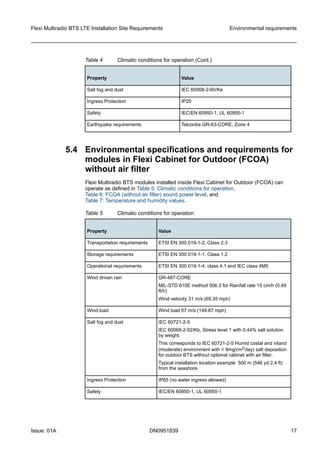
Flexi Multiradio BTS modules installed inside Flexi Cabinet for Outdoor (FCOA) can
operate as defined in Table 5: Climatic conditions for operation,
Table 6: FCOA (without air filter) sound power level, and
Table 7: Temperature and humidity values.
Table 5 Climatic conditions for operation
Property Value
Transportation requirements ETSI EN 300 019-1-2, Class 2.3
Storage requirements ETSI EN 300 019-1-1, Class 1.2
Operational requirements ETSI EN 300 019-1-4, class 4.1 and IEC class 4M5
Wind driven rain GR-487-CORE
MIL-STD 810E method 506.3 for Rainfall rate 15 cm/h (0.49
ft/h)
Wind velocity 31 m/s (69.35 mph)
Wind load Wind load 67 m/s (149.87 mph)
Salt fog and dust IEC 60721-2-5
IEC 60068-2-52/Kb, Stress level 1 with 0,44% salt solution
by weight.
This corresponds to IEC 60721-2-5 Humid costal and inland
(moderate) environment with < 8mg/(m2/day) salt deposition
for outdoor BTS without optional cabinet with air filter.
Typical installation location example: 500 m (546 yd 2.4 ft)
from the seashore.
Ingress Protection IP65 (no water ingress allowed)
Safety IEC/EN 60950-1, UL 60950-1
Flexi Multiradio BTS LTE Installation Site Requirements Environmental requirements
Issue: 01A DN0951839 17
   
Table 5 Climatic conditions for operation (Cont.)
Property Value
Earthquake requirements Telcordia GR-63-CORE, Zone 4
Table 6: FCOA (without air filter) sound power level shows the sound power levels
measured with linear curve control.
Table 6 FCOA (without air filter) sound power level
Value Configuration Max [dBA]
Sound power, night time
(in +15°C (59°F), 10% RF load,
ISO3744)
1+1+1 40W/carrier
(System Module with one 3-sector RF
Module)
55
Sound power, day time
(in +23°C (73.4°F), 50% RF load,
ISO3744)
1+1+1 40W/carrier
(System Module with one 3-sector RF
Module)
57
Sound power, extreme
(in +40°C (104°F), 100% RF load,
ISO3744)
1+1+1 40W/carrier
(System Module with one 3-sector RF
Module)
63
Table 7 Temperature and humidity values
Property Temperature Humidity, relative%
Transportation -40°C - +70°C (-40°F - +158°F) Max. 95%
Storage -33°C - +40°C (-27.4°F - +104°F) 15 - 100%
High ambient air
temperature limit
+55°C (+131°F) in shade with guaranteed
minimum performance of 3GPP specification
+50°C (+122°F) in shade with guaranteed
performance (that is better than 3GPP)
+50°C (+122°F) in direct sunlight with guaran-
teed minimum performance of 3GPP specifi-
cation
+45°C (+113°F) in direct sunlight with guaran-
teed performance (that is better than 3GPP)
15 - 100%
Operational -35°C - +55°C (-31°F - +131°F) ~95%
g To reduce the risk of temperature alarms or power reduction, average power
across all TX branches should be limited to 60 W or less (or 4 kW total power
consumption for all modules in cabinet) for ambient temperatures 46-55ºC
(114.8-131ºF). Temperature alarms are based on internal module sensors.
Environmental requirements Flexi Multiradio BTS LTE Installation Site Requirements
18 DN0951839 Issue: 01A
   
5.5 Environmental specifications and requirements for
modules in Flexi Cabinet for Outdoor (FCOA) with
air filter
Flexi Multiradio BTS modules installed inside Flexi Cabinet for Outdoor (FCOA) with an
optional air filter can operate as defined in Table 8: Climatic conditions for operation,
Table 9: FCOA (with air filter) sound power level, and
Table 10: Temperature and humidity values.
Table 8 Climatic conditions for operation
Property Value
Transportation requirements ETSI EN 300 019-1-2, Class 2.3
Storage requirements ETSI EN 300 019-1-1, Class 1.3
Operational requirements ETSI EN 300 019-1-4, class 4.1 and IEC class 4M5
Wind driven rain GR-487-CORE
MIL-STD 810E method 506.3 for rainfall rate 15cm/h ()0.49
ft/h
Wind velocity 31 m/s (69.35 mph)
Wind load Wind load 67 m/s (149.87 mph)
Salt fog and dust IEC 60721-2-5
IEC 60068-2-52/Kb, Stress level 1 with 5% salt solution by
weight
This corresponds to IEC 60721-2-5 oceanic and coastal en-
vironment with > 8mg/(m2day) salt deposition for outdoor
BTS with optional air filter.
When installing a cabinet with an air filter on a seashore, it is recommended that the cabinet is
installed with the side wall facing the sea (not the filter or the door).
Ingress Protection IP65 (no water ingress allowed)
Safety IEC/EN 60950-1, UL 60950-1
Earthquake requirements Telcordia GR-63-CORE, Zone 4
Table 9: FCOA (with air filter) sound power level shows the sound power levels
measured with linear curve control.
Table 9 FCOA (with air filter) sound power level
Value Configuration Max [dBA]
Sound power, night time 1+1+1 40W/carrier 56*
Flexi Multiradio BTS LTE Installation Site Requirements Environmental requirements
Issue: 01A DN0951839 19
   
Table 9 FCOA (with air filter) sound power level (Cont.)
Value Configuration Max [dBA]
(in +15°C (59°F), 10% RF load,
ISO3744)
(System Module with one 3-sector
RF Module)
Sound power, day time
(in +23°C (73.4°F), 50% RF load,
ISO3744)
1+1+1 40W/carrier
(System Module with one 3-sector
RF Module)
59*
Sound power, extreme
(in +40°C (104°F), 100% RF load,
ISO3744)
1+1+1 40W/carrier
(System Module with one 3-sector
RF Module)
65*
*) Sound power figures measured with a clean filter.
Table 10 Temperature and humidity values
Property Temperature Humidity, relative%
Transportation -40°C - +70°C (-40°F - +158°F) Max. 95%
Storage -33°C - +40°C (-27.4°F - +104°F) 15 - 100%
High ambient air
temperature limit
+55°C (+131°F) in shade with guaranteed min-
imum performance of 3GPP specification
+50°C (+122°F) in shade with guaranteed per-
formance (that is better than 3GPP)
+50°C (+122°F) in direct sunlight with guaran-
teed minimum performance of 3GPP specifi-
cation
+45°C (+113°F) in direct sunlight with guaran-
teed performance (that is better than 3GPP)
15 - 100%
Operational -35°C - +55°C (-31°F - +131°F) ~95%
g To reduce the risk of temperature alarms or power reduction, average power
across all TX branches should be limited to 60 W or less (or 4 kW total power
consumption for all modules in cabinet) for ambient temperatures 46-55ºC
(114.8-131ºF). Temperature alarms are based on internal module sensors.
5.6 Environmental specifications and requirements for
modules in Flexi Mounting Shield (FMSA/FMSB)
Flexi Multiradio BTS modules installed inside Flexi Mounting Shield (FMSA/FMSB)
cabinet can operate in the climatic conditions as defined in
Table 11: Climatic conditions for operation.
Environmental requirements Flexi Multiradio BTS LTE Installation Site Requirements
20 DN0951839 Issue: 01A
   
Table 11 Climatic conditions for operation
Property Value
Operational requirements ETSI EN 300 019-1-4, class 4.1 and IEC class 4M5
Wind driven rain GR-487-CORE
Wind velocity 31 m/s (69.36 mph)
Wind load Wind load 67 m/s (149.87 mph)
Ingress Protection IP65 (no water ingress allowed)
Safety IEC 60529
Earthquake requirements Telcordia GR-63-CORE, Zone 4*
*If a sixth module is installed in the cabinet, the earthquake requirements are according to
Zone 2.
In extreme conditions, for example, with high salinity less than 500 m to the sea or high
dust density in the air, it is required to use a shelter or outdoor cabinet with an air filter.
Table 12 Temperature and humidity values
Property Temperature Humidity, relative%
Transportation -40°C - +70°C (-40°F - +158°F) Max. 95%
Storage -33°C - +40°C (-27.4°F - +104°F) 15 - 100%
Operational -35°C - +55°C (-31°F - +131°F) ~95%
Table 13: FMSA/FMSB sound power levels (measured according to ISO 3744) shows
the sound power levels measured with linear curve control.
Table 13 FMSA/FMSB sound power levels (measured according to ISO 3744)
Configuration Minimum
[dBA]
(in 15°C
(59°F), 10%
RF load)
Typical [dBA]
(in 23°C
(73.4°F), 50%
RF load)
Max [dBA]
(in 40°C
(104°F),
100% RF
load)
Max [dBA]
(in 50°C
(122°F),
100% RF
load)
1+1+1 @ 20W
(System Module one 3-sector
RF Module)
Max. 51 Max. 54 Max. 60 Max. 65
1+1+1 @ 40W
(System Module with one 3-
sector RF Module)
Max. 54 Max. 56 Max. 62 Max. 66
2+2+2 @ 40W Max. 57 Max. 59 Max. 66 Max. 69
Flexi Multiradio BTS LTE Installation Site Requirements Environmental requirements
Issue: 01A DN0951839 21
   
Table 13 FMSA/FMSB sound power levels (measured according to ISO 3744)
(Cont.)
Configuration Minimum
[dBA]
(in 15°C
(59°F), 10%
RF load)
Typical [dBA]
(in 23°C
(73.4°F), 50%
RF load)
Max [dBA]
(in 40°C
(104°F),
100% RF
load)
Max [dBA]
(in 50°C
(122°F),
100% RF
load)
(System Module and two RF
Modules)
FPMA effect
Add to above values:
Max. 3 Max. 3 Max. 3 Max. 3
5.7 Environmental specifications and requirements for
Remote Radio Head
w NOTICE:
Unprotected equipment might be damaged during transportation. Transport the
equipment to the installation site in its original transportation package.
Table 14 Climatic conditions for operation
Property Value
Transportation requirements ETSI EN 300 019-1-2, Class 2.3
Storage requirements ETSI EN 300 019-1-1, Class 1.2
Operational requirements ETSI EN 300 019-1-4, class 4.1 and IEC class
4M5
Wind driven rain GR-487-CORE
MIL-STD 810E method 506.3 for Rainfall rate 15
cm/hr.
Wind velocity 31 m/s
Wind load Mounting kit (VMPB or FPKA/FPKC) included: 67
m/s
Salt fog and dust IEC 60721-2-5
IEC 60068-2-52/Kb, Stress level 1 with 0,44% salt
solution by weight.
This corresponds to IEC 60721-2-5 Humid costal
and inland (moderate) environment with <
8mg/(m2day) salt deposition for outdoor BTS with-
out optional cabinet with air filter.
Typical installation location example: 500 m from
the seashore.
Environmental requirements Flexi Multiradio BTS LTE Installation Site Requirements
22 DN0951839 Issue: 01A
   
Table 14 Climatic conditions for operation (Cont.)
Property Value
Ingress Protection IP65 (no water ingress allowed)
Safety IEC-60950-1
Earthquake requirements Telcordia GR-63-CORE, Zone 4
For Remote Radio Head temperature range, see
Table 15: Remote Radio Head temperature range.
Table 15 Remote Radio Head temperature range
Property Temperature Note
Maximum operational out-
door temperature
(in the shade)
+55°C (131°F) At constant high ambient tem-
perature maximum output power
might be limited.
Maximum operational out-
door temperature
(in the sun)1)
+50°C (122°F) At constant high ambient tem-
perature maximum output power
might be limited.
Maximum indoor tempera-
ture
+40°C (104°F) This is valid for fanless products.
Minimum operational tem-
perature
-40°C (-40°F) Including cold start.
The Remote Radio Head can be classified as silent. Therefore, a sound power level
table is not included.
5.8 Safety distance requirements (compliance
boundaries)
This section describes compliance with reference levels (based on basic restrictions) for
general public and occupational exposure to radio frequency electromagnetic fields.
Ensuring public safety
This equipment generates radio frequency energy, which has a thermal effect when
absorbed by the human body. For this reason compliance boundaries specific to this
equipment have been established. The thermal effects of radio frequency energy can
exceed safety levels when a person is inside the established compliance boundaries.
Observe the compliance boundary, and make sure the general public has no access to
areas inside the established boundaries. The information shown in the section
Warnings and cautions provided is taken from the relevant section of NSN product
documentation containing warnings and cautions specific to the equipment.
 
1) According to GR-487-Core specification
Flexi Multiradio BTS LTE Installation Site Requirements Environmental requirements
Issue: 01A DN0951839 23
   
Installing base stations to ensure installer safety
Installation engineers need to be aware of the potential risk of the thermal effects of radio
frequency energy and how to protect themselves against undue risk. The information
shown in the Warnings and cautions provided section is taken from the relevant section
of NSN product documentation containing warnings and cautions specific to the
equipment.
Warnings and cautions provided
Reference safety distances
When working close to transmitter antennas, the proper safety distances must be
observed. The minimum safe distance from an antenna is measured in metres.
f The antenna generates electromagnetic fields at radio frequencies. Do not
cross the compliance boundary.
f This equipment generates electromagnetic fields. If performing installation or
maintenance procedures on the antenna systems, make sure that all the
transmitters in the area are switched off.
When assessing the applicable boundaries, the European standards EN 50383, EN
50384, EN 50385 and Council Recommendation 1999/519/EC for occupational and
general public electromagnetic exposure limits - see Annex A - have been applied.
The statements shown below are taken from the NSN product documentation containing
warning and cautions specific to the equipment.
Assessment applying Specific Absorption Rate (SAR)
measurements
European standards EN 50383, EN 50384 and EN 50385 do not include specifications
for whole body SAR measurements. Whole body SAR measurements are not required
for transmitters that have maximum output power levels too low to result in exposure
levels that can reach the whole body SAR compliance limits under any conditions. Whole
body SAR exclusion power levels have been based on the worst case assumptions. For
details, see Table 16: Whole body SAR exclusion power levels.
Table 16 Whole body SAR exclusion power levels
Exposure category Maximum output power (rms)
General public Max power [W] = general public whole
body SAR limit [W/kg] * 12.5 kg: 4-year-
old child body mass = 1 W
Occupational Max power [W] = occupational whole body
SAR limit [W/kg] * 42 kg: 16-year-old
worker body mass = 16.8 W
Localized SAR measurements can only be used when:
1. The separation between the phantom and the outer surface of the energy generating
element is 40 cm (15.6 in.) or less.
2. The surface area of the energy generating element is less than 60 cm (23.6 in.) by
30 cm (11.8 in.).
3. The frequency is in the range of 800 to 3000 MHz.
Environmental requirements Flexi Multiradio BTS LTE Installation Site Requirements
24 DN0951839 Issue: 01A
   
For the reasons above, SAR measurements are not applicable to Flexi Multiradio Base
Station.
Assessment of compliance boundary
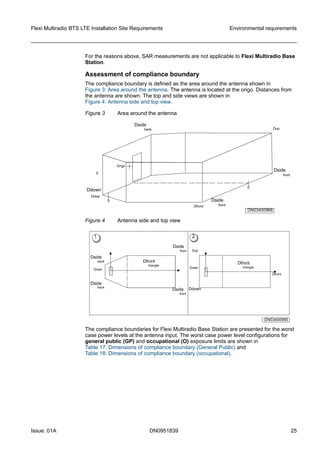
The compliance boundary is defined as the area around the antenna shown in
Figure 3: Area around the antenna. The antenna is located at the origo. Distances from
the antenna are shown. The top and side views are shown in
Figure 4: Antenna side and top view.
Figure 3 Area around the antenna
0
0
0
Dside
back
Ddown
Drear
Dfront front
front
Dside
Dside
Dup
DN03400968
Origo
Figure 4 Antenna side and top view
DN03400995
1 2
Dside
back
Drear
back
Dside
Dfront
triangle
Dside
front
Dside
front
Drear
Dup
Ddown
Dfront
triangle
Dfront
The compliance boundaries for Flexi Multiradio Base Station are presented for the worst
case power levels at the antenna input. The worst case power level configurations for
general public (GP) and occupational (O) exposure limits are shown in
Table 17: Dimensions of compliance boundary (General Public) and
Table 18: Dimensions of compliance boundary (occupational).
Flexi Multiradio BTS LTE Installation Site Requirements Environmental requirements
Issue: 01A DN0951839 25
   
Table 17 Dimensions of compliance boundary (General Public)
Dfront
[m]
Dfront
triangle
[m]
Drear
[m]
Dside
back
[m]
Dside
front
[m]
Dup
[m]
Ddown
[m]
Freq. (MHz) Power
at an-
tenna
input
GP GP GP GP GP GP GP
900 40 7 2.4 0.3 0.4 2 0.95 0.95
1700 40 4.4 1.2 0.1 0.2 1.5 0.6 0.6
1700 2 * 60 7.7 2.4 0.1 0.7 3.0 0.8 1.8
1800 40 4.4 1.2 0.1 0.2 1.5 0.5 0.5
1900 80 6.45 1.5 0.25 0.4 2.05 0.6 0.6
2100 40 4.7 1.5 0.1 0.4 1.5 0.6 0.6
2100 60 5.7 2.0 0.1 0.5 1.85 1.6 1.0
2100 80 6.45 1.5 0.25 0.4 2.05 0.6 0.6
2100 2 * 60 7.8 3.0 0.1 0.8 2.8 2.1 1.4
2300 - 2600 8 0.85 0.25 0.1 0.15 0.15 0.7 0.7
2300 - 2600 20 2.7 0.75 0.1 0.25 0.65 1.1 0.8
2300 - 2600 40 4.5 1.6 0.1 0.4 1.4 1.45 1.1
2300 - 2600 60 5.8 1.8 0.1 0.5 2 1.7 1.25
Recommend 2-200 m (6.56- 656.17 ft.)
Table 18 Dimensions of compliance boundary (occupational)
Dfront
[m]
Dfront
triangle
[m]
Drear
[m]
Dside
back
[m]
Dside
front
[m]
Dup
[m]
Ddown
[m]
Freq. (MHz) Power
at an-
tenna
input
O O O O O O O
900 40 2.95 1 0.05 0.2 0.6 0.85 0.85
1700 40 1.9 1.1 0.1 0.2 0.45 0.48 0.48
1700 2 * 60 2.6 0.8 0.1 0.2 0.7 0.7 0.75
Environmental requirements Flexi Multiradio BTS LTE Installation Site Requirements
26 DN0951839 Issue: 01A
   
Table 18 Dimensions of compliance boundary (occupational) (Cont.)
Dfront
[m]
Dfront
triangle
[m]
Drear
[m]
Dside
back
[m]
Dside
front
[m]
Dup
[m]
Ddown
[m]
1800 40 2.1 1.1 0.1 0.2 0.65 0.45 0.45
1900 80 3 1.1 0.15 0.2 0.95 0.5 0.5
2100 40 1.95 0.7 0.1 0.25 0.5 0.6 0.6
2100 60 1.1 0.4 0.1 0.1 0.3 1.0 1.0
2100 80 3 1.1 0.15 0.2 0.95 0.5 0.5
2100 2 * 60 1.8 0.6 0.1 0.2 0.55 0.9 0.7
2300 - 2600 8 0.15 0.1 0.1 0.1 0.1 0.7 0.7
2300 - 2600 20 0.35 0.1 0.1 0.1 0.15 0.7 0.7
2300 - 2600 40 0.85 0.2 0.1 0.15 0.25 0.7 0.7
2300 - 2600 60 1.4 0.3 0.1 0.15 0.35 0.75 0.7
Recommend 2-200 m (6.56- 656.17 ft.)
The component specifications for 900 MHz and 1800 MHz also apply to 850 MHz and
1900 MHz products, respectively, and can be used to demonstrate compliance with FCC
guidelines for human exposure to radio frequency electromagnetic fields contained in the
FCC document OET Bulletin 65 (August 1997).
Typical configuration
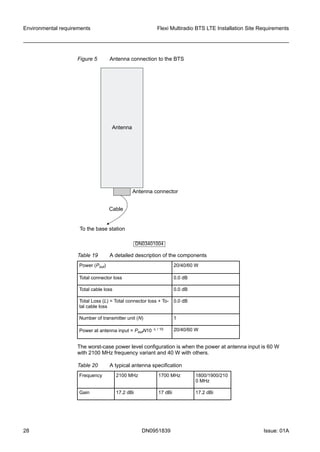
The antenna is connected through a connector and cable(s) to the base station as
shown in Figure 5: Antenna connection to the BTS.
Flexi Multiradio BTS LTE Installation Site Requirements Environmental requirements
Issue: 01A DN0951839 27
   
Figure 5 Antenna connection to the BTS
Tothebasestation
Antennaconnector
Cable
Antenna
DN03401004
Table 19 A detailed description of the components
Power (Pout) 20/40/60 W
Total connector loss 0.0 dB
Total cable loss 0.0 dB
Total Loss (L) = Total connector loss + To-
tal cable loss
0.0 dB
Number of transmitter unit (N) 1
Power at antenna input = PoutN10 -L / 10 20/40/60 W
The worst-case power level configuration is when the power at antenna input is 60 W
with 2100 MHz frequency variant and 40 W with others.
Table 20 A typical antenna specification
Frequency 2100 MHz 1700 MHz 1800/1900/210
0 MHz
Gain 17.2 dBi 17 dBi 17.2 dBi
Environmental requirements Flexi Multiradio BTS LTE Installation Site Requirements
28 DN0951839 Issue: 01A
   
Table 20 A typical antenna specification (Cont.)
Half-power
beam width
H-plane: 68 deg. H-plane: 60
deg.
H-plane: 68
deg.
E-plane: 10 deg. E-plane: 10
deg.
E-plane: 10
deg.
Electrical
downtilt
0 deg. 0 deg. 0 deg.
Height/width/d
epth
1000 / 200 / 100
mm
1100 / 200 /
100 mm
1100 / 200 /
100 mm
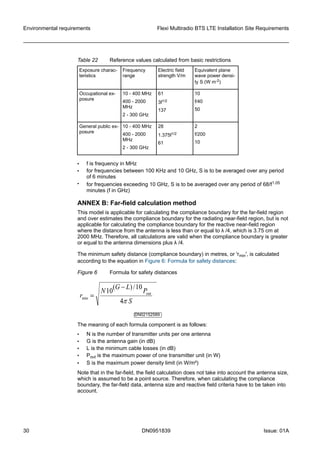
When using different configurations
IMPORTANT:
• In tables: 'Dimensions of compliance boundary in meters for general public
(GP)' and 'Dimensions of compliance boundary in meters (Occupational)' the
compliance boundaries are given for worst case power levels. If an exposure
limit, antenna, and/or configuration is used which does not correspond to the
levels given in tables 'Dimensions of compliance boundary in meters for
general public (GP)' and 'Dimensions of compliance boundary in meters
(Occupational)', the compliance boundary must be re-calculated according to
EN50383.
• The formula for calculating the compliance boundary using the far-field model,
which is referenced in EN50383, is given in ANNEX B later in this section. This
model is applicable for calculating the compliance boundary for the far-field
region and over estimates the compliance boundary for the radiating near-field
region, but is not applicable for calculating the compliance boundary for the
reactive near-field region where the distance from the antenna is less than or
equal to λ / 4.
ANNEX A: Council recommendation 1999/519/EC for occupational
and general public electromagnetic exposure limits
Table 21 Basic restrictions
Exposure char-
acteristics
Frequency
range
Whole body
average SAR
W kg-1
Localized
SAR (head
and trunk) W
kg-1
Localized
SAR (limbs)
W kg-1
Occupational ex-
posure
10 MHz - 10
GHz
0.4 10 20
General public
exposure
10 MHz - 10
GHz
0.08 2 4
Note that all SAR values are to be averaged over any period of 6 minutes. Localized
SAR averaging mass is any 10 g of contiguous tissue: the maximum SAR so obtained
should be the value used for the estimation of exposure.
Basic restrictions between 10 GHz and 300 GHz are given in power densities. For
occupational exposure, it is 50 Wm-2 and for general public exposure 10 Wm-2.
Flexi Multiradio BTS LTE Installation Site Requirements Environmental requirements
Issue: 01A DN0951839 29
   
Table 22 Reference values calculated from basic restrictions
Exposure charac-
teristics
Frequency
range
Electric field
strength V/m
Equivalent plane
wave power densi-
ty S (W m-2)
Occupational ex-
posure
10 - 400 MHz
400 - 2000
MHz
2 - 300 GHz
61
3f1/2
137
10
f/40
50
General public ex-
posure
10 - 400 MHz
400 - 2000
MHz
2 - 300 GHz
28
1.375f1/2
61
2
f/200
10
• f is frequency in MHz
• for frequencies between 100 KHz and 10 GHz, S is to be averaged over any period
of 6 minutes
• for frequencies exceeding 10 GHz, S is to be averaged over any period of 68/f1.05
minutes (f in GHz)
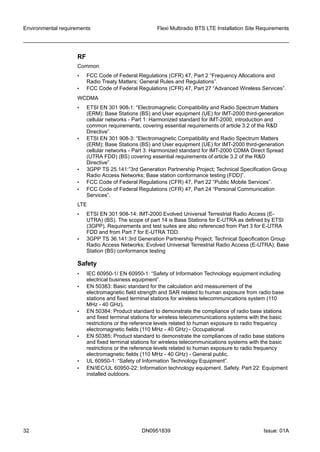
ANNEX B: Far-field calculation method
This model is applicable for calculating the compliance boundary for the far-field region
and over estimates the compliance boundary for the radiating near-field region, but is not
applicable for calculating the compliance boundary for the reactive near-field region
where the distance from the antenna is less than or equal to λ /4, which is 3.75 cm at
2000 MHz. Therefore, all calculations are valid when the compliance boundary is greater
or equal to the antenna dimensions plus λ /4.
The minimum safety distance (compliance boundary) in metres, or 'rmin', is calculated
according to the equation in Figure 6: Formula for safety distances:
Figure 6 Formula for safety distances
DN02152589
The meaning of each formula component is as follows:
• N is the number of transmitter units per one antenna
• G is the antenna gain (in dB)
• L is the minimum cable losses (in dB)
• Pout is the maximum power of one transmitter unit (in W)
• S is the maximum power density limit (in W/m²)
Note that in the far-field, the field calculation does not take into account the antenna size,
which is assumed to be a point source. Therefore, when calculating the compliance
boundary, the far-field data, antenna size and reactive field criteria have to be taken into
account.
Environmental requirements Flexi Multiradio BTS LTE Installation Site Requirements
30 DN0951839 Issue: 01A
   
5.9 Compliance with EMC, RF and safety
In Europe, this means compliance with Directive 1999/5/EC of the European Parliament
and of the Council of 9 March 1999 on radio equipment and telecommunications terminal
equipment and the mutual recognition of their conformity.
In other market areas additional compliance is fulfilled according to relevant authority
requirements.
EMC emission
Common
• ETSI EN 301 489-1: Electromagnetic compatibility and Radio spectrum Matters
(ERM); Electromagnetic Compatibility (EMC) standard for radio equipment and
services; Part 1: Common technical requirements.
• EN55022: “Limits and methods of measurement of radio disturbance characteristics
of information technology equipment”.
• FCC Code of Federal Regulations (CFR) 47, Part 15 “Radio Frequency Devices”.
WCDMA
• 3GPP TS 25.113: 3rd Generation Partnership Project; Technical Specification Group
Radio Access Networks; Base station and Repeater electromagnetic compatibility
(EMC).
LTE
• 3GPP TS 36.113: 3rd Generation Partnership Project; Technical Specification Group
Radio Access Networks; Evolved Universal Terrestrial Radio Access (E-UTRA); Base
Station (BS) and Repeater electromagnetic compatibility (EMC).
EMC immunity
Common
• ETSI EN 301 489-1: “Electromagnetic Compatibility and Radio Spectrum Matters
(ERM); Electromagnetic Compatibility (EMC) standard for radio equipment and
services - Part 1: Common technical requirements”.
• ETSI EN 301 489-23: “Electromagnetic Compatibility and Radio Spectrum Matters
(ERM); Electromagnetic Compatibility (EMC) standard for radio equipment and
services - Part 23: Specific conditions for IMT-2000 CDMA Direct Spread (UTRA)
Base Station (BS) radio, repeater and ancillary equipment”.
• IEC 1000-4-9: Pulse magnetic field immunity test.
• IEC 1000-4-8: “Electromagnetic Compatibility (EMC) Part 4. Testing and
measurement techniques Section 8: Power frequency magnetic field immunity test,
Basic EMC Publication”.
WCDMA
• 3GPP TS 25.113: 3rd Generation Partnership Project; Technical Specification Group
Radio Access Networks; Base station and Repeater electromagnetic compatibility
(EMC).
LTE
• 3GPP TS 36.113: 3rd Generation Partnership Project; Technical Specification Group
Radio Access Networks; Evolved Universal Terrestrial Radio Access (E-UTRA); Base
Station (BS) and Repeater electromagnetic compatibility (EMC).
Flexi Multiradio BTS LTE Installation Site Requirements Environmental requirements
Issue: 01A DN0951839 31
   
RF
Common
• FCC Code of Federal Regulations (CFR) 47, Part 2 “Frequency Allocations and
Radio Treaty Matters; General Rules and Regulations”.
• FCC Code of Federal Regulations (CFR) 47, Part 27 “Advanced Wireless Services”.
WCDMA
• ETSI EN 301 908-1: “Electromagnetic Compatibility and Radio Spectrum Matters
(ERM); Base Stations (BS) and User equipment (UE) for IMT-2000 third-generation
cellular networks - Part 1: Harmonized standard for IMT-2000, introduction and
common requirements, covering essential requirements of article 3.2 of the R&D
Directive”.
• ETSI EN 301 908-3: “Electromagnetic Compatibility and Radio Spectrum Matters
(ERM); Base Stations (BS) and User equipment (UE) for IMT-2000 third-generation
cellular networks - Part 3: Harmonized standard for IMT-2000 CDMA Direct Spread
(UTRA FDD) (BS) covering essential requirements of article 3.2 of the R&D
Directive”.
• 3GPP TS 25.141:”3rd Generation Partnership Project; Technical Specification Group
Radio Access Networks; Base station conformance testing (FDD)”.
• FCC Code of Federal Regulations (CFR) 47, Part 22 “Public Mobile Services”.
• FCC Code of Federal Regulations (CFR) 47, Part 24 “Personal Communication
Services”.
LTE
• ETSI EN 301 908-14: IMT-2000 Evolved Universal Terrestrial Radio Access (E-
UTRA) (BS). The scope of part 14 is Base Stations for E-UTRA as defined by ETSI
(3GPP). Requirements and test suites are also referenced from Part 3 for E-UTRA
FDD and from Part 7 for E-UTRA TDD.
• 3GPP TS 36.141:3rd Generation Partnership Project; Technical Specification Group
Radio Access Networks; Evolved Universal Terrestrial Radio Access (E-UTRA); Base
Station (BS) conformance testing
Safety
• IEC 60950-1/ EN 60950-1: “Safety of Information Technology equipment including
electrical business equipment”.
• EN 50383: Basic standard for the calculation and measurement of the
electromagnetic field strength and SAR related to human exposure from radio base
stations and fixed terminal stations for wireless telecommunications system (110
MHz - 40 GHz).
• EN 50384: Product standard to demonstrate the compliance of radio base stations
and fixed terminal stations for wireless telecommunications systems with the basic
restrictions or the reference levels related to human exposure to radio frequency
electromagnetic fields (110 MHz - 40 GHz) - Occupational.
• EN 50385: Product standard to demonstrate the compliances of radio base stations
and fixed terminal stations for wireless telecommunications systems with the basic
restrictions or the reference levels related to human exposure to radio frequency
electromagnetic fields (110 MHz - 40 GHz) - General public.
• UL 60950-1: “Safety of Information Technology Equipment”.
• EN/IEC/UL 60950-22: Information technology equipment. Safety. Part 22: Equipment
installed outdoors.
Environmental requirements Flexi Multiradio BTS LTE Installation Site Requirements
32 DN0951839 Issue: 01A
   
6 Site requirements
6.1 Planning and preparing the site
Purpose
Before installing the BTS, the site must be properly surveyed and prepared, and all
required external connections must be correctly installed. Any special requirements for
installation must also be identified during the survey.
Steps
1 Check that the BTS can be installed safely:
• The site is accessible, adequately lit and safe for working.
• Safety distance calculations are made and taken into account.
• The site is prepared according to drawings.
• The site survey is complete.
• The Site Survey Report is available.
• The site is clean.
• Product delivery is complete.
• All wiring is done in accordance with national electric code.
• Needed equipment is available as defined in the Site Survey Report.
• Sufficient service clearances are available.
2 Verify that the following external cabinet connections are available:
• Grounding busbar,
• Mains power (AC or DC, depending on the site),
• Transmission connection point.
6.2 General site requirements
Ensure that the following BTS site requirements are met:
1. All required documentation is available, for example, site-specific installation
instructions.
2. When radio link transmission is used, the line-of-sight to the far end radios has been
ensured.
3. External connections for the cabinet are available: site grounding point, mains power
(AC or DC according to the site), and transmission connection point. Furthermore,
AC or DC distribution panel and AC electric are available for power tools.
4. Main grounding (earthing) is installed and tested.
5. Floor or wall surface is even (installation base flatness requirement is 2 mm (0.08
in.).
6. Wall or pole at the BTS site is strong enough to withstand the weight of the BTS.
7. Wall or pole at the BTS site is strong enough to meet earthquake requirement
Telcordia GR-63-CORE Zone 4 (only applicable in earthquake areas).
Flexi Multiradio BTS LTE Installation Site Requirements Site requirements
Issue: 01A DN0951839 33
   
8. Pole at the BTS site is strong enough to withstand the wind load.
9. The BTS is not taken out of its delivery package until the site construction work is
finished and the site is clean and dry.
10. Site security is established so the BTS and other units can remain undisturbed at the
site.
11. Make sure you can take the BTS to the installation site. For example, in roof top
installations, the hole through which you take the BTS to the roof must be large
enough.
6.2.1 Indoor site requirements
If installing the BTS to an indoor site, ensure that the following indoor BTS site
requirements are met:
• Door and lock to site room are properly installed and operational (recommended).
• Access to the site is secure.
• The site is adequately lit.
• Feeder entry hole and cable rack for feeder and power cables are ready, if needed.
• Heater, or air conditioner, is installed and operational, if needed. This depends on the
heat emission and the environment.
6.2.2 Choosing site for the Remote Radio Heads
f CAUTION! Risk of personal injury.
The unit might have very hot surfaces when operating in hot environments.
The unit should be installed in a restricted access location so that unintentional
touch of the unit hot surface is blocked.
The Remote Radio Head is a heat dissipating unit and so it runs at a temperature
notably above the local ambient. If the temperatures of the unit become excessive the
unit runs less efficiently, therefore the unit should always be mounted vertically as
detailed in these instructions, in an area with unrestricted airflow/ventilation. Solar
radiation can also significantly increase the temperature of the unit and so should be
taken into consideration when choosing a location for the unit. In particular it is
recommended that the finned surfaces should be shaded from the sun. Ideally in the
Northern Hemisphere the unit should be located on a North facing wall where it is
shaded from the sun; or in a location where an adjacent object or building offers similar
shade. In the Southern hemisphere the unit is should ideally be located on a South
facing wall. In areas where the temperature can be considered to be moderately warm,
or the ambient temperature could reach temperatures of approaching 30°C (86ºF) or
above and shade is not given to the unit by any of the adjacent walls or buildings then a
solar shield should be fitted to the unit.
Site requirements Flexi Multiradio BTS LTE Installation Site Requirements
34 DN0951839 Issue: 01A
   
6.3 Feederless site and Distributed site solution
requirements
6.3.1 NSN SFPs properties
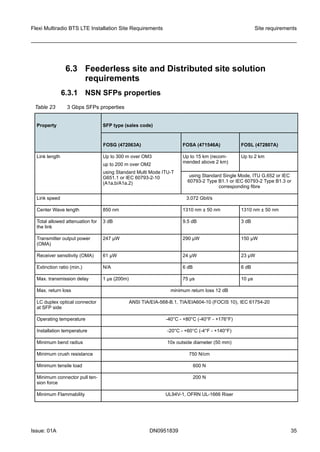
Table 23 3 Gbps SFPs properties
Property SFP type (sales code)
FOSG (472063A) FOSA (471546A) FOSL (472807A)
Link length Up to 300 m over OM3
up to 200 m over OM2
using Standard Multi Mode ITU-T
G651.1 or IEC 60793-2-10
(A1a,b/A1a.2)
Up to 15 km (recom-
mended above 2 km)
Up to 2 km
using Standard Single Mode, ITU G.652 or IEC
60793-2 Type B1.1 or IEC 60793-2 Type B1.3 or
corresponding fibre
Link speed 3.072 Gbit/s
Center Wave length 850 nm 1310 nm ± 50 nm 1310 nm ± 50 nm
Total allowed attenuation for
the link
3 dB 9.5 dB 3 dB
Transmitter output power
(OMA)
247 µW 290 µW 150 μW
Receiver sensitivity (OMA) 61 µW 24 µW 23 µW
Extinction ratio (min.) N/A 6 dB 6 dB
Max. transmission delay 1 µs (200m) 75 µs 10 µs
Max. return loss minimum return loss 12 dB
LC duplex optical connector
at SFP side
ANSI TIA/EIA-568-B.1, TIA/EIA604-10 (FOCIS 10), IEC 61754-20
Operating temperature -40°C - +80°C (-40°F - +176°F)
Installation temperature -20°C - +60°C (-4°F - +140°F)
Minimum bend radius 10x outside diameter (50 mm)
Minimum crush resistance 750 N/cm
Minimum tensile load 600 N
Minimum connector pull ten-
sion force
200 N
Minimum Flammability UL94V-1, OFRN UL-1666 Riser
Flexi Multiradio BTS LTE Installation Site Requirements Site requirements
Issue: 01A DN0951839 35
   
Table 23 3 Gbps SFPs properties (Cont.)
Property SFP type (sales code)
FOSG (472063A) FOSA (471546A) FOSL (472807A)
Minimum UV protection UV resistant
Weather protection IP 65 with NSN connector IP-shield and cable
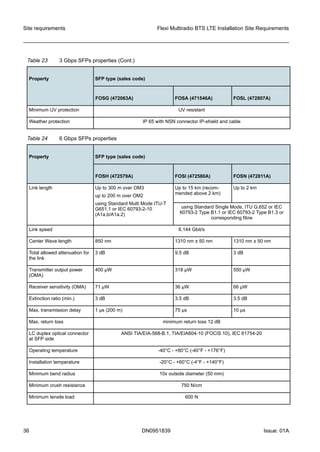
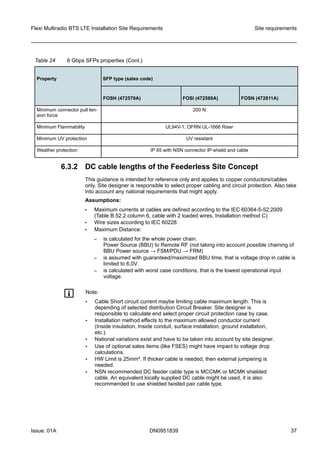
Table 24 6 Gbps SFPs properties
Property SFP type (sales code)
FOSH (472579A) FOSI (472580A) FOSN (472811A)
Link length Up to 300 m over OM3
up to 200 m over OM2
using Standard Multi Mode ITU-T
G651.1 or IEC 60793-2-10
(A1a,b/A1a.2)
Up to 15 km (recom-
mended above 2 km)
Up to 2 km
using Standard Single Mode, ITU G.652 or IEC
60793-2 Type B1.1 or IEC 60793-2 Type B1.3 or
corresponding fibre
Link speed 6.144 Gbit/s
Center Wave length 850 nm 1310 nm ± 50 nm 1310 nm ± 50 nm
Total allowed attenuation for
the link
3 dB 9.5 dB 3 dB
Transmitter output power
(OMA)
400 μW 318 μW 550 μW
Receiver sensitivity (OMA) 71 μW 36 μW 66 μW
Extinction ratio (min.) 3 dB 3.5 dB 3.5 dB
Max. transmission delay 1 µs (200 m) 75 µs 10 µs
Max. return loss minimum return loss 12 dB
LC duplex optical connector
at SFP side
ANSI TIA/EIA-568-B.1, TIA/EIA604-10 (FOCIS 10), IEC 61754-20
Operating temperature -40°C - +80°C (-40°F - +176°F)
Installation temperature -20°C - +60°C (-4°F - +140°F)
Minimum bend radius 10x outside diameter (50 mm)
Minimum crush resistance 750 N/cm
Minimum tensile load 600 N
Site requirements Flexi Multiradio BTS LTE Installation Site Requirements
36 DN0951839 Issue: 01A
   
Table 24 6 Gbps SFPs properties (Cont.)
Property SFP type (sales code)
FOSH (472579A) FOSI (472580A) FOSN (472811A)
Minimum connector pull ten-
sion force
200 N
Minimum Flammability UL94V-1, OFRN UL-1666 Riser
Minimum UV protection UV resistant
Weather protection IP 65 with NSN connector IP-shield and cable
6.3.2 DC cable lengths of the Feederless Site Concept
This guidance is intended for reference only and applies to copper conductors/cables
only. Site designer is responsible to select proper cabling and circuit protection. Also take
into account any national requirements that might apply.
Assumptions:
• Maximum currents at cables are defined according to the IEC 60364-5-52:2009
(Table B.52.2 column 6, cable with 2 loaded wires, Installation method C)
• Wire sizes according to IEC 60228.
• Maximum Distance:
– is calculated for the whole power chain.
Power Source (BBU) to Remote RF (not taking into account possible chaining of
BBU Power source → FSM/PDU → FRM)
– is assumed with guaranteed/maximized BBU time, that is voltage drop in cable is
limited to 6,0V.
– is calculated with worst case conditions, that is the lowest operational input
voltage.
g Note:
• Cable Short circuit current maybe limiting cable maximum length. This is
depending of selected distribution Circuit Breaker. Site designer is
responsible to calculate end select proper circuit protection case by case.
• Installation method effects to the maximum allowed conductor current
(Inside insulation, Inside conduit, surface installation, ground installation,
etc.).
• National variations exist and have to be taken into account by site designer.
• Use of optional sales items (like FSES) might have impact to voltage drop
calculations.
• HW Limit is 25mm². If thicker cable is needed, then external jumpering is
needed.
• NSN recommended DC feeder cable type is MCCMK or MCMK shielded
cable. An equivalent locally supplied DC cable might be used, it is also
recommended to use shielded twisted pair cable type.
Flexi Multiradio BTS LTE Installation Site Requirements Site requirements
Issue: 01A DN0951839 37
   
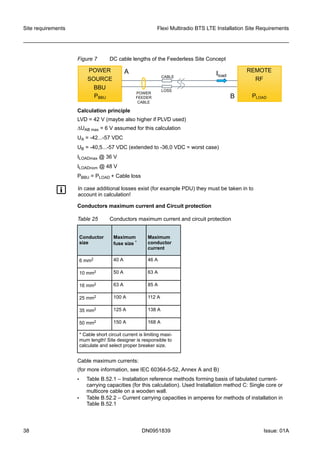
Figure 7 DC cable lengths of the Feederless Site Concept
Calculation principle
LVD = 42 V (maybe also higher if PLVD used)
∆UAB max = 6 V assumed for this calculation
UA = -42...-57 VDC
UB = -40,5...-57 VDC (extended to -36,0 VDC = worst case)
ILOADmax @ 36 V
ILOADnom @ 48 V
PBBU = PLOAD + Cable loss
g In case additional losses exist (for example PDU) they must be taken in to
account in calculation!
Conductors maximum current and Circuit protection
Table 25 Conductors maximum current and circuit protection
Conductor
size
Maximum
fuse size *
Maximum
conductor
current
6 mm2 40 A 46 A
10 mm2 50 A 63 A
16 mm2 63 A 85 A
25 mm2 100 A 112 A
35 mm2 125 A 138 A
50 mm2 150 A 168 A
* Cable short circuit current is limiting maxi-
mum length! Site designer is responsible to
calculate and select proper breaker size.
Cable maximum currents:
(for more information, see IEC 60364-5-52, Annex A and B)
• Table B.52.1 – Installation reference methods forming basis of tabulated current-
carrying capacities (for this calculation). Used Installation method C: Single core or
multicore cable on a wooden wall.
• Table B.52.2 – Current carrying capacities in amperes for methods of installation in
Table B.52.1
Site requirements Flexi Multiradio BTS LTE Installation Site Requirements
38 DN0951839 Issue: 01A
   
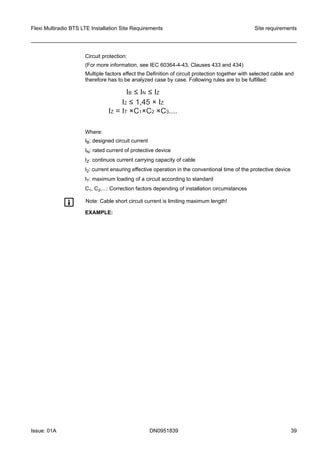
Circuit protection:
(For more information, see IEC 60364-4-43, Clauses 433 and 434)
Multiple factors effect the Definition of circuit protection together with selected cable and
therefore has to be analyzed case by case. Following rules are to be fulfilled:
Where:
IB: designed circuit current
IN: rated current of protective device
IZ: continuos current carrying capacity of cable
I2: current ensuring effective operation in the conventional time of the protective device
IT: maximum loading of a circuit according to standard
C1, C2,...: Correction factors depending of installation circumstances
g Note: Cable short circuit current is limiting maximum length!
EXAMPLE:
Flexi Multiradio BTS LTE Installation Site Requirements Site requirements
Issue: 01A DN0951839 39
   
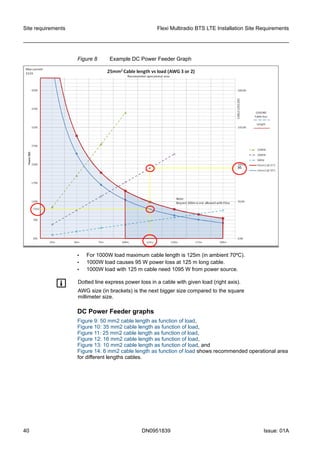
Figure 8 Example DC Power Feeder Graph
• For 1000W load maximum cable length is 125m (in ambient 70ºC).
• 1000W load causes 95 W power loss at 125 m long cable.
• 1000W load with 125 m cable need 1095 W from power source.
g Dotted line express power loss in a cable with given load (right axis).
AWG size (in brackets) is the next bigger size compared to the square
millimeter size.
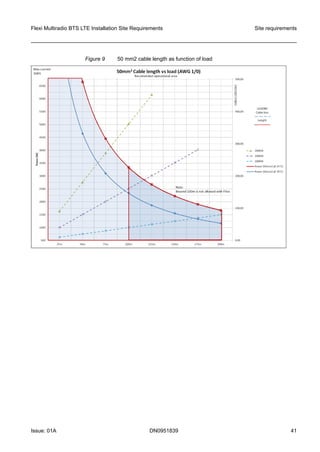
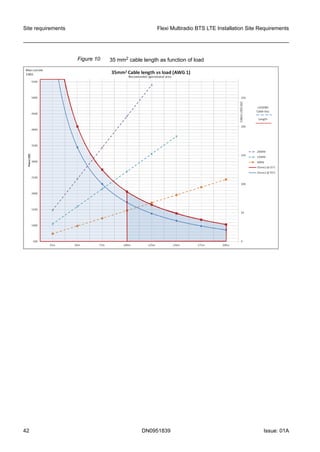
DC Power Feeder graphs
Figure 9: 50 mm2 cable length as function of load,
Figure 10: 35 mm2 cable length as function of load,
Figure 11: 25 mm2 cable length as function of load,
Figure 12: 16 mm2 cable length as function of load,
Figure 13: 10 mm2 cable length as function of load, and
Figure 14: 6 mm2 cable length as function of load shows recommended operational area
for different lengths cables.
Site requirements Flexi Multiradio BTS LTE Installation Site Requirements
40 DN0951839 Issue: 01A
   
Figure 9 50 mm2 cable length as function of load
Flexi Multiradio BTS LTE Installation Site Requirements Site requirements
Issue: 01A DN0951839 41
   
Figure 10 35 mm2 cable length as function of load
Site requirements Flexi Multiradio BTS LTE Installation Site Requirements
42 DN0951839 Issue: 01A
   
Figure 11 25 mm2 cable length as function of load
Flexi Multiradio BTS LTE Installation Site Requirements Site requirements
Issue: 01A DN0951839 43
   
Figure 12 16 mm2 cable length as function of load
Site requirements Flexi Multiradio BTS LTE Installation Site Requirements
44 DN0951839 Issue: 01A
   
Figure 13 10 mm2 cable length as function of load
Flexi Multiradio BTS LTE Installation Site Requirements Site requirements
Issue: 01A DN0951839 45
   
Figure 14 6 mm2 cable length as function of load
Circuit protection analysis (example):
Case:
• Load current IB=40 A
• Cable 25 mm2, length 100 m, installed on the wall, for the whole length
• Maximum current for cable IZ=112 A
• Selected Breaker 50 A, Curve B
Analysis:
• I2 for Breaker = 1.45 x IN => 1,45 x 50 A = 72.5 A
• I2 for Cable = 1.45 x Iz => 1.45 x 112 A = 162 A
• IEC 60364-4-43 Clause 433 Conditions are satisfactorily met:
– IB ≤ IN ≤ IZ => (40 A < 50 A < 112 A) -> OK
– I2 ≤ 1.45 × IZ => (72.5 A < 1.45 x 112 A) -> OK
• Short circuit analysis:
Calculated Short circuit current for 100 m Cable @ 70°C is 275 A
=> 5.5 x IN => Provides disconnect in less than 0.2 s
Site requirements Flexi Multiradio BTS LTE Installation Site Requirements
46 DN0951839 Issue: 01A
   
6.3.3 DC cabling principles and shielding
The NSN recommended DC feeder cable type is MCCMK or MCMK shielded cable. An
equivalent locally supplied DC cable might be used. Make sure that both ends of the
connection to a Flexi RF Module or System Module are IP65-protected.
DC cable extension:
• There is an additional NSN IP55 2 m DC cable in the FSEC sales package. By
cutting both cables in one end and using IP55 protection to both the RF Module and
System Module they can be used for extending the DC cable distance.
• A long DC cable needs to be shielded and grounded.
• Connection of the long DC cable and NSN IP55 cable is recommended to be done in
an IP55 outdoor weather protected space, for example in Flexi External OVP box
(FSEC).
• The FSEC clamping range is from 19 mm to 28 mm DC cable diameters.
t If the diameter of the cable is smaller than 19 mm (0.75 in.), use either self-
fusing tape or heat-shrinkable tube to increase the cable diameter to 20mm-
21mm (0.79-0.83 in.) to fulfil the IP67 requirement. The distance between the
expansion and the stripped part of the cable must be at least 10 cm (4 in.).
Table 26 NSN requirements for a shielded, locally sourced DC cable (3U RF
Module), T=20ºC (68ºF)
Cable type mm2 R (Ohm/km) L (mH/km)
Shielded
twisted pair
10 1.83 -
16 1.15 0.3
25 0.727 0.26
35 0.524 0.24
g In feederless and distributed site installations, Ohm's law cannot be applied
alone because inductance must also be taken into account.
6.4 Pole installation requirements
The optional pole mounting kits VMPB and FPKA/FPKC enable Flexi Multiradio BTS
installation on a pole 60-300 mm in diameter (60-120 mm (2.4-4.7 in.) with the FPKA and
60-300 mm (2.4-11.8 in.) with the FPKC/VMPB). Up to four 3U modules can be fitted on
either pole mounting kit, and up to three Remote Radio Heads can be fitted on one
FPKA.
• Up to four 3U modules can be fitted on VMPB and FPKA/FPKC.
• Up to three Remote Radio Heads can be fitted on one FPKA.
• Up to two 2x60 W RRHs can be installed with an FMFA on the same FPKA. Only one
2x40 W RRH can be installed with an FMFA on the same FPKA.
• A 2x60 W RRH can be installed next to an FMFA on an FPKA. A 2x40 W RRH
cannot be installed next to an FMFA on an FPKA.
Flexi Multiradio BTS LTE Installation Site Requirements Site requirements
Issue: 01A DN0951839 47
   
• If there is an FMFA installed on the pole mounting kit, RRH can be installed next to
FMFA.
• If two FMFAs are installed on a pole mounting kit, RRH can be installed next to
FMFA.
f Excess torsion damages the casings. In wall and pole installation, do not install
more than two modules per plinth.
g Modules installed outdoors can be left non-operational for a maximum of one
week. The fluctuation of temperature during one day can be 30°C (86°F) at the
maximum.
When installing modules on a pole, make sure that the pole at the BTS site is strong
enough to withstand the weight of the BTS, to meet earthquake requirement Telcordia
GR-63 core Zone 4, and the wind load requirement.
Figure 15 Wind load calculations, side view
DN7083024
When the wind area is as in the Wind load calculations, side view figure, the area value
used for wind load calculations is 0.33 m2.
Site requirements Flexi Multiradio BTS LTE Installation Site Requirements
48 DN0951839 Issue: 01A
   
Figure 16 Wind load calculations, front view
4 3 1 2
DN7083036
When the wind area is as in the Figure 16: Wind load calculations, front view, the area
for wind load calculations depends on the number of installed modules. For more
information, see Table 27: Area for wind load calculations.
Table 27 Area for wind load calculations
Number of modules Area
1 0.12 m2
2 0.18 m2
3 0.30 m2
4 0.36 m2
Flexi Mounting Shield 6U (FMSA)
Table 28 Area for wind load calculations (FMSA)
Mounting shield Area
FMSA 0.45 m2
6.5 Floor installation requirements
See Figure 17: Anchoring the plinth on the floor and
Figure 18: Anchoring the plinth on base with maintenance space in the back for floor
installation requirements. Option A is for stack configuration.
Flexi Multiradio BTS LTE Installation Site Requirements Site requirements
Issue: 01A DN0951839 49
   
Figure 17 Anchoring the plinth on the floor
Site requirements Flexi Multiradio BTS LTE Installation Site Requirements
50 DN0951839 Issue: 01A
   
Figure 18 Anchoring the plinth on base with maintenance space in the back
6.6 Wall installation requirements
The optional mounting kit (FMFA) enables Flexi Multiradio BTS 3U module installation on
a wall. There is a separate wall mounting kit available for the Remote Radio Head.
The following requirements must be met and inspected by a qualified person before
mounting the BTS:
• It must be ensured that the installation wall is strong enough to bear the weight of the
BTS in any condition.
• The wall must meet the earthquake requirement Telcordia GR-63 CORE (only
applicable in earthquake areas).
• The 3U module fixing screws (4 pcs) and module casing must be tightened to 5 Nm
to meet the earthquake requirement Telcordia GR-63 CORE, Vibrational
requirements for earthquake Zone 4.
• The maximum number of 3U modules per plinth is two.
• 3U modules must be installed in horizontal alignment, cabling direction up and down.
• 3U module bottoms must be installed facing the wall.
• For the Remote Radio Head, only vertical mounting is allowed.
• It is not recommended to install Remote Radio Head modules inside an enclosed
space without proper ventilation or climate control, as cooling is done through
convection method.
6.7 Module clearances
The minimum clearances around the modules are listed in
Table 29: Required minimum clearances.
Flexi Multiradio BTS LTE Installation Site Requirements Site requirements
Issue: 01A DN0951839 51
   
Table 29 Required minimum clearances
Property Value
Front space 600 mm (23.6 in. front maintenance
space)
Back space 40 mm (1.6 in. intake air space)
200 mm (7.9 in. to remove back cover and
change fan)
Top space 30 mm (1.2 in.)
Space on both sides 75 mm (3.0 in.) with front covers
Space on both sides (if two base stations
are installed side by side on floor or wall)
100 mm (3.9 in.)
t Fans can also be changed without minimum clearances, with no back access,
but this might need switching off some units in addition to the faulty module.
6.8 Remote Radio Head clearances
Figure 19: Minimum RRH clearances for cooling purposes shows the minimum
clearances for cooling purposes.
The minimum front space clearance for maintenance purposes is 900 mm (35.43 in.).
Side space clearance is 10 mm (0.39 in.).
Figure 19 Minimum RRH clearances for cooling purposes
W
H
D
1000mm
(39.37in.)
10mm
(0.39in.)
sideviewfrontview
10mm
(0.39in.)
1000mm
(39.37in.)
25mm
(0.98in.)
H is module height excluding the mounting brackets.D is the module depth including the
mounting brackets.
It is not recommended to install RRH modules inside an enclosed space without proper
ventilation or climate control.
g For proper cooling, it is not recommended to vertically align RRHs with less
than 1 m top or bottom clearance. Staggered mounting is preferred. Vertical
alignment is never allowed in enclosed spaces.
Site requirements Flexi Multiradio BTS LTE Installation Site Requirements
52 DN0951839 Issue: 01A
   
6.9 FPAD clearances
Figure 19: Minimum RRH clearances for cooling purposes shows the minimum
clearances for cooling purposes.
Figure 20 FPAD clearances for cooling purposes
W
H
D
>120mm
(4.72in.)
>20mm
(0.79in.)
sideviewfrontview
>20mm
(0.79in.)
>50mm
(1.97in.)
No
effect
H is module height excluding the mounting brackets.D is the module depth including the
mounting brackets.
g FPAD must be installed in vertical position in order to allow efficient natural
convection cooling. Staggered mounting is preferred. Vertical alignment is never
allowed in enclosed spaces.
6.10 Flexi Cabinet for Indoor (FCIA) clearances and
anchoring holes
See Cabinet clearances, Clearances around FCIA,
FCIA fixing points, minimum clearances, and
FCIA fixing points with maintenance space in the back for required clearances around
Flexi Cabinet for Indoor (FCIA).
Table 30 Cabinet clearances
Property Required clearance
Front of the cabinet 900 mm (35.4 in.)
Behind the cabinet 50 mm (2.0 in.)
Behind the cabinet (with maintenance
space in the back) 1)
500 mm (19.7 in.) with side access
Space on the door hinges side of the cabi-
net
50 mm (2.0 in.)
Door swing radius 597 mm (23.5 in).
Above the cabinet 300 mm (11.8 in.)
Flexi Multiradio BTS LTE Installation Site Requirements Site requirements
Issue: 01A DN0951839 53
   
1) For maintenance space in the back, side access of 500 mm (19.7 in.) is also needed.
The floor must be level. The level tolerance is ± 5 mm (0.19 in.) for the base area
immediately under the cabinet.
A 50 mm (2.0 in.) backstop is included in the cabinet delivery. The clearance behind the
cabinet is measured from the back wall of the cabinet.
When installing 3rd party 19" rack equipment in the FCIA, the distance from the rack
fixing space to the inner surface of the door must be 102.5 mm (4.0 in.).
For the dimensions of the FCIA cabinet, see Flexi Cabinet for Indoor (FCIA) dimensions
and weight.
Figure 21 Clearances around FCIA
Figure 22 FCIA fixing points, minimum clearances
Site requirements Flexi Multiradio BTS LTE Installation Site Requirements
54 DN0951839 Issue: 01A
   
Figure 23 FCIA fixing points with maintenance space in the back
Anchoring holes
The cabinet is anchored to the ground using four M10 or M12 bolts. The optional
mounting holes are available for backup purposes, in case the official holes cannot be
used for some reason.
6.11 Flexi Cabinet for Outdoor (FCOA) clearances and
anchoring holes
See Table 31: Cabinet clearances and
Figure 24: Cabinet clearances and anchoring holes for required clearances around Flexi
Cabinet for Outdoor (FCOA).
Table 31 Cabinet clearances
Property Required clearance
Front of the cabinet 800 mm (31.5 in.)
Behind the cabinet (one cabinet installed) 0 mm/in.
Behind the cabinet (several cabinet in-
stalled in a row)
100 mm (4 in.)
Behind the cabinet (with back access) 500 mm (19.7 in.)
Flexi Multiradio BTS LTE Installation Site Requirements Site requirements
Issue: 01A DN0951839 55
   
Table 31 Cabinet clearances (Cont.)
Property Required clearance
Behind the cabinet (with air filter and ca-
bles routed through back)
1000 mm (39.3 in.)
Behind the cabinet (with air filter and ca-
bles routed through side or through bot-
tom)
450 mm (17.7 in.)
Door opening direction 50 mm (2 in.)
Door opening with wind plate 80 mm (3.2 in.)
Above the cabinet 500 mm (19.7 in.)
The floor must be level. Requirements for the base are as follows:
• Aberration for plane = 1 mm (0.04 in.)
• Maximum inclination = 2 mm/metre
When installing 3rd party 19" rack equipment in the FCOA, the distance from the rack
fixing space to the inner surface of the door must be 135 mm (5.3 in.).
For the dimensions of the FCOA cabinet, see Flexi Cabinet for Outdoor (FCOA)
dimensions and weight.
Figure 24 Cabinet clearances and anchoring holes
Anchoring holes
The cabinet is anchored to the ground using four M12 bolts. Optional four holes are
available for backup purposes, in case the actual holes cannot be used for some reason.
Site requirements Flexi Multiradio BTS LTE Installation Site Requirements
56 DN0951839 Issue: 01A
   
Cable entry
For the location of the FCOA cabinet bottom cable entry, see
Figure 25: FCOA cabinet bottom cable entry.
Figure 25 FCOA cabinet bottom cable entry
6.12 Flexi Mounting Shield (FMSA and FMSB)
clearances and anchoring holes
See Table 32: FMSA clearances and Table 33: FMSB clearances for required clearances
around Flexi Mounting Shields (FMSA/FMSB).
Table 32 FMSA clearances
Property Required clearance
Front of the cabinet 600 mm (23.6 in.)
Behind the cabinet 40 mm (1.6 in.)
Behind the cabinet (with maintenance
space in the back)
200 mm (7.9 in.)
Space for cables outside the cabinet
(above/underneath/on the side)
150 mm (5.9 in.)
Table 33 FMSB clearances
Property Required clearance
Front of the cabinet 600 mm (23.6 in.)
Behind the cabinet 40 mm (1.6 in.)
Behind the cabinet (with maintenance
space in the back)
200 mm (7.9 in.)
Space for cables outside the cabinet (on
the side)
150 mm (5.9 in.)
Flexi Multiradio BTS LTE Installation Site Requirements Site requirements
Issue: 01A DN0951839 57
   
Table 33 FMSB clearances (Cont.)
Property Required clearance
Above the cabinet 40 mm (1.6 in.)
See Figure 26: FMSA fixing points and Figure 27: FMSB fixing points for the fixing point
locations.
g To reduce the risk of temperature alarms or power reduction, average power
across all TX branches should be limited to 60 W or less (or 4 kW total power
consumption for all modules in cabinet) for ambient temperatures 46-55ºC
(114.8-131ºF). Temperature alarms are based on internal module sensors.
Figure 26 FMSA fixing points
DN70335066
Lowerbracket
Upperbracket
623mm(24.5in)
185mm
(7.3in)
185mm
(7.3in)
118.5mm
(4.7in)
558.5mm(22.0in)
688mm(26.3in)
fixingpoints
o10mm
40mm (1.6in)
forairintake
200mm (7.9in)
formaintenance
fromtheback
Site requirements Flexi Multiradio BTS LTE Installation Site Requirements
58 DN0951839 Issue: 01A
   
Figure 27 FMSB fixing points
DN70316252
Frontside
359mm(14.1in)
106.5mm
(4.2in)
149.5mm
(5.9in)
300mm (11.8in)
40mm(1.6in)
forairintake
fixingpoints
o18mm
200mm(7.9in)
formaintenance
fromtheback
Flexi Multiradio BTS LTE Installation Site Requirements Site requirements
Issue: 01A DN0951839 59
   
7 Power requirements
7.1 Site earth and BTS grounding requirements
BTS site grounding is divided into two contexts: site earthing and site equipment
grounding.
To protect the BTS from damaging over voltages through antenna equipment,
communication cables, or power supply lines, grounding cabling must be planned and
installed before the installation of the base station. To avoid interference, it is
recommended that large grounding systems are designed case-specifically.
The function of the site earth is to convoy the lethal and hazardous voltages and electric
currents from the site main grounding point (main grounding busbar) to the earth.
The impedance of the earth connection should be as low as possible:
• The earthing (grounding) resistance target of the BTS site is ≤10 Ω. If it is not
possible to reach this target because of the difficult conditions, for instance in areas
such as solid rocks or dry desert, the earthing (grounding) resistance can be max.
150 Ω.
• The cross-sectional area of the Main Earthing Conductor should not be smaller than
live (L) and neutral never less than 6 mm2 (10 AWG), recommended size is 16 mm2
(6 AWG). For NEBS installations, 16 mm2 (6 AWG) or higher is required.
Site equipment grounding is required to ensure personnel safety and to avoid
electrostatic discharge which can damage the equipment.
An AC power plug with a protective earth (PE) connection is not sufficient. Grounding
must have a fixed, non-removable connection.
BTS DC power input must be floating -48 VDC, or positive grounded. Note that the fuse
protection does not work with negative grounding. In a +24 VDC system, a Flexi Power
DC/DC Module (FPDA) or a similar safety-approved DC/DC converter must be used to
convert the negative grounded +24 VDC to floating -48 VDC.
g Follow local requirements for earthing (grounding). The principles and
requirements vary in different countries.
Observe the following recommendations when planning the BTS grounding:
• Grounding cable cross-section has to be more than any of AC or DC power feeding
cable cross-section.
• The grounding cable is connected with screws to the BTS mains grounding point.
• The grounding cable must be connected to a main grounding busbar with a minimum
of 6 mm2 (10 AWG) grounding cable.
• Route the grounding cables as directly as possible from the equipment to the
grounding point. Avoid unnecessary loops and sharp bending of the grounding cable.
The grounding cables should not be run parallel with power cables.
• The external antenna feeders must also be grounded according to the local
legislation if the antennas are exposed to lightning.
• The BTS is suitable for installation in a Common Bonding Network (CBN), Isolated
Bonding Network (IBN) or both.
Power requirements Flexi Multiradio BTS LTE Installation Site Requirements
60 DN0951839 Issue: 01A
   
7.2 Mains power requirements
f WARNING!
Danger of lethal voltages.
Make sure that the mains power breaker is off, and that the cabinet is properly
earthed (grounded), before connecting or removing any mains power supply
cables from the BTS cabinet.
At the site there must be a main switch for disconnecting the BTS mains power. The
disconnecting device should disconnect both input supply poles simultaneously.
Table 34 Permitted operating voltage
Property Nominal operating voltage Permitted operating voltage
DC voltage 48 VDC 40.5 to 57.0 VDC
AC voltage with op-
tional FPMA
200 - 240 VAC 184 to 276 VAC (45 - 66 Hz)
DC voltage with op-
tional DC Module
24 VDC 18 to 32 VDC
DC return connections can be isolated DC return (DC-I) or common DC return (DC-C).
Check the power consumption. If the power demand exceeds 30A and you use a 30A
source such as an integrated power distribution unit (PDU) or System Module Power
Output port with 30A output capability, then it is recommended to use the dual power
cable FPCA (472806A) with the PDU or System Module Power Output port.
See Cabling Flexi Multiradio BTS LTE for instructions on how to connect the dual power
cable.
g Note that there are some variations in input voltages between different RF
variants. For more information, see
RF Module and Remote Radio Head power requirements in
Flexi Multiradio BTS LTE RF Module and Remote Radio Head Description.
7.2.1 Circuit breakers
General guidelines for circuit breakers are provided below. The maximum power
consumption in amps is smaller than the circuit breaker in amps, and the circuit breaker
is smaller than the allowed current capacity of the cable in amps.
• Slow D type (10 In up to 20 In) is recommended to avoid tripping in rush current or
minor lightning surges.
• Circuit breaker interrupt rating is recommended for exceeding maximum short circuit
(breaking) capacity expected from the power source.
• Voltage rating for overvoltage protection device should also be considered.
• It is recommended to calculate circuit breaker values based on maximum power
input for each RF/RRH Module with 10% margin added. This accounts for worst case
operating conditions, future expansion and/or MHA/RETs.
Always follow local regulations.
Installations with the FSMF frontpanel DC interface port (without optional FPFD PDU
installed) require a dedicated fuse. The fuse size should be between 20 A and 30 A.
Flexi Multiradio BTS LTE Installation Site Requirements Power requirements
Issue: 01A DN0951839 61
   
7.2.2 FPMA Battery backup times
Flexi BTS uses 48 VDC power. In a BTS site with AC feed only, Flexi Power Module
(FPMA) is required to convert AC to DC. Flexi Power Module (FPMA) consists of
mechanics, AC terminal, and four slots for AC/DC sub-module (FPAA) or battery sub-
module (FPBA/B).
Two FPMAs can be installed in a stack to support FPAA and FPBA/B operating in
parallel.
Table 35: Battery backup times shows the battery backup times depending on
configuration and load scenario.
Table 35 Battery backup times
FPMA Estimated typical battery backup time in 23°C for new battery [min.]
Single FPMA Dual FPMA (stacked)
Rectifying
capacity [W]
FPAA
(rectifier)
1 x FPBA/B
(battery)
2 x FPBA/B
(battery)
3 x FPBA/B
(battery)
4 x FPBA/B
(battery)
5 x FPBA/B
(battery)
6 x FPBA/B
(battery)
250 1 32 64 96 128 160 192
500 1 16 32 48 64 80 96
750 1 11 22 33 44 55 66
1000 1 8 16 24 32 40 48
1250 2 - 13 19 26 32 38
1500 2 - 11 16 21 27 32
1750 2 - 9 14 18 23 27
2000 2 - 8 12 16 20 24
2250 3 - - 11 14 18 -
2500 3 - - 10 13 16 -
2750 3 - - 9 12 15 -
3000 3 - - 8 11 13 -
3250 4 - - - 10 - -
3500 4 - - - 9 - -
3750 4 - - - 9 - -
4000 4 - - - 8 - -
Power requirements Flexi Multiradio BTS LTE Installation Site Requirements
62 DN0951839 Issue: 01A
   
g FPBA/FPBB maximum charge and heating power is 100 W per battery.
The “per battery” charge power needs to be taken into account and subtracted
from the available rectifying capacity, thus reducing the power available for the
BTS.
In redundant (n+1) configurations an extra FPAA provides rectifying redundancy
and, additionally, takes care of battery charging.
7.2.3 FPMA AC wiring and Fuse requirements
Table 36 Fuse and wire cross section requirements single phase AC
# of FPAA in FPMA Fuse sieze (A) for single
phase 240 Vac
Wire cross section
1 6 3 x 1.5 mm2
2 10 3 x 1.5 mm2
3 16 3 x 2.5 mm2
4 20 3 x 4 mm2
Table 37 Fuse and wire cross section requirements three phase AC
FPMA Fuse size (A) for 3 phase 240 Vac
Wire cross section
FPAA 1 1st phase 10 5 x 1.5 mm2
FPAA 2
FPAA 3 2nd phase 6
FPAA 4 3rd phase 6
Table 38 Fuse and wire cross section requirements three phase AC for dual FPMA
dual FPMA #1 dual FPMA #2 Fuse size (A) dual FPMA for 3
phase 240 Vac
Wire cross
section
FPAA 1 FPAA 5 1st phase 20 5 x 4 mm2
FPAA 2 FPAA 6
FPAA 3 FPAA 7 2nd phase 10
FPAA 4 FPAA 8 3rd phase 10
Flexi Multiradio BTS LTE Installation Site Requirements Power requirements
Issue: 01A DN0951839 63
   
7.3 RF Module and RRH DC cable requirements
7.3.1 DC cable requirements for 80 W RF Modules
The DC cable is not included in the 80 W RF Module delivery. 48 VDC power can be fed
from a System Module or directly from an external power source.
• Only single power cable is needed with FXCB/FXDB regardless of System Module.
• If FXEB/FXFC/FRGT is used with FSMC/D/E or FPFC/FPFD (30A PDU), then the
rules in Table 39: DC Cable Requirements for 80 W RF Modules apply:
Table 39 DC Cable Requirements for 80 W RF Modules
Total Configured
output power
RET/MHA Minimum
voltage
Power Cable
<= 180 W Any Any Single
> 180 W Yes < 46.5 Dual
> 180 W Yes >= 46.5 Single
> 180 W No < 41.5 Dual
> 180 W No >= 41.5 Single
Requirements if power is supplied from an external source
The following requirements apply if power is fed from an external power source:
• The allowed diameter of shielded or jacketed cables is 6-25 mm (0.24-1 in.).
• The allowed cross section of individual DC wires is 6-25 mm2 (10-4 AWG) at the DC
terminal. It is recommended that 25 mm2 (4 AWG) wires are capped to avoid loose
strands. If thicker DC wires are required, then an FSEC/FSES or other IP65 DC
distribution box is required to reduce the cable thickness at the module.
• Recommended DC cable lengths, thicknesses, and type are provided in the section
Feederless site and Distributed site solution requirements.
• The DC connector has three screw terminals. The outer terminals are for (+) and (-)
wires. The middle terminal is for grounding the shielded DC cable braid.
7.3.2 DC cable requirements for 6TX 40W RF Modules
The DC cable is not included in the 6TX 40 W RF Module delivery. 48 VDC power can
be fed from an external power source.
• If 6TX 40 W RFM is used with FSME or FPFC/FPFD (30 A PDU), then the rules in
Table 40: DC cable requirements for 6TX 40W FRMC, FRPA, FRPB Modules and
Table 41: DC cable requirements for 6TX 40W FRHC, FRHF Modules apply:
Power requirements Flexi Multiradio BTS LTE Installation Site Requirements
64 DN0951839 Issue: 01A
   
Table 40 DC cable requirements for 6TX 40W FRMC, FRPA, FRPB Modules
Total Configured
output power
RET/MHA Minimum DC
Voltage voltage (at
FRM input)
Power Cable
<= 180 W No Any Single
<= 180 W Yes Any Single
> 180 W Yes <44.3 Dual
> 180 W Yes >44.3 Single
> 180 W No <41.3 Dual
> 180 W No >41.3 Single
Table 41 DC cable requirements for 6TX 40W FRHC, FRHF Modules
Total Configured
output power
RET/MHA Minimum DC
Voltage voltage (at
FRM input)
Power Cable
<= 180 W No Any Single
<= 180 W Yes Any Single
> 180 W Yes <48.2 Dual
> 180 W Yes >48.2 Single
> 180 W No <45.2 Dual
> 180 W No >45.2 Single
Requirements if power is supplied from an external source
The following requirements apply if power is fed from an external power source:
• The allowed diameter of shielded or jacketed cables is 6-25 mm (0.24-1 in.).
• The allowed cross section of individual DC wires is 6-25 mm2 (10-4 AWG) at the DC
terminal. It is recommended that 25 mm2 (4 AWG) wires are capped to avoid loose
strands. If thicker DC wires are required, then an FSEC/FSES or other IP65 DC
distribution box is required to reduce the cable thickness at the module.
• Recommended DC cable lengths, thicknesses, and type are provided in the section
Feederless site and Distributed site solution requirements.
• The DC connector has three screw terminals. The outer terminals are for (+) and (-)
wires. The middle terminal is for grounding the shielded DC cable braid.
Flexi Multiradio BTS LTE Installation Site Requirements Power requirements
Issue: 01A DN0951839 65
   
7.4 BTS power consumption
7.4.1 Power consumption of various FDD Flexi Multiradio BTS
configurations
See
Table 42: Typical and maximum power consumptions for Flexi Multiradio BTS
configurations in LTE FDD for Flexi Multiradio BTS power consumption values at 48 VDC
input in 23°C.
For the FSME system module with FTIB transmission sub-module, add 110 W to
the given values.
For the alternative transmission sub-module FTLB, add 25 W in addition to the
given values.
Table 42 Typical and maximum power consumptions for Flexi Multiradio BTS
configurations in LTE FDD
Configuration RF output
power per
sector
[W]
Estimated typical power
consumption [W] at 48 VDC
input in 23 °C
50% RF load 100% RF
load
1+1+1 SIMO 1TX 2RX 2600MHz
FSMF + 3-sector RF Module
60 931 1255
1+1+1 SIMO 1TX 2RX 1800MHz
FSMF + 3-sector RF Module
60 804 1034
1+1+1 SIMO 1TX 2RX 1800MHz
FSMF + 3-sector RF Module
80 809 1183
1+1+1 SIMO 1TX 2RX 800MHz
FSMF + 3-sector RF Module
60 794 1068
1+1+1 MIMO 2TX 2RX 2600MHz
FSMF + 3-sector RF Module
60+60 1737 2385
1+1+1 MIMO 2TX 2RX 1800MHz
FSMF + 3-sector RF Module
60+60 1483 1943
1+1+1 MIMO 2TX 2RX 1800MHz
FSMF + 3-sector RF Module
80+80 1493 2241
1+1+1 MIMO 2TX 2RX 800MHz
FSMF + 3-sector RF Module
60+60 1463 2011
1+1+1 MIMO 2TX 2RX 2600MHz
FSMF + 2TX RRH Module
40+40 1076 1442
Power requirements Flexi Multiradio BTS LTE Installation Site Requirements
66 DN0951839 Issue: 01A
   
Table 42 Typical and maximum power consumptions for Flexi Multiradio BTS
configurations in LTE FDD (Cont.)
Configuration RF output
power per
sector
[W]
Estimated typical power
consumption [W] at 48 VDC
input in 23 °C
50% RF load 100% RF
load
1+1+1 MIMO 2TX 2RX 1800MHz
FSMF + 2-sector RRH Module
40+40 1034 1316
1+1+1 MIMO 2TX 2RX 1800MHz
FSMF + 2TX RRH Module
60+60 1265 1721
1+1+1 MIMO 2TX 2RX 800MHz
FSMF + 2TX RRH Module
40+40 947 1244
See the following table for Flexi Multiradio BTS power consumption values at 48 VDC
input in 23°C.
Basic typical conditions:
• GbE Ethernet transport used
• room temperature 23°C
• no MHA power feeding included
• no antenna tilting power feeding included
Flexi BTS site maximum power consumption consists of power feed to MHA + antenna
tilt. Up to 150 W higher power consumption can exist in extreme conditions and in BTS
output power overdrive situations. In possible short circuit cases (for instance, antenna
line), power consumption can momentarily be higher.
g The tolerance of the power consumption values is +/-10%.
The values do not include the optional cabinet (FCOA) and optional site support (FCSA)
power consumption.
The estimated maximum heat load can be assumed to be the same as the power
consumption values.
For the power consumption of Flexi Outdoor Cabinet fans FCFA, FCSA, and FCOS, see
Table 43: Power consumption of Flexi Outdoor Cabinet fans FCFA, FCSA, and FCOS.
Table 43 Power consumption of Flexi Outdoor Cabinet fans FCFA, FCSA, and
FCOS
FCFA FCSA FCOS
60 W clean 34 W at 23 °C 5 W minimum at 23 °C
100 W typical 94 W at 55 °C -
180 W dirty - 55 W at 55 °C
Flexi Multiradio BTS LTE Installation Site Requirements Power requirements
Issue: 01A DN0951839 67
   
The total power consumption of Flexi Cabinet Site Support Module depends on which
third-party configuration has been installed in the line terminal equipment space.
7.4.2 Power consumption of TDD Flexi RF Modules and RRHs
configurations
Table 44 Typical power consumptions for Flexi Multiradio BTS configurations in LTE
TDD
Configuration # of
cells
RF Power per
sector [W]
Estimated typical
power consumption
[W] at 48 VDC input
in 23°C, 68% TX
duty
1+1+1 MIMO 2TX 2300MHz
FSMF+FBBA + 6TX RF Module
3 10+10 518
1+1+1+1+1+1 MIMO 2TX 2300MHz
FSMF+2xFBBA + 2x6TX RF Module
6 10+10 911
1+1+1 MIMO 4TX 2300MHz
FSMF+FBBA + 2x6TX RF Module
3 10+10+10+10 826
2+2+2 MIMO 4TX 2300MHz
FSMF+FBBA + 2x6TX RF Module
6 2x5+2x5+2x5+2x5 826
1+1+1 MIMO 2TX 2600MHz
FSMF+FBBA + 8TX RF Module
3 10+10 586
2+2+2 MIMO 2TX 2600MHz
FSMF+FBBA + 8TX RF Module
6 2x5+2x5 586
2+2+2 MIMO 2TX 2600MHz
FSMF+FBBA + 2x8TX RF Module
6 2x5+2x5+2x5+2x5 1047
2+2+2 MIMO 2TX 2300MHz
FSMF+2xFBBA + 3x8TX RF Module
6 2x5+2x5+2x5+2x5 1423
1+1+1 MIMO 8TX 2600MHz
FSMF+2xFBBA + 3x8TX RF Module
3 10+10+10+10+10+
10+10+10
1423
2+2+2 MIMO 8TX 2600MHz
3x(FSMF+FBBA + 3x8TX RF Module)
6 2x5+2x5+2x5+2x5+
2x5+2x5+2x5+2x5
1758
1+1+1 MIMO 4TX 2300MHz
FSMF+FBBA + 3x4TX RRH Module
3 30+30+30+30 1689
1+1+1+1+1+1 MIMO 4TX 2300MHz
FSMF+2xFBBA + 6x4TX RRH Module
6 30+30+30+30 3253
2+2+2 MIMO 4TX 2300MHz
FSMF+FBBA + 3x4TX RRH Module
6 2x15+2x15+2x15+2
x15
1689
Power requirements Flexi Multiradio BTS LTE Installation Site Requirements
68 DN0951839 Issue: 01A
   
Table 44 Typical power consumptions for Flexi Multiradio BTS configurations in LTE
TDD (Cont.)
Configuration # of
cells
RF Power per
sector [W]
Estimated typical
power consumption
[W] at 48 VDC input
in 23°C, 68% TX
duty
2+2+2+2 MIMO 4TX 2300MHz
2x(FSMF+FBBA) + 4x4TX RRH Module
8 2x15+2x15+2x15+2
x15
2392
7.5 Lightning surge requirements
AC power port
Table 45 Switching and lightning transient requirements for AC power port
Spec Method Requirement
ETSI EN 301 489-1 EN 61000-4-5 ±2 kV line to ground (com-
mon), pulse 1.2/50µs,
Rs=(2Ω+ 10Ω)
±1.0 kV line to line (differ-
ential), pulse 1.2/50µs
(Rs=2Ω)
GR-1089 GR-1089 ±2 kV each phase conduc-
tor to green-wire ground,
pulse 1.2/50µs (Rs=2Ω)
±2 kV each phase conduc-
tor to neutral conductor,
pulse 1.2/50µs (Rs=2Ω)
±2 kV between neutral con-
ductor and green-wire
ground, pulse 1.2/50µs
(Rs=2Ω)
DC power port
Table 46 Surge immunity requirements for DC power port
Spec Method Requirement
- EN 61000-4-5 ±1 kV line to ground, pulse
1.2/50µs (Rs=2Ω)
±0,5 kV line to line, pulse
1.2/50µs (Rs=2Ω)
Flexi Multiradio BTS LTE Installation Site Requirements Power requirements
Issue: 01A DN0951839 69
   
RF antenna ports
Table 47 Lightning surge requirements for antenna ports
Spec Method Requirements
EN 61000-4-5 ±50 V…±500 V 1.2/50µs
(Rs=2Ω), pulses at the cen-
ter pin of the antenna con-
nector
IEC 62305-4 ±3 kA, 10/350µs pulses to
the center pin of the anten-
na connector
IEC 62305-4 ±20 kA, 10/350µs pulses to
the shield of the antenna
connector
Telecom ports
Table 48 Lightning surge requirements for telecom ports
Spec Method Requirements
ETSI EN 301 489-1 EN61000-4-5 ±1 kV line to ground, pulse
1.2/50µs, Rs = 2Ω for
shielded I/O and communi-
cation lines
EN61000-4-5 ±4 kV line to ground, pulse
1.2/50µs, Rs = 2Ω for
shielded I/O and communi-
cation lines
Use only tested IP65 class cables with seals provided by NSN.
The cable shielding/drain wire must always be connected to the relevant ground pins
at the Digital Distribution Frame (DDF) or Network Termination Unit (NTU)/Network In-
terface Unit (NIU) as close as possible to avoid EMC interfering effects. Make sure ad-
ditional country-specific grounding regulations for transmission wiring installations are
followed!
The Flexi BTS Transmission interface is a SELV circuit and must not be directly con-
nected to TNV circuits.
The Flexi BTS interfaces can be connected to the telecommunication network only
through a Network Terminating Unit (NTU)/Network Interface Unit (NIU) that provides
overvoltage protection and the required isolation.
Power requirements Flexi Multiradio BTS LTE Installation Site Requirements
70 DN0951839 Issue: 01A
   
Alarm and control ports
Table 49 Surge requirements for alarm and control ports
Spec Method Requirement
ITU-T K.45 ITU-T K.44 ±1kV, 10/700µs (Rs=25Ω)
between center conductors
and shield
±4 kV, 10/700µs (Rs=25Ω)
between cable shield and
ground
Ethernet ports
Table 50 Lightning surge requirements for Ethernet ports
Spec Method Requirements
ETSI EN 301 489-1 EN61000-4-5 ±1 kV line to ground, pulse
1.2/50µs, Rs = 2Ω for
shielded I/O and communi-
cation lines
EN61000-4-5 ±4 kV line to ground, pulse
1.2/50µs, Rs = 2Ω for
shielded I/O and communi-
cation lines
Use only tested IP65 class cables with seals provided by NSN.
The cable shielding/drain wire must always be connected to the relevant ground pins
at the Digital Distribution Frame (DDF) or Network Termination Unit (NTU)/Network In-
terface Unit (NIU) as close as possible to avoid EMC interfering effects. Make sure ad-
ditional country-specific grounding regulations for transmission wiring installations are
followed!
The Flexi BTS Transmission interface is a SELV circuit and must not be directly con-
nected to TNV circuits.
The Flexi BTS transmission interfaces can be connected to the telecommunication net-
work only through a Network Terminating Unit (NTU)/Network Interface Unit (NIU) that
provides overvoltage protection and the required isolation.
Flexi Multimode System Module (FSMF)
Spec Method Requirements
ETSI EN 301 489-1 Sec
9.8
EN61000-4-5 4 kV between shield and
ground, pulse 1.2/50µs,
RS=2Ω
DC power port with FSEC/FSES box (OVP box)
The FSEC/FSES gives Class II (C, T2) protection for both common and differential mode
disturbance. The following levels should be fulfilled:
Flexi Multiradio BTS LTE Installation Site Requirements Power requirements
Issue: 01A DN0951839 71
   
• Protection level UP (Line - Line) < 500 V (at IN, 8/20 s)
• Protection level UP (Line - Ground) < 1000 V (at IN, 8/20 s)
Protection devices should fulfil following standard IEC 61643-1 and IEC 60364-4-443.
Nominal voltage is -48.0 VDC according to ETSI EN 300 -132-2.
Table 51 Lightning surge requirements for FSEC/FSES
Common mode protection Class II (C, T2) requirements
Voltage protection level, UP max. 1 kV
Nominal discharge current (8/20), IN 15 kA
Max discharge current, Imax 30 kA
Response time, tA <25 ns
Differential mode Class II (C, T2) requirements
FSEC FSES
Voltage protection level, UP max. 500 V
Nominal discharge current (8/20), IN 15 kA 5 kA
Max discharge current, Imax 30 kA 6.5 kA
Response time, tA <25 ns
g Voltage should be measured from all of the output ports
and it should not rise above 500 V line to line.
Flexi Power Distribution and Fuses (FPFD)
FPFD should have surge voltage protection integrated on input and support the following
requirements:
Table 52 Lightning surge requirements (DC power port) FPFD
Spec Method Requirements
EN61000-4-5 1 kV line to ground, pulse
1.2/50µs, RS=12Ω
500V line to line, pulse
1.2/50µs, RS=2Ω
g Voltage should be measured from all of the output ports and it should not rise
above 100 V line to line.
Flexi Power Distribution and Fuses (FPFC)
FPFC has surge voltage protection integrated on DC input and support the following
requirements:
FPFC gives Class II (C, T2) DC input protection for both common and differential mode
disturbance. The following levels should be fulfilled:
Power requirements Flexi Multiradio BTS LTE Installation Site Requirements
72 DN0951839 Issue: 01A
   
• Protection level UP (Line - Line) < 500 V (at IN, 8/20 s)
• Protection level UP (Line - Ground) < 1000 V (at IN, 8/20 s)
Protection devices should fulfil following standard IEC 61643-1 and IEC 60364-4-443.
Nominal voltage is -48.0 VDC according to ETSI EN 300 -132-2.
Table 53 Lightning surge requirements for FPFC
Common mode protection Class II (C, T2) requirements
Voltage protection level, UP max. 1 kV
Nominal discharge current (8/20), IN 15 kA
Max discharge current, Imax 30 kA
Response time, tA <25 ns
Differential mode Class II (C, T2) requirements
Voltage protection level, UP max. 500 V
Nominal discharge current (8/20), IN 15 kA
Max discharge current, Imax 30 kA
Response time, tA <25 ns
g Voltage should be measured from all of the output ports and it should not rise
above 500 V line to line.
When using FPFC, FPFC shall be plus grounded in order to provide surge protection for
the site.
Selected RF Modules
Table 54 Lightning surge requirements for selected RF Modules
RF Module Method Requirements
FRGP (2100) (3x60W) EN 61000-4-5 ±1 kV line to ground
FRGP_B (2100) (3x60W) OVP IEC 62305-4: Class II integrated, up to 5kA
FRGT (2100) (3x80W) OVP IEC 62305-4: Class II integrated, up to 5kA
FRHA (2600) (3x60W) EN 61000-4-5 ±1 kV line to ground
FXCA (850)  (3x60W) EN 61000-4-5 ±1 kV line to ground
FXCB (850) (3x80W) OVP IEC 62305-4: Class II integrated, up to 5kA
FXDA (900) (3x60W) EN 61000-4-5 ±1 kV line to ground
FXDB (900) (3x80w) OVP IEC 62305-4: Class II integrated, up to 5kA
Flexi Multiradio BTS LTE Installation Site Requirements Power requirements
Issue: 01A DN0951839 73
   
Table 54 Lightning surge requirements for selected RF Modules (Cont.)
RF Module Method Requirements
FXEA (1800) (3x60W) EN 61000-4-5 ±1 kV line to ground
FXEB (1800) (3x80w) OVP IEC 62305-4: Class II integrated, up to 5kA
FXFB (1900) (3x60w) OVP IEC 62305-4: Class II integrated, up to 5kA
FXFC (1800) (3x80W) OVP IEC 62305-4: Class II integrated, up to 5kA
OVP levels assume that shielded cable is used. In case unshielded cable is used, external
OVP (FSEC/FSES) is to be used.
Selected Remote Radio Heads
Table 55 Lightning surge requirements for selected RRHs.
RRH Method Requirements
FHDA (900) (2x40W) OVP IEC 62305-4: Class II integrated, up to 5kA
FHDB (900) (2x60W) OVP IEC 62305-4: Class II integrated, up to 5kA
FHEA (1800) (2x40W) OVP IEC 62305-4: Class II integrated, up to 5kA
FRGQ (2100) (2x40W) OVP IEC 62305-4: Class II integrated, up to 5kA
FRHB (2600) (2x40W) OVP IEC 62305-4: Class II integrated, up to 5kA
Power requirements Flexi Multiradio BTS LTE Installation Site Requirements
74 DN0951839 Issue: 01A
   
8 Dimensions and weights
8.1 Module dimensions and weights
8.1.1 RF Module dimensions and weight
The dimensions of the Radio Frequency Module are presented in
Table 56: RF Module dimensions and weight.
Table 56 RF Module dimensions and weight
Property Value
Width 1) 447/492 mm
(17.6/19.4 in.)
Height 133 mm/ 3U
(5.2 in.)
Depth 2) 422/560 mm
(16.6/22.1 in.)
Weight 25 kg
(55.1 lb)
1) Width of the casing without front covers/with front covers
2) Depth of the casing without front covers/with front covers
Figure 28 3U module dimensions without covers
Flexi Multiradio BTS LTE Installation Site Requirements Dimensions and weights
Issue: 01A DN0951839 75
   
Figure 29 3U module dimensions with covers
Figure 30 Isometric view of the RF Module FRGT
g For isometric view of other RF Module variants, see
Flexi Multiradio BTS Radio Module and Remote Radio Head Description.
8.1.2 RRH Module dimensions and weight
Table 57: Dimensions and weight of the Remote Radio Head presents the dimensions
and weights of Flexi Multiradio BTS modules.
Table 57 Dimensions and weight of the Remote Radio Head
Property
RRH Module
variant
Height Width Depth Weight
FRGQ 486 mm
(19.1 in)
324 mm
(12.8 in)
155 mm
(6.1 in)
17 kg
(37.47 lb)
 
Dimensions and weights Flexi Multiradio BTS LTE Installation Site Requirements
76 DN0951839 Issue: 01A
   
Table 57 Dimensions and weight of the Remote Radio Head (Cont.)
Property
RRH Module
variant
Height Width Depth Weight
FRGV 430 mm 361 mm 221 mm2)
(8.7 in)
13 kg
(28.66 lb)
FRMB/FRHB 514 mm
(20.27 in)
326 mm
(12.83 in)
148 mm(5.83 in) 17.3 kg (without
solar shield and
mounting
shroud)
(38.14 lb)
FRLB 400 mm
(15.75 in)
400 mm
(15.75 in)
150 mm
(5.90 in)
27 kg (without
solar shield and
mounting
shroud)
(59.52 lb)
FHCA 450 mm
(17.72 in)
290 mm
(11.42 in)
190 mm
(7.48 in)
15 kg (without
solar shield and
mounting
shroud)
(33.07 lb)
FRIG 459.5 mm
(18.09 in)
400 mm
(15.74 in)
145.5 / 164.5 mm
(5.72 / 6.47 in)
max. 24 kg
(52.91 lb)
FHDA/FHEA 579 mm (22.7
in.) - (as deliv-
ered, cable tie
point recessed)
733 mm (28.8
in.) - (as in-
stalled, cable tie
point released
due to brackets
and solar shield
s)
358 mm (14.1 in.) 215 mm (8.4 in.) 20 kg (44 lb)
FHDB/FHEB 335.2 (13.2 in.)
as delivered
without lower
mounting bracket
571 mm (22.5
in.) with lower
mounting bracket
in the "FMFA"
position
260 mm (10.2 in.) 324 mm (12.8 in.) 17.3 kg (38.1 lb)
 
2) 224 mm (8.81 in) with mounting brackets
Flexi Multiradio BTS LTE Installation Site Requirements Dimensions and weights
Issue: 01A DN0951839 77
   
Table 57 Dimensions and weight of the Remote Radio Head (Cont.)
Property
RRH Module
variant
Height Width Depth Weight
621 mm (24.4
in.) with lower
mounting bracket
in the "ALT" posi-
tion
Figure 31 Isometric view of the Remote Radio Head (FRIG)
Dimensions and weights Flexi Multiradio BTS LTE Installation Site Requirements
78 DN0951839 Issue: 01A
   
Figure 32 Isometric view of the Remote Radio Head (FHDB)
g For isometric view of other RRH Module variants, see
Flexi Multiradio BTS Radio Module and Remote Radio Head Description.
8.2 FCIA dimensions and weight
Table 58: Dimensions and weight of Flexi Cabinet for Indoor (FCIA) shows the
dimensions and weight of the Flexi Cabinet for Indoor (FCIA).
Flexi Multiradio BTS LTE Installation Site Requirements Dimensions and weights
Issue: 01A DN0951839 79
   
Table 58 Dimensions and weight of Flexi Cabinet for Indoor (FCIA)
Property Value
Height 1793 mm / 40.3U
(70.59 in.)
Width 597 mm
(23.50 in.)
Depth 521 mm
(20.51 in.)
Weight
(empty cabinet)
60.5 kg
(133 lb)
Free space for modules 36 U
8.3 Flexi Cabinet for Outdoor (FCOA) dimensions and
weight
Table 59: Dimensions and weight of Flexi Cabinet for Outdoor (FCOA) shows the
dimensions and weight of Flexi Cabinet for Outdoor (FCOA).
Table 59 Dimensions and weight of Flexi Cabinet for Outdoor (FCOA)
Property Value
Height 1550 mm
(61 in.)
Width 770 mm
(30.3 in.)
Depth 770 mm
(30.3 in.)
Depth with air filter 930 mm
(36.6 in.)
Depth with air filter and wind plate 1020 mm
(40.2 in.)
Weight
(empty cabinet)
63.2 kg
(139.3 lb)
Weight
(with air filter and wind plate)
97.2 kg
(214.3 lb)
Total weight 358 kg
Dimensions and weights Flexi Multiradio BTS LTE Installation Site Requirements
80 DN0951839 Issue: 01A
   
Table 59 Dimensions and weight of Flexi Cabinet for Outdoor (FCOA) (Cont.)
Property Value
(fully equipped with batteries) (789 lb)
Free space for modules 40 U
(30 U horizontally + 5 U + 5 U vertically
Free space for modules
(site support and batteries installed)
21 U
(16 U horizontally + 5 U vertically)
8.4 Flexi Mounting Shield (FMSA and FMSB)
dimensions and weights
Table 60: Dimensions and weight of Flexi Mounting Shield 6U (FMSA) and
Table 61: Dimensions and weight of Flexi Mounting Shield 18U (FMSB) shows the
dimensions and weight of the Flexi Mounting Shields (FMSA/FMSB).
Table 60 Dimensions and weight of Flexi Mounting Shield 6U (FMSA)
Property Value
Height 605 mm
(23.8 in.)
Width 400 mm
(15.7 in.)
Depth 620 mm
(24.4 in.)
Weight (empty) 15.1 kg
(33.3 lb)
Free space for modules 6U
Table 61 Dimensions and weight of Flexi Mounting Shield 18U (FMSB)
Property Value
Height 930 mm
(36.6 in.)
Width 605 mm
(23.8 in.)
Depth 620 mm
Flexi Multiradio BTS LTE Installation Site Requirements Dimensions and weights
Issue: 01A DN0951839 81
   
Table 61 Dimensions and weight of Flexi Mounting Shield 18U (FMSB) (Cont.)
Property Value
(24.4 in.)
Weight (empty) 26 kg
(57.3 lb)
Free space for modules 18U
8.5 Flexi Power Rectifier (FPRx) dimensions
Table 62: Flexi Power Rectifier FPRA shows the dimensions of the Flexi Power Rectifier
(FPRx).
Table 62 Flexi Power Rectifier FPRA
Property Value
Height 128.7 mm
(5.1 in.)
Width 475 mm
(18.7 in.)
Depth 504 mm
(19.8 in.)
Dimensions and weights Flexi Multiradio BTS LTE Installation Site Requirements
82 DN0951839 Issue: 01A
   
9 Citytalk cabinet requirements
Both Flexi Multiradio BTS and Flexi Multiradio 10 Base Station modules can be installed
into a Citytalk cabinet by using the Talk Conversion Kit (EMIB). The inner parts of the
Citytalk cabinet must be stripped out before Flexi BTS modules are installed, and certain
parts of the Citytalk cabinet is to be replaced with new parts belonging to the Talk
Conversion Kit. Standard Citytalk installation tools can be used for stripping out the
cabinet.
The Citytalk cabinet retains its outline dimensions and the mechanical shape when
modified with the Talk Conversion Kit. The Flexi BTS within the modified cabinet fulfills
the Flexi BTS temperature and environmental requirements.
g To reduce the risk of temperature alarms or power reduction, average power
across all TX branches should be limited to 60 W or less (or 4 kW total power
consumption for all modules in cabinet) for ambient temperatures 46-55ºC
(114.8-131ºF). Temperature alarms are based on internal module sensors.
Flexi Multiradio BTS LTE Installation Site Requirements Citytalk cabinet requirements
Issue: 01A DN0951839 83
   
10 Third-party cabinet requirements
Basic requirements for a third-party cabinet
The basic requirements for a third-party cabinet are the following:
• 19-inch cabinet with supporting side trays or plates (must meet the IEC 60297
Dimensions of mechanical structures of the 482.6 mm (19 in.) series standard)
f In cabinet installations, Flexi Multiradio module casings are needed to
ensure proper cooling and support for the module cores. When installing
modules in a third-party cabinet, do not remove the module cores from their
casings.
• Minimum depth 600 mm (23.6 in.)
• Rear air intake (Make sure that input air is evenly distributed between the installed
modules.)
• Front exhaust
• Proper cable routing
• The recommended constant ambient temperature for modules installed inside the
cabinet must be -35ºC - +45ºC (-31ºF - +113ºF)
• If the installation is a stand-alone rack (and no cabinet), NSN requires that the front
and the rear covers are used for safety purposes. A casing is required to mount the
rear cover.
For more information on the third-party cabinet installations, see
Installing modules inside a third-party cabinet in the Installing Flexi Multiradio Base
Station and Flexi Multiradio 10 Base Station Modules in Cabinets document.
Requirements for Flexi Multiradio BTS and Flexi Multiradio 10 Base
Station module level cooling in a third-party cabinet
Flexi BTS module is installed in the cabinet without the rear-side and front-side plastic
covers. The air volume flow requirement and pressure drop caused by the cabinet back
wall and front wall (door) for a single Flexi BTS module vary with module version, see
Table 63: Air volume flow and cabinet pressure drop. The module cooling fans’ minimum
distance to any obstacle in the rear side of the cabinet is 40 mm (1.6 in.). When planning
site cooling, BTS power consumption must be taken into consideration.
Table 63 Air volume flow and cabinet pressure drop
Variant Air Volume Flow Cabinet Pressure Drop [5]
FSMx, RF Module Release 1,
RF Module Release 2[1], RF
Module Release 3[2]
140 m3/h 25 Pa
ESMB/C, RF Module Release
2[3]
200 m3/h 51 Pa
RF Module Release 3[4] 210 m3/h 56 Pa
[1] All RF Module Release 2 variants except FXCA, FXDA, FXDJ, FXEA, FXFA/B
[2] All RF Module Release 2 variants except FXCB, FXDB, FXEB, FXFC
[3] FXCA, FXDA, FXDJ, FXEA, FXFA/B
[4] FXCB, FXDB, FXEB, FXFC, FRGT
[5] Includes combined pressure for both back wall and front wall (door)
Third-party cabinet requirements Flexi Multiradio BTS LTE Installation Site Requirements
84 DN0951839 Issue: 01A
   
Figure 33 Module level cooling in a third-party cabinet
FlexiBTSmodule
Aircirculationfromfrontside
torearsidemustbeprevented
Cabinetfront
Freeareaformodulecoolingfan.
Minimumfreedistancetomodule
coolingfan40mm.
Therecommendeddistancefromtherearorfront
sideofthecabinettoanyobstacle100mm.
DN70117692
Cabinetrearside
Air
intake
The entire cabinet volume flow is dependent on the number of modules used (for
example, if three Release 1 RF Modules are used, the entire cabinet volume flow is 420
m3/h (3*140 m3/h) and the pressure drop caused by the front and rear door maximum 25
Pa). All modules must receive cool ambient air, and the circulation from the front of the
module to the rear side of the module must be prevented. There must be sufficient
distance to the wall (or any other obstacle) in the rear side of the cabinet, so that the
required airflow rate (for example 140 m3/h) is reached in all modules used.
It is recommended that the module cables be routed so that they do not prevent the air
outflow from the BTS.
Flexi Multiradio BTS LTE Installation Site Requirements Third-party cabinet requirements
Issue: 01A DN0951839 85
   
11 19-inch open rack requirements
19 in. Open Rack is designed for the installation of the Flexi modules in Indoor sites.
Figure 34 19-inch open rack
Basic requirements are listed below:
• temperature range: -35ºC - +55ºC ( -31ºF - 131ºF)
• minimum depth 600 mm (23.6 in.)
• humidity resistant
• RoHs compliance with the directive 2002/95/EC that requires that all new electrical
and electronic equipment put on the EU market from July 1 2006 do not contain lead,
mercury, cadmium, PBB and PBDE.
• In a stand-alone 19 in. racks installations front and back covers must be installed for
safety purposes. Since the cable support plate of the cable entry assembly does not
fit into the rack, some modifications are required to the cable entry assembly.
For more information on stand-alone 19 in. racks installations, see
Installing cable entries for modules in 19 in. racks.
19-inch open rack requirements Flexi Multiradio BTS LTE Installation Site Requirements
86 DN0951839 Issue: 01A
   

Flexi multiradio bts lte installation site requirements

  • 1.
    LTE Radio Access,Rel. RL50, Operating Documentation, Issue 02 Flexi Multiradio BTS LTE Installation Site Requirements DN0951839 Issue 01A Approval Date 2013-11-29  
  • 2.
    The information in this document is subject to change without notice and describes only the product defined  in  the introduction  of  this  documentation.  This  documentation  is  intended  for  the  use  of Nokia Solutions and Networks customers only for the purposes of the agreement under which the document is submitted, and no part of it may be used, reproduced, modified or transmitted in any form or means without the prior written permission of Nokia Solutions and Networks. The documen- tation has been prepared to be used by professional and properly trained personnel, and the cus- tomer assumes full responsibility when using it. Nokia Solutions and Networks welcomes customer comments as part of the process of continuous development and improvement of the documenta- tion. The information or statements given in this documentation concerning the suitability, capacity, or performance of the mentioned hardware or software products are given "as is" and all liability aris- ing in connection with such hardware or software products shall be defined conclusively and finally in  a  separate  agreement  between  Nokia  Solutions  and  Networks  and  the  customer.  However, Nokia Solutions and Networks has made all reasonable efforts to ensure that the instructions con- tained in the document are adequate and free of material errors and omissions. Nokia Solutions and Networks will, if deemed necessary by Nokia Solutions and Networks, explain issues which may not be covered by the document. Nokia Solutions and Networks will correct errors in this documentation as soon as possible. IN NO EVENT WILL Nokia Solutions and Networks BE LIABLE FOR ERRORS IN THIS DOCUMENTA- TION OR FOR ANY DAMAGES, INCLUDING BUT NOT LIMITED TO SPECIAL, DIRECT, INDI- RECT, INCIDENTAL OR CONSEQUENTIAL OR ANY LOSSES, SUCH AS BUT NOT LIMITED TO LOSS OF PROFIT, REVENUE, BUSINESS INTERRUPTION, BUSINESS OPPORTUNITY OR DA- TA,THAT MAY ARISE FROM THE USE OF THIS DOCUMENT OR THE INFORMATION IN IT. This documentation and the product it describes are considered protected by copyrights and other intellectual property rights according to the applicable laws. NSN is a trademark of Nokia Solutions and Networks. Nokia is a registered trademark of Nokia Corporation. Other product names mentioned in this document may be trademarks of their respec- tive owners, and they are mentioned for identification purposes only. Copyright © Nokia Solutions and Networks 2013. All rights reserved f Important Notice on Product Safety   This product may present safety risks due to laser, electricity, heat, and other sources of danger. Only  trained  and  qualified  personnel  may  install,  operate,  maintain  or  otherwise  handle this product and only after having carefully read the safety information applicable to this product. The safety information is provided in the Safety Information section in the “Legal, Safety and Environmental Information” part of this document or documentation set. Nokia Solutions and Networks is continually striving to reduce the adverse environmental effects of its products and services. We would like to encourage you as our customers and users to join us in working  towards  a  cleaner,  safer  environment.  Please  recycle  product  packaging  and  follow  the recommendations for power use and proper disposal of our products and their components. If you should have questions regarding our Environmental Policy or any of the environmental ser- vices we offer, please contact us at Nokia Solutions and Networks for any additional information. Flexi Multiradio BTS LTE Installation Site Requirements 2 DN0951839 Issue: 01A
  • 3.
    Table of Contents This document has 86 pages    Summary of changes..................................................................... 8     1 CE marking.................................................................................... 9     2 FCC Part 15 compliance.............................................................. 10     3 RSS-310 compliance....................................................................11     4 EU RoHS statement.....................................................................12     5 Environmental requirements........................................................ 13 5.1 Environmental specifications and requirements for a standalone BTS.............................................................................................. 13 5.2 Installations with cabinet ............................................................. 15 5.3 Environmental specifications and requirements for modules in Flexi Cabinet for Indoor (FCIA).................................................... 16 5.4 Environmental specifications and requirements for modules in Flexi Cabinet for Outdoor (FCOA) without air filter...................... 17 5.5 Environmental specifications and requirements for modules in Flexi Cabinet for Outdoor (FCOA) with air filter........................... 19 5.6 Environmental specifications and requirements for modules in Flexi Mounting Shield (FMSA/FMSB).......................................... 20 5.7 Environmental specifications and requirements for Remote Radio Head.............................................................................................22 5.8 Safety distance requirements (compliance boundaries).............. 23 5.9 Compliance with EMC, RF and safety......................................... 31     6 Site requirements......................................................................... 33 6.1 Planning and preparing the site................................................... 33 6.2 General site requirements............................................................33 6.2.1 Indoor site requirements.............................................................. 34 6.2.2 Choosing site for the Remote Radio Heads.................................34 6.3 Feederless site and Distributed site solution requirements..........35 6.3.1 NSN SFPs properties...................................................................35 6.3.2 DC cable lengths of the Feederless Site Concept....................... 37 6.3.3 DC cabling principles and shielding............................................. 47 6.4 Pole installation requirements...................................................... 47 6.5 Floor installation requirements..................................................... 49 6.6 Wall installation requirements...................................................... 51 6.7 Module clearances....................................................................... 51 6.8 Remote Radio Head clearances.................................................. 52 6.9 FPAD clearances..........................................................................53 6.10 Flexi Cabinet for Indoor (FCIA) clearances and anchoring holes.... 53 Flexi Multiradio BTS LTE Installation Site Requirements Issue: 01A DN0951839 3
  • 4.
    6.11 Flexi Cabinet for Outdoor (FCOA) clearances and anchoring holes ..................................................................................................... 55 6.12Flexi Mounting Shield (FMSA and FMSB) clearances and anchoring holes............................................................................57     7 Power requirements..................................................................... 60 7.1 Site earth and BTS grounding requirements................................60 7.2 Mains power requirements...........................................................61 7.2.1 Circuit breakers............................................................................ 61 7.2.2 FPMA Battery backup times.........................................................62 7.2.3 FPMA AC wiring and Fuse requirements.....................................63 7.3 RF Module and RRH DC cable requirements.............................. 64 7.3.1 DC cable requirements for 80 W RF Modules............................. 64 7.3.2 DC cable requirements for 6TX 40W RF Modules.......................64 7.4 BTS power consumption.............................................................. 66 7.4.1 Power consumption of various FDD Flexi Multiradio BTS configurations...............................................................................66 7.4.2 Power consumption of TDD Flexi RF Modules and RRHs configurations...............................................................................68 7.5 Lightning surge requirements.......................................................69     8 Dimensions and weights.............................................................. 75 8.1 Module dimensions and weights.................................................. 75 8.1.1 RF Module dimensions and weight.............................................. 75 8.1.2 RRH Module dimensions and weight........................................... 76 8.2 FCIA dimensions and weight....................................................... 79 8.3 Flexi Cabinet for Outdoor (FCOA) dimensions and weight..........80 8.4 Flexi Mounting Shield (FMSA and FMSB) dimensions and weights ..................................................................................................... 81 8.5 Flexi Power Rectifier (FPRx) dimensions.....................................82     9 Citytalk cabinet requirements.......................................................83     10 Third-party cabinet requirements................................................. 84     11 19-inch open rack requirements...................................................86 Flexi Multiradio BTS LTE Installation Site Requirements 4 DN0951839 Issue: 01A
  • 5.
    List of Figures Figure 1List of countries respecting EU Directive 1999/5/EC............................9 Figure 2 Sea salt distribution over land masses...............................................16 Figure 3 Area around the antenna....................................................................25 Figure 4 Antenna side and top view................................................................. 25 Figure 5 Antenna connection to the BTS..........................................................28 Figure 6 Formula for safety distances.............................................................. 30 Figure 7 DC cable lengths of the Feederless Site Concept..............................38 Figure 8 Example DC Power Feeder Graph.....................................................40 Figure 9 50 mm2 cable length as function of load............................................41 Figure 10 35 mm2 cable length as function of load............................................ 42 Figure 11 25 mm2 cable length as function of load............................................ 43 Figure 12 16 mm2 cable length as function of load............................................ 44 Figure 13 10 mm2 cable length as function of load............................................ 45 Figure 14 6 mm2 cable length as function of load...............................................46 Figure 15 Wind load calculations, side view.......................................................48 Figure 16 Wind load calculations, front view...................................................... 49 Figure 17 Anchoring the plinth on the floor.........................................................50 Figure 18 Anchoring the plinth on base with maintenance space in the back....51 Figure 19 Minimum RRH clearances for cooling purposes................................ 52 Figure 20 FPAD clearances for cooling purposes.............................................. 53 Figure 21 Clearances around FCIA....................................................................54 Figure 22 FCIA fixing points, minimum clearances............................................ 54 Figure 23 FCIA fixing points with maintenance space in the back..................... 55 Figure 24 Cabinet clearances and anchoring holes........................................... 56 Figure 25 FCOA cabinet bottom cable entry...................................................... 57 Figure 26 FMSA fixing points..............................................................................58 Figure 27 FMSB fixing points..............................................................................59 Figure 28 3U module dimensions without covers...............................................75 Figure 29 3U module dimensions with covers....................................................76 Figure 30 Isometric view of the RF Module FRGT............................................. 76 Figure 31 Isometric view of the Remote Radio Head (FRIG)............................. 78 Figure 32 Isometric view of the Remote Radio Head (FHDB)............................79 Figure 33 Module level cooling in a third-party cabinet...................................... 85 Figure 34 19-inch open rack...............................................................................86 Flexi Multiradio BTS LTE Installation Site Requirements Issue: 01A DN0951839 5
  • 6.
    List of Tables Table 1Climatic conditions for operation........................................................ 13 Table 2 Temperature and humidity values ......................................................14 Table 3 Flexi Multiradio BTS sound power levels (measured according to ISO 3744).................................................................................................. 14 Table 4 Climatic conditions for operation........................................................ 16 Table 5 Climatic conditions for operation........................................................ 17 Table 6 FCOA (without air filter) sound power level........................................18 Table 7 Temperature and humidity values ......................................................18 Table 8 Climatic conditions for operation........................................................ 19 Table 9 FCOA (with air filter) sound power level.............................................19 Table 10 Temperature and humidity values ......................................................20 Table 11 Climatic conditions for operation........................................................ 21 Table 12 Temperature and humidity values ......................................................21 Table 13 FMSA/FMSB sound power levels (measured according to ISO 3744)... 21 Table 14 Climatic conditions for operation........................................................ 22 Table 15 Remote Radio Head temperature range............................................ 23 Table 16 Whole body SAR exclusion power levels........................................... 24 Table 17 Dimensions of compliance boundary (General Public).......................26 Table 18 Dimensions of compliance boundary (occupational)..........................26 Table 19 A detailed description of the components...........................................28 Table 20 A typical antenna specification........................................................... 28 Table 21 Basic restrictions................................................................................ 29 Table 22 Reference values calculated from basic restrictions.......................... 30 Table 23 3 Gbps SFPs properties..................................................................... 35 Table 24 6 Gbps SFPs properties..................................................................... 36 Table 25 Conductors maximum current and circuit protection.......................... 38 Table 26 NSN requirements for a shielded, locally sourced DC cable (3U RF Module), T=20ºC (68ºF)..................................................................... 47 Table 27 Area for wind load calculations...........................................................49 Table 28 Area for wind load calculations (FMSA)............................................. 49 Table 29 Required minimum clearances...........................................................52 Table 30 Cabinet clearances.............................................................................53 Table 31 Cabinet clearances.............................................................................55 Table 32 FMSA clearances............................................................................... 57 Table 33 FMSB clearances............................................................................... 57 Table 34 Permitted operating voltage................................................................61 Table 35 Battery backup times..........................................................................62 Table 36 Fuse and wire cross section requirements single phase AC..............63 Flexi Multiradio BTS LTE Installation Site Requirements 6 DN0951839 Issue: 01A
  • 7.
    Table 37 Fuse and wire cross section requirements three phase AC...............63 Table 38 Fuse and wire cross section requirements three phase AC for dual FPMA..................................................................................................63 Table 39DC Cable Requirements for 80 W RF Modules..................................64 Table 40 DC cable requirements for 6TX 40W FRMC, FRPA, FRPB Modules.65 Table 41 DC cable requirements for 6TX 40W FRHC, FRHF Modules............ 65 Table 42 Typical and maximum power consumptions for Flexi Multiradio BTS configurations in LTE FDD..................................................................66 Table 43 Power consumption of Flexi Outdoor Cabinet fans FCFA, FCSA, and FCOS..................................................................................................67 Table 44 Typical power consumptions for Flexi Multiradio BTS configurations in LTE TDD.............................................................................................68 Table 45 Switching and lightning transient requirements for AC power port ....69 Table 46 Surge immunity requirements for DC power port............................... 69 Table 47 Lightning surge requirements for antenna ports.................................70 Table 48 Lightning surge requirements for telecom ports................................. 70 Table 49 Surge requirements for alarm and control ports.................................71 Table 50 Lightning surge requirements for Ethernet ports................................ 71 Table 51 Lightning surge requirements for FSEC/FSES...................................72 Table 52 Lightning surge requirements (DC power port) FPFD........................72 Table 53 Lightning surge requirements for FPFC............................................. 73 Table 54 Lightning surge requirements for selected RF Modules.....................73 Table 55 Lightning surge requirements for selected RRHs...............................74 Table 56 RF Module dimensions and weight.................................................... 75 Table 57 Dimensions and weight of the Remote Radio Head...........................76 Table 58 Dimensions and weight of Flexi Cabinet for Indoor (FCIA)................ 80 Table 59 Dimensions and weight of Flexi Cabinet for Outdoor (FCOA)............80 Table 60 Dimensions and weight of Flexi Mounting Shield 6U (FMSA)............81 Table 61 Dimensions and weight of Flexi Mounting Shield 18U (FMSB)..........81 Table 62 Flexi Power Rectifier FPRA................................................................82 Table 63 Air volume flow and cabinet pressure drop........................................ 84 Flexi Multiradio BTS LTE Installation Site Requirements Issue: 01A DN0951839 7
  • 8.
    Summary of changes Changes between document issues are cumulative. Therefore, the latest document issue contains all changes made to previous issues. Changesbetween issues 01 (2013-09-18, RL50) and 01A (2013-11-29, RL50) • Tables: Dimensions of compliance boundary (General Public) and Dimensions of compliance boundary (occupational) have been updated. • Section Battery backup times has been renamed to FPMA Battery backup times. • Section DC cable requirements for 80 W RF Modules has been updated with the FRGT information. • Sections: DC cable requirements for 80 W RF Modules and Lightning surge requirements have been updated with the FPFC information. • The following sections have been added: – FPAD clearances – FPMA AC wiring and Fuse requirements – DC cable requirements for 6TX 40W RF Modules – Flexi Power Distribution and Fuses (FPFC) • The following sections have been updated: – Circuit breakers – Third-party cabinet requirements – FPMA Battery backup times This is the first issue of the document. This document is a combined version of two documents, Flexi Multiradio BTS LTE Installation Site Requirements (DN09123378, issue 01, 2013-05-24) and Flexi Multiradio BTS LTE Installation Site Requirements (DN0951839, issue 03C, 2013-07-11), which were available respectively in RL25TD library and RL40 library in the previous releases. Summary of changes Flexi Multiradio BTS LTE Installation Site Requirements 8 DN0951839 Issue: 01A    
  • 9.
    1 CE marking Declarationof Conformity with Regard to the EU Directive 1999/5/EC (R&TTE Directive) Hereby, NSN declares that this equipment is in compliance with the essential requirements and other relevant provisions of Directive: 1999/5/EC. Figure 1 List of countries respecting EU Directive 1999/5/EC AT ü FR ü LV ü LI ü BE ü DE ü LT ü RO ü BG ü GB ü LU ü SK ü CY ü GR ü MT ü SI ü CZ ü HU ü NL ü ES ü DK ü IS ü NO ü SE ü EE ü IE ü PL ü CH ü FI ü IT ü PT R&TTEDirective1995/5/EC ü TR ü This declaration is only valid for configurations (combinations of software, firmware, and hardware) provided and/or supported by NSN. Flexi Multiradio BTS LTE Installation Site Requirements CE marking Issue: 01A DN0951839 9    
  • 10.
    2 FCC Part15 compliance This equipment has been tested and found to comply with the limits for a Class A digital device, pursuant to Part 15 of the FCC Rules. These limits are designed to provide reasonable protection against harmful interference in a commercial environment. This equipment generates, uses, and can radiate radio frequency energy and, if not installed and used in accordance with the instruction manuals, may cause harmful interference to radio communications. Operation of this equipment in a residential area is likely to cause harmful interference in which case the user will be required to correct the interference at his own expense. Changes or modifications not expressly approved by the party responsible for compliance could void the user´s authority to operate the equipment. FCC Part 15 compliance Flexi Multiradio BTS LTE Installation Site Requirements 10 DN0951839 Issue: 01A    
  • 11.
  • 12.
    4 EU RoHSstatement This equipment complies with the European Union RoHS Directive 2011/65/EU on the restriction of the use of certain hazardous substances in electrical and electronic equipment. The directive applies to the use of lead, mercury, cadmium, hexavalent chromium, polybrominated biphenyls (PBB), and polybrominated diphenyl ethers (PBDE) in electrical and electronic equipment. EU RoHS statement Flexi Multiradio BTS LTE Installation Site Requirements 12 DN0951839 Issue: 01A    
  • 13.
    5 Environmental requirements 5.1Environmental specifications and requirements for a standalone BTS w NOTICE: Unprotected equipment might be damaged during transportation. Transport the equipment to the installation site in its original transportation package. Flexi Multiradio stand-alone BTS (modules installed without a cabinet) can operate under the environmental specifications defined in Table 1: Climatic conditions for operation, Table 2: Temperature and humidity values, and Table 3: Flexi Multiradio BTS sound power levels (measured according to ISO 3744). Table 1 Climatic conditions for operation Property Value Transportation requirements ETSI EN 300 019-1-2, Class 2.3 (for single module, in packing) Storage requirements ETSI EN 300 019-1-1, Class 1.2 (for single module, in packing) Operational requirements ETSI EN 300 019-1-3, class 3.2 (indoor site) ETSI EN 300 019-1-4, class 4.1 (outdoor site) Wind driven rain GR-487-CORE MIL-STD 810E method 506.3 for Rainfall rate 15 cm/h (0.49 ft/h) and Wind velocity 31 m/s (69.35 mph) Wind load Two 3U modules, FMFA and mounting kit (VMPB or FP- KA/FPKC): 67 m/s (149.87 mph) Salt fog and dust IEC 60721-2-5 IEC 60068-2-52/Kb, Stress level 1 with 0,44% salt solu- tion by weight. This corresponds to IEC 60721-2-5 Humid costal and inland (moderate) environment with < 8mg/(m2day) salt deposition for outdoor BTS without optional cabinet with air filter. A typical installation location example: not less than 500 m from the seashore. Ingress Protection IP65 (no water ingress allowed) Safety IEC/EN 60950-1, UL 60950-1 Earthquake Requirements Telcordia GR-63-CORE, Vibrational requirements for earthquake Zone 4 Max. 5 modules in pile, maximum total height 15 U Flexi Multiradio BTS LTE Installation Site Requirements Environmental requirements Issue: 01A DN0951839 13    
  • 14.
    Table 1 Climatic conditions for operation (Cont.) Property Value Telcordia GR-63-CORE, Vibrational requirements for earthquake Zone 2 Max. 9 modules in pile, maximum total height 22 U Table 2Temperature and humidity values Property Temperature Humidity, relative Transportation -40°C - +70°C (-40°F - +158°F) Max. 95% Storage -33°C - +40°C (-27.4°F - +104°F) 15 - 100% High ambient air temperature limit +55°C (+131°F) in shade with guar- anteed minimum performance of 3GPP specification +50°C (+122°F) in shade with guar- anteed performance (that is better than 3GPP) +50°C (+122°F) in direct sunlight with guaranteed minimum perfor- mance of 3GPP specification +45°C (+113°F) in direct sunlight with guaranteed performance (that is better than 3GPP) 15 - 100% Operational -35°C - +55°C (-31°F - +131°F) ~95% Table 3: Flexi Multiradio BTS sound power levels (measured according to ISO 3744) shows the sound power levels measured with linear curve control. Table 3 Flexi Multiradio BTS sound power levels (measured according to ISO 3744) Configuration Minimum [dBA] (15°C (59°F), 10% RF load) Typical [dBA] (23°C (73.4°F), 50% RF load) Max [dBA] (40°C (104°F), 100% RF load) Max [dBA] (50°C (122°F), 100% RF load) 1+1+1@ 20 W System Module with one 3-sector RF Module Max. 51 Max. 54 Max. 60 Max. 65 1+1+1@ 40 W System Module with one 3-sector RF Module Max. 54 Max. 56 Max. 62 Max. 66 2+2+2@ 40 W Max. 57 Max. 59 Max. 66 Max. 69 Environmental requirements Flexi Multiradio BTS LTE Installation Site Requirements 14 DN0951839 Issue: 01A    
  • 15.
    Table 3 Flexi Multiradio BTS sound power levels (measured according to ISO 3744) (Cont.) Configuration Minimum [dBA] (15°C(59°F), 10% RF load) Typical [dBA] (23°C (73.4°F), 50% RF load) Max [dBA] (40°C (104°F), 100% RF load) Max [dBA] (50°C (122°F), 100% RF load) System Module and two RF Modules FPMA effect Add to above values: Max. 3 Max. 3 Max. 3 Max. 3 For the sound power of a 3-sector RF Module alone, see the values for a 1+1+1@ 20 W config- uration. For the sound power of a System Module alone, subtract 3 dBA from the above values. 5.2 Installations with cabinet Modules must be installed in an indoor cabinet or an outdoor cabinet, when: • more than nine modules are installed in a stack (total height over 22 U*) • more than five modules are installed in a stack (total height over 15 U) and the Telcordia GR-63-CORE Zone 4 requirement is still met • the BTS is installed in a separate locked space • cabinet can be also used as one option to make locked space g 22 U high stack meets Telcordia GR-63-CORE Zone 2 earthquake requirement. An air filter must be used together with the BTS cabinet when standard-based operational environmental conditions presented in Environmental specifications and requirements for a stand-alone BTS are exceeded. Typically, a cabinet with an optional air filter is needed: • in places where dust is a concern • next to a dusty road with heavy traffic • in sandy terrain with the possibility of wind-blown sand in the air • next to an industrial plant with significant emissions of dust or other particles, such as cement factory, sawmill, and so on • nearby a cornfield with heavy straw dust during harvesting • in places where salt fog or acid rain caused by air pollution is a concern • in site locations where surrounding metal structures show signs of corrosion because of the extreme conditions (salt in air) • in locations with especially heavy rainfall and high humidity combined with air pollution • near sea shore: – with dense salt fog because of the breaking waves – with dense salt fog and line of sight to the sea (not behind a large building) – where wind-driven salt fog from sea can be identified Flexi Multiradio BTS LTE Installation Site Requirements Environmental requirements Issue: 01A DN0951839 15    
  • 16.
    For a generic model for sea salt distribution, see Figure 2: Sea salt distribution over land masses. Typically, the further away from the sea the BTS is located the less salt is accumulated. However, because of the local environmental variables a general rule for determining the distance cannot be stated. Always check the local environmental conditions before installing a BTS in the proximity of the sea. Figure 2 Sea salt distribution over land masses 5.3 Environmentalspecifications and requirements for modules in Flexi Cabinet for Indoor (FCIA) Flexi Multiradio BTS modules inside Flexi Cabinet for Indoor (FCIA) can operate as defined in Table 4: Climatic conditions for operation. Table 4 Climatic conditions for operation Property Value Transportation requirements ETS 300 019-1-2, class 2.3 Storage requirements ETS 300 019-1-1, class 1.2 Operational requirements ETS 300 019-1-3, class 3.2 GR-63-CORE Environmental requirements Flexi Multiradio BTS LTE Installation Site Requirements 16 DN0951839 Issue: 01A    
  • 17.
    Table 4 Climatic conditions for operation (Cont.) Property Value Salt fog and dustIEC 60068-2-60/Ke Ingress Protection IP20 Safety IEC/EN 60950-1, UL 60950-1 Earthquake requirements Telcordia GR-63-CORE, Zone 4 5.4 Environmental specifications and requirements for modules in Flexi Cabinet for Outdoor (FCOA) without air filter Flexi Multiradio BTS modules installed inside Flexi Cabinet for Outdoor (FCOA) can operate as defined in Table 5: Climatic conditions for operation, Table 6: FCOA (without air filter) sound power level, and Table 7: Temperature and humidity values. Table 5 Climatic conditions for operation Property Value Transportation requirements ETSI EN 300 019-1-2, Class 2.3 Storage requirements ETSI EN 300 019-1-1, Class 1.2 Operational requirements ETSI EN 300 019-1-4, class 4.1 and IEC class 4M5 Wind driven rain GR-487-CORE MIL-STD 810E method 506.3 for Rainfall rate 15 cm/h (0.49 ft/h) Wind velocity 31 m/s (69.35 mph) Wind load Wind load 67 m/s (149.87 mph) Salt fog and dust IEC 60721-2-5 IEC 60068-2-52/Kb, Stress level 1 with 0,44% salt solution by weight. This corresponds to IEC 60721-2-5 Humid costal and inland (moderate) environment with < 8mg/(m2/day) salt deposition for outdoor BTS without optional cabinet with air filter. Typical installation location example: 500 m (546 yd 2.4 ft) from the seashore. Ingress Protection IP65 (no water ingress allowed) Safety IEC/EN 60950-1, UL 60950-1 Flexi Multiradio BTS LTE Installation Site Requirements Environmental requirements Issue: 01A DN0951839 17    
  • 18.
    Table 5 Climatic conditions for operation (Cont.) Property Value Earthquake requirementsTelcordia GR-63-CORE, Zone 4 Table 6: FCOA (without air filter) sound power level shows the sound power levels measured with linear curve control. Table 6 FCOA (without air filter) sound power level Value Configuration Max [dBA] Sound power, night time (in +15°C (59°F), 10% RF load, ISO3744) 1+1+1 40W/carrier (System Module with one 3-sector RF Module) 55 Sound power, day time (in +23°C (73.4°F), 50% RF load, ISO3744) 1+1+1 40W/carrier (System Module with one 3-sector RF Module) 57 Sound power, extreme (in +40°C (104°F), 100% RF load, ISO3744) 1+1+1 40W/carrier (System Module with one 3-sector RF Module) 63 Table 7 Temperature and humidity values Property Temperature Humidity, relative% Transportation -40°C - +70°C (-40°F - +158°F) Max. 95% Storage -33°C - +40°C (-27.4°F - +104°F) 15 - 100% High ambient air temperature limit +55°C (+131°F) in shade with guaranteed minimum performance of 3GPP specification +50°C (+122°F) in shade with guaranteed performance (that is better than 3GPP) +50°C (+122°F) in direct sunlight with guaran- teed minimum performance of 3GPP specifi- cation +45°C (+113°F) in direct sunlight with guaran- teed performance (that is better than 3GPP) 15 - 100% Operational -35°C - +55°C (-31°F - +131°F) ~95% g To reduce the risk of temperature alarms or power reduction, average power across all TX branches should be limited to 60 W or less (or 4 kW total power consumption for all modules in cabinet) for ambient temperatures 46-55ºC (114.8-131ºF). Temperature alarms are based on internal module sensors. Environmental requirements Flexi Multiradio BTS LTE Installation Site Requirements 18 DN0951839 Issue: 01A    
  • 19.
    5.5 Environmental specificationsand requirements for modules in Flexi Cabinet for Outdoor (FCOA) with air filter Flexi Multiradio BTS modules installed inside Flexi Cabinet for Outdoor (FCOA) with an optional air filter can operate as defined in Table 8: Climatic conditions for operation, Table 9: FCOA (with air filter) sound power level, and Table 10: Temperature and humidity values. Table 8 Climatic conditions for operation Property Value Transportation requirements ETSI EN 300 019-1-2, Class 2.3 Storage requirements ETSI EN 300 019-1-1, Class 1.3 Operational requirements ETSI EN 300 019-1-4, class 4.1 and IEC class 4M5 Wind driven rain GR-487-CORE MIL-STD 810E method 506.3 for rainfall rate 15cm/h ()0.49 ft/h Wind velocity 31 m/s (69.35 mph) Wind load Wind load 67 m/s (149.87 mph) Salt fog and dust IEC 60721-2-5 IEC 60068-2-52/Kb, Stress level 1 with 5% salt solution by weight This corresponds to IEC 60721-2-5 oceanic and coastal en- vironment with > 8mg/(m2day) salt deposition for outdoor BTS with optional air filter. When installing a cabinet with an air filter on a seashore, it is recommended that the cabinet is installed with the side wall facing the sea (not the filter or the door). Ingress Protection IP65 (no water ingress allowed) Safety IEC/EN 60950-1, UL 60950-1 Earthquake requirements Telcordia GR-63-CORE, Zone 4 Table 9: FCOA (with air filter) sound power level shows the sound power levels measured with linear curve control. Table 9 FCOA (with air filter) sound power level Value Configuration Max [dBA] Sound power, night time 1+1+1 40W/carrier 56* Flexi Multiradio BTS LTE Installation Site Requirements Environmental requirements Issue: 01A DN0951839 19    
  • 20.
    Table 9 FCOA (with air filter) sound power level (Cont.) Value ConfigurationMax [dBA] (in +15°C (59°F), 10% RF load, ISO3744) (System Module with one 3-sector RF Module) Sound power, day time (in +23°C (73.4°F), 50% RF load, ISO3744) 1+1+1 40W/carrier (System Module with one 3-sector RF Module) 59* Sound power, extreme (in +40°C (104°F), 100% RF load, ISO3744) 1+1+1 40W/carrier (System Module with one 3-sector RF Module) 65* *) Sound power figures measured with a clean filter. Table 10 Temperature and humidity values Property Temperature Humidity, relative% Transportation -40°C - +70°C (-40°F - +158°F) Max. 95% Storage -33°C - +40°C (-27.4°F - +104°F) 15 - 100% High ambient air temperature limit +55°C (+131°F) in shade with guaranteed min- imum performance of 3GPP specification +50°C (+122°F) in shade with guaranteed per- formance (that is better than 3GPP) +50°C (+122°F) in direct sunlight with guaran- teed minimum performance of 3GPP specifi- cation +45°C (+113°F) in direct sunlight with guaran- teed performance (that is better than 3GPP) 15 - 100% Operational -35°C - +55°C (-31°F - +131°F) ~95% g To reduce the risk of temperature alarms or power reduction, average power across all TX branches should be limited to 60 W or less (or 4 kW total power consumption for all modules in cabinet) for ambient temperatures 46-55ºC (114.8-131ºF). Temperature alarms are based on internal module sensors. 5.6 Environmental specifications and requirements for modules in Flexi Mounting Shield (FMSA/FMSB) Flexi Multiradio BTS modules installed inside Flexi Mounting Shield (FMSA/FMSB) cabinet can operate in the climatic conditions as defined in Table 11: Climatic conditions for operation. Environmental requirements Flexi Multiradio BTS LTE Installation Site Requirements 20 DN0951839 Issue: 01A    
  • 21.
    Table 11 Climatic conditions for operation Property Value Operational requirementsETSI EN 300 019-1-4, class 4.1 and IEC class 4M5 Wind driven rain GR-487-CORE Wind velocity 31 m/s (69.36 mph) Wind load Wind load 67 m/s (149.87 mph) Ingress Protection IP65 (no water ingress allowed) Safety IEC 60529 Earthquake requirements Telcordia GR-63-CORE, Zone 4* *If a sixth module is installed in the cabinet, the earthquake requirements are according to Zone 2. In extreme conditions, for example, with high salinity less than 500 m to the sea or high dust density in the air, it is required to use a shelter or outdoor cabinet with an air filter. Table 12 Temperature and humidity values Property Temperature Humidity, relative% Transportation -40°C - +70°C (-40°F - +158°F) Max. 95% Storage -33°C - +40°C (-27.4°F - +104°F) 15 - 100% Operational -35°C - +55°C (-31°F - +131°F) ~95% Table 13: FMSA/FMSB sound power levels (measured according to ISO 3744) shows the sound power levels measured with linear curve control. Table 13 FMSA/FMSB sound power levels (measured according to ISO 3744) Configuration Minimum [dBA] (in 15°C (59°F), 10% RF load) Typical [dBA] (in 23°C (73.4°F), 50% RF load) Max [dBA] (in 40°C (104°F), 100% RF load) Max [dBA] (in 50°C (122°F), 100% RF load) 1+1+1 @ 20W (System Module one 3-sector RF Module) Max. 51 Max. 54 Max. 60 Max. 65 1+1+1 @ 40W (System Module with one 3- sector RF Module) Max. 54 Max. 56 Max. 62 Max. 66 2+2+2 @ 40W Max. 57 Max. 59 Max. 66 Max. 69 Flexi Multiradio BTS LTE Installation Site Requirements Environmental requirements Issue: 01A DN0951839 21    
  • 22.
    Table 13 FMSA/FMSB sound power levels (measured according to ISO 3744) (Cont.) Configuration Minimum [dBA] (in15°C (59°F), 10% RF load) Typical [dBA] (in 23°C (73.4°F), 50% RF load) Max [dBA] (in 40°C (104°F), 100% RF load) Max [dBA] (in 50°C (122°F), 100% RF load) (System Module and two RF Modules) FPMA effect Add to above values: Max. 3 Max. 3 Max. 3 Max. 3 5.7 Environmental specifications and requirements for Remote Radio Head w NOTICE: Unprotected equipment might be damaged during transportation. Transport the equipment to the installation site in its original transportation package. Table 14 Climatic conditions for operation Property Value Transportation requirements ETSI EN 300 019-1-2, Class 2.3 Storage requirements ETSI EN 300 019-1-1, Class 1.2 Operational requirements ETSI EN 300 019-1-4, class 4.1 and IEC class 4M5 Wind driven rain GR-487-CORE MIL-STD 810E method 506.3 for Rainfall rate 15 cm/hr. Wind velocity 31 m/s Wind load Mounting kit (VMPB or FPKA/FPKC) included: 67 m/s Salt fog and dust IEC 60721-2-5 IEC 60068-2-52/Kb, Stress level 1 with 0,44% salt solution by weight. This corresponds to IEC 60721-2-5 Humid costal and inland (moderate) environment with < 8mg/(m2day) salt deposition for outdoor BTS with- out optional cabinet with air filter. Typical installation location example: 500 m from the seashore. Environmental requirements Flexi Multiradio BTS LTE Installation Site Requirements 22 DN0951839 Issue: 01A    
  • 23.
    Table 14 Climatic conditions for operation (Cont.) Property Value Ingress ProtectionIP65 (no water ingress allowed) Safety IEC-60950-1 Earthquake requirements Telcordia GR-63-CORE, Zone 4 For Remote Radio Head temperature range, see Table 15: Remote Radio Head temperature range. Table 15 Remote Radio Head temperature range Property Temperature Note Maximum operational out- door temperature (in the shade) +55°C (131°F) At constant high ambient tem- perature maximum output power might be limited. Maximum operational out- door temperature (in the sun)1) +50°C (122°F) At constant high ambient tem- perature maximum output power might be limited. Maximum indoor tempera- ture +40°C (104°F) This is valid for fanless products. Minimum operational tem- perature -40°C (-40°F) Including cold start. The Remote Radio Head can be classified as silent. Therefore, a sound power level table is not included. 5.8 Safety distance requirements (compliance boundaries) This section describes compliance with reference levels (based on basic restrictions) for general public and occupational exposure to radio frequency electromagnetic fields. Ensuring public safety This equipment generates radio frequency energy, which has a thermal effect when absorbed by the human body. For this reason compliance boundaries specific to this equipment have been established. The thermal effects of radio frequency energy can exceed safety levels when a person is inside the established compliance boundaries. Observe the compliance boundary, and make sure the general public has no access to areas inside the established boundaries. The information shown in the section Warnings and cautions provided is taken from the relevant section of NSN product documentation containing warnings and cautions specific to the equipment.   1) According to GR-487-Core specification Flexi Multiradio BTS LTE Installation Site Requirements Environmental requirements Issue: 01A DN0951839 23    
  • 24.
    Installing base stationsto ensure installer safety Installation engineers need to be aware of the potential risk of the thermal effects of radio frequency energy and how to protect themselves against undue risk. The information shown in the Warnings and cautions provided section is taken from the relevant section of NSN product documentation containing warnings and cautions specific to the equipment. Warnings and cautions provided Reference safety distances When working close to transmitter antennas, the proper safety distances must be observed. The minimum safe distance from an antenna is measured in metres. f The antenna generates electromagnetic fields at radio frequencies. Do not cross the compliance boundary. f This equipment generates electromagnetic fields. If performing installation or maintenance procedures on the antenna systems, make sure that all the transmitters in the area are switched off. When assessing the applicable boundaries, the European standards EN 50383, EN 50384, EN 50385 and Council Recommendation 1999/519/EC for occupational and general public electromagnetic exposure limits - see Annex A - have been applied. The statements shown below are taken from the NSN product documentation containing warning and cautions specific to the equipment. Assessment applying Specific Absorption Rate (SAR) measurements European standards EN 50383, EN 50384 and EN 50385 do not include specifications for whole body SAR measurements. Whole body SAR measurements are not required for transmitters that have maximum output power levels too low to result in exposure levels that can reach the whole body SAR compliance limits under any conditions. Whole body SAR exclusion power levels have been based on the worst case assumptions. For details, see Table 16: Whole body SAR exclusion power levels. Table 16 Whole body SAR exclusion power levels Exposure category Maximum output power (rms) General public Max power [W] = general public whole body SAR limit [W/kg] * 12.5 kg: 4-year- old child body mass = 1 W Occupational Max power [W] = occupational whole body SAR limit [W/kg] * 42 kg: 16-year-old worker body mass = 16.8 W Localized SAR measurements can only be used when: 1. The separation between the phantom and the outer surface of the energy generating element is 40 cm (15.6 in.) or less. 2. The surface area of the energy generating element is less than 60 cm (23.6 in.) by 30 cm (11.8 in.). 3. The frequency is in the range of 800 to 3000 MHz. Environmental requirements Flexi Multiradio BTS LTE Installation Site Requirements 24 DN0951839 Issue: 01A    
  • 25.
    For the reasons above, SAR measurements are not applicable to Flexi Multiradio Base Station. Assessmentof compliance boundary The compliance boundary is defined as the area around the antenna shown in Figure 3: Area around the antenna. The antenna is located at the origo. Distances from the antenna are shown. The top and side views are shown in Figure 4: Antenna side and top view. Figure 3 Area around the antenna 0 0 0 Dside back Ddown Drear Dfront front front Dside Dside Dup DN03400968 Origo Figure 4 Antenna side and top view DN03400995 1 2 Dside back Drear back Dside Dfront triangle Dside front Dside front Drear Dup Ddown Dfront triangle Dfront The compliance boundaries for Flexi Multiradio Base Station are presented for the worst case power levels at the antenna input. The worst case power level configurations for general public (GP) and occupational (O) exposure limits are shown in Table 17: Dimensions of compliance boundary (General Public) and Table 18: Dimensions of compliance boundary (occupational). Flexi Multiradio BTS LTE Installation Site Requirements Environmental requirements Issue: 01A DN0951839 25    
  • 26.
    Table 17 Dimensions of compliance boundary (General Public) Dfront [m] Dfront triangle [m] Drear [m] Dside back [m] Dside front [m] Dup [m] Ddown [m] Freq. (MHz) Power at an- tenna input GPGP GP GP GP GP GP 900 40 7 2.4 0.3 0.4 2 0.95 0.95 1700 40 4.4 1.2 0.1 0.2 1.5 0.6 0.6 1700 2 * 60 7.7 2.4 0.1 0.7 3.0 0.8 1.8 1800 40 4.4 1.2 0.1 0.2 1.5 0.5 0.5 1900 80 6.45 1.5 0.25 0.4 2.05 0.6 0.6 2100 40 4.7 1.5 0.1 0.4 1.5 0.6 0.6 2100 60 5.7 2.0 0.1 0.5 1.85 1.6 1.0 2100 80 6.45 1.5 0.25 0.4 2.05 0.6 0.6 2100 2 * 60 7.8 3.0 0.1 0.8 2.8 2.1 1.4 2300 - 2600 8 0.85 0.25 0.1 0.15 0.15 0.7 0.7 2300 - 2600 20 2.7 0.75 0.1 0.25 0.65 1.1 0.8 2300 - 2600 40 4.5 1.6 0.1 0.4 1.4 1.45 1.1 2300 - 2600 60 5.8 1.8 0.1 0.5 2 1.7 1.25 Recommend 2-200 m (6.56- 656.17 ft.) Table 18 Dimensions of compliance boundary (occupational) Dfront [m] Dfront triangle [m] Drear [m] Dside back [m] Dside front [m] Dup [m] Ddown [m] Freq. (MHz) Power at an- tenna input O O O O O O O 900 40 2.95 1 0.05 0.2 0.6 0.85 0.85 1700 40 1.9 1.1 0.1 0.2 0.45 0.48 0.48 1700 2 * 60 2.6 0.8 0.1 0.2 0.7 0.7 0.75 Environmental requirements Flexi Multiradio BTS LTE Installation Site Requirements 26 DN0951839 Issue: 01A    
  • 27.
    Table 18 Dimensions of compliance boundary (occupational) (Cont.) Dfront [m] Dfront triangle [m] Drear [m] Dside back [m] Dside front [m] Dup [m] Ddown [m] 1800 402.1 1.1 0.1 0.2 0.65 0.45 0.45 1900 80 3 1.1 0.15 0.2 0.95 0.5 0.5 2100 40 1.95 0.7 0.1 0.25 0.5 0.6 0.6 2100 60 1.1 0.4 0.1 0.1 0.3 1.0 1.0 2100 80 3 1.1 0.15 0.2 0.95 0.5 0.5 2100 2 * 60 1.8 0.6 0.1 0.2 0.55 0.9 0.7 2300 - 2600 8 0.15 0.1 0.1 0.1 0.1 0.7 0.7 2300 - 2600 20 0.35 0.1 0.1 0.1 0.15 0.7 0.7 2300 - 2600 40 0.85 0.2 0.1 0.15 0.25 0.7 0.7 2300 - 2600 60 1.4 0.3 0.1 0.15 0.35 0.75 0.7 Recommend 2-200 m (6.56- 656.17 ft.) The component specifications for 900 MHz and 1800 MHz also apply to 850 MHz and 1900 MHz products, respectively, and can be used to demonstrate compliance with FCC guidelines for human exposure to radio frequency electromagnetic fields contained in the FCC document OET Bulletin 65 (August 1997). Typical configuration The antenna is connected through a connector and cable(s) to the base station as shown in Figure 5: Antenna connection to the BTS. Flexi Multiradio BTS LTE Installation Site Requirements Environmental requirements Issue: 01A DN0951839 27    
  • 28.
    Figure 5 Antenna connection to the BTS Tothebasestation Antennaconnector Cable Antenna DN03401004 Table 19 A detailed description of the components Power (Pout)20/40/60 W Total connector loss 0.0 dB Total cable loss 0.0 dB Total Loss (L) = Total connector loss + To- tal cable loss 0.0 dB Number of transmitter unit (N) 1 Power at antenna input = PoutN10 -L / 10 20/40/60 W The worst-case power level configuration is when the power at antenna input is 60 W with 2100 MHz frequency variant and 40 W with others. Table 20 A typical antenna specification Frequency 2100 MHz 1700 MHz 1800/1900/210 0 MHz Gain 17.2 dBi 17 dBi 17.2 dBi Environmental requirements Flexi Multiradio BTS LTE Installation Site Requirements 28 DN0951839 Issue: 01A    
  • 29.
    Table 20 A typical antenna specification (Cont.) Half-power beam width H-plane: 68 deg. H-plane: 60 deg. H-plane: 68 deg. E-plane: 10 deg.E-plane: 10 deg. E-plane: 10 deg. Electrical downtilt 0 deg. 0 deg. 0 deg. Height/width/d epth 1000 / 200 / 100 mm 1100 / 200 / 100 mm 1100 / 200 / 100 mm When using different configurations IMPORTANT: • In tables: 'Dimensions of compliance boundary in meters for general public (GP)' and 'Dimensions of compliance boundary in meters (Occupational)' the compliance boundaries are given for worst case power levels. If an exposure limit, antenna, and/or configuration is used which does not correspond to the levels given in tables 'Dimensions of compliance boundary in meters for general public (GP)' and 'Dimensions of compliance boundary in meters (Occupational)', the compliance boundary must be re-calculated according to EN50383. • The formula for calculating the compliance boundary using the far-field model, which is referenced in EN50383, is given in ANNEX B later in this section. This model is applicable for calculating the compliance boundary for the far-field region and over estimates the compliance boundary for the radiating near-field region, but is not applicable for calculating the compliance boundary for the reactive near-field region where the distance from the antenna is less than or equal to λ / 4. ANNEX A: Council recommendation 1999/519/EC for occupational and general public electromagnetic exposure limits Table 21 Basic restrictions Exposure char- acteristics Frequency range Whole body average SAR W kg-1 Localized SAR (head and trunk) W kg-1 Localized SAR (limbs) W kg-1 Occupational ex- posure 10 MHz - 10 GHz 0.4 10 20 General public exposure 10 MHz - 10 GHz 0.08 2 4 Note that all SAR values are to be averaged over any period of 6 minutes. Localized SAR averaging mass is any 10 g of contiguous tissue: the maximum SAR so obtained should be the value used for the estimation of exposure. Basic restrictions between 10 GHz and 300 GHz are given in power densities. For occupational exposure, it is 50 Wm-2 and for general public exposure 10 Wm-2. Flexi Multiradio BTS LTE Installation Site Requirements Environmental requirements Issue: 01A DN0951839 29    
  • 30.
    Table 22 Reference values calculated from basic restrictions Exposure charac- teristics Frequency range Electric field strength V/m Equivalent plane wave power densi- ty S (W m-2) Occupational ex- posure 10 - 400 MHz 400 - 2000 MHz 2 - 300 GHz 61 3f1/2 137 10 f/40 50 General public ex- posure 10 - 400 MHz 400 - 2000 MHz 2 - 300 GHz 28 1.375f1/2 61 2 f/200 10 • f is frequency in MHz •for frequencies between 100 KHz and 10 GHz, S is to be averaged over any period of 6 minutes • for frequencies exceeding 10 GHz, S is to be averaged over any period of 68/f1.05 minutes (f in GHz) ANNEX B: Far-field calculation method This model is applicable for calculating the compliance boundary for the far-field region and over estimates the compliance boundary for the radiating near-field region, but is not applicable for calculating the compliance boundary for the reactive near-field region where the distance from the antenna is less than or equal to λ /4, which is 3.75 cm at 2000 MHz. Therefore, all calculations are valid when the compliance boundary is greater or equal to the antenna dimensions plus λ /4. The minimum safety distance (compliance boundary) in metres, or 'rmin', is calculated according to the equation in Figure 6: Formula for safety distances: Figure 6 Formula for safety distances DN02152589 The meaning of each formula component is as follows: • N is the number of transmitter units per one antenna • G is the antenna gain (in dB) • L is the minimum cable losses (in dB) • Pout is the maximum power of one transmitter unit (in W) • S is the maximum power density limit (in W/m²) Note that in the far-field, the field calculation does not take into account the antenna size, which is assumed to be a point source. Therefore, when calculating the compliance boundary, the far-field data, antenna size and reactive field criteria have to be taken into account. Environmental requirements Flexi Multiradio BTS LTE Installation Site Requirements 30 DN0951839 Issue: 01A    
  • 31.
    5.9 Compliance withEMC, RF and safety In Europe, this means compliance with Directive 1999/5/EC of the European Parliament and of the Council of 9 March 1999 on radio equipment and telecommunications terminal equipment and the mutual recognition of their conformity. In other market areas additional compliance is fulfilled according to relevant authority requirements. EMC emission Common • ETSI EN 301 489-1: Electromagnetic compatibility and Radio spectrum Matters (ERM); Electromagnetic Compatibility (EMC) standard for radio equipment and services; Part 1: Common technical requirements. • EN55022: “Limits and methods of measurement of radio disturbance characteristics of information technology equipment”. • FCC Code of Federal Regulations (CFR) 47, Part 15 “Radio Frequency Devices”. WCDMA • 3GPP TS 25.113: 3rd Generation Partnership Project; Technical Specification Group Radio Access Networks; Base station and Repeater electromagnetic compatibility (EMC). LTE • 3GPP TS 36.113: 3rd Generation Partnership Project; Technical Specification Group Radio Access Networks; Evolved Universal Terrestrial Radio Access (E-UTRA); Base Station (BS) and Repeater electromagnetic compatibility (EMC). EMC immunity Common • ETSI EN 301 489-1: “Electromagnetic Compatibility and Radio Spectrum Matters (ERM); Electromagnetic Compatibility (EMC) standard for radio equipment and services - Part 1: Common technical requirements”. • ETSI EN 301 489-23: “Electromagnetic Compatibility and Radio Spectrum Matters (ERM); Electromagnetic Compatibility (EMC) standard for radio equipment and services - Part 23: Specific conditions for IMT-2000 CDMA Direct Spread (UTRA) Base Station (BS) radio, repeater and ancillary equipment”. • IEC 1000-4-9: Pulse magnetic field immunity test. • IEC 1000-4-8: “Electromagnetic Compatibility (EMC) Part 4. Testing and measurement techniques Section 8: Power frequency magnetic field immunity test, Basic EMC Publication”. WCDMA • 3GPP TS 25.113: 3rd Generation Partnership Project; Technical Specification Group Radio Access Networks; Base station and Repeater electromagnetic compatibility (EMC). LTE • 3GPP TS 36.113: 3rd Generation Partnership Project; Technical Specification Group Radio Access Networks; Evolved Universal Terrestrial Radio Access (E-UTRA); Base Station (BS) and Repeater electromagnetic compatibility (EMC). Flexi Multiradio BTS LTE Installation Site Requirements Environmental requirements Issue: 01A DN0951839 31    
  • 32.
    RF Common • FCC Code of Federal Regulations (CFR) 47, Part 2 “Frequency Allocations and Radio Treaty Matters; General Rules and Regulations”. • FCC Code of Federal Regulations (CFR) 47, Part 27 “Advanced Wireless Services”. WCDMA •ETSI EN 301 908-1: “Electromagnetic Compatibility and Radio Spectrum Matters (ERM); Base Stations (BS) and User equipment (UE) for IMT-2000 third-generation cellular networks - Part 1: Harmonized standard for IMT-2000, introduction and common requirements, covering essential requirements of article 3.2 of the R&D Directive”. • ETSI EN 301 908-3: “Electromagnetic Compatibility and Radio Spectrum Matters (ERM); Base Stations (BS) and User equipment (UE) for IMT-2000 third-generation cellular networks - Part 3: Harmonized standard for IMT-2000 CDMA Direct Spread (UTRA FDD) (BS) covering essential requirements of article 3.2 of the R&D Directive”. • 3GPP TS 25.141:”3rd Generation Partnership Project; Technical Specification Group Radio Access Networks; Base station conformance testing (FDD)”. • FCC Code of Federal Regulations (CFR) 47, Part 22 “Public Mobile Services”. • FCC Code of Federal Regulations (CFR) 47, Part 24 “Personal Communication Services”. LTE • ETSI EN 301 908-14: IMT-2000 Evolved Universal Terrestrial Radio Access (E- UTRA) (BS). The scope of part 14 is Base Stations for E-UTRA as defined by ETSI (3GPP). Requirements and test suites are also referenced from Part 3 for E-UTRA FDD and from Part 7 for E-UTRA TDD. • 3GPP TS 36.141:3rd Generation Partnership Project; Technical Specification Group Radio Access Networks; Evolved Universal Terrestrial Radio Access (E-UTRA); Base Station (BS) conformance testing Safety • IEC 60950-1/ EN 60950-1: “Safety of Information Technology equipment including electrical business equipment”. • EN 50383: Basic standard for the calculation and measurement of the electromagnetic field strength and SAR related to human exposure from radio base stations and fixed terminal stations for wireless telecommunications system (110 MHz - 40 GHz). • EN 50384: Product standard to demonstrate the compliance of radio base stations and fixed terminal stations for wireless telecommunications systems with the basic restrictions or the reference levels related to human exposure to radio frequency electromagnetic fields (110 MHz - 40 GHz) - Occupational. • EN 50385: Product standard to demonstrate the compliances of radio base stations and fixed terminal stations for wireless telecommunications systems with the basic restrictions or the reference levels related to human exposure to radio frequency electromagnetic fields (110 MHz - 40 GHz) - General public. • UL 60950-1: “Safety of Information Technology Equipment”. • EN/IEC/UL 60950-22: Information technology equipment. Safety. Part 22: Equipment installed outdoors. Environmental requirements Flexi Multiradio BTS LTE Installation Site Requirements 32 DN0951839 Issue: 01A    
  • 33.
    6 Site requirements 6.1Planning and preparing the site Purpose Before installing the BTS, the site must be properly surveyed and prepared, and all required external connections must be correctly installed. Any special requirements for installation must also be identified during the survey. Steps 1 Check that the BTS can be installed safely: • The site is accessible, adequately lit and safe for working. • Safety distance calculations are made and taken into account. • The site is prepared according to drawings. • The site survey is complete. • The Site Survey Report is available. • The site is clean. • Product delivery is complete. • All wiring is done in accordance with national electric code. • Needed equipment is available as defined in the Site Survey Report. • Sufficient service clearances are available. 2 Verify that the following external cabinet connections are available: • Grounding busbar, • Mains power (AC or DC, depending on the site), • Transmission connection point. 6.2 General site requirements Ensure that the following BTS site requirements are met: 1. All required documentation is available, for example, site-specific installation instructions. 2. When radio link transmission is used, the line-of-sight to the far end radios has been ensured. 3. External connections for the cabinet are available: site grounding point, mains power (AC or DC according to the site), and transmission connection point. Furthermore, AC or DC distribution panel and AC electric are available for power tools. 4. Main grounding (earthing) is installed and tested. 5. Floor or wall surface is even (installation base flatness requirement is 2 mm (0.08 in.). 6. Wall or pole at the BTS site is strong enough to withstand the weight of the BTS. 7. Wall or pole at the BTS site is strong enough to meet earthquake requirement Telcordia GR-63-CORE Zone 4 (only applicable in earthquake areas). Flexi Multiradio BTS LTE Installation Site Requirements Site requirements Issue: 01A DN0951839 33    
  • 34.
    8. Pole at the BTS site is strong enough to withstand the wind load. 9. The BTS is not taken out of its delivery package until the site construction work is finished and the site is clean and dry. 10.Site security is established so the BTS and other units can remain undisturbed at the site. 11. Make sure you can take the BTS to the installation site. For example, in roof top installations, the hole through which you take the BTS to the roof must be large enough. 6.2.1 Indoor site requirements If installing the BTS to an indoor site, ensure that the following indoor BTS site requirements are met: • Door and lock to site room are properly installed and operational (recommended). • Access to the site is secure. • The site is adequately lit. • Feeder entry hole and cable rack for feeder and power cables are ready, if needed. • Heater, or air conditioner, is installed and operational, if needed. This depends on the heat emission and the environment. 6.2.2 Choosing site for the Remote Radio Heads f CAUTION! Risk of personal injury. The unit might have very hot surfaces when operating in hot environments. The unit should be installed in a restricted access location so that unintentional touch of the unit hot surface is blocked. The Remote Radio Head is a heat dissipating unit and so it runs at a temperature notably above the local ambient. If the temperatures of the unit become excessive the unit runs less efficiently, therefore the unit should always be mounted vertically as detailed in these instructions, in an area with unrestricted airflow/ventilation. Solar radiation can also significantly increase the temperature of the unit and so should be taken into consideration when choosing a location for the unit. In particular it is recommended that the finned surfaces should be shaded from the sun. Ideally in the Northern Hemisphere the unit should be located on a North facing wall where it is shaded from the sun; or in a location where an adjacent object or building offers similar shade. In the Southern hemisphere the unit is should ideally be located on a South facing wall. In areas where the temperature can be considered to be moderately warm, or the ambient temperature could reach temperatures of approaching 30°C (86ºF) or above and shade is not given to the unit by any of the adjacent walls or buildings then a solar shield should be fitted to the unit. Site requirements Flexi Multiradio BTS LTE Installation Site Requirements 34 DN0951839 Issue: 01A    
  • 35.
    6.3 Feederless siteand Distributed site solution requirements 6.3.1 NSN SFPs properties Table 23 3 Gbps SFPs properties Property SFP type (sales code) FOSG (472063A) FOSA (471546A) FOSL (472807A) Link length Up to 300 m over OM3 up to 200 m over OM2 using Standard Multi Mode ITU-T G651.1 or IEC 60793-2-10 (A1a,b/A1a.2) Up to 15 km (recom- mended above 2 km) Up to 2 km using Standard Single Mode, ITU G.652 or IEC 60793-2 Type B1.1 or IEC 60793-2 Type B1.3 or corresponding fibre Link speed 3.072 Gbit/s Center Wave length 850 nm 1310 nm ± 50 nm 1310 nm ± 50 nm Total allowed attenuation for the link 3 dB 9.5 dB 3 dB Transmitter output power (OMA) 247 µW 290 µW 150 μW Receiver sensitivity (OMA) 61 µW 24 µW 23 µW Extinction ratio (min.) N/A 6 dB 6 dB Max. transmission delay 1 µs (200m) 75 µs 10 µs Max. return loss minimum return loss 12 dB LC duplex optical connector at SFP side ANSI TIA/EIA-568-B.1, TIA/EIA604-10 (FOCIS 10), IEC 61754-20 Operating temperature -40°C - +80°C (-40°F - +176°F) Installation temperature -20°C - +60°C (-4°F - +140°F) Minimum bend radius 10x outside diameter (50 mm) Minimum crush resistance 750 N/cm Minimum tensile load 600 N Minimum connector pull ten- sion force 200 N Minimum Flammability UL94V-1, OFRN UL-1666 Riser Flexi Multiradio BTS LTE Installation Site Requirements Site requirements Issue: 01A DN0951839 35    
  • 36.
    Table 23 3 Gbps SFPs properties (Cont.) Property SFPtype (sales code) FOSG (472063A) FOSA (471546A) FOSL (472807A) Minimum UV protection UV resistant Weather protection IP 65 with NSN connector IP-shield and cable Table 24 6 Gbps SFPs properties Property SFP type (sales code) FOSH (472579A) FOSI (472580A) FOSN (472811A) Link length Up to 300 m over OM3 up to 200 m over OM2 using Standard Multi Mode ITU-T G651.1 or IEC 60793-2-10 (A1a,b/A1a.2) Up to 15 km (recom- mended above 2 km) Up to 2 km using Standard Single Mode, ITU G.652 or IEC 60793-2 Type B1.1 or IEC 60793-2 Type B1.3 or corresponding fibre Link speed 6.144 Gbit/s Center Wave length 850 nm 1310 nm ± 50 nm 1310 nm ± 50 nm Total allowed attenuation for the link 3 dB 9.5 dB 3 dB Transmitter output power (OMA) 400 μW 318 μW 550 μW Receiver sensitivity (OMA) 71 μW 36 μW 66 μW Extinction ratio (min.) 3 dB 3.5 dB 3.5 dB Max. transmission delay 1 µs (200 m) 75 µs 10 µs Max. return loss minimum return loss 12 dB LC duplex optical connector at SFP side ANSI TIA/EIA-568-B.1, TIA/EIA604-10 (FOCIS 10), IEC 61754-20 Operating temperature -40°C - +80°C (-40°F - +176°F) Installation temperature -20°C - +60°C (-4°F - +140°F) Minimum bend radius 10x outside diameter (50 mm) Minimum crush resistance 750 N/cm Minimum tensile load 600 N Site requirements Flexi Multiradio BTS LTE Installation Site Requirements 36 DN0951839 Issue: 01A    
  • 37.
    Table 24 6 Gbps SFPs properties (Cont.) Property SFPtype (sales code) FOSH (472579A) FOSI (472580A) FOSN (472811A) Minimum connector pull ten- sion force 200 N Minimum Flammability UL94V-1, OFRN UL-1666 Riser Minimum UV protection UV resistant Weather protection IP 65 with NSN connector IP-shield and cable 6.3.2 DC cable lengths of the Feederless Site Concept This guidance is intended for reference only and applies to copper conductors/cables only. Site designer is responsible to select proper cabling and circuit protection. Also take into account any national requirements that might apply. Assumptions: • Maximum currents at cables are defined according to the IEC 60364-5-52:2009 (Table B.52.2 column 6, cable with 2 loaded wires, Installation method C) • Wire sizes according to IEC 60228. • Maximum Distance: – is calculated for the whole power chain. Power Source (BBU) to Remote RF (not taking into account possible chaining of BBU Power source → FSM/PDU → FRM) – is assumed with guaranteed/maximized BBU time, that is voltage drop in cable is limited to 6,0V. – is calculated with worst case conditions, that is the lowest operational input voltage. g Note: • Cable Short circuit current maybe limiting cable maximum length. This is depending of selected distribution Circuit Breaker. Site designer is responsible to calculate end select proper circuit protection case by case. • Installation method effects to the maximum allowed conductor current (Inside insulation, Inside conduit, surface installation, ground installation, etc.). • National variations exist and have to be taken into account by site designer. • Use of optional sales items (like FSES) might have impact to voltage drop calculations. • HW Limit is 25mm². If thicker cable is needed, then external jumpering is needed. • NSN recommended DC feeder cable type is MCCMK or MCMK shielded cable. An equivalent locally supplied DC cable might be used, it is also recommended to use shielded twisted pair cable type. Flexi Multiradio BTS LTE Installation Site Requirements Site requirements Issue: 01A DN0951839 37    
  • 38.
    Figure 7 DC cable lengths of the Feederless Site Concept Calculation principle LVD = 42 V (maybe also higher if PLVD used) ∆UAB max = 6 V assumed for this calculation UA = -42...-57 VDC UB = -40,5...-57 VDC (extended to -36,0 VDC = worst case) ILOADmax @ 36 V ILOADnom @ 48 V PBBU = PLOAD + Cable loss gIn case additional losses exist (for example PDU) they must be taken in to account in calculation! Conductors maximum current and Circuit protection Table 25 Conductors maximum current and circuit protection Conductor size Maximum fuse size * Maximum conductor current 6 mm2 40 A 46 A 10 mm2 50 A 63 A 16 mm2 63 A 85 A 25 mm2 100 A 112 A 35 mm2 125 A 138 A 50 mm2 150 A 168 A * Cable short circuit current is limiting maxi- mum length! Site designer is responsible to calculate and select proper breaker size. Cable maximum currents: (for more information, see IEC 60364-5-52, Annex A and B) • Table B.52.1 – Installation reference methods forming basis of tabulated current- carrying capacities (for this calculation). Used Installation method C: Single core or multicore cable on a wooden wall. • Table B.52.2 – Current carrying capacities in amperes for methods of installation in Table B.52.1 Site requirements Flexi Multiradio BTS LTE Installation Site Requirements 38 DN0951839 Issue: 01A    
  • 39.
    Circuit protection: (For more information, see IEC 60364-4-43, Clauses 433 and 434) Multiple factors effect the Definition of circuit protection together with selected cable and therefore has to be analyzed case by case. Following rules are to be fulfilled: Where: IB: designed circuit current IN: rated current of protective device IZ: continuos current carrying capacity of cable I2: current ensuring effective operation in the conventional time of the protective device IT: maximum loading of a circuit according to standard C1, C2,...: Correction factors depending of installation circumstances g Note: Cable short circuit current is limiting maximum length! EXAMPLE: Flexi Multiradio BTS LTE Installation Site Requirements Site requirements Issue: 01ADN0951839 39    
  • 40.
    Figure 8 Example DC Power Feeder Graph • For 1000W load maximum cable length is 125m (in ambient 70ºC). •1000W load causes 95 W power loss at 125 m long cable. • 1000W load with 125 m cable need 1095 W from power source. g Dotted line express power loss in a cable with given load (right axis). AWG size (in brackets) is the next bigger size compared to the square millimeter size. DC Power Feeder graphs Figure 9: 50 mm2 cable length as function of load, Figure 10: 35 mm2 cable length as function of load, Figure 11: 25 mm2 cable length as function of load, Figure 12: 16 mm2 cable length as function of load, Figure 13: 10 mm2 cable length as function of load, and Figure 14: 6 mm2 cable length as function of load shows recommended operational area for different lengths cables. Site requirements Flexi Multiradio BTS LTE Installation Site Requirements 40 DN0951839 Issue: 01A    
  • 41.
  • 42.
  • 43.
  • 44.
  • 45.
  • 46.
    Figure 14 6 mm2 cable length as function of load Circuit protectionanalysis (example): Case: • Load current IB=40 A • Cable 25 mm2, length 100 m, installed on the wall, for the whole length • Maximum current for cable IZ=112 A • Selected Breaker 50 A, Curve B Analysis: • I2 for Breaker = 1.45 x IN => 1,45 x 50 A = 72.5 A • I2 for Cable = 1.45 x Iz => 1.45 x 112 A = 162 A • IEC 60364-4-43 Clause 433 Conditions are satisfactorily met: – IB ≤ IN ≤ IZ => (40 A < 50 A < 112 A) -> OK – I2 ≤ 1.45 × IZ => (72.5 A < 1.45 x 112 A) -> OK • Short circuit analysis: Calculated Short circuit current for 100 m Cable @ 70°C is 275 A => 5.5 x IN => Provides disconnect in less than 0.2 s Site requirements Flexi Multiradio BTS LTE Installation Site Requirements 46 DN0951839 Issue: 01A    
  • 47.
    6.3.3 DC cablingprinciples and shielding The NSN recommended DC feeder cable type is MCCMK or MCMK shielded cable. An equivalent locally supplied DC cable might be used. Make sure that both ends of the connection to a Flexi RF Module or System Module are IP65-protected. DC cable extension: • There is an additional NSN IP55 2 m DC cable in the FSEC sales package. By cutting both cables in one end and using IP55 protection to both the RF Module and System Module they can be used for extending the DC cable distance. • A long DC cable needs to be shielded and grounded. • Connection of the long DC cable and NSN IP55 cable is recommended to be done in an IP55 outdoor weather protected space, for example in Flexi External OVP box (FSEC). • The FSEC clamping range is from 19 mm to 28 mm DC cable diameters. t If the diameter of the cable is smaller than 19 mm (0.75 in.), use either self- fusing tape or heat-shrinkable tube to increase the cable diameter to 20mm- 21mm (0.79-0.83 in.) to fulfil the IP67 requirement. The distance between the expansion and the stripped part of the cable must be at least 10 cm (4 in.). Table 26 NSN requirements for a shielded, locally sourced DC cable (3U RF Module), T=20ºC (68ºF) Cable type mm2 R (Ohm/km) L (mH/km) Shielded twisted pair 10 1.83 - 16 1.15 0.3 25 0.727 0.26 35 0.524 0.24 g In feederless and distributed site installations, Ohm's law cannot be applied alone because inductance must also be taken into account. 6.4 Pole installation requirements The optional pole mounting kits VMPB and FPKA/FPKC enable Flexi Multiradio BTS installation on a pole 60-300 mm in diameter (60-120 mm (2.4-4.7 in.) with the FPKA and 60-300 mm (2.4-11.8 in.) with the FPKC/VMPB). Up to four 3U modules can be fitted on either pole mounting kit, and up to three Remote Radio Heads can be fitted on one FPKA. • Up to four 3U modules can be fitted on VMPB and FPKA/FPKC. • Up to three Remote Radio Heads can be fitted on one FPKA. • Up to two 2x60 W RRHs can be installed with an FMFA on the same FPKA. Only one 2x40 W RRH can be installed with an FMFA on the same FPKA. • A 2x60 W RRH can be installed next to an FMFA on an FPKA. A 2x40 W RRH cannot be installed next to an FMFA on an FPKA. Flexi Multiradio BTS LTE Installation Site Requirements Site requirements Issue: 01A DN0951839 47    
  • 48.
    • If there is an FMFA installed on the pole mounting kit, RRH can be installed next to FMFA. • If two FMFAs are installed on a pole mounting kit, RRH can be installed next to FMFA. fExcess torsion damages the casings. In wall and pole installation, do not install more than two modules per plinth. g Modules installed outdoors can be left non-operational for a maximum of one week. The fluctuation of temperature during one day can be 30°C (86°F) at the maximum. When installing modules on a pole, make sure that the pole at the BTS site is strong enough to withstand the weight of the BTS, to meet earthquake requirement Telcordia GR-63 core Zone 4, and the wind load requirement. Figure 15 Wind load calculations, side view DN7083024 When the wind area is as in the Wind load calculations, side view figure, the area value used for wind load calculations is 0.33 m2. Site requirements Flexi Multiradio BTS LTE Installation Site Requirements 48 DN0951839 Issue: 01A    
  • 49.
    Figure 16 Wind load calculations, front view 4 31 2 DN7083036 When the wind area is as in the Figure 16: Wind load calculations, front view, the area for wind load calculations depends on the number of installed modules. For more information, see Table 27: Area for wind load calculations. Table 27 Area for wind load calculations Number of modules Area 1 0.12 m2 2 0.18 m2 3 0.30 m2 4 0.36 m2 Flexi Mounting Shield 6U (FMSA) Table 28 Area for wind load calculations (FMSA) Mounting shield Area FMSA 0.45 m2 6.5 Floor installation requirements See Figure 17: Anchoring the plinth on the floor and Figure 18: Anchoring the plinth on base with maintenance space in the back for floor installation requirements. Option A is for stack configuration. Flexi Multiradio BTS LTE Installation Site Requirements Site requirements Issue: 01A DN0951839 49    
  • 50.
  • 51.
    Figure 18 Anchoring the plinth on base with maintenance space in the back 6.6 Wallinstallation requirements The optional mounting kit (FMFA) enables Flexi Multiradio BTS 3U module installation on a wall. There is a separate wall mounting kit available for the Remote Radio Head. The following requirements must be met and inspected by a qualified person before mounting the BTS: • It must be ensured that the installation wall is strong enough to bear the weight of the BTS in any condition. • The wall must meet the earthquake requirement Telcordia GR-63 CORE (only applicable in earthquake areas). • The 3U module fixing screws (4 pcs) and module casing must be tightened to 5 Nm to meet the earthquake requirement Telcordia GR-63 CORE, Vibrational requirements for earthquake Zone 4. • The maximum number of 3U modules per plinth is two. • 3U modules must be installed in horizontal alignment, cabling direction up and down. • 3U module bottoms must be installed facing the wall. • For the Remote Radio Head, only vertical mounting is allowed. • It is not recommended to install Remote Radio Head modules inside an enclosed space without proper ventilation or climate control, as cooling is done through convection method. 6.7 Module clearances The minimum clearances around the modules are listed in Table 29: Required minimum clearances. Flexi Multiradio BTS LTE Installation Site Requirements Site requirements Issue: 01A DN0951839 51    
  • 52.
    Table 29 Required minimum clearances Property Value Front space600 mm (23.6 in. front maintenance space) Back space 40 mm (1.6 in. intake air space) 200 mm (7.9 in. to remove back cover and change fan) Top space 30 mm (1.2 in.) Space on both sides 75 mm (3.0 in.) with front covers Space on both sides (if two base stations are installed side by side on floor or wall) 100 mm (3.9 in.) t Fans can also be changed without minimum clearances, with no back access, but this might need switching off some units in addition to the faulty module. 6.8 Remote Radio Head clearances Figure 19: Minimum RRH clearances for cooling purposes shows the minimum clearances for cooling purposes. The minimum front space clearance for maintenance purposes is 900 mm (35.43 in.). Side space clearance is 10 mm (0.39 in.). Figure 19 Minimum RRH clearances for cooling purposes W H D 1000mm (39.37in.) 10mm (0.39in.) sideviewfrontview 10mm (0.39in.) 1000mm (39.37in.) 25mm (0.98in.) H is module height excluding the mounting brackets.D is the module depth including the mounting brackets. It is not recommended to install RRH modules inside an enclosed space without proper ventilation or climate control. g For proper cooling, it is not recommended to vertically align RRHs with less than 1 m top or bottom clearance. Staggered mounting is preferred. Vertical alignment is never allowed in enclosed spaces. Site requirements Flexi Multiradio BTS LTE Installation Site Requirements 52 DN0951839 Issue: 01A    
  • 53.
    6.9 FPAD clearances Figure 19: Minimum RRH clearances for cooling purposes shows the minimum clearances for cooling purposes. Figure 20FPAD clearances for cooling purposes W H D >120mm (4.72in.) >20mm (0.79in.) sideviewfrontview >20mm (0.79in.) >50mm (1.97in.) No effect H is module height excluding the mounting brackets.D is the module depth including the mounting brackets. g FPAD must be installed in vertical position in order to allow efficient natural convection cooling. Staggered mounting is preferred. Vertical alignment is never allowed in enclosed spaces. 6.10 Flexi Cabinet for Indoor (FCIA) clearances and anchoring holes See Cabinet clearances, Clearances around FCIA, FCIA fixing points, minimum clearances, and FCIA fixing points with maintenance space in the back for required clearances around Flexi Cabinet for Indoor (FCIA). Table 30 Cabinet clearances Property Required clearance Front of the cabinet 900 mm (35.4 in.) Behind the cabinet 50 mm (2.0 in.) Behind the cabinet (with maintenance space in the back) 1) 500 mm (19.7 in.) with side access Space on the door hinges side of the cabi- net 50 mm (2.0 in.) Door swing radius 597 mm (23.5 in). Above the cabinet 300 mm (11.8 in.) Flexi Multiradio BTS LTE Installation Site Requirements Site requirements Issue: 01A DN0951839 53    
  • 54.
    1) For maintenance space in the back, side access of 500 mm (19.7 in.) is also needed. The floor must be level. The level tolerance is ± 5 mm (0.19 in.) for the base area immediately under the cabinet. A 50 mm (2.0 in.) backstop is included in the cabinet delivery. The clearance behind the cabinet is measured from the back wall of the cabinet. When installing 3rd party 19" rack equipment in the FCIA, the distance from the rack fixing space to the inner surface of the door must be 102.5 mm (4.0 in.). For the dimensions of the FCIA cabinet, see Flexi Cabinet for Indoor (FCIA) dimensions and weight. Figure 21 Clearances around FCIA Figure 22 FCIA fixing points, minimum clearances Site requirementsFlexi Multiradio BTS LTE Installation Site Requirements 54 DN0951839 Issue: 01A    
  • 55.
    Figure 23 FCIA fixing points with maintenance space in the back Anchoring holes The cabinet is anchored to the ground using four M10 or M12 bolts. The optional mounting holes are available for backup purposes, in case the official holes cannot be used for some reason. 6.11Flexi Cabinet for Outdoor (FCOA) clearances and anchoring holes See Table 31: Cabinet clearances and Figure 24: Cabinet clearances and anchoring holes for required clearances around Flexi Cabinet for Outdoor (FCOA). Table 31 Cabinet clearances Property Required clearance Front of the cabinet 800 mm (31.5 in.) Behind the cabinet (one cabinet installed) 0 mm/in. Behind the cabinet (several cabinet in- stalled in a row) 100 mm (4 in.) Behind the cabinet (with back access) 500 mm (19.7 in.) Flexi Multiradio BTS LTE Installation Site Requirements Site requirements Issue: 01A DN0951839 55    
  • 56.
    Table 31 Cabinet clearances (Cont.) Property Requiredclearance Behind the cabinet (with air filter and ca- bles routed through back) 1000 mm (39.3 in.) Behind the cabinet (with air filter and ca- bles routed through side or through bot- tom) 450 mm (17.7 in.) Door opening direction 50 mm (2 in.) Door opening with wind plate 80 mm (3.2 in.) Above the cabinet 500 mm (19.7 in.) The floor must be level. Requirements for the base are as follows: • Aberration for plane = 1 mm (0.04 in.) • Maximum inclination = 2 mm/metre When installing 3rd party 19" rack equipment in the FCOA, the distance from the rack fixing space to the inner surface of the door must be 135 mm (5.3 in.). For the dimensions of the FCOA cabinet, see Flexi Cabinet for Outdoor (FCOA) dimensions and weight. Figure 24 Cabinet clearances and anchoring holes Anchoring holes The cabinet is anchored to the ground using four M12 bolts. Optional four holes are available for backup purposes, in case the actual holes cannot be used for some reason. Site requirements Flexi Multiradio BTS LTE Installation Site Requirements 56 DN0951839 Issue: 01A    
  • 57.
    Cable entry For the location of the FCOA cabinet bottom cable entry, see Figure 25: FCOA cabinet bottom cable entry. Figure 25 FCOA cabinet bottom cable entry 6.12Flexi Mounting Shield (FMSA and FMSB) clearances and anchoring holes See Table 32: FMSA clearances and Table 33: FMSB clearances for required clearances around Flexi Mounting Shields (FMSA/FMSB). Table 32 FMSA clearances Property Required clearance Front of the cabinet 600 mm (23.6 in.) Behind the cabinet 40 mm (1.6 in.) Behind the cabinet (with maintenance space in the back) 200 mm (7.9 in.) Space for cables outside the cabinet (above/underneath/on the side) 150 mm (5.9 in.) Table 33 FMSB clearances Property Required clearance Front of the cabinet 600 mm (23.6 in.) Behind the cabinet 40 mm (1.6 in.) Behind the cabinet (with maintenance space in the back) 200 mm (7.9 in.) Space for cables outside the cabinet (on the side) 150 mm (5.9 in.) Flexi Multiradio BTS LTE Installation Site Requirements Site requirements Issue: 01A DN0951839 57    
  • 58.
    Table 33 FMSB clearances (Cont.) Property Requiredclearance Above the cabinet 40 mm (1.6 in.) See Figure 26: FMSA fixing points and Figure 27: FMSB fixing points for the fixing point locations. g To reduce the risk of temperature alarms or power reduction, average power across all TX branches should be limited to 60 W or less (or 4 kW total power consumption for all modules in cabinet) for ambient temperatures 46-55ºC (114.8-131ºF). Temperature alarms are based on internal module sensors. Figure 26 FMSA fixing points DN70335066 Lowerbracket Upperbracket 623mm(24.5in) 185mm (7.3in) 185mm (7.3in) 118.5mm (4.7in) 558.5mm(22.0in) 688mm(26.3in) fixingpoints o10mm 40mm (1.6in) forairintake 200mm (7.9in) formaintenance fromtheback Site requirements Flexi Multiradio BTS LTE Installation Site Requirements 58 DN0951839 Issue: 01A    
  • 59.
  • 60.
    7 Power requirements 7.1Site earth and BTS grounding requirements BTS site grounding is divided into two contexts: site earthing and site equipment grounding. To protect the BTS from damaging over voltages through antenna equipment, communication cables, or power supply lines, grounding cabling must be planned and installed before the installation of the base station. To avoid interference, it is recommended that large grounding systems are designed case-specifically. The function of the site earth is to convoy the lethal and hazardous voltages and electric currents from the site main grounding point (main grounding busbar) to the earth. The impedance of the earth connection should be as low as possible: • The earthing (grounding) resistance target of the BTS site is ≤10 Ω. If it is not possible to reach this target because of the difficult conditions, for instance in areas such as solid rocks or dry desert, the earthing (grounding) resistance can be max. 150 Ω. • The cross-sectional area of the Main Earthing Conductor should not be smaller than live (L) and neutral never less than 6 mm2 (10 AWG), recommended size is 16 mm2 (6 AWG). For NEBS installations, 16 mm2 (6 AWG) or higher is required. Site equipment grounding is required to ensure personnel safety and to avoid electrostatic discharge which can damage the equipment. An AC power plug with a protective earth (PE) connection is not sufficient. Grounding must have a fixed, non-removable connection. BTS DC power input must be floating -48 VDC, or positive grounded. Note that the fuse protection does not work with negative grounding. In a +24 VDC system, a Flexi Power DC/DC Module (FPDA) or a similar safety-approved DC/DC converter must be used to convert the negative grounded +24 VDC to floating -48 VDC. g Follow local requirements for earthing (grounding). The principles and requirements vary in different countries. Observe the following recommendations when planning the BTS grounding: • Grounding cable cross-section has to be more than any of AC or DC power feeding cable cross-section. • The grounding cable is connected with screws to the BTS mains grounding point. • The grounding cable must be connected to a main grounding busbar with a minimum of 6 mm2 (10 AWG) grounding cable. • Route the grounding cables as directly as possible from the equipment to the grounding point. Avoid unnecessary loops and sharp bending of the grounding cable. The grounding cables should not be run parallel with power cables. • The external antenna feeders must also be grounded according to the local legislation if the antennas are exposed to lightning. • The BTS is suitable for installation in a Common Bonding Network (CBN), Isolated Bonding Network (IBN) or both. Power requirements Flexi Multiradio BTS LTE Installation Site Requirements 60 DN0951839 Issue: 01A    
  • 61.
    7.2 Mains powerrequirements f WARNING! Danger of lethal voltages. Make sure that the mains power breaker is off, and that the cabinet is properly earthed (grounded), before connecting or removing any mains power supply cables from the BTS cabinet. At the site there must be a main switch for disconnecting the BTS mains power. The disconnecting device should disconnect both input supply poles simultaneously. Table 34 Permitted operating voltage Property Nominal operating voltage Permitted operating voltage DC voltage 48 VDC 40.5 to 57.0 VDC AC voltage with op- tional FPMA 200 - 240 VAC 184 to 276 VAC (45 - 66 Hz) DC voltage with op- tional DC Module 24 VDC 18 to 32 VDC DC return connections can be isolated DC return (DC-I) or common DC return (DC-C). Check the power consumption. If the power demand exceeds 30A and you use a 30A source such as an integrated power distribution unit (PDU) or System Module Power Output port with 30A output capability, then it is recommended to use the dual power cable FPCA (472806A) with the PDU or System Module Power Output port. See Cabling Flexi Multiradio BTS LTE for instructions on how to connect the dual power cable. g Note that there are some variations in input voltages between different RF variants. For more information, see RF Module and Remote Radio Head power requirements in Flexi Multiradio BTS LTE RF Module and Remote Radio Head Description. 7.2.1 Circuit breakers General guidelines for circuit breakers are provided below. The maximum power consumption in amps is smaller than the circuit breaker in amps, and the circuit breaker is smaller than the allowed current capacity of the cable in amps. • Slow D type (10 In up to 20 In) is recommended to avoid tripping in rush current or minor lightning surges. • Circuit breaker interrupt rating is recommended for exceeding maximum short circuit (breaking) capacity expected from the power source. • Voltage rating for overvoltage protection device should also be considered. • It is recommended to calculate circuit breaker values based on maximum power input for each RF/RRH Module with 10% margin added. This accounts for worst case operating conditions, future expansion and/or MHA/RETs. Always follow local regulations. Installations with the FSMF frontpanel DC interface port (without optional FPFD PDU installed) require a dedicated fuse. The fuse size should be between 20 A and 30 A. Flexi Multiradio BTS LTE Installation Site Requirements Power requirements Issue: 01A DN0951839 61    
  • 62.
    7.2.2 FPMA Batterybackup times Flexi BTS uses 48 VDC power. In a BTS site with AC feed only, Flexi Power Module (FPMA) is required to convert AC to DC. Flexi Power Module (FPMA) consists of mechanics, AC terminal, and four slots for AC/DC sub-module (FPAA) or battery sub- module (FPBA/B). Two FPMAs can be installed in a stack to support FPAA and FPBA/B operating in parallel. Table 35: Battery backup times shows the battery backup times depending on configuration and load scenario. Table 35 Battery backup times FPMA Estimated typical battery backup time in 23°C for new battery [min.] Single FPMA Dual FPMA (stacked) Rectifying capacity [W] FPAA (rectifier) 1 x FPBA/B (battery) 2 x FPBA/B (battery) 3 x FPBA/B (battery) 4 x FPBA/B (battery) 5 x FPBA/B (battery) 6 x FPBA/B (battery) 250 1 32 64 96 128 160 192 500 1 16 32 48 64 80 96 750 1 11 22 33 44 55 66 1000 1 8 16 24 32 40 48 1250 2 - 13 19 26 32 38 1500 2 - 11 16 21 27 32 1750 2 - 9 14 18 23 27 2000 2 - 8 12 16 20 24 2250 3 - - 11 14 18 - 2500 3 - - 10 13 16 - 2750 3 - - 9 12 15 - 3000 3 - - 8 11 13 - 3250 4 - - - 10 - - 3500 4 - - - 9 - - 3750 4 - - - 9 - - 4000 4 - - - 8 - - Power requirements Flexi Multiradio BTS LTE Installation Site Requirements 62 DN0951839 Issue: 01A    
  • 63.
    g FPBA/FPBB maximum charge and heating power is 100 W per battery. The “per battery” charge power needs to be taken into account and subtracted from the available rectifying capacity, thus reducing the power available for the BTS. In redundant (n+1) configurations an extra FPAA provides rectifying redundancy and, additionally, takes care of battery charging. 7.2.3 FPMAAC wiring and Fuse requirements Table 36 Fuse and wire cross section requirements single phase AC # of FPAA in FPMA Fuse sieze (A) for single phase 240 Vac Wire cross section 1 6 3 x 1.5 mm2 2 10 3 x 1.5 mm2 3 16 3 x 2.5 mm2 4 20 3 x 4 mm2 Table 37 Fuse and wire cross section requirements three phase AC FPMA Fuse size (A) for 3 phase 240 Vac Wire cross section FPAA 1 1st phase 10 5 x 1.5 mm2 FPAA 2 FPAA 3 2nd phase 6 FPAA 4 3rd phase 6 Table 38 Fuse and wire cross section requirements three phase AC for dual FPMA dual FPMA #1 dual FPMA #2 Fuse size (A) dual FPMA for 3 phase 240 Vac Wire cross section FPAA 1 FPAA 5 1st phase 20 5 x 4 mm2 FPAA 2 FPAA 6 FPAA 3 FPAA 7 2nd phase 10 FPAA 4 FPAA 8 3rd phase 10 Flexi Multiradio BTS LTE Installation Site Requirements Power requirements Issue: 01A DN0951839 63    
  • 64.
    7.3 RF Moduleand RRH DC cable requirements 7.3.1 DC cable requirements for 80 W RF Modules The DC cable is not included in the 80 W RF Module delivery. 48 VDC power can be fed from a System Module or directly from an external power source. • Only single power cable is needed with FXCB/FXDB regardless of System Module. • If FXEB/FXFC/FRGT is used with FSMC/D/E or FPFC/FPFD (30A PDU), then the rules in Table 39: DC Cable Requirements for 80 W RF Modules apply: Table 39 DC Cable Requirements for 80 W RF Modules Total Configured output power RET/MHA Minimum voltage Power Cable <= 180 W Any Any Single > 180 W Yes < 46.5 Dual > 180 W Yes >= 46.5 Single > 180 W No < 41.5 Dual > 180 W No >= 41.5 Single Requirements if power is supplied from an external source The following requirements apply if power is fed from an external power source: • The allowed diameter of shielded or jacketed cables is 6-25 mm (0.24-1 in.). • The allowed cross section of individual DC wires is 6-25 mm2 (10-4 AWG) at the DC terminal. It is recommended that 25 mm2 (4 AWG) wires are capped to avoid loose strands. If thicker DC wires are required, then an FSEC/FSES or other IP65 DC distribution box is required to reduce the cable thickness at the module. • Recommended DC cable lengths, thicknesses, and type are provided in the section Feederless site and Distributed site solution requirements. • The DC connector has three screw terminals. The outer terminals are for (+) and (-) wires. The middle terminal is for grounding the shielded DC cable braid. 7.3.2 DC cable requirements for 6TX 40W RF Modules The DC cable is not included in the 6TX 40 W RF Module delivery. 48 VDC power can be fed from an external power source. • If 6TX 40 W RFM is used with FSME or FPFC/FPFD (30 A PDU), then the rules in Table 40: DC cable requirements for 6TX 40W FRMC, FRPA, FRPB Modules and Table 41: DC cable requirements for 6TX 40W FRHC, FRHF Modules apply: Power requirements Flexi Multiradio BTS LTE Installation Site Requirements 64 DN0951839 Issue: 01A    
  • 65.
    Table 40 DC cable requirements for 6TX 40W FRMC, FRPA, FRPB Modules Total Configured outputpower RET/MHA Minimum DC Voltage voltage (at FRM input) Power Cable <= 180 W No Any Single <= 180 W Yes Any Single > 180 W Yes <44.3 Dual > 180 W Yes >44.3 Single > 180 W No <41.3 Dual > 180 W No >41.3 Single Table 41 DC cable requirements for 6TX 40W FRHC, FRHF Modules Total Configured output power RET/MHA Minimum DC Voltage voltage (at FRM input) Power Cable <= 180 W No Any Single <= 180 W Yes Any Single > 180 W Yes <48.2 Dual > 180 W Yes >48.2 Single > 180 W No <45.2 Dual > 180 W No >45.2 Single Requirements if power is supplied from an external source The following requirements apply if power is fed from an external power source: • The allowed diameter of shielded or jacketed cables is 6-25 mm (0.24-1 in.). • The allowed cross section of individual DC wires is 6-25 mm2 (10-4 AWG) at the DC terminal. It is recommended that 25 mm2 (4 AWG) wires are capped to avoid loose strands. If thicker DC wires are required, then an FSEC/FSES or other IP65 DC distribution box is required to reduce the cable thickness at the module. • Recommended DC cable lengths, thicknesses, and type are provided in the section Feederless site and Distributed site solution requirements. • The DC connector has three screw terminals. The outer terminals are for (+) and (-) wires. The middle terminal is for grounding the shielded DC cable braid. Flexi Multiradio BTS LTE Installation Site Requirements Power requirements Issue: 01A DN0951839 65    
  • 66.
    7.4 BTS powerconsumption 7.4.1 Power consumption of various FDD Flexi Multiradio BTS configurations See Table 42: Typical and maximum power consumptions for Flexi Multiradio BTS configurations in LTE FDD for Flexi Multiradio BTS power consumption values at 48 VDC input in 23°C. For the FSME system module with FTIB transmission sub-module, add 110 W to the given values. For the alternative transmission sub-module FTLB, add 25 W in addition to the given values. Table 42 Typical and maximum power consumptions for Flexi Multiradio BTS configurations in LTE FDD Configuration RF output power per sector [W] Estimated typical power consumption [W] at 48 VDC input in 23 °C 50% RF load 100% RF load 1+1+1 SIMO 1TX 2RX 2600MHz FSMF + 3-sector RF Module 60 931 1255 1+1+1 SIMO 1TX 2RX 1800MHz FSMF + 3-sector RF Module 60 804 1034 1+1+1 SIMO 1TX 2RX 1800MHz FSMF + 3-sector RF Module 80 809 1183 1+1+1 SIMO 1TX 2RX 800MHz FSMF + 3-sector RF Module 60 794 1068 1+1+1 MIMO 2TX 2RX 2600MHz FSMF + 3-sector RF Module 60+60 1737 2385 1+1+1 MIMO 2TX 2RX 1800MHz FSMF + 3-sector RF Module 60+60 1483 1943 1+1+1 MIMO 2TX 2RX 1800MHz FSMF + 3-sector RF Module 80+80 1493 2241 1+1+1 MIMO 2TX 2RX 800MHz FSMF + 3-sector RF Module 60+60 1463 2011 1+1+1 MIMO 2TX 2RX 2600MHz FSMF + 2TX RRH Module 40+40 1076 1442 Power requirements Flexi Multiradio BTS LTE Installation Site Requirements 66 DN0951839 Issue: 01A    
  • 67.
    Table 42 Typical and maximum power consumptions for Flexi Multiradio BTS configurations in LTE FDD (Cont.) Configuration RFoutput power per sector [W] Estimated typical power consumption [W] at 48 VDC input in 23 °C 50% RF load 100% RF load 1+1+1 MIMO 2TX 2RX 1800MHz FSMF + 2-sector RRH Module 40+40 1034 1316 1+1+1 MIMO 2TX 2RX 1800MHz FSMF + 2TX RRH Module 60+60 1265 1721 1+1+1 MIMO 2TX 2RX 800MHz FSMF + 2TX RRH Module 40+40 947 1244 See the following table for Flexi Multiradio BTS power consumption values at 48 VDC input in 23°C. Basic typical conditions: • GbE Ethernet transport used • room temperature 23°C • no MHA power feeding included • no antenna tilting power feeding included Flexi BTS site maximum power consumption consists of power feed to MHA + antenna tilt. Up to 150 W higher power consumption can exist in extreme conditions and in BTS output power overdrive situations. In possible short circuit cases (for instance, antenna line), power consumption can momentarily be higher. g The tolerance of the power consumption values is +/-10%. The values do not include the optional cabinet (FCOA) and optional site support (FCSA) power consumption. The estimated maximum heat load can be assumed to be the same as the power consumption values. For the power consumption of Flexi Outdoor Cabinet fans FCFA, FCSA, and FCOS, see Table 43: Power consumption of Flexi Outdoor Cabinet fans FCFA, FCSA, and FCOS. Table 43 Power consumption of Flexi Outdoor Cabinet fans FCFA, FCSA, and FCOS FCFA FCSA FCOS 60 W clean 34 W at 23 °C 5 W minimum at 23 °C 100 W typical 94 W at 55 °C - 180 W dirty - 55 W at 55 °C Flexi Multiradio BTS LTE Installation Site Requirements Power requirements Issue: 01A DN0951839 67    
  • 68.
    The total power consumption of Flexi Cabinet Site Support Module depends on which third-party configuration has been installed in the line terminal equipment space. 7.4.2 Power consumptionof TDD Flexi RF Modules and RRHs configurations Table 44 Typical power consumptions for Flexi Multiradio BTS configurations in LTE TDD Configuration # of cells RF Power per sector [W] Estimated typical power consumption [W] at 48 VDC input in 23°C, 68% TX duty 1+1+1 MIMO 2TX 2300MHz FSMF+FBBA + 6TX RF Module 3 10+10 518 1+1+1+1+1+1 MIMO 2TX 2300MHz FSMF+2xFBBA + 2x6TX RF Module 6 10+10 911 1+1+1 MIMO 4TX 2300MHz FSMF+FBBA + 2x6TX RF Module 3 10+10+10+10 826 2+2+2 MIMO 4TX 2300MHz FSMF+FBBA + 2x6TX RF Module 6 2x5+2x5+2x5+2x5 826 1+1+1 MIMO 2TX 2600MHz FSMF+FBBA + 8TX RF Module 3 10+10 586 2+2+2 MIMO 2TX 2600MHz FSMF+FBBA + 8TX RF Module 6 2x5+2x5 586 2+2+2 MIMO 2TX 2600MHz FSMF+FBBA + 2x8TX RF Module 6 2x5+2x5+2x5+2x5 1047 2+2+2 MIMO 2TX 2300MHz FSMF+2xFBBA + 3x8TX RF Module 6 2x5+2x5+2x5+2x5 1423 1+1+1 MIMO 8TX 2600MHz FSMF+2xFBBA + 3x8TX RF Module 3 10+10+10+10+10+ 10+10+10 1423 2+2+2 MIMO 8TX 2600MHz 3x(FSMF+FBBA + 3x8TX RF Module) 6 2x5+2x5+2x5+2x5+ 2x5+2x5+2x5+2x5 1758 1+1+1 MIMO 4TX 2300MHz FSMF+FBBA + 3x4TX RRH Module 3 30+30+30+30 1689 1+1+1+1+1+1 MIMO 4TX 2300MHz FSMF+2xFBBA + 6x4TX RRH Module 6 30+30+30+30 3253 2+2+2 MIMO 4TX 2300MHz FSMF+FBBA + 3x4TX RRH Module 6 2x15+2x15+2x15+2 x15 1689 Power requirements Flexi Multiradio BTS LTE Installation Site Requirements 68 DN0951839 Issue: 01A    
  • 69.
    Table 44 Typical power consumptions for Flexi Multiradio BTS configurations in LTE TDD (Cont.) Configuration #of cells RF Power per sector [W] Estimated typical power consumption [W] at 48 VDC input in 23°C, 68% TX duty 2+2+2+2 MIMO 4TX 2300MHz 2x(FSMF+FBBA) + 4x4TX RRH Module 8 2x15+2x15+2x15+2 x15 2392 7.5 Lightning surge requirements AC power port Table 45 Switching and lightning transient requirements for AC power port Spec Method Requirement ETSI EN 301 489-1 EN 61000-4-5 ±2 kV line to ground (com- mon), pulse 1.2/50µs, Rs=(2Ω+ 10Ω) ±1.0 kV line to line (differ- ential), pulse 1.2/50µs (Rs=2Ω) GR-1089 GR-1089 ±2 kV each phase conduc- tor to green-wire ground, pulse 1.2/50µs (Rs=2Ω) ±2 kV each phase conduc- tor to neutral conductor, pulse 1.2/50µs (Rs=2Ω) ±2 kV between neutral con- ductor and green-wire ground, pulse 1.2/50µs (Rs=2Ω) DC power port Table 46 Surge immunity requirements for DC power port Spec Method Requirement - EN 61000-4-5 ±1 kV line to ground, pulse 1.2/50µs (Rs=2Ω) ±0,5 kV line to line, pulse 1.2/50µs (Rs=2Ω) Flexi Multiradio BTS LTE Installation Site Requirements Power requirements Issue: 01A DN0951839 69    
  • 70.
    RF antenna ports Table 47Lightning surge requirements for antenna ports Spec Method Requirements EN 61000-4-5 ±50 V…±500 V 1.2/50µs (Rs=2Ω), pulses at the cen- ter pin of the antenna con- nector IEC 62305-4 ±3 kA, 10/350µs pulses to the center pin of the anten- na connector IEC 62305-4 ±20 kA, 10/350µs pulses to the shield of the antenna connector Telecom ports Table 48 Lightning surge requirements for telecom ports Spec Method Requirements ETSI EN 301 489-1 EN61000-4-5 ±1 kV line to ground, pulse 1.2/50µs, Rs = 2Ω for shielded I/O and communi- cation lines EN61000-4-5 ±4 kV line to ground, pulse 1.2/50µs, Rs = 2Ω for shielded I/O and communi- cation lines Use only tested IP65 class cables with seals provided by NSN. The cable shielding/drain wire must always be connected to the relevant ground pins at the Digital Distribution Frame (DDF) or Network Termination Unit (NTU)/Network In- terface Unit (NIU) as close as possible to avoid EMC interfering effects. Make sure ad- ditional country-specific grounding regulations for transmission wiring installations are followed! The Flexi BTS Transmission interface is a SELV circuit and must not be directly con- nected to TNV circuits. The Flexi BTS interfaces can be connected to the telecommunication network only through a Network Terminating Unit (NTU)/Network Interface Unit (NIU) that provides overvoltage protection and the required isolation. Power requirements Flexi Multiradio BTS LTE Installation Site Requirements 70 DN0951839 Issue: 01A    
  • 71.
    Alarm and controlports Table 49 Surge requirements for alarm and control ports Spec Method Requirement ITU-T K.45 ITU-T K.44 ±1kV, 10/700µs (Rs=25Ω) between center conductors and shield ±4 kV, 10/700µs (Rs=25Ω) between cable shield and ground Ethernet ports Table 50 Lightning surge requirements for Ethernet ports Spec Method Requirements ETSI EN 301 489-1 EN61000-4-5 ±1 kV line to ground, pulse 1.2/50µs, Rs = 2Ω for shielded I/O and communi- cation lines EN61000-4-5 ±4 kV line to ground, pulse 1.2/50µs, Rs = 2Ω for shielded I/O and communi- cation lines Use only tested IP65 class cables with seals provided by NSN. The cable shielding/drain wire must always be connected to the relevant ground pins at the Digital Distribution Frame (DDF) or Network Termination Unit (NTU)/Network In- terface Unit (NIU) as close as possible to avoid EMC interfering effects. Make sure ad- ditional country-specific grounding regulations for transmission wiring installations are followed! The Flexi BTS Transmission interface is a SELV circuit and must not be directly con- nected to TNV circuits. The Flexi BTS transmission interfaces can be connected to the telecommunication net- work only through a Network Terminating Unit (NTU)/Network Interface Unit (NIU) that provides overvoltage protection and the required isolation. Flexi Multimode System Module (FSMF) Spec Method Requirements ETSI EN 301 489-1 Sec 9.8 EN61000-4-5 4 kV between shield and ground, pulse 1.2/50µs, RS=2Ω DC power port with FSEC/FSES box (OVP box) The FSEC/FSES gives Class II (C, T2) protection for both common and differential mode disturbance. The following levels should be fulfilled: Flexi Multiradio BTS LTE Installation Site Requirements Power requirements Issue: 01A DN0951839 71    
  • 72.
    • Protection level UP (Line - Line) < 500 V (at IN, 8/20 s) • Protection level UP (Line - Ground) < 1000 V (at IN, 8/20 s) Protection devices should fulfil following standard IEC 61643-1 and IEC 60364-4-443. Nominal voltage is -48.0 VDC according to ETSI EN 300 -132-2. Table 51Lightning surge requirements for FSEC/FSES Common mode protection Class II (C, T2) requirements Voltage protection level, UP max. 1 kV Nominal discharge current (8/20), IN 15 kA Max discharge current, Imax 30 kA Response time, tA <25 ns Differential mode Class II (C, T2) requirements FSEC FSES Voltage protection level, UP max. 500 V Nominal discharge current (8/20), IN 15 kA 5 kA Max discharge current, Imax 30 kA 6.5 kA Response time, tA <25 ns g Voltage should be measured from all of the output ports and it should not rise above 500 V line to line. Flexi Power Distribution and Fuses (FPFD) FPFD should have surge voltage protection integrated on input and support the following requirements: Table 52 Lightning surge requirements (DC power port) FPFD Spec Method Requirements EN61000-4-5 1 kV line to ground, pulse 1.2/50µs, RS=12Ω 500V line to line, pulse 1.2/50µs, RS=2Ω g Voltage should be measured from all of the output ports and it should not rise above 100 V line to line. Flexi Power Distribution and Fuses (FPFC) FPFC has surge voltage protection integrated on DC input and support the following requirements: FPFC gives Class II (C, T2) DC input protection for both common and differential mode disturbance. The following levels should be fulfilled: Power requirements Flexi Multiradio BTS LTE Installation Site Requirements 72 DN0951839 Issue: 01A    
  • 73.
    • Protection level UP (Line - Line) < 500 V (at IN, 8/20 s) • Protection level UP (Line - Ground) < 1000 V (at IN, 8/20 s) Protection devices should fulfil following standard IEC 61643-1 and IEC 60364-4-443. Nominal voltage is -48.0 VDC according to ETSI EN 300 -132-2. Table 53Lightning surge requirements for FPFC Common mode protection Class II (C, T2) requirements Voltage protection level, UP max. 1 kV Nominal discharge current (8/20), IN 15 kA Max discharge current, Imax 30 kA Response time, tA <25 ns Differential mode Class II (C, T2) requirements Voltage protection level, UP max. 500 V Nominal discharge current (8/20), IN 15 kA Max discharge current, Imax 30 kA Response time, tA <25 ns g Voltage should be measured from all of the output ports and it should not rise above 500 V line to line. When using FPFC, FPFC shall be plus grounded in order to provide surge protection for the site. Selected RF Modules Table 54 Lightning surge requirements for selected RF Modules RF Module Method Requirements FRGP (2100) (3x60W) EN 61000-4-5 ±1 kV line to ground FRGP_B (2100) (3x60W) OVP IEC 62305-4: Class II integrated, up to 5kA FRGT (2100) (3x80W) OVP IEC 62305-4: Class II integrated, up to 5kA FRHA (2600) (3x60W) EN 61000-4-5 ±1 kV line to ground FXCA (850)  (3x60W) EN 61000-4-5 ±1 kV line to ground FXCB (850) (3x80W) OVP IEC 62305-4: Class II integrated, up to 5kA FXDA (900) (3x60W) EN 61000-4-5 ±1 kV line to ground FXDB (900) (3x80w) OVP IEC 62305-4: Class II integrated, up to 5kA Flexi Multiradio BTS LTE Installation Site Requirements Power requirements Issue: 01A DN0951839 73    
  • 74.
    Table 54 Lightning surge requirements for selected RF Modules (Cont.) RF ModuleMethod Requirements FXEA (1800) (3x60W) EN 61000-4-5 ±1 kV line to ground FXEB (1800) (3x80w) OVP IEC 62305-4: Class II integrated, up to 5kA FXFB (1900) (3x60w) OVP IEC 62305-4: Class II integrated, up to 5kA FXFC (1800) (3x80W) OVP IEC 62305-4: Class II integrated, up to 5kA OVP levels assume that shielded cable is used. In case unshielded cable is used, external OVP (FSEC/FSES) is to be used. Selected Remote Radio Heads Table 55 Lightning surge requirements for selected RRHs. RRH Method Requirements FHDA (900) (2x40W) OVP IEC 62305-4: Class II integrated, up to 5kA FHDB (900) (2x60W) OVP IEC 62305-4: Class II integrated, up to 5kA FHEA (1800) (2x40W) OVP IEC 62305-4: Class II integrated, up to 5kA FRGQ (2100) (2x40W) OVP IEC 62305-4: Class II integrated, up to 5kA FRHB (2600) (2x40W) OVP IEC 62305-4: Class II integrated, up to 5kA Power requirements Flexi Multiradio BTS LTE Installation Site Requirements 74 DN0951839 Issue: 01A    
  • 75.
    8 Dimensions andweights 8.1 Module dimensions and weights 8.1.1 RF Module dimensions and weight The dimensions of the Radio Frequency Module are presented in Table 56: RF Module dimensions and weight. Table 56 RF Module dimensions and weight Property Value Width 1) 447/492 mm (17.6/19.4 in.) Height 133 mm/ 3U (5.2 in.) Depth 2) 422/560 mm (16.6/22.1 in.) Weight 25 kg (55.1 lb) 1) Width of the casing without front covers/with front covers 2) Depth of the casing without front covers/with front covers Figure 28 3U module dimensions without covers Flexi Multiradio BTS LTE Installation Site Requirements Dimensions and weights Issue: 01A DN0951839 75    
  • 76.
    Figure 29 3U module dimensions with covers Figure 30 Isometric view of the RF Module FRGT gFor isometric view of other RF Module variants, see Flexi Multiradio BTS Radio Module and Remote Radio Head Description. 8.1.2 RRH Module dimensions and weight Table 57: Dimensions and weight of the Remote Radio Head presents the dimensions and weights of Flexi Multiradio BTS modules. Table 57 Dimensions and weight of the Remote Radio Head Property RRH Module variant Height Width Depth Weight FRGQ 486 mm (19.1 in) 324 mm (12.8 in) 155 mm (6.1 in) 17 kg (37.47 lb)   Dimensions and weights Flexi Multiradio BTS LTE Installation Site Requirements 76 DN0951839 Issue: 01A    
  • 77.
    Table 57 Dimensions and weight of the Remote Radio Head (Cont.) Property RRH Module variant HeightWidth Depth Weight FRGV 430 mm 361 mm 221 mm2) (8.7 in) 13 kg (28.66 lb) FRMB/FRHB 514 mm (20.27 in) 326 mm (12.83 in) 148 mm(5.83 in) 17.3 kg (without solar shield and mounting shroud) (38.14 lb) FRLB 400 mm (15.75 in) 400 mm (15.75 in) 150 mm (5.90 in) 27 kg (without solar shield and mounting shroud) (59.52 lb) FHCA 450 mm (17.72 in) 290 mm (11.42 in) 190 mm (7.48 in) 15 kg (without solar shield and mounting shroud) (33.07 lb) FRIG 459.5 mm (18.09 in) 400 mm (15.74 in) 145.5 / 164.5 mm (5.72 / 6.47 in) max. 24 kg (52.91 lb) FHDA/FHEA 579 mm (22.7 in.) - (as deliv- ered, cable tie point recessed) 733 mm (28.8 in.) - (as in- stalled, cable tie point released due to brackets and solar shield s) 358 mm (14.1 in.) 215 mm (8.4 in.) 20 kg (44 lb) FHDB/FHEB 335.2 (13.2 in.) as delivered without lower mounting bracket 571 mm (22.5 in.) with lower mounting bracket in the "FMFA" position 260 mm (10.2 in.) 324 mm (12.8 in.) 17.3 kg (38.1 lb)   2) 224 mm (8.81 in) with mounting brackets Flexi Multiradio BTS LTE Installation Site Requirements Dimensions and weights Issue: 01A DN0951839 77    
  • 78.
    Table 57 Dimensions and weight of the Remote Radio Head (Cont.) Property RRH Module variant HeightWidth Depth Weight 621 mm (24.4 in.) with lower mounting bracket in the "ALT" posi- tion Figure 31 Isometric view of the Remote Radio Head (FRIG) Dimensions and weights Flexi Multiradio BTS LTE Installation Site Requirements 78 DN0951839 Issue: 01A    
  • 79.
    Figure 32 Isometric view of the Remote Radio Head (FHDB) g For isometric view of other RRH Module variants, see Flexi Multiradio BTS Radio Module and Remote Radio Head Description. 8.2FCIA dimensions and weight Table 58: Dimensions and weight of Flexi Cabinet for Indoor (FCIA) shows the dimensions and weight of the Flexi Cabinet for Indoor (FCIA). Flexi Multiradio BTS LTE Installation Site Requirements Dimensions and weights Issue: 01A DN0951839 79    
  • 80.
    Table 58 Dimensions and weight of Flexi Cabinet for Indoor (FCIA) Property Value Height1793 mm / 40.3U (70.59 in.) Width 597 mm (23.50 in.) Depth 521 mm (20.51 in.) Weight (empty cabinet) 60.5 kg (133 lb) Free space for modules 36 U 8.3 Flexi Cabinet for Outdoor (FCOA) dimensions and weight Table 59: Dimensions and weight of Flexi Cabinet for Outdoor (FCOA) shows the dimensions and weight of Flexi Cabinet for Outdoor (FCOA). Table 59 Dimensions and weight of Flexi Cabinet for Outdoor (FCOA) Property Value Height 1550 mm (61 in.) Width 770 mm (30.3 in.) Depth 770 mm (30.3 in.) Depth with air filter 930 mm (36.6 in.) Depth with air filter and wind plate 1020 mm (40.2 in.) Weight (empty cabinet) 63.2 kg (139.3 lb) Weight (with air filter and wind plate) 97.2 kg (214.3 lb) Total weight 358 kg Dimensions and weights Flexi Multiradio BTS LTE Installation Site Requirements 80 DN0951839 Issue: 01A    
  • 81.
    Table 59 Dimensions and weight of Flexi Cabinet for Outdoor (FCOA) (Cont.) Property Value (fully equipped with batteries)(789 lb) Free space for modules 40 U (30 U horizontally + 5 U + 5 U vertically Free space for modules (site support and batteries installed) 21 U (16 U horizontally + 5 U vertically) 8.4 Flexi Mounting Shield (FMSA and FMSB) dimensions and weights Table 60: Dimensions and weight of Flexi Mounting Shield 6U (FMSA) and Table 61: Dimensions and weight of Flexi Mounting Shield 18U (FMSB) shows the dimensions and weight of the Flexi Mounting Shields (FMSA/FMSB). Table 60 Dimensions and weight of Flexi Mounting Shield 6U (FMSA) Property Value Height 605 mm (23.8 in.) Width 400 mm (15.7 in.) Depth 620 mm (24.4 in.) Weight (empty) 15.1 kg (33.3 lb) Free space for modules 6U Table 61 Dimensions and weight of Flexi Mounting Shield 18U (FMSB) Property Value Height 930 mm (36.6 in.) Width 605 mm (23.8 in.) Depth 620 mm Flexi Multiradio BTS LTE Installation Site Requirements Dimensions and weights Issue: 01A DN0951839 81    
  • 82.
    Table 61 Dimensions and weight of Flexi Mounting Shield 18U (FMSB) (Cont.) Property Value (24.4 in.) Weight (empty)26 kg (57.3 lb) Free space for modules 18U 8.5 Flexi Power Rectifier (FPRx) dimensions Table 62: Flexi Power Rectifier FPRA shows the dimensions of the Flexi Power Rectifier (FPRx). Table 62 Flexi Power Rectifier FPRA Property Value Height 128.7 mm (5.1 in.) Width 475 mm (18.7 in.) Depth 504 mm (19.8 in.) Dimensions and weights Flexi Multiradio BTS LTE Installation Site Requirements 82 DN0951839 Issue: 01A    
  • 83.
    9 Citytalk cabinetrequirements Both Flexi Multiradio BTS and Flexi Multiradio 10 Base Station modules can be installed into a Citytalk cabinet by using the Talk Conversion Kit (EMIB). The inner parts of the Citytalk cabinet must be stripped out before Flexi BTS modules are installed, and certain parts of the Citytalk cabinet is to be replaced with new parts belonging to the Talk Conversion Kit. Standard Citytalk installation tools can be used for stripping out the cabinet. The Citytalk cabinet retains its outline dimensions and the mechanical shape when modified with the Talk Conversion Kit. The Flexi BTS within the modified cabinet fulfills the Flexi BTS temperature and environmental requirements. g To reduce the risk of temperature alarms or power reduction, average power across all TX branches should be limited to 60 W or less (or 4 kW total power consumption for all modules in cabinet) for ambient temperatures 46-55ºC (114.8-131ºF). Temperature alarms are based on internal module sensors. Flexi Multiradio BTS LTE Installation Site Requirements Citytalk cabinet requirements Issue: 01A DN0951839 83    
  • 84.
    10 Third-party cabinetrequirements Basic requirements for a third-party cabinet The basic requirements for a third-party cabinet are the following: • 19-inch cabinet with supporting side trays or plates (must meet the IEC 60297 Dimensions of mechanical structures of the 482.6 mm (19 in.) series standard) f In cabinet installations, Flexi Multiradio module casings are needed to ensure proper cooling and support for the module cores. When installing modules in a third-party cabinet, do not remove the module cores from their casings. • Minimum depth 600 mm (23.6 in.) • Rear air intake (Make sure that input air is evenly distributed between the installed modules.) • Front exhaust • Proper cable routing • The recommended constant ambient temperature for modules installed inside the cabinet must be -35ºC - +45ºC (-31ºF - +113ºF) • If the installation is a stand-alone rack (and no cabinet), NSN requires that the front and the rear covers are used for safety purposes. A casing is required to mount the rear cover. For more information on the third-party cabinet installations, see Installing modules inside a third-party cabinet in the Installing Flexi Multiradio Base Station and Flexi Multiradio 10 Base Station Modules in Cabinets document. Requirements for Flexi Multiradio BTS and Flexi Multiradio 10 Base Station module level cooling in a third-party cabinet Flexi BTS module is installed in the cabinet without the rear-side and front-side plastic covers. The air volume flow requirement and pressure drop caused by the cabinet back wall and front wall (door) for a single Flexi BTS module vary with module version, see Table 63: Air volume flow and cabinet pressure drop. The module cooling fans’ minimum distance to any obstacle in the rear side of the cabinet is 40 mm (1.6 in.). When planning site cooling, BTS power consumption must be taken into consideration. Table 63 Air volume flow and cabinet pressure drop Variant Air Volume Flow Cabinet Pressure Drop [5] FSMx, RF Module Release 1, RF Module Release 2[1], RF Module Release 3[2] 140 m3/h 25 Pa ESMB/C, RF Module Release 2[3] 200 m3/h 51 Pa RF Module Release 3[4] 210 m3/h 56 Pa [1] All RF Module Release 2 variants except FXCA, FXDA, FXDJ, FXEA, FXFA/B [2] All RF Module Release 2 variants except FXCB, FXDB, FXEB, FXFC [3] FXCA, FXDA, FXDJ, FXEA, FXFA/B [4] FXCB, FXDB, FXEB, FXFC, FRGT [5] Includes combined pressure for both back wall and front wall (door) Third-party cabinet requirements Flexi Multiradio BTS LTE Installation Site Requirements 84 DN0951839 Issue: 01A    
  • 85.
    Figure 33 Module level cooling in a third-party cabinet FlexiBTSmodule Aircirculationfromfrontside torearsidemustbeprevented Cabinetfront Freeareaformodulecoolingfan. Minimumfreedistancetomodule coolingfan40mm. Therecommendeddistancefromtherearorfront sideofthecabinettoanyobstacle100mm. DN70117692 Cabinetrearside Air intake The entire cabinet volume flow is dependent on the number of modules used (for example, if three Release 1 RF Modules are used, the entire cabinet volume flow is 420 m3/h (3*140 m3/h) and the pressure drop caused by the front and rear door maximum 25 Pa). All modules must receive cool ambient air, and the circulation from the front of the module to the rear side of the module must be prevented. There must be sufficient distance to the wall (or any other obstacle) in the rear side of the cabinet, so that the required airflow rate (for example 140 m3/h) is reached in all modules used. It is recommended that the module cables be routed so that they do not prevent the air outflow from the BTS. Flexi Multiradio BTS LTE Installation Site Requirements Third-party cabinet requirements Issue: 01ADN0951839 85    
  • 86.
    11 19-inch openrack requirements 19 in. Open Rack is designed for the installation of the Flexi modules in Indoor sites. Figure 34 19-inch open rack Basic requirements are listed below: • temperature range: -35ºC - +55ºC ( -31ºF - 131ºF) • minimum depth 600 mm (23.6 in.) • humidity resistant • RoHs compliance with the directive 2002/95/EC that requires that all new electrical and electronic equipment put on the EU market from July 1 2006 do not contain lead, mercury, cadmium, PBB and PBDE. • In a stand-alone 19 in. racks installations front and back covers must be installed for safety purposes. Since the cable support plate of the cable entry assembly does not fit into the rack, some modifications are required to the cable entry assembly. For more information on stand-alone 19 in. racks installations, see Installing cable entries for modules in 19 in. racks. 19-inch open rack requirements Flexi Multiradio BTS LTE Installation Site Requirements 86 DN0951839 Issue: 01A