Presented By
Subhankar Deb Barman
M.Sc 3rd Semester
1
INTRODUCTION
The Chan–Lam coupling reaction–also known as the
Chan–Evans–Lam coupling, is a cross-coupling
reaction between an aryl boronic acid and an alcohol
or an amine to form the corresponding secondary aryl
ethers or aryl amines respectively. The Chan–Lam
coupling is catalyzed in the presence of copper(II)
salts and may be conducted in air at room
temperature
2
Over the last two decades, palladium-catalyzed
coupling reactions have become a staple reaction of the
pharmaceutical industry, to the extent that processes to
remove residual palladium from pharmaceutical
products have become an active area of work. In 1998
Chan, Evans, and Lam reported the oxidative coupling
of amines (and other nucleophiles) with arylboronic
acids by copper salts .
HISTORY BEHIND CHAN LAM COUPLING
Patrick Y-S. Lam, PhD
Blumberg Institute Distinguished Professor
(Principal Investigator)
Dominic Chan
Professor, Department of Chemistry,
The Chinese University of Hong
Kong
3
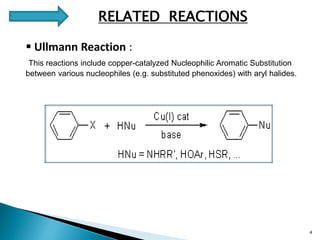
RELATED REACTIONS
 Ullmann Reaction :
This reactions include copper-catalyzed Nucleophilic Aromatic Substitution
between various nucleophiles (e.g. substituted phenoxides) with aryl halides.
4
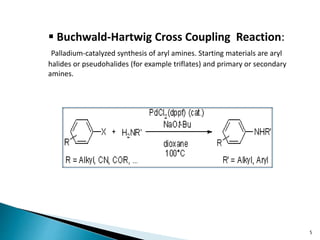
 Buchwald-Hartwig Cross Coupling Reaction:
Palladium-catalyzed synthesis of aryl amines. Starting materials are aryl
halides or pseudohalides (for example triflates) and primary or secondary
amines.
5
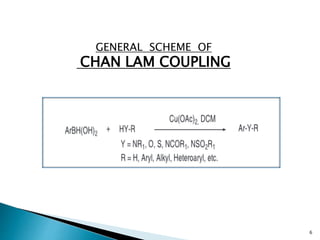
GENERAL SCHEME OF
CHAN LAM COUPLING
6
ADVANTAGE OF CHAN LAM COUPLING
In comparison to the Ullmann–Goldberg reaction or
Buchwald–Hartwig Reaction catalyzed by copper or
palladium, CEL couplings proceed under much milder
conditions, often amination at room temperature, and are
thus more attractive for complicated and sensitive
substrates.
•Room Temparature Reaction
•Weak Base
•Aerobic Reaction
7
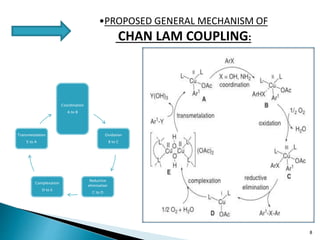
•PROPOSED GENERAL MECHANISM OF
CHAN LAM COUPLING:
Coordination
A to B
Oxidation
B to C
Reductive
elimination
C to D
Complexation
D to E
Transmetalation
E to A
8
APPLICATIONS:
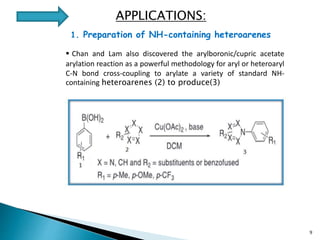
1. Preparation of NH-containing heteroarenes
 Chan and Lam also discovered the arylboronic/cupric acetate
arylation reaction as a powerful methodology for aryl or heteroaryl
C-N bond cross-coupling to arylate a variety of standard NH-
containing heteroarenes (2) to produce(3)
9
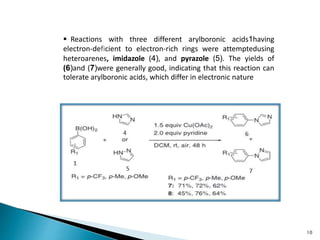
 Reactions with three different arylboronic acids1having
electron-deficient to electron-rich rings were attemptedusing
heteroarenes, imidazole (4), and pyrazole (5). The yields of
(6)and (7)were generally good, indicating that this reaction can
tolerate arylboronic acids, which differ in electronic nature
10
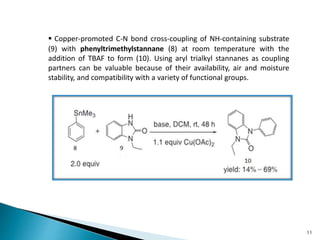
 Copper-promoted C-N bond cross-coupling of NH-containing substrate
(9) with phenyltrimethylstannane (8) at room temperature with the
addition of TBAF to form (10). Using aryl trialkyl stannanes as coupling
partners can be valuable because of their availability, air and moisture
stability, and compatibility with a variety of functional groups.
11
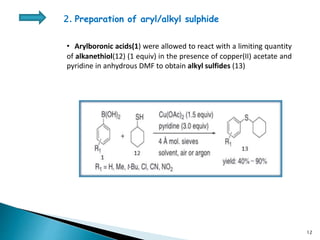
• Arylboronic acids(1) were allowed to react with a limiting quantity
of alkanethiol(12) (1 equiv) in the presence of copper(II) acetate and
pyridine in anhydrous DMF to obtain alkyl sulfides (13)
2. Preparation of aryl/alkyl sulphide
12
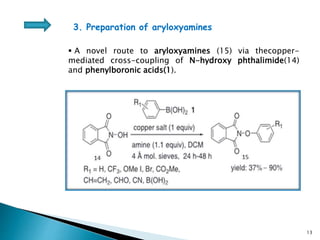
 A novel route to aryloxyamines (15) via thecopper-
mediated cross-coupling of N-hydroxy phthalimide(14)
and phenylboronic acids(1).
3. Preparation of aryloxyamines
13
 The copper-promoted N-arylation of enantiomerically
pure alpha-aminoesters(16) with p-tolylboronic acid(1)
and copper(II) acetate under mild conditions to
form(17)with little or no racemization at room
temperature
4. Synthesis of alpha-aminoesters
14
 A synthetic method for preparing novel phenoxyquinoline-
4(1H)-one compounds (19)and (20) via cross-coupling of
hydroxyquinoline-4(1H)-one (18) with a variety of phenylboronic
acids (1). The reaction is mediated by copper(II) acetate at room
temperature in air and is tolerant of several functional groups
on phenylboronic acids
5. Preparation of N aryloxyquinoline
15
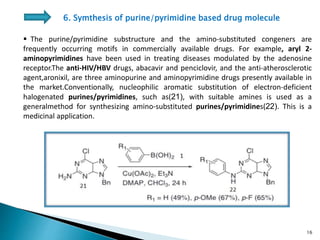
 The purine/pyrimidine substructure and the amino-substituted congeners are
frequently occurring motifs in commercially available drugs. For example, aryl 2-
aminopyrimidines have been used in treating diseases modulated by the adenosine
receptor.The anti-HIV/HBV drugs, abacavir and penciclovir, and the anti-atherosclerotic
agent,aronixil, are three aminopurine and aminopyrimidine drugs presently available in
the market.Conventionally, nucleophilic aromatic substitution of electron-deficient
halogenated purines/pyrimidines, such as(21), with suitable amines is used as a
generalmethod for synthesizing amino-substituted purines/pyrimidines(22). This is a
medicinal application.
6. Symthesis of purine/pyrimidine based drug molecule
16
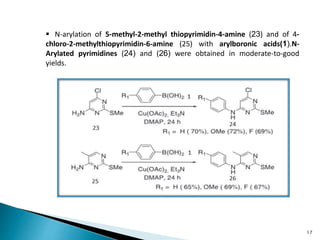
 N-arylation of 5-methyl-2-methyl thiopyrimidin-4-amine (23) and of 4-
chloro-2-methylthiopyrimidin-6-amine (25) with arylboronic acids(1).N-
Arylated pyrimidines (24) and (26) were obtained in moderate-to-good
yields.
17
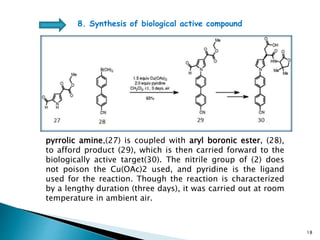
pyrrolic amine,(27) is coupled with aryl boronic ester, (28),
to afford product (29), which is then carried forward to the
biologically active target(30). The nitrile group of (2) does
not poison the Cu(OAc)2 used, and pyridine is the ligand
used for the reaction. Though the reaction is characterized
by a lengthy duration (three days), it was carried out at room
temperature in ambient air.
8. Synthesis of biological active compound
18
19
Conclusions:
I have discussed a novel copper catalyst
for an improved CHAN LAM protocol which is simple & rapid ,
can be performed at room temperature producing coupling
product within a short time. The catalyst could be used very
effectively for coupling reaction of amines, amides, & thiols with
boronic acids to produce corresponding coupling products in
high yield.
20
1. Kodepelly Sanjeeva Rao; Tian-Shung Wu (2012).
"Chan-Lam coupling reactions: Further reading
synthesis of heterocycles". Tetrahedron. 68: 7735–7754.
doi:10.1016/j.tet.2012.06.015 .
References
2. Vantourout, J. C.; Miras, H. N.; IsidroLlobet, A.;
Sproules, S.; Watson, A. J. B. (2017). "Spectroscopic
Studies of the Chan–Lam Amination: A
MechanismInspired Solution to Boronic Ester Reactivity".
Journal of the American Chemical Society. 139: 4769–
4779. doi:10.1021/jacs.6b12800 .
21
Acknowledgements :
▪ I would like to express my special thanks to Dr.
Kinkar Biswas for giving me an opportunity to present
this seminar on the topic and providing his able
guidance.
▪ I also extend my gratitude to all other teachers
Department of Chemistry , for providing me the
necessary facilities.
▪ I would also like to thank my dear classmates for
their support
22
THANK YOU

CHAN LAM COUPLING

  • 1.
    Presented By Subhankar DebBarman M.Sc 3rd Semester 1
  • 2.
    INTRODUCTION The Chan–Lam couplingreaction–also known as the Chan–Evans–Lam coupling, is a cross-coupling reaction between an aryl boronic acid and an alcohol or an amine to form the corresponding secondary aryl ethers or aryl amines respectively. The Chan–Lam coupling is catalyzed in the presence of copper(II) salts and may be conducted in air at room temperature 2
  • 3.
    Over the lasttwo decades, palladium-catalyzed coupling reactions have become a staple reaction of the pharmaceutical industry, to the extent that processes to remove residual palladium from pharmaceutical products have become an active area of work. In 1998 Chan, Evans, and Lam reported the oxidative coupling of amines (and other nucleophiles) with arylboronic acids by copper salts . HISTORY BEHIND CHAN LAM COUPLING Patrick Y-S. Lam, PhD Blumberg Institute Distinguished Professor (Principal Investigator) Dominic Chan Professor, Department of Chemistry, The Chinese University of Hong Kong 3
  • 4.
    RELATED REACTIONS  UllmannReaction : This reactions include copper-catalyzed Nucleophilic Aromatic Substitution between various nucleophiles (e.g. substituted phenoxides) with aryl halides. 4
  • 5.
     Buchwald-Hartwig CrossCoupling Reaction: Palladium-catalyzed synthesis of aryl amines. Starting materials are aryl halides or pseudohalides (for example triflates) and primary or secondary amines. 5
  • 6.
    GENERAL SCHEME OF CHANLAM COUPLING 6
  • 7.
    ADVANTAGE OF CHANLAM COUPLING In comparison to the Ullmann–Goldberg reaction or Buchwald–Hartwig Reaction catalyzed by copper or palladium, CEL couplings proceed under much milder conditions, often amination at room temperature, and are thus more attractive for complicated and sensitive substrates. •Room Temparature Reaction •Weak Base •Aerobic Reaction 7
  • 8.
    •PROPOSED GENERAL MECHANISMOF CHAN LAM COUPLING: Coordination A to B Oxidation B to C Reductive elimination C to D Complexation D to E Transmetalation E to A 8
  • 9.
    APPLICATIONS: 1. Preparation ofNH-containing heteroarenes  Chan and Lam also discovered the arylboronic/cupric acetate arylation reaction as a powerful methodology for aryl or heteroaryl C-N bond cross-coupling to arylate a variety of standard NH- containing heteroarenes (2) to produce(3) 9
  • 10.
     Reactions withthree different arylboronic acids1having electron-deficient to electron-rich rings were attemptedusing heteroarenes, imidazole (4), and pyrazole (5). The yields of (6)and (7)were generally good, indicating that this reaction can tolerate arylboronic acids, which differ in electronic nature 10
  • 11.
     Copper-promoted C-Nbond cross-coupling of NH-containing substrate (9) with phenyltrimethylstannane (8) at room temperature with the addition of TBAF to form (10). Using aryl trialkyl stannanes as coupling partners can be valuable because of their availability, air and moisture stability, and compatibility with a variety of functional groups. 11
  • 12.
    • Arylboronic acids(1)were allowed to react with a limiting quantity of alkanethiol(12) (1 equiv) in the presence of copper(II) acetate and pyridine in anhydrous DMF to obtain alkyl sulfides (13) 2. Preparation of aryl/alkyl sulphide 12
  • 13.
     A novelroute to aryloxyamines (15) via thecopper- mediated cross-coupling of N-hydroxy phthalimide(14) and phenylboronic acids(1). 3. Preparation of aryloxyamines 13
  • 14.
     The copper-promotedN-arylation of enantiomerically pure alpha-aminoesters(16) with p-tolylboronic acid(1) and copper(II) acetate under mild conditions to form(17)with little or no racemization at room temperature 4. Synthesis of alpha-aminoesters 14
  • 15.
     A syntheticmethod for preparing novel phenoxyquinoline- 4(1H)-one compounds (19)and (20) via cross-coupling of hydroxyquinoline-4(1H)-one (18) with a variety of phenylboronic acids (1). The reaction is mediated by copper(II) acetate at room temperature in air and is tolerant of several functional groups on phenylboronic acids 5. Preparation of N aryloxyquinoline 15
  • 16.
     The purine/pyrimidinesubstructure and the amino-substituted congeners are frequently occurring motifs in commercially available drugs. For example, aryl 2- aminopyrimidines have been used in treating diseases modulated by the adenosine receptor.The anti-HIV/HBV drugs, abacavir and penciclovir, and the anti-atherosclerotic agent,aronixil, are three aminopurine and aminopyrimidine drugs presently available in the market.Conventionally, nucleophilic aromatic substitution of electron-deficient halogenated purines/pyrimidines, such as(21), with suitable amines is used as a generalmethod for synthesizing amino-substituted purines/pyrimidines(22). This is a medicinal application. 6. Symthesis of purine/pyrimidine based drug molecule 16
  • 17.
     N-arylation of5-methyl-2-methyl thiopyrimidin-4-amine (23) and of 4- chloro-2-methylthiopyrimidin-6-amine (25) with arylboronic acids(1).N- Arylated pyrimidines (24) and (26) were obtained in moderate-to-good yields. 17
  • 18.
    pyrrolic amine,(27) iscoupled with aryl boronic ester, (28), to afford product (29), which is then carried forward to the biologically active target(30). The nitrile group of (2) does not poison the Cu(OAc)2 used, and pyridine is the ligand used for the reaction. Though the reaction is characterized by a lengthy duration (three days), it was carried out at room temperature in ambient air. 8. Synthesis of biological active compound 18
  • 19.
    19 Conclusions: I have discusseda novel copper catalyst for an improved CHAN LAM protocol which is simple & rapid , can be performed at room temperature producing coupling product within a short time. The catalyst could be used very effectively for coupling reaction of amines, amides, & thiols with boronic acids to produce corresponding coupling products in high yield.
  • 20.
    20 1. Kodepelly SanjeevaRao; Tian-Shung Wu (2012). "Chan-Lam coupling reactions: Further reading synthesis of heterocycles". Tetrahedron. 68: 7735–7754. doi:10.1016/j.tet.2012.06.015 . References 2. Vantourout, J. C.; Miras, H. N.; IsidroLlobet, A.; Sproules, S.; Watson, A. J. B. (2017). "Spectroscopic Studies of the Chan–Lam Amination: A MechanismInspired Solution to Boronic Ester Reactivity". Journal of the American Chemical Society. 139: 4769– 4779. doi:10.1021/jacs.6b12800 .
  • 21.
    21 Acknowledgements : ▪ Iwould like to express my special thanks to Dr. Kinkar Biswas for giving me an opportunity to present this seminar on the topic and providing his able guidance. ▪ I also extend my gratitude to all other teachers Department of Chemistry , for providing me the necessary facilities. ▪ I would also like to thank my dear classmates for their support
  • 22.