Supporting teachers to use e-learning tools and processes in relation to the criteria Integrating new technologies to empower learning and transform leadership by Suzie Vesper - CORE Education [email_address]
Overview of the criteria
The purpose of the criteria Background information taken from the workshop materials found on the NZ Teachers Council website: http://www.teacherscouncil.govt.nz/rtc/rtcworkshopresources.stm The Registered Teacher Criteria are designed to:. represent the essential knowledge and capabilities for quality teaching in Aotearoa New Zealand be both aspirational and achievable for teachers apply to all teachers seeking to gain full registration and to renew practising certificates from across all sectors
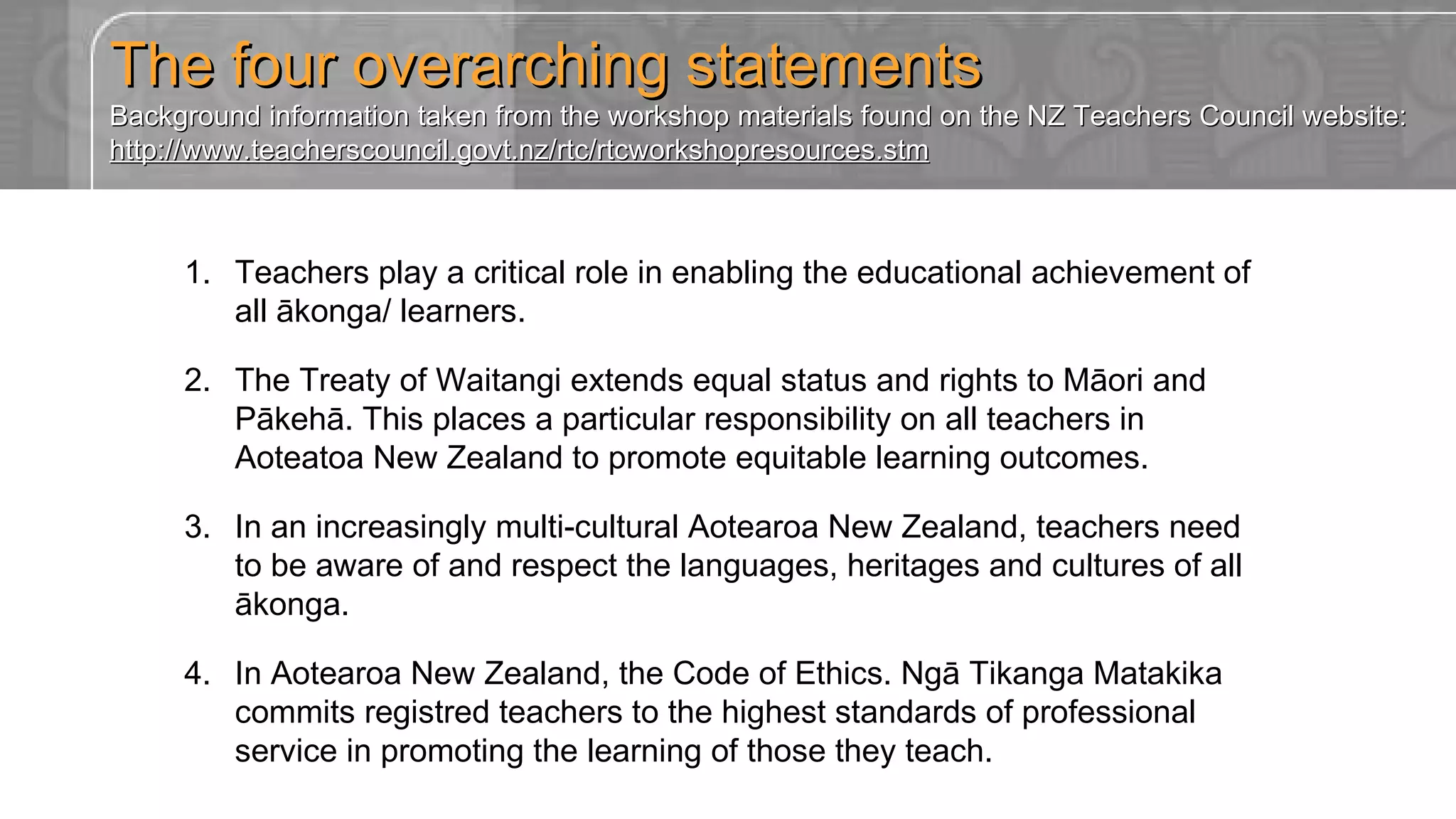
The four overarching statements Background information taken from the workshop materials found on the NZ Teachers Council website: http://www.teacherscouncil.govt.nz/rtc/rtcworkshopresources.stm Teachers play a critical role in enabling the educational achievement of all ākonga/ learners. The Treaty of Waitangi extends equal status and rights to Māori and Pākehā. This places a particular responsibility on all teachers in Aoteatoa New Zealand to promote equitable learning outcomes. In an increasingly multi-cultural Aotearoa New Zealand, teachers need to be aware of and respect the languages, heritages and cultures of all ākonga. In Aotearoa New Zealand, the Code of Ethics. Ngā Tikanga Matakika commits registred teachers to the highest standards of professional service in promoting the learning of those they teach.
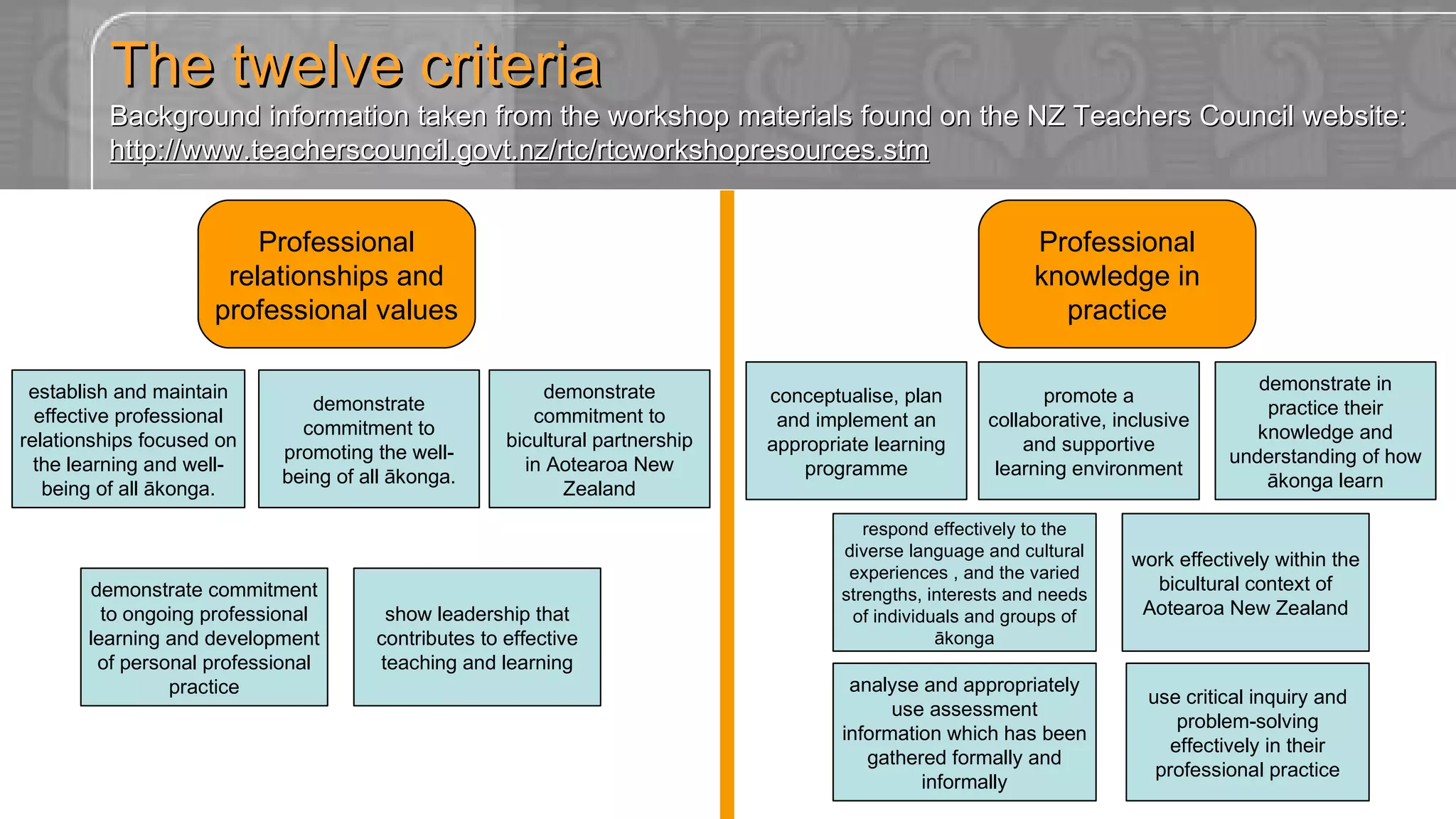
The twelve criteria Background information taken from the workshop materials found on the NZ Teachers Council website: http ://www.teacherscouncil.govt.nz/rtc/rtcworkshopresources.stm Professional relationships and professional values  Professional knowledge in practice establish and maintain effective professional relationships focused on the learning and well-being of all ākonga. demonstrate commitment to promoting the well-being of all ākonga. demonstrate commitment to bicultural partnership in Aotearoa New Zealand respond effectively to the diverse language and cultural experiences , and the varied strengths, interests and needs of individuals and groups of ākonga demonstrate commitment to ongoing professional learning and development of personal professional practice show leadership that contributes to effective teaching and learning promote a collaborative, inclusive and supportive learning environment conceptualise, plan and implement an appropriate learning programme demonstrate in practice their knowledge and understanding of how ākonga learn work effectively within the bicultural context of Aotearoa New Zealand analyse and appropriately use assessment information which has been gathered formally and informally use critical inquiry and problem-solving effectively in their professional practice
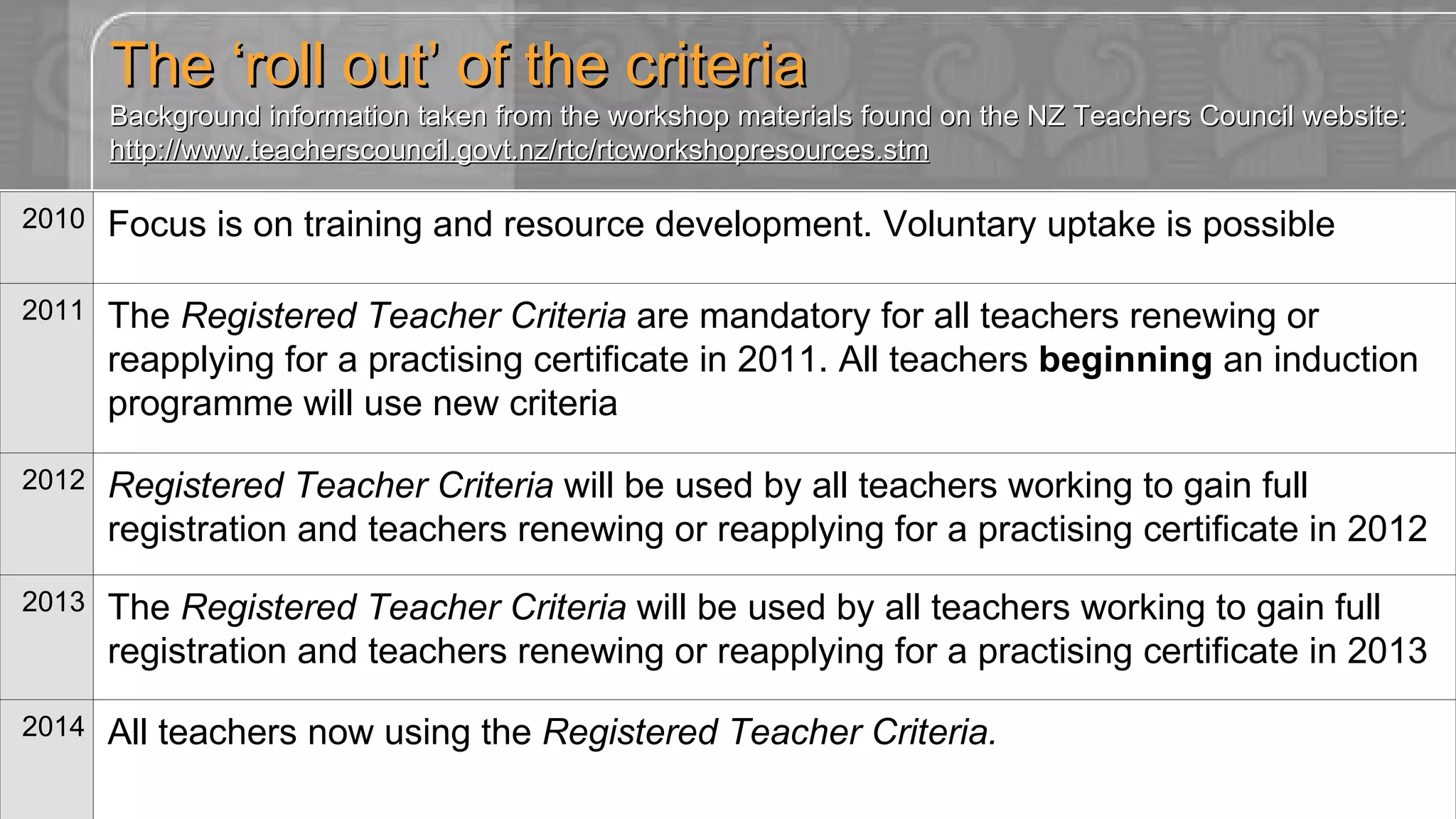
The ‘roll out’ of the criteria Background information taken from the workshop materials found on the NZ Teachers Council website: http://www.teacherscouncil.govt.nz/rtc/rtcworkshopresources.stm 2010 Focus is on training and resource development. Voluntary uptake is possible 2011 The  Registered Teacher Criteria  are mandatory for all teachers renewing or reapplying for a practising certificate in 2011. All teachers  beginning  an induction programme will use new criteria 2012 Registered Teacher Criteria  will be used by all teachers working to gain full registration and teachers renewing or reapplying for a practising certificate in 2012 2013 The  Registered Teacher Criteria  will be used by all teachers working to gain full registration and teachers renewing or reapplying for a practising certificate in 2013 2014 All teachers now using the  Registered Teacher Criteria.
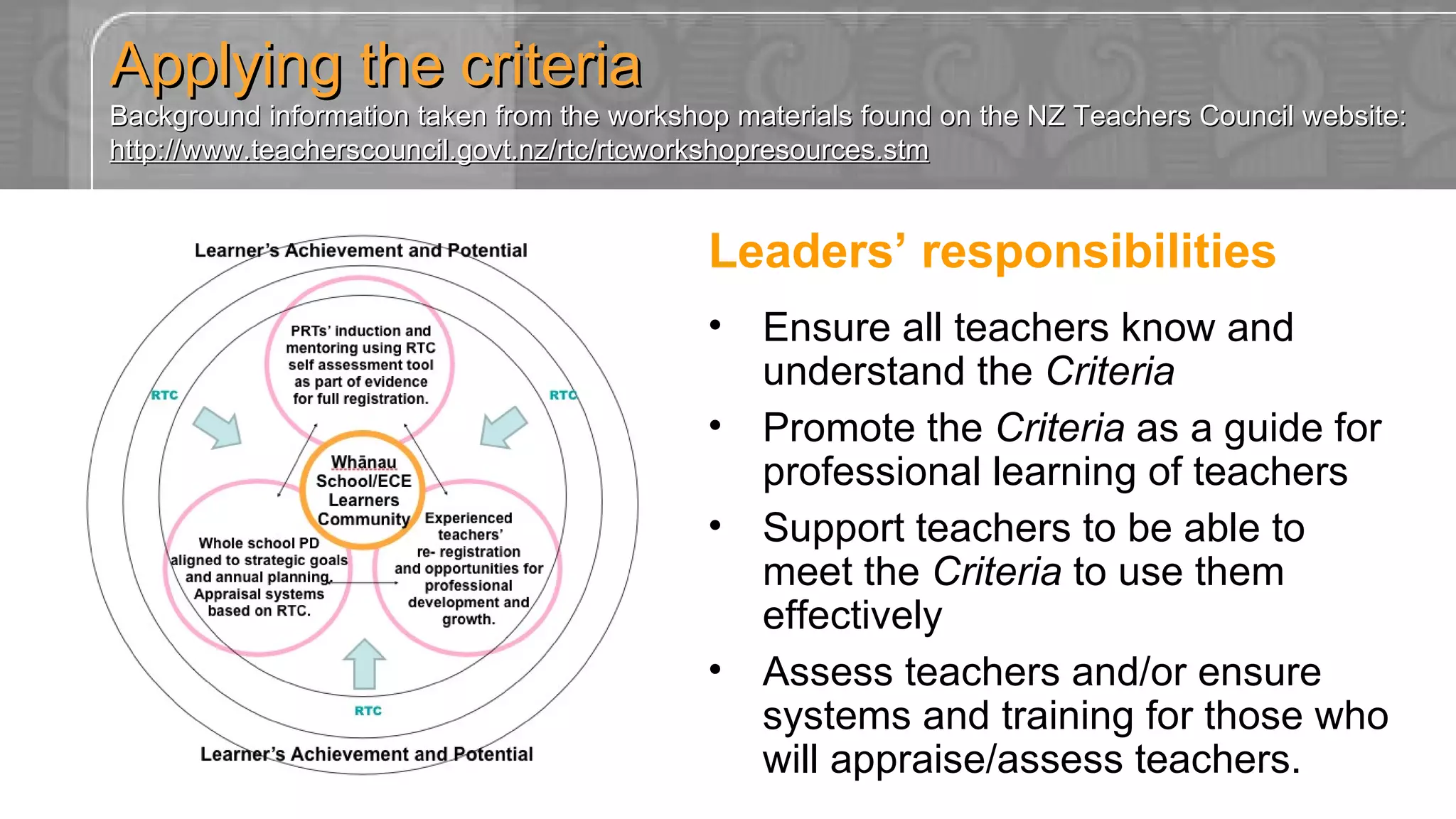
Applying the criteria Background information taken from the workshop materials found on the NZ Teachers Council website: http://www.teacherscouncil.govt.nz/rtc/rtcworkshopresources.stm Leaders’ responsibilities Ensure all teachers know and understand the  Criteria   Promote the  Criteria  as a guide for professional learning of teachers Support teachers to be able to meet the  Criteria  to use them effectively Assess teachers and/or ensure systems and training for those who will appraise/assess teachers.
How has your school already engaged with the criteria?
The role of the e-learning in relation to the criteria
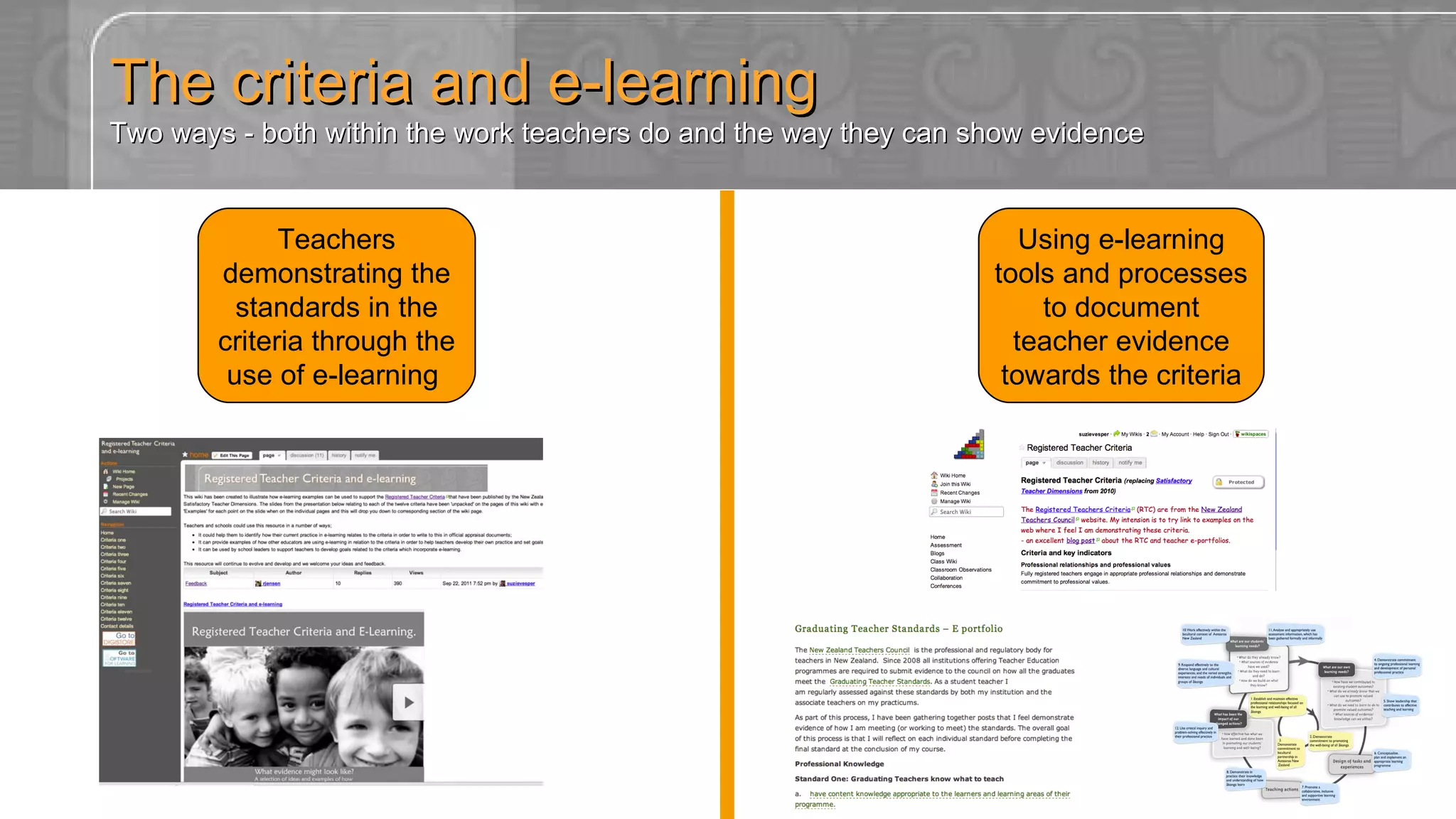
The criteria and e-learning Two ways - both within the work teachers do and the way they can show evidence Teachers demonstrating the standards in the criteria through the use of e-learning  Using e-learning tools and processes to document teacher evidence towards the criteria
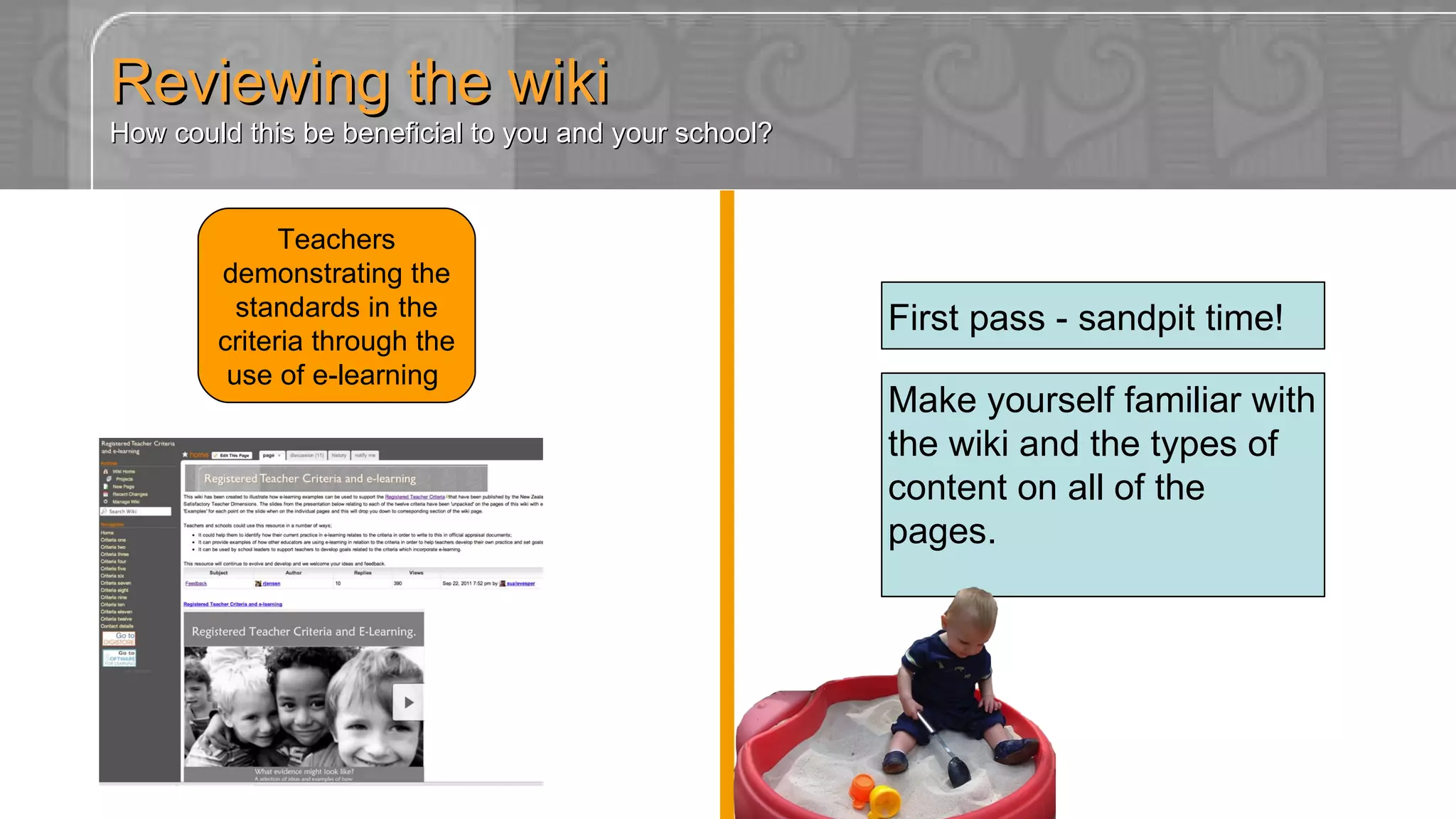
Reviewing the wiki How could this be beneficial to you and your school? Teachers demonstrating the standards in the criteria through the use of e-learning  http://registeredteachercriteria.wikispaces.com Make yourself familiar with the wiki and the types of content on all of the pages. First pass - sandpit time!
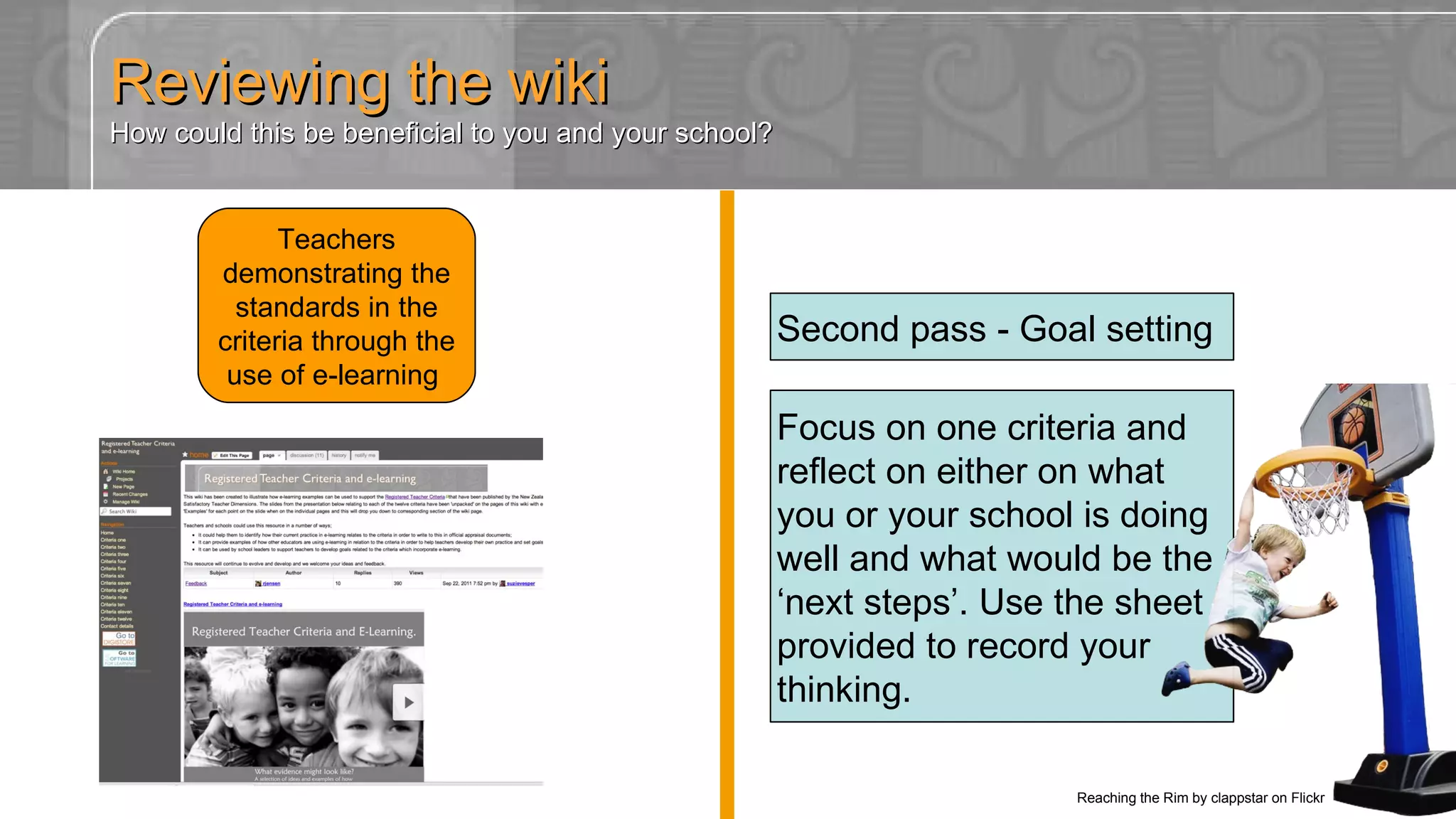
Teachers demonstrating the standards in the criteria through the use of e-learning  http://registeredteachercriteria.wikispaces.com Focus on one criteria and reflect on either on what you or your school is doing well and what would be the ‘next steps’. Use the sheet provided to record your thinking. Second pass - Goal setting Reviewing the wiki How could this be beneficial to you and your school? Reaching the Rim by clappstar on Flickr
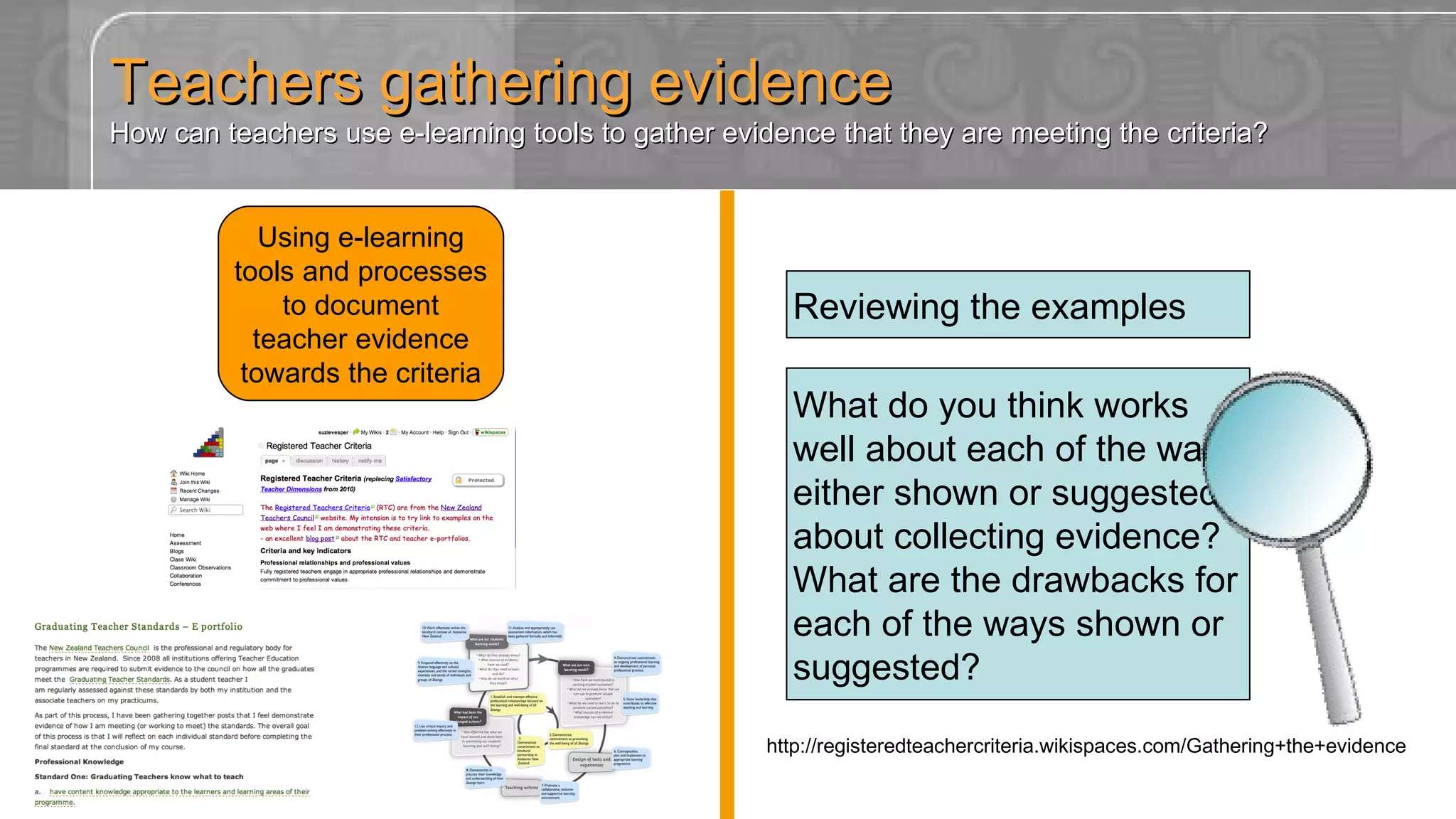
Teachers gathering evidence How can teachers use e-learning tools to gather evidence that they are meeting the criteria? Using e-learning tools and processes to document teacher evidence towards the criteria What do you think works well about each of the ways either shown or suggested about collecting evidence? What are the drawbacks for each of the ways shown or suggested? Reviewing the examples http://registeredteachercriteria.wikispaces.com/Gathering+the+evidence
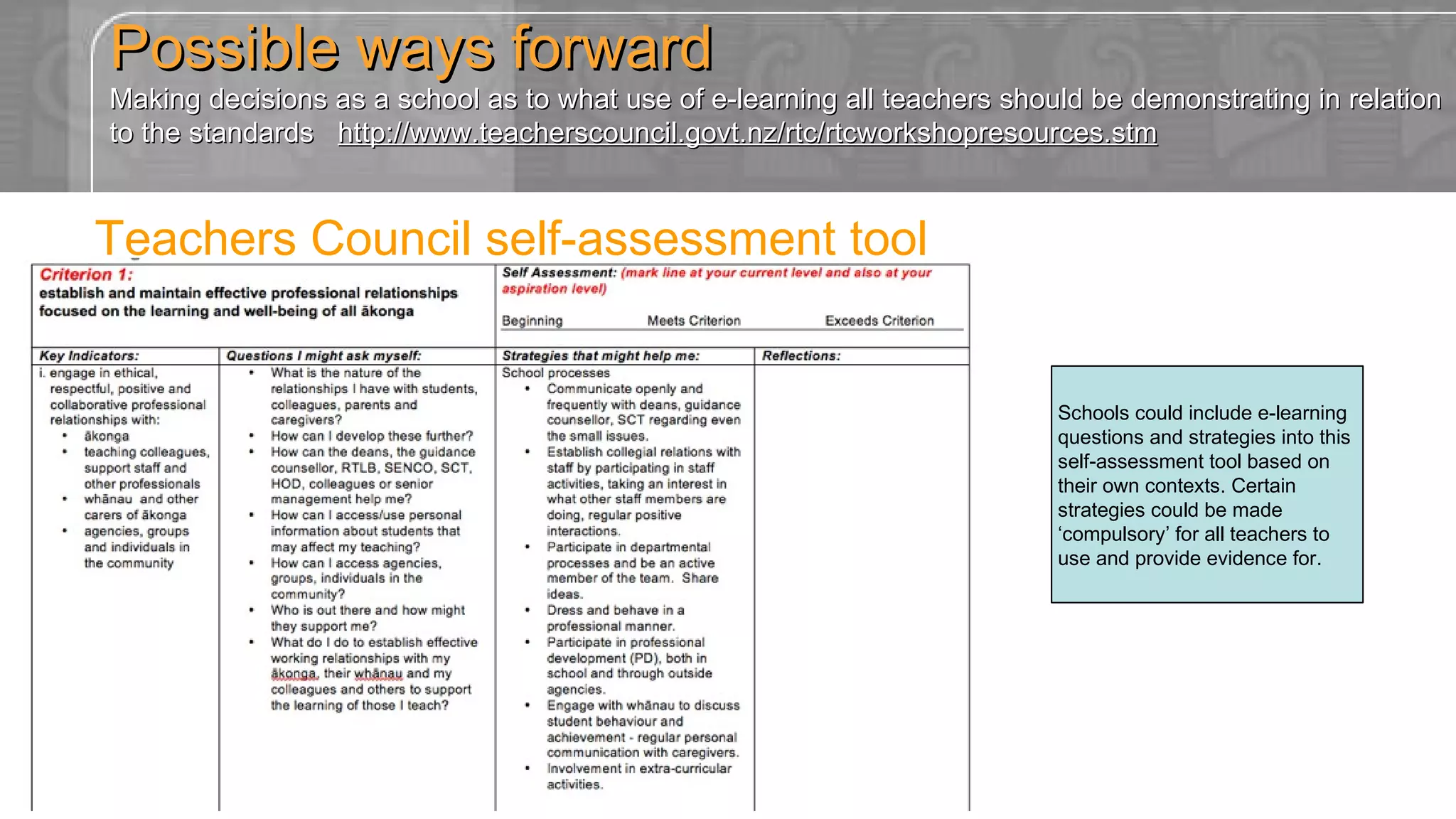
Possible ways forward Making decisions as a school as to what use of e-learning all teachers should be demonstrating in relation to the standards  http://www.teacherscouncil.govt.nz/rtc/rtcworkshopresources.stm Teachers Council self-assessment tool Schools could include e-learning questions and strategies into this self-assessment tool based on their own contexts. Certain strategies could be made ‘compulsory’ for all teachers to use and provide evidence for.
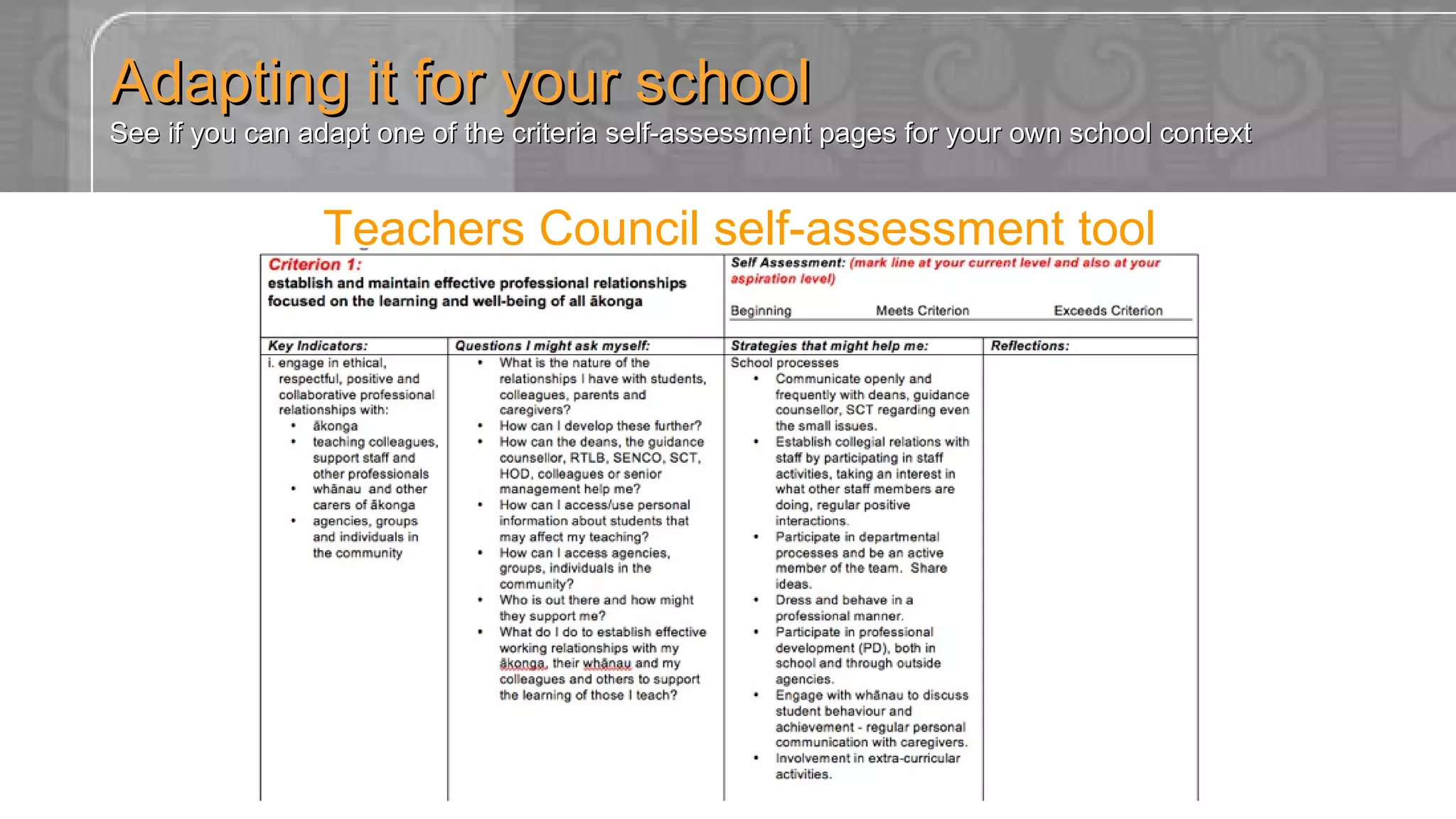
Adapting it for your school See if you can adapt one of the criteria self-assessment pages for your own school context Teachers Council self-assessment tool
So what is your next step as a result of participating in this workshop today?

Ulearn presentation on rtc wiki

  • 1.
  • 2.
    Supporting teachers touse e-learning tools and processes in relation to the criteria Integrating new technologies to empower learning and transform leadership by Suzie Vesper - CORE Education [email_address]
  • 3.
  • 4.
    The purpose ofthe criteria Background information taken from the workshop materials found on the NZ Teachers Council website: http://www.teacherscouncil.govt.nz/rtc/rtcworkshopresources.stm The Registered Teacher Criteria are designed to:. represent the essential knowledge and capabilities for quality teaching in Aotearoa New Zealand be both aspirational and achievable for teachers apply to all teachers seeking to gain full registration and to renew practising certificates from across all sectors
  • 5.
    The four overarchingstatements Background information taken from the workshop materials found on the NZ Teachers Council website: http://www.teacherscouncil.govt.nz/rtc/rtcworkshopresources.stm Teachers play a critical role in enabling the educational achievement of all ākonga/ learners. The Treaty of Waitangi extends equal status and rights to Māori and Pākehā. This places a particular responsibility on all teachers in Aoteatoa New Zealand to promote equitable learning outcomes. In an increasingly multi-cultural Aotearoa New Zealand, teachers need to be aware of and respect the languages, heritages and cultures of all ākonga. In Aotearoa New Zealand, the Code of Ethics. Ngā Tikanga Matakika commits registred teachers to the highest standards of professional service in promoting the learning of those they teach.
  • 6.
    The twelve criteriaBackground information taken from the workshop materials found on the NZ Teachers Council website: http ://www.teacherscouncil.govt.nz/rtc/rtcworkshopresources.stm Professional relationships and professional values Professional knowledge in practice establish and maintain effective professional relationships focused on the learning and well-being of all ākonga. demonstrate commitment to promoting the well-being of all ākonga. demonstrate commitment to bicultural partnership in Aotearoa New Zealand respond effectively to the diverse language and cultural experiences , and the varied strengths, interests and needs of individuals and groups of ākonga demonstrate commitment to ongoing professional learning and development of personal professional practice show leadership that contributes to effective teaching and learning promote a collaborative, inclusive and supportive learning environment conceptualise, plan and implement an appropriate learning programme demonstrate in practice their knowledge and understanding of how ākonga learn work effectively within the bicultural context of Aotearoa New Zealand analyse and appropriately use assessment information which has been gathered formally and informally use critical inquiry and problem-solving effectively in their professional practice
  • 7.
    The ‘roll out’of the criteria Background information taken from the workshop materials found on the NZ Teachers Council website: http://www.teacherscouncil.govt.nz/rtc/rtcworkshopresources.stm 2010 Focus is on training and resource development. Voluntary uptake is possible 2011 The Registered Teacher Criteria are mandatory for all teachers renewing or reapplying for a practising certificate in 2011. All teachers beginning an induction programme will use new criteria 2012 Registered Teacher Criteria will be used by all teachers working to gain full registration and teachers renewing or reapplying for a practising certificate in 2012 2013 The Registered Teacher Criteria will be used by all teachers working to gain full registration and teachers renewing or reapplying for a practising certificate in 2013 2014 All teachers now using the Registered Teacher Criteria.
  • 8.
    Applying the criteriaBackground information taken from the workshop materials found on the NZ Teachers Council website: http://www.teacherscouncil.govt.nz/rtc/rtcworkshopresources.stm Leaders’ responsibilities Ensure all teachers know and understand the Criteria Promote the Criteria as a guide for professional learning of teachers Support teachers to be able to meet the Criteria to use them effectively Assess teachers and/or ensure systems and training for those who will appraise/assess teachers.
  • 9.
    How has yourschool already engaged with the criteria?
  • 10.
    The role ofthe e-learning in relation to the criteria
  • 11.
    The criteria ande-learning Two ways - both within the work teachers do and the way they can show evidence Teachers demonstrating the standards in the criteria through the use of e-learning Using e-learning tools and processes to document teacher evidence towards the criteria
  • 12.
    Reviewing the wikiHow could this be beneficial to you and your school? Teachers demonstrating the standards in the criteria through the use of e-learning http://registeredteachercriteria.wikispaces.com Make yourself familiar with the wiki and the types of content on all of the pages. First pass - sandpit time!
  • 13.
    Teachers demonstrating thestandards in the criteria through the use of e-learning http://registeredteachercriteria.wikispaces.com Focus on one criteria and reflect on either on what you or your school is doing well and what would be the ‘next steps’. Use the sheet provided to record your thinking. Second pass - Goal setting Reviewing the wiki How could this be beneficial to you and your school? Reaching the Rim by clappstar on Flickr
  • 14.
    Teachers gathering evidenceHow can teachers use e-learning tools to gather evidence that they are meeting the criteria? Using e-learning tools and processes to document teacher evidence towards the criteria What do you think works well about each of the ways either shown or suggested about collecting evidence? What are the drawbacks for each of the ways shown or suggested? Reviewing the examples http://registeredteachercriteria.wikispaces.com/Gathering+the+evidence
  • 15.
    Possible ways forwardMaking decisions as a school as to what use of e-learning all teachers should be demonstrating in relation to the standards http://www.teacherscouncil.govt.nz/rtc/rtcworkshopresources.stm Teachers Council self-assessment tool Schools could include e-learning questions and strategies into this self-assessment tool based on their own contexts. Certain strategies could be made ‘compulsory’ for all teachers to use and provide evidence for.
  • 16.
    Adapting it foryour school See if you can adapt one of the criteria self-assessment pages for your own school context Teachers Council self-assessment tool
  • 17.
    So what isyour next step as a result of participating in this workshop today?