Manthan Topic: Stepping Stones
Enhancing the quality of primary education in India
Compounded Learning Gap
A new citizen driven intervention programme to bridge the gap
Team Details
1. Suraj Kumar Sahoo , Chemistry
2. Faizan Mohd. , Chemistry
3. Vishnu Vinjam, Computer Science
4. Barkha Bansal , Energy Science
5. Parul Maheshwari, Engineering Physics
IIT Bombay
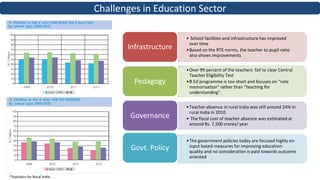
Challenges in Education Sector
• School facilities and infrastructure has improved
over time
•Based on the RTE norms, the teacher to pupil ratio
also shows improvements
Infrastructure
•Over 99 percent of the teachers fail to clear Central
Teacher Eligibility Test
•B.Ed programme is too short and focuses on “rote
memorisation” rather than “teaching for
understanding”.
Pedagogy
•Teacher absence in rural India was still around 24% in
rural India in 2010
• The fiscal cost of teacher absence was estimated at
around Rs. 7,500 crores/ year
Governance
•The government policies today are focused highly on
input based measures for improving education
quality and no consideration is paid towards outcome
oriented
Govt. Policy
*Statistics for Rural India
 Inputs like improvements in infrastructure and teacher-pupil
ratio have little effect on learning outcomes of students
 Learning levels of students dropping in many states since RTE
came in to effect
 Using summer vacation of students for remedial and
additional learning
 Involving educated and skilled students &
professionals as tutors
Need for Outcome oriented approach
 Parents increasingly preferring private schools to
government
 Children opting for private tuition to supplement
school
Increasing cost of Education
 Huge gap between standard and aptitude of children
 School teachers not motivated or skilled to bridge the gap
 Any permanent policy reform will take years for improvements
to materialise, which would not address needs of students today
Need for Intervention programmeNeed to Expand Schooling system
A ‘business as usual’ approach
cannot solve the problem.
It requires a structural change in our
thinking of the problem
Establishing a local network of citizen tutors, utilizing existing educational infrastructure during
vacations to bridge learning gap in students by targeting current learning levels of a child
•Enrolled in
government
schools
•Lacking basic
reading &
arithmetic skills
Students
• Unutilised
Government
educational
infrastructure in
summer months
Schools
•College Students
• Working
professionals
•Educated and
Skilled
Citizens
Supplemental Remedial Instruction
 Accelerated 4 week programme during summer vacations targeted
to bridge learning gap among students
Local Network of Citizen Tutors
 Selection of teaching associates (tutors) after training in pedagogy
and bloom’s taxonomy
 2 week residential programme for instruction in schools
Monitoring
 Identification of students into different grades based on aptitude
 Continuous evaluation and outcome driven approach
 Special focus on underperforming schools and districts
Outreach
 Branding and Publicity to attract the best talent to be tutors
 Forging tie-ups with corporates for adopting schools and districts
Merits of the Policy
 Dictates a quick and efficient way of imparting targeted knowledge to students through the
use of minimum resources
 Easy to fit in the current scenario and scalable to the entire country
Stakeholders Implementation
Students &
Professionals
• Command in
English & Math
Workshops
• Training in
pedagogy
Recruitment
• Tutors mapped
to schools
School
• Accelerated
programme in
vacations
• Leadership Development Opportunity
• Exposure to ground realities & experiences
• Building Curriculum Vitae
• Corporate Opportunities
• Social Responsibility
• Workshops organized across the state
• Trained in bloom’s taxonomy & pedagogy
• Recruitment of teaching associates
• 2 week residential programme
• Stipend covering travel and living expense
100,000 tutors trained across the nation every year
Outreach to remote and economically backward sections of the population
Why Volunteer..?Tutor Programme
Network of Citizen Tutors
Supplemental remedial instruction targeted to improve child’s current aptitude
through differential grading and focussed learning exercise
 Develop a grading system based on practical skills and
foundational knowledge of a child
 Prepare a unique exam to allot a child a particular grade
 Target is to increase the aptitude of students by 1 grade
 Monitor the progress through-out the 4 week programme
Differential Grading
Focussed Learning
Curriculum
Subjects Tools People
• Maths –
arithmetic
• English –
Reading.
Writing
• Games
• Exercises
• Videos
• Practical
Experiences
• Educationist
• NCERT
• NGOs
• Navodya
Vidyalaya
Curriculum is aimed at significant learning gains through intervention programme & community participation
 4 week accelerated intervention programme during summer
months
 Learning exercises suitable for a child’s aptitude targeted
towards improving performance
 Specially designed curriculum that focuses on building
foundational skills in different genres rather than rote
memorization
State
Coordination
Unit
Planning and
Execution
Finance Media IT Team Curriculum
 Tie-ups with corporate
for Sponsorships and
participation
 Management of funds
and expenditure
Incurred
 Print and Television
 Outdoor and online
publicity
 Publicise the scheme as
a brand
 Reaching out to colleges
and corporates
 Back-end support
 Data collection
 Website
 Recruitment
Coordination
Organizational Structure
State Coordination
Unit
Planning &
Execution
Department
District Committee
Planning and
Execution team
Recruitment Team
Workshop
Organisers
Curriculum Design
Department
Planning & Execution Team
• Set targets & prepare a year long
strategy
• Identify critical villages and
economically backward sections
and associated government
infrastructure
• Special focus on under-
performing centers
• Coordination among different
departments for smooth
functioning
• Logistics involved in travel and
accommodation of associates
Recruitment Team
• Hiring of teaching associates
• Mapping of teaching associates
to different centers
• Monitor the performance of
teaching associates
• Distribution of awards to best
performing teaching associates
• Collaborate with media team to
get the best talent
Workshop organisers
• Approach educationists and
pedagogy researchers to conduct
seminars and workshops
• Organise workshops and
conferences in the particular
districts
• Train college students and full
time working professionals
• Ensure proper knowledge
transfer from previous year’s
experiences
Curriculum Design
Department
• Develop a grading system based
on practical skills and
foundational knowledge of a
child
• Develop a focussed 4 week
learning programme for a
particular grade
• Build a need specific curriculum
with expertise from
educationists
• Develop a mechanism to monitor
the performance to students and
associates
Organisational Structure contd.
Financial Requirements
Total Expenses
Media
IT
School cost
Tutor
Student
Resources
Planning and
Execution
Curriculum &
Workshops
Rs. 1.2 crores (Stipend)
Rs.60 lakh-Travel allowance
Rs. 60 lakhs
Rs. 5 lakhs
Rs. 10 lakhs
Rs. 5 lakhs
Rs. 2 crores
Corporate Engagement encouraging big companies to adopt districts or schools aiding in technical, human and financial
resources will make the scheme sustainable, robust and up to date
Annual cost
for
programme
running in
1000 schools
per state
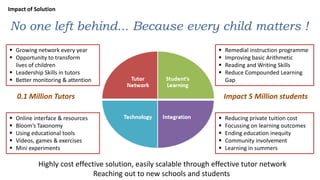
No one left behind... Because every child matters !
 Remedial instruction programme
 Improving basic Arithmetic
 Reading and Writing Skills
 Reduce Compounded Learning
Gap
 Reducing private tuition cost
 Focussing on learning outcomes
 Ending education inequity
 Community involvement
 Learning in summers
 Online interface & resources
 Bloom’s Taxonomy
 Using educational tools
 Videos, games & exercises
 Mini experiments
 Growing network every year
 Opportunity to transform
lives of children
 Leadership Skills in tutors
 Better monitoring & attention
0.1 Million Tutors Impact 5 Million students
Impact of Solution
Highly cost effective solution, easily scalable through effective tutor network
Reaching out to new schools and students
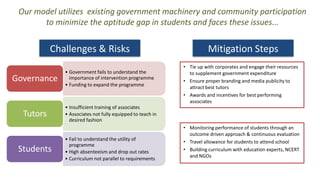
Challenges & Risks
• Government fails to understand the
importance of intervention programme
• Funding to expand the programme
Governance
• Insufficient training of associates
• Associates not fully equipped to teach in
desired fashion
Tutors
• Fail to understand the utility of
programme
• High absenteeism and drop out rates
• Curriculum not parallel to requirements
Students
Mitigation Steps
• Tie up with corporates and engage their resources
to supplement government expenditure
• Ensure proper branding and media publicity to
attract best tutors
• Awards and incentives for best performing
associates
• Monitoring performance of students through an
outcome driven approach & continuous evaluation
• Travel allowance for students to attend school
• Building curriculum with education experts, NCERT
and NGOs
Our model utilizes existing government machinery and community participation
to minimize the aptitude gap in students and faces these issues...
1. Teach for India. (2012). India’s Education Crisis. Retrieved from http://www.teachforindia.org/about-
us/indiaeducation-crisis
2. ASER. (2012). Annual Status of Education Report, 2012. Retrieved from http://www.pratham.org/file/ASER-
2012report.pdf
3. Kumar, Pramod G. (2013, Jan 22). Why the State of India’s Primary Education is Shocking? First Post. Retrieved from
http://www.firstpost.com/india/why-the-state-of-indias-primary-education-is-shocking-598011.html
4. Muralidharan, K. (2013, March 18). Using evidence for better policy: The case of primary education in India. Ideas
for India. http://www.ideasforindia.in/article.aspx?article_id=119
5. Ojha, Anjali. (2012, July 9). 95% schools don't comply with RTE guidelines: Study. DNA India. Retrieved from
http://www.dnaindia.com/india/1712602/report-95pct-schools-don-t-comply-with-rte-guidelines-study
6. Financial Express. (2012, May 12). Education’s Primary Problems. Retrieved from
http://www.financialexpress.com/news/education-s-primary-problems/948273/2
7. Balasubramanian, Sriram (2013, May 27). Primary Education in India needs a fix. Forbes India. Retrieved from
http://forbesindia.com/article/briefing/primary-education-in-india-needs-a-fix/35287/1
8. Financial Express. (2013, July 23). Education’s primary problems. Retrieved from
http://www.financialexpress.com/news/education-s-primary-problems/948273/1
Appendix – Resources

TeamInvictus

  • 1.
    Manthan Topic: SteppingStones Enhancing the quality of primary education in India Compounded Learning Gap A new citizen driven intervention programme to bridge the gap Team Details 1. Suraj Kumar Sahoo , Chemistry 2. Faizan Mohd. , Chemistry 3. Vishnu Vinjam, Computer Science 4. Barkha Bansal , Energy Science 5. Parul Maheshwari, Engineering Physics IIT Bombay
  • 2.
    Challenges in EducationSector • School facilities and infrastructure has improved over time •Based on the RTE norms, the teacher to pupil ratio also shows improvements Infrastructure •Over 99 percent of the teachers fail to clear Central Teacher Eligibility Test •B.Ed programme is too short and focuses on “rote memorisation” rather than “teaching for understanding”. Pedagogy •Teacher absence in rural India was still around 24% in rural India in 2010 • The fiscal cost of teacher absence was estimated at around Rs. 7,500 crores/ year Governance •The government policies today are focused highly on input based measures for improving education quality and no consideration is paid towards outcome oriented Govt. Policy *Statistics for Rural India
  • 3.
     Inputs likeimprovements in infrastructure and teacher-pupil ratio have little effect on learning outcomes of students  Learning levels of students dropping in many states since RTE came in to effect  Using summer vacation of students for remedial and additional learning  Involving educated and skilled students & professionals as tutors Need for Outcome oriented approach  Parents increasingly preferring private schools to government  Children opting for private tuition to supplement school Increasing cost of Education  Huge gap between standard and aptitude of children  School teachers not motivated or skilled to bridge the gap  Any permanent policy reform will take years for improvements to materialise, which would not address needs of students today Need for Intervention programmeNeed to Expand Schooling system A ‘business as usual’ approach cannot solve the problem. It requires a structural change in our thinking of the problem
  • 4.
    Establishing a localnetwork of citizen tutors, utilizing existing educational infrastructure during vacations to bridge learning gap in students by targeting current learning levels of a child •Enrolled in government schools •Lacking basic reading & arithmetic skills Students • Unutilised Government educational infrastructure in summer months Schools •College Students • Working professionals •Educated and Skilled Citizens Supplemental Remedial Instruction  Accelerated 4 week programme during summer vacations targeted to bridge learning gap among students Local Network of Citizen Tutors  Selection of teaching associates (tutors) after training in pedagogy and bloom’s taxonomy  2 week residential programme for instruction in schools Monitoring  Identification of students into different grades based on aptitude  Continuous evaluation and outcome driven approach  Special focus on underperforming schools and districts Outreach  Branding and Publicity to attract the best talent to be tutors  Forging tie-ups with corporates for adopting schools and districts Merits of the Policy  Dictates a quick and efficient way of imparting targeted knowledge to students through the use of minimum resources  Easy to fit in the current scenario and scalable to the entire country Stakeholders Implementation
  • 5.
    Students & Professionals • Commandin English & Math Workshops • Training in pedagogy Recruitment • Tutors mapped to schools School • Accelerated programme in vacations • Leadership Development Opportunity • Exposure to ground realities & experiences • Building Curriculum Vitae • Corporate Opportunities • Social Responsibility • Workshops organized across the state • Trained in bloom’s taxonomy & pedagogy • Recruitment of teaching associates • 2 week residential programme • Stipend covering travel and living expense 100,000 tutors trained across the nation every year Outreach to remote and economically backward sections of the population Why Volunteer..?Tutor Programme Network of Citizen Tutors
  • 6.
    Supplemental remedial instructiontargeted to improve child’s current aptitude through differential grading and focussed learning exercise  Develop a grading system based on practical skills and foundational knowledge of a child  Prepare a unique exam to allot a child a particular grade  Target is to increase the aptitude of students by 1 grade  Monitor the progress through-out the 4 week programme Differential Grading Focussed Learning Curriculum Subjects Tools People • Maths – arithmetic • English – Reading. Writing • Games • Exercises • Videos • Practical Experiences • Educationist • NCERT • NGOs • Navodya Vidyalaya Curriculum is aimed at significant learning gains through intervention programme & community participation  4 week accelerated intervention programme during summer months  Learning exercises suitable for a child’s aptitude targeted towards improving performance  Specially designed curriculum that focuses on building foundational skills in different genres rather than rote memorization
  • 7.
    State Coordination Unit Planning and Execution Finance MediaIT Team Curriculum  Tie-ups with corporate for Sponsorships and participation  Management of funds and expenditure Incurred  Print and Television  Outdoor and online publicity  Publicise the scheme as a brand  Reaching out to colleges and corporates  Back-end support  Data collection  Website  Recruitment Coordination Organizational Structure
  • 8.
    State Coordination Unit Planning & Execution Department DistrictCommittee Planning and Execution team Recruitment Team Workshop Organisers Curriculum Design Department Planning & Execution Team • Set targets & prepare a year long strategy • Identify critical villages and economically backward sections and associated government infrastructure • Special focus on under- performing centers • Coordination among different departments for smooth functioning • Logistics involved in travel and accommodation of associates Recruitment Team • Hiring of teaching associates • Mapping of teaching associates to different centers • Monitor the performance of teaching associates • Distribution of awards to best performing teaching associates • Collaborate with media team to get the best talent Workshop organisers • Approach educationists and pedagogy researchers to conduct seminars and workshops • Organise workshops and conferences in the particular districts • Train college students and full time working professionals • Ensure proper knowledge transfer from previous year’s experiences Curriculum Design Department • Develop a grading system based on practical skills and foundational knowledge of a child • Develop a focussed 4 week learning programme for a particular grade • Build a need specific curriculum with expertise from educationists • Develop a mechanism to monitor the performance to students and associates Organisational Structure contd.
  • 9.
    Financial Requirements Total Expenses Media IT Schoolcost Tutor Student Resources Planning and Execution Curriculum & Workshops Rs. 1.2 crores (Stipend) Rs.60 lakh-Travel allowance Rs. 60 lakhs Rs. 5 lakhs Rs. 10 lakhs Rs. 5 lakhs Rs. 2 crores Corporate Engagement encouraging big companies to adopt districts or schools aiding in technical, human and financial resources will make the scheme sustainable, robust and up to date Annual cost for programme running in 1000 schools per state
  • 10.
    No one leftbehind... Because every child matters !  Remedial instruction programme  Improving basic Arithmetic  Reading and Writing Skills  Reduce Compounded Learning Gap  Reducing private tuition cost  Focussing on learning outcomes  Ending education inequity  Community involvement  Learning in summers  Online interface & resources  Bloom’s Taxonomy  Using educational tools  Videos, games & exercises  Mini experiments  Growing network every year  Opportunity to transform lives of children  Leadership Skills in tutors  Better monitoring & attention 0.1 Million Tutors Impact 5 Million students Impact of Solution Highly cost effective solution, easily scalable through effective tutor network Reaching out to new schools and students
  • 11.
    Challenges & Risks •Government fails to understand the importance of intervention programme • Funding to expand the programme Governance • Insufficient training of associates • Associates not fully equipped to teach in desired fashion Tutors • Fail to understand the utility of programme • High absenteeism and drop out rates • Curriculum not parallel to requirements Students Mitigation Steps • Tie up with corporates and engage their resources to supplement government expenditure • Ensure proper branding and media publicity to attract best tutors • Awards and incentives for best performing associates • Monitoring performance of students through an outcome driven approach & continuous evaluation • Travel allowance for students to attend school • Building curriculum with education experts, NCERT and NGOs Our model utilizes existing government machinery and community participation to minimize the aptitude gap in students and faces these issues...
  • 12.
    1. Teach forIndia. (2012). India’s Education Crisis. Retrieved from http://www.teachforindia.org/about- us/indiaeducation-crisis 2. ASER. (2012). Annual Status of Education Report, 2012. Retrieved from http://www.pratham.org/file/ASER- 2012report.pdf 3. Kumar, Pramod G. (2013, Jan 22). Why the State of India’s Primary Education is Shocking? First Post. Retrieved from http://www.firstpost.com/india/why-the-state-of-indias-primary-education-is-shocking-598011.html 4. Muralidharan, K. (2013, March 18). Using evidence for better policy: The case of primary education in India. Ideas for India. http://www.ideasforindia.in/article.aspx?article_id=119 5. Ojha, Anjali. (2012, July 9). 95% schools don't comply with RTE guidelines: Study. DNA India. Retrieved from http://www.dnaindia.com/india/1712602/report-95pct-schools-don-t-comply-with-rte-guidelines-study 6. Financial Express. (2012, May 12). Education’s Primary Problems. Retrieved from http://www.financialexpress.com/news/education-s-primary-problems/948273/2 7. Balasubramanian, Sriram (2013, May 27). Primary Education in India needs a fix. Forbes India. Retrieved from http://forbesindia.com/article/briefing/primary-education-in-india-needs-a-fix/35287/1 8. Financial Express. (2013, July 23). Education’s primary problems. Retrieved from http://www.financialexpress.com/news/education-s-primary-problems/948273/1 Appendix – Resources