An overview of primary and secondary sources

               Content by Dylan Owen
      Development specialist at the National Library
What are primary sources?
A primary source is an item created around or during a specific event, place
or time.
They are a record of a person’s perspective or experience of an event,
place or time.
What are primary sources?
Primary sources reveal personal information rarely contained
in books and articles of the time. They offer students a direct
link to the lives of people in the past.
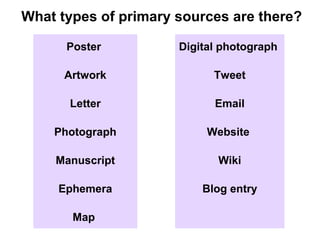
What types of primary sources are there?

      Poster          Digital photograph

      Artwork               Tweet

      Letter                Email

    Photograph             Website

    Manuscript               Wiki

     Ephemera             Blog entry

       Map
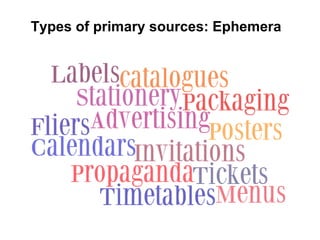
Types of primary sources: Ephemera
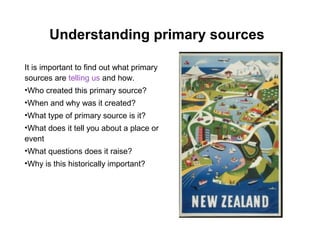
Understanding primary sources

It is important to find out what primary
sources are telling us and how.
•Who created this primary source?
•When and why was it created?
•What type of primary source is it?
•What does it tell you about a place or
event
•What questions does it raise?
•Why is this historically important?
Using primary sources


There are amazing resources out
   there – use them!
• Make sure you cite your sources
• Check for any conditions or
   restrictions
• What can I use and reuse?
• Respect the material, the
   creator and the subject


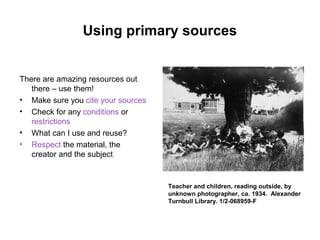
                                    Teacher and children, reading outside, by
                                    unknown photographer, ca. 1934. Alexander
                                    Turnbull Library. 1/2-068959-F
What are secondary sources?
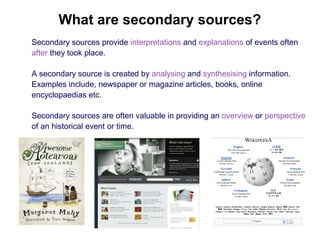
Secondary sources provide interpretations and explanations of events often
after they took place.

A secondary source is created by analysing and synthesising information.
Examples include, newspaper or magazine articles, books, online
encyclopaedias etc.

Secondary sources are often valuable in providing an overview or perspective
of an historical event or time.
Summary
    Primary sources                 Secondary sources


• Are first-hand accounts       • Second-hand, published
                                  accounts
• Provide clues that            • Can include some primary
  historians call the             sources, eg direct quotes or
  ‘historical record’             excerpts
• Are often unpublished         • Interpret an event

                                • Can include some primary
                                  sources, eg direct quotes or
                                  excerpts

Overview of primary sources

  • 1.
    An overview ofprimary and secondary sources Content by Dylan Owen Development specialist at the National Library
  • 2.
    What are primarysources? A primary source is an item created around or during a specific event, place or time. They are a record of a person’s perspective or experience of an event, place or time.
  • 3.
    What are primarysources? Primary sources reveal personal information rarely contained in books and articles of the time. They offer students a direct link to the lives of people in the past.
  • 4.
    What types ofprimary sources are there? Poster Digital photograph Artwork Tweet Letter Email Photograph Website Manuscript Wiki Ephemera Blog entry Map
  • 5.
    Types of primarysources: Ephemera
  • 6.
    Understanding primary sources Itis important to find out what primary sources are telling us and how. •Who created this primary source? •When and why was it created? •What type of primary source is it? •What does it tell you about a place or event •What questions does it raise? •Why is this historically important?
  • 7.
    Using primary sources Thereare amazing resources out there – use them! • Make sure you cite your sources • Check for any conditions or restrictions • What can I use and reuse? • Respect the material, the creator and the subject Teacher and children, reading outside, by unknown photographer, ca. 1934. Alexander Turnbull Library. 1/2-068959-F
  • 8.
    What are secondarysources? Secondary sources provide interpretations and explanations of events often after they took place. A secondary source is created by analysing and synthesising information. Examples include, newspaper or magazine articles, books, online encyclopaedias etc. Secondary sources are often valuable in providing an overview or perspective of an historical event or time.
  • 9.
    Summary Primary sources Secondary sources • Are first-hand accounts • Second-hand, published accounts • Provide clues that • Can include some primary historians call the sources, eg direct quotes or ‘historical record’ excerpts • Are often unpublished • Interpret an event • Can include some primary sources, eg direct quotes or excerpts

Editor's Notes

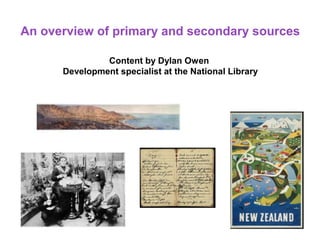
  • #2 Note 50 minutes Image 1: Anzac Cove ; the historic landing-place, by Horace Moore-Jones, 1916. Alexander Turnbull Library. This is a primary source , because it was painted at the time of the Gallipoli landings by someone who was there, Horace Moore-Jones. Image 2 The battle of Chunuk Bair, 8 August 1915, by Ion Brown, 1990. Alexander Turnbull Library. This is not a primary source. It was painted in 1990 by someone who was not an eye witness to the battle of Chunuk Bair though the painter would have examined primary sources to ‘ make ’ the painting authentic in terms of backdrop, uniforms and weapons . These sources are called secondary sources – more on those later. Note Primary sources help students relate in a personal way to past events 1. First-person accounts helps make events more real, fostering active reading and response 2. Being snippets of history, primary sources encourage students to seek additional evidence through research
  • #3 Note 50 minutes Image 1: Anzac Cove ; the historic landing-place, by Horace Moore-Jones, 1916. Alexander Turnbull Library. This is a primary source , because it was painted at the time of the Gallipoli landings by someone who was there, Horace Moore-Jones. Image 2 The battle of Chunuk Bair, 8 August 1915, by Ion Brown, 1990. Alexander Turnbull Library. This is not a primary source. It was painted in 1990 by someone who was not an eye witness to the battle of Chunuk Bair though the painter would have examined primary sources to ‘ make ’ the painting authentic in terms of backdrop, uniforms and weapons . These sources are called secondary sources – more on those later. Note Primary sources help students relate in a personal way to past events 1. First-person accounts helps make events more real, fostering active reading and response 2. Being snippets of history, primary sources encourage students to seek additional evidence through research
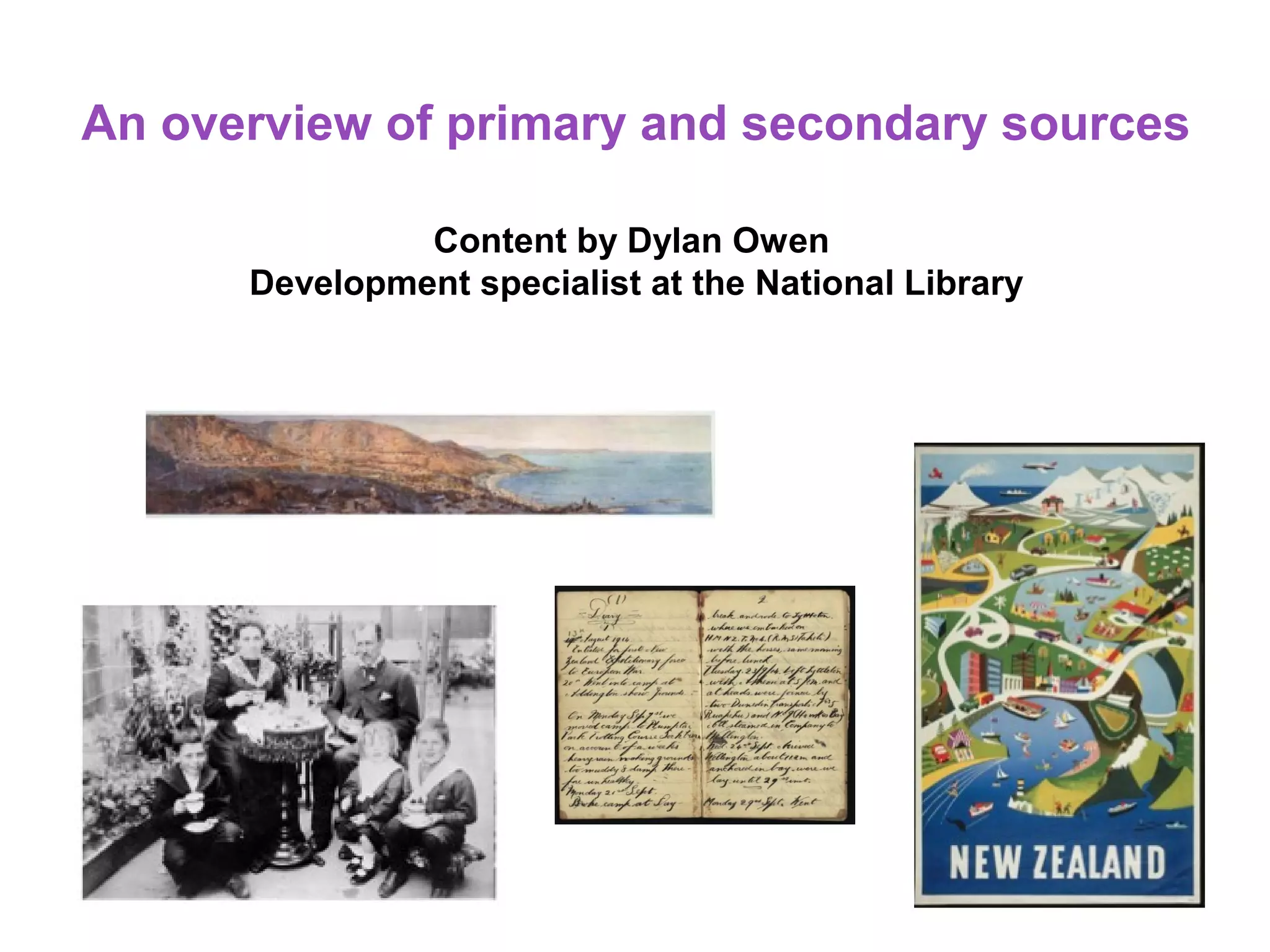
  • #4 Note “ People who lived a long time ago left many clues about their lives including documents, objects and images. These items, created at the time events took place, form our historical record and are called primary sources. You can find many primary sources in libraries, museums and archives. Many primary sources have now been digitised, and are available online. ” Quote from http://ncmuseumofhistory.org/workshops/civilrights1/primary_sources.htm Examples These two very different primary sources reveal the many experiences/perspectives of Auckland children in the late 18 th century. Image 1 : Newspaper Article THIEVING SCHOOLBOYS. Poverty Bay Herald, Volume XV, Issue 5339, 29 November 1888, Page 3 Image 2 : Man, woman and three children, having afternoon tea, Auckland by unknown photographer, ca 1900: 1/2-002362-F Activity 1 Ask what other kinds of items/material could be considered primary sources. Examples on next slide
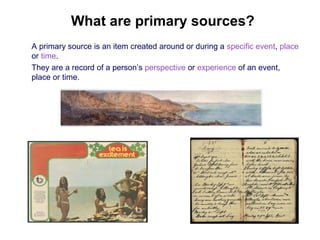
  • #5 Note Also note primary sources are not only paper based some electronic/digital items of today are also considered primary sources Letter example is an 1922 illustrated letter by Katherine Mansfield is to her friend and painter Anne Estelle Drey – which probably explains the landscape Mansfield sketched at the top of the page. Anne Estelle Drey was an American artist and like Mansfield had submitted work to the literary journal Rhythm . “ Dearest Anne I have just been through that dechirante (heart rendering) experience – two lovely young creatures from the Chemiserie with little frocks “pour essayer seule-ment Madame”. I’m sitting, fringe straight again at last writing to you in the one they forced on me – a kind of plum grey –tout droll, with buttings on the hips and no trimming at all except a large embroidered lobster bien pose sur la ventre!!! Shall I ever wear it again? It’s beginning to look (more) extraordinary every moment. The little creatures twittering chic-chic-chic would have made me buy a casserole for a chapeau (hat) with two poireaux (leeks) in the front. That is the worst of living as I do far from the female kind. These moments come and I’m lost…” The collected letters of Katherine Mansfield ,  edited by Vincent O ’Sullivan and Margaret Scott. Clarendon Press, 1984-2008. v. 5. Image
  • #6 Note We define ephemera as published material issued for short term use only. After its time of use, much of this material gets thrown away, so that what is left becomes rare. Sometimes it is the only source of documentary evidence that can help researchers understand our past. Eph-B-BEVERAGE-Tea-1971-01-cover Note click on the work show to link out to a range of 1800 NZ food labels the library holds. Alexander Turnbull Library have over 200,000 primary source ephemera items in their Ephemera collection - only about 4000 are digitised
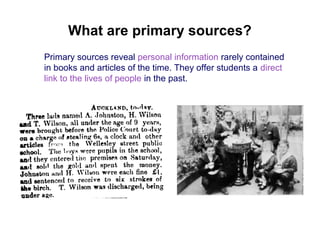
  • #7 Note Lead and facilitate discussion here using these questions and the example shown here: New Zealand, by Dennis Beytagh, 1960. Alexander Turnbull Library: Eph-E-TOURISM-1960-01 Then click on the image as it links to the PS resources page – explain this pages
  • #8 Note Image Teacher and children, reading outside, by unknown photographer, ca. 1934. Alexander Turnbull Library. 1/2-068959-F Direct people to the Free to Mix guide - http://schools.natlib.govt.nz/21st-century-literacy-inquiry/sources-resources/guide-reusing-digital-content with lots of ideas for finding reusable content, citing sufficiently, understanding copyright and creative commons. (click on photograph for link to site) What can I use Reuse – image links to the reuse gallery
  • #9 Note A secondary source is where other people write about or comment on a topic. Examples are: biographies, political or historical events, discussions of scientific data, or studies of issues. Here ’ s two examples of New Zealand secondary sources Front Page: Awesome Aotearoa New Zealand by Margaret Mahy Front Page: Online encyclopaedia Te Ara Note: Some secondary sources can and do incorporate primary sources (like Te Ara ’ s use of historical photographs from the Alexander Turnbull Library)