Up to care!
A nationwide programme to ensure
  sustainability of long-term care
                  -
             Henk Nies
       Utrecht, 7 april 2011
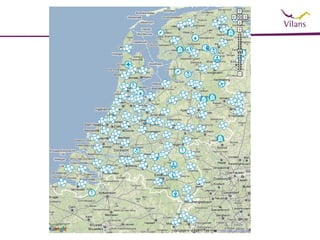
Nation-wide implementation programs
from 2004

• Quality collaboratives in LTC (falls,
  medication, pressure ulcers etc.) (> 500
  organisations)
• National Dementia Program: Regional
  networks of dementia services (57 regions)
• Care for Volunteers (95 organisations)
• Implementation Disease Management (22
  pilots)
• Up to care!
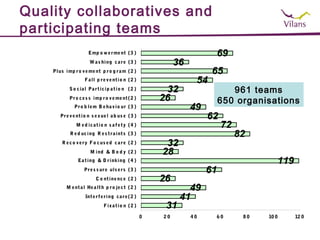
Quality collaboratives and
participating teams
                       Emp o w e r me nt ( 3 )                                 69
                        W a s hi ng c a r e (3 )                36
    Plus i mp r o v e me nt p r o g r a m ( 2 )                            65
                     F a l l p r e v e ntio n ( 2 )                   54
            S o c ia l Pa r t ic i p a t i o n ( 2 )        32                    961 teams
            Pr o c e s s imp r o v e me nt ( 2 )           26                  650 organisations
               Pr o b le m B e ha v io ur ( 3 )                      49
       Pr e v e nt io n s e x ue l a b us e ( 3 )                         62
                M e d ic a t io n s a f e t y ( 4 )                             72
            R e d uc i ng R e s t r a int s ( 3 )                                    82
        R e c o v e r y F o c us e d c a r e ( 2 )          32
                        M ind & B o d y (2 )               28
                 Ea t ing & D r inking ( 4 )                                                  119
                    Pr e s s ur e ul s e r s ( 3 )                        61
                           C o nt ine nc e ( 2 )           26
          M e nt a l He a lt h p r o je c t ( 2 )                  49
                     Int e r f e r i ng ca r e ( 2 )             41
                                F ix a t io n ( 2 )         31
                                                       0   20        40        60     80   10 0     12 0
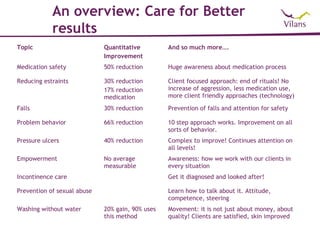
An overview: Care for Better
            results
Topic                        Quantitative         And so much more….
                             Improvement
Medication safety            50% reduction        Huge awareness about medication process

Reducing estraints           30% reduction        Client focused approach: end of rituals! No
                             17% reduction        increase of aggression, less medication use,
                             medication           more client friendly approaches (technology)

Falls                        30% reduction        Prevention of falls and attention for safety

Problem behavior             66% reduction        10 step approach works. Improvement on all
                                                  sorts of behavior.
Pressure ulcers              40% reduction        Complex to improve! Continues attention on
                                                  all levels!
Empowerment                  No average           Awareness: how we work with our clients in
                             measurable           every situation
Incontinence care                                 Get it diagnosed and looked after!

Prevention of sexual abuse                        Learn how to talk about it. Attitude,
                                                  competence, steering
Washing without water        20% gain, 90% uses   Movement: it is not just about money, about
                             this method          quality! Clients are satisfied, skin improved
National Dementia Care Program
(2005-2008)


• Networks in 57 regions across the country
  (>90% coverage)
• Views of clients and relatives as point of
  departure by local Alzheimer associations (14
  fields)
• 206 projects implemented
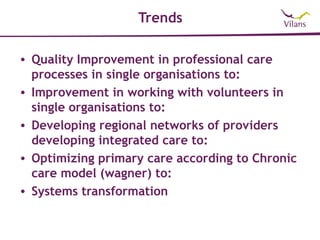
Trends

• Quality Improvement in professional care
  processes in single organisations to:
• Improvement in working with volunteers in
  single organisations to:
• Developing regional networks of providers
  developing integrated care to:
• Optimizing primary care according to Chronic
  care model (wagner) to:
• Systems transformation
The context

• Population ageing   • Shrinking work force
• Increasing demand   • Increased need for
  for LTC ánd TLC!      cost containment
• Decreasing social   • Productivity growth
  networks              lags behind
• Increasing demand   • Quality at risk
  for care workers    • Organisations
                        collapsing
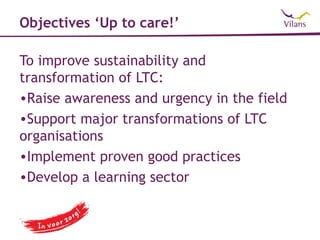
Objectives ‘Up to care!’

To improve sustainability and
transformation of LTC:
•Raise awareness and urgency in the field
•Support major transformations of LTC
organisations
•Implement proven good practices
•Develop a learning sector
What are we talking about?

• 600,000 service users in LTC
• 400,000 people employed
• 2,500,000 informal carers
   3,5 million people directly involved (= 1 out
  of five in the population)
• 13 billion Euros = 18,5 billion US $
How?

• Build up or to build upon strategic choices of an
  organisation
• Accelerate existing processes
• Input of existing knowledge (many piliots and
  programmes have preceded)  the end of
  pilotitis!
• Input of expert expertise
• Knowledge management, learning networks,
  community of practice
How?

• Generate/ spread knowledge on implementation
• Wide spread dissemination
• Transform hundreds of individual organizations over
  a period of four to five years supported by coaches
• Implement good practices, organize learning
  activities, communities
• Monitor results/outcomes
• Support the sector by sharing innovations and
  communication
Aims

• Better value for money
• Lower staff turnover, higher employees’
  satisfaction
• Empowered care workers
• In the end: improve quality of care/life
The target group


             Focus of transition policy
              Focus of transition policy
Themes

•   Technology supported care
•   Integrated care
•   Empowerment of care workers, bottom up
•   Operational management (Lean etc.)
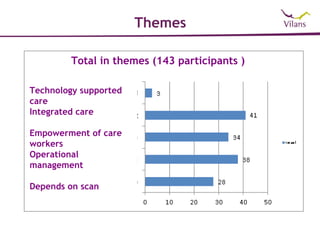
Themes

          Total   in themes (143 participants )

Technology supported
care
Integrated care

Empowerment of care
workers
Operational
management

Depends on scan
 
 
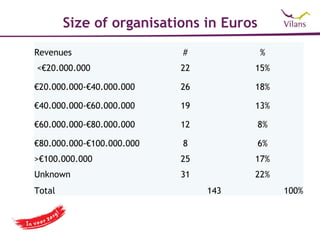
Size of organisations in Euros
Revenues                   #             %
<€20.000.000               22         15%

€20.000.000-€40.000.000    26         18%

€40.000.000-€60.000.000    19         13%

€60.000.000-€80.000.000    12            8%

€80.000.000-€100.000.000   8             6%
>€100.000.000              25         17%
Unknown                    31         22%
Total                           143           100%
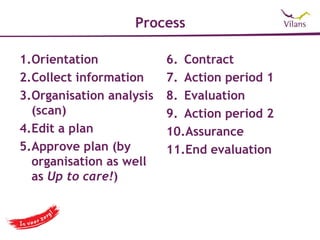
Process

1.Orientation             6. Contract
2.Collect information     7. Action period 1
3.Organisation analysis   8. Evaluation
  (scan)                  9. Action period 2
4.Edit a plan             10.Assurance
5.Approve plan (by        11.End evaluation
  organisation as well
  as Up to care!)


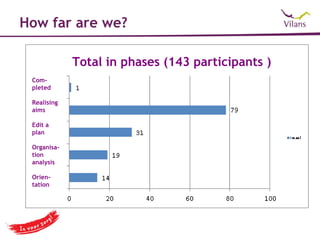
How far are we?

               Total in phases (143 participants )
 Com-
 pleted

 Realising
 aims

 Edit a
 plan

 Organisa-
 tion
 analysis

 Orien-
 tation
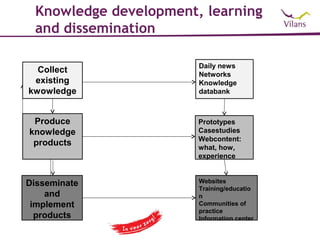
Knowledge development, learning
 and dissemination

                       Daily news
  Collect              Networks
 existing              Knowledge
kwowledge              databank


 Produce               Prototypes
knowledge              Casestudies
                       Webcontent:
 products              what, how,
                       experience


Disseminate            Websites
                       Training/educatio
    and                n
 implement             Communities of
                       practice
  products             Information center
Lots of communication
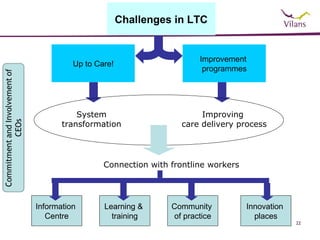
Challenges in LTC


                                         Improvement
          Up to Care!
                                          programmes


           System                         Improving
       transformation                care delivery process


                  Connection with frontline workers


Information       Learning &      Community           Innovation
   Centre           training      of practice           places
                                                                   22
Our main challenges

• How to collect, describe, validate and use good
  practices on sustainability with very weak evidence?
• How to streamline the method of system improvement
  across organizations and coaches?
• How to monitor/measure effects and causalities, while
  there are so many interfering factors?
• How to work with low professionalized staff in the
  organisations?
• How to ensure position of the client?

Up to care! IHI 2011 04-07 Vilans

  • 1.
    Up to care! Anationwide programme to ensure sustainability of long-term care - Henk Nies Utrecht, 7 april 2011
  • 2.
    Nation-wide implementation programs from2004 • Quality collaboratives in LTC (falls, medication, pressure ulcers etc.) (> 500 organisations) • National Dementia Program: Regional networks of dementia services (57 regions) • Care for Volunteers (95 organisations) • Implementation Disease Management (22 pilots) • Up to care!
  • 3.
    Quality collaboratives and participatingteams Emp o w e r me nt ( 3 ) 69 W a s hi ng c a r e (3 ) 36 Plus i mp r o v e me nt p r o g r a m ( 2 ) 65 F a l l p r e v e ntio n ( 2 ) 54 S o c ia l Pa r t ic i p a t i o n ( 2 ) 32 961 teams Pr o c e s s imp r o v e me nt ( 2 ) 26 650 organisations Pr o b le m B e ha v io ur ( 3 ) 49 Pr e v e nt io n s e x ue l a b us e ( 3 ) 62 M e d ic a t io n s a f e t y ( 4 ) 72 R e d uc i ng R e s t r a int s ( 3 ) 82 R e c o v e r y F o c us e d c a r e ( 2 ) 32 M ind & B o d y (2 ) 28 Ea t ing & D r inking ( 4 ) 119 Pr e s s ur e ul s e r s ( 3 ) 61 C o nt ine nc e ( 2 ) 26 M e nt a l He a lt h p r o je c t ( 2 ) 49 Int e r f e r i ng ca r e ( 2 ) 41 F ix a t io n ( 2 ) 31 0 20 40 60 80 10 0 12 0
  • 5.
    An overview: Carefor Better results Topic Quantitative And so much more…. Improvement Medication safety 50% reduction Huge awareness about medication process Reducing estraints 30% reduction Client focused approach: end of rituals! No 17% reduction increase of aggression, less medication use, medication more client friendly approaches (technology) Falls 30% reduction Prevention of falls and attention for safety Problem behavior 66% reduction 10 step approach works. Improvement on all sorts of behavior. Pressure ulcers 40% reduction Complex to improve! Continues attention on all levels! Empowerment No average Awareness: how we work with our clients in measurable every situation Incontinence care Get it diagnosed and looked after! Prevention of sexual abuse Learn how to talk about it. Attitude, competence, steering Washing without water 20% gain, 90% uses Movement: it is not just about money, about this method quality! Clients are satisfied, skin improved
  • 6.
    National Dementia CareProgram (2005-2008) • Networks in 57 regions across the country (>90% coverage) • Views of clients and relatives as point of departure by local Alzheimer associations (14 fields) • 206 projects implemented
  • 7.
    Trends • Quality Improvementin professional care processes in single organisations to: • Improvement in working with volunteers in single organisations to: • Developing regional networks of providers developing integrated care to: • Optimizing primary care according to Chronic care model (wagner) to: • Systems transformation
  • 8.
    The context • Populationageing • Shrinking work force • Increasing demand • Increased need for for LTC ánd TLC! cost containment • Decreasing social • Productivity growth networks lags behind • Increasing demand • Quality at risk for care workers • Organisations collapsing
  • 9.
    Objectives ‘Up tocare!’ To improve sustainability and transformation of LTC: •Raise awareness and urgency in the field •Support major transformations of LTC organisations •Implement proven good practices •Develop a learning sector
  • 10.
    What are wetalking about? • 600,000 service users in LTC • 400,000 people employed • 2,500,000 informal carers  3,5 million people directly involved (= 1 out of five in the population) • 13 billion Euros = 18,5 billion US $
  • 11.
    How? • Build upor to build upon strategic choices of an organisation • Accelerate existing processes • Input of existing knowledge (many piliots and programmes have preceded)  the end of pilotitis! • Input of expert expertise • Knowledge management, learning networks, community of practice
  • 12.
    How? • Generate/ spreadknowledge on implementation • Wide spread dissemination • Transform hundreds of individual organizations over a period of four to five years supported by coaches • Implement good practices, organize learning activities, communities • Monitor results/outcomes • Support the sector by sharing innovations and communication
  • 13.
    Aims • Better valuefor money • Lower staff turnover, higher employees’ satisfaction • Empowered care workers • In the end: improve quality of care/life
  • 14.
    The target group Focus of transition policy Focus of transition policy
  • 15.
    Themes • Technology supported care • Integrated care • Empowerment of care workers, bottom up • Operational management (Lean etc.)
  • 16.
    Themes   Total in themes (143 participants ) Technology supported care Integrated care Empowerment of care workers Operational management Depends on scan    
  • 17.
    Size of organisationsin Euros Revenues # % <€20.000.000 22 15% €20.000.000-€40.000.000 26 18% €40.000.000-€60.000.000 19 13% €60.000.000-€80.000.000 12 8% €80.000.000-€100.000.000 8 6% >€100.000.000 25 17% Unknown 31 22% Total 143 100%
  • 18.
    Process 1.Orientation 6. Contract 2.Collect information 7. Action period 1 3.Organisation analysis 8. Evaluation (scan) 9. Action period 2 4.Edit a plan 10.Assurance 5.Approve plan (by 11.End evaluation organisation as well as Up to care!)   
  • 19.
    How far arewe?   Total in phases (143 participants ) Com- pleted Realising aims Edit a plan Organisa- tion analysis Orien- tation
  • 20.
    Knowledge development, learning and dissemination Daily news Collect Networks existing Knowledge kwowledge databank Produce Prototypes knowledge Casestudies Webcontent: products what, how, experience Disseminate Websites Training/educatio and n implement Communities of practice products Information center
  • 21.
  • 22.
    Challenges in LTC Improvement Up to Care! programmes System Improving transformation care delivery process Connection with frontline workers Information Learning & Community Innovation Centre training of practice places 22
  • 23.
    Our main challenges •How to collect, describe, validate and use good practices on sustainability with very weak evidence? • How to streamline the method of system improvement across organizations and coaches? • How to monitor/measure effects and causalities, while there are so many interfering factors? • How to work with low professionalized staff in the organisations? • How to ensure position of the client?

Editor's Notes

  • #4 Engelse versie nog invoegen