headspace: getting the fit right
April 2012


Nick Prendergast
The Reality


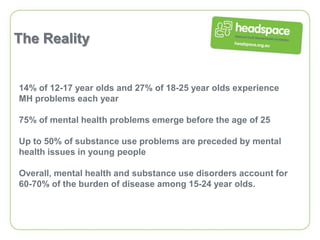
14% of 12-17 year olds and 27% of 18-25 year olds experience
MH problems each year

75% of mental health problems emerge before the age of 25

Up to 50% of substance use problems are preceded by mental
health issues in young people

Overall, mental health and substance use disorders account for
60-70% of the burden of disease among 15-24 year olds.
Standard System Approach


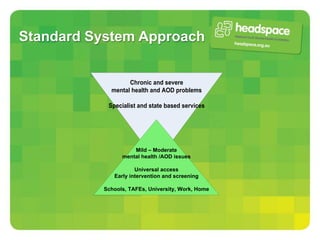
                  Chronic and severe
            mental health and AOD problems

           Specialist and state based services


                    Mild – Moderate
                mental health /AOD issues

                     Universal access
             Early intervention and screening

          Schools, TAFEs, University, Work, Home
Key Messages


Young people should have access to youth-specific services

Early intervention ensures timely treatment thus decreasing the
disruption to the young person’s life and preventing the
development of chronic disabilities

Services need to provide a range of evidence-based clinical
interventions to respond to the diverse range of needs and goals
that young people with mental health problems experience
A new paradigm in mental
health & AOD services
Bridging the gaps between;


   •General health care and specialist services
   •Commonwealth and State/Territory initiatives
   •Adult and child systems
   •Mental health and AOD services

Client group = ALL young people, aged between 12-25

Early intervention and early help seeking
A new paradigm in mental
health / AOD services


 • No ‘gate keeping’, no ‘screening out’
 • Services designed and tailored to meet client demand
 • Locally relevant services
 • Fee structure - free, low cost or fee for service
 • Re-orienting and maximising the use of existing resources

 • Meaningful youth participation

 • Respectful family involvement
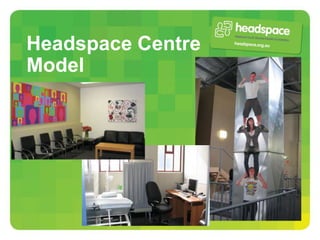
Headspace Centre
Model
Integration, coordination and
community capacity
Integration and Co-ordination:
•Common assessment, common management, improved
coordination
•Co-location
•Referral pathways
•Case review systems

Community capacity building:
Service provider education and training
Community awareness activities
Actively working with schools, TAFEs, Universities
Accessible youth
friendly services

The services must include the following:

•General health
•Mental health and counselling
•Education, employment and other services
•Alcohol and other drug services

Ideally service should include a broad range of youth and health
services to meet local needs

In kind sessions from consortium members and stakeholders
Co-location and sessional
services

The enhancement of the existing services and systems of
Consortium organisations and community partners:

• Co-location of services
• Sessional services
• Effective and efficient links to off site services
Components of hWM &
            NMh
Direct Service Delivery using a multidisciplinary approach

•   General practice, psychology, psychiatry, social work and occupational
    therapy.
•   Episode of Care model


Capacity Building
•  Scoping of available services and difficulties in accessing services
•  Improved coordination and mobilisation of existing resources
•  Identification of training needs
•  Coordination of training initiatives
•  Roll-out of community awareness raising strategies

Research and Evaluation
•  Development of new tools for assessment and early intervention
•  Utilisation of existing neuropsychological and co morbidity expertise
•  Contribution to knowledge of evidence-based approaches
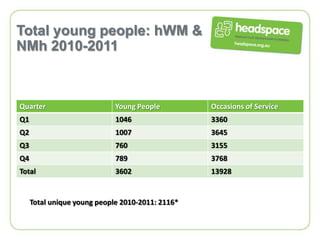
Total young people: hWM &
NMh 2010-2011


Quarter                      Young People         Occasions of Service
Q1                           1046                 3360
Q2                           1007                 3645
Q3                           760                  3155
Q4                           789                  3768
Total                        3602                 13928


     Total unique young people 2010-2011: 2116*
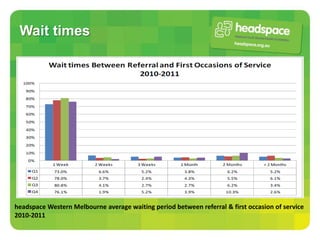
Wait times


headspace Western Melbourne average waiting period between referral & first occasion of service
2010-2011
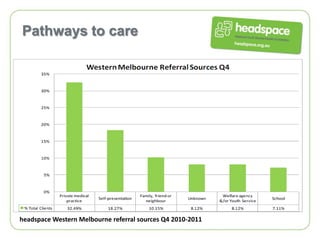
Pathways to care


headspace Western Melbourne referral sources Q4 2010-2011
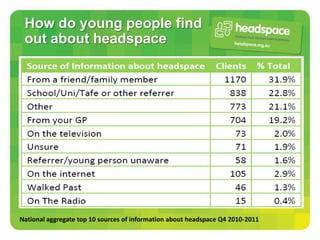
How do young people find
 out about headspace


National aggregate top 10 sources of information about headspace Q4 2010-2011
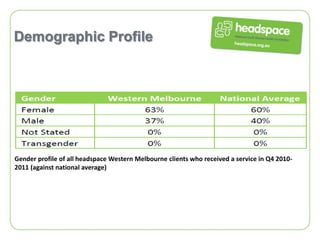
Demographic Profile


Gender profile of all headspace Western Melbourne clients who received a service in Q4 2010-
2011 (against national average)
Thank You

     Nick Prendergast
nprendergast@G21.com.au
 hWM ph: 61 3 5227 4016
 NMh ph: 61 1300 880 218
  Mob: 61 3 40109 1060

Nick Prendergat - The International Perspective on Youth Mental Health Services

  • 1.
    headspace: getting thefit right April 2012 Nick Prendergast
  • 3.
    The Reality 14% of12-17 year olds and 27% of 18-25 year olds experience MH problems each year 75% of mental health problems emerge before the age of 25 Up to 50% of substance use problems are preceded by mental health issues in young people Overall, mental health and substance use disorders account for 60-70% of the burden of disease among 15-24 year olds.
  • 4.
    Standard System Approach Chronic and severe mental health and AOD problems Specialist and state based services Mild – Moderate mental health /AOD issues Universal access Early intervention and screening Schools, TAFEs, University, Work, Home
  • 5.
    Key Messages Young peopleshould have access to youth-specific services Early intervention ensures timely treatment thus decreasing the disruption to the young person’s life and preventing the development of chronic disabilities Services need to provide a range of evidence-based clinical interventions to respond to the diverse range of needs and goals that young people with mental health problems experience
  • 6.
    A new paradigmin mental health & AOD services Bridging the gaps between; •General health care and specialist services •Commonwealth and State/Territory initiatives •Adult and child systems •Mental health and AOD services Client group = ALL young people, aged between 12-25 Early intervention and early help seeking
  • 7.
    A new paradigmin mental health / AOD services • No ‘gate keeping’, no ‘screening out’ • Services designed and tailored to meet client demand • Locally relevant services • Fee structure - free, low cost or fee for service • Re-orienting and maximising the use of existing resources • Meaningful youth participation • Respectful family involvement
  • 8.
  • 9.
    Integration, coordination and communitycapacity Integration and Co-ordination: •Common assessment, common management, improved coordination •Co-location •Referral pathways •Case review systems Community capacity building: Service provider education and training Community awareness activities Actively working with schools, TAFEs, Universities
  • 10.
    Accessible youth friendly services Theservices must include the following: •General health •Mental health and counselling •Education, employment and other services •Alcohol and other drug services Ideally service should include a broad range of youth and health services to meet local needs In kind sessions from consortium members and stakeholders
  • 11.
    Co-location and sessional services Theenhancement of the existing services and systems of Consortium organisations and community partners: • Co-location of services • Sessional services • Effective and efficient links to off site services
  • 12.
    Components of hWM& NMh Direct Service Delivery using a multidisciplinary approach • General practice, psychology, psychiatry, social work and occupational therapy. • Episode of Care model Capacity Building • Scoping of available services and difficulties in accessing services • Improved coordination and mobilisation of existing resources • Identification of training needs • Coordination of training initiatives • Roll-out of community awareness raising strategies Research and Evaluation • Development of new tools for assessment and early intervention • Utilisation of existing neuropsychological and co morbidity expertise • Contribution to knowledge of evidence-based approaches
  • 13.
    Total young people:hWM & NMh 2010-2011 Quarter Young People Occasions of Service Q1 1046 3360 Q2 1007 3645 Q3 760 3155 Q4 789 3768 Total 3602 13928 Total unique young people 2010-2011: 2116*
  • 14.
    Wait times headspace WesternMelbourne average waiting period between referral & first occasion of service 2010-2011
  • 15.
    Pathways to care headspaceWestern Melbourne referral sources Q4 2010-2011
  • 16.
    How do youngpeople find out about headspace National aggregate top 10 sources of information about headspace Q4 2010-2011
  • 17.
    Demographic Profile Gender profileof all headspace Western Melbourne clients who received a service in Q4 2010- 2011 (against national average)
  • 18.
    Thank You Nick Prendergast nprendergast@G21.com.au hWM ph: 61 3 5227 4016 NMh ph: 61 1300 880 218 Mob: 61 3 40109 1060

Editor's Notes

  • #9 Young people come to headspace with a range of issues. Mostly they self-refer or are referred by their families. They rarely identify as having a mental health problem. They come because they feel down, trapped, stressed, bullied, have problems with relationships, have problems holding jobs or staying in school or have problems maintaining concentration. As one would expect, the language used is mainstream and is not easily translated into specific diagnostic criteria or categories. While these problems may seem small or even trivial to the older generation the consequences can be significant and may include family discord, isolation, decreased attendance at school and at work, self harm and, in its most extreme, suicide.