Promoting Inclusive
classrooms:-
Adopting Universal
Design for
Learning(UDL)
DR.GITA NARAHARI
PSYCHOLOGIST AND AUTHOR
Universal Design for Learning
(UDL)
 Is a research-based framework for designing
curricula—that is, educational goals, methods,
materials, and assessments.
That enable all individuals to gain knowledge, skills, and
enthusiasm for learning.
This is accomplished by simultaneously providing rich
supports for learning and reducing barriers to the
curriculum, while maintaining high achievement
standards for all students.
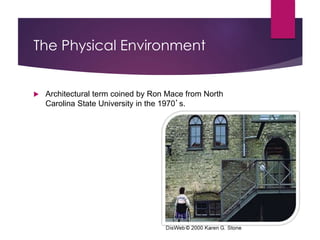
The Physical Environment
 Architectural term coined by Ron Mace from North
Carolina State University in the 1970’s.
Curricular Barriers
 Just as physical Barriers occur in our physical
environment, curricular barriers exist in our
Instructional.
UDL
 Instructional Environment
 Learning barriers may exist in our curricular
environment
 Proactive design of curriculum
and instruction
 Instructional accommodations can be time
consuming and difficult to implement
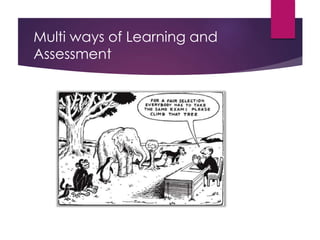
Multi ways of Learning and
Assessment
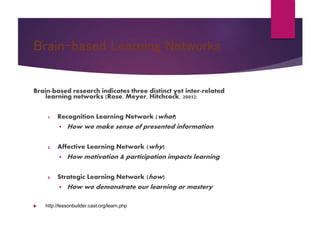
Brain-based Learning Networks
Brain-based research indicates three distinct yet inter-related
learning networks (Rose, Meyer, Hitchcock, 2005):
1. Recognition Learning Network (what)
 How we make sense of presented information
2. Affective Learning Network (why)
 How motivation & participation impacts learning
3. Strategic Learning Network (how)
 How we demonstrate our learning or mastery
 http://lessonbuilder.cast.org/learn.php
Practicing UDL
 1.Share one unique Experience with your group.
 2. videos Making
 3.Ppts
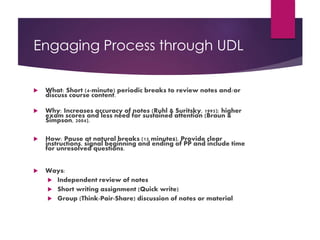
Engaging Process through UDL
 What: Short (4-minute) periodic breaks to review notes and/or
discuss course content.
 Why: Increases accuracy of notes (Ruhl & Suritsky, 1995); higher
exam scores and less need for sustained attention (Braun &
Simpson, 2004).
 How: Pause at natural breaks (15 minutes). Provide clear
instructions, signal beginning and ending of PP and include time
for unresolved questions.
 Ways:
 Independent review of notes
 Short writing assignment (Quick write)
 Group (Think-Pair-Share) discussion of notes or material
Lets learn more, lets UDL.
Prof.S.B.Gita Narahari
gitanarahari@rediffmail.com
drsbgita@gmail.com
Thank you for Willingness to
Learn.

Udl

  • 1.
    Promoting Inclusive classrooms:- Adopting Universal Designfor Learning(UDL) DR.GITA NARAHARI PSYCHOLOGIST AND AUTHOR
  • 2.
    Universal Design forLearning (UDL)  Is a research-based framework for designing curricula—that is, educational goals, methods, materials, and assessments. That enable all individuals to gain knowledge, skills, and enthusiasm for learning. This is accomplished by simultaneously providing rich supports for learning and reducing barriers to the curriculum, while maintaining high achievement standards for all students.
  • 3.
    The Physical Environment Architectural term coined by Ron Mace from North Carolina State University in the 1970’s.
  • 4.
    Curricular Barriers  Justas physical Barriers occur in our physical environment, curricular barriers exist in our Instructional. UDL  Instructional Environment  Learning barriers may exist in our curricular environment  Proactive design of curriculum and instruction  Instructional accommodations can be time consuming and difficult to implement
  • 5.
    Multi ways ofLearning and Assessment
  • 6.
    Brain-based Learning Networks Brain-basedresearch indicates three distinct yet inter-related learning networks (Rose, Meyer, Hitchcock, 2005): 1. Recognition Learning Network (what)  How we make sense of presented information 2. Affective Learning Network (why)  How motivation & participation impacts learning 3. Strategic Learning Network (how)  How we demonstrate our learning or mastery  http://lessonbuilder.cast.org/learn.php
  • 7.
    Practicing UDL  1.Shareone unique Experience with your group.  2. videos Making  3.Ppts
  • 9.
    Engaging Process throughUDL  What: Short (4-minute) periodic breaks to review notes and/or discuss course content.  Why: Increases accuracy of notes (Ruhl & Suritsky, 1995); higher exam scores and less need for sustained attention (Braun & Simpson, 2004).  How: Pause at natural breaks (15 minutes). Provide clear instructions, signal beginning and ending of PP and include time for unresolved questions.  Ways:  Independent review of notes  Short writing assignment (Quick write)  Group (Think-Pair-Share) discussion of notes or material
  • 10.
    Lets learn more,lets UDL. Prof.S.B.Gita Narahari gitanarahari@rediffmail.com drsbgita@gmail.com Thank you for Willingness to Learn.