Open Government Data
Insights from the International Open
Government Data Conference
September 17, 2012
Peter Speyer
Director of Data Development
The conference
• Objective:
Gather policymakers, developers, and others with a keen
interest in open government data to share lessons learned,
stimulate new ideas, and demonstrate the power of
democratizing data
• 400 people / 50 countries / 3 days
• 100 speakers (including 2 days of online lightning talks)
• Policy & technical track
• Presentations and videos online
http://www.data.gov/communities/conference
• LinkedIn Open Data Innovation Group
http://bit.ly/ODNetwork
2
Organizers
• Launched in May 2009
• “The purpose of Data.gov is to
increase public access to high-
value, machine-readable datasets
generated by the Executive Branch
of the Federal Government”
• More than 450,000 datasets
• Several communities & community
features
• Launch of Open Government
Platform (OGPL) in May 2012
• Launched in April 2010
• “Bringing global economic and
development data to the web for
the world to use”
• Centered around
data.worldbank.org
• Indicators, data catalog, microdata
• Next frontier for open data at World
Bank: help governments open up
(Jim Yong Kim)
o Mapping aid-funded projects:
Malawi done, 13 countries to follow
3
Benefits of open government data
• Outsource creativity to improve public services:
most of the world’s smartest people don’t work for you
(Sun co-founder Bill Joy)
• Improve accountability of government
• Increase trust in government through transparency
• Save time/expenditure of answering citizens’ data requests
• Enable government to use own data
• Create economic opportunity, e.g., $100B weather data market
• Show gaps in data collected
4
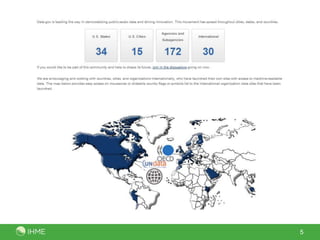
5
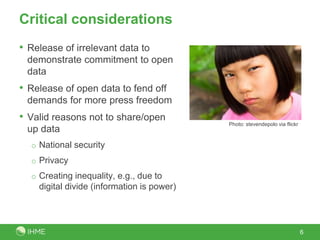
Critical considerations
• Release of irrelevant data to
demonstrate commitment to open
data
• Release of open data to fend off
demands for more press freedom
• Valid reasons not to share/open
up data
o National security
o Privacy
o Creating inequality, e.g., due to
digital divide (information is power)
6
Photo: stevendepolo via flickr
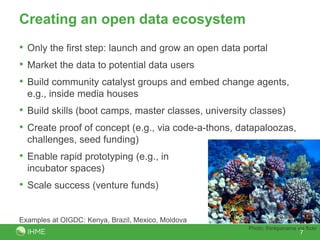
Creating an open data ecosystem
• Only the first step: launch and grow an open data portal
• Market the data to potential data users
• Build community catalyst groups and embed change agents,
e.g., inside media houses
• Build skills (boot camps, master classes, university classes)
• Create proof of concept (e.g., via code-a-thons, datapaloozas,
challenges, seed funding)
• Enable rapid prototyping (e.g., in
incubator spaces)
• Scale success (venture funds)
Examples at OIGDC: Kenya, Brazil, Mexico, Moldova
7
Photo: thinkpanama via flickr
Keys to success
• Focus on bigger agenda than just launching a portal
• Involve all data owners and stakeholders early on
• Engage data users (entrepreneurs, developers, journalists)
and citizens to encourage the use of data
• Use standardization carefully: can be useful or straightjacket
• Consider open-source software
• Launching a platform is easy; the real work is making it
sustainable and creating an ecosystem around it
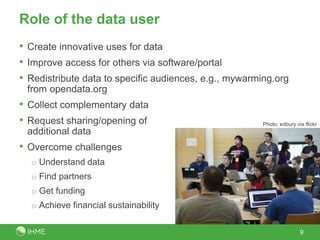
Role of the data user
• Create innovative uses for data
• Improve access for others via software/portal
• Redistribute data to specific audiences, e.g., mywarming.org
from opendata.org
• Collect complementary data
• Request sharing/opening of
additional data
• Overcome challenges
o Understand data
o Find partners
o Get funding
o Achieve financial sustainability
9
Photo: edbury via flickr
Key points
• Focus of open data discussions will have to
shift from data publishing to data use
• The best validator of open data is usage
• Open data should be optimized for
consumption, not for business/process
• Sustainability of open data depends on
creation of ecosystems around them
• Biggest obstacle for governments to open
data is not doing something
10
Photo: Erik Moberg via flickr

Open Goverment Data: Insights from the International Open Goverment Data Conference

  • 1.
    Open Government Data Insightsfrom the International Open Government Data Conference September 17, 2012 Peter Speyer Director of Data Development
  • 2.
    The conference • Objective: Gatherpolicymakers, developers, and others with a keen interest in open government data to share lessons learned, stimulate new ideas, and demonstrate the power of democratizing data • 400 people / 50 countries / 3 days • 100 speakers (including 2 days of online lightning talks) • Policy & technical track • Presentations and videos online http://www.data.gov/communities/conference • LinkedIn Open Data Innovation Group http://bit.ly/ODNetwork 2
  • 3.
    Organizers • Launched inMay 2009 • “The purpose of Data.gov is to increase public access to high- value, machine-readable datasets generated by the Executive Branch of the Federal Government” • More than 450,000 datasets • Several communities & community features • Launch of Open Government Platform (OGPL) in May 2012 • Launched in April 2010 • “Bringing global economic and development data to the web for the world to use” • Centered around data.worldbank.org • Indicators, data catalog, microdata • Next frontier for open data at World Bank: help governments open up (Jim Yong Kim) o Mapping aid-funded projects: Malawi done, 13 countries to follow 3
  • 4.
    Benefits of opengovernment data • Outsource creativity to improve public services: most of the world’s smartest people don’t work for you (Sun co-founder Bill Joy) • Improve accountability of government • Increase trust in government through transparency • Save time/expenditure of answering citizens’ data requests • Enable government to use own data • Create economic opportunity, e.g., $100B weather data market • Show gaps in data collected 4
  • 5.
  • 6.
    Critical considerations • Releaseof irrelevant data to demonstrate commitment to open data • Release of open data to fend off demands for more press freedom • Valid reasons not to share/open up data o National security o Privacy o Creating inequality, e.g., due to digital divide (information is power) 6 Photo: stevendepolo via flickr
  • 7.
    Creating an opendata ecosystem • Only the first step: launch and grow an open data portal • Market the data to potential data users • Build community catalyst groups and embed change agents, e.g., inside media houses • Build skills (boot camps, master classes, university classes) • Create proof of concept (e.g., via code-a-thons, datapaloozas, challenges, seed funding) • Enable rapid prototyping (e.g., in incubator spaces) • Scale success (venture funds) Examples at OIGDC: Kenya, Brazil, Mexico, Moldova 7 Photo: thinkpanama via flickr
  • 8.
    Keys to success •Focus on bigger agenda than just launching a portal • Involve all data owners and stakeholders early on • Engage data users (entrepreneurs, developers, journalists) and citizens to encourage the use of data • Use standardization carefully: can be useful or straightjacket • Consider open-source software • Launching a platform is easy; the real work is making it sustainable and creating an ecosystem around it
  • 9.
    Role of thedata user • Create innovative uses for data • Improve access for others via software/portal • Redistribute data to specific audiences, e.g., mywarming.org from opendata.org • Collect complementary data • Request sharing/opening of additional data • Overcome challenges o Understand data o Find partners o Get funding o Achieve financial sustainability 9 Photo: edbury via flickr
  • 10.
    Key points • Focusof open data discussions will have to shift from data publishing to data use • The best validator of open data is usage • Open data should be optimized for consumption, not for business/process • Sustainability of open data depends on creation of ecosystems around them • Biggest obstacle for governments to open data is not doing something 10 Photo: Erik Moberg via flickr

Editor's Notes

  • #2 Welcome Thanks for coming, I’m sure you are all here because of the Global Health Data Exchange, not because there is food