Integrating Differentiated Instruction & Understanding by Design Carol Ann Tomlinson Jay McTighe    Presentation by  Colleen Mitchell
 
UBd= Understanding by Design= curriculum design model DI= Differentiated Instruction= instructional design model UbD + DI= whom they teach (students), where they teach (learning environment), what they teach (content), how they teach (instruction).
"Quality classrooms evolve around powerful knowledge that works for each student." p. 3
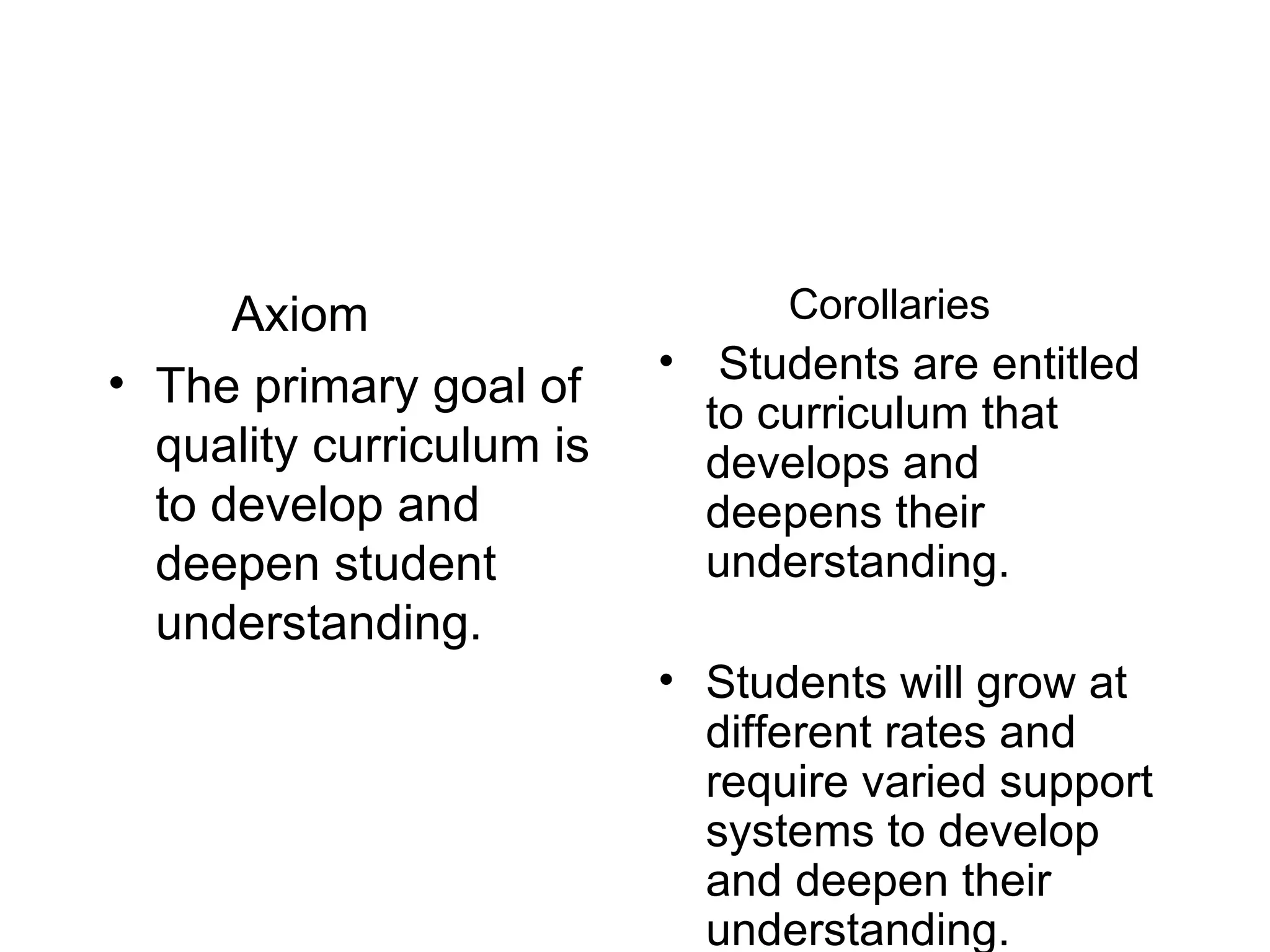
Axiom The primary goal of quality curriculum is to develop and deepen student understanding. Corollaries  Students are entitled to curriculum that develops and deepens their understanding. Students will grow at different rates and require varied support systems to develop and deepen their understanding.
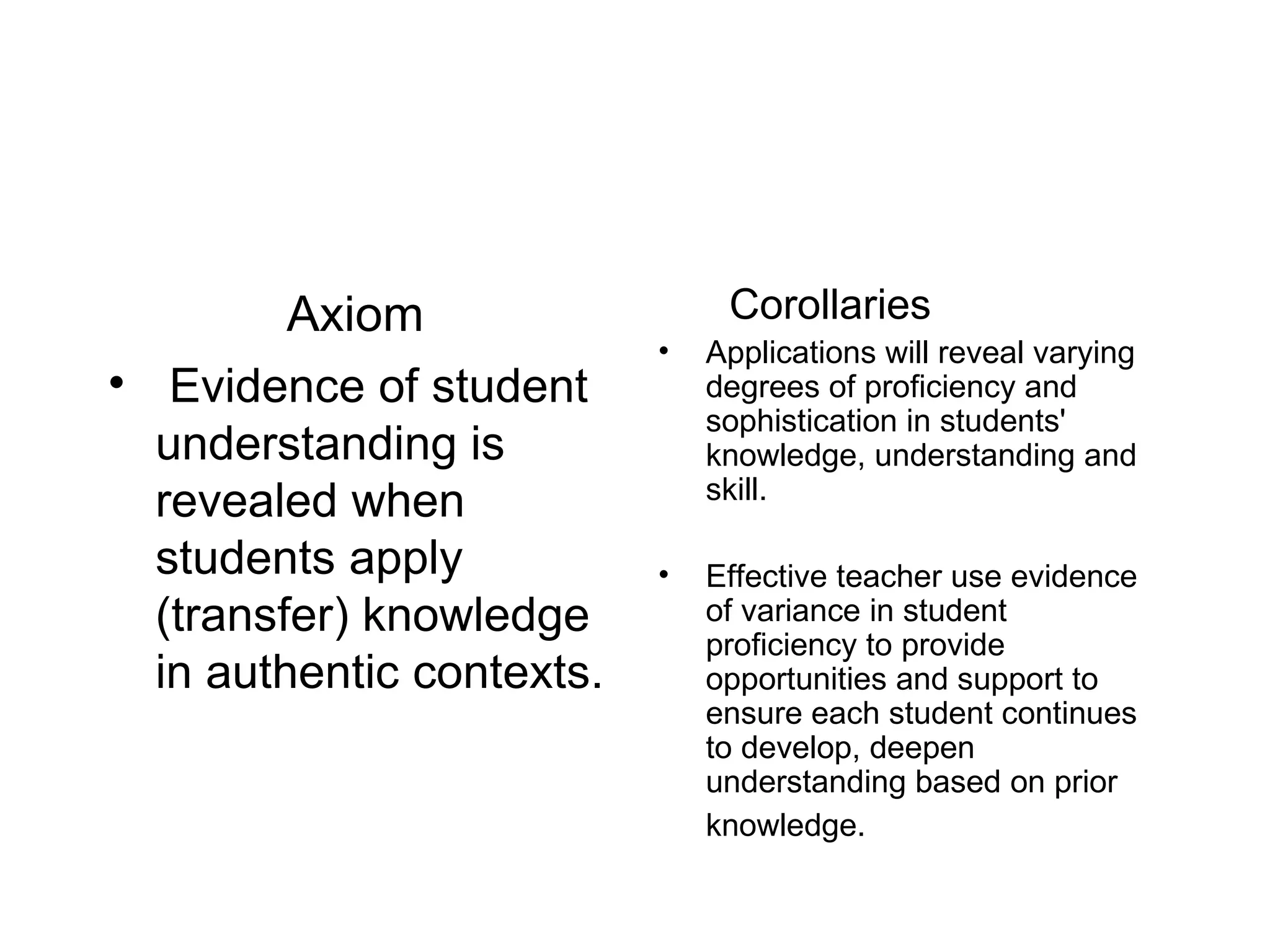
Axiom Evidence of student understanding is revealed when students apply (transfer) knowledge in authentic contexts. Corollaries Applications will reveal varying degrees of proficiency and sophistication in students' knowledge, understanding and skill. Effective teacher use evidence of variance in student proficiency to provide opportunities and support to ensure each student continues to develop, deepen understanding based on prior knowledge.
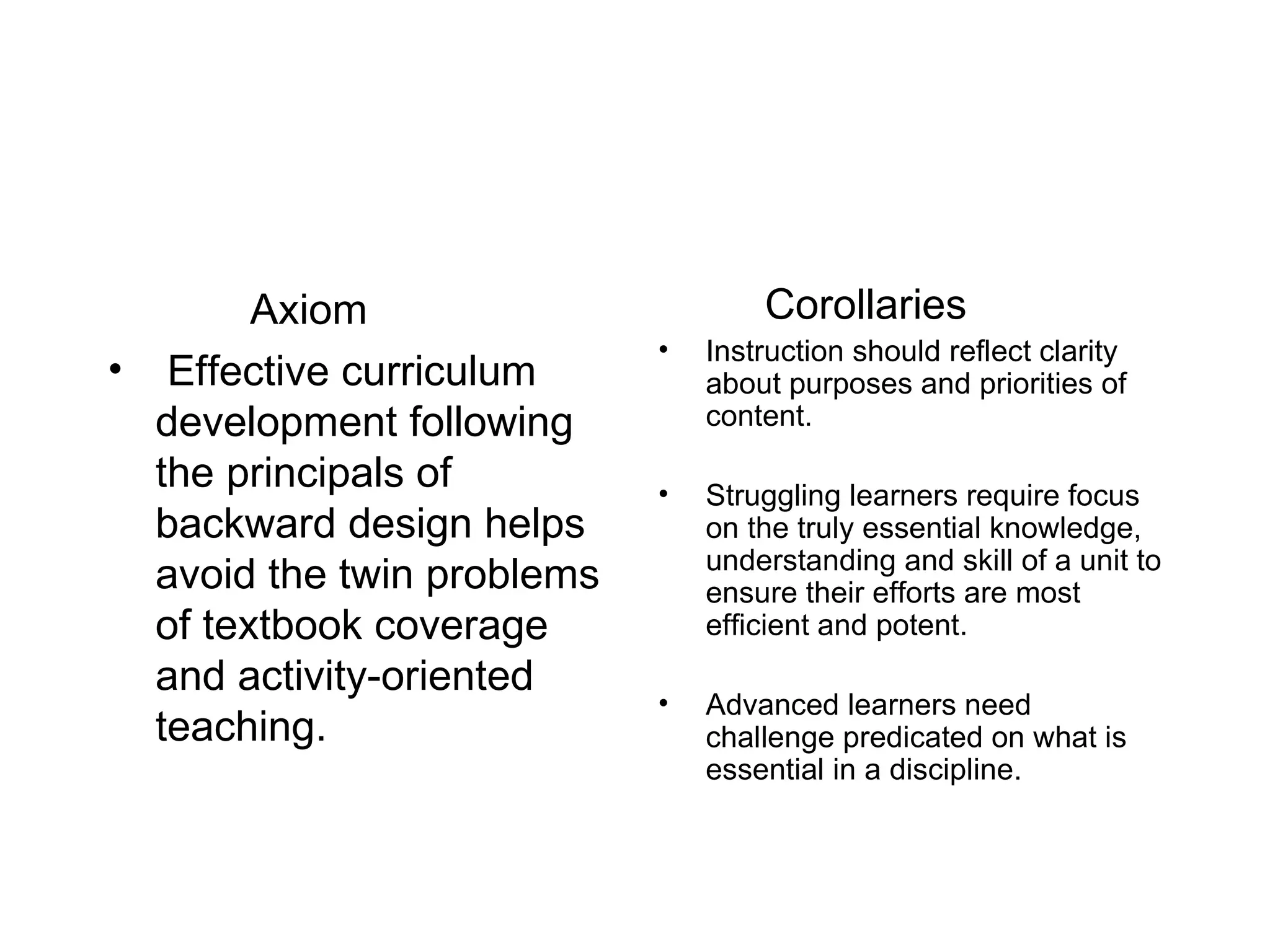
Axiom Effective curriculum development following the principals of backward design helps avoid the twin problems of textbook coverage and activity-oriented teaching. Corollaries Instruction should reflect clarity about purposes and priorities of content. Struggling learners require focus on the truly essential knowledge, understanding and skill of a unit to ensure their efforts are most efficient and potent. Advanced learners need challenge predicated on what is essential in a discipline.
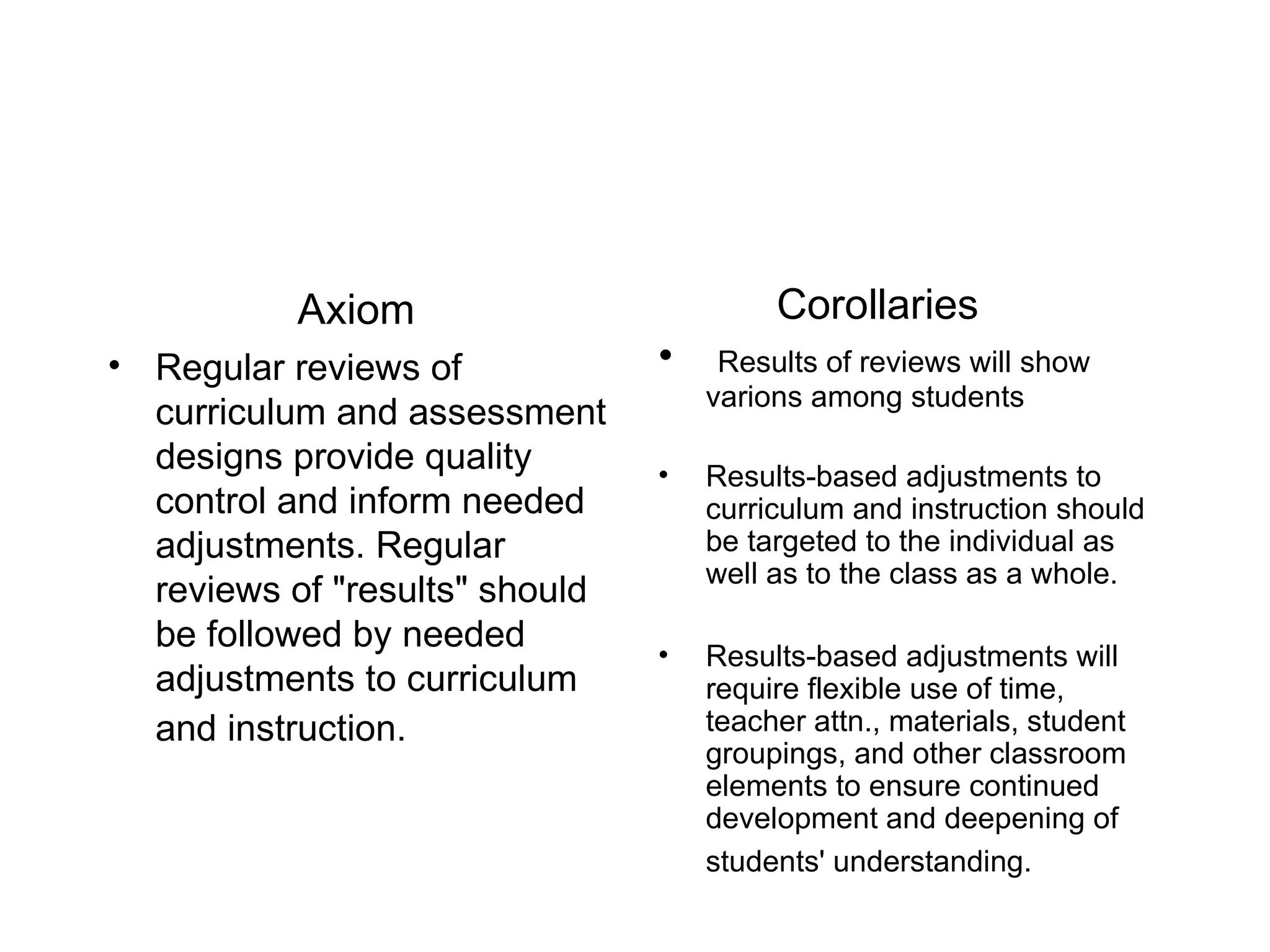
Axiom Regular reviews of curriculum and assessment designs provide quality control and inform needed adjustments. Regular reviews of "results" should be followed by needed adjustments to curriculum and instruction.   Corollaries Results of reviews will show varions among students Results-based adjustments to curriculum and instruction should be targeted to the individual as well as to the class as a whole. Results-based adjustments will require flexible use of time, teacher attn., materials, student groupings, and other classroom elements to ensure continued development and deepening of students' understanding.
Axiom Teacher provide opportunities for students to explore, interpret, apply, shift perspectives, empathize and self-assess. These six facets provide conceptual lenses through which student understanding is assessed. Corollaries Students should be guided and supported in thinking in complex ways. It is NOT the case that struggling learners must master the basics before they can engage in thinking. Master and understanding come THROUGH meaning interaction with ideas. Students will differ in the level of sophistication of their thinking and understanding at a given time. Teachers should be prepared to provide opportunity and support continually develop students' understandings and capacities as thinkers.
Axiom Teachers,  students and districts benefit by "working smarter" and using technology and other vehicles to collaboratively design, share and critique units of study.  Corollaries Students benefit when teachers share understandings, routines, instructional approaches, etc. Routine collaboration between experts, teachers, etc. should occur. Technology should be used to address varied learner needs and to assist teacher in keeping track of student growth.
  Axiom UbD is a way of thinking, not a program. Educators adapt its tools and materials with the goal of promoting better student understanding.   Corollaries Differentiated instruction is a way of thinking, not a formula or recipe. Educators draw on, apply and adapts its tools to maximize learning for the full range of learners. Effective differentiation guides educators in thinking effectively about whom they teach, where they teach, and how they teach in order to ensure that what they teacher provides each students with maximum power as a learner.
Question? How do we create equitable learning communities where the needs of every child is met? How do we foster learning where students see the value and real world connections in all topics and content areas? How to we as teachers sustain such a high level of teaching and learning?
 

Ub D Mitchell

  • 1.
    IntegratingDifferentiated Instruction & Understanding by Design Carol Ann Tomlinson Jay McTighe Presentation by Colleen Mitchell
  • 2.
  • 3.
    UBd= Understanding byDesign= curriculum design model DI= Differentiated Instruction= instructional design model UbD + DI= whom they teach (students), where they teach (learning environment), what they teach (content), how they teach (instruction).
  • 4.
    "Quality classrooms evolvearound powerful knowledge that works for each student." p. 3
  • 5.
    Axiom The primarygoal of quality curriculum is to develop and deepen student understanding. Corollaries Students are entitled to curriculum that develops and deepens their understanding. Students will grow at different rates and require varied support systems to develop and deepen their understanding.
  • 6.
    Axiom Evidence ofstudent understanding is revealed when students apply (transfer) knowledge in authentic contexts. Corollaries Applications will reveal varying degrees of proficiency and sophistication in students' knowledge, understanding and skill. Effective teacher use evidence of variance in student proficiency to provide opportunities and support to ensure each student continues to develop, deepen understanding based on prior knowledge.
  • 7.
    Axiom Effective curriculumdevelopment following the principals of backward design helps avoid the twin problems of textbook coverage and activity-oriented teaching. Corollaries Instruction should reflect clarity about purposes and priorities of content. Struggling learners require focus on the truly essential knowledge, understanding and skill of a unit to ensure their efforts are most efficient and potent. Advanced learners need challenge predicated on what is essential in a discipline.
  • 8.
    Axiom Regular reviewsof curriculum and assessment designs provide quality control and inform needed adjustments. Regular reviews of "results" should be followed by needed adjustments to curriculum and instruction. Corollaries Results of reviews will show varions among students Results-based adjustments to curriculum and instruction should be targeted to the individual as well as to the class as a whole. Results-based adjustments will require flexible use of time, teacher attn., materials, student groupings, and other classroom elements to ensure continued development and deepening of students' understanding.
  • 9.
    Axiom Teacher provideopportunities for students to explore, interpret, apply, shift perspectives, empathize and self-assess. These six facets provide conceptual lenses through which student understanding is assessed. Corollaries Students should be guided and supported in thinking in complex ways. It is NOT the case that struggling learners must master the basics before they can engage in thinking. Master and understanding come THROUGH meaning interaction with ideas. Students will differ in the level of sophistication of their thinking and understanding at a given time. Teachers should be prepared to provide opportunity and support continually develop students' understandings and capacities as thinkers.
  • 10.
    Axiom Teachers, students and districts benefit by "working smarter" and using technology and other vehicles to collaboratively design, share and critique units of study. Corollaries Students benefit when teachers share understandings, routines, instructional approaches, etc. Routine collaboration between experts, teachers, etc. should occur. Technology should be used to address varied learner needs and to assist teacher in keeping track of student growth.
  • 11.
    AxiomUbD is a way of thinking, not a program. Educators adapt its tools and materials with the goal of promoting better student understanding. Corollaries Differentiated instruction is a way of thinking, not a formula or recipe. Educators draw on, apply and adapts its tools to maximize learning for the full range of learners. Effective differentiation guides educators in thinking effectively about whom they teach, where they teach, and how they teach in order to ensure that what they teacher provides each students with maximum power as a learner.
  • 12.
    Question? How dowe create equitable learning communities where the needs of every child is met? How do we foster learning where students see the value and real world connections in all topics and content areas? How to we as teachers sustain such a high level of teaching and learning?
  • 13.