Teaching for Understanding Framework in Practice Su-Tuan Lulee Instructor: Dr. Susan Moisey EDDE 803, Nov. 11, 2010
Introduction In this presentation: Core elements of the TfU framework Examples for using TfU in designing unit plans or curriculum  Criteria & tools for design and implementation
Introduction Teaching for Understanding (TfU) is a research project (1988 - 1995) in Project Zero at HGSE. Teaching for Understanding Guide  Teaching for Understanding: Linking Research with Practice  (Both Jossey-Bass, 1998)
What is Teaching for Understanding? Understanding as the capability to perform. TfU is not all new. It’s not created. What the researchers have done was to capture what good teachers do & make them more explicit and visible. TfU framework does not  mean to capture every element of effective classroom practice—other factors such as classroom structure and teacher-student relationships also play a role.
What is Teaching for Understanding? TfU framework  is a guide to keep the focus of educational practice on understanding, while allowing teachers flexibility to design units that fit their priorities and teaching style.  provides a set of language and structure for planning curriculum and for discussion pedagogy with other colleagues and students  http:// www.youtube.com/watch?v =xf3VThBEex8
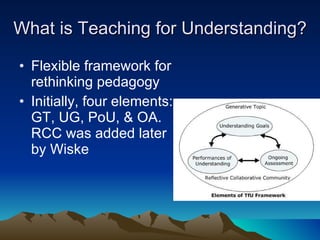
What is Teaching for Understanding? Flexible framework for  rethinking pedagogy Initially, four elements:  GT, UG, PoU, & OA.  RCC was added later  by Wiske
Generative Topics What topics are worth teaching? Dewey’s idea of organizing curriculum around themes  Criteria for a good GT: Centrality: core to the discipline Connectivity: connect to other topics, one or more disciplines, and students’ non-school context  Accessibility: has more resources for students to access Interesting: to students and to instructors Examples:  “ Balance diet – balance budget” “ Understanding statistics through sports”
Generative Topics  - Examples GT: “Balance diet – balance budget” [Middle school] Students are required to work in team to plan and shop for a week’s worth of nutritious family meals while staying within a budget.  shop in online grocery stores  check nutrition on Food and Nutrition Information Center  learn to understand nutrition labels on health websites  learn about Using Unit Pricing  calculate the amount they have spent using spreadsheet Good GTs: pulling together knowledge they   learned from different disciplines and connect them to non-school context .
Generative Topics  - Examples GT: “Understanding statistics through sports” Students will engage in analysis and interpretation of statistics by examine how data actually are used in college and professional sports  tracking player and league performance, tournament selections, team finances, and draft picks.  They’ll learn  how statistics are generated,  how to correctly apply multiple uses and interpretations of statistics,  how to identify misleading and manipulated data how to represent data accurately.
Understanding Goals   What should learners understand? UGs are nested goals that Focus on common misconceptions, assumptions, or bottlenecks Align with state or nation “standards” Ready to share with students Examples: “Students will understand”   (focus on the big ideas) history was written by people; history might contain bias. the principles of mechanics so that they could apply them to explain the workings of everyday objects like nail clippers.  a historical account vs. a literary account; and claims based on conviction or prejudice vs. claims based on empirical evidence through the movie JFK.
Performances of Understanding   How will learners develop & demonstrate learning? PoU are learning activities that  Are sequenced into 1) introductory, 2) guided inquiry, and 3) culminating performances Require students to engage actively with content Employ a range of entry points Examples “ Simple Machine”
Performances of Understanding  - Example  P of U for “Simple Machine”:  Students will brainstorm to name the machine they find in their daily life and to talk about how those machine works  (Introductory performances) keep journals in which they reflect on their investigation using words, drawings, and demonstrations  (Guided inquiry performance) exhibit and explain their investigation to the class  (Culminating performance)
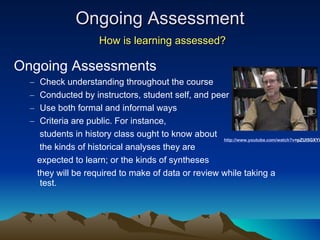
Ongoing Assessment   How is learning assessed? Ongoing Assessments Check understanding throughout the course Conducted by instructors, student self, and peer Use both formal and informal ways Criteria are public.  For instance,  students in history class ought to know about  the kinds of historical analyses they are  expected to learn; or the kinds of syntheses  they will be required to make of data or review while taking a test. http:// www.youtube.com/watch?v =pZUl5GXYiio
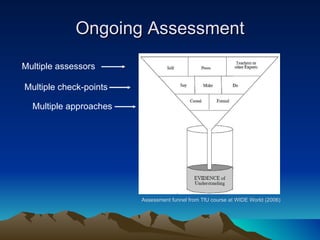
Ongoing Assessment Multiple assessors Multiple check-points Multiple approaches Assessment funnel from TfU course at WIDE World (2006)
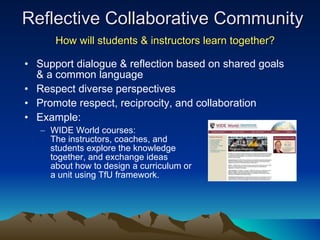
Reflective Collaborative Community   How will students & instructors learn together? Support dialogue & reflection based on shared goals & a common language Respect diverse perspectives Promote respect, reciprocity, and collaboration Example: WIDE World courses:  The instructors, coaches, and  students explore the knowledge  together, and exchange ideas  about how to design a curriculum or  a unit using TfU framework.
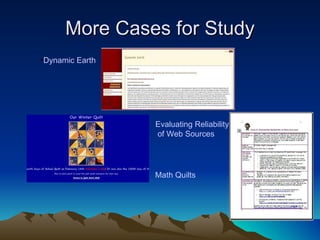
More Cases for Study Evaluating Reliability  of Web Sources Dynamic Earth Math Quilts
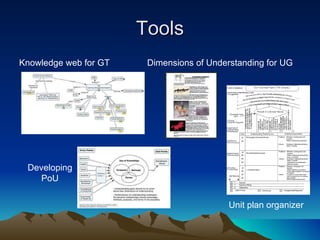
Tools Knowledge web for GT Dimensions of Understanding for UG Unit plan organizer Developing PoU
Conclusions Among the many agendas of education, surely understanding must rank far up on the short list of high priorities.  (Perkins, 1994) Try define practicing basic skills, remembering facts, or learning to cooperate or keep orderly notes as the intermediate academic goals next time your design a unit.
Main References Blythe, T. (1997).  The Teaching for Understanding Guide  (1st ed.). San Francisco, CA: Jossey-Bass.   Bransford, J. D., Brown, A. L., Cocking, R. R., Committee on Developments in the Science of Learning, & National Research Council. (2000).  How People Learn: Brain, Mind, Experience, and School: Expanded Edition  (2nd ed.). National Academies Press.  Gardner, H. E. (2006). Multiple Intelligences: New Horizons in Theory and Practice (2nd ed.). Basic Books.   Perkins, D. (1998). What is Understanding? In Martha Stone Wiske (Eds.)  Teaching for Understanding: Linking Research with Practice , (1st ed., p. 39). San Francisco, CA: Jossey-Bass Publishers.   Perkins, D., & Blythe, T. (1994). Putting understanding up front. (Cover story).  Educational Leadership ,  51 (5),  Wiske, M. S. (1998b).  Teaching for Understanding: Linking Research with Practice  (1st ed.). San Francisco, CA: Jossey-Bass Publishers.  

Teaching for Understanding in Practice

  • 1.
    Teaching for UnderstandingFramework in Practice Su-Tuan Lulee Instructor: Dr. Susan Moisey EDDE 803, Nov. 11, 2010
  • 2.
    Introduction In thispresentation: Core elements of the TfU framework Examples for using TfU in designing unit plans or curriculum Criteria & tools for design and implementation
  • 3.
    Introduction Teaching forUnderstanding (TfU) is a research project (1988 - 1995) in Project Zero at HGSE. Teaching for Understanding Guide Teaching for Understanding: Linking Research with Practice (Both Jossey-Bass, 1998)
  • 4.
    What is Teachingfor Understanding? Understanding as the capability to perform. TfU is not all new. It’s not created. What the researchers have done was to capture what good teachers do & make them more explicit and visible. TfU framework does not mean to capture every element of effective classroom practice—other factors such as classroom structure and teacher-student relationships also play a role.
  • 5.
    What is Teachingfor Understanding? TfU framework is a guide to keep the focus of educational practice on understanding, while allowing teachers flexibility to design units that fit their priorities and teaching style. provides a set of language and structure for planning curriculum and for discussion pedagogy with other colleagues and students http:// www.youtube.com/watch?v =xf3VThBEex8
  • 6.
    What is Teachingfor Understanding? Flexible framework for rethinking pedagogy Initially, four elements: GT, UG, PoU, & OA. RCC was added later by Wiske
  • 7.
    Generative Topics Whattopics are worth teaching? Dewey’s idea of organizing curriculum around themes Criteria for a good GT: Centrality: core to the discipline Connectivity: connect to other topics, one or more disciplines, and students’ non-school context Accessibility: has more resources for students to access Interesting: to students and to instructors Examples: “ Balance diet – balance budget” “ Understanding statistics through sports”
  • 8.
    Generative Topics - Examples GT: “Balance diet – balance budget” [Middle school] Students are required to work in team to plan and shop for a week’s worth of nutritious family meals while staying within a budget. shop in online grocery stores check nutrition on Food and Nutrition Information Center learn to understand nutrition labels on health websites learn about Using Unit Pricing calculate the amount they have spent using spreadsheet Good GTs: pulling together knowledge they learned from different disciplines and connect them to non-school context .
  • 9.
    Generative Topics - Examples GT: “Understanding statistics through sports” Students will engage in analysis and interpretation of statistics by examine how data actually are used in college and professional sports tracking player and league performance, tournament selections, team finances, and draft picks. They’ll learn how statistics are generated, how to correctly apply multiple uses and interpretations of statistics, how to identify misleading and manipulated data how to represent data accurately.
  • 10.
    Understanding Goals What should learners understand? UGs are nested goals that Focus on common misconceptions, assumptions, or bottlenecks Align with state or nation “standards” Ready to share with students Examples: “Students will understand” (focus on the big ideas) history was written by people; history might contain bias. the principles of mechanics so that they could apply them to explain the workings of everyday objects like nail clippers. a historical account vs. a literary account; and claims based on conviction or prejudice vs. claims based on empirical evidence through the movie JFK.
  • 11.
    Performances of Understanding How will learners develop & demonstrate learning? PoU are learning activities that Are sequenced into 1) introductory, 2) guided inquiry, and 3) culminating performances Require students to engage actively with content Employ a range of entry points Examples “ Simple Machine”
  • 12.
    Performances of Understanding - Example P of U for “Simple Machine”: Students will brainstorm to name the machine they find in their daily life and to talk about how those machine works (Introductory performances) keep journals in which they reflect on their investigation using words, drawings, and demonstrations (Guided inquiry performance) exhibit and explain their investigation to the class (Culminating performance)
  • 13.
    Ongoing Assessment How is learning assessed? Ongoing Assessments Check understanding throughout the course Conducted by instructors, student self, and peer Use both formal and informal ways Criteria are public. For instance, students in history class ought to know about the kinds of historical analyses they are expected to learn; or the kinds of syntheses they will be required to make of data or review while taking a test. http:// www.youtube.com/watch?v =pZUl5GXYiio
  • 14.
    Ongoing Assessment Multipleassessors Multiple check-points Multiple approaches Assessment funnel from TfU course at WIDE World (2006)
  • 15.
    Reflective Collaborative Community How will students & instructors learn together? Support dialogue & reflection based on shared goals & a common language Respect diverse perspectives Promote respect, reciprocity, and collaboration Example: WIDE World courses: The instructors, coaches, and students explore the knowledge together, and exchange ideas about how to design a curriculum or a unit using TfU framework.
  • 16.
    More Cases forStudy Evaluating Reliability of Web Sources Dynamic Earth Math Quilts
  • 17.
    Tools Knowledge webfor GT Dimensions of Understanding for UG Unit plan organizer Developing PoU
  • 18.
    Conclusions Among themany agendas of education, surely understanding must rank far up on the short list of high priorities. (Perkins, 1994) Try define practicing basic skills, remembering facts, or learning to cooperate or keep orderly notes as the intermediate academic goals next time your design a unit.
  • 19.
    Main References Blythe,T. (1997). The Teaching for Understanding Guide (1st ed.). San Francisco, CA: Jossey-Bass.   Bransford, J. D., Brown, A. L., Cocking, R. R., Committee on Developments in the Science of Learning, & National Research Council. (2000). How People Learn: Brain, Mind, Experience, and School: Expanded Edition (2nd ed.). National Academies Press. Gardner, H. E. (2006). Multiple Intelligences: New Horizons in Theory and Practice (2nd ed.). Basic Books.   Perkins, D. (1998). What is Understanding? In Martha Stone Wiske (Eds.) Teaching for Understanding: Linking Research with Practice , (1st ed., p. 39). San Francisco, CA: Jossey-Bass Publishers.   Perkins, D., & Blythe, T. (1994). Putting understanding up front. (Cover story). Educational Leadership , 51 (5), Wiske, M. S. (1998b). Teaching for Understanding: Linking Research with Practice (1st ed.). San Francisco, CA: Jossey-Bass Publishers.