Closing the Gap: 
Raising Special Education Achievement 
through Differentiation 
Adam Zunic
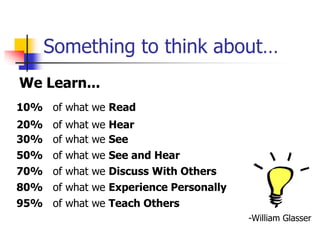
Something to think about
 
We Learn... 
10% of what we Read 
20% of what we Hear 
30% of what we See 
50% of what we See and Hear 
80% of what we Experience Personally 
95% of what we Teach Others 
-William Glasser 
70% of what we Discuss With Others
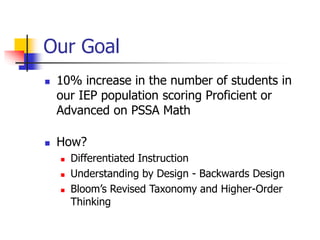
Our Goal 
ïź 10% increase in the number of students in 
our IEP population scoring Proficient or 
Advanced on PSSA Math 
ïź How? 
ïź Differentiated Instruction 
ïź Understanding by Design - Backwards Design 
ïź Bloom’s Revised Taxonomy and Higher-Order 
Thinking
Our Vision 
ïź Aide in the development of our students’ intellectual 
abilities. 
ïź Focus on all aspects of human development 
necessary for mature adult living 
ïź Educate and inspire a community of life long learners 
ïź Students are academically proficiency and have the 
ability to succeed in either higher education or 
productive employment.
Our Mission 
ïź To insure that all of our graduates 
achieve their full potential as persons 
competent to participate and interact 
intelligently in the complex and dynamic 
society of the 21st century.
It Fits 
ïź Higher-Order Thinking 
ïź Students become problem solvers, not problem 
do-ers 
ïź Backwards Design 
ïź All students will gain the same core set of 
knowledge and skills, meeting state standards 
ïź Differentiation 
ïź All students will be successful!
Research 
ïź Cognitive Development 
ïź Higher-order thinking engages frontal lobe of the brain. 
ïź This engagement helps learners make connections between 
past and new learning, create new pathways, strengthens 
existing pathways, and increases the likelihood that the new 
learning will be consolidated and stored for future retrieval. 
ïź Asking students for explanatory responses to higher-level 
questions prior to instruction activates prior knowledge and 
focuses attention, resulting in better learning. 
Sousa, David. How the Brain Learns. Chapter 7: Thinking and Learning Skills. p. 245-274. 
Pressley, M., (1984). Synthesis of research on teacher questioning. Educational Leadership, 42(3), 40–46. 
1 
1 
1 
2 
2
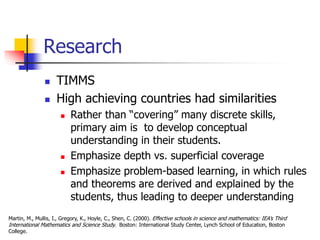
Research 
ïź TIMMS 
ïź High achieving countries had similarities 
ïź Rather than “covering” many discrete skills, 
primary aim is to develop conceptual 
understanding in their students. 
ïź Emphasize depth vs. superficial coverage 
ïź Emphasize problem-based learning, in which rules 
and theorems are derived and explained by the 
students, thus leading to deeper understanding 
Martin, M., Mullis, I., Gregory, K., Hoyle, C., Shen, C. (2000). Effective schools in science and mathematics: IEA’s Third 
International Mathematics and Science Study. Boston: International Study Center, Lynch School of Education, Boston 
College.
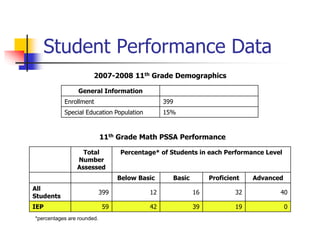
Student Performance Data 
2007-2008 11th Grade Demographics 
General Information 
Enrollment 399 
Special Education Population 15% 
11th Grade Math PSSA Performance 
Total 
Number 
Assessed 
Percentage* of Students in each Performance Level 
Below Basic Basic Proficient Advanced 
All 
Students 
399 12 16 32 40 
IEP 59 42 39 19 0 
*percentages are rounded.
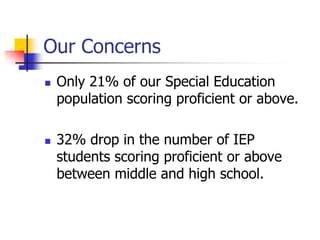
Our Concerns 
ïź Only 21% of our Special Education 
population scoring proficient or above. 
ïź 32% drop in the number of IEP 
students scoring proficient or above 
between middle and high school.
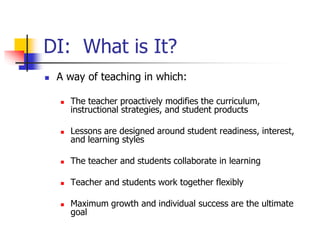
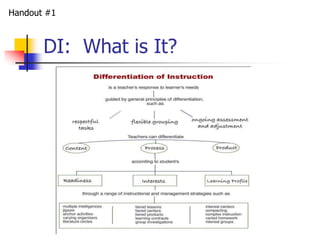
DI: What is It? 
ïź A way of teaching in which: 
ïź The teacher proactively modifies the curriculum, 
instructional strategies, and student products 
ïź Lessons are designed around student readiness, interest, 
and learning styles 
ïź The teacher and students collaborate in learning 
ïź Teacher and students work together flexibly 
ïź Maximum growth and individual success are the ultimate 
goal
Handout #1 
DI: What is It?
Three General Principals of DI 
ïź Respectful Tasks: Know your Students 
ïź Learning Profile: How a student learns 
ïź Learning Styles – www.howtolearn.com 
ïź Readiness: What does the student know already? 
ïź Interest: Students’ affinity, curiosity, or passion 
for a topic or skill
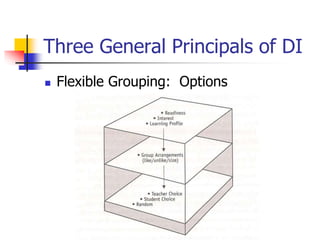
Three General Principals of DI 
ïź Flexible Grouping: Options
Three General Principals of DI 
ïź Flexible Grouping 
ïź Heterogeneous grouping 
ïź Individual, Small group, or Whole Group 
instruction
Three General Principals of DI 
ïź Ongoing Assessment and Adjustment 
ïź Instruction and assessment are inseparable 
ïź Content, process, and product are adjusted 
based on the needs of the student
What does DI look like? 
ïź Video: A Visit to a Differentiated Classroom 
ïź Small Group Discussion: 
ïź What evidence of DI did you see in the video? 
ïź What questions do you have about DI after 
watching this video? 
ïź Whole Group Discussion: 
ïź Share your observations and questions
The DI Continuum 
ïź Where are you on the continuum? 
ïź Place an ‘x’ on the line where you feel your 
classroom practices fall. 
ïź Are your practices more traditional or more 
differentiated? 
Handout #2
Bloom’s Revised Taxonomy 
ïź Six levels of thinking provide a framework for 
planning units that incorporate low to high-level 
thinking activities 
ïź When used as a planning framework we can plan 
for student thinking at all levels. 
ïź Teach Higher-Order Thinking Skills (HOTS)
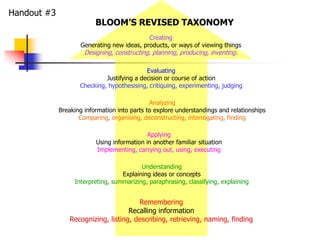
BLOOM’S REVISED TAXONOMY 
Creating 
Generating new ideas, products, or ways of viewing things 
Designing, constructing, planning, producing, inventing. 
Evaluating 
Justifying a decision or course of action 
Checking, hypothesising, critiquing, experimenting, judging 
Analyzing 
Breaking information into parts to explore understandings and relationships 
Comparing, organising, deconstructing, interrogating, finding 
Applying 
Using information in another familiar situation 
Implementing, carrying out, using, executing 
Understanding 
Explaining ideas or concepts 
Interpreting, summarizing, paraphrasing, classifying, explaining 
Remembering 
Recalling information 
Recognizing, listing, describing, retrieving, naming, finding 
Handout #3
How to use it 
ïź Higher order thinking occurs at the top 
three levels of the taxonomy: creating, 
evaluating, and analyzing 
ïź We must teach students how to think, 
providing opportunities for: 
ïź Problem-solving 
ïź Open-ended responses
Teaching HOTS 
ïź Help students understand the thinking 
process 
ïź Incite discovery, invention, and creativity 
ïź Make learning meaningful to the student 
ïź Engage students in real life problem solving 
ïź Encourage questions and discussion 
ïź Make cross-curricular connections 
ïź Provide models, graphic organizers
The Top Three Levels 
ïź Analyzing: 
ïź Breaking information 
into parts to explore 
understanding and 
relationships 
ïź Analyzing Verbs: 
ïź Comparing 
ïź Organizing 
ïź Deconstructing 
ïź Attributing 
ïź Outlining 
ïź Finding 
ïź Structuring 
ïź Integrating
The Top Three Levels 
ïź Evaluating: 
ïź Justifying a decision 
or course of action 
ïź Evaluating Verbs 
ïź Checking 
ïź Hypothesizing 
ïź Critiquing 
ïź Experimenting 
ïź Judging 
ïź Testing 
ïź Detecting 
ïź Monitoring
The Top Three Levels 
ïź Creating: 
ïź Generating new 
products, ideas, 
ways of thinking, or 
ways of viewing 
things 
ïź Creating Verbs: 
ïź Designing 
ïź Constructing 
ïź Planning 
ïź Producing 
ïź Inventing 
ïź Devising 
ïź Making
Put your HOTS to the test 
ïź Take a Concept Up the Taxonomy 
ïź Split your small group into pairs 
ïź Choose a concept that you teach in class 
ïź Using the handout, create a question or activity 
related to your concept for each level of the 
taxonomy. 
Handout #4
Understanding By Design - 
Backwards Design 
BEGIN 
with the END 
in mind
What is Backwards Design? 
ïź An approach to designing curriculum or unit that 
begins with the end in mind and designs toward that 
end. 
ïź Viewed as backward because many teachers begin 
their unit with the means - textbooks, favored 
lessons, and time-honored activities - rather than 
deriving those from the end - the targeted results, as 
content standards or understandings. 
(Grant Wiggins and Jay McTighe, Understanding by Design, 2005, page 338)
How to use it 
ïź Identify desired results 
ïź Goals, knowledge and skills, essential questions, 
enduring understanding 
ïź Determine acceptable evidence 
ïź Tests or quizzes, academic prompts, formative 
assessment, performance tasks, observations or 
dialogue 
ïź Plan learning experiences and instruction 
ïź Based on desired results and acceptable evidence
Handout #5 
Backwards Framework 
ïź This framework can be used to plan your 
lessons utilizing backwards design 
ïź Stage 1 – Utilize the Standards 
ïź Stage 2 – Products and Assessments 
ïź Stage 3 – Implement DI 
ïź Video: Connecting Differentiated Instruction, 
Understanding by Design and What Works in 
Schools: An Exploration of Research-Based 
Strategies
Culminating Activity 
ïź Lets put it all together 
ïź You will need: 
ïź Handout #2 – DI Continuum 
ïź Handout #4 – Take a Concept up the Taxonomy 
ïź Handout #5 – Backwards Design Framework
Culminating Activity 
ïź Your Task: 
ïź Choose a concept you teach in class 
ïź Create a lesson using the Backwards Design 
Framework 
ïź Include differentiated instruction strategies 
ïź Include questions/activities related to Bloom’s 
Revised Taxonomy
Questions for Discussion 
ïź How can you implement DI in your 
classroom? 
ïź Using HOTS 
ïź Using Backwards Design 
ïź How can we support you in this 
process? 
ïź What resources/support systems will 
you need to be successful?
Closure 
ïź Set a goal. 
ïź Choose an area from the DI continuum that you 
rated yourself more traditional 
ïź Brainstorm ways to make this are more 
differentiated 
ïź Create a Plan of Action describing how you will 
implement this change in your classroom 
ïź Share this with your principal for informal 
observations and feedback 
ïź See Handout #6 “Look-Fors”
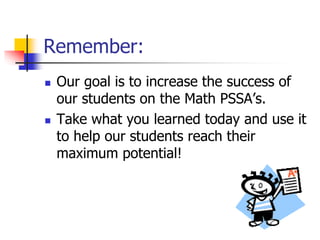
Remember: 
ïź Our goal is to increase the success of 
our students on the Math PSSA’s. 
ïź Take what you learned today and use it 
to help our students reach their 
maximum potential!

Instructional strategies

  • 1.
    Closing the Gap: Raising Special Education Achievement through Differentiation Adam Zunic
  • 2.
    Something to thinkabout
 We Learn... 10% of what we Read 20% of what we Hear 30% of what we See 50% of what we See and Hear 80% of what we Experience Personally 95% of what we Teach Others -William Glasser 70% of what we Discuss With Others
  • 3.
    Our Goal ïź10% increase in the number of students in our IEP population scoring Proficient or Advanced on PSSA Math ïź How? ïź Differentiated Instruction ïź Understanding by Design - Backwards Design ïź Bloom’s Revised Taxonomy and Higher-Order Thinking
  • 4.
    Our Vision ïźAide in the development of our students’ intellectual abilities. ïź Focus on all aspects of human development necessary for mature adult living ïź Educate and inspire a community of life long learners ïź Students are academically proficiency and have the ability to succeed in either higher education or productive employment.
  • 5.
    Our Mission ïźTo insure that all of our graduates achieve their full potential as persons competent to participate and interact intelligently in the complex and dynamic society of the 21st century.
  • 6.
    It Fits ïźHigher-Order Thinking ïź Students become problem solvers, not problem do-ers ïź Backwards Design ïź All students will gain the same core set of knowledge and skills, meeting state standards ïź Differentiation ïź All students will be successful!
  • 7.
    Research ïź CognitiveDevelopment ïź Higher-order thinking engages frontal lobe of the brain. ïź This engagement helps learners make connections between past and new learning, create new pathways, strengthens existing pathways, and increases the likelihood that the new learning will be consolidated and stored for future retrieval. ïź Asking students for explanatory responses to higher-level questions prior to instruction activates prior knowledge and focuses attention, resulting in better learning. Sousa, David. How the Brain Learns. Chapter 7: Thinking and Learning Skills. p. 245-274. Pressley, M., (1984). Synthesis of research on teacher questioning. Educational Leadership, 42(3), 40–46. 1 1 1 2 2
  • 8.
    Research ïź TIMMS ïź High achieving countries had similarities ïź Rather than “covering” many discrete skills, primary aim is to develop conceptual understanding in their students. ïź Emphasize depth vs. superficial coverage ïź Emphasize problem-based learning, in which rules and theorems are derived and explained by the students, thus leading to deeper understanding Martin, M., Mullis, I., Gregory, K., Hoyle, C., Shen, C. (2000). Effective schools in science and mathematics: IEA’s Third International Mathematics and Science Study. Boston: International Study Center, Lynch School of Education, Boston College.
  • 9.
    Student Performance Data 2007-2008 11th Grade Demographics General Information Enrollment 399 Special Education Population 15% 11th Grade Math PSSA Performance Total Number Assessed Percentage* of Students in each Performance Level Below Basic Basic Proficient Advanced All Students 399 12 16 32 40 IEP 59 42 39 19 0 *percentages are rounded.
  • 10.
    Our Concerns ïźOnly 21% of our Special Education population scoring proficient or above. ïź 32% drop in the number of IEP students scoring proficient or above between middle and high school.
  • 11.
    DI: What isIt? ïź A way of teaching in which: ïź The teacher proactively modifies the curriculum, instructional strategies, and student products ïź Lessons are designed around student readiness, interest, and learning styles ïź The teacher and students collaborate in learning ïź Teacher and students work together flexibly ïź Maximum growth and individual success are the ultimate goal
  • 12.
    Handout #1 DI:What is It?
  • 13.
    Three General Principalsof DI ïź Respectful Tasks: Know your Students ïź Learning Profile: How a student learns ïź Learning Styles – www.howtolearn.com ïź Readiness: What does the student know already? ïź Interest: Students’ affinity, curiosity, or passion for a topic or skill
  • 14.
    Three General Principalsof DI ïź Flexible Grouping: Options
  • 15.
    Three General Principalsof DI ïź Flexible Grouping ïź Heterogeneous grouping ïź Individual, Small group, or Whole Group instruction
  • 16.
    Three General Principalsof DI ïź Ongoing Assessment and Adjustment ïź Instruction and assessment are inseparable ïź Content, process, and product are adjusted based on the needs of the student
  • 17.
    What does DIlook like? ïź Video: A Visit to a Differentiated Classroom ïź Small Group Discussion: ïź What evidence of DI did you see in the video? ïź What questions do you have about DI after watching this video? ïź Whole Group Discussion: ïź Share your observations and questions
  • 18.
    The DI Continuum ïź Where are you on the continuum? ïź Place an ‘x’ on the line where you feel your classroom practices fall. ïź Are your practices more traditional or more differentiated? Handout #2
  • 19.
    Bloom’s Revised Taxonomy ïź Six levels of thinking provide a framework for planning units that incorporate low to high-level thinking activities ïź When used as a planning framework we can plan for student thinking at all levels. ïź Teach Higher-Order Thinking Skills (HOTS)
  • 20.
    BLOOM’S REVISED TAXONOMY Creating Generating new ideas, products, or ways of viewing things Designing, constructing, planning, producing, inventing. Evaluating Justifying a decision or course of action Checking, hypothesising, critiquing, experimenting, judging Analyzing Breaking information into parts to explore understandings and relationships Comparing, organising, deconstructing, interrogating, finding Applying Using information in another familiar situation Implementing, carrying out, using, executing Understanding Explaining ideas or concepts Interpreting, summarizing, paraphrasing, classifying, explaining Remembering Recalling information Recognizing, listing, describing, retrieving, naming, finding Handout #3
  • 21.
    How to useit ïź Higher order thinking occurs at the top three levels of the taxonomy: creating, evaluating, and analyzing ïź We must teach students how to think, providing opportunities for: ïź Problem-solving ïź Open-ended responses
  • 22.
    Teaching HOTS ïźHelp students understand the thinking process ïź Incite discovery, invention, and creativity ïź Make learning meaningful to the student ïź Engage students in real life problem solving ïź Encourage questions and discussion ïź Make cross-curricular connections ïź Provide models, graphic organizers
  • 23.
    The Top ThreeLevels ïź Analyzing: ïź Breaking information into parts to explore understanding and relationships ïź Analyzing Verbs: ïź Comparing ïź Organizing ïź Deconstructing ïź Attributing ïź Outlining ïź Finding ïź Structuring ïź Integrating
  • 24.
    The Top ThreeLevels ïź Evaluating: ïź Justifying a decision or course of action ïź Evaluating Verbs ïź Checking ïź Hypothesizing ïź Critiquing ïź Experimenting ïź Judging ïź Testing ïź Detecting ïź Monitoring
  • 25.
    The Top ThreeLevels ïź Creating: ïź Generating new products, ideas, ways of thinking, or ways of viewing things ïź Creating Verbs: ïź Designing ïź Constructing ïź Planning ïź Producing ïź Inventing ïź Devising ïź Making
  • 26.
    Put your HOTSto the test ïź Take a Concept Up the Taxonomy ïź Split your small group into pairs ïź Choose a concept that you teach in class ïź Using the handout, create a question or activity related to your concept for each level of the taxonomy. Handout #4
  • 27.
    Understanding By Design- Backwards Design BEGIN with the END in mind
  • 28.
    What is BackwardsDesign? ïź An approach to designing curriculum or unit that begins with the end in mind and designs toward that end. ïź Viewed as backward because many teachers begin their unit with the means - textbooks, favored lessons, and time-honored activities - rather than deriving those from the end - the targeted results, as content standards or understandings. (Grant Wiggins and Jay McTighe, Understanding by Design, 2005, page 338)
  • 29.
    How to useit ïź Identify desired results ïź Goals, knowledge and skills, essential questions, enduring understanding ïź Determine acceptable evidence ïź Tests or quizzes, academic prompts, formative assessment, performance tasks, observations or dialogue ïź Plan learning experiences and instruction ïź Based on desired results and acceptable evidence
  • 30.
    Handout #5 BackwardsFramework ïź This framework can be used to plan your lessons utilizing backwards design ïź Stage 1 – Utilize the Standards ïź Stage 2 – Products and Assessments ïź Stage 3 – Implement DI ïź Video: Connecting Differentiated Instruction, Understanding by Design and What Works in Schools: An Exploration of Research-Based Strategies
  • 31.
    Culminating Activity ïźLets put it all together ïź You will need: ïź Handout #2 – DI Continuum ïź Handout #4 – Take a Concept up the Taxonomy ïź Handout #5 – Backwards Design Framework
  • 32.
    Culminating Activity ïźYour Task: ïź Choose a concept you teach in class ïź Create a lesson using the Backwards Design Framework ïź Include differentiated instruction strategies ïź Include questions/activities related to Bloom’s Revised Taxonomy
  • 33.
    Questions for Discussion ïź How can you implement DI in your classroom? ïź Using HOTS ïź Using Backwards Design ïź How can we support you in this process? ïź What resources/support systems will you need to be successful?
  • 34.
    Closure ïź Seta goal. ïź Choose an area from the DI continuum that you rated yourself more traditional ïź Brainstorm ways to make this are more differentiated ïź Create a Plan of Action describing how you will implement this change in your classroom ïź Share this with your principal for informal observations and feedback ïź See Handout #6 “Look-Fors”
  • 35.
    Remember: ïź Ourgoal is to increase the success of our students on the Math PSSA’s. ïź Take what you learned today and use it to help our students reach their maximum potential!